2017 International Conference on Computer Science and Application Engineering (CSAE 2017) ISBN: 978-1-60595-505-6
Research on Web Based Information Importance Ranking
Algorithm for Marine Big Data
Chao Fu, Yan-xiu Sheng, Zhi-qiang Wei and Yong-quan Yang*
College of Information Science & Engineering, Ocean University of China, 266100 Qingdao, China
ABSTRACT
Research on web based information of the marine big data, has always been a vital part of marine big data information platform. However, it is difficult to find the web information of marine big data, for its massive amount and overbroad extent. Faced with this issue, it is not enough to use the PageRank algorithm alone. Based on the basic characteristics of marine big data pages, we use the PageRank algorithm for reference, and improves its relevance, authority and anti-cheating in this paper. Finally, we purpose a Web based information importance ranking algorithm for marine big data, the Marine Information PageRank (MIPR) algorithm. Experimental results on data sets of marine big data web pages show that, the Marine Information PageRank (MIPR) algorithm has a much better performance of web based information importance ranking algorithm for marine big data, than the PageRank algorithm.
INTRODUCTION
Generally, the marine big data is the vast amounts of data accumulated by the observations on land, air, sea. The establishment of an efficient and authoritative ocean large data information platform is an essential means of studying marine big data. Because of its large quantity and wide spread, web information for marine big data has become a vital part of the marine big data [1] information platform. There are plenty of web ranking algorithms, such as PageRank, HITS and SALSA. We choose the PageRank [2] algorithm for reference, in the process of studying the importance of web pages for marine big data, for its efficiency. The PageRank algorithm is proposed by Sergey, B. and Lawrence P. for reference to citation analysis [3]. The algorithm obtains the authoritative web pages in the network by analyzing the link structure of the network, and achieves the success in the search engine Google [4]. We improve the PageRank algorithm, and apply it to the Research on web based information importance ranking for marine big data. Finally, we purpose a Web based information importance ranking algorithm for marine big data, the MIPR algorithm.
RELATED WORK
The PageRank algorithm is based on web link analysis to process keyword matching search results.
importance of the A itself, the greater the importance of the page A, the higher the contribution value the page B gets. As the web pages link to each other, the calculation of the score is an iterative process, and finally the web pages are retrieved and sorted according to the scores obtained.
The PageRank (as PR below) value of a web page can be calculated by expression (1):
n
i i
i
T C
T PR d d A
PR
1 ( )
) ( )
1 ( )
( (1)
In the expression, PR(p) is the page level of the web page p, Ti(i=1,2,…,n) is other pages pointing to the web page p. d is the probability that a user will reach a web page at random is between 0 and 1 (usually 0.85), C(Ti) is the number of links pointed out by the page Ti. PR(Ti)/C(Ti) is the PR value that p obtained from Ti. Usually, the initial PR value of each page is 1, and the PR value of each page is calculated recursively by the expression until the value becomes stable. The algorithm adopts the behavior model of the user completely accessing the network randomly, so that the PR value of a webpage is distributed to its chain-out web page.
The link structure of Internet is spontaneous and disorderly formation, so there may be instances that the links in a group are linked with each other, no outside chain-out links. Once an outside web page links to the web page in this group, the PR value will always stay in this group inside, not pass out, leading to the phenomenon of LinkSink.
[image:2.612.146.432.414.460.2]As shown in Figure 1, web pages, A, B, are linked with each other, no outside chain-out links. If the web page C links to the web page B. Then, in the iterative calculation, the PR value of web page A, B can not be distributed out.
Figure 1. LinkSink.
In order to avoid precipitation, Sergey Brin and Lawrence Page improved the algorithm [5], introducing the fading factor E(A), and E(A) corresponding to a vector of the web page set, corresponding to the initial value of PR, and improving the algorithm as follows:
) ( )
( ) ( )
1 ( ) ( '
1
A dE T
C T PR d d A
PR n
i i
i
(2)
Find a proper E(A) value to make || PR’ || = 1 in this expression.
THE CHARACTERISTICS OF PAGERANK ALGORITHM The Advantages
do with the query, which has higher response speed. The PR value of a web page can only be increased from the web page leads to it, and the sharing strategy of the algorithm makes the more the citation of a web page, the less the PR value of the referenced web page [6]. Therefore, the algorithm can effectively avoid the intentional use of links in order to improve the search rank of the web site.
The Disadvantages
However, the PageRank algorithm is entirely based on link analysis, and the link information is relatively static, without considering the dynamic information used by the web pages [7]. Therefore, for the study of the importance ranking of web pages for marine big data, the PageRank algorithm has some drawbacks.
BAD ABILITY OF ANTI-CHEATING
Cheating in the web can be divided into 3 types according to cheating method, Content based web cheating, Link based web cheating and Hidden links [8]. The PageRank algorithm is based on the principle of linking, which assumes that the quality of the page is highly related to the quality of the link, and that the link is considered a voting behavior. Therefore, cheating based on the link principle is common, while the corresponding anti-cheating methods are relatively few.
SUBJECT DRIFT PROBLEM
PageRank algorithm can not judge the similarity of web content only by using the link structure of network. In addition, the algorithm assigns the weights according to the external links to make the irrelevant pages get the same attention as the topic related web pages.
AVERAGING OF WEIGHTS DISTRIBUTION
The PageRank algorithm assigns the PR value of the current web page to the web pages it links to. In fact, there are differences in the importance of each web page in a web page. This method of average allocation of the PR value, to some extent, affects the quality of web pages sorting [9].
WEB BASED INFORMATION IMPORTANCE RANKING ALGORITHM FOR MARINE BIG DATA – MIPR
Anti-cheating
For Anti-cheating, we draw on the idea of TrustRank algorithm. It is assumed that good websites rarely link to bad websites, and vice versa. That is, many spam sites link to sites of high authority and high trust, trying to improve their trust. So, we choose a bunch of seed sites that set the initial value of the weights to 1, and the rest of the site is 0. The weights are then transmitted by means of distribution [10]. As for the selection of seed websites, we select the authoritative web pages in the marine related fields both at home and abroad as seed websites, such as, Official website of China National Oceanic Administration (http://www.soa.gov.cn/index.html), Official website of the International Maritime Organization (http://www.imo.org/en/Pages/Default.aspx). Then, the crawler crawls out of its chain site, making TF-IDF correlation analysis. If the correlation is high, then join it into the seed web library. With this method, seed web libraries are expanded larger.
Improvement Based on Relevance
As above, we can see that the idea that the PageRank algorithm assigns the weights according to the external connections can lead to the subject drift problem. Therefore, when assigning weights, the degree of relevance to the topic should be used. The weights are assigned according to the weight proportion of the text in the page. The larger the weight ratio is, the greater the weight is assigned, and vice versa [11]. Based on this idea, we introduce the classical TF-IDF algorithm, the proportion of the hyperlink text in the page in the page is calculated by a hyperlink text weight divided by the sum of all hyperlink text weights in a web page.
Suppose u is a web page, Bu is a collection of pages pointing to u, and V is any web page in Bu. Then, there must be a link to u in V. A is the text in the hyperlink, Da is the phrases of V, the expression for the weight ratio W (A|V) of the hyperlink text A in the page V as follow:
a
D
a tinA
tinA
t idf tinV tf
t idf tinV tf V
A W
) ( ) (
) ( ) ( )
|
( (3)
In this expression, TF (T, in, V) is the frequency of word C in page V, idf(t)=log2(N/nt+a) is the Inverse text frequency function. N is the total pages for web pages, nt is the web page contains the number of pages that contain t, a is a constant (usually 0.01).
The final score of a web page is calculated by expression (4):
tinq t idf tinu tf qW( ) ( ) ( ) (4)
In this expression, q is the query condition, and t is the query item in q. Then, the correlation ratio of the MIPR algorithm is:
) ( ) |
(A V W q W
Wv
c (5)
Improvement Based on Authority
The PageRank algorithm assigns the PR value of the current web page to the web pages it links to, ignoring the authority of the web pages, which means the number of important web pages referenced is far more than the number of references to ‘other pages’ [13]. So, we make rules in the MIPR algorithm: If it refers to an important web page, more weights should be assigned to it. If it refers to a common web page, less weights should be assigned to it. The so-called important web pages are referenced by multiple web pages, or pages that can be referenced by other important pages. In the meanwhile, the number of references is much greater than the number of pages that it refers to other pages.
Based on this, we can obtain the expression (6):
) ( ) ( ) ( V PR W u PR u B v v s
(6)
In this expression, Wsv is the proportion of the weight assigned to the page u by the web page v, which can be gotten by the following 2 steps.
(1) Suppose v is a web page to u, v∈B(u). B(u) includes v{n}={v1,v2,v3,…,vn}. S{n}={S1,S2,S3,…,Sn} are the chains-out of vi. First, calculate the ratio of the total chains-in number and the total chains-out number – IO, of S{n}. The expression of IO in a web page, as below:
OutLink InLink
IO (7)
In the expression, InLink is the chains-in number, which inputs weights. Outlink is the chains-out number, which outputs weights. The IO value indicates the ability of the web page to obtain weights from other pages. The bigger the IO value is, the easier to obtain large weights. However, when the number of chains-out is 0, the value of IO will be infinite. The IO value can be set to a small constant m0 in this case.
(2) Redistribute the weights according to the IO values above. Suppose the current page as j in v∈B(u), Wsv can be calculated as:
n i i j j s v s IO IO W W 1 (8)In this article, we synthesize the above three aspects thought, resolving authority issues from the view of link analysis, resolving relevance issues from the view of content relevance analysis, and Combining with anti-cheating treatment. Finally, we purpose a Web based information importance ranking algorithm for marine big data, the MIPR algorithm.
) ( ) ) 1 ( )( ( ) 1 ( ) ( u B v v c v s W W v MIPR d n d uIn the expression, Wsv is the authority of page v in the forward link set u of F (u),
v c
W is the relevance of page v in the forward link set u of F (u). is factor of controlling authority and relevance.
EXPERIMENTS AND RESULT ANALYSIS
First, manually select 200 marine related authoritative sites as seed sites, of which weight are assigned to 1. The others’ weights are assigned to 0 to suppress web-cheating.
For the measurement of search quality, the standard of evaluation usually is: (1) Recall ratio: Recall is the ratio of the number of retrieved pages to the number of related pages in a web page, which is generally used to measure the ability to search for relevant pages.
(2) Precision ratio: Precision is the ratio between the number of retrieved pages and the total number of retrieved pages, which is generally used to measure the ability to search and filter irrelevant web pages.
In most cases, it is impossible to calculate how many pages on the Internet have relevance to the topic, so the recall has no practical significance for the evaluation of the algorithm. Therefore, in this paper, we focus on evaluating the precision ratio of the algorithm. In order to analyze the performance of MIPR algorithm, special web crawling tools [14] are used to crawl web pages related to the ocean. And, there are about 200,000 valid pages are grabbed. PageRank algorithm and MIPR algorithm are used to calculate the importance of web pages, setting the query topic with 10 keywords -- marine big data, marine information, marine medicine, marine economy, marine environment, marine fisheries, marine geology, marine power, marine cooperation, blue ecology. The two algorithms use iterative computation until its value converges, and the specific implementation of the iterative algorithm can be referred to the literature. Finally, Precision ratio is calculated by the first 50 search results, the expression as below:
% 100 50 n ratio
precision s (10)
In the expression, ns is the number of pages related to search topics in the first 50
search results.
Figure 2. Precision Ratio.
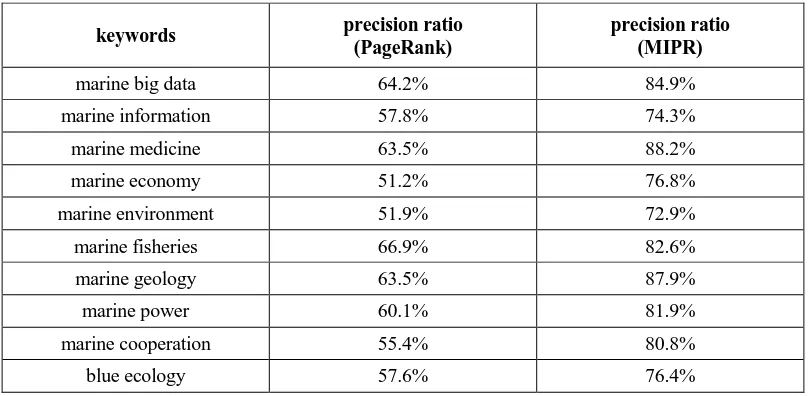
The origin data is below:
TABLE I. ORIGIN DATA.
keywords precision ratio (PageRank)
precision ratio (MIPR)
marine big data 64.2% 84.9%
marine information 57.8% 74.3%
marine medicine 63.5% 88.2%
marine economy 51.2% 76.8%
marine environment 51.9% 72.9%
marine fisheries 66.9% 82.6%
marine geology 63.5% 87.9%
marine power 60.1% 81.9%
marine cooperation 55.4% 80.8%
blue ecology 57.6% 76.4%
From Figure 2 and TABLE I, the average satisfaction of query results with PageRank algorithm is about 60.9%, while the satisfaction of query results is improved to about 80.6% by using MIPR algorithm. That means, the MIPR algorithm can judge the authority of web pages more accurately and return the web pages which are more in line with the user's query condition.
CONCLUSIONS
[image:7.612.88.493.304.502.2]Experimental results on data sets of marine big data web pages show that, the MIPR algorithm has a much better performance of web based information importance ranking algorithm for marine big data, than the PageRank algorithm. At the present stage, this algorithm is mainly based on link analysis. In subsequent research, it will expand the data including text, pictures and other data.
ACKNOWLEDGMENT
This work is supported by The Aoshan Innovation Project in Science and Technology of Qingdao National Laboratory for Marine Science and Technology (No. 2016ASK07).
REFERENCES
1. Sun Chao-sui, Liu Qing, Hu Tong, and Guo Zhong-wen. “Architecture design of marine big data
processing software,” J. Periodical of Ocean University of China, 2015, 2.
2. Page L., Brin S., and Motwani R., et al. “The pagerank citation ranking: Bringing order to the web,” Stanford Digital Libraries SIDL-WP-1999-0120, 1999.
3. Kamvar S. “Extrapolation Methods for Accelerating PageRank computations,” USA: Stanford University, 2003.
4. Arasu A., Novak J., and Tomkins A., et al. “Page Rank computation and the structure of the web: Experiments and algorithms,” presented at Proceedings of the 11th International WWW Conference. New York, USA: ACM Press, 2002.
5. Zhang Fang, and Guo Chang-ying. “Web page sorting algorithm based on Web site influence,” J.
Journal of Computer Applications, 2012, 32(6):1666 -1669.
6. Zhu Z., Lu G., Chen Y., Fu Z., Roberts P., and Han K. “Botnet research survey,” presented at proceedings of the 32nd Annual IEEE International Conference on Computer Software and Applications, IEEE COMPSAC, 2008: 967-972.
7. Peng Cong, and Wu Qiang. “An improved web page sorting algorithm,” J. Microcomputer information, 2010, 11(3):72-74.
8. Wang Can-hui, Zhang Min, and Ma Shao-ping. “A review of cheating and anti-cheating techniques,” presented at the 2nd academic conference on information retrieval and content security. Beijing, 2009:274-289.
9. Wu Chun-lei, and Guo Lei. “Improvement of PageRank algorithm for Web structure mining,” J. Intelligence magazine, 2015(10):55-58.
10. Gyongyi Z., and Garcia-Molica H. “Combating web spam with trustrank,” J. In Very Large Data
Base’04, 2004:576-584.
11. Haveliwala T. H. “Topic-sensitive PageRank,” presented at Proceedings of the Eleventh International World Wide Web Conference. Honolulu Hawaii, 2002.
12. Xu Hong-bo, Cheng Xue-qi, and Wang bin. “Text mining and machine learning,” J. Information Technology Bulletin, 2011, 3(2):1-14.
13. Wenpu Xing, and Ali Ghorbani. “Weighted PageRank Algorithm,” presented at Proceedings of the
Second Annual Conference on Communication Networks and Services Research, 2012.
14. T.Bennouas, and F.D. Montgolfier. “Random Web Crawls,” presented at Proceedings of the 16th