2018 International Conference on Information, Electronic and Communication Engineering (IECE 2018) ISBN: 978-1-60595-585-8
Cognitive Transmitting Frequency Codewords Design for Sparse
Stepped Frequency Radar Based on Sensing Matrix Optimization
Qiu-shi CHEN
1, Xin ZHANG
1,2, Bo GUO
3, Qiang YANG
1,2,*,
Meng-xiao ZHAO
1and Jia-zhi ZHANG
11
Department of Electronic and Information Engineering, Harbin Institute of Technology, China 2
Key Laboratory of Marine Environmental Monitoring and Information Processing, Ministry of Industry and Information Technology, Harbin, China
3People's Liberation Army of China, Troops 92985, Xiamen, China
*Corresponding author
Keywords: Cognitive radar, Sensing matrix optimization, Range-Doppler estimation, Waveform design, Sparse stepped frequency.
Abstract. Cognitive waveform design is of great significance for radar transmitting system to better adapt to the changing electromagnetic environment and target scene. In this paper, a novel cognitive waveform design method of sparse stepped frequency based on sensing matrix optimization is proposed. The proposed cognitive waveform exploits the information returned from the target scene to continuously optimize the transmitted frequency and sensing matrix. Compressive sensing (CS) technique is applied for range-Doppler reconstruction due to the sparse property of the target to be estimated. Comparing with random stepped frequency, this optimized cognitive waveform could further improve the upper limit of the number of detection targets; also increase the accuracy and robustness.
Introduction
The stepped frequency waveform in radar system has the property of synthesizing bandwidth. It can increase the effective bandwidth and further improve the range resolution of targets. Compared with the linear stepped frequency, the non-uniform stepped frequency has the advantages of resisting interception, reducing coupling between range and velocity, and synthesizing large bandwidth [1].
However, the discontinuity using the common processing method will produce large sidelobe, grating lobes, and also coupling from distance and velocity, etc., which have a great influence on the detection and estimation. This problem can be solved by modifying transmitting waveform with good properties. In [2], a class of non-linear SF chirp pulse train has been investigated with low sidelobe and small grating lobes. Another low sidelobe SF waveform has also been designed using adaptive learning method in [3]. In [4], non-uniform SF has been designed to enhance resolution capability without increasing bandwidth utilization and measurement time.
In this paper, based on CS theory as a means of RD estimation, we propose a new optimization scheme generated by simultaneous iteration of the transmitted waveform and the sensing matrix. We name it Frequency Codewords-Sensing Matrix joint Optimization (FC-CMO) method. The remainder of this paper is organized as follows. In Section 2, the signal model of the stepped frequency radar is introduced. In Section 3, the process of frequency codewords-sensing matrix joint optimization is presented. Simulations and results are conducted to demonstrate the validity of the proposed method in Section 4.
Signal Model and Compressive Sensing Method
Conventional Stepped Frequency Signal Model
Considering the Sparse SF radar that transmits N pulses in one burst, the th
n transmitting frequency is fn f0 Cn f , where f0 is the starting frequency and Cn
0,1, 2,...,N
is defined as the codewords of non-linear frequencies.The transmitting signal can be expressed as
1 2 0
/ 2
( ) n rect
N
j f t w
n w
t iT T
s t e
T
(1) where Tw is the pulse duration, Tis the pulse repetition interval, rect( ) denotes rectangular function1 / 2 t / 2
rect =
0 otherwise
w w
w
T T
t T
,
,
Assuming the kth point target at distance Rk moves radially with velocity Vk, its corresponding
echo delay is 2 k k
k
R V nT c
, where c is light speed, k is the number of targets.
We assume that every pulse only one sampling with the total target information, therefore, the value of th
n echo sample is
0
4 ( )(R )/
1
, 0,1, 2,..., 1
n k k
K
j f C f V n k
c
k n
T
Y e n N
(2)Mutual Coherence of Sensing Matrix
The echo signal x is projected on the sparse representation matrixΨ, the signal model can be rewritten to the following form,
y = Φx = ΦΨθ Φn (3)
In above formula, Α = ΦΨ is the sensing matrix, n is the noise vector. The optimization problem can be further equivalent to
1 2
ˆ min θ , s.t. yA
2 2 max ( , )
( , ) ( ), ( )
( ) ( )
u v
u v
u v
C u v
C u v
Α Α
Α Α
(5)
where Α( ), ( )u Αv denotes the u column and the v column, , denotes the vector inner product of the two columns, the error between the correct solution and the sparsest solution is
2
0 ˆ
1 2 1
θ θ
θ (6)
where denotes the upper bound of noise and yΑθ2. The sparsity can be described as the following inequality
0
1
1 / 2
k θ (7) From the error formula, we can see that the smaller makes the greater upper limit of sparsity, which means a larger number of detectable targets. The sensing matrix Α in is related to the transmitting signal, therefore, the target estimation error can be reduced by optimizing the transmitting waveform for a smaller correlation coefficient, The accuracy and anti-noise ability of signal recovery from noise can be improved simultaneously.
Waveform Optimization
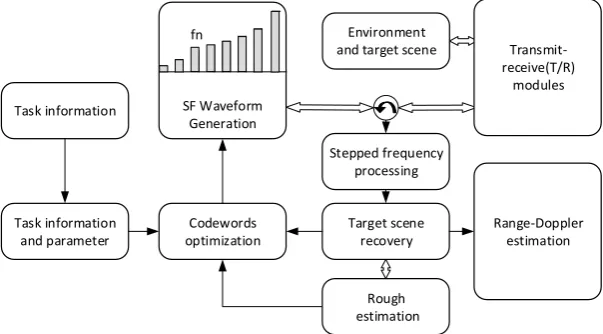
From the above analysis, reasonable design of frequency combination is necessary, because the randomness will bring about unstable changes in performance. In addition, all the target estimation using the CS processing method, the normalized cross correlation coefficient of the sensing matrix will affect the upper limit of the number of observable targets, as well as the ability to resist noise and the precision of the scene recovery. Therefore, the joint optimization of the transmitting frequency combination and the sensing matrix will not only match the real target scene, but also improve the radar performance. The main process of the system is to construct the corresponding transmit waveform and sensing matrix after acquiring the task information and system parameters. Then the correlation coefficient of the sensing matrix is minimized to achieve nearly optimal performance of target scene reconstruction. The main flow of the system is shown in Figure 1.
Range-Doppler estimation SF Waveform
Generation
Codewords optimization
Target scene recovery Stepped frequency
processing Environment and target scene
Task information and parameter Task information
fn
Transmit-receive(T/R)
modules
[image:3.595.147.449.548.715.2]Rough estimation
Figure 1. The constitution of cognitive stepped frequency radar system.
Model Simplification
Dimension reduction is considered from frequency-range-velocity grid to frequency-target grid. Through this transforming, the matrix dimension can be reduced from 3-D to 2-D, and the computational complexity could be reduced. In the Equation (3), the size of Ψ is NPQ, Φ is MN. In the iteration, the size of Φm is m N , where m is the times of updates. θ is the corresponding subscript of all grids with size PQ1. P is the number of distance units, Q is the number of speed units, and N is the divided total frequency units. Ψ is
1,1,1 1,1,2 1,1, 1,2,1 1,2,2 1,2, 1, ,
2,1,1 2,1,2 2,1, 2,2,1 2,2,2 2,2, 2, ,
,1,1 ,1,2 ,1, ,2,1 ,2,2 ,2, , ,
Q Q P Q
Q Q P Q
N N N Q N N N Q N P Q
Ψ (8)
where 2 ,
, , , [1, 2,..., ], [1, 2,..., ], [1, 2,..., ]
i j m
n
f i j
j
N
e n i P j Q
.
Frequency Codewords – Sensing Matrix Joint Optimization
The optimization iterative flow is specifically description as follows:
Step1: To initialize the working range resolution r, we can calculate the effective bandwidth by / 2
Bc r. Input the start frequency f0, the frequency step f , therefore, the total number of optional frequency is NB/f . Define the pulses number is M (M N), namely, M frequencies are used after optimization. To ensure the resolution performance, the first frequency and the last frequency must be preserved. The codeword copt(1) [c(1),c(M)], where c(1) 0,c(M) N.
Step 2: The rest codeword c( )m, (m1, 2,...,M1) are defined through the loop iteration, this process can be written as follows:
a. To add one frequency at a time, therefore, a new row is added into Φ, that is 1 [ H ]H m m
Φ Φ φ .
Using this new matrix Φm1 to sample the dictionary Ψ under the support set index of target
estimation supp( )θˆ , therefore the new sensing matrix is obtained Αm1Φ Ψm1 . b. We use the sequential codeword design, that is
( 1) ( 1)
s.t
arg min . {1,..., N 1}
m m
c
c , c (9) where (m1)
is the updated mutual coherence of the m1 times
1 1
(m 1) (m 1)
1 2 1 2
max ( , ) ( ), ( )
( ) ( )
m m
u v
m m
u u
u v
v
C v
Α Α
Α Α (10)
c. The new codeword are added into the optimized matrix (optm 1) [ ( )optm ,c(m 1)]
c c .
d. Repeat the operation above for M2 times.
Step 3: From above steps, the choosen codewords are in the matrix copt [c(1),c(2),...,c(M)]. The finally optimized frequencies can be obtained f=f0coptf . The final transmitting waveform is generated.
Step 4: Transmitting stepped frequency waveform with the optimized codewords, and then obtain the echo sample matrix y with the targets information.
range and velocity estimation are determined by calculation Rk R*,Vk mod( , ) k , where /
k Q
, is the rouding operator, mod( , )a b denotes remainder operators from a to b. The sparse targets are reconstructed.
Simulation and Results
We perform following simulations to evaluate the performance of the proposed waveform. In a group of test for example, the pulse interval is set to T4 ms, the width of transmitting pulse is Tw1 ms, the carried frequency is f010 MHz, and then the range resolution is r c/ (2 )B , it depends on the signal bandwidth B50 KHz. The frequency step f 1KHz, we choose M frequencies for every pulses from the total N50 available frequency sets. Six point-like targets with different range and velocity are defined.
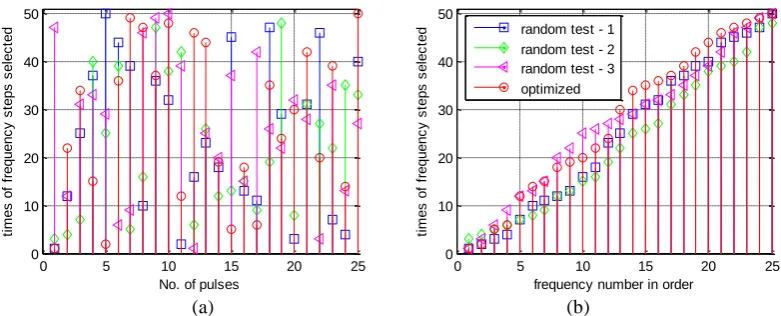
Supposing M 20, the comparison between random waveform and optimized waveform is tested. Randomly generating three sets of frequency combinations, namely, random test - 1, random test - 2, and random test - 3, and the optimized is designed using the proposed optimization method. The transmitting pulses with the codewords generated by different methods are shown in Fig.2 (a). We rearrange these selected ones according to the order from small to large for a clearer comparison in Figure 2. (b).
0 5 10 15 20 25
0 10 20 30 40 50
No. of pulses
ti
m
e
s
o
f
fr
e
q
u
e
n
c
y
s
te
p
s
s
e
le
c
te
d
0 5 10 15 20 25
0 10 20 30 40 50
frequency number in order
ti
m
e
s
o
f
fr
e
q
u
e
n
c
y
s
te
p
s
s
e
le
c
te
d random test - 1
random test - 2 random test - 3 optimized
[image:5.595.102.493.347.505.2](a) (b)
Figure 2. Selected frequencies by random method and optimized method.
0 1 2 3 4
x 105 -1
0 1
Range/m
V
e
lo
c
it
y
m
/s
random test - 1
target estimation
0 1 2 3 4
x 105 -1
0 1
Range/m
V
e
lo
c
it
y
m
/s
random test - 2
target estimation
0 1 2 3 4
x 105 -1
0 1
Range/m
V
e
lo
c
it
y
m
/s
random test - 3
target estimation
0 1 2 3 4
x 105 -1
0 1
optimized frequency
Range/m
V
e
lo
c
it
y
m
/s target
[image:6.595.142.451.73.299.2]estimation
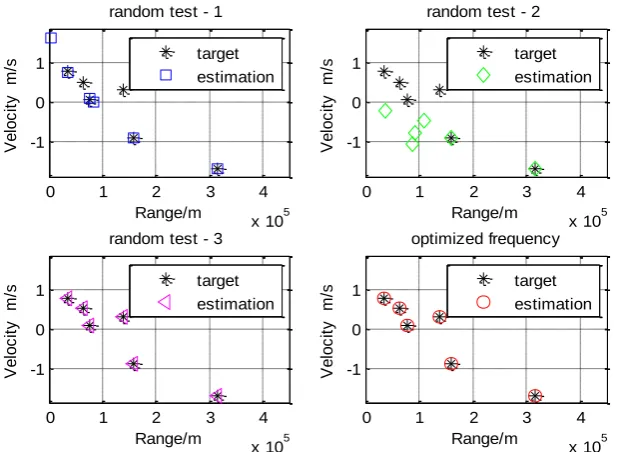
Figure 3. Target estimation from different transmitting waveform.
As can be seen from Figure 3, the random signal does not guarantee stable and reliable output, and we cannot make multiple measurements and statistics in practical applications. Therefore, accuracy rate is an important measure. The Root Mean Square Error (RMSE) of the estimation is considered to evaluate the performance,
2 2 1
1 ˆ
RMSE
N
i i
i
N
θ θ (11)We set the probability of correctly estimating the target information is p. It is regarded as a
successful estimate when RMSE , is a constant defined as 2 2
(R/ 2) ( v/ 2) here. At the
same time, frequencies utilization ratio M N/ is also an effect to recover the targets parameter. Therefore, the probability p in 500 Monte Carlo experientments at each point are calculated by changing SNR and respectively. In Table 1, set 40%, the SNR is changing from 0dB to 30dB. In Table 2, set SNR=20dB, the is changing from 10% to 100%.
Table 1. Estimation probability versus SNR for random and optimized SF waveform.
SNR (dB) 0 5 10 15 20 25 30
p(%) Random 44.5 55.17 57.67 61.67 62.83 63.67 67
Optimized 42.83 57 69.83 86.17 95.67 100 100
Table 2. Estimation probability versus frequencies utilization ratio for random and optimized SF waveform.
(%) 10 20 30 40 50 60 70 80
p(%) Random 33.33 35.67 45.33 62.83 86.67 93.67 97.67 100
Optimized 34 38.67 55 95.67 98 100 100 100
From the rate of successful estimation p by changing SNR and , we can see that the optimized waveform has higher robustness and accuracy. Besides, from the extent of increasing, the optimized SF waveform has the better anti-noise capability than the random one.
Conclusion
same range resolution as a full-band SF signal in the same frequency span. Through simulations and analyses, CS theory make it possible to recover the accurate range-Doppler spectrum as the same as continuous SF signal even if it is discontinuous and randomness. Optimized waveform displays a better robustness performance and an increased adaptability in noise environment.
Acknowledgement
This work was supported by the National Natural Science Foundation of China under Grant 61171182 and 61032011.
References
[1] S. R. J. Axelsson, "Analysis of Random Step Frequency Radar and Comparison With Experiments," IEEE Transactions on Geoscience and Remote Sensing, vol. 45, no. 4, pp. 890-904, April 2007.
[2] Y. Hu , X. Wang. High range resolution synthesized by non-linear stepped-frequency chirp pulse train. World Scientific and Engineering Academy and Society (WSEAS), vol. 8, no. 11, pp. 1123-1134, 2009.
[3] W. Yinsheng and Y. Siliang, "A novel adaptive learning method for low-sidelobe step frequency waveform designing," IEEE 10th International conference on signal processing proceedings, Beijing, 2010, pp. 2096-2099.
[4] G. Kalverkamp, B. Schaffer and E. Biebl, "Nonuniform Stepped Frequency Radar Scheme Reducing Spectrum Occupancy and Data Acquisition Time," GeMiC 2014; German Microwave Conference, Aachen, Germany, 2014, pp. 1-4.
[5] E. J. Candes, J. Romberg and T. Tao, "Robust uncertainty principles: exact signal reconstruction from highly incomplete frequency information," IEEE Transactions on Information Theory, vol. 52, no. 2, pp. 489-509, Feb. 2006.
[6] Y. Yu, A. P. Petropulu and H. V. Poor, "Range estimation for MIMO step-frequency radar with compressive sensing," 2010 4th International Symposium on Communications, Control and Signal Processing (ISCCSP), Limassol, 2010, pp. 1-5.
[7] L. Pallotta, V. Carotenuto, A. Aubry, A. De Maio and S. Iommelli, "A Cognitive Stepped Frequency Strategy for HRRP Estimation," 2017 Sensor Signal Processing for Defence Conference (SSPD), London, 2017, pp. 1-5.
[8] T. Huang, Y. Liu, H. Meng and X. Wang, "Cognitive random stepped frequency radar with sparse recovery," IEEE Transactions on Aerospace and Electronic Systems, vol. 50, no. 2, pp. 858-870, April 2014.
[9] J. A. Tropp and A. C. Gilbert, "Signal Recovery From Random Measurements Via Orthogonal Matching Pursuit," IEEE Transactions on Information Theory, vol. 53, no. 12, pp. 4655-4666, Dec. 2007.