http://dx.doi.org/10.4236/cn.2014.63018
Adaptive Distributed Inter Frame Space
for IEEE 802.11 MAC Protocol
Ja’afer AL-Saraireh
1, Saleh Saraireh
2, Mohammad Saraireh
3, Mohammed Bani Younis
2 1Princess Sumaya University for Technology, Amman, Jordan2Philadelphi University, Amman, Jordan 3Mutah University, Karak, Jordan
Email: [email protected], [email protected], [email protected], [email protected]
Received 5 May 2014; revised 5 June 2014; accepted 23 June 2014
Copyright © 2014 by authors and Scientific Research Publishing Inc.
This work is licensed under the Creative Commons Attribution International License (CC BY). http://creativecommons.org/licenses/by/4.0/
Abstract
In this research, an Adaptive Distributed Inter Frame Space (ADIFS) has been proposed for IEEE 802.11 Medium Access Control (MAC) protocol. The aim of this approach is to improve Quality of Services (QoS) for IEEE 802.11 MAC protocol in single-hop wireless network. The proposed ap- proach is based on traffic type, Collision Rate (CR), Collision Rate Variation (CRV) and Packet Loss Rate. These parameters are used to adjust the DIFS at runtime. The adjusted DIFS is employed to enhance service differentiation at the MAC layer in single-hop wireless networks. The proposed approach contributes to the enhancement of the average QoS for high priority traffic by 32.9% and 33.4% for the 5 and 10 connections, respectively. While the average QoS for the low priority traffic is improved by 14.3% and 18.2% for the 5 and 10 connections, respectively. The results indicate that, the proposed approach contributes in the enhancement of the QoS in wireless network.
Keywords
DCF, Collision Rate, Packet Loss, Average Delay, ADIFS
1. Introduction
The random transmission of applications over the wireless medium may lead to incomprehensible or unpredict- able results [1]. Therefore, a controller, which manages access to the medium of the shared resources is an es- sential tool for achieving a successful transmission process between the communicating parties, and ensuring access is fair and suitable [2].
rules and procedures that permit the communication pairs to communicate with each other in an efficient and fair manner [3] [4].
The IEEE 802.11 MAC Distributed Coordination Function (DCF) has two access techniques [5]. The first has two-way handshake known as basic access technique, while the other one has four-way handshake procedures
[6].
The basic access method based on the status of channel, so first of all it examines the channel status. If the channel is busy, the node is waiting and monitoring the channel status until it is idle for a period of time called the DIFS. Then the node generates a random back-off interval before transmitting to minimize the probability of multiple nodes concurrently transmission [7]-[9].
The minimum DIFS value is 20 μs and the maximum DIFS is 140 μs [5]. The minimum value is selected to be longer than the Short Inter Frame Space (SIFS) that is identified for control frames, such as an acknowledge- ment (ACK) frame, while the maximum value is chosen in order to minimize the wasted time slots by avoiding an excessively long defer of data packets.
This paper is organized as follows: The previous studies for providing service differentiation are presented in the following section. A description of the proposed approach is presented in Section 3. In Section 4, the simula- tion model is introduced. The results and discussions are presented in Section 5. In Section 6, the paper is con- cluded.
2. Related Works
Most of the proposed priority-based approaches were aimed to support service differentiation by providing dif- ferent MAC parameter values. The previous works enabled higher priority classes to access the medium faster than low priority classes. For instance, faster access could be provided by assigning a smaller Contention Win- dow (CW) causes a smaller Back-off Interval (BI) as reported in [2] [3] [6] [10]-[15] or by assigning smaller In- ter Frame Space (IFS) as reported in (Deng and Chang, 1999), and (Ksentini et al., 2004).
DIFS parameter has been studied for providing service differentiation among different traffic priorities [16]. The value of DIFS in these studies was statically assigned for each class. However, less effort has been made for tuning the DIFS for various traffic types.
In Zhang and Ye (2004), the length of DIFS was computed based on the ratio between the value of estimated transmission rate and total transmission rate [17]. This technique required a significant modification to the IEEE 802.11 DCF scheme.
Sung and Yun (2006) proposed a technique which is called Enhanced Distributed Coordination Function (EDCF) protocol [18]. This technique used Pareto database to store network configuration. For each new confi- guration the proposed scheme required comparing the current configuration with the already stored in the Pareto curve.
Using IFS is another approach to enhance service differentiation in the IEEE 802.11 MAC protocol. It is based on: 1) using the existing IFS values defined by the standard such as SIFS, Point Inter Frame Space (PIFS), and DIFS and 2) using new IFS values. Different schemes were proposed based on the already available IFS values. For example, the proposed approaches in [14] [19] [20] used PIFS and DIFS values to differentiate be- tween time-sensitive and time-insensitive applications. Some other approaches used new IFS values to differen- tiate between high and low priority traffic. These new IFS values were based on allocating the low priority traf- fic longer IFS value than the IFS value of high priority traffic.
Other studies such as [4] [7] [8] [12] [21] were proposed to provide service differentiation based on the dis- tributed function of the standard. These schemes were based on modifying the back-off time of the IEEE 802.11 MAC protocol. Although significant research efforts have been carried out on supporting service differentiation in IEEE 802.11 DCF by adopting the priority-based scheme, several issues have still not been considered.
In this paper, the following points are considered for providing service differentiation in the basic IEEE 802.11 DCF scheme: 1) MAC protocol parameters such as DIFS is dynamically adjusted, 2) different QoS metrics such as throughput, collision rate, packet loss, delay and jitter.
3. Proposed Approach Description
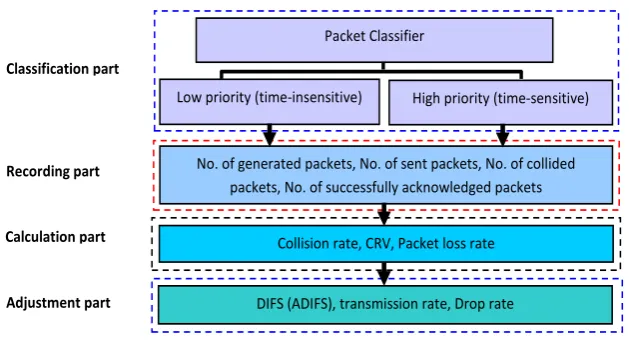
Figure 1.Adaptive distributed inter frame space.
generating packets, sent packets, successfully acknowledged packets, and collided packets. The third is calcula- tion part, where CR, CRV, and l N
[ ]
values are computed and fed to the final part, the decision on choosing an appropriate parameter values.The following equation is used to compute CR
[ ]
(
[ ]
(
)
[ ]
(
)
[ ]
)
current
collisions
collisions successful
Num N
CR N
Num N Num N
=
+ (1)
where Num
(
collisions[ ]
N)
is the number of collisions for node N; Num(
successful[ ]
N)
represents the number of packets that have been successfully acknowledged for node N; CRcurrent[ ]
N is the current collision ratio of node N. The CRV value of each node is calculated based on Equation (2).[ ]
current average[ ]
previous average[ ]
CRV N =CR − N −CR − N (2)
where CRV N
[ ]
is the collision ratio variation innode N; CRcurrent average−[ ]
N and CRprevious average−[ ]
N are the current and the previous average collision ratio, respectively. The CRV provides values within [−1 to 1]. The packet loss rate for node Ni,(
l N[ ]
i)
is calculated using Equation (3).[ ]
1(
(
sucess _ Ack[ ]
[ ]
)
)
gen _ packetsi i
i
Num N
l N
Num N
= − (3)
where Num
(
sucess _ Ack[ ]
Ni)
is the number of successfully received acknowledgements for a node N; i stands for high priority class, and Num(
gen _ packets[ ]
Ni)
is the number of generating packets at the sender.For high priority traffic, when the CRV value of a high priority node
(
CRV N[ ]
i)
is greater than zero, the proposed scheme examines the packet loss rate(
l N[ ]
i)
, if the packet loss rate is below the threshold (i.e.[ ]
i _[ ]
il N <l ths N ), then DIFS length of high priority
(
ADIFSnew =[ ]
Ni)
is set equal to DIFSinit (i.e.50
init
ADIFS = μs as defined in (IEEE, 1999)), in order to give low priority traffic a greater chance to access the channel. The minimum length of
(
ADIFSnew =[ ]
Ni)
is limited to one slot time (one slot time equal to 20 μsas defined in [5]). If the packet loss rate exceeds the packet loss rate threshold (i.e. l N[ ]
i <l ths N_[ ]
i ), the DIFS of high priority traffic(
ADIFSnew =[ ]
Ni)
is reduced by one slot time, to reduce the delay and to prevent an excessive packet loss for high priority packets. When the CRV N[ ]
i of high priority traffic is less than zero, the adaptive approach examines the packet loss rate l N[ ]
i value, if this value is below the packet loss rate threshold(
l_ths N[ ]
i)
, the DIFS of high priority(
ADIFSnew =[ ]
Ni)
is set equal to DIFSinit, while if the packet loss rate value l N[ ]
i is above the packet loss rate threshold(
l_ths N[ ]
i)
, the DIFS value of high pri- ority packets(
ADIFSnew =[ ]
Ni)
is updated as given in Equation (4).[ ]
(
[ ]
)
new Ni DIF init 1 i
ADIFS = S +CRV N (4)
For low priority traffic, when the CRV N
[ ]
i value is larger than zero, this implies that the number of con-Low priority (time-insensitive) High priority (time-sensitive)Packet Classifier
No. of generated packets, No. of sent packets, No. of collided packets, No. of successfully acknowledged packets
Collision rate, CRV, Packet loss rate
DIFS (ADIFS), transmission rate, Drop rate
Calculation part Classification part
Recording part
tending nodes is increased; and the probability of collisions is increased, since the current collision ratio is larger than the previous one. Therefore the
(
ADIFSnew =[ ]
Ni)
length is increased and is updated using Equation (5).[ ]
(
)
new Ni DIFSinit f CRV Nj ADIF new 1 j
ADIFS = + ∗ ∗ S − N (5)
where f is a scaling factor, with value of f =3 as considered in the simulations (Saraireh et al., 2014). If the CRV N
[ ]
i value is less than zero, this means that, the current probability of collisions is smaller than the previous one, and as a result, the proposed approach decreases the AD FSI new[ ]
Ni by one slot time as repre- sented in Equation (6).(
)
new 1
new j j one _ slot _ time
ADIFS N =ADIFS − N − (6)
To ensure that the lengths of AD FSI new
[ ]
Ni and ADIFSnewNj are within the specified ranges the follow- ing conditions are applied:In Equation (4), if ADI SF new
[ ]
Ni < one time-slot, then ADIFSnew[ ]
Ni = one slot.In Equation (5), if ADIFSnewNj > seven slots then ADIFSnewNj = seven slots.
In Equation (6), if ADI SF newNj < DIFSinit then ADI SF newNj = DIFSinit.
To avoid starvation for low priority traffic, after each update of the DIFS, the adaptive approach examines the value of this parameter. If DIFS has high values. The proposed scheme sets these parameters as shown in Equa- tion (7).
(
)
new new 1(
)
if priority=low then ADIFS Nj= ADIFS − Nj− one _ slot _ time (7)
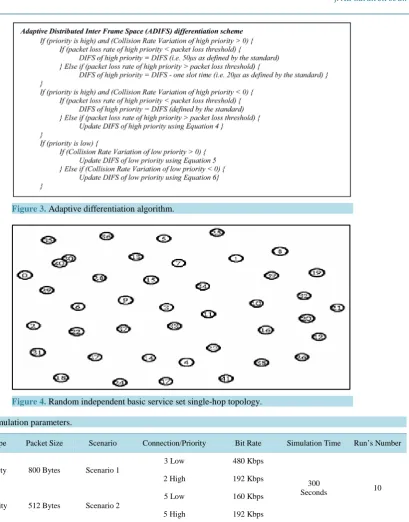
An overview of the adaptive differentiation operation is provided in Figure 2. It is assumed that there are two nodes, one is a high priority and the other is a low priority node. The high priority node is competing with smaller DIFS, while the lower priority node is competing with larger DIFS. Therefore, the high priority node accesses the medium first. A full description of the proposed algorithm is presented in Figure 3.
4. Simulation Model
To analyze the proposed ADIFS approach, and compare their functionalities with the standard IEEE 802.11 DCF scheme, network models with different scenarios have been proposed for the simulations by using NS-2.
In this approach, 40 fixed nodes are used, and they are randomly distributed in an area of 100 m × 100 m, and the transmission type is CBR traffic. The nodes are located in the same Independent Basic Service Set to represent a wireless ad-hoc network, as shown in Figure 4. The parameters of simulation are presented in Table 1.
The total offered load in each scenario is more than 110% of the effective channel capacity (i.e. it is consi- dered 1.6 Mbps without considering the protocol overhead) and more than 90% of the total channel capacity (i.e. 2 Mbps, with considering the impact of protocol overhead).
5. Results and Discussion
[image:4.595.102.526.635.701.2]In the ADIFS scheme, the CW size is updated according to the Binary Exponential Backoff (BEB) procedure as defined by IEEE 802.11 DCF. In IEEE 802.11 DCF, the ACK frame is assigned as a higher priority over data packets by having a shorter IFS known as SIFS, while data packets have a longer IFS known as DIFS (i.e. SIFS < DIFS). The same concept is applied for the ADIFS scheme, where the DIFS length is dynamically adjusted for each priority based on the packet loss rate and CRV values.
Figure 3.Adaptive differentiation algorithm.
[image:5.595.139.504.268.458.2]Figure 4.Random independent basic service set single-hop topology.
Table 1.Simulation parameters.
Traffic Type Packet Size Scenario Connection/Priority Bit Rate Simulation Time Run’s Number
Low Priority 800 Bytes Scenario 1
3 Low 480 Kbps
300
Seconds 10
2 High 192 Kbps
High Priority 512 Bytes Scenario 2
5 Low 160 Kbps
5 High 192 Kbps
As indicated in Table 2, the average delay for the high priority connections is less than 13 μs. The results in- dicate that high priority connections have better QoS, with a mean value equal to 86.9%. This significant im- provement in the QoS of high priority traffic is at the cost of low priority traffic. For instance, the first low prior- ity connection has a poor QoS with an average of 45.3%. This is due to the long waiting time prior to the trans- mission which lead to high packet drops at the buffer.
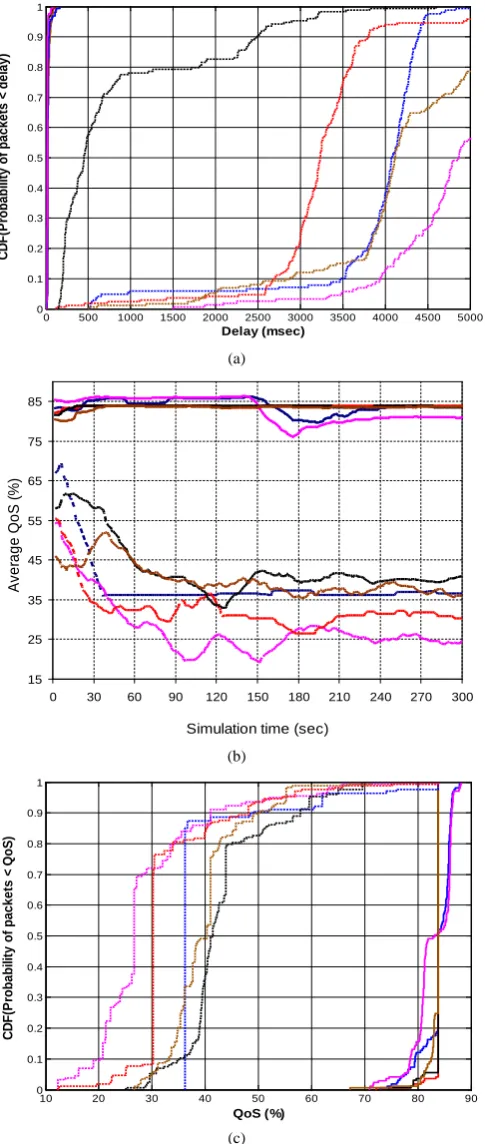
[image:5.595.89.540.493.587.2]for a shorter period, so it could get access to the channel earlier than a low priority node. At the time, when a low priority node tries to access the medium, it finds the channel busy and has to wait until the transmission of higher priority packet is complete. Once the channel becomes idle, all nodes commence their back-off duration. Due to shorter lengths of DIFS for high priority nodes, they wait for shorter time periods and start to decrease their back-off time earlier than low priority nodes. This behaviour leads to better performance for the QoS pa- rameters and the average QoS of all connections as depicted in Figures 5(a)-(c) and shown in Table 3. The av- erage QoS for higher priority traffic is 83.5% with fewer fluctuations and the average QoS for the low priority traffic is 37.1%.
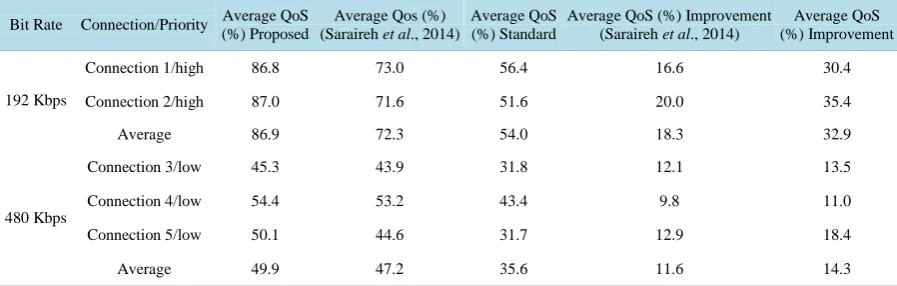
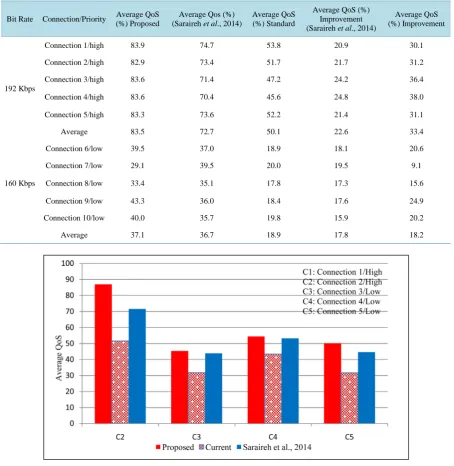
Table 4 summarizes the QoS results for the proposed approach as compared with others for 5 connections.
Table 2.QoS parameters values obtained using the adaptive ADIFS differentiation scheme.
Bit Rate Connection/Priority Average delay (μs) Average jitter (μs) Average throughput (Kbps)
Average MAC efficiency (%)
Average QoS (%)
192 Kbps
Connection 1/high 12.7 6.1 189.3 99.9 86.8
Connection 2/high 10.0 6.0 188.5 99.9 87.0
480 Kbps
Connection 3/low 1471.5 22.3 281.7 99.9 45.3
Connection 4/low 709.6 9.9 304.9 99.9 54.4
[image:6.595.89.538.571.714.2]Connection 5/low 955.4 11.4 284.8 99.8 50.1
Table 3.QoS parameters values obtained using the adaptive ADIFS differentiation scheme for 10 connections.
Bit Rate Connection/Priority Average delay (μs) Average jitter (μs) Average throughput (Kbps)
Average MAC efficiency (%)
Average QoS (%)
192 Kbps
Connection 1/high 24.3 7.03 193.8 99.7 83.9
Connection 2/high 26.7 6.5 188.7 99.8 82.9
Connection 3/high 25.4 8.2 174.0 99.9 83.6
Connection 4/high 18.3 7.2 181.6 99.8 83.6
Connection 5/high 27.8 7.3 178.5 99.7 83.3
160 Kbps
Connection 6/low 3859.4 61.4 86.9 99.6 39.5
Connection 7/low 5009.8 60.1 71.4 99.9 29.1
Connection 8/low 3263.9 46.5 80.4 99.7 33.4
Connection 9/low 860.0 25.2 123.0 99.5 43.3
Connection 10/low 4145.4 60.1 97.0 99.5 40.0
Table 4.Comparison of IEEE 802.11 DCF QoS, Saraireh et al., 2014 with proposed schem for 5 connections.
Bit Rate Connection/Priority Average QoS (%) Proposed
Average Qos (%) (Saraireh et al., 2014)
Average QoS (%) Standard
Average QoS (%) Improvement (Saraireh et al., 2014)
Average QoS (%) Improvement
192 Kbps
Connection 1/high 86.8 73.0 56.4 16.6 30.4
Connection 2/high 87.0 71.6 51.6 20.0 35.4
Average 86.9 72.3 54.0 18.3 32.9
480 Kbps
Connection 3/low 45.3 43.9 31.8 12.1 13.5
Connection 4/low 54.4 53.2 43.4 9.8 11.0
Connection 5/low 50.1 44.6 31.7 12.9 18.4
(a)
(b)
(c)
[image:7.595.194.437.87.660.2]Connection 1 (high priority); Connection 2 (high priority); Connection 3 (high priority); Connec-tion 4 (high priority); Connection 5 (high priority); Connection 6 (low priority); Connection 7 (low priority); Connection 8 (low priority); Connection 9 (low priority); Connection 10 (low priority).
Figure 5.ADIFS―based differentiation for 10 connections (5 high and 5 low priority nodes). (a)
cumulative distribution of delay; (b) average QoS; and (c) cumulative distribution of QoS.
0 500 1000 1500 2000 2500 3000 3500 4000 4500 5000
0 0.1 0.2 0.3 0.4 0.5 0.6 0.7 0.8 0.9 1 Delay (msec) C D F (P ro b ab il it y o f p acket s < d el ay) 15 25 35 45 55 65 75 85
0 30 60 90 120 150 180 210 240 270 300
Simulation time (sec)
A v er age Q oS ( % )
10 20 30 40 50 60 70 80 90
These results are also shown in Figure 6. The average of QoS of proposed scheme increases from 54% to 86.9% for the high priority connections as compared with the standard, while it increases from 72.3% to 86.9% as compared with (Saraireh et al., 2014). On the other hand, for low priority connections the average of QoS is improved by 14.3% and 2.7% as compared with the standard and (Saraireh et al., 2014), respectively. These re- sults indicate that the use of the proposed approach improves QoS in wireless networks.
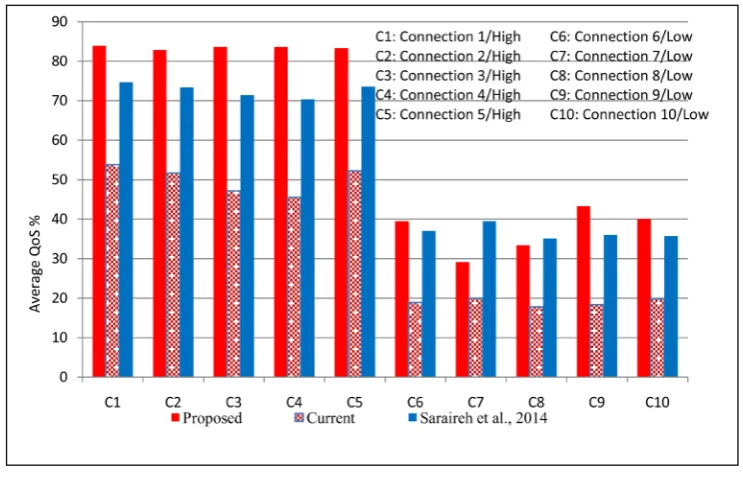
[image:8.595.87.542.231.698.2]Table 5 summarizes the QoS results by using the proposed approach as compared with others for 10 connec- tions. These results are also shown Figure 7. The average of QoS of proposed scheme increases from 50.1% to 83.5% for the high priority connections as compared with the standard, while it increases from 72.7% to 83.5% as compared with (Saraireh et al., 2014) for the high priority connections. For low priority, the average QoS is enhanced by 18.2% and 0.4% as compared with the standard and (Saraireh et al., 2014), respectively.
Table 5.Comparison of IEEE 802.11 DCF QoS, Saraireh et al., 2014 with proposed schem for 10 connections.
Bit Rate Connection/Priority Average QoS (%) Proposed
Average Qos (%) (Saraireh et al., 2014)
Average QoS (%) Standard
Average QoS (%) Improvement (Saraireh et al., 2014)
Average QoS (%) Improvement
192 Kbps
Connection 1/high 83.9 74.7 53.8 20.9 30.1
Connection 2/high 82.9 73.4 51.7 21.7 31.2
Connection 3/high 83.6 71.4 47.2 24.2 36.4
Connection 4/high 83.6 70.4 45.6 24.8 38.0
Connection 5/high 83.3 73.6 52.2 21.4 31.1
Average 83.5 72.7 50.1 22.6 33.4
160 Kbps
Connection 6/low 39.5 37.0 18.9 18.1 20.6
Connection 7/low 29.1 39.5 20.0 19.5 9.1
Connection 8/low 33.4 35.1 17.8 17.3 15.6
Connection 9/low 43.3 36.0 18.4 17.6 24.9
Connection 10/low 40.0 35.7 19.8 15.9 20.2
Average 37.1 36.7 18.9 17.8 18.2
Figure 7.Comparison of IEEE 802.11 DCF QoS, Saraireh et al., 2014 with a proposed scheme for 10 connections.
6. Conclusions
In this research, an enhancement to IEEE 802.11 DCF scheme to provide QoS has been developed. The pro- posed approach based on dynamically adjustment of DIFS at run time depend on traffic types at MAC layer in the single hop network.
The simulation results indicate that, the adaptive approach improves the performance for high and low priori- ty traffics. The results reveal that the adaptive scheme is capable of providing service differentiation and improv- ing the network performance. The results indicate that, the QoS for priority traffics in terms of delay, jitter and throughput are improved for high and low priority traffics using different number of connections.
References
[1] Saraireh, M., Saraireh, J. and Saraireh, S. (2014) A Novel Adaptive Contention Window Scheme for IEEE 802.11 MAC Protocol. Journal of Trends in Applied Sciences Research, 9, 275-289.
http://dx.doi.org/10.3923/tasr.2014.275.289
[2] Balador, A., Movaghar, A., Jabbehdari, S. and Kanellopoulos, D. (2012) A Novel Contention Window Control Scheme for IEEE 802.11 WLANs. IETE Technical Review, 29, 202-212. http://dx.doi.org/10.4103/0256-4602.98862
[3] Raksha, U., Prakash, D. and Sanjiv, T. (2013) Collision Resolution Schemes with Nonoverlapped Contention Slots for Heterogeneous and Homogeneous WLANs. Journal of Engineering, 2013, 1-9.
http://dx.doi.org/10.1155/2013/852959
[4] Li, B., Battiti, R. and Yong, F. (2007) Achieving Optimal Performance by Using IEEE 802.11 MAC Protocol with Ser- vice Differentiation Enhancements. IEEE Transactions on Vehicular Technology, 56, 1374-1387.
http://dx.doi.org/10.1109/TVT.2007.895565
[5] IEEE (1999) IEEE Standard for Wireless LAN Medium Access Control (MAC) and Physical Layer (PHY) Specifica- tions, ISO/IEC 8802-11:1999E.
[6] Deng, D.J., Ke, C.H., Chen, H.H. and Huang, Y.M. (2008) Contention Window Optimization for IEEE 802.11 DCF Access Control. IEEE Transactions on Wireless Communications, 7, 29-35.
http://dx.doi.org/10.1109/T-WC.2008.071259
[7] Zhang, M., Gong, C. and Lu, Y. (2008) Dynamic Priority Backoff Algorithm for IEEE 802.11 DCF. Proceedings of the International Conference on Computer Science and Software Engineering, Wuhan, 12-14 December 2004,956-958.
http://dx.doi.org/10.1109/CSSE.2008.901
Conten-tion-Based Wireless Networks. Proceedings of the International Conference on Mobile Technology, Applications, and Systems (Mobility ‘08). http://dx.doi.org/10.1145/1506270.1506324
[9] Mahdieh, G., Naser, M. and Kamal, J. (2013) A Game Theory Based Contention Window Adjustment for IEEE 802.11 under Heavy Load. International Journal of Communication Networks and Information Security (IJCNIS), 5, 93-103.
http://dx.doi.org/10.3923/tasr.2014.275.289
[10] Veres, A., Campbell, A., Barry, M. and Sun, L. (2006) Supporting Service Differentiation in Wireless Packet Networks Using Distributed Control. IEEE Journal on Selected Areas in Communications (JSAC), 19, 2081-2093.
http://dx.doi.org/10.1109/49.957321
[11] Kim, K., Shin, S. and Kim, K. (2001) A Novel MAC Scheme for Prioritized Services in IEEE 802.11 DCF 802.11a Wireless LAN. Proceeding of IEEE International Conference on ATM and High Speed Intelligent Internet (ICATM), Seoul, 22-25 April 2001, 196-199. http://dx.doi.org/10.1109/ICATM.2001.932084
[12] Barry, M., Campbell, A. and Veres, A. (2001) Distributed Control Algorithms for Service Differentiation in Wireless Packet Networks. Proceeding of 20th Annual Joint Conference of the IEEE Computer and Communications Societies
(INFOCOM), Anchorage, 22-26 April 2001, 582-590. http://dx.doi.org/10.1109/INFCOM.2001.916786
[13] Gannoune, L. (2006) A Comparative Study of Dynamic Adaptation Algorithms for Enhanced Service Differentiation in IEEE 802.11 Wireless Ad Hoc Networks. Proceeding of AICT-ICIW’06, International Conference on Telecommu-nications and International Conference on Internet, Web Applications and Services, 19-25 February 2006, 31-37.
http://dx.doi.org/10.1109/AICT-ICIW.2006.4
[14] Deng, J. and Chang, R. (1999) Priority Scheme for IEEE 802.11 DCF Access Method. IEICE Transactions on Com- munications, 82, 96-102.
[15] Ksentini, A., Naimi, M., Nafaa, A. and Gueroui, M. (2004) Adaptive Service Differentiation for QoS Provisioning in IEEE 802.11 Wireless Ad Hoc Networks. PE-WASUN ‘04 Proceedings of the 1st ACM International Workshop on Performance Evaluation of Wireless Ad Hoc, Sensor, and Ubiquitous Networks, 39-45.
[16] Aad, I. and Castelluccia, C. (2001) Differentiation Mechanisms for IEEE 802.11. Proceeding Joint Conference of the IEEE Computer and Communications Societies (INFOCOM), Anchorage, 22-26 April 2001, 209-218.
http://dx.doi.org/10.1109/INFCOM.2001.916703
[17] Zhang, S. and Ye, C. (2004) On Service Differentiation in Mobile Ad Hoc Networks. Journal of Zhejiang University Science, 5, 1087-1094. http://dx.doi.org/10.1631/jzus.2004.1087
[18] Sung, M. and Yun, N. (2006) A MAC Parameter Optimization Scheme for IEEE 802.11e-Based Multimedia Home Networks.3rd IEEE, Consumer Communications and Networking Conference, CCNC 2006, 8-10 January 2006,390- 394. http://dx.doi.org/10.1109/CCNC.2006.1593053
[19] Shue, S.T. and Shue, T.F. (2001) A Bandwidth Allocation, Sharing and Extension Protocol for Multimedia over IEEE 802.11 DCF 802.11 Ad Hoc Wireless LANs. IEEE Journal on Selected Areas in Communications (JSAC), 19, 2065- 2080.
[20] Banchs, A., Perez, X., Radimirsch, M. and Stuttgen, H. (2001) Service Differentiation Extensions for Elastic and Real-Time Traffic in 802.11 Wireless LAN. Proceeding of IEEE Workshop on High Performance Switching and Routing (HPSR), Dallas, 29-31 May 2001, 245-249. http://dx.doi.org/10.1109/HPSR.2001.923640
[21] Ayyagari, A., Bernet, Y. and Moore, T. (2000) IEEE 802.11 Quality of Service. White Paper, 1-10.