Journal of Behavioral and Brain Science, 2014, 4, 384-395
Published Online August 2014 in SciRes. http://www.scirp.org/journal/jbbs http://dx.doi.org/10.4236/jbbs.2014.48037
Quantitative Objective Assessment of
Websites by Neurocode-Tracking in
Combination with Eye-Tracking
Wilfried Dimpfel
1, Andrè Morys
21Justus-Liebig-University Giessen c/o NeuroCode AG, Wetzlar, Germany 2Web Arts AG, Bad Homburg v. d. Höhe, Germany
Email: [email protected], [email protected]
Received 30 June 2014; revised 16 August 2014; accepted 28 August 2014
Copyright © 2014 by authors and Scientific Research Publishing Inc.
This work is licensed under the Creative Commons Attribution International License (CC BY).
http://creativecommons.org/licenses/by/4.0/
Abstract
Internet websites.
Keywords
Neurocode-Tracking, Eye-Tracking, Quantitative EEG, Internet Surfing, CATEEM
1. Introduction
During the last years, the expression “Neuromarketing” has entered the field of market research. It suggests a combination of brain research with market research. However, the word “Neuromarketing” is ill-defined and obviously misused in many cases. The question therefore arises how brain research might contribute to, for ex- ample, advertisement research. A common methodological approach in this field consists in using an Eye- Tracker in order to follow the glances of a subject when watching TV commercials or during internet surfing. The camera following the eye movements provides information of when, where and how long an area of interest is fixed by the subject. But interpretation of such data is discussed controversially. Longer fixation of an area does not necessarily mean higher attention, but could also mean that the matter is depicted in a too complicated manner. This would be negative. Additional information is needed. It might be provided by analysing electric brain activity concomitantly with using the Eye-Tracking methodology. Quantitative assessment of electric brain activity based on frequency analysis has been reported earlier [1] [2]. By special processing of the frequency data succeeding in quantitative brain maps, various states of cognition and emotion have been described and named “Enkephaloglyphs” [3]. A combination of Eye-Tracking and EEG has been used during natural reading [4]. Meanwhile, even very short epochs of 364 ms duration of the electroencephalogram (EEG) are accessible for frequency analysis and were reported as Neurocode-Tracking in combination with Eye-Tracking [5]. The present investigation aimed at the proof of the concept of using this new methodology for assessment of web- sites during Internet surfing. Ten male subjects (aged 36 ± 4.4 years) entered the study. They were asked to view Internet landing pages of five banking institutions. Parameters of assessment were surrogate parameters like visual perception, focused attention, memory, mental activation and tension, which were based on changes of frequency contents in particular brain regions observed during earlier experiments.
2. Method
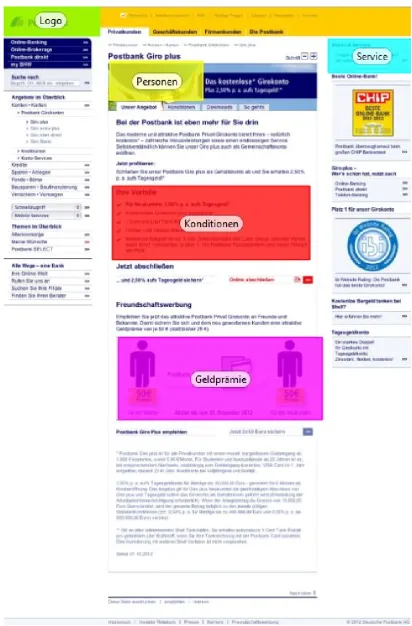
Ten male subjects aged 36 ± 4.4 years participated in this pilot proof of concept study. They all were internet users. They were tested for alcohol and were not allowed to have coffee or to smoke before and during the expe- riment. After giving informed consent, subjects were asked to surf at predefined landing pages and registration forms of 5 different banking institutions: ComDirect, DKB, INGDiBa, Postbank and Targo-Bank. Websites were presented by anEye-Tracking device (Tobii GmbH, Frankfurt, Germany). For the duration of the web-surfing on one page a so-called Heat-Map was constructed. After definition of particular areas of interest (ROI’s), time to awareness was calculated by the evaluation program. The definitions of areas of interest are given in Figure 1.
W. Dimpfel, A. Morys
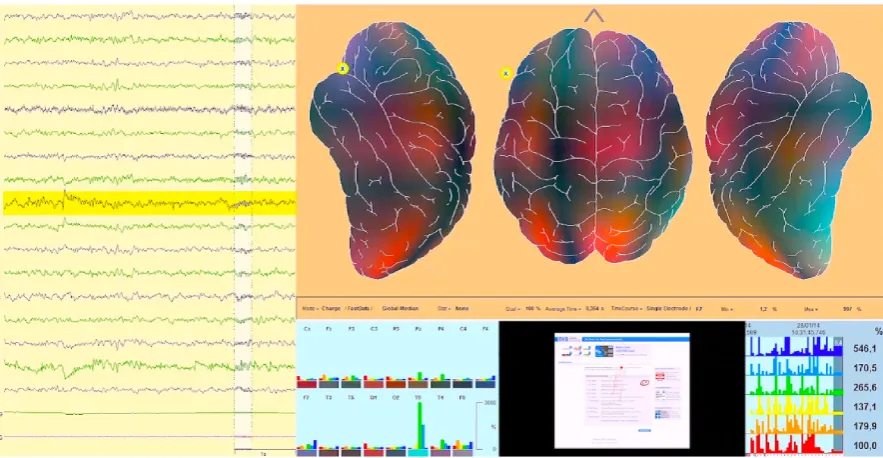
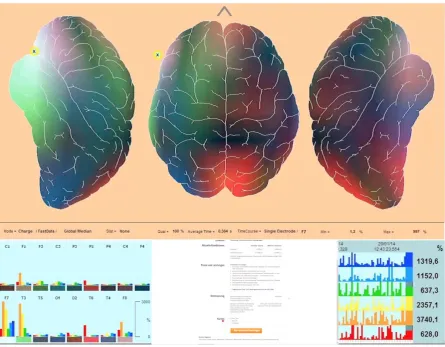
Figure 2.Documentation of are presentative enkephaloglyph obtained from fast dynamic quantitative EEG recording (Neu- rocode-Tracking) showing 364 ms of the raw signal on the left side (verticalenlightment) and brain mapping (upper right). Bar chart (middle lower part) depicts focal alpha2 activity (green bar) within the right temporal lobe (Position T6) indicating a memory process. Glance from Eye-tracking (right of the bar chart) is marked by a very small red spot on the website (mid- dle upper part at first written line). Right from this a time course of frequency changes is depicted for electrode position F7 (marked yellow on the raw signal on the left side). Delta power is marked red, theta orange, alpha1 yellow, alpha2 green, beta1 turquoise and beta2 blue. Numbers in the lower right corner represent % regional power for each frequency range.
3. Results
The presentation by the Eye-Tracking device was started with a gong for synchronisation purposes between Eye-Tracking and Neurocode-Tracking. After this, a fixation cross was presented for one minute providing a reference for the EEG recording condition “eyes open”. Classic evaluation of eye-tracking data provides infor- mation where subjects have concentrated their glances over time. The result is documented as a so-called “Heat- Map”. Figures 3-7 show such maps for the five different landing pages. With respect to the ComDirect bank 3 “hot spots” were achieved: 1) “Kostenloses Bargeld mit der Girocard”, 2) “50€ wenn Sie uns mögen”, and 3)
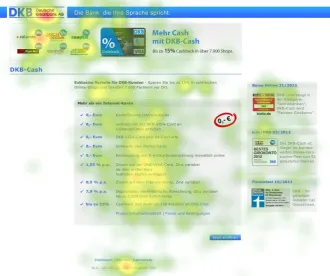
“Preise und Konditionen” (Figure 3). With respect to the DKB bank attention was obviously focussed on the
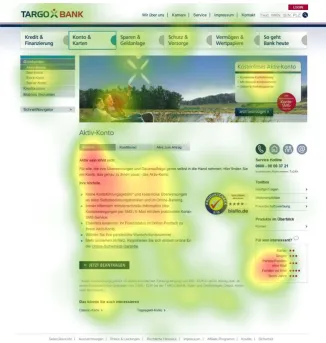
logo in the left upper corner (Figure 4). Most attention at visit of the INGDiBa website was given at the heading of “Kostenlos”, which means “free of charge”. Heat-map is shown in Figure 5. A different pattern of focused attention was detected with respect to the landing page of the Postbank. Here, subjects concentrated on the head- ing of “Vorteile”, which means “advantages” (Figure 6). Finally, the Heat-map of the Targo-Bank provided in- formation on particular interest to the heading of “Aktiv Konto”. The resulting Heat-map is depicted in Figure 7. Thus, Heat-maps are insofar interesting as they provide information on particular preferences of the visitor of the website. Every bank obviously used different “Eye catcher” slogans in order to catch attention of the internet visitor.
Another way to look at Eye-Tracking data is to determine the time which passed before a particular region of interests was detected by the visitor for the first time (Table 1). With respect to “conditions” and “service” INGDiBa clearly succeeded in the shorter times, whereas with respect to “Geldprämie” ComDirect bank was most successfully.
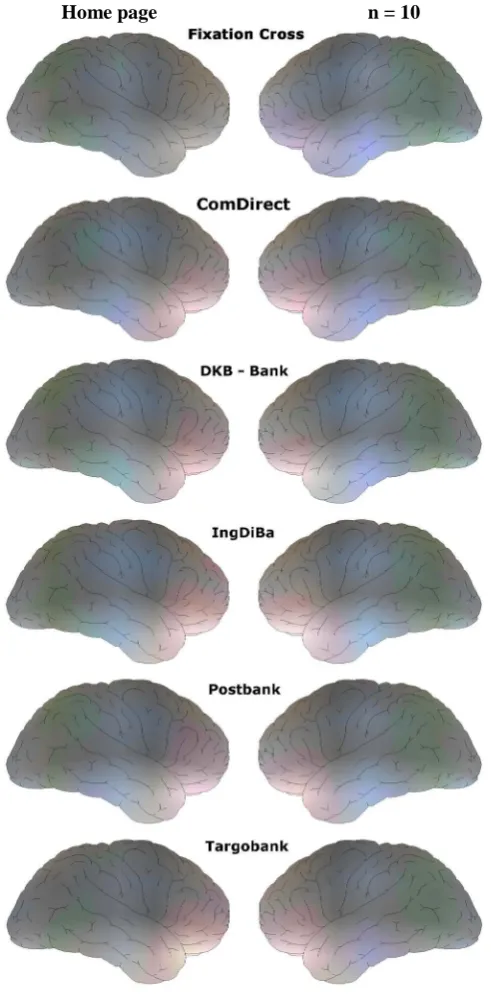
Looking now at the results from Neurocode-Tracking one can see clear differences in mental activation be- tween just looking at a fixation cross and visiting the landing pages of the bank portals. Results are depicted as functional brain maps in Figure 8. Strongest activation is observed for the website of INGDiBa.
W. Dimpfel, A. Morys
Figure 3.Heat-map of the ComDirect landing page. Highest fixation is documented as red spot.
[image:5.595.145.476.426.702.2]Figure 5.Heat-map of the INGDiBa landing page. High- est fixation is documented as red spot.
Figure 6. Heat-map of the Postbank landing page.
[image:6.595.212.416.401.699.2]W. Dimpfel, A. Morys
Figure 7. Head-map of the Targo-Bank landing page. Highest fixation is documented as red spot.
Table 1. Time in seconds to first awareness of particular predefined region of interest.
Konditionen Logo
n Mean (s) Sum (s) n Mean (s) Sum (s)
ComDirect 10 10.89 108.93 9 14.64 131.80
DKB 10 4.98 49.77 7 8.45 59.18
INGDiBa 10 4.42 44.20
Postbank 10 8.38 83.77
Targo-Bank 10 9.44 94.44 8 7.68 61.41
Geldprämie Personen
n Mean (s) Sum (s) n Mean (s) Sum (s)
ComDirect 10 0.57 5.74 10 0.33 3.34
DKB 10 1.43 14.32 10 0.41 4.14
INGDiBa 10 3.43 34.29 9 2.16 19.44
Postbank 10 5.12 51.19 10 1.49 14.90
Targo-Bank 10 1.65 16.54 10 1.62 16.21
Service
n Mean (s) Sum (s)
ComDirect 10 10.89 108.93
DKB 10 4.98 49.77
INGDiBa 10 4.42 44.20
Postbank 10 8.38 83.77
Home page n = 10
Figure 8. Functional electric brain maps derived from Neuro-code-Tracking reflecting focal enhancement of frontal slow waves indicating mental activation when visiting the landing page of five different ban institutions. The more of red enlightening the higher the activation (frontal brain in the middle).
fronto-temporal brain areas as depicted by the enkephaloglyph in Figure 9.
[image:8.595.192.438.85.583.2]W. Dimpfel, A. Morys
Figure 9. Enkephaloglyph showing very high focal theta power (orange) in fronto-temporal brain region as indicator of high concentration of a subject during Internet surfing. Glance according to Eye-Tracking is fixed on the topic “accounts” (small red spot at lower middle image). For more details please seeFigure 2.
visiting the websites revealed considerably and statistically significant higher values. Best values with respect to all parameters except for memory processing were measured for the visit of INGDiBa.
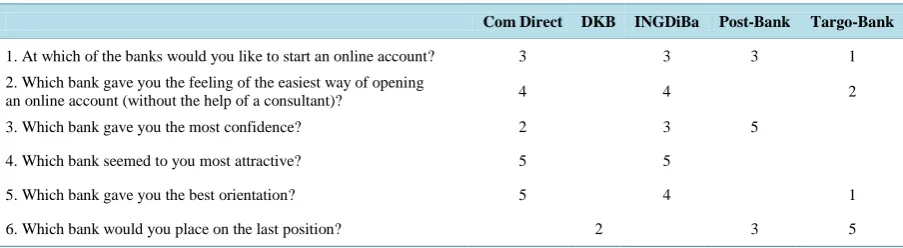
Finally, a questionnaire consisting of 6 questions was filled out regarding subjective impressions after having finished Internet surfing. Except for the question regarding confidence, which was chosen by 50% of the visitors in favour of the Postbank, all other questions showed ComDirect and INGDiBa in the two first places. Results are depicted in Table 3. Last place was given the Targo-Bank.
4. Discussion
Figure 10.Enkephaloglyph with high values of beta2 electric power (blue bar chart lower left corner and blue spots at the map) as indication of high tension. Glance according to Eye-Tracking is fixing the topic of starting an account (small red spot on image in lower middle part).
Table 2.Results from Neurocode-Tracking showing the intensity of various physiological states as derived from electric power at particular regions and frequencies according to spectral signatures during visit of the landing pages of 5 different banking institutions. The higher the values, the higher is the intensity of the psychological state.
Cognitive Activation [µV2] P =
Focused Attention [µV2] P =
Visual Awareness [µV2] P =
Memory Processing [µV2] P =
Tension [µV2] P =
Fixation Cross 3.72 2.04 1.15 1.13 3.71
ComDirect Home page 7.47 0.021 3.51 0.021 1.34 0.109 0.62 3.87
DKB Home page 7.85 0.021 3.76 0.021 1.49 0.021 0.78 4.70
Ing-Diba Home Page 9.00 0.021 4.72 0.021 1.72 0.002 0.73 0.109 4.28
Postbank Home page 8.51 0.021 4.11 0.021 1.49 0.021 1.08 0.109 4.10
Targo-Bank Home page 8.79 0.021 3.58 0.021 1.75 0.021 1.66 0.109 2.06
[image:10.595.92.538.513.638.2]W. Dimpfel, A. Morys
Table 3.Result from the questionnaire regarding subjective impressions after finish of the surfing. Number of first choice votes are given for n = 10 subjects.
Com Direct DKB INGDiBa Post-Bank Targo-Bank
1. At which of the banks would you like to start an online account? 3 3 3 1
2. Which bank gave you the feeling of the easiest way of opening
an online account (without the help of a consultant)? 4 4 2
3. Which bank gave you the most confidence? 2 3 5
4. Which bank seemed to you most attractive? 5 5
5. Which bank gave you the best orientation? 5 4 1
6. Which bank would you place on the last position? 2 3 5
reached highest values. But we cannot exclude at this point, that the knowledge of the name of the bank might have influenced the results.
One might argue now, that it might be too early to use these psychological terms for quantitative assessment based on electric power development in different regions. But, as published earlier, particular frequencies with defined brain regions can be used as surrogate parameters for example with respect to concentration, where theta power increases indicated high concentration [11] and memory processes [12]. Likewise, alpha2 spectral power has been related to memory processes in the past [13]. Visual perception must be seen in connection with spec- tral changes within the occipital lobe. Again theta power increases have been identified as a surrogate parameter for this psychological feature. Thus, interpretation of spectral power values within particular brain regions al- lows for use of psychological terms describing quantitatively behaviour.
Finally, also the result from the questionnaire confirmed the leading position of the ComDirect and INGDiBa bank with respect to web design of their starting page. In summary, this pilot study consisting in the combina- tion of Eye-Tracking and Neurocode-Tracking supplemented by a questionnaire has proven to provide much more information than with any one of the methods used in separate. Future work will show, if this result of the pilot approach can be generalized for use in advertisement research.
Acknowledgements
Mrs. Petra Werling is gratefully acknowledged for her excellent performance of the experiment. Mrs. Leonie Schombert was of great help in producing the documentation of the results. Jürgen Bluhm from Tobii Technol- ogy GmbH, Frankfurt, Germany, is greatfully acknowledged for providing the eye track technology for this pilot experiments. Mrs. Keplinger-Dimpfel is acknowledged for taking care of the logistics of the study and perform- ance of the quality control.
Conflict of Interest
There was no conflict of interest.References
[1] Dimpfel, W., Wedekind, W. and Keplinger, I. (2003) Gender Difference in Electrical Brain Activity during Presenta- tion of Various Film Excerpts with Different Emotional Content. European Journal of Medical Research, 8, 192-198.
[2] Dimpfel, W. (2011) Simultaneous Eye Tracking and Fast Dynamic EEG Current Source Density Imaging for Assess- ment of Commercials or Websites. 16th European Conference on Eye Movements ECEM, Marseille, 21-25 August 2011, 49.
[3] Dimpfel, W. (2011) Enkephaloglyphen. Spektrale Signaturen der elektrischen Hirntätigkeit als Spiegel der Psyche, Bod Verlag, Norderstedt.
[4] Dimigen, O., Sommer, W., Hohlfeld, A., Jacobs, A.M. and Kliegl, R. (2011) Co-Registration of Eye Movements and EEG in Natural Reading: Analysis & Review. Journal of Experimental Psychology, 140, 552-572.
http://dx.doi.org/10.1037/a0023885
64-77. http://dx.doi.org/10.4236/aad.2014.32008
[6] Berger, H. (1931) Über das Elektroenzephalogramm des Menschen. Dritte Mitteilung. Archiv für Psychiatrie, 94, 16- 60. http://dx.doi.org/10.1007/BF01835097
[7] Jasper, H.H. (1958) The ten-twenty electrode system of the International Federation. Electroencephalography and Clinical Neurophysiology, 10, 371-375.
[8] Dimpfel, W., Hofmann, H.C. (2014) Neurocode-Tracking Based on Quantitative Fast Dynamic EEG Recording in Combination with Eye-Tracking. World Journal of Neuroscience, 4, 106-119.
http://dx.doi.org/10.4236/wjns.2014.42013
[9] Schober, F., Schellenberg, R. and Dimpfel, W. (1995) Reflection of Mental Exercise in the Dynamic Quantitative To- pographical EEG. Neuropsychobiology, 31, 9 -112. http://dx.doi.org/10.1159/000119179
[10] Sachs, L. (1992) Angewandte Statistik: Anwendungstatistischer Methoden.
[11] Dimpfel, W., Hofmann, H.C., Prohaska, A., Schober, F. and Schellenberg, R. (1996) Source Density Analysis of Func- tional Topographical EEG: Monitoring of Cognitive Drug Action.European Journal of Medical Research, 1, 283-290.
[12] Hsieh, L.T. and Rangnath, C. (2014) Frontal Midline Theta Oscillations during Working Memory Maintenance and Episodic Encoding and Retrieval. NeuroImage, 2, 721-729. http://dx.doi.org/10.1016/j.neuroimage.2013.08.003