MULTITROPHIC INTERACTIONS IN A POTATO-APHID SYSTEM
ASAD ALI B.Sc. (Hons), M.Sc. (Hons)
A thesis submitted for the Degree of Doctor of Philosophy
of Imperial College London and the Diploma of Imperial College London
Division of Biology
Silwood Park Campus
Imperial College London
2
Dedication
This research work is dedicated to my worthy parents,
My loving wife Gul Naz
&
3
Declaration
The work presented in this thesis is entirely my own and has not been submitted anywhere else.
Signed...Asad Ali
Certified...Professor Denis J. Wright (PhD Supervisor)
4
Acknowledgements
All praises and appreciations are for ALMIGHTY ALLAH, the most merciful and compassionate, the greatest source of knowledge and wisdom, who bestowed upon me skill and intellect to conduct and accomplish the assigned project in the most humble manner. The deepest love and inspirations are due to Holy Prophet MUHAMMAD (Peace be Upon Him), who is forever a torch of guidance and knowledge for humanity.
I wish to express my sincere gratitude to my worthy supervisor Prof. Denis J. Wright for his substantial guidance, continuous inspiration and invaluable assistance in bringing this dissertation to its present form. Without his encouragement and constant guidance, I could not have finished this dissertation. I am also greatly thankful to members of my PRP, Prof. Jim Hardie and Dr. Glen Powell for their valuable suggestions, constructive criticism and encouragement throughout my research endeavour.
I wish to thank Syngenta, Jealott‟s Hill, UK for supplying me with the culture of
Meloidogyne javanica for this research. I am also thankful to my colleagues; Dr. Khalid Farooq, Mr. Malik Muhammad Masud and Mr. Shahid Riaz at National Potato Programme, NARC, Islamabad, Pakistan, for their help and assistance in establishing and data collection of potato field trials at Pakistan.
This study was made possible through the financial support of Higher Education Commission (HEC) of Pakistan. I am also grateful to the PARC Islamabad, Pakistan for granting study leave to complete this task.
I don‟t have the words to acknowledge the fascinating love, encouragement, support both moral and financial of my beloved parents. Thanks BABA and MOOR for giving me life, for educating me with aspects from both arts and sciences, for unconditional support and encouragement to pursue my interests, even when the interests went beyond boundaries of language, field and geography. Their prayers are the root of my success.
5
I am grateful to my wife GUL NAZ for her sincerity which was continuous push for me and the joy she gave me in the form of Asjad Ali, my beloved son, my asset, and much more. Thank you both for your time and patience.
My thanks are also due to the kindness and love of my family members, especially my Bibi Gulaney, Masher baba, Daji, Kaji and family, brothers, Yousaf Ali, Ashraf Ali, Waqas Ali and sister, Nazia Farooq. I am also grareful to my In-laws who added charm to my life, especially Haji saib and Sheena aunty, Amjad Islam, Fazal Karim, Jaini, Bushi, Lado and Uzmi the great, for her amusing chat.
Friends are co-sharer of my struggle and my work. I am also grateful to all my friends during my stay at Imperial College especially Asim Gulzar, Muhammad Tariq, Anjum Aqueel, Rahim Shah, Muhammad Adrees, Farida and Sofia, Khalid Zafar, Ziab Khan at Leicester, Dr. Syed Meher Ali Shah and Maqsood Shah at Pakistan and Asim Khan at Bradford. Also thanks to the folks at the Silwood Park Campus for interesting discussions and being fun to be with. Thanks, Silwoodians!
I am also Thankful to all of my teachers in life who put me on the track for success especially Prof. Muhammad Naeem, Prof. Mian Inayatullah, Dr. Sajjad Ahmad, Dr. Imtiaz Ali Khan and Mr. Salim Jan for getting me interested in Entomology and for their continuous encouragements during the course of my studies.
6
Abstract
In interactions between plants, insect herbivores and natural enemies, resistant
plant varieties and soil abiotic/biotic factors can affect natural enemies through
changes in the plant or host insect. Interactions can be negative, neutral or positive
in relation to herbivore populations. The majority of studies have used above-ground
plant–insect–parasitoid systems and relatively few studies have included
below-ground effects on above-below-ground tritrophic interactions.
The aim of the present
project was to understand how soil-based stress factors (nutrient availability and
root pathogens) influence multitrophic interactions in a potato-aphid (
Myzus
persicae
)-parasitoid (
Aphidius colemani
) system. Specific objectives were: to assess
aphid performance on different potato cultivars under laboratory and field conditions;
use aphid resistant and susceptible cultivars to assess the effects of soil nutrition
and a plant pathogen (root-knot nematode) on aphid performance; conduct
multifactorial ditrophic (aphid performance) and tritrophic (parasitism success)
experiments with selected combinations of soil treatments; use olfactometry to
determine whether plant volatiles are involved where significant tritrophic
interactions occur between treatments. Potato cv. Anya, a cv derived from Desiree
and Pink Fir Apple, was found to be consistently resistant to
M. persicae
compared
with the three other cultivars tested (Desiree, Santé and Pink Fir Apple) in both
laboratory experiments (UK) and field trials (Pakistan and UK). For Anya (resistant)
and Desiree and Pink Fir Apple (susceptible), high levels of soil nutrients enhanced
aphid performance, their parasitism by
A. colemani
, and adult parasitoid emergence.
Root-knot nematodes had a negative effect on aphid performance at both low and
high soil nutrition but had a positive effect on parasitism at low soil nutrition.
Olfactometry showed Desiree to be more attractive to
M. persicae
compared with
Anya. The work is discussed in relation to the development of pest management
strategies for the control of
M. persicae
on
potato.
7
TABLE OF CONTENTS
Dedication...2
Declaration...3
Acknowledgements... 4
Abstract... 6
Table of Contents... 7
CHAPTER 1:
Introduction
1.1Background………...13
1.2
Aims and objectives……….…..16
1.3
Hypotheses………...…17
CHAPTER 2:
Literature Review
2.1
Multitrophic interactions………..……..18
2.2
Soil Nutrition and insect-plant interactions……….…...…….20
2.2.1
Effect of soil nutrition on plants………..…..21
2.2.2
Indirect effects of soil nutrition on insect herbivores………...…22
2.2.3
Indirect effects of soil nutrition on parasitoids………....24
2.3
Potato………...25
2.4
Aphids……….….26
2.4.1
Myzus persicae
……….…..…30
2.4.2
Host plant resistance……….……….31
2.5
Parasitoids………...……...32
2.6
Plant parasitic nematodes……….……...34
8
CHAPTER 3:
General Materials and Methods
3.1
Plant production………..37
3.1.1
Potato cultivars……….…...37
3.1.2
John Innes compost………..…....38
3.2
Insect culture……….…….….39
3.3
Parasitoids………..……….39
3.4
Plant parasitic nematodes……….40
3.5
Data analysis………..………....…40
CHAPTER 4:
The performance of
Myzus persicae
on potato
cultivars at different soil nutritional levels
4.1
Introduction……….….41
4.2
Materials and Methods………..42
4.2.1
Plant production………..…42
4.2.2
Insect culture………....…..43
4.2.3
Performance experiments………..…..43
4.2.4
Data analysis………..45
4.3
Results……….…45
4.3.1
Developmental time………..….45
4.3.2
Fecundity and intrinsic rate of increase………..46
4.4
Discussion………...49
CHAPTER 5:
Field performance of
Myzus persicae
on potato
cultivars in Pakistan and the UK
5.1
Introduction………..52
9
5.2.1
Field sites and farming practices……….53
5.2.2
Aphid survey………...55
5.2.3
Data analysis………...56
5.3
Results………..56
5.3.1
Meteorological data for Silwood Park………...56
5.3.2
Meteorological data for Pakistan………..57
5.3.3
Field performance of
M. persicae
on potato cultivars: Silwood Park
2008…...59
5.3.4
Field performance of
M. persicae
on potato cultivars: Pakistan
2009………...60
5.3.5
Performance of
M. persicae
on potato cultivars in pots (semi-field):
Silwood Park 2009 ………...64
5.3.6
Field performance of
M. persicae
on potato cultivars: Pakistan
2010……...66
5.4.
Discussion ...70
CHAPTER 6:
Performance of
Myzus persicae
on upper,
middle and lower leaves of three potato
cultivars at low and high soil nutrition
6.1
Introduction...74
6.2
Materials and Methods...75
6.2.1
Plant production...75
6.2.2
Insect culture...75
6.2.3
Performance Experiments...76
6.2.4
Data Analysis...77
10
6.3.1
Developmental time...77
6.3.2
Fecundity and Intrinsic rate of increase...79
6.4
Discussion...82
CHAPTER 7:
The preference of
Myzus persicae
on potato
cultivars at different soil nutrition levels
7.1
Introduction...85
7.2
Materials and Methods...86
7.2.1
Plant production...86
7.2.2
Insect culture...86
7.2.3
Preference (settling) bioassay with winged aphids...86
7.2.4
Olfactometer experiment...87
7.2.5
Trichome density on potato cultivars...89
7.2.6
Data analysis...89
7.3
Results...90
7.3.1
Preference (settling) bioassay with winged aphids...90
7.3.2
Olfactometer experiment... ....93
7.3.3
Trichome density on potato cultivars...94
7.4
Discussion... ....96
CHAPTER 8:
Performance of
Aphidius colemani
on
Myzus
persicae
reared on three potato cultivars at
different soil nutrition levels
8.1
Introduction...100
8.2
Materials and Methods...101
11
8.2.2
Insect culture...101
8.2.3
Parasitoids...101
8.2.4
Experimental Procedure...102
8.2.5
Data analysis...103
8.3
Results...104
8.3.1
Percentage parasitism...104
8.3.2
Percentage emergence...105
8.3.3
Developmental time...106
8.3.4
Sex ratio...108
8.3.5
Adult size...108
8.4
Discussion...109
CHAPTER 9:
Multitrophic interactions in a
potato-aphid-parasitoid system: influence of root herbivory and
soil nutrition
9.1
Introduction...113
9.2
Materials and Methods...115
9.2.1
Plant production...115
9.2.2
Insect culture...115
9.2.3
Parasitoids...115
9.2.4
Root knot nematodes (RKN)...115
9.2.5
Experimental treatments...116
9.2.6
Foliar herbivore performance...116
9.2.7
Parasitoid performance...117
9.2.8
Plant performance...118
12
9.3
Results...119
9.3.1
Plant performance...119
9.3.2
Foliar herbivore performance...121
9.3.3
Parasitoid performance...124
9.4
Discussion...128
CHAPTER 10: Summary and General Discussion
10.1 Summary of the experimental findings...133
10.2 General Discussion ...135
10.2.1
Soil nutrition...135
10.2.2
Host plant resistance...136
10.2.3
Root herbivory...138
10.2.4
Conclusion...139
10.3 Future work...139
References………..…….141
13
CHAPTER 1
INTRODUCTION
1.1 Background
All organisms in an ecosystem are linked chemically and their relationship is apparent in food chains and food webs (van Veen et al. 2006; Olff et al. 2009). If linear food chains in a generalized food web are considered, these contain at least three trophic levels (Price et al. 1980; Schmitz et al. 2000). In tritrophic interactions, organisms at lower trophic levels are forced to evolve to reduce feeding by organisms at higher trophic levels; whereas organisms at higher trophic levels evolve to increase consumption (Price et al. 1980; Hare 2002).
To understand tritrophic interactions, it is necessary to study the chemical factors (e.g. plant secondary compounds including plant volatiles, insect pheromones and soil nutrients) that mediate them. For example, when using natural enemies to control herbivorous pests it is essential to understand the interactions between the plants, herbivores and natural enemies that are involved. Manipulation of plant attributes that promote the success of the natural enemies may enhance pest control (Verkerk et al.
1998a; Cortesero et al. 2000; Symondson et al. 2002; Powell and Pickett 2003; Poppy and Sutherland 2004; Wilkinson and Landis 2005; Fiedler et al. 2008; Greenstone et al. 2010). Price et al. (1980) highlighted the importance of also considering the third trophic level in insect–plant interactions. Thus, natural enemies of herbivores can help plants by reducing herbivore damage, and plants can help natural enemies by making herbivores more vulnerable to them (Nordlund 1981).
Numerous studies on tritrophic interactions have contributed to our knowledge of how plants, herbivores, and parasitoids interact between different trophic levels and what consequences this can have for their respective populations (Poppy and Sutherland 2004;
14
Turlings and Wäckers 2004; Ode 2006; Stout et al. 2006; Zehnder et al. 2007; Poelman et al. 2008; Schädler et al. 2010). Tritrophic interactions include various aggressive and defensive interactions both between and within trophic levels, including morphological, behavioural, and physiological relationships (de Moraes et al. 2000; Bowers 2003; Bezemer
et al. 2005; Vencl et al. 2005; Griffin and Thaler 2006).
Plants possess a variety of biochemical and physical defence mechanisms that can deter, poison, or starve herbivores feeding on them (Hartley and Jones 1997; Sabelis et al.
1999; Kessler and Baldwin 2002; Dicke and van Poecke 2002; Gershenson 2002; Strauss and Murch 2004; Arimura et al. 2005; Schilmiller and Howe 2005; Stout 2007; Bruinsma et al. 2008; Agrawal and Konno 2009). Interactions between plants and parasitoids may have evolved in a race between plants and herbivores. For instance, where there has been a competitive advantage for plants that produce more efficient signals when attacked, for parasitoids that utilize these signals, and for herbivores that minimise plant responses to herbivory (de Moraes et al. 2000; Bezemer et al. 2003; Nyman et al. 2007; Bailey et al.
2009).
Many plant secondary compounds (metabolites) have toxic effects on herbivores and pathogens, while other plant defences appear to have indirect effects upon pests and pathogens, such as attracting predators and inhibiting insect oviposition (Elbanna 2007). One trophic level can affect diversity maintenance in other trophic levels (Chesson and Kuang 2008). In these interactions, herbivore-induced volatiles of plants attract the third trophic level, e.g. natural enemies. It has been shown that such induced volatiles play an important role against insect herbivores and pathogens (Mauricio et al. 1997; Stotz et al.
2000; Scutareanu et al. 2003; Snoeren et al. 2007; Liu et al. 2009; Snoeren et al. 2010; Dicke and Baldwin 2010).
Potato
Potatoes, Solanum tuberosum L. (Solanales: Solanaceae) were first domesticated in Peru and Chile and introduced to the British Isles around 1600 AD. Over the next century
15
their popularity grew to such an extent that they became the staple diet of a large part of the population. Potatoes are a valuable crop in the United Kingdom and worldwide, including Pakistan (Section 2.3).
Potatoes are attacked by various insect pests, including borers and sap feeders (Section 2.3). Among these insect pests, aphids can cause considerable economic loss through direct and indirect damage to the crop worldwide (Raman 1984; Hooker 1986; Shah 1988; Blackman and Eastop 2000; Kuroli and Lantos 2006; van Emden and Harrington 2007). Because of their role as virus vectors (over 13 viruses are transmitted by aphids in potato), aphids are probably of greater economic importance as potato pests worldwide than are insect defoliators or tuber pests (Hanafi 2006). Apart from insect pests, plant parasitic nematodes, particularly cyst and root-knot species, are also a major threat and play an important role in reducing potato production all over the world (Hanafi 2006; Scurrah
et al. 2005; Mugniéry 2007; Hodda and Cook 2009).
Aphids
Aphids (Hemiptera: Aphididae) are phytophagous insects that feed on plant phloem, producing serious damage to crops (Section 2.4; Dixon 1998). The peach-potato aphid
Myzus persicae Sulzer (Hemiptera: Aphididae) is a generalist aphid species, attacking many host plants including potatoes (van Emden et al. 1969; Blackman and Eastop 2000). Although chemical pest management has been implemented with relative success against aphid pests of agriculture (Parker et al. 2002), their capacity to develop insecticide resistance has become an important problem (Field et al. 1988; Field and Devonshire 1997; Devonshire et al. 1998; Foster et al. 2000; Denholm and Devine 2001; Field and Foster 2002; Srigiriraju et al. 2009). Unlike many lepidopteran and some coleopteran pests, there has been no commercialization of transgenic crops expressing toxins for aphid control (Sharma et al. 2000; Romeis et al. 2006; Burgio et al. 2007). Cultural and biological methods for aphid control have become increasingly important in protected crops and more widely as part of integrated crop management programmes (Albajes et al. 1999; Gullino et
16
al. 1999; Heinz et al. 2004; Yano 2006; van Emden and Harrington 2007; Bailey et al.
2009).
The role of natural enemies in the regulation of insect populations has been the subject of considerable debate (Stiling 1988; Walde and Murdoch 1988; Murdoch 1990; Hawkins 1992; Kos et al. 2008). Among the natural enemies of aphids, parasitoid wasps can play an important role in controlling the aphids including pest of potato crops (Tomanovi and Brajkovi 2001; Herzog et al. 2007). Among parasitoids, the genus Aphidius
(Hymenoptera: Braconidae) contains numerous species which attack and provide biological control of aphids (Section 2.5). Aphidius colemani Viereck (Hymenoptera: Braconidae) is the most commonly used parasitoid species for controlling aphid species in protected crops (Kim and Kim 2003; Vásquez et al. 2006; Van Driesche et al. 2008).
1.2 Aims and objectives
The main aim of the project was to understand how two soil-based factors (soil fertilizer levels, plant pathogens) and host plant resistance influence multitrophic interactions in a potato - aphid - parasitoid system.
Objectives:
1) To assess aphid (M. persicae) performance on a range of potato cultivars under controlled environmental conditions to determine which were the most susceptible and resistant cultivars.
2) Using the most aphid resistant and aphid susceptible cultivars (1), to assess the separate effects of soil fertilizer levels, plant cv and pathogen (plant parasitic nematode) on aphid performance.
3) To conduct multifactorial ditrophic (aphid performance) and tritrophic (parasitism success) experiments with selected combinations of soil fertilizer or pathogen treatments.
17
4) Where significant differences occur between treatments in multifactorial experiments, to use whole plant olfactometry on aphids to determine whether plant volatiles are involved in specific trophic interactions.
5) To conduct field trials (UK and Pakistan) with potato cultivars to help determine the extent that the effects of cultivars on aphid performance observed in the laboratory are manifested under field conditions.
1.4
Hypotheses
The above objectives are linked to the following hypothesis:
1) That soil based factors will significantly influence aphid performance on foliage through direct effects on plant quality and indirect effects (e.g. plant volatiles) on parasitism. [Objectives 2, 3, 4 and 5].
2) That host plant resistance will be a major compounding factor with soil-based factors in influencing aphid performance [Objectives 1, 2, 3 and 4].
18
CHAPTER 2
LITERATURE REVIEW
2.1 Multitrophic interactions
In the last three decades, the study of trophic interactions between organisms has evolved from work on plant-herbivore or prey-predator interactions to a more complex, multitrophic approach involving three or more trophic levels that addresses the complexity of food webs much more realistically (Tscharntke and Hawkins 2002; van der Putten et al.
2004; Green et al. 2005; Hopkins et al. 2009; Megίas and Müller 2010).
Research on multitrophic interactions aims to identify the forces that regulate populations, including bottom-up forces controlled by resources and top-down forces controlled by predators and antagonists. Multitrophic interactions are however more complex than linear bottom-up / top-down interactions. For instance, food webs can be characterised in two dimensions: vertically, in which they form a food chain of rarely more than four or five trophic levels, or horizontally, i.e. within one trophic level (Hassell and Waage 1984; Murray et al. 2006; Wardle 2006; Huntley and Kowalewski 2007; Schneider and Maraun 2009; Harvey et al. 2010). Ecological interactions between two species are also often indirectly mediated by a third species of the same or another trophic level (Bronstein and Barbosa 2002; Salminen et al. 2010). This is found in intra-guild interactions, where two species that share a host or prey also engage in a trophic interaction with each other (Rosenheim et al. 1995; Rosenheim 1998; Moore et al. 2003; Putten et al. 2009), and in apparent competition, where two species, that do not come into direct contact, interact because they share a natural enemy (Holt and Lawton 1993; Denno et al. 1995; Chaneton and Bonsal 2000; Brassil and Abrams 2004; van Veen et al. 2006; Diaz et al. 2010).
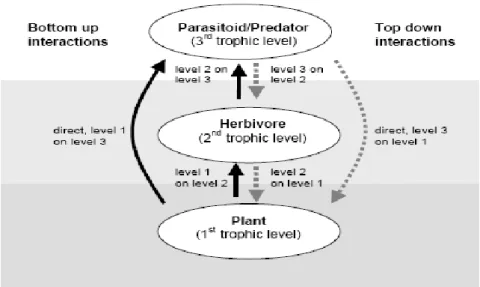
The present study focused on bottom-up interactions and especially the effects of soil nutrition and soil pathogens on herbivores and their parasitoids (Fig. 2.1).
19
Fig. 2.1 Conceptual model of interactions between three trophic levels; solid lines show bottom-up interactions, dotted lines show top-down interactions (from Jansson 2003).
In insects, interactions between plants, herbivores and their natural enemies are among the most studied multitrophic interactions (e.g. Turlings et al. 1990; Vet and Dicke 1992; Vet et al. 1995; Lewis et al. 1997; Verkerk et al. 1998a; Dicke 1999; Singer and Stireman 2003; Whitfield 2003; Novotny et al. 2006; Dyer et al. 2007; Inbar and Gerling 2008; Connahs et al. 2009; Harvey et al. 2010). In this type of food chain, the first trophic level, represented by the plant, influences the herbivore (the second trophic level) by its quality and quantity as a food-source. At the third trophic level, natural enemies limit herbivore populations by mortality. As indicated above, interactions between herbivores and their host plants and between herbivores and their natural enemies can only be understood when they are considered together within a multitrophic context (Fig 2.1; Price et al. 1980; Faeth 1992; van der Meijden and Klinkhamer 2000; Hare 2002; Jansson 2003; Inbar and Gerling 2008; Desneux and Ramirez-Romero 2009). For instance, the first trophic level (plant) can also influence the efficiency of the third trophic level (natural enemy) by providing shelter; mediating host/prey accessibility and availability; providing host/prey
20
finding cues; influencing host/prey suitability; and providing supplemental food sources for natural enemies (Cortesero et al. 2000). Natural enemies may „help‟ the plants, using the
benefits named above, thus limiting the herbivore population more than would be otherwise possible (Godfray 1994; Bottrell and Barbosa 1998; Van Rijn et al. 2002; Brewer and Elliott 2004; Almohamad et al. 2009).
The influence of a host plant can act directly on the third trophic level for instance by plant volatiles attracting parasitoids (Dicke 1999; Shiojiri et al. 2001; Hilker and Meiners 2002; Steidle and van Loon 2003; Fatouros et al. 2005; Liu 2009; Zhang and Schlyter 2010), plant structures that hinder parasitoids searching for hosts, or plant structures that can provide parasitoid shelter or food for parasitoids (Lovinger et al. 2000; Olson and Andow 2003; Mulatu et al. 2006; Carrillo 2008; Wise et al. 2010). The influence of a host plant can also act indirectly, for instance by influencing the nutritional quality of the parasitoid´s host (Harvey and Gols 1998; Jansson 2003; Urrutia et al. 2007; Sarfaraz et al.
2009a,b; Sarfaraz et al. 2010; Blake et al. 2010). A parasitoid is also influenced by the host itself, for instance by its preference for a particular developmental stage or stages (Hågvar and Hofsvang 1991; Liu et al. 2004; Li et al. 2006; Martinou and Wright 2007; Mironidis and Savopoulou-Soultani 2009; Amarasekare et al. 2010).
2.2 Soil nutrition and insect-plant interactions
Soil nutrition means nurturing the soil to the point where it is able to grow nutrient-dense plants and not just maintain fertility but improve fertility with each crop grown (Cook 2010). Soil nutrition plays an important role in multitrophic interactions among plants, phytophagous insect and their parasitoids through its effects on plant quality (Van der Putten 2001; Harvey et al. 2003; Ohghushi 2005; Blake et al. 2010; Staley et al. 2010).
21
2.2.1 Effect of soil nutrition on plants
Ingestad (1987) suggested that the relative addition rate of each nutrient, rather than the nutrient concentration in fertiliser or soil is important for plant growth, and that any nutrient shortage can slow down the plant relative growth rate. Some nutrients, e.g. potassium (K) and phosphorous (P) are known to be taken up in excess by plants when available (Mengel and Kirkby 1987; Mengel et al. 2001; Jansson 2003). Excess of nutrients can disturb the uptake of other nutrients (Mengel and Kirkby 1987; Prasad and Power 1997; Mengel et al. 2001). In general, increased supply of one cation species can lead to lower uptake of other cations. For example, K competes strongly with the uptake of other cations (Prasad and Power 1997). An increase in soil nitrogen (N) fertilisation can raise the content of both nitrate (N03) and soluble amino acids in the plant, while N deficiency can lead to hydrolysis of proteins and redistribution of amino acids from older leaves to younger organs. In both cases, the N content in the phloem is increased (Mengel and Kirkby 1987; Mengel et al. 2001; Barker and Pilbeam 2006).
In the phloem, assimilates are transported from actively photosynthetic leaves to growing tissues and breakdown products are transported from senescing leaves to growing tissues (Sengbusch 2003). The phloem content is not only influenced by the plant‟s uptake of nutrients but also by the growth of the plant and shifts between growth and senescence of plant tissues. Potassium is vital for the water balance in the plant and influences the uptake of NO3 and the assimilation of CO2; K deficiency can lead to decreased protein synthesis and accumulation of amino acids (Mengel and Kirkby 1987; Mengel et al. 2001; Chapagain and Wiesman 2004; Barker and Pilbeam 2006), probably due to inadequate energy (ATP) supply. Phosphorous is essential for energy transfer in plants and deficiency can affect various processes, such as protein synthesis and active ion uptake and thus lead to retarded plant growth (Schachtman et al. 1998; Hermans et al. 2006; Zekri and Obreza 2009).
22
2.2.2 Indirect effects of soil nutrition on insect herbivores
Soil nutrient availability can alter the nutritional quality of plants and this can influence herbivore growth and reproduction (Larsson 1989; Waring and Cobb 1992 Altieri and Nicholls 2003; Facknath and Lalljee 2005; Hwang et al. 2008; Vandegehuchte
et al.
2010b). Nitrogen is one of the plant nutrients that plays an important role for herbivore
performance (Mattsson 1980; Scriber 1984; Scriber and Slansky 1981; Bruyn 2002; Altieri and Nicholls 2003; Pennings and Simpson 2008; Sauge et al. 2010). This is especially true in the case of aphids, because the N content is low in the phloem. Phloem sap contains 0.004-0.6% w/v N while most plant tissues contain at least 1% N of dry weight (Mattson 1980).Nitrogen fertilisation of plants has, in many cases, been shown to have a positive effect on aphids and other phloem feeding insects (van Emden 1966; Waring and Cobb 1992; Nevo and Coll 2001; Throop and Lerdau 2004; Sauge et al. 2010). In 115 studies, crop damage by insect pests increased when the N content of the host plant was increased (Schoonhoven et al. 2005). In a review, Waring and Cobb (1992) reported that in approximately 50% of studies the response of phloem feeding insects was positive to N fertilisation and in 25% there was no response. While Van Emden (1969) found that in about 40% of the studies he reviewed aphids responded positively to N fertilisation, in 35% they responded negatively, and in about 25% there was no response. One reason for the varying results may be that different plants and different aphid species react differently. For instance, the nutritional demands are not identical for M. persicae and the potato aphid,
Macrosiphum euphorbiae Thomas (Hemiptera: Aphididae), Myzus persicae colonize on the lower senescing leaves while M. euphorbiae mostly found on the upper young leaves (Aldamen and Gerowitt 2009). Many experiments have shown that M. persicae is positively influenced by N fertilisation (Harrewijn 1983; Jansson and Smilowitz 1986; Nevo and Coll 2001; Jansson and Ekbom 2002; Zehnder and Hunt 2008; Sauge et al. 2010).
23
Low soil K content has been shown to be positive for M. persicae (Jansson 2003) and Aphis glycines Matsumura (Hemiptera: Aphididae) (Myers and Gratton 2006), High levels of K have mostly been shown to influence reproduction negatively or not at all for aphids and other phloem feeding insects (Myers et al. 2005; Myers and Gratton 2006). However, some studies have shown a positive effect of increased K on the performance of insects (Woolridge and Harrisson 1968; Perrenoud 1990). Waring and Cobb (1992) concluded that fertilisation with P does not generally influence phloem feeding insects or influences them positively. Skinner and Cohen (1994) reported that P deficiency reduced whitefly ovipositon on true leaves by 40% in the growth chamber and by 38% in the youngest expended leaves in the greenhouse. Bishop et al. (2010) studied the relative abundance of eight arthropod orders and five families in plots that received N, P, or no nutrients for 3–5 years and concluded that in Year 3 orthopteran abundance was associated with a P-mediated increase in plant cover, whereas in Year 5 orthopteran density was not related to cover, diversity or plant %N but rather to unmeasured effects of P.
The ratios between soil nutrients have also been shown to influence herbivores (Busch and Phelan 1999; Jansson and Ekbom 2002; Huberty and Denno 2006). Van Emden and Bashford (1971) found that a high N:K ratio was favourable for M. persicae on Brussels sprout. Harrewijn (1983) found a positive effect of high N:K ratio in the fertilisation of potatoes on M. euphorbiae. Apple et al. (2009) conducted a study on the performance of gelechiid larvae on greenhouse-grown lupins with factorial manipulation of competitors and soil N and P. In the presence of competition, larval mass was highest at intermediate N:P and high % P. Huberty and Denno (2006) also highlighted the importance of interfacing herbivore life-history strategies with ecological stoichiometry (elemental ratios that affect ecological processes at scales from the cellular to the global) of N and P in order to interpret the consequences of N and P limitation on herbivore performance and population dynamics.
Soil nutrition may also alter the attractiveness of plants to insects by enhancing plant vigour, morphology and phenology (Rahier 1978; Stadler 1992; Jansson 2003; Schonhof et
24
al. 2007; Facknath and Lalljee 2005; Sarfraz et al. 2005; Shennan 2008; Hsu et al. 2009; Sarfraz et al. 2010).
2.2.3 Indirect effects of soil nutrition on parasitoids
Insufficient nutrients in the host can affect development and survival, sex ratio, longevity, fecundity, and the size of parasitoid wasps (Vinson and Iwantsch 1980; Godfray 1994; Hunter 2003; Karimzadeh and Wright 2008; Sarfraz et al. 2009b). Askew and Shaw (1986) divided parasitoids into two groups based on their life style: koinobiont and idiobiont, which are mostly ectoparasites (e.g. Mastrus ridibundus Gravenhorst (Hymenoptera: Ichneumonidae) (Section 2.5). For koinobiont parasitoids, such as Aphidius spp., host quality is determined both by host resources at parasitization and the resources the host acquires during parasitoid development (Mackauer et al. 1997; Mackauer and Chau 2001; Hunter 2003; Jervis et al. 2008; Boivin 2010). The quality of an herbivore as a host for a parasitoid is affected by the quality of the herbivore‟s nutrient intake (Vinson and Barbosa 1987; Fox et al. 1990; Awmack and Leather 2002; Sarfraz et al. 2009a; Gharratt et al. 2010; Sarfraz et al. 2010).
Soil nutrition has been suggested as one way of manipulating plant attributes for improved biological control (Verkerk et al. 1998a; Cortesero et al. 2000). In a study by Bentz
et al. (1996), parasitization of the whitefly Bemisia argentifolii Bellows and Perring (Hemiptera: Aleyrodidae) by Encarsia formosa Gahan (Hymenoptera: Aphelinidae) was greater on plants treated with calcium nitrate than on unfertilised plants or plants treated with ammonium nitrate.
In field and laboratory studies, the parasitoid Diadegma insulare Cresson (Hymenoptera: Ichneumonidae) preferred host larvae of the diamondback moth, Plutella xylostella L. (Lepidoptera: Plutellidae), reared on plants fertilised with NPK and micro nutrients compared with hosts on unfertilised plants (Fox et al. 1996). In a study by Stadler and Mackauer (1996), the negative effects of unfertilised plants on A. pisum (lower fecundity, small body size and prolonged developmental time) were reflected in negative
25
effects on the aphid parasitoid, Ephedrus californicus Baker (Hymenoptera: Aphidiidae) in the form of a more male biased sex ratio and high parasitoid mortality. Sarfraz et al.
(2009b) evaluated the bottom-up effects of five soil fertility regimes on nutritional quality of canola (Brassica napus L.) and on several fitness correlates of female and male D. insulare
(% parasitism, survival, developmental time and longivity) as mediated through P. xylostella. Variation in soil fertility influenced the nutritional quality of host plants and this in turn affected the performance of D. insulare; with D. insulare performing best on plants grown with 3.0 g fertilizer pot−1. These plants had 2.06-, 3.77-, and 1.02-fold more NPK respectively than ones grown without any added fertilizer.
2.3 Potato
The largest producers of potatoes worldwide are: China, Russia, India, United states and Germany (World Potato Atlas 2010). The United Kingdom ranks No. 11 among world potato producing countries, recording a 2009 harvest of 6 million tonnes and average yields exceeding 45 tonnes per hectare; with an annual per capita potato consumption of 102 kg (FAOSTAT 2009). Pakistan is the seventh largest potato producing country in the world and potato has emerged as an important cash crop with over 134,000 ha grown p.a. Potato production in Pakistan has risen significantly in recent years and reached 2,941,000 tonnes in 2009 (Agricultural Statistics of Pakistan 2009).
Potatoes are attacked by a large number of insect pests, including borers, aphids, whiteflies, jassids and beetles (Visser 2005; Grafius and Douches 2008). Insect pests of potato can be categorized into three different general types (Hanafi 2007). The most apparent ones are those that damage leaves or stems such as the Colorado potato beetle,
Leptinotarsa decemlineata Say (Coleoptera: Chrysomelidae) and flea beetles, e.g. Epitrix tuberis Gentner (Coleoptera: Chrysomelidae). Less obvious are those that damage tubers or roots, such as potato tuber moth, Phthorimaea operculella Zeller (Lepidoptera: Gelechiidae), cutworms, e.g. Agrotis ipsilon Hufnagel (Lepidoptera: Noctuidae), wireworms
26
(Agriotes spp. (Coleoptera: Elaterlidae)), and white grubs or chafer grubs (Phyllophagaspp.
(Coleoptera: Scarabaeidae))
(
Hanafi 2007).Aphids such M. euphorbiae, M. persicae, Aphis nasturti Kaltenbach (Hemiptera: Aphididae) and Aulacorthum solani Kaltenbach (Hemiptera: Aphididae) and leafhoppers, e.g. Empoasca fabae Harris (Hemiptera: Cicadellidae) cause damage by feeding on the plant sap, and some are vectors of important potato viruses (Piron 1986; Radcliffe et al.
1993; Radcliffe and Ragsdale 2002; Andret-link and Fuchs 2005; Pelletier et al. 2008; Verbeek et al. 2010).
Potato occupies a prominent position among vegetable crops consumed worldwide due to its high productivity and good nutritional and calorific value (Burton 1989; Gould 1999; Romans 2005). High nutritional and water content however make potatoes vulnerable to attack by pests and diseases, both in the field and in storage (Radcliffe 1982; Malik 1995; Sharma and Ortiz 2000; Strand 2006; Johnson 2007; Kapsa 2008; Boiteau 2010).
2.4 Aphids
Aphids are considered by many to be the most important insect pests in temperate zone agriculture (Hill 1987; Blackman and Eastop 2000; Sorensen 2009; Hulle et al. 2010). They primarily cause damage either by direct feeding and subsequent nutrient loss from the plant or by the transmission of plant viruses (Pickett et al. 1992; Ng and Perry 2004; Ng et al. 2005; Alvarez et al. 2007; Brault et al. 2010). Aphids can also adversely affect crops through toxic compounds in their saliva as well as reducing photosynthetic capacity indirectly in leaves through excretion products and saprophytic fungi (Schepers 1989). Aphids feeding can also induce galling, tissue senescing and leaf curling (Miles 1999).
Aphids range in size from 1.5 to 3.5 mm (Borror et al. 1976). They are pear-shaped, globose, ovate, and spindle-shaped or elongate in shape and vary greatly in their body markings and colour (black, grey, red, orange, yellow, green, brown, blue-green,
white-27
marked, wax-covered, etc.). Single species show polymorphism, with several colour forms and shapes and may be winged (alate) or wingless (apterous) (Blackman and Eastop 2000). Winged forms are usually triggered by environmental changes, i.e. decreasing photoperiod (special sort of alates in host alternating species) or temperature, deterioration of the host plant or overcrowding (Kennedy and Stroyan 1959; Dixon 1987; Dixon 1998; Flint 2000; Blackman and Eastop 2000; Van Emden and Harrington 2007; Sorensen 2009).
The life cycle of aphids can be complex (Kundu and Dixon 1995; Drees 1997). Most aphids reproduce sexually and develop through incomplete or hemimetabolous metamorphosis but also through parthenogenesis (Blackman and Eastop 2000). Incomplete metamorphosis is the mode of insect development that includes three distinct stages: the egg, nymph, and the adult stage, or imago. These groups go through gradual changes; there is no pupal stage (Minks and Harrewijn 1987). In greenhouse conditions A. gossypi
may complete up to 50 generations a year parthenogenetically, with each adult producing about 85 young (Little 1972; Dress 1997). Adult maturity for A. gossypi is reached in four to ten days and the reproductive period is about three weeks (Little 1972). Similarly M. persicae in moderate climates can produce up to 20 generations in one year (Blackman and Eastop, 2000).
Most aphids are relatively host specific due to their specific dietary requirements, as the phloem sap which they feed on has a strictly defined composition that differs between different plant species (Dixon 1987; Cole 1994; Blackman and Eastop 2000; Peccoud et al. 2010)., Some aphids are however generalist feeders, such as M. persicae, and can have wide host ranges (Kennedy 1958; Theunissen 1989; Margaritopoulos et al. 2005; Peccoud
et al. 2010).
Aphids can be controlled by manipulating environmental conditions such as temperature, humidity and moisture (Awmack et al. 1997; Hallman and Denlinger 1998; Mcvean and Dixon 2001), by cultural control (Hill 1989; Vincent et al. 2003) by chemical control, and by biological control (van Emden and Harrington 2007). Chemical control is the most frequently used method to suppress insect pests (Parker et al. 2002). Chemical control is easy to
28
apply and relatively inexpensive (Chiras 2009). It is estimated that without pesticides, crop losses to pests would increase by 15 - 20 % (Paoletti and Pimentel 2000). There is, however, an increasing problem with insecticide resistance (Foster et al. 2005; Foster et al.
2007; Fenton et al. 2010). The efficacy of insecticides used to control M. persicae are heavily influenced by the level of resistance of the pest towards these chemicals (Foster and Devonshire 1999) and the problem has worsened in glasshouse crops since more individuals carry different combinations of the resistance mechanisms (Foster et al. 2003; Ghadamyari et al. 2008; Fenton et al. 2010). Widespread use of insecticides carries drawbacks not only for the environment but also for aphid control because important species like M. persicae have developed resistance to most major insecticide classes including organochlorines, organophosphates, carbamates and pyrethroids (Devonshire and Field 1991; Robert et al. 2000; ffrench-Constant et al. 2004; Anstead et al. 2007; Fenton et al. 2010). Therefore, alternative approaches for its control are needed. To date, genetically modified (GM) crops expressing insecticidal Bacillus thuringiensis crystal (Cry) toxins, which were first introduced commercially in 1996 (Fernandez-Cornejo and McBride 2002; Toenniessen et al. 2003; Brookes and Barfoot 2005; Ali et al. 2006; James 2007; Lemaux 2008; USDA 2008; Lemaux 2009), have proved very successful in controlling lepidopteran and coleopteran pests of cotton and maize in particular. Commercial GM crops expressing traits conferring resistance to sucking insect pests have however yet to be developed (Castle et al. 2006; Gatehouse 2008).
Another possibility to control aphids is the use of the non-GM resistant crop cultivars. Integrating host plant resistance into a pest management system is an economical way to control aphids. Successful examples of the use of host plant resistance to control aphids include resistance to Russian wheat aphid, Diuraphis noxia Mordvilko (Hemiptera: Aphididae), on wheat (Triticum aestivum L) (Basky 2003; Lynch et al. 2003; Randolph et al.
2003) and on barley (Hordeum vulgare L.) (Bregitzer et al. 2003). More than 60 wild
Solanum species have been reported to possess genotypes with resistance to M. persicae
29
Roux et at. 2008, Le Roux et al. 2010) and these species represent an important alternative source of aphid resistance, which can be exploited to enhance aphid‟s resistance in cultivated potato (Le Roux et at. 2008, Le Roux et al. 2010). But so far, no commercial potatoes have been specifically developed for insect resistance (Flanders et al. 1999; Jauhar 2006).
Another method for control of insect pests is the use of natural enemies (Hajek et al. 2004). Populations of all living organisms are subject to some extent to reduction by natural enemies, a process known as natural or biological control, and it has been suggested that around 99% of all potential pests are controlled by their natural enemies (Hajek 2004). When pests are controlled with human intervention by using their predators, parasites, antagonists and diseases, it is known as „biological control‟ (Hajek 2004). In non-subsistence agriculture, where chemical pesticides have often been overused, biological control has increasingly been considered/adopted when pesticides do not work as expected due to resistance or resurgence (where pesticides reduce natural control) and/or where negative environmental and health side-effects of chemical pesticides become unacceptable (Zadoks 1991; Stefan et al. 1995; World Bank 2005; Séralini et al. 2009).
The reliance on chemical control methods over the past 50 years has thus led to various problems for pest management, shifting pest management towards a more sustainable and balanced approach that reflects cultural, biological and biorational standards (Maredia 2003; Koul and Cuperus 2007). As a consequence integrated pest management (IPM) first promoted over 40 years ago is gaining increasing acceptance (Peshin and Dhawan 2009). IPM, which can include chemical control, combines a range of methods described above and prioritizes a good understanding of the pest biology and ecology, its interaction with the ecosystem, the importance in society and economics (Norris
et al. 2003). To illustrate the importance of IPM, in 2003 5% of protected crops worldwide were under IPM, and this is projected to increase to 20% in the next 3 years (van Lenteren 2003). Both conventional and organic growers indicate an increasing interest in the use of
30
IPM strategies for the control of insect‟s pest both in greenhouse and out door (Cook et al. 2007; Pimentel 2007; Bale 2008; Lester 2009; Pilkington et al. 2010).
2.4.1 Myzus persicae
Myzus persicae has a worldwide distribution (Blackman and Eastop 2000; van Emden and Harrington 2007; Peccoud et al. 2010) and is the primary aphid pest species on potato crops (Kuroli and Lantos, 2006). Apart from its primary host, Prunus spp., hundreds of plant species have been identified as secondary hosts in more than 40 plant families (Blackman and Eastop 2000; Van Emden and Harrington 2007). Myzus persicae causes damage principally by its ability to transmit plant viruses (Salazar 1996; Ragsdale et al.
2001; Radcliffe and Ragsdale 2002).
At least 54 viruses are known to infect potatoes (Brunt et al. 1996) and aphids are their most important vectors (Peters 1987; Raman and Radcliffe 1992; Nault 1997; Jeffries 1998; Blackman and Eastop 2000; Basky 2002; Radcliffe and Ragsdale 2002; Qi et al.
2004; Kuroli and Lantos 2006; Anstead et al. 2008). In potato crops, the percentage of plants infected with Potato leaf roll virus (PLRV) strongly depends on the number of aphids that have previously visited PLRV-infected plants (Beekman 1987; van den Heuvel et al.
1993; Thomas et al. 1997; Radcliffe and Ragsdale 2002). Myzus persicae is the most efficient, cosmopolitan, and commonly abundant vector of PLRV (Woodford et al. 1995; Robert and Bourdin 2000; Robert et al. 2000) and Potato virus Y (Piron 1986; Ragsdale et al. 2001 Radcliffe and Ragsdale 2002). Kanavaki et al. (2006) evaluated the transmission efficiency of Potato virus YN from and to tobacco plants by M. persicae nicotianae
Blackman, a tobacco specialist, and M. persicae a generalist, and found that M. persicae
had a significantly higher propensity to transmit PV YN (31.9 versus 15.3%).
Due to its importance as a virus vector, M. persicae is considered of great economic importance in all potato growing areas (van Emden et al. 1969; Radcliffe 1982; Radcliffe et al. 1999; Radcliffe and Ragsdale 2002; Kuroli and Lantos, 2006). Castle and Berger (1993) and Castle et al. (1998) reported that M. persicae grows faster, has higher fecundity and
31
preferentially settles on cultivated potato infected by the potato leaf-roll virus (PLRV) than on uninfected potato plants. Eigenbrode et al. (2002) and Srinivasan et al. (2006) have observed that M. persicae prefers PLRV-infected potato plants to non-infected plants, PVY-infected plants or PVX-PVY-infected plants.
2.4.2 Host plant resistance
Painter (1951) defined resistance of plants to insect attack as the relative amount of heritable qualities possessed by the plant that influence the ultimate degree of damage done by the insect. Plant resistance is, however, relative and can be measured only by comparison with other genotypes, and it can be modified by physical, chemical and biological factors (Auclair 1989; van Emden 2007; Pedigo and Rice 2009). The multiplication of aphids and the development of an infestation on plants are highly dependent on either genetically inherent or environmentally induced plant characteristics (van Emden et al. 1969; Wellings and Ward 1994; van Emden 2007).
For phytophagous insects, host plants represent heterogeneous resources due to temporal and spatial variability in host quality and availability (Fox et al. 1995; Olivares-Donoso et al. 2007). Plant cultivars can vary with respect to various morphological and physiological traits, including trichome number, tissue toughness, leaf shape, leaf structures, wax contents, secondary plant substances, primary metabolite content and the number of genes involved in these traits (Khan et al. 1986; Sandström and Pettersson 1994; Panda and Khush 1995; Castro et al. 1996; Legrand and Barbosa 2000; Gniwotta et al.
2005; Goggin et al. 2007; Campitelli et al. 2008; Kang et al. 2010). All these factors may have direct or indirect effects on herbivore performance (van Emden 2007; Khan and Port 2008; Raupp et al. 2010).
Host plant resistance can be classified as either antibiosis (changes in insect biology and demographic parameters) or antixenosis (changes in insect behavior leading to low or non-acceptance of the host plant) (Flanders et al. 1992; Panda and Khush 1995; Le Roux et al. 2007, 2008). Antixenosis-based resistance may be conferred by glandular trichomes
32
(Yencho and Tingey 1994; Alvarez et al. 2006; Pelletier and Dutheil 2006) and volatile organic compounds (VOC) of plants (Holopainen 2008; Dewhirst and Pickett 2010). Antibiosis-based resistance may be due to protease inhibitors (Goggin 2007), the accumulation of alkaloids (Cardoza et al. 2006), cardenolides (Zehnder and Hunter 2007), glucosinolates (Broekgaarden et al. 2008) and a diverse range of phenolic compounds (Ranger et al. 2007).
Variation in host-plant characteristics may influence the population dynamics of herbivores (Hunter and Price 1992; Panda and Khush 1995; van Emden 2007). Several studies have demonstrated that plant genotypes vary in their suitability for insect growth, survival and reproduction (Panda and Khush 1995; Leimu and Koricheva 2006; Wise 2007; Leimu et al. 2008). This variation in plant genotypes may affect the life history parameters such as fecundity, longevity and survival of insects (Cronin and Abrahamson 1999; Underwood and Rausher 2000; Nikolakakis et al. 2003; Fritz and Hochwender 2005, Davis
et al. 2007; Johnson and Agrawal 2007; Johnson 2008 ; Schädler et al. 2010).
2.5 Parasitoids
A parasitoid is „an organism which develops on or in another single ("host") organism, extracts nourishment from it, and kills it as a direct or indirect result of that development' (Eggleton and Gaston 1990, following Kuris 1974). It is estimated that around 25% of all insects are „parasitoids‟ (Godfray 1994). While there are around 70,000 described species of parasitoids, it is believed that there could be more than 1.5 - 2 million still undescribed (Godfray 1994; Quicke, 1997). About 75% of the species belong to the orders Hymenoptera (Feener and Brown 1997; Belshaw and Quicke 2002) but the orders Diptera, Coleoptera, Lepidoptera, Trichoptera, Neuroptera and Strepsiptera also have representatives (Godfray 1994; Quicke 1997).
The main characteristic shared by parasitoids is the need for a second insect species to complete their life cycle. While adult parasitoids are free-living, their larvae use a
33
second insect species as a food source (Godfray 1994; Quicke 1997). Among parasitoids, the genus Aphidius (Hymenoptera: Braconidae) is a large group containing numerous species which attack and provide biological control of aphids in horticulture, field crops and urban landscapes (Kos et al. 2008). Female Aphidius spp. lay eggs singly in aphid nymphs. The wasp larvae then hatch and consume the aphids from inside.
Parasitoids can be divided into two different groups, depending on host growth: koinobionts, which usually allow the host to continue its development after oviposition, and idiobionts, that do not (Askew and Shaw 1986). Idiobionts inject venom into their host during oviposition, either causing permanent paralysis or arrested development (Gauld and Bolton 1988). While koinobionts do not paralyse the host, or do so temporarily, and the host can continue to grow while the parasitoid larvae feed on its hemolymph or non vital organs (Shaw 1997; Völkl et al. 2007).
Parasitic wasps (parasitoids) are important biological control agents as discussed earlier and are used extensively in biological control and IPM in many parts of the world (Purcell 1998; Gahukar 2006). Some parasitoids are specific to aphids and several species of these are produced commercially for use against aphid pests, principally on protected crops (Section 2.2.3; Messing and Rabasse 1995; van Lenteren 2003).
Aphid parasitoids have considerable potential as biological control agents but their efficiency is dependent upon their presence in the right place at the right time; their appearance in crops should be synchronized with colonising pest populations early in the season (Powell et al. 1998). Biological control strategies by parasitoids are being increasingly applied for aphid management in greenhouse crops (van Lenteren and Woets 1988, Parrella et al. 1999; Hajek 2004; Lopes et al. 2009; Henry et al. 2010). Aphidiine wasps are all parasitoids of aphids (Mackauer and Starý 1967; Quicke 1997; Stary 2007; Völkl et al. 2007; Latham and Mills 2010). Many aphidiine species have been successfully used in biological control programmes against pest species in the field and glasshouses (Ramakers 1989; van Steenis and El-Khawass 1995; Yano 2006).
34
Aphidius colemani is one of the most important parasitoids worldwide for the control of A. gossypii and other aphid species, including M. persicae (van Steenis 1993). Aphidius colemani is believed to be indigenous to India but has been found in many other regions of the world (Starý 1975; Goh et al. 2001; Starý, 2002; Langhöf et al. 2005; Starý et al. 2007; Frank 2010) and it is produced commercially for biological control of M. persicae and A. gossypii in protected cropping systems such as greenhouses (van Schelt et al. 1990; Messing and Rabasse 1995; Grasswitz 1998; Elenberg et al. 2000; Bolckmans and Tetteroo 2002; van Lenteren 2003; Yano 2006).
2.6 Plant parasitic nematodes
Another group of pests which severely affect potato production are plant parasitic nematodes (Brodie et al. 1993; Minnis et al. 2002; Scurrah et al. 2005; Mugniéry 2007; Hodda and Cook 2009). Plant nematodes generally damage plant roots rather than the aerial parts of plants and reduce yield, even when infestations produce no obvious symptoms in the above-ground plant stem and leaves. Severely infested plants are stunted, often chlorotic and typically occur in patches within fields (Brodie et al. 1993; Scurrah et al.
2005; Mugniéry 2007). Rhizoctonia and other fungal diseases associated with nematode feeding may also contribute to the yield loss (Hugot et al. 2001; Bhattarai et al. 2009). In potato crops, the major nematode species are potato cyst nematodes, Globodera spp., in temperate regions (Winslow and Willis 1972; Trudgill 1985; Den Nijs 2007), and root-knot nematodes, Meloidogyne spp., in warmer climates (Stirling and Wachtel 1985; Vovlas et al.
2005; Mugniéry 2007).
2.6.1 Meloidogyne spp.
Meloidogyne spp. are obligate endoparasites and the most important species can infect a very wide range large number of crop plants and cause severe losses in yield (Sasser 1980; Mai 1985; Williamson and Hussey 1996; van der Putten et al. 2006). The
35
disease is characterized by the presence of galls or „root-knots‟ on infected plants. Symptoms include poor fruit yield, stunted growth, wilting and susceptibility to other pathogens (Brodie et al. 1993; Scurrah et al. 2005; Mugniéry 2007). Second-stage juveniles (J2) of Meloidogyne spp. penetrate the host, generally near root tips; migrate intercellularly toward the meristem then up the developing vascular cylinder to the region of cell differentiation where they lose their vermiform shape and develop to form sedentary swollen adults (Potenza et al. 1996; Abad et al. 2009).
Meloidogyne spp. can cause significant losses in potato in both warm and cool climates depending upon the nematode species (Chitwood, 1949; Mitchell et al. 1971;
Dabaj and Khan 1981; Nakasono et al. 1990; Brodie et al. 1993; Al-Hazmi et al. 1993;
Cinarli and Eterkin 1996; Charchar 1997; Chaves and Torres, 2001; Vovlas 2005).
Besides direct yield losses, root-knot nematodes may cause indirect damage in the
form of blisters on tubers, as well as brown spots in tuber flesh where the maturing egg
mass is located directly under the epidermis. These deformations and blemishes make
tubers unmarketable and, more importantly, facilitate dissemination of the pathogen in
infected seed tubers to new areas. Although many species of Meloidogyne are known to
infect potato, only six are considered to be of global importance: Meloidogyne chitwoodi, M.
fallax, M. hapla, M. arenaria, M. incognita and M. javanica (Jatala and Bridge 1990; Brodie
et al. 1993; Molendijk and Mulder 1996). The first three of those six species are found in
cool temperate regions, whereas the others are more important in warm temperate, tropical
and subtropical regions of the world (Brodie et al. 1993).
In response to signals from the nematode, phenotypic changes occur in root cells in the vascular cylinder adjacent to the head of the nematode enlarge forming „giant cells‟, large multinucleate, metabolically active cells that serve as a source of nutrients for the developing, endoparasitic form of the nematode (Jones 1978; Dangl and Jones 2001; Davis
et al. 2004; Abad and Williamson 2010). Concurrent swelling and division of cortical cells around the nematode lead to the formation of the galls or „root knots‟ characteristic of
36
phloem via the giant cells (Dorhout 1993) and cause a strong nutrient sink effect on the plant (McClure 1977). After female development, which usually takes about 3 weeks, eggs are released on the root surface in a protective, gelatinous matrix (Hussey 1985).
The complex morphological and physiological changes that occur during the establishment of feeding sites are reflected by altered gene expression in the host (Niebel et al. 1994; Sijmons et al. 1994; Williamson and Hussy 1996; Abad et al. 2003; Sukno et al.
2006; Caillaud 2008). Molecular responses include those to wounding or stress caused by nematode infection as well as perturbations directed toward the initiation and maintenance of feeding sites (Foyer and Noctor 2005).
37
CHAPTER 3
General Materials and Methods
3.1
Plant production
Potato, Solanum tuberosum, cv. Anya (Suttons Ltd, Paignton, UK), and cvs Desiree, Pink Fir Apple and Santé (Marshalls and Co, Cambridge, UK) were sprouted at 20 ºC for 2 to 3 weeks before cultivation. The sprouted seed potatoes were then planted in plastic pots (15 cm diameter) in John Innes Seed, No.1, No. 2 or No. 3 compost (Fargro Ltd, Littlehampton, UK) in a glasshouse at Silwood Park. The minimum temperature in the glasshouse was kept at 20 ºC + 2 ºC. Additional lighting (16 : 8 L : D cycle) was provided (mercury halide and sodium) to ensure a minimum light intensity during day time. Potatoes emerged after 2 weeks and when the plants were 4 to 5 week-old they were transferred to a controlled environment room at 20 ºC+ 1 ºC, 65-70% RH with a 16 : 8 L : D cycle for experiments.
Chinese cabbage, Brassica chinensis L. var pekinensis cv. Wonk Bok (Kings Seeds, Colchester, UK) were grown in pots (10 cm diameter) in John Innes No. 2 compost (Fargo Ltd., Littlehampton, UK) in a glasshouse as above. Tomato, Lycopersicon esculentum cv. Moneymaker (Tozer Seeds, Cobham, UK), a cultivar susceptible to root-knot nematodes and widely used for their culture (Khan et al. 2000; Darban et al. 2003) were grown in pots (15 cm diameter) in John Innes No.2 compost in a glasshouse as above.
3.1.1. Potato cultivars
Morphological descriptions of the potato cultivars used in the experiment are given in Table 3.1. Cultivar Desiree has thick stems and broad, dark green foliage (Appendix 1).
38
Cultivar Anya has thin delicate, hairy stema, with narrow, light green foliage (Appendix 2). Cultivar Pink Fir Apple has tall thin violet stems, with narrow to broad dark green foliage. The leaves are broader than that of cv. Anya (Appendix 3). Cultivar Santé has thick stems, with broad, dark green foliage (Appendix 4).
Table 3.1 Morphological characteristics of potato cultivars used in experiments.
Desiree Anya Pink Fir
Apple
Santé
Pedigree Urgenta x
Depesche
Desiree x Pink Fir Apple
Bred from Darbre
SVP Y 66 13 636 x SVP AM 66 42 Country of origin Netherlands United
Kingdom
France Netherlands
Foliage cover Moderate Poor Moderate Good
Growth habit Semi erect
to erect
Spreading to semi erect
Semi erect Spreading to semi erect
Maturity Late Intermediate Very late Intermediate
to late Resistant to potato
leaf roll virus
Very low to low Medium to high Very Low to low Medium to high Resistance to other viruses Medium to high Very low to low Low Medium to high Resistance to potato cyst nematodes
Low Low Low Medium to
high
Source: The European cultivated potato data base.
(www.europotato.org/display_discription.php?variety_name)
3.1.2 John Innes compost
The John Innes range of loam-based composts was used for experiments. John Innes composts are a blend of loam, peat, course sand or grit and fertilizers. Compound fertilizer in John Innes composts provide a wide spectrum of plant nutrients needed for balanced growth, including nitrogen, phosphorus and potassium (NPK) (John Innes Manufacturers‟ Association 2010)
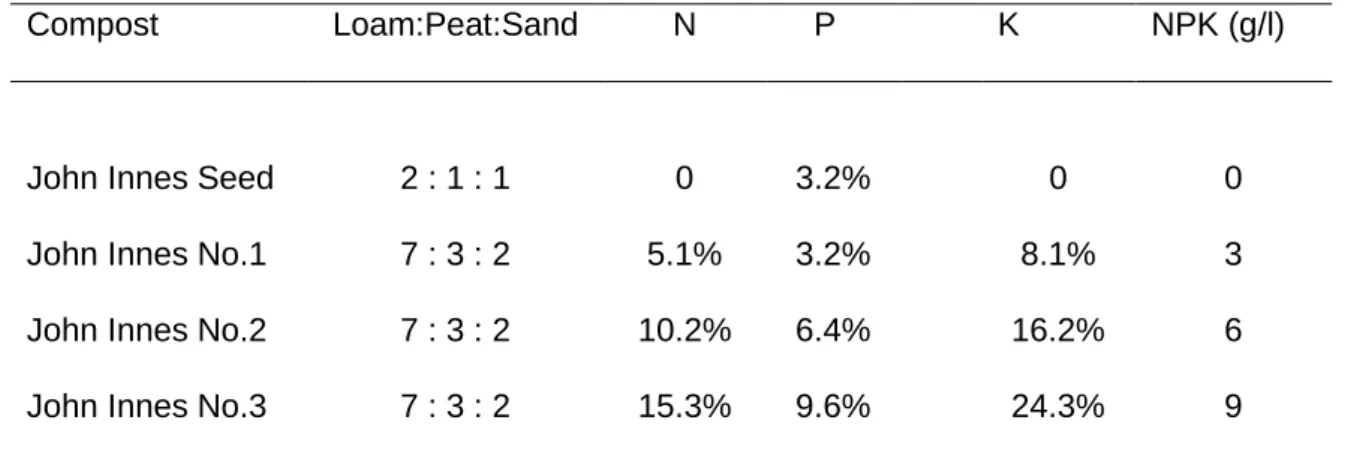
John Innes seed compost has no added N and K (Table 3.1). John Innes No.1 compost has added base fertilizer (Harvey and Baker 2002) to the standard mixture of steam-sterilized loam, peat and grit (Lawrence 1950; Bunt 1963). The concentration of N, P
39
and K in the compost can be increased by doubling (John Innes No.2) or tripling (John Innes No.3) the amount of base fertiliser (John Innes No.1).
Table 3.2 Composition (% w/w) of the composts used in the experiments.
Compost Loam:Peat:Sand N P K NPK (g/l)
John Innes Seed 2 : 1 : 1 0 3.2% 0 0
John Innes No.1 7 : 3 : 2 5.1% 3.2% 8.1% 3
John Innes No.2 7 : 3 : 2 10.2% 6.4% 16.2% 6
John Innes No.3 7 : 3 : 2 15.3% 9.6% 24.3% 9
Source: www.gardeningdata.co.uk/soil/john_innes/john_innes.php
3.2 Insect culture
Myzus persicae was obtained from the MpSIL colony established at Silwood Park in March, 1996 from a sub-population of a clone that had been maintained for over 10 years at Rothamsted Research, Hertfordshire, UK (Verkerk et al. 1998b; Kalule and Wright 2005; Kati 2009). In order to avoid a behavioural bias toward susceptible cultivars of potato, aphids were reared on 6 week-old Chinese cabbage in all experiments except those involving parasitoids. The aphids were reared in a cage (45 x 45 x 35 cm) in a controlled environment room (Section 3.1). All experiments were conducted under the same environmental conditions.
3.3 Parasitoids
Aphidiuscolemani (Syngenta-Bioline, Little Clacton, UK) were reared on M. persicae
on Potato cv. Santé in a controlled environment room (Section 3.2) for six generations. Sixth generation mummified aphids were collected from the plant and placed in plastic containers
40
provided with a 30% w/v honey solution. Female and male parasitoids that emerged were recorded and transferred to Eppendorf tubes (1.5 ml), with one female plus one male per tube with honey solution (30 %) and left to mate for 24 h. The