Email Classification Using Artificial Neural Network
Ahmed Alghoul, Sara Al Ajrami, Ghada Al Jarousha, Ghayda Harb, Samy S. Abu-NaserDepartment of Information Technology, Faculty of Engineering & Information Technology,
Al-Azhar University - Gaza, Palestine
Abstract: In recent years email has become one of the fastest and most economical means of communication. However increase of email users has resulted in the dramatic increase of spam emails during the past few years. Data mining -classification algorithms are used to categorize the email as spam or non-spam. Numerous email spam messages are marketable in nature but might similarly encompass camouflaged links that seem to be for acquainted websites but actually lead to phishing web sites or sites that are holding malware. Spam email might likewise comprise malware as scripts or other executable file attachments. Spammers use spam bots to generate email distribution lists. A spammer naturally sends an email to millions of email addresses. The address and identity of the sender are concealed Mass Mailing with the expectation that only a small number will respond or interact with the message and Spam mails might be the cause of phishing attack, hacking of banking accounts, attacks on confidential data. Spamming is rising at a quick speed as sending a deluge of mails is simple and for free. Spam mails interrupt the one calmness, spending much time and put away various resources like memory and networks bandwidth. In this study, we present a method for spam filtering using Artificial Neural Network to predict whether an email is spam or not.
Keywords: Classification Algorithms, Neural Networks, Spam Mails, Artificial Neural Networks. 1.INTRODUCTION
During the last few years, the application of artificial Intelligence in education has grown exponentially, spurred by the fact that it allows us to discover new, interesting and useful knowledge about email classification.
E-mail is a technique of electronic communication among 2 or more persons using the Internet. Through the growing reputation of the email and the incursions of internet marketers, unwelcome commercial email (spam) has become problematic on the WWW. Spam has produced considerate economy damage and turn out to be a social matter. Unwelcome email may desce nd fr o m anywhere. Present trends indicate that 94 percent of Internet transfer is going to be Spam. At the moment; emails are not just castoff for communication nonetheless also used for handling the job, resolving client queries. Email categorization has been enthused from the text classification in machine learning and currently email categorizations has been accepted in diverse variants for example categorizing emails into a spam folder, obstructive spam email, recognizing the attitude of the user from email body. Most recent email app and the SP like Gmail, Hotmail, permit the user to easily filter received emails founded on the email topic, key tokens in the body of the email, this technique is appropriate for individual work or home operators, which mean you must generate token-based rules to sieve emails into variants folders. Applying or creating these rules yourself in email progra m ma y be hard if you want to classify each received email. Nowadays, in the world of big data, the sizes of emails are growing
very fast. Hulk e-commerce like Amazon, eBay normally has a shared email address “[email protected]” for all type of inquiries. It means that an e-commerce business must be receiving approximately 120000 emails every month, consequently a business needs a big database to save all emails and a system which may automatically recognize/classify an email into accurate division categories such as Requesting, Shipping, Quality issues etc[1,3].
2.LITERATURE REVIEW:
Authors in [2] adopted Artificial Neural Networks (ANN) and expert systems to get knowledge for the student model in the Linear Programming Intelligent Tutoring System to be able to decide the academic performance level of the students classify emails whether i t i s spam or not and suggested this method to identify whether an email is a spam o r no t :
1. Sorting according to language (spam or non- spam), then words, and then count.
2. If a word does not exist, consider to approximate P (word|class) using Laplacian.
3. A learning dataset for analysis.
4. The Learning Dataset contains each word that content filtering uses to determine if a message is spam.
5. Beside each word, there are two numbers. The first number is the number of times that the word has occurred in non-spam e-mail messages. The second number is the number of times that the word has occurred in spam e-mail messages.
3.BACKGROUND:
Many systems have been established over the last period that evolves both neural network topologies and weights [2]. These methods include a variety of ideas about how Topology and Weight Evolving Artificial Neural Networks (TWEANNs) should be applied. In this part, we address some of the ideas and suppositions about the design of TWEANNs, and propose answers to some unanswered problems.
Artificial Neural Networks (ANNs) can resemble with the human brain which refers to interconnected networks of nodes, which manipulate data from input to output feature. ANN is computationally complex and the learning curve too. Various software packages are now available for Practitioners such as (Just NN) that will be used here, which remove much of the burden placed on truly understanding the mathematical Backbone in which ANNs are derived[4-10].
4.DATA PARTITIONING PHILOSOPHIES
In the ANN learning process, one should avoid training and testing on the same observations; to avoid this situation, observations should be sequestered for training, testing, and cross-validation of schemes are iterative, updating network weights after investigating all training set observations. Statistical information, such as mean squared error (MSE), is collected while the learning algorithm investigates all samples, a period termed „epoch, in order to adjust the weights of a network[11-15]. Here in this research we have set of data which equals to (4601) divided into two groups which it is as the following:
1- Training set of data which contains of (3233): This data set used to approximate the weight of data and to learn the machine how attribute affect the output with respect to their weight.
2- Validation set of data which contains of (1368): This data used to validate the prediction of the learning artificial neural network prediction tools which we have built appending to learning data set, these results will be compared to the original data to determine the error or approximated error.
5.ARTIFICIAL NEURAL NETWORKS
An Artificial Neural Network (ANN) is an arithmetical model that is motivated by the organization and/or functional feature of biological neural networks. A neural network contains an interrelated set of artificial neurons, and it processes information using a connectionist form to computation. As a general rule an ANN is an adaptive
system that adjusts its structure based on external or internal information that runs through the network during the learning process. Recent neural networks are non-linear numerical data modeling tools. They are usually used to model intricate relationships among inputs and outputs or to uncover patterns in data. ANN learning can be either supervised or unsupervised. Supervised training is done by inputting to the neural network a set of sample data accompany with the expected outputs from each of these samples. Supervised training is the utmost communal form of neural network training. As supervised training go on the neural network is goes through a few iterations, or called epochs, until the real output of the neural network matches the expected output, with a sensibly minor error. Every epoch is one pass through the training samples. Unsupervised training is like supervised training but that no expected outputs are given. Unsupervised training typically happens when the neural network is to classify the inputs into a number of groups. The training evolves through numerous epochs, just as in supervised training. As training continues the classification groups are revealed by the artificial neural network. Training is the process by which these connection weights are allocated. Utmost training algorithms start by allocating random numbers to the weight matrix. Then the validity of the neural network is inspected. Next the weights are attuned based on how effective the neural network did. This procedure is repeated until the validation error is within a satisfactory limit. Validation of the system is prepared once a neural network has been trained and it need be assessed to see if it is ready for real use. This final step is significant so that it can be unwavering if additional training is vital. To properly validate a neural network validation data must be set aside that is completely distinct from the training data[16-36].
About 70% of the total sample data was used for network training in this study. About 30% of the total sample data served as test and validation of the system[37-47].
6.ARTIFICIAL NEURAL NETWORK USAGE IN E MAIL CLASSIFICATION:
An Artificial Neural Network (ANN) is an arithmetical model that is motivated by the organization and/or functional feature of biological neural networks. A neural network contains an interrelated set of artificial neurons, and it processes information using a connectionist form to computation. As a general rule an ANN is an adaptive system that adjusts its structure based on external or internal information that runs through the network during the learning process. Recent neural networks are non-linear numerical data modeling tools. They are usually used to
model intricate relationships among inputs and outputs or to uncover patterns in data[48-59].
7.METHODOLOGY
By looking deeply through the scientists and soliciting the experience of data science experts on emails classification, a number of factors that are considered to have an effect on the classification of emails. These factors were cautiously studied and synchronized into a convenient number appropriate for computer coding within the environment of the Just NN modeling. These factors were classified as input variables. The output variables embody some likely levels of performance of an emails classification for spam or not. 7.1 THE INPUT VARIABLES
The input variables identified are those which can simply be obtained from emails file and. The input variables are: Make: Number of occurrences of the word „make‟. Address: Number of occurrences of the word „Address‟. All: Number of occurrences of the word „All‟.
3D: Number of occurrences of the word „3D‟. Our: Number of occurrences of the word „Our‟. Over: Number of occurrences of the word „Over‟. Remove: Number of occurrences of the word „Remove‟. Internet: Number of occurrences of the word „Internet‟. Order: Number of occurrences of the word „Order‟. Mail: Number of occurrences of the word „Mail‟. Receive: Number of occurrences of the word „Receive‟. Will: Number of occurrences of the word „Will‟. People: Number of occurrences of the word „People‟. Report: Number of occurrences of the word „Report‟. Addresses: Number of occurrences of the word „Addresses‟. Free: Number of occurrences of the word „Free‟.
Business: Number of occurrences of the word „Business‟. Email: Number of occurrences of the word „Email‟. You: Number of occurrences of the word „You‟. Credit: Number of occurrences of the word „Credit‟. Your: Number of occurrences of the word „Your‟. Font: the font style used in the mail.
0: Number of occurrences of the word „0‟.
Money: Number of occurrences of the word „Money‟. Hp: Number of occurrences of the word „Hp‟. Hpl: Number of occurrences of the word „Hpl‟. George: Number of occurrences of the word „George‟. 650: Number of occurrences of the word „650‟. Lab: Number of occurrences of the word „Lab‟. Labs: Number of occurrences of the word „Labs‟. Talent: Number of occurrences of the word „Talent‟. 857: Number of occurrences of the word „857‟. Data: Number of occurrences of the word „Data‟. 415: Number of occurrences of the word „415‟. 85: Number of occurrences of the word „85‟. Technology: Number of occurrences of the word „Technology‟.
1999: Number of occurrences of the word „1999‟.
Parts: Number of occurrences of the word „Parts‟. Pm: Number of occurrences of the word „Pm‟. Direct: Number of occurrences of the word „Direct‟. Cs: Number of occurrences of the word „Cs‟.
Meeting: Number of occurrences of the word „Meeting‟. Original: Number of occurrences of the word „Original‟. Project: Number of occurrences of the word „Project‟. Re: Number of occurrences of the word „Re‟.
Edu: Number of occurrences of the word „Edu‟. Table: Number of occurrences of the word „Table‟. Conference: Number of occurrences of the word „Conference‟.
; : Number of occurrences of the word „;‟. (: Number of occurrences of the word „(‟. [: Number of occurrences of the word „[‟. ! : Number of occurrences of the word „!‟. $: Number of occurrences of the word „$‟. #: Number of occurrences of the word „#‟.
Capital Run Length Average: Average of capital letters continuously.
Capital Run Length longest: The long of capital letters continuously.
Capital Run Length Total: Total length of capital letters.
7.2 THE OUTPUT VARIABLE
Table 1 shows the result of the prediction tool. Table 1: The result of the prediction tool.
S/N Output Variable Meaning
1 0 Not spam
2 1 Spam
7.3 NETWORK ARCHITECTURE
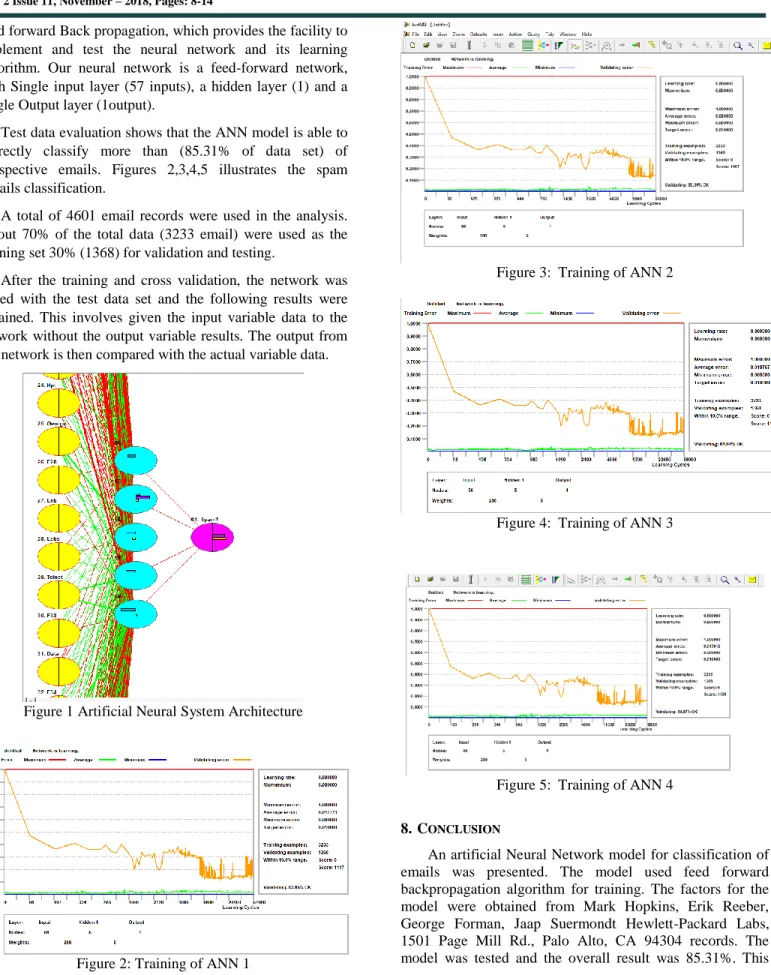
The network is a multilayer perceptron neural network using the linear sigmoid activation function as seen in Figure 1.
The Back-propagation Training Algorithm -Initialize each wi to some small random value -Until the termination condition is met, Do -For each training example <(x1…xn),t> Do
-INPUT THE INSTANCE (X1,…,XN) TO THE NETWORK AND COMPUTE THE NETWORK OUTPUTS OK
- For each output unit k: Δk=ok (1-ok)(tk-ok) - For each hidden unit h: Δh=oh (1-oh) Δk wh,k Δk - For each network weight wj Do
- wi,j=wi,j+Δwi,j,where Δwi,j= Δj xi,j and Δ is the learning rate.
7.4 EVALUATION OF NEURAL NETWORK
As stated earlier, the purpose of this experiment was to predict the classification of emails to spam or not. We used
feed forward Back propagation, which provides the facility to implement and test the neural network and its learning algorithm. Our neural network is a feed-forward network, with Single input layer (57 inputs), a hidden layer (1) and a single Output layer (1output).
Test data evaluation shows that the ANN model is able to correctly classify more than (85.31% of data set) of prospective emails. Figures 2,3,4,5 illustrates the spam Emails classification.
A total of 4601 email records were used in the analysis. About 70% of the total data (3233 email) were used as the training set 30% (1368) for validation and testing.
After the training and cross validation, the network was tested with the test data set and the following results were obtained. This involves given the input variable data to the network without the output variable results. The output from the network is then compared with the actual variable data.
Figure 1 Artificial Neural System Architecture
Figure 2: Training of ANN 1
Figure 3: Training of ANN 2
Figure 4: Training of ANN 3
Figure 5: Training of ANN 4
8.CONCLUSION
An artificial Neural Network model for classification of emails was presented. The model used feed forward backpropagation algorithm for training. The factors for the model were obtained from Mark Hopkins, Erik Reeber, George Forman, Jaap Suermondt Hewlett-Packard Labs, 1501 Page Mill Rd., Palo Alto, CA 94304 records. The model was tested and the overall result was 85.31%. This
study showed the potential of the artificial neural network for classification of emails.
REFERENCES
[1] Bajaj, Kamini Simi, and Josef Pieprzyk. "A case study of user-level spam filtering." Proceedings of the Twelfth Australasian Information Security
Conference-Volume 149. Australian Computer Society, Inc., 2014.
[2] Roy, S., Patra, A., Sau, S., Mandal, K., & Kunar, S. (2013). An Efficient Spam Filtering Techniques for Email Account. American Journal of Research, 2(10). [3] Brain Whit Worth, Ellizbet Whit Worth, "Spam and
the social technical gap", IEEE Computer society, pp. 38-45, 2004.Brain Whit Worth, Ellizbet Whit Worth, "Spam and the social technical gap", IEEE Computer society, pp. 38-45, 2004.
[4] Nazirova, Saadat. "Survey on spam filtering techniques." Communications and Network 3.03 (2011): 153.
[5] https://en.wikipedia.org/wiki/Email_spam
[6] https://searchsecurity.techtarget.com/definition/spam [7]
https://emailmarketing.comm100.com/email-marketing-ebook/email-spam.aspx
[8] Abu Naser, S., Zaqout, I., Ghosh, M. A., Atallah, R., & Alajrami, E. (2015). Predicting Student
Performance Using Artificial Neural Network: in the Faculty of Engineering and Information Technology. International Journal of Hybrid Information
Technology, 8(2), 221-228.
[9] Elzamly, A., Abu Naser, S. S., Hussin, B., & Doheir, M. (2015). Predicting Software Analysis Process Risks Using Linear Stepwise Discriminant Analysis: Statistical Methods. Int. J. Adv. Inf. Sci. Technol, 38(38), 108-115.
[10] Abu Naser, S. S. (2012). Predicting learners
performance using artificial neural networks in linear programming intelligent tutoring system.
International Journal of Artificial Intelligence & Applications, 3(2), 65.
[11] Elzamly, A., Hussin, B., Abu Naser, S. S., Shibutani, T., & Doheir, M. (2017). Predicting Critical Cloud Computing Security Issues using Artificial Neural Network (ANNs) Algorithms in Banking
Organizations. International Journal of Information Technology and Electrical Engineering, 6(2), 40-45. [12] Abu Naser, S. S., & Al-Bayed, M. H. (2016).
Detecting Health Problems Related to Addiction of Video Game Playing Using an Expert System. World Wide Journal of Multidisciplinary Research and Development, 2(9), 7-12.
[13] Abu Ghali, M. J., Mukhaimer, M. N., Abu Yousef,
M. K., & Abu Naser, S. S. (2017). Expert System for Problems of Teeth and Gums. International Journal of Engineering and Information Systems (IJEAIS), 1(4), 198-206.
[14] Abu Naser, S., & Akkila, A. N. (2008). A Proposed Expert System for Skin Diseases Diagnosis. INSInet Publication. Journal of Applied Sciences Research, 4(12), 1682-1693.
[15] El Agha, M., Jarghon, A., & Abu Naser, S. S. (2017). Polymyalgia Rheumatic Expert System. International Journal of Engineering and Information Systems (IJEAIS), 1(4), 125-137.
[16] Abu Naser, S., Al-Dahdooh, R., Mushtaha, A., & El-Naffar, M. (2010). Knowledge management in ESMDA: expert system for medical diagnostic assistance. AIML Journal, 10(1), 31-40. [17] Almurshidi, S. H., & Abu-Naser, S. S. (2018).
EXPERT SYSTEM FOR DIAGNOSING BREAST CANCER. Al-Azhar University, Gaza, Palestine. [18] Abu Naser, S. S., & Alawar, M. W. (2016). An expert
system for feeding problems in infants and children. International Journal of Medicine Research, 1(2), 79-82.
[19] Al Rekhawi, H. A., Ayyad, A. A., & Abu Naser, S. S. (2017). Rickets Expert System Diagnoses and Treatment. International Journal of Engineering and Information Systems (IJEAIS), 1(4), 149-159. [20] Abu Naser, S. S., & AlDahdooh, R. M. (2016). Lower Back Pain Expert System Diagnosis and Treatment. Journal of Multidisciplinary Engineering Science Studies (JMESS), 2(4), 441-446.
[21] Nabahin, A., Abou Eloun, A., & Abu Naser, S. S. (2017). Expert System for Hair Loss Diagnosis and Treatment. International Journal of Engineering and Information Systems (IJEAIS), 1(4), 160-169. [22] Abu Naser, S. S., & Alhabbash, M. I. (2016). Male
Infertility Expert system Diagnoses and Treatment. American Journal of Innovative Research and Applied Sciences, 2(4).
[23] Qwaider, S. R., & Abu Naser, S. S. (2017). Expert System for Diagnosing Ankle Diseases. International Journal of Engineering and Information Systems (IJEAIS), 1(4), 89-101.
[24] Abu Naser, S. S., & Al-Hanjori, M. M. (2016). An expert system for men genital problems diagnosis and treatment. International Journal of Medicine
Research, 1(2), 83-86.
[25] Naser, S. S. A., & Hasanein, H. A. A. (2016). Ear Diseases Diagnosis Expert System Using SL5 Object. World Wide Journal of Multidisciplinary Research and Development, 2(4), 41-47.
[26] Nassr, M. S., & Abu Naser, S. S. (2018). Knowledge Based System for Diagnosing Pineapple Diseases. International Journal of Academic Pedagogical Research (IJAPR), 2(7), 12-19.
[27] Abu Naser, S. S., & El-Najjar, A. E. A. (2016). An expert system for nausea and vomiting problems in infants and children. International Journal of Medicine Research, 1(2), 114-117.
[28] Elqassas, R.,& Abu-Naser, S. S. (2018). Expert System for the Diagnosis of Mango Diseases. International Journal of Academic Engineering Research (IJAER) 2 (8), 10-18.
[29] Naser, S. S. A., & Hilles, M. M. (2016). An expert system for shoulder problems using CLIPS. World Wide Journal of Multidisciplinary Research and Development, 2(5), 1-8.
[30] Musleh, M. M., & Abu-Naser, S. S. (2018). Rule Based System for Diagnosing and Treating Potatoes Problems. International Journal of Academic Engineering Research (IJAER) 2 (8), 1-9.
[31] Abu Naser, S. S., & Hamed, M. A. (2016). An Expert System for Mouth Problems in Infants and Children. Journal of Multidisciplinary Engineering Science Studies (JMESS), 2(4), 468-476.
[32] Almadhoun, H., & Abu-Naser, S. (2017). Banana
Knowledge Based System Diagnosis and
Treatment. International Journal of Academic Pedagogical Research (IJAPR), 2(7), 1-11.
[33] Abu Naser, S. S., & Mahdi, A. O. (2016). A proposed Expert System for Foot Diseases Diagnosis.
American Journal of Innovative Research and Applied Sciences, 2(4), 155-168.
[34] Dahouk, A. W., & Abu-Naser, S. S. (2018). A Proposed Knowledge Based System for Desktop PC Troubleshooting. International Journal of Academic Pedagogical Research (IJAPR) 2 (6), 1-8
[35] Abu Naser, S. S., & Ola, A. Z. A. (2008). AN EXPERT SYSTEM FOR DIAGNOSING EYE DISEASES USING CLIPS. Journal of Theoretical & Applied Information Technology, 4(10).
[36] Bakeer, H., & Abu-Naser, S. S. (2017). Photo Copier Maintenance Expert System V. 01 Using SL5 Object Language. International Journal of Engineering and Information Systems (IJEAIS) 1 (4), 116-124. [37] Abu Naser, S. S., & Shaath, M. Z. (2016). Expert
system urination problems diagnosis. World Wide Journal of Multidisciplinary Research and Development, 2(5), 9-19.
[38] Khella, R., & Abu-Naser, S. S. (2017). Rule Based System for Chest Pain in Infants and Children. International Journal of Engineering and Information Systems 1 (4), 138-148.
[39] Abu-Naser, S. S., Hissi, H., Abu-Rass, M., & El-Khozondar, N. (2010). An expert system for endocrine diagnosis and treatments using JESS. Journal of Artificial Intelligence; Scialert, 3(4), 239-251.
[40] Mrouf, A., Albatish, I., Mosa, M., & Abu Naser, S. S. (2017). Knowledge Based System for Long-term Abdominal Pain (Stomach Pain) Diagnosis and Treatment. International Journal of Engineering and Information Systems (IJEAIS) 1 (4), 71-88.
[41] Abu Naser, S. S., Baraka, M. H.,& Baraka, A. R. (2008). A Proposed Expert System For Guiding
Freshman Students In Selecting A Major In Al-Azhar University, Gaza.Journal of Theoretical & Applied Information Technology 4(9).
[42] Abu-Nasser, B. S., & Abu-Naser, S. S. (2018). Cognitive System for Helping Farmers in Diagnosing Watermelon Diseases. International Journal of Academic Information Systems Research (IJAISR) 2 (7), 1-7.
[43] Abu Naser, S. S., Alamawi, W. W., & Alfarra, M. F. (2016). Rule Based System for Diagnosing Wireless
Connection Problems Using SL5 Object.
International Journal of Information Technology and Electrical Engineering 5(6), 26-33.
[44] Akkila, A. N., & Abu Naser, S. S. (2016). Proposed Expert System for Calculating Inheritance in Islam. World Wide Journal of Multidisciplinary Research and Development 2 (9), 38-48.
[45] Abu Naser, S. S., & Zaqout, I. S. (2016). Knowledge-based systems that determine the appropriate students major: In the faculty of engineering and information technology, World Wide Journal of Multidisciplinary Research and Development 2 (10), 26-34.
[46] AbuEl-Reesh, J. Y., & Abu Naser, S. S. (2017). A Knowledge Based System for Diagnosing Shortness of Breath in Infants and Children. International Journal of Engineering and Information Systems (IJEAIS) 1 (4), 102-115.
[47] Abu Naser, S. S., & Bastami, B. G. (2016). A proposed rule based system for breasts cancer diagnosis. World Wide Journal of Multidisciplinary Research and Development 2 (5), 27-33.
[48] Abu-Nasser, B. S. (2017). Medical Expert Systems Survey. International Journal of Engineering and Information Systems, 1(7), 218-224.
[49] Abu Naser, S. S., & ALmursheidi, S. H. (2016). A Knowledge Based System for Neck Pain Diagnosis. World Wide Journal of Multidisciplinary Research and Development (WWJMRD), 2(4), 12-18.
[50] Azaab, S., Abu Naser, S., & Sulisel, O. (2000). A proposed expert system for selecting exploratory factor analysis procedures. Journal of the College of Education 4 (2), 9-26.
[51] Abu-Naser, S. S., Kashkash, K. A., & Fayyad, M. (2010). Developing an expert system for plant disease diagnosis. Journal of Artificial Intelligence, 3 (4), 269-276.
[52] Barhoom, A. M., & Abu-Naser, S. S. (2018). Black Pepper Expert System. International Journal of Academic Information Systems Research, (IJAISR) 2 (8), 9-16.
[53] AlZamily, J. Y., & Abu-Naser, S. S. (2018). A Cognitive System for Diagnosing Musa Acuminata Disorders. International Journal of Academic Information Systems Research, (IJAISR) 2 (8), 1-8. [54] Alajrami, M. A., & Abu-Naser, S. S. (2018). Onion
Treatment. International Journal of Academic Pedagogical Research (IJAPR), 2 (8), 1-9.
[55] Al-Shawwa, M., Al-Absi, A., Abu Hassanein, S., Abu Baraka, K., & Abu-Naser, S. S. (2018). Predicting Temperature and Humidity in the Surrounding Environment Using Artificial Neural Network. International Journal of Academic Pedagogical Research (IJAPR), 2(9), 1-6.
[56] Salah, M., Altalla, K., Salah, A., & Abu-Naser, S. S. (2018). Predicting Medical Expenses Using Artificial Neural Network. International Journal of Engineering and Information Systems (IJEAIS), 2(20), 11-17. [57] Marouf, A., & Abu-Naser, S. S. (2018). Predicting
Antibiotic Susceptibility Using Artificial Neural Network. International Journal of Academic Pedagogical Research (IJAPR), 2(10), 1-5.
[58] Jamala, M. N., & Abu-Naser, S. S. (2018). Predicting MPG for Automobile Using Artificial Neural Network Analysis. International Journal of Academic Information Systems Research (IJAISR), 2(10), 5-21.
[59] Kashf, D. W. A., Okasha, A. N., Sahyoun, N. A.,
El-Rabi, R. E., & Abu-Naser, S. S. (2018). Predicting DNA Lung Cancer using Artificial Neural Network. International Journal of Academic Pedagogical Research (IJAPR), 2(10), 6-13.