A Token-Based Access Control System for RDF Data in the Clouds
Arindam Khaled
∗Computer Science Department
Mississippi State University
[email protected]
Mohammad Farhan Husain
1Latifur Khan
2Kevin W. Hamlen
3Bhavani Thuraisingham
4Department of Computer Science
University of Texas at Dallas
{
1mfh062000,
2lkhan}@utdallas.edu
{
3hamlen,
4bhavani.thuraisingham}@utdallas.edu
Abstract
The Semantic Web is gaining immense popularity— and with it, the Resource Description Framework (RDF) broadly used to model Semantic Web content. However, ac-cess control on RDF stores used for single machines has been seldom discussed in the literature. One significant ob-stacle to using RDF stores defined for single machines is their scalability. Cloud computers, on the other hand, have proven useful for storing large RDF stores; but these sys-tems lack access control on RDF data to our knowledge.
This work proposes a token-based access control system that is being implemented in Hadoop (an open source cloud computing framework). It defines six types of access levels and an enforcement strategy for the resulting access control policies. The enforcement strategy is implemented at three levels: Query Rewriting, Embedded Enforcement, and Post-processing Enforcement. In Embedded Enforcement, poli-cies are enforced during data selection using MapReduce, whereas in Post-processing Enforcement they are enforced during the presentation of data to users. Experiments show that Embedded Enforcement consistently outperforms Post-processing Enforcement due to the reduced number of jobs required.
1
Introduction
The Semantic Web is becoming increasingly ubiquitous. More small and large businesses, such as Oracle, IBM, Adobe, Software AG, and many others, are actively us-ing Semantic Web technologies [22], and broad applica-tion areas such as Health Care and Life Sciences are con-sidering its possibilities for data integration [22]. Sir Tim
∗The work was done while the author was a graduate student at the
University of Texas at Dallas.
Berners-Lee originally envisioned the Semantic Web as a machine-understandable web [3]. The power of the Seman-tic Web lies in its codification of relationships among web resources [22].
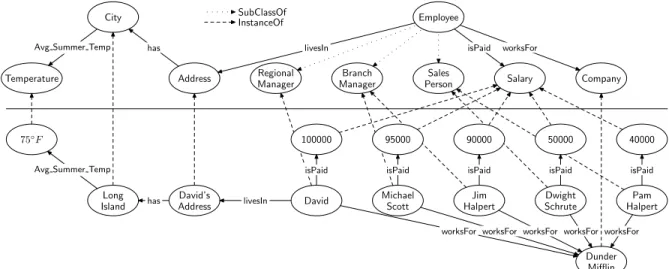
Semantic Web, along with ontologies, is one of the most robust ways to represent knowledge. Anontologyformally describes the concepts or classes in a domain, various prop-erties of the classes, the relationships between classes, and restrictions. A knowledge base can be constructed by an ontology and its various class instances. An example of a knowledge base (ontology and its instance) is presented in Figure 1.
Resource Description Framework (RDF) is widely used for Semantic Web due to its expressive power, semantic interoperability, and reusability. Most RDF stores in cur-rent use, including Joseki [15], Kowari [17], 3store [10], and Sesame [5], are not primarily concerned with secu-rity. Efforts have been made to incorporate security, es-pecially in Jena [14, 20]; however, one drawback of Jena is that it lacks scalability. Its execution times can become quite slow with larger data-sets, making certain queries over large stores intractable (e.g., those with 10 million triples or more) [12, 13].
On the other hand, large RDF stores can be stored and retrieved from cloud computers due to their scalability, par-allel processing ability, cost effectiveness, and availabil-ity. Hadoop (Apache) [1]—one of the most widely used cloud computing environments—uses Google’s MapRe-duce framework. MapReMapRe-duce splits large jobs into smaller jobs, and combines the results of these jobs to produce the final output once once the sub-jobs are complete. Prior work has demonstrated that large RDF graphs can be efficiently stored and queried in these clouds [6, 12, 13, 18]. To our knowledge, access control has not yet been implemented on RDF stores in Hadoop. Doing so is the subject of this work. Our system implements a token-based access control system. System administrators grant access tokens for
Employee Salary isPaid Sales Person Branch Manager Regional Manager Company worksFor Address livesIn City has Temperature
Avg Summer Temp
Dwight Schrute Jim Halpert Michael Scott
David HalpertPam
50000 isPaid 90000 isPaid 95000 isPaid 100000 isPaid 40000 isPaid Dunder Mifflin worksFor worksFor worksFor worksFor worksFor David’s Address livesIn Long Island has 75◦F
Avg Summer Temp
SubClassOf InstanceOf
Figure 1. A sample RDF ontology and ontology instance security-relevant data according to agents’ needs and
secu-rity levels. Conflicts that might arise due to the assignment of conflicting access tokens to the same agent are resolved using the timestamps of the access tokens. We use the Lehigh University Benchmark (LUBM) [9] test instances for experiments. A few sample scenarios have been gener-ated and implemented in Hadoop.
We have several contributions. First, we propose an architecture that scales well to extremely large data-sets. Second, we address access control not only at the level of users but also at the level of subjects, objects, and pred-icates, making policies finer-grained and more expressive than past work. Third, a timestamp-based conflict detection and resolution algorithm is proposed. Fourth, the architec-ture has been implemented and tested on benchmark data in several alternative stages: Query Rewriting (preprocess-ing phase), Embedded Enforcement (MapReduce execu-tion phase), and Post-processing Enforcement (data display phase). Finally, the whole system is being implemented on Hadoop—an open source cloud computing environment. We consider the work beneficial for others considering ac-cess control for RDF data in Hadoop.
The remainder of the paper is organized as follows. In Section 2, we present related work and a brief overview of Hadoop and MapReduce. Section 3 introduces access to-kens, access token tuples, conflicts, and our conflict reso-lution algorithm. We describe the architecture of the our system in Section 4. In Section 5, we describe the impact of assigning access tokens to agents, including experiments and their running times. Finally, Section 6 concludes with a summary and suggestions for future work.
2
Background
2.1
Related Work
We begin by describing prior work on RDF Security for single machines. We then summarize some of the proposed
Cloud Computing architectures that store RDF data. Fi-nally, we provide a summary of our own prior work.
Although plenty of research has been undertaken on stor-ing, representstor-ing, and reasoning about RDF knowledge, re-search on security and access control issues for RDF stores is comparatively sparse [20]. Reddivari et al. [20] have im-plemented access control based on a set of policy rules. They address insertion/deletion actions of triples, models, and sets in RDF stores, as well as see and use actions. Jain and Farkas [14] have described RDF protection ob-jects as RDF patterns, and designed security requirements for them. They show that the security level of a subclass or sub-property should be at least as restricted as the super-type. The RDF triple-based access control model proposed in [16] considers explicit and implicit authorization propa-gation.
Most of these works are implemented in Jena. However, Jena scales poorly in that it runs on single machines and is unable to handle large amounts of data [12, 13]. Husain et al. [12, 13] propose and implement an architecture to store and query large RDF graphs. Mika and Tummarello [18] store RDF data in Hadoop. The SPIDER system [6] stores and processes huge RDF data-sets, but lacks an access con-trol mechanism.
Our proposed architecture supports access control for large data-sets by including an access control layer in the architecture proposed in [13]. Instead of assigning access controls directly to users or agents, our proposed method generates tokens for specific access levels and assigns these tokens to agents, considering the business needs and secu-rity levels of the agents. Although tokens have been used by others for access control to manage XML documents [4] and digital information [11], these have not been used for RDF stores. One of the advantages of using tokens is that they can be reused if the needs and security requirements for multiple agents are identical.
2.2
Hadoop and MapReduce
In this section we provide a brief overview of Hadoop [1] and MapReduce. In Hadoop, the unit of computation is called a job. Users submit jobs to Hadoop’s JobTracker component. Each job has two phases: Map and Reduce. The Map phase takes as input a key-value pair and may output zero or more key-value pairs. In the Reduce phase, the values for each key are grouped together into collec-tions traversable by an iterator. These key-iterator pairs are then passed to the Reduce method, which also outputs zero or more key-value pairs. When a job is submitted to the JobTracker, Hadoop attempts to position the Map processes near to the input data in the cluster. Each Map process and Reduce process works independently without communicat-ing. This lack of communication is advantageous for both speed and simplicity.
3
Access Control Levels
Definition 1. Access Tokens (AT)permit access to security-relevant data. An agent in possession of an AT may view the data permitted by that AT. We denote AT’s by positive integers.
Definition 2. Access Token Tuples (ATT) have the form
hAccessToken,Element,ElementType,ElementNamei, where Element can be Subject, Object, or Predicate, and ElementType can be described asURI, DataType, Literal,Model, or BlankNode. Model is used to access Subject Models, and will be explained later in the section.
For example, in the ontology in Figure 1, David is a subject andh1,Subject,URI,Davidiis an ATT. Any agent having AT 1 may retrieve David’s information over all files (subject to any other security restrictions governing access to URI’s, literals, etc., associated withDavid’s ob-jects). While describing ATT’s forPredicates, we leave the ElementNameblank ( ).
Based on the record organization, we support six access levels along with a few sub-types described below. Agents may be assigned one or more of the following access levels. Access levels with a common AT combine conjunctively, while those with different AT’s combine disjunctively.
1. Predicate Data Access: If an object type is defined for one particular predicate in an access level, then an agent having that access level may read the whole predicate file (subject to any other policy restrictions). For example,h1,Predicate,isPaid, iis an ATT that permits its possessor to read the entire predicate file isPaid.
2. Predicate and Subject Data Access:Agents possess-ing a Subject ATT may access data associated with a
1 AT Vitamins E Predicate Object Agent
Figure 2. Conjunctive combination of ATT’s with a common AT
particular subject, where the subject can be either a URI or aDataType. Combining one of these Sub-ject ATT’s with a Predicate data access ATT having the same AT grants the agent access to a specific subject of a specific predicate. For example:
(a) Predicate and Subject as URI’s: Combining ATT’sh1,Predicate,isPaid, iandh1,Subject,
URI,MichaelScotti (drawn from the ontology in Figure 1) permits an agent with AT 1 to ac-cess a subject with URIMichaelScott of predi-cateisPaid.
(b) Predicate and Subject as DataTypes: Simi-larly, Predicate and DataType ATT’s can be com-bined to permit access to subjects of a specific data type over a specific predicate file.
For brevity, we omit descriptions of the different Sub-ject and ObSub-ject variations of each of the remaining ac-cess levels.
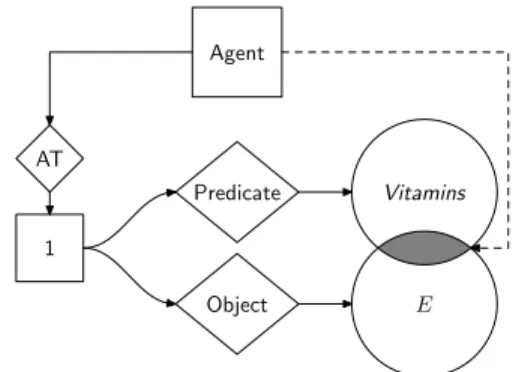
3. Predicate and Object: This access level permits a principal to extract the names of subjects satis-fying a particular predicate and object. For exam-ple, with ATT’s h1,Predicate,hasVitamins, i and
h1,Object,URI, Ei, an agent possessing AT 1 may view the names of subjects (e.g., foods) that have vi-taminE. More generally, ifX1andX2are the set of triples generated by Predicate and Object triples (re-spectively) describing an AT, then agents possessing the AT may view setX1∩X2 of triples. An illustra-tion of this example is displayed in Figure 2.
4. Subject Access: With this access level an agent may read the subject’s information over all the files. This is one of the less restrictive access levels. The subject can be aURI,DataType, orBlankNode.
5. Object Access: With this access level an agent may read the object’s subjects over all the files. Like the
previous level, this is one of the less restrictive access levels The object can be aURI,DataType,Literal, orBlankNode.
6. Subject Model Level Access:Model level access per-mits an agent to read all necessary predicate files to ob-tain all objects of a given subject. Of these objects, the ones that are URI’s are next treated as subjects to ex-tract their respective predicates and objects. This pro-cess continues iteratively until all objects finally be-come literals or blank nodes. In this manner, agents possessing Model level access may generate models on a given subject.
The following example drawn from Figure 1 illus-trates. David lives in LongIsland. LongIsland is a subject with an Avg Summer Temp predicate hav-ing object 75◦F. An agent with Model level access ofDavidmay therefore read the average summer tem-perature ofLongIsland.
3.1
Access Token Assignment
Definition 3. AnAccess Token List(AT-list) is an array of one or more AT’s granted to a given agent, along with a timestamp identifying the time at which each was granted. A separate AT-list is maintained for each agent.
When a system administrator decides to add an AT to an agent’s AT-list, the AT and timestamp are first stored in a temporary variableTempAT. Before committing the change, the system must first detect potential conflicts in the new AT-list.
3.2
Final output of an Agent’s ATs
Each AT permits access to a set of triples. We refer to this set as the AT’sresult set. The set of triples accessible by an agent is the union of the result sets of the AT’s in the agent’s AT-list. Formally, if Y1, Y2, . . . , Yn are the result sets of AT’sAT1, AT2, . . . , ATn(respectively) in an agent’s AT-list, then the agent may access the triples in setY1∪Y2∪
· · · ∪Yn.
3.3
Security Level Defaults
An administrator’s AT assignment burden can be con-siderably simplified by conservatively choosing default se-curity levels for data in the system. In our implementation, all items in the data store have default security levels. Per-sonal information of individuals is kept private by denying access to any URI of data type Person by default. This prevents agents from making inferences about any individ-ual to whom they have not been granted explicit permission.
However, if an agent is granted explicit access to a particu-lar type or property, the agent is also granted default access to the subtypes or sub-properties of that type or property.
As an example, consider a predicate fileLikesthat lists elements that an individual likes. Assume further that Jim is a person who likes Flying, SemanticWeb, and Jenny, which are URI’s of typeHobby,ResearchInterest, and Person, respectively, and 1 is an AT with ATTs
h1,Subject,URI,Jimi and h1,Likes,Predicate, i. By default, agent Ben having only AT 1 cannot learn that Jenny is in Jim’s Likes-list since Jenny’s data type is Person. However, if Ben also has AT 2 described by ATTh2,Object,URI,Jennyi, thenBenwill be able to see JennyinJim’sLikes-list.
3.4
Conflicts
A conflict arises when the following three conditions oc-cur: (1) An agent possesses two AT’s 1 and 2, (2) the result set of AT 2 is a proper subset of AT 1, and (3) the timestamp of AT 1 is earlier than the timestamp of AT 2. In this case the later, more specific AT supersedes the former, so AT 1 is discarded from the AT-list to resolve the conflict. Such con-flicts arise in two varieties, which we termsubset conflicts
andsubtype conflicts.
A subset conflict occurs when AT 2 is a conjunction of ATT’s that refines those of AT 1. For example, sup-pose AT 1 is defined by ATTh1,Subject,URI,Sami, and AT 2 is defined by ATT’s h2,Subject,URI,Sami and
h2,Predicate,HasAccounts, i. In this case the result set of AT 2 is a subset of the result set of AT 1. A conflict will therefore occur if an agent possessing AT 1 is later assigned AT 2. When this occurs, AT 1 is discarded from the agent’s AT-list to resolve the conflict.
Subtype conflicts occur when the ATT’s in AT 2 involve data types that are subtypes of those in AT 1. The data types can be those of subjects, objects or both.
Conflict resolution is summarized by Algorithm 1. Here,
Subset(AT1,AT2)is a function that returnstrueif the
re-sult set ofAT1is a proper subset of the result set ofAT2,
andSubjectSubType(AT1,AT2)returnstrue if the
sub-ject ofAT1is a subtype of the subject ofAT2. Similarly,
ObjectSubType(AT1,AT2), decides subtyping relations
for objects instead of subjects.
4
Proposed Architecture
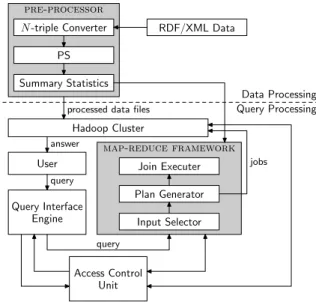
Our architecture consists of two components. The upper part of Figure 3 depicts the data preprocessing component, and the lower part shows the components responsible for answering queries.
Three subcomponents perform data generation and pre-processing. We convert RDF/XML [2] toN-Triples seri-alization format [7] using our N-Triples Converter com-ponent. The Predicate Split (PS) component takes theN -Triples data and splits it into predicate files. These steps
Input: ATnewATwith timestampTSnewAT
Result: Detect conflict and, if none exists, add
(newAT, T SnewAT)to the agent’s AT-list 1 currentAT[ ]←the AT’s and their timestamps; 2 if(!Subset(newAT , tempATTS) AND
!Subset(tempATTS , newAT) AND
!SubjectSubType(newAT, tempATTS)) AND !SubjectSubType(tempATTS, newAT) AND !ObjectSubType(newAT, tempATTS)) AND !ObjectSubType(tempATTS, newAT))then 3 currentAT[lengthcurrentAT].AT ←newAT; 4 currentAT[lengthcurrentAT].TS ←TSnewAT; 5 else
6 count ←0;
7 whilecount <lengthcurrentAT do
8 ATtempATTS ←currentAT[count].AT; 9 tempTS ←currentAT[count].TS;
10 /* the timestamp during the AT assignment */
11 if(Subset(newAT , tempATTS) AND
(TSnewAT ≥tempTS))then 12 /* a conflict occurs */
13 currentAT[count].AT ←newAT; 14 currentAT[count].TS ←TSnewAT; 15 else if((Subset(tempATTS, newAT)) AND
(tempTS <TSnewAT))then
16 currentAT[count].AT ←newAT; 17 currentAT[count].TS ←TSnewAT; 18 else if((SubjectSubType(newAT, tempATTS)
ORObjectSubType(newAT, tempATTS)) AND
TSnewAT ≥tempTS)then 19 /* a conflict occurs */
20 currentAT[count].AT ←newAT; 21 currentAT[count].TS ←TSnewAT; 22 else if((SubjectSubType(tempATTS, newAT)
ORObjectSubType(tempATTS, newAT)) AND (tempATTS <TSnewAT))then
23 currentAT[count].AT ←newAT; 24 currentAT[count].TS ←TSnewAT;
25 end
26 count ←count+ 1;
27 end
28 end
Algorithm 1:Conflict detection and resolution
pre-processor N-triple Converter PS Summary Statistics RDF/XML Data Hadoop Cluster
processed data files
User answer Query Interface Engine query map-reduce framework query Join Executer Plan Generator jobs Input Selector Access Control Unit Data Processing Query Processing
Figure 3. The system architecture
are described in Section 4.1. The output of the last com-ponent is then used to gather summary statistics, which are delivered to the Hadoop File System (HDFS).
The bottom part of the architecture shows the Access Control Unit and the MapReduce framework. The Access Control Unit takes part in different phases of query execu-tion. When the user submits a query, the query is rewritten (if possible) to enforce one or more access control policies. The MapReduce framework has three sub-components. It takes the rewritten SPARQL query from the query interface engine and passes it to the Input Selector and Plan Gen-erator. This component selects the input files, decides how many jobs are needed, and passes the information to the Job Executer component, which submits corresponding jobs to Hadoop. The Job Executer component communicates with the Access Control Unit to get the relevant policies to en-force, and runs jobs accordingly. It then relays the query answer from Hadoop to the user. To answer queries that require inferencing, we use the Pellet OWL Reasoner. The policies are stored in the HDFS and loaded by the Access Control Unit each time the framework loads.
4.1
Data Generation and Storage
We use the LUBM [9] dataset for our experiments. This benchmark dataset is widely used by researchers [8]. The LUBM data generator generates data in RDF/XML serial-ization format. This format is not suitable for our purpose because we store data in HDFS as flat files. If the data is in RDF/XML format, then to retrieve even a single triple we need to parse the entire file. Also, RDF/XML format is not suitable as an input for a MapReduce job. Therefore we store data asN-Triples, because with that format we have
Table 1. Sample data for an LUBM query type ub:advisor ub:takesCourse ub:teacherOf
GS1 Student GS2 A2 GS1 C2 A1 C1 GS2 Student GS1 A1 GS3 C1 A2 C2 GS3 Student GS3 A3 GS3 C3 A3 C3 GS4 Student GS4 A4 GS2 C4 A4 C4 GS1 C1 A5 C5 GS4 C2
a complete RDF triple (Subject, Predicate, and Object) in one file line, which is very convenient for MapReduce jobs. We therefore convert the data toN-Triple format, partition-ing the data by predicate. This step is called PS. In real-world RDF datasets, the number of distinct predicates is no more than 10 or 20 [21]. This partitioning reduces the search space for any SPARQL query that does not contain a variable predicate [19]. For such a query, we can just pick a file for each predicate and run the query on those files only. We name the files by predicate for simplicity; e.g., all the triples containing predicatep1:predare stored in a file namedp1-pred. A more detailed description of this process is provided in [13].
4.2
Example Data
Table 1 shows sample data for three predicates. The leftmost column shows the type file forstudentobjects af-ter the PS step. It lists only the subjects of the triples having rdf:type predicate andstudent object. The rest of the columns show theadvisor,takesCourse, andteacherOf
predicate files after the PS step. Each row has a subject-object pair. In all cases, the predicate can be retrieved from the filename.
4.3
Policy Enforcement
Our MapReduce framework enforces policies in two phases. Some policies can be enforced by simply rewrit-ing a SPARQL query durrewrit-ing the query parsrewrit-ing phase. The remaining policies can be enforced in the query answering phase in two ways. First, we can enforce the policies as we run MapReduce jobs to answer a query. Second, we can run the jobs for a query as if there is no policy to enforce, and then take the output and run a set of jobs to enforce the policies. These post-processing jobs are calledfilter jobs. In both cases, we enforce predicate-level policies while we select the input files by the Input Selector. In the following sections we discuss these approaches in detail.
4.3.1 Query Rewriting
Policies involving predicates can be enforced by rewriting a SPARQL query. This involves replacing predicate vari-ables by the predicates to which a user has access. An ex-ample illustrates. Suppose a user’s AT-list consists of AT 1
SELECT ?o WHERE
{ A ?p ?o } =⇒
SELECT ?o WHERE
{ A takesCourse ?o }
Figure 4. A SPARQL query before and after rewriting
described by ATTh1,Predicate,takesCourses, i(i.e., the user may only access predicate file takesCourse). If the user submits the query on the left of Figure 4, we can re-place predicate variable?pwithtakesCourse. The rewritten query is shown on the right of the figure.
After query is rewritten we can answer the query in two ways, detailed in the following two sections.
4.3.2 Embedded Enforcement
In this approach, we enforce the policies as we answer a query by Hadoop jobs. We leverage the query language’s join mechanism to do this kind of enforcement. Policies involving URI’s, literals, etc., can be enforced in this way. For example, suppose access to data for some confidential courses is restricted to only a few students. If an unprivi-leged user wishes to list the courses a student has taken, we can join the file listing the confidential courses with the file
takesCourse, and thereby enforce the desired policy within the Reduce phase of a Hadoop job. Suppose coursesC3and
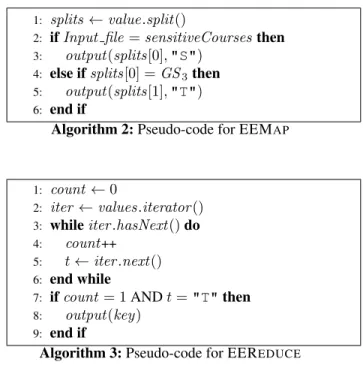
C4are confidential courses. If an unprivileged user wishes to list the courses taken by GS3, then we can answer the query by the Map and Reduce code shown in Algorithms 2 and 3.
1: splits←value.split()
2: ifInput file=sensitiveCoursesthen 3: output(splits[0],"S")
4: else ifsplits[0] =GS3then 5: output(splits[1],"T")
6: end if
Algorithm 2:Pseudo-code for EEMAP
1: count←0
2: iter←values.iterator()
3: whileiter.hasNext()do 4: count++
5: t←iter.next()
6: end while
7: ifcount = 1ANDt="T"then 8: output(key)
9: end if
Algorithm 3:Pseudo-code for EEREDUCE
Algorithm 2 shows the code of the Map phase. It first splits each line into a key and a value. If the input is from a
Table 2. EEMap output and EEReduce input EEMap Output EEReduce Input
Key Value Key Values
C1 T C1 T
C3 S C3 S, T
C3 T C4 S
C4 S
confidential course file, it outputs the course and a flag ("S" for “secret”) denoting a confidential course as the output pair in line 3. If it is from the takesCoursefile, it checks whether the subject isGS3 in line 4. If so, it outputs the course as the key and a flag ("T" for “takes”) indicating that the course is of studentGS3. The left half of Table 2 shows the output of Algorithm 2 on the example data.
Algorithm 3 shows the code of the Reduce phase. It gets a course as the key and the flag strings as the value. The input it gets while running on our example data is shown in the right half of Table 2. The code simply counts the number of flags in line 4. If the only flag indicates that the course is of studentGS3(line 7), then it outputs the course (line 8). A confidential course that is taken by the studentGS3 has an additional flag, raising the count to 2, and preventing those courses from being reported. A confidential course not taken by the student will also have one flag indicating that it is a confidential course. The check whether the flag is the one for course taken by studentGS3 prevents such courses from being reported. These two checks together ensure that only non-confidential courses taken byGS3are divulged in the output. Hence, only courseC1appears in the output.
4.3.3 Post-processing Enforcement
The second approach runs jobs as if there are no access con-trols, and then runs one or more additional jobs to filter the output in accordance with the policy. The advantage of this approach is that it is simple to implement, but it may take longer to answer the query. We can use the previous exam-ple to illustrate this approach. We first run the job as if there is no restriction on courses. Then we run one extra job to enforce the policy. The extra job takes two files as input: the output of the first job and theconfidentialCoursesfile con-taining the URI’s of confidential courses. In the Map phase we output the course as the key and, depending on the input file, a flag string. The Map code is largely the same as Algo-rithm 2. The only difference is that we do not need to check the URI identifying the student, since the output of the first job will contain the courses taken by only that student. The code for the Reduce phase remains the same. Hence, at the end of the second job we get output that does not contain any confidential courses.
0 0.5 1 2 6 9 0 50 100 150 200 250 300 350 runtime (sec)
data set size (K triples) Postprocessing
Embedded
Figure 5. Performance measurements for the
takesCoursescenario 0 0.5 1 2 6 9 0 50 100 150 200 250 300 350 runtime (sec)
data set size (K triples) Postprocessing
Embedded
Figure 6. Performance measurements for the
displayTeachersscenario
5
Experimental Setup and Results
We ran our experiments in a Hadoop cluster of 10 nodes. Each node had a Pentium IV 2.80 GHz processor, 4 GB main memory, and 640 GB disk space. The operating system was Ubuntu Linux 9.04. We compared our Em-bedded Enforcement approach with our Postprocessing En-forcement approach. We used the LUBM100, LUBM500, LUBM1000, LUBM2000, LUBM6000 and LUBM9000 datasets for the experiments.
We experimented with these approaches using two sce-narios:takeCourseanddisplayTeachers. In thetakesCourse
scenario, a list of confidential courses cannot be viewed by an unprivileged user for any student. A query was submitted to display the courses taken by one particular student. Fig-ure 5 shows the runtimes of the two different approaches.
In thedisplayTeachersscenario, an unprivileged user may view information about the lecturers only. A query was sub-mitted to display the URI of people who are employed in a particular department. Even though professors, assistant professors, associate professors, etc., are employed in that department, only URI’s of Lecturers are returned because of the policy. Figure 6 shows the runtimes we obtained from the two different approaches for this scenario.
We observe that Postprocessing Enforcement always takes 20–80% more time than the Embedded Enforcement approach. This can be easily explained by the extra job needed in Postprocessing. Hadoop takes roughly equal times to set up jobs regardless of the input and output data sizes of the jobs. The Postprocessing Enforcement proach runs more jobs than the Embedded Enforcement ap-proach, yielding the observed overhead.
6
Conclusion and Future Improvements
Access controls for RDF data on single machines have been widely proposed in the literature, but these systems scale poorly to large data-sets. The amount of RDF data in the web is growing rapidly, so this is a serious limita-tion. One of the most efficient ways to handle this data is to store it in cloud computers. However, access control has not yet been adequately addressed for cloud-resident RDF data. Our implemented mechanism incorporates a token-based access control system where users of the system are granted tokens based on business needs and authorization levels. We are currently building a generic system that in-corporates tokens and resolves policy conflicts. Our next goal is to implement Subject Model Level Access that recur-sively extracts objects of subjects and treats these objects as subjects as long as these objects are URI’s. This will allow agents possessing Model level access to generate models on a given subject.
References
[1] Apache. Hadoop. http://hadoop.apache.org/. [2] D. Beckett. RDF/XML syntax specification (revised).
Tech-nical report, W3C, February 2004.
[3] T. Berners-Lee. Semantic web road map. http://www. w3.org/DesignIssues/Semantic.html, 1998. [4] L. Bouganim, F. D. Ngoc, and P. Pucheral.
Client-based access control management for XML documents. In
Proc. 20´emes Journ´ees Bases de Donn´ees Avanc´ees (BDA), pages 65–89, Montpellier, France, October 2004.
[5] J. Broekstra, A. Kampman, and F. van Harmelen. Sesame: A generic architecture for storing and querying RDF. In
Proc. 1st International Semantic Web Conference (ISWC), pages 54–68, Sardinia, Italy, June 2002.
[6] H. Choi, J. Son, Y. Cho, M. K. Sung, and Y. D. Chung. SPIDER: a system for scalable, parallel / distributed evalua-tion of large-scale RDF data. InProc. 18th ACM Conference on Information and Knowledge Management (CIKM), pages 2087–2088, Hong Kong, China, November 2009.
[7] J. Grant and D. Beckett. RDF test cases. Technical report, W3C, February 2004.
[8] Y. Guo, Z. Pan, and J. Heflin. An evaluation of knowledge base systems for large OWL datasets. InIn Proc. 3rd Inter-national Semantic Web Conference (ISWC), pages 274–288, Hiroshima, Japan, November 2004.
[9] Y. Guo, Z. Pan, and J. Heflin. LUBM: A benchmark for OWL knowledge base systems. Journal of Web Semantics, 3(2–3):158–182, 2005.
[10] S. Harris and N. Shadbolt. SPARQL query processing with conventional relational database systems. InProc. Web In-formation Systems Engineering (WISE) International Work-shop on Scalable Semantic Web Knowledge Base Systems (SSWS), pages 235–244, New York, New York, November 2005.
[11] L. E. Holmquist, J. Redstr¨om, and P. Ljungstrand. Token-based access to digital information. InProc. 1st Interna-tional Symposium on Handheld and Ubiquitous Comput-ing (HUC), pages 234–245, Karlsruhe, Germany, September 1999.
[12] M. F. Husain, P. Doshi, L. Khan, and B. M. Thuraisingham. Storage and retrieval of large RDF graph using Hadoop and MapReduce. InProc. 1st International Conference on Cloud Computing (CloudCom), pages 680–686, Beijing, China, December 2009.
[13] M. F. Husain, L. Khan, M. Kantarcioglu, and B. Thuraising-ham. Data intensive query processing for large RDF graphs using cloud computing tools. InProc. IEEE 3rd Interna-tional Conference on Cloud Computing (CLOUD), pages 1– 10, Miami, Florida, July 2010.
[14] A. Jain and C. Farkas. Secure resource description frame-work: an access control model. In Proc. 11th ACM Symposium on Access Control Models and Technologies (SACMAT), pages 121–129, Lake Tahoe, California, June 2006.
[15] Joseki.http://www.joseki.org.
[16] J. Kim, K. Jung, and S. Park. An introduction to authoriza-tion conflict problem in RDF access control. InProc. 12th International Conference on Knowledge-Based Intelligent Information and Engineering Systems (KES), pages 583– 592, Zagreg, Croatia, September 2008.
[17] Kowari.http://kowari.sourceforge.net. [18] P. Mika and G. Tummarello. Web semantics in the clouds.
IEEE Intelligent Systems, 23(5):82–87, 2008.
[19] E. Prud’hommeaux and A. Seaborne. SPARQL query lan-guage for RDF. Technical report, W3C, January 2008. [20] P. Reddivari, T. Finin, and A. Joshi. Policy based access
control for an RDF store. InProc. Policy Management for the Web Workshop, 2005.
[21] M. Stocker, A. Seaborne, A. Bernstein, C. Kiefer, and D. Reynolds. SPARQL basic graph pattern optimization us-ing selectivity estimation. InProc. 17th International Con-ference on World Wide Web (WWW), pages 595–604, Bei-jing, China, April 2008.
[22] W3C. Semantic web frequently asked questions. http: //www.w3.org/RDF/FAQ, 2009.