Incremental Maximum Flows for Fast Envelope Computation
Nicola Muscettola
NASA Ames Research Center Moffett Field, CA 94035 [email protected]
Abstract
Resource envelopes provide the tightest exact bounds on the resource consumption and production caused by all possible instantiations of a temporally flexible plan. We present a new algorithm that computes an envelope in O(Maxflow(n, m, U)) where n, m and U measure the size of the flexible plan. This is an O(n) improvement on the best envelope algorithm known so far and makes envelopes more amenable to practical use in scheduling algorithms. The reduction in complexity depends on the fact that when the algorithm computes the constant segment i of the envelope it makes full reuse of the maximum flow that was computed in order to obtain segment i-1.
Resource Envelopes
The execution of plans greatly benefits from temporal flexibility. Fixed-time plans are brittle and may require extensive replanning due to execution uncertainty. Moreover, when plans must deal with uncontrollable exogenous events (Morris et al., 2001) temporal flexibility cannot be avoided. However, effective algorithms to build temporally flexible plans are rare, especially when activities produce or consume variable amounts of resource capacity. A major obstacle is the difficulty of assessing the resource needs across all possible plan executions. Methods are available to compute resource consumption bounds (Laborie, 2001; Muscettola, 2002). In particular, (Muscettola, 2002) proposes a polynomial algorithm to compute a resource envelope, the tightest of these bounds. By being the tightest possible, resource envelopes can potentially save an exponential amount of search (through early backtracking and solution detection) when compared to using looser bounds. Also, methods that compute resource envelopes identify maximally matched sets of resource consumer/producers that balance each other for any plan execution. This and other structural information could be crucial in minimizing the search space and suggesting effective scheduling heuristics, potentially enabling new classes of highly efficient schedulers.
However, preliminary studies on schedulers using envelopes appear not to show advantages with respect to more traditional heuristic methods based on fixed-time resource profiles (Pollicella et al., 2003). When compared to traditional fixed-time profiling methods, it is critical to balance the increased computation cost with the extraction of more structural problem information from the envelope
than backtrack/termination tests and maximum resource contention intervals. Making the trade-off advantageous requires two complementary approaches. The first reduces the cost of computing an envelope; the second devises new envelope analysis methods to extract useful heuristics. In this paper we address the problem of cost reduction. The fastest known resource envelope algorithm (Muscettola, 2002) computes all piecewise-constant segments of the envelope through as many as 2n stages, where n is the number of events in the flexible plan. Each stage computes a maximum flow using some maximum flow algorithm. The worst case complexity is O(n Maxflow(n,m,U)) where
m is the number of temporal constraints between activities
in the plan, U is the maximum level of resource production or consumption at some activity, and Maxflow(n, m, U) is the asymptotic cost of the maximum flow algorithm.
This staged method, however, can be significantly improved since at each stage it recomputes the needed maximum flow completely from scratch. This suggests using an incremental flow method. Starting from the maximum flow at one stage, this method computes the maximum flow at the next stage by minimally reducing flow when deleting nodes and edges, and by minimally increasing flow when adding new nodes and edges (Kumar, 2003). However, without appropriately ordering flow reductions and increases, the asymptotic complexity may not improve (at it appears to be the case in (Kumar, 2003)). In this paper we introduce an incremental method that provably computes an envelope in O(Maxflow(n, m, U)) for a large class of maximum flow algorithms. This reduction of complexity is significant. Experimental analysis has shown that the practical cost of maximum flow is usually as low as O (n 1.5) (Ahuja et al., 1993). This
compares well with O(n log n), the cost of building resource profiles for fixed time schedules. This paper is organized as follows. We first give a succinct introduction to the resource envelope problem and the staged envelope algorithm in (Muscettola, 2002). Next we present the new incremental algorithm identifying all sources of performance improvements. We then prove the complexity result and conclude by discussing future work.
Staged Computation of Envelopes
In this section we introduce the essential information on the envelope problem and the staged algorithm that solves it. For a complete discussion, see (Muscettola, 2002).
Figure 1 shows an activity network with resource allocations. The network has two time variables per activity, a start event and an end event (e.g., e1s and e1e for activity A1), a non-negative flexible activity duration link (e.g., [2, 5] for activity A1), and flexible separation links between
events (e.g., [0, 4] from e3e to e4s). Two additional events Ts, and Te define a time horizon within which all events
occur.
Time origin, events and links constitute a Simple Temporal Network. To describe resource production and consumption each event has also an allocation value (e.g.,
r31 for event e3s), a numeric weight that represents the
amount of resource allocated when the event occurs. We will assume that all allocations refer to a single, multi-capacity resource. The extension to multiple resources is straightforward. If the allocation is negative an event e−−−− is a consumer, if it is positive e++++ is a producer. We assume that
the temporal constraints are consistent which means that for any pair of events the shortest path |e1e2| from e1 to e2 is
well defined. Each event e can occur within its time bound, between the earliest time et(e) = −−−−|eTs| and the latest time lt(e) = |Tse|. The triangular inequality |e1e3| ≤≤≤≤ |e1e2| + |e2e3|
holds for any three events e1, e2 and e3.
Figure 1: An activity network with resource allocations
The anti-precedence graph, Aprec, is a graph containing a path between any two events e1 ande2 such that |e1 e2| ≤≤≤≤ 0.
Figure 2 depicts an anti-precedence graph of the network in Figure 1 with each event labeled with its time bound and resource allocation.
We can now formally define a resource envelope. For any subset of events A, the resource level increment of A is ∆∆∆∆(A) = 0 if A = ∅∅∅∅, and ∆∆∆∆(A) = ΣΣΣΣe∈∈∈∈A c(e) if A ≠≠≠≠∅∅∅∅. If S is
the set of all possible consistent time instantiations for all events and t is a time within the time horizon, the resource level at time t for a specific time instantiation s ∈∈∈∈ S is Ls(t) = ∆∆∆∆(Es(t)). Here Es(t) is the set of events e which
occur at or before t in s. The maximum resource envelope is Lmax(t) = maxs∈∈∈∈S Ls(t) and the minimum resource envelope is Lmin(t) = mins∈∈∈∈S Ls(t). Since Lmin can be
computed with obvious term substitution on the method that computes Lmax,we only focus on Lmax.
To compute the resource envelope at time t we partition all events into three sets depending on the position of their time bound relative to t: 1) the closed events Ct that must
occur before or at t, i.e., such that that lt(e) ≤≤≤≤ t; 2) the
pending events Rt that can occur before, at or after t, i.e.,
such that (e) ≤≤≤≤ t < lt(e); and 3) the open events Ot that must
occur strictly after t, i.e., such that et(e) > t.
Any resource level increment Ls(t) will always include the
contribution of all events in Ct and none of those in Ot but
can include only some subset of events in Rt, i.e., only
those that are scheduled before t in s. It is possible to show that this subset must be a predecessor set P⊆⊆⊆⊆Rt such that if e∈∈∈∈P and e’ follows e in Aprec, then e’∈∈∈∈P. We call Pmax(Rt) the (possibly empty) predecessor set with
maximum non-negative resource level increment.
The fundamental result reported in (Muscettola, 2002) is that Lmax(t) can be determined from the following equation. Equation 1: Lmax(t) = ∆∆∆∆(Ct)+∆∆∆∆(Pmax(Rt))
Figure 3: Anti-precedence graph with time/resource usage
The cost of computing an envelope depends on the cost of computing Pmax(Rt). We can compute Pmax(Rt) by solving a
maximum flow problem on an auxiliary flow network
F F F
F (Rt), the resource increment flow network for Rt.
The formal definition of a resource increment flow network can be found in (Muscettola, 2002). As an example, Figure 2 gives F F F F (R4) for the activity network in Figure 1. The
network has a node for each event in R4, an infinite
capacity flow edge between two events for each edge in
Aprec (see Figure 2), an edge from the source σσσσ to a
producer with capacity equal to the producer’s allocation, and an edge from a consumer to the sink ττττ with capacity
equal to the opposite of the consumer’s allocation.
A complete discussion of maximum flow algorithms can be found in (Cormen, Leiserson and Rivest, 1990). Here we only highlight a few concepts that we will use in the following. A flow is a function f(e1, e2) of pair of events in F
FF
F (Rt) that is skew-symmetric, i.e., f(e2, e1) = −−−− f(e1, e2), has <[5, 17], -4> <[6, 13], 2> <[1, 4], −4> <[3,9], -4> <[4, 10], 3> <[3, 15], 4> <[2, 11], -2> <[3, 15], 3> e1s e1e e2s e2e e3s e 3e e4s e4e
Figure 2: A resource increment flow network
[1, 10] <e2e, 2> A1 A2 A3 A4 <e1s, −4> <e1e, −4> <e2s, 3> <e4s, 4> <e4e, −4> <e3s, −2> <e3e, 3> Ts [30, 30] Te [1, 4] [2, 5] [-2, 3] [1, 5] [2, 3] [0, 4] [-1, 4] [0, +∞] [0, +∞] [1, 1] [0, 6] ττττ 3 3 4 +∞ +∞ +∞ +∞ e1e e2s e4s e3e e3s 4 2 σσσσ ττττ 3 3 4 +∞ +∞ +∞ +∞ e1e e2s e4s e3e e3s 4 2 σσσσ
a value no greater than the capacity of edge e1→→→→e2
(assuming capacity zero if the edge is not in FFFF (Rt)), and is
balanced, i.e., the sum of all flows entering an event must be zero. A pre-flow is a function defined similarly but that relaxes the balance constraint by allowing the sum of preflows entering a node to be positive. The total network flow is defined as Σe∈Rt f(σσσσ, e) = Σe∈Rt f(e, ττττ). The
maximum flow of a network is a flow function fmax such
that the total network flow is maximum.
A fundamental concept in the theory of flows is the
residual network, a graph with an edge for each pair of
nodes in FFFF (Rt) with positive residual capacity, i.e., the
difference between edge capacity and flow. Each residual network edge has capacity equal to the residual capacity. An augmenting path is a path connecting σσσσ to ττττ in the
residual network. The existence of an augmenting path indicates that additional flow can be pushed from σσσσ to ττττ. Alternatively, the lack of an augmenting path indicates that a flow is maximum.
We can compute Pmax(Rt) according to the next theorem. Theorem 2: (Muscettola 2002) Pmax(Rt) is the (possibly empty) set of events that are reachable from the source σσσσ in the residual network of some fmax of FF FF(Rt).
From Equation 1 and Theorem 2 (Muscettola, 2002) derives a staged envelope algorithm as follows. Consider the 2n times ti corresponding to the earliest and latest times
for all events. Since the envelope level can only change at one of these times, the algorithm computes a different level for each of them. At a particular ti the algorithm determines
its closed and pending event sets Ci and Ri, builds F F F F (Ri),
solves a maximum flow over it, determines Pmax(Ri)
according to Theorem 2, and computes Lmax(ti) according
to Equation 1. It is easy to see that the worst-case time complexity of this algorithm is O(n Maxflow(n, m, U)).
Incremental Computation of Envelopes
In the previously described staged envelope algorithm flows are recomputed from scratch for each FFFF (Ri).
Assuming that the times ti are sorted in increasing order, in
To reduce cost, we can try and reuse as much as possible of the maximum flow computation performed on FFFF (Ri-1). At
time ti the set of pending events can undergo two
modifications. First, the events δδδδCi = Ri-1 – Ri move from Ri-1 to Ci. These are events e such that ti = lt(e). Second,
the events δδδδRi = Ri−−−− Ri-1 move from Oi-1 to Ri. Theseare
the events e such that ti = et(e). For example, consider the
activity network in Figure 1 and the process through which
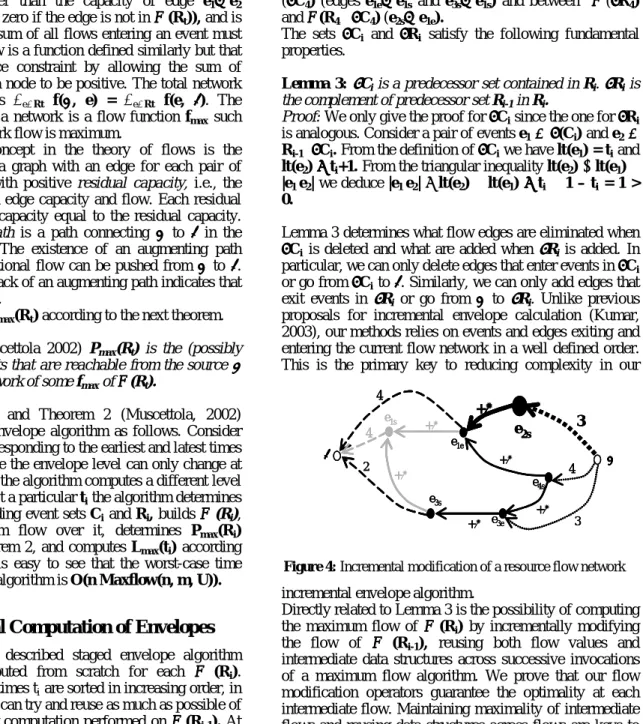
R3 is transformed into R4. This is described in Figure 4
where the grayed part of the network is deleted and the emphasized part of the network is added at time 4. In particular, we have δδδδC4 = {e1s} and δδδδR4 = {e2s}. For
completeness, we note that
F F F
F (δδδδC4) consists of node e1s and edge e1s→ττττ→→→ while FFFF (δδδδR4)
consists of node e2s and edge σ→→→→e2s. All other added and
deleted edges are connectives between FF FF(R4−−−−δδδδC4) and FFFF
(δδδδC4) (edges e1e→→→→e1s and e3s→→→→e1s) and between FFFF (δδδδR4)
and FFFF (R4−−−−δδδδC4) (e2s→→→→e1e).
The sets δδδδCi and δδδδRi satisfy the following fundamental
properties.
Lemma 3: δδδδCi is a predecessor set contained in Ri. δδδδRi is the complement of predecessor set Ri-1 in Ri.
Proof: We only give the proof for δδδδCi since the one for δδδδRi
is analogous. Consider a pair of events e1∈∈∈∈δδδδ(Ci) and e2∈∈∈∈ Ri-1−−−−δδδδCi. From the definition of δδδδCi we have lt(e1) = ti and lt(e2) ≥≥≥≥ ti+1. From the triangular inequality lt(e2) ≤≤≤≤ lt(e1) ++++ |e1 e2| we deduce |e1 e2| ≥ lt(e2) −−−− lt(e1) ≥≥≥≥ ti++++ 1 – ti = 1 > 0.!!!!
Lemma 3 determines what flow edges are eliminated when δδδδCi is deleted and what are added when δδδδRi is added. In
particular, we can only delete edges that enter events in δδδδCi
or go from δδδδCi to ττττ. Similarly, we can only add edges that
exit events in δδδδRi or go from σσσσ to δδδδRi. Unlike previous
proposals for incremental envelope calculation (Kumar, 2003), our methods relies on events and edges exiting and entering the current flow network in a well defined order. This is the primary key to reducing complexity in our
incremental envelope algorithm.
Directly related to Lemma 3 is the possibility of computing the maximum flow of FFFF (Ri) by incrementally modifying
the flow of FFFF (Ri-1), reusing both flow values and
intermediate data structures across successive invocations of a maximum flow algorithm. We prove that our flow modification operators guarantee the optimality at each intermediate flow. Maintaining maximality of intermediate flows and reusing data structures across flows are keys to reduce complexity for different kinds of maximum flow algorithms.
A final factor is minimizing the size of each intermediate flow network. We will show that as soon as the weight of an intermediate Pmax is used in the envelope calculation, F (Pmax) and all of its connecting edges can be safely
eliminated from further consideration. This reduces flow network size and additionally contributes to cost reduction.
Flow Modification Networks
We now define the operators needed for the incremental envelope algorithm. The philosophy of each operator is similar to that used by the flow augmentation method in
σσσσ ττττ 3 3 4 +∞∞∞∞ +∞ +∞ +∞ e1e e2s e4s e3e e3s 4 2 +∞ +∞ e1s 4 σσσσ ττττ 3 3 4 +∞∞∞∞ +∞ +∞ +∞ e1e e2s e4s e3e e3s 4 2 +∞ +∞ e1s 4 ττττ 3 3 4 +∞∞∞∞ +∞ +∞ +∞ e1e e2s e4s e3e e3s 4 2 +∞ +∞ e1s 4
maximum flow theory. However, we use this method more generally not only to augment flow but also to shift flow around the network and to reduce flow. The general idea is the following. Given a flow network FFFF and one of its
maximum flows f, an operator first defines an auxiliary flow transformation network FFFFT, then finds one of its
maximum flows fT, and finally produces a flow fnew = f + fT.
Each FFFFT consists of selected edges in the residual network
of FFFF for f. Since the properties of flows are preserved when
adding a flow of a residual network to the flow that originated the residual network, fnew is also a flow for
network FFFF.
Consider now the resource increment flow network FFFF (Ri-1)
at stage i-1 and assume that the set of new closed events at stage i δδδδCi is not empty. At stage i all events in δδδδCi and all
of its incoming and outgoing edges will be deleted. This also means that any flow that at the end of stage i-1 enters δδδδCi will necessarily have to be zeroed, i.e., pushed back
into FFFF (Ri-1). The value of this flow is the sum of the
residual capacities of all edges e1→→→→e2 where e1∈∈∈∈ δδδδCi and e2∈∈∈∈ Ri-1−−−−δδδδCi. Once pushed back, this flow can follow two
routes. The first reaches ττττ to fill up some non-saturated
exiting edges of FFFF (Ri-1−−−−δδδδCi). The second reverses all the
way to σσσσ because it cannot find any way to exit
F F F
F (Ri-1−−−−δδδδCi) through its sink. We call this flow push-back
operation a flow contraction. The first flow route corresponds to a flow shift and the second one is a flow
reduction. For example, consider the network in Figure 4.
Assume that at t=3 it is fmax(e1s, ττττ) = 4, fmax(e1e, ττττ) = 1 and fmax(e3e, ττττ) = 2. At t=3 the elimination of e1s requires
pushing back 4 units of flow. However, note that three units can still reach ττττ by being shifted to e1e→→→→ττττ. Only one unit of
flow needs to be pushed back to σσσσ. If we did not shift (as in
(Kumar, 2003)), three additional units of flow would have to be pushed again from σσσσ to ττττ to ensure flow maximality. Assume now that at stage i there is also a non-empty set δδδδRi of new pending events. Augmenting FFFF (Ri-1−−−−δδδδCi) with
the part of the resource increment flow network pertaining to δδδδRi yields FFFF (Ri). Assume now that FFFF (Ri-1−−−−δδδδCi) is
traversed by the flow resulting from flow contraction. Even if this flow is maximum for FFFF (Ri-1 −−−− δδδδCi), it may not be
maximum for FFFF Ri) since additional flow could be pushed
through edges σσσσ→→→→e with e∈∈δδδδ∈∈ Ri. We call this flow
push-forward operation a flow expansion. If at every stage of flow contraction and flow expansion we guarantee flow maximality, we will obtain a maximum flow for FFFF (Rt(i))
that moves a minimal amount of flow.
Flow Contraction
Let us call fmax,i-1 the maximum flow for FFFF (Ri-1). In our
discussion we ignore the structure of the flow sub-network for δδδδCi by using an auxiliary flow network FFFFi-1 that
redirects all flow entering δδδδCi into the sink ττττ. Formally, to
obtain FFFFi-1 we firstdelete from FFFF (Ri) all events in δδδδCi,
together with all their incoming and outgoing flow edges. We then add an auxiliary edge e1→→ττττ→→ for each set of
component edges e1→→→→e2 in F(Ri-1) such that e1∈∈∈∈ Ri-1−−−−δδδδCi
and e2∈∈δδδδ∈∈ Ci. The capacity of the auxiliary edge e1→→→→ττττ is the
sum of all component edge flows fmax,i-1(e1, e2). We call
fmax,,i-1 a function over the edges of FFFFi-1 where fmax,i-1(e1,e2)
is equal to fmax,i-1(e1,e2) if e1→→→→e2 also belongs to FFFF (Ri-1),
and fmax,i-1(e1,ττττ) is equal to the edge’s capacity if e1→→ττττ→→ is
one of the auxiliary flow edges. It is easy to see that fmax,i-1
is a maximum flow for Fi-1. We call Resi-1 the residual
network of FFFFi-1 for fmax,i-1.
We define a flow shift network Shifti as follows.
Flow shift network: Shifti is a flow network with the same intermediate events of Resi-1. Shifti has a flow edges e1→→→→e2 equal to a corresponding one in Resi-1 if e1∉∉∉∉{σσσσ,ττττ} and e2≠σσσσ. Finally, for each edge τ→e in Resi-1 such that e→τ is an auxiliary flow edge in FFFFi-1, Shifti has a corresponding edge σ→e of the same capacity.
Let us now call call Res(Shifti) the residual network of Fi-1
for f’ = fmax,i + fmax,shift,i. We define a flow reduction network Reducei as follows.
Flow reduction network: Reducei is a flow network with the same nodes as Res(Shifti) and edges e1→→→→e2 identical to Res(Shifti) if one of the following three conditions is satisfied:
1) e2≠ττττ; 2) e1≠σσσσ;
3) e1=σσσσ and the edge σσσσ→→→→e2 in Shifti originates from an auxiliary flow edge for FFFFi-1.
Using Shifti and Reducei, we define the Flow_Contraction
operator needed by the incremental envelope algorithm. Flow_Contraction(FFFF (Ri-1) , fmax,i-1, δδδδCi, Aprec ):
1) Compute a maximum flow max,shift,i for Shifti; 2) Compute a maximum flow fmax,red,i for Reducei; 3) Return fcontr,i=fmax,i+ fmax,shift,i+fmax,red,i
We now prove that the operator keeps the flow maximum.
Lemma 4: The flow f’ = fmax,i + fmax,shift,i is maximum for FFFF i-1..
Proof: f’ is a flow of FFFFi-1. It is also maximum since by
construction of Shifti it is fmax.shift,i(σσσσ, e) = 0. Therefore f’(σσσσ, e) = fmax,i-1(σσσσ, e) and therefore f’ is also maximum for FFFFi-1. Lemma 5: fcontr,i is a flow for FFFF (Ri-1−−−−δδδδCi).
Proof: fcontr,i is a flow for FFFFi-1. For it to be a flow for F
FF
F (Ri-1−−−−δδδδCi) it must be fcontr,i(e, ττττ)=0 if e→→→→ττττ is an auxiliary
edge. If it were fcontr,i(e, ττττ) > 0 for an auxiliary edge, by
using the flow conservation constraint we could show that there must be a path from σσσσ to ττττ, passing through e→→→→ττττ,
with all edges having positive flow. Therefore, there must be a flow-reducing path from ττττ to σσσσ in the corresponding residual network. Such path is an augmenting path in the residual network of Reducei for flow fmax,red,i, which
contradicts the maximality of fmax,red,i.
Proof: This is clearly true if fmax,red,i is a null flow since f’
is maximum. If fmax,red,i is not null, assume that fcontr,i is not
maximum. This yields an augmenting path from σσσσ to ττττ in FFFF (Ri-1 −−−− δδδδCi ) for fcontr,i. Since fmax,i is optimal, such path
could only have appeared after the computation of fmax,shift,i.
Since f’ is maximum for FFFFi-1, there must be at least one
edge e1→→→→e2 on the augmenting path that does not belong to
the residual network of FFFFi-1 for f’ while the suffix path from e2 to ττττ has positive residual capacity in Shifti for fmax,shift,i.
A positive residual for e1→→→→e2 implies that flow reduction
pushed flow in the opposite direction, i.e., fmax,red,i(e2, e1) > 0. Consider the last such edge in the augmenting path. By
backtracing its flow we find a positive flow path for fmax,red,i
from σσσσ to e2. This can only happen if the capacity of the
path in Reducei is positive, which is equivalent to a prefix
path with positive residual capacity in Shifti for fmax,shift,i.
Tying the prefix and postfix at e2 yields an augmenting path
in Shifti for fmax,shift,i, impossible since fmax,shift,i is
maximum.!!!!
Flow Expansion
The completion of stage i of the algorithm requires now to incorporate the event set δδδδRi to yield Ri and allow the
computation of Pmax,i = Pmax(Ri). Again, we define an
incremental operation on an incremental residual flow network, the flow expansion network. The network is built on the residual network of FFFF (Ri-1−−−−δδδδCi) for flow fcontr,i. We
call this residual network Res(Contri).
Flow expansion network: Expandi is a flow network with the intermediate events Ri. Expandi all flow edges e1→→→→e2 in Res(Contri), all flow edges in FFFF (δδδδRi) and an infinite capacity edge e1→→→→e2 for each anti-precedence edge between e1∈δδδδRi and e2∈Ri-1−−−−δδδδCi.
Note that by construction Expandi is the residual network
in FFFF (Ri) for fcontr,i. We now define the final operator
needed by the incremental envelope algorithm, Flow_Expansion.
Flow_Expansion(FFFF (Ri-1−−−−δδδδCi), fcontr,i, δδδδRi, Aprec):
1) Compute a maximum flow fmax,exp,i for Expandi; 2) Return fmax,i= fcontr,i + fmax,exp,i
Theorem 7: fmax,i computed by Flow_Expansion is maximum for FFFF (Ri).
Proof: fmax,i is clearly a flow for FFFF (Ri). Moreover, fmax,exp,i
is maximum for Expandi and therefore there is no
augmenting path in the corresponding residual network. The maximality of fmax,i follows from the identity between
the residual network of Expandi for fmax,exp,i and the
residual network of FFFF (Ri) for fmax,i.!!!!
Flow Separation for P
maxWe can achieve further performance improvements by minimizing the number of nodes and flow edges that need to be considered at each stage. During stage i two Pmax are
computed: Pmax,contr,i after Flow_Contractioniand Pmax,i after
Flow_Expansioni.We know that each Pmax is a predecessor
set (i.e., it contains all of its successors in the anti-precedence graph), it is flow isolated (i.e., for each pair of events e1∈∈∈∈Pmax and e2∈∈∈∈ PCmax, fmax(e1, e2) = 0 and fmax(e2, e1) = 0) and has all exit edges saturated (i.e., fmax(e, ττττ) = c(e,
ττττ) for all e∈∈∈∈Pmax) (Muscettola, 2002). This will allow us to
prove that FFFF (Pmax,i-1) can be ignored during the
computation of Flow_Contractioni and FFFF (Pmax,contr,i) can be ignored during computation of Flow_Expansioni.
Let us consider each maximum flow operation executed at stage i. The first is flow shifting. Note that by construction, the Pmax of FFFFi-1, Pmax,i-1, contains the events in Pmax,i-1−−−−δδδδCi. Pmax,i-1 is a predecessor set since δδδδCi. contains events at the
bottom of the anti-precedence graph for FFFF (Ri-1). However,
due to the additional links e→→→→ττττ the value of the positive
residual of Pmax,i-1 is equal to ∆(Pmax,i-1). Pnax, i-1 is still flow
insulated and has all exit edges saturated. Assume that flow shifting pumped flow to reach an event e’∈∈∈∈Pmax,i-1. In order
for at least part of such flow to reach ττττ there must be a
postfix augmenting path that reaches τ from e’. But this is impossible since Pmax,i-1 is a predecessor set, all postfix
paths must remain inside Pmax,i-1, and all exit edges from Pmax,i-1 to ττττ are saturated. Therefore, any maximum flow
algorithm pushing flows that searches for augmenting paths can avoid doing so in Pmax,i-1 and any excess flow pumped
into events of Pmax,i that can achieve ττττ will have to be
pushed back from Pmax,i-1 to P C
max,,i-1. Therefore we can
ignore Pmax,i-1 during flow shifting.
After flow shifting the maximum predecessor set is still
Pmax,i-1 since flow shifting simply produces a different
maximum flow for FFFFi-1 and Pmax,i-1 is independent from the
specific flow instance (Muscettola, 2002).
Considering now flow reduction, fmax,red,i this can be
computed by simply backtracing flow in FFFFi-1. Because of
the flow insulation of Pmax,,i-1, this backtracing is either
performed exclusively over events in PCmax, i-1 = P C
max,i-1−−−−
δδδδCi or is confined within the events in Pmax,i.1 = Pmax,i-1 −−−−
δδδδCi. Note that since after flow reduction all auxiliary edges
must have zero flow, the producers’ residual of Pmax,i-1 after
flow contraction must be equal to ∆(Pmax,i-1−−−−δδδδCi).
Finally, we can use a similar argument to the one used for
flow shifting to show that Flow_Expansioni can be
performed entirely over F(PCmax,contr,i), therefore ignoring Pmax,,contr,i.
Incremental Computation of L
maxWe are now ready to derive a recursive equations for the
incremental calculation of Lmax(t) by transforming
Equation 1 through the application of flow reduction and expansion.
From the discussion on flow separation, we know that, after Flow_Contractioni-1, Pmax,contr,I =(Pmax(Ri-1) −−−−δδδδCi) ∪∪∪∪
Pmax(Pcmax(Ri-1) −−−−δδδδCi). After Flow_Expansioni,because of flow separation, we have Pmax,i = Pmax,contr,i ∪ Pmax(PCcontr,i
∪ ∪∪ ∪δδδδRi).
Theorem 8: Lmax(t) satisfies this recursive equation: if t = t1
Lmax(t) = ∆∆∆∆(C1) + ∆∆∆∆(Pmax(R1)) if t = ti and i >1
Lmax(t) = Lmax(ti-1) ++++ i
∆∆∆∆(δδδδCi∩∩∩∩ PCmax(Ri-1)) ++++ ii ∆∆∆∆(Pmax(Pcmax(Ri-1) −−−−δδδδCi)) ++++ iii ∆∆∆∆(Pmax(δδδδRi∪∪∪∪ Pcmax(Pcmax(Ri-1−−−−δδδδCi))); iv
if t≠≠≠≠ti, then
Lmax(t) = Lmax(t-1).
Proof: Lmax(t) only changes when Rt changes, i.e., at a time
ti. Let us consider in turn the application of
Flow_Contractioniand Flow_Expansioni.
a) Flow_Contractioni: the level after flow contraction,
Lmax,contr(ti) is the weight of the closed events after
contraction and of Pmax,contr,i. Since new events at time ti are only closed during flow contraction and Ci and Pmax,contr,i are disjoint, Lmax,contr(ti) = ∆∆∆∆(Ci-1 ∪∪∪∪ δδδδCi ∪∪∪∪ Pmax,contr,i) = ∆∆∆∆(Ci-1 ∪∪∪∪ δδδδCi ∪∪∪∪ (Pmax(Ri-1) −−−− δδδδCi) ∪∪∪∪ Pmax(P
c
max(Ri-1) −−−− δδδδCi)). Since for any two sets A and B it is A ∪∪∪∪ (B – A) = B ∪∪∪∪ (A – B), with B and (A–B)
being disjoint sets, we have δδδδCi∪∪∪∪ (Pmax(Ri-1) −−−−δδδδCi) = Pmax(Ri-1) ∪∪∪∪ (δδδδCi −−−− Pmax(Ri-1)). Since δδδδCi ⊆⊆⊆⊆ Ri-1 = Pmax(Ri-1) ∪∪∪∪ PCmax(Ri-1), it is easy to see that δδδδCi −−−− Pmax(Ri-1) = δδδδCi∩∩∩∩ PCmax(Ri-1). This yields Lmax,contr(ti) = Lmax(ti-1) + ∆∆∆∆(δδδδCi∩∩∩∩ PCmax(Ri-1)) + ∆∆∆∆(Pmax(Pcmax(Ri-1)
−−−− δδδδ(Ci))), i.e., lines i, ii and iii in the theorem’s
statement.
b) Flow_Expansioni: the only new increment comes from
set Pmax(PCmax,contr,i∪∪∪∪δδδδRi) = Pmax(PCmax(Ri-1 - δδδδCi) ∪∪∪∪
δδδδRi) which yields line iv in the theorem’s statement. Algorithm Time Complexity Complexity Key
Labeling O(nmU) Total pushable
flow
Capacity scaling O(nm logU) Total pushable flow
Successive shortest paths
O(n2m) Shortest distance
to ττττ Generic
preflow-push
O(n2m) Distance label
FIFO reflow-push
O(n3) Distance label
Table 1: Complexity of maximum flow algorithms
Figure 5 shows the pseudocode of the algorithm. The functions Flow_Contraction and Flow_Expansion receive as arguments the current flow network Fcur,which includes the current maximum flow, the incremental set of events that need to be added/deleted Ecur.{earliest,latest}, and the
anti-precedence graph Aprec(N) for the set of all events in the plan N. Aprec carries the topological information needed to expand the flow network.
Given the current flow network and its maximum flow both stored in Fcur, Extract_P_max returns both its maximum
increment predecessor set Pmax and the restricted network and flow resulting from the elimination of the Pmax. Comparing with the formula for Lmax(ti) described by
Theorem 8, line 12 in the algorithm computes i+ii, line 15 adds iii and line 18 adds iv. Note that the algorithm is actually more of a method that can be implemented in different ways depending of which maximum flow
algorithm is used in Flow_Contraction and
Flow_Expansion. As we shall see the worst-case time
complexity of the method is the same as that the maximum flow algorithm used. We will also see that further optimizations are possible when using specific algorithms such as push-preflow methods.
Complexity Analysis
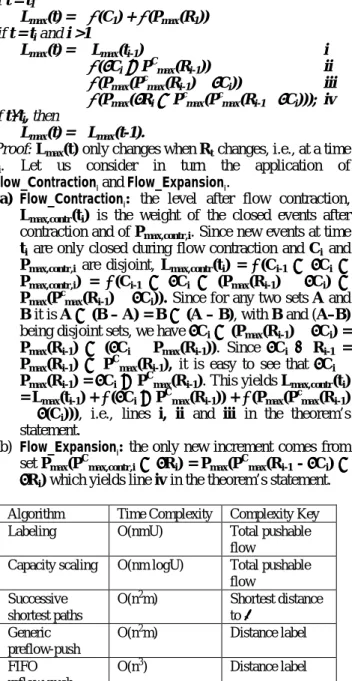
The complexity analysis of the incremental envelope algorithm applies to a large number of maximum flow algorithms used for Flow_Contraction and Flow_Expansion. Each algorithm has a complexity key, i.e., a measurable entity whose static properties or dynamic behavior during its computations determines its time complexity. Table 1 (adapted from (Ahuja, Magnanti and Orlin, 1992)) reports the time complexity and complexity key of several maximum flow algorithms.
The Labeling and Capacity Scaling algorithms are based on the original Ford-Fulkerson method. The complexity depends on the strict monotonicity of the flow pushed at each iteration of the algorithm and on the fact that the total
pushable flow is bound by nU where U is the maximum Figure 5: Incremental envelope algorithm
Incremental_Resource_Envelope (N, Apred(N))
{ 1: E := { Group events in the input set N into entries Et with three
members: a time t and two lists earliest and latest. Event e∈∈∈∈N is included in Et.earliest if et(e) = t and in Et.latest if
lt(e) = t. Sort the Et in increasing order of t. }
2: Lmax := {<-∞∞∞∞, 0>} /* Maximum resource envelope. */
3: tcur := 0; /* Current time */
4: Lold := 0; /* Envelope level at previous iteration. */
5: Lnew := 0; /* Envelope level at current iteration. */
6: Pmax := ∅∅∅∅; /* Maximum increment predecessors.*/
7: Fcur := ∅; /*Resource increment flow graph with associated
maximum flow */ 8: Ecur := ∅∅∅∅; /* Entry from E at tcur. */
9: while (E is not empty) 10: {Ecur := pop(E);
11: tcur := Ecur.t;
12: Lnew := Lold + weight (intersection (Events(Fcur), Ecur.latest)); 13: Fcur := Flow_Contraction (Fcur, Ecur.latest, Aprec(N));
14: <Pmax, Fcur> := Extract_P_Max (Fcur);
15: Lnew := Lnew ++++ weight (Pmax);
16: Fcur := Flow_Expansion (Fcur, Ecur.earliest, Aprec(N));
17: <Pmax, Fcur> := Extract_P_max (F);
18: Lnew := Lnew++++ weight (Pmax);
19: Lmax := append (Lmax, <tcur, Lnew>);
20: Lold := Lnew;
} return Lmax;
capacity of an edge σσσσ→→→→e or e→→ττττ→→ . The successive shortest
paths class of algorithms is based on the original
Edmonds-Karp algorithm. The complexity depends on the fact that flow is pushed through augmenting paths of monotonically increasing length. The complexity key for this class of algorithms is the shortest distance to ττττ for each event e. For these algorithms it is crucial to demonstrate that the distance function d(e) increases by at least one unit after each iteration.
Finally, push algorithms such as generic
preflow-push and FIFO preflow-preflow-push (Goldberg and Tarjan, 1988)
maintain a distance labeling d(e). These algorithms use purely local operations that push excess flow available at node e1 through edges e1→→→→e2 such that d(e1) = d(e2) + 1.
When excess flow exists at some node and no such edge exist, the node’s distance labeling is increased by the minimum amount that re-establishes a one unit difference in distance label over an edge. This allows more flow to be pushed. The complexity of the algorithms depends on creating a valid labeling at each iteration and on the fact that for each node the distance labeling is monotonically increasing up to 2n-1.
We now analyze the cumulative cost of computing all flows over 2n stages respectively for fmax,shift,i, fmax,red,i and fmax,exp,i. First note that at each stage fmax,red,i can be
computed by flow backtracing through a backwards depth first search on the resource increment flow network. Since this can cost up to O(m), the total cost of computing flow reduction is O(nm) and is therefore smaller than the cost of applying a regular maximum flow algorithm. Therefore we focus on the cost for the cumulative fmax,shift,i and fmax,exp,i,
respectively Fshift = ΣΣΣΣi fmax,shift,i and Fexp = ΣΣΣΣi fmax,exp,i. Lemma 9: Each of Fshift and Fexp is no greater than n U. Proof: Consider Fshift (the argument is similar for Fexp). The
upper bound of the total capacity of the edges σσσσ→→→→e
entering Shifti is the total capacity of edges e−→ττττ with e−−−−∈∈δδδδ∈∈ (Ci). After iteration i all nodes in δδδδCi are eliminated
from further consideration, hence flow can go through each σσσσ→→→→e only during iteration i. Therefore, the total flow is
upper bounded by Σi |δδδδCi| U = n U.!!!!
Note that the argument above does not hold for Fexp if
instead of using flow shifting the flow is simply reduced and then expanded again (Kumar, 2003). In this case the same flow could be pushed up to n times with Fexp being O(n2U). This would not improve on the staged envelope
algorithm.
Consider now the distance d(e) for node e and how it changes when computing fmax,shift,i.and fmax,exp,i. Let us call d0shift,i(e) and dfshift,i(e) the distances at the beginning and at
the end of flow shifting for iteration i. We define similarly
d0exp,i(e) and dfexp,i(e). Lemma 10: dfexp,i-1(e) ≤ d
0
shift,i(e) and d f
shift,i(e) ≤ d 0
exp,i(e). Proof: Between the end of flow expansion at iteration i-1
and the start of flow shifting at iteration i, the auxiliary
flow network changes through the elimination of nodes and edges in FFFF (δδδδCi). Therefore, the new distances in the
remaining residual capacity network can only increase. Since Shifti only adds edges σσσσ→→→→e, the distances in Shifti
must analogously increase and therefore dfexp,i-1(e) ≤ d0shift,i(e). For Expand1 node distances can further increase
because flow reduction can only eliminate residual network edges present in Shifti for fmax,shift,i. Also, from Lemma 3
the addition of F (δδδδRi)cannot reduce distances since it
cannot add any edge from an event in Shifti to one in δδδδRt(i).
Therefore, dfshift,i(e) ≤ d 0
exp,i(e).!!!!
Note that the argument in Lemma 10 does not hold if events are added in arbitrary order. In this case the addition of edges can reduce the distance function of some node e between a shifting and an expansion phase. In the worst case, this may reduce the distance to one for each application of maximum flow and therefore does not improve on the staged algorithm.
Finally, consider reusing distance labeling across preflow-pushes for shifting and expansion. d0shift,i, dfshift,i, d0exp,i and dfexp,i are the distance labelings at the beginning and end of
shifting and expansion. Assume also that the distance label of a node that has not yet entered Expandi or Shifti is zero. Lemma 11: d0shift,I can be made equal to dfexp,i-1 for all nodes in Shifti. Also, d
0
exp,i can be made equal to d f
shift,I for all nodes in Expandi.
Proof: The distance label of a node remains valid when
edges are deleted or new edges are only added to enter it from new nodes. Also, a distance function at node e must be an upper bound of its labeling. From Lemma 10 we know that the distance function can only increase from
Expandi-1 to Shifti and from Shifti to Expandi. Therefore dfexp,i-1 and dfshift,iare valid choices respectively for d0shift,i
and d0exp,i..!!!!
We can now prove the main complexity result.
Theorem 12: For a large class of maximum flow algorithms, Incremental_Resource_Envelope has time complexity O(Maxflow(n, m, U)).
Proof: Assume we applied one of the maximum flow
algorithms in Table 1 to find the full maximum flow on the entire resource increment flow network (e.g., to compute the maximum envelope level over the entire time horizon (Muscettola, 2002)) with cost O(Maxflow(n, m, U)). We use Lemmas 9, 10 and 11 to prove that the cumulative cost of using the same algorithms for flow shifting and flow expansion is O(Maxflow(n, m, U)) for the same algorithm. 1. Labeling and Capacity scaling: Lemma 9 shows that the worst case bound for the total flow moved during shifting and expansion is at worst twice that for full flow calculation. Also, at each iteration during shifting and expansion, finding an augmenting path costs at most m as for full flow calculation. Hence shifting and expansion cost at most O(Maxflow(n, m, U)).
2. Successive shortest paths: the cost bound for each full flow augmentation is an upper bound for that in shifting and expansion. The algorithm’s complexity also depends on the monotonic increase of the distance function up to n after each elementary operation. Note that until the deletion of a δδδδCi or a Pmax, a node’s
distance is bound by n as for the full flow. Monotonic increase is guaranteed by the algorithm within each shifting and expansion phase and by Lemma 10 across phases. Hence, the cost is O(Maxflow(n, m, U)). 3. Preflow-push methods: the complexity is found through
amortized analysis (Goldberg and Tarjan, 1988), relying on an appropriate potential function ΦΦΦ and on Φ the determination of its possible variations after the applying a local operation (e.g., a saturating or a non-saturating preflow push). One key observation is the monotonic increase of each node’s distance label for each local operation. Both for the incremental and for the full flow this increase is bound by 2n−−−−1 and
Lemma 11 guarantees monotonic distance label increase across phases. Note that, unlike for the full flow, for shifting and expansion ΦΦΦ increases also at the Φ beginning of each shifting phase, when nodes are activated by the creation of initial flow excesses. However, a detailed amortized analysis (omitted for space limitations) shows that this increase does not affect the order of complexity of the shifting and expansion phases that remains O(Maxflow(n, m, U)). The worst case complexity of the other phases of
Incremental_Resource_Envelope besides shifting and
expansion are dominated by O(Maxflow(n, m, U). Flow reduction is cumulatively O(nm). The total cost of
Extract_P_max and of incrementally constructing and
deleting the flow network, is 2 O(m). Finally the sorting of events during initialization is O(n log n).!!!!
Optimized Preflow-Push Implementation
If the incremental algorithm is implemented using a preflow-push method, the previous complexity analysis indicates that, in order to reduce complexity, we need to reuse the distance labeling function from the end of a maximum flow computation to the start of the next.
A further optimization is possible. Consider the maximum flow calculation on Shifti. During initialization, an excess
flow is loaded on each event e for each edge σσσσ→→→→e in Shifti.
We know that only a fraction of this excess flow may reach ττττ. The remainder will be pushed back out of Shift1 during
flow shifting and then pushed again through the flow network during flow reduction. In other words, this flow travels twice through the network before being eliminated. We can remove this duplication as flows. Assume that instead of deleting the σσσσ→→→→e edges of FFFFi-1 when constructing Shifti we delete instead the σσσσ→→→→e edges of Shifti after
having performed the appropriate excess loading needed to perform flow shifting. In this case the flow that cannot be shifted will be pushed back to the source in FFFFi-1,, i.e., FFFF (Ri),
instead making the additional O(nm) cost of flow reduction
unnecessary. Another possible optimization consists of combining preflow-push through Shifti and Expandi by
connecting δδδδRi before running the shift/reduce
preflow-push. In this case the flow excess initializations of contraction and expansion are combined and a single preflow-push is run during phase i.
These optimizations do not affect asymptotic complexity but may have a significant effect in practice. Empirical studies will be needed to assess their actual usefulness.
Conclusions
We presented a new algorithm that efficiently computes resource envelopes for flexible plans. The methods has complexity O(Maxflow(n, m, U)) where n and m measure the size of the activity plan and U measures the maximum resource consumption or production of an activity. We are currently experimenting with various implementations of the methods. While we expect that for large problem sizes the O(n) cost reduction will be evident, practical improvements on smaller problems require careful design of efficient and minimal data structures. We are also addressing the second part of the cost/benefit equation for envelopes by exploiting additional structural information resulting from the method’s incrementality and designing scheduling algorithms that use a minimal search space.
References
R.K. Ahuja, T.L. Magnati, J.N. Orlin, 1993. Network Flows, Prentice Hall, NJ.
R.K. Ahuja, M. Kodialam, A.K. Mishra, J.B. Orlin, 1997. Computational Investigations of Maximum Flow Algorithms,
European Journal of OR, Vol 97(3).
T.H. Cormen, C.E. Leiserson, R.L. Rivest, 1990. Introduction to
Algorithms. Cambridge, MA.
A.V. Goldberg, R.E. Tarjan, 1988. A New Approach to the Maximum-Flow Problem. JACM, Vol. 35(4).
T.K.S. Kumar, 2003. Incremental Computation of Resource-Envelopes in Producer-Consumer Models, Procs. of CP2003, Kinsale, Ireland.
P. Laborie, 2001. Algorithms for Propagating Resource Constraints in AI Planning and Scheduling: Existing Approaches and New Results, Procs. ECP 2001, Spain. P. Morris, N. Muscettola, T. Vidal, 2001. Dynamic Control of
Plans with Temporal Uncertainty, in Procs. of IJCAI 2001, Seattle, WA.
N. Muscettola, 2002. Computing the Envelope for Stepwise-Constant Resource Allocations, Procs. of CP2002, Ithaca, NY.
N. Pollicella, S.F. Smith, A. Cesta, A. Oddi, 2003. Steps toward Computing Flexible Schedules, Procs. of Online-2003
Workshop at CP 2003, Kinsale, Ireland,
![Figure 1 shows an activity network with resource allocations. The network has two time variables per activity, a start event and an end event (e.g., e 1s and e 1e for activity A 1 ), a non-negative flexible activity duration link (e.g., [2, 5] for ac](https://thumb-us.123doks.com/thumbv2/123dok_us/357912.2539397/2.918.90.802.82.1071/activity-resource-allocations-variables-activity-activity-negative-flexible.webp)