UC Santa Barbara
UC Santa Barbara Electronic Theses and Dissertations
Title
Reinforcement Learning for Generative Art Permalink https://escholarship.org/uc/item/2m02t46z Author Luo, Jieliang Publication Date 2020 Peer reviewed|Thesis/dissertation
Reinforcement Learning for Generative Art
A dissertation submitted in partial satisfaction of the requirements for the degree
Doctor of Philosophy in
Media Arts & Technology
by Jieliang Luo
Committee in charge:
Professor George Legrady, Chair Professor Tobias H¨ollerer
Professor Yon Visell Dr. Hui Li
The Dissertation of Jieliang Luo is approved.
Professor Tobias H¨ollerer
Professor Yon Visell
Dr. Hui Li
Professor George Legrady, Committee Chair
Copyright c 2020 by
Acknowledgements
I would love to thank my dissertation committee for their supports, guidance, un-derstanding, and inspirations throughout my time at this program. Foremost, I thank Prof. George Legrady for his consistent supports and encouragements to develop my works, and inspiring me to explore the fields of media art. I appreciate Professor Tobias H¨ollerer for his ongoing support of my work, raising the motivations, and understanding. I appreciate Prof. Yon Visell for his devoted help, motivations, and inspiring discussions to develop my dissertation. I appreciate Dr. Hui Li for her supports, understanding, and inspiring discussions. I would also like to thank the whole MAT community as well. I acknowledge financial support from the Media Arts and Technology graduate program and Robert W. Deutsch Foundation.
Education
09.2014-01.2020 PhD in Media Arts and Technology
University of California, Santa Barbara
Dissertation Bridging Reinforcement Learning & Generative Art Advisor: Prof. George Legrady
09.2010-03.2013 MA in Emergent Digital Practice
University of Denver
Advisor: Prof. Christopher Coleman 09.2006-06.2010 BE in Digital Media Technology
Beijing University of Posts & Telecommunications
Work Experience
Begins at 02.2020 Autodesk Research (San Francisco, CA) Principal AI Researcher
06.2018-12.2019 Autodesk Research (San Francisco, CA) Machine Learning & Robotics Intern
• Published “Dynamic Experience Replay”, a reinforcement learn-ing technique to enhance robotic assembly, at Conference of Robot Learning (CoRL) 2019.
• Developed a distributed reinforcement learning framework for architectural-scale robotic assembly, featuring data-sampling enhancement and sim-to-real transition.
01.2015-06.2018 Experimental Visualization Lab, UCSB(Santa Barbara, CA) Graduate Researcher & Lecturer
• Designed and developed an autonomous multiple robotic-camera system for studying distributed reinforcement learning on em-bedded systems. A version of the system named “Machinery Interference” was featured at Beijing Times Arts Museum.
• Developed an interactive fluid simulation called “Anamorphic Fluid”, featured in USA, Thailand, and South Korea.
• Taught two courses as lecturer
– Data Visualization (Processing and MySQL)
– Mobile Robotics (Raspberry Pi, Arduino, and OpenCV) 09.2017-06.2018 Koc Lab, UCSB (Santa Barbara, CA)
• Published a book chapter called “Reinforcement Learning and Trustworthy Autonomy” at Cyber-Physical Systems and Secu-rity.
• Developed a toolkit for visually understanding deep reinforce-ment learning policies.
06.2015-09.2015 InTouch Health (Santa Barbara, CA) Software Engineer
• Developed middleware and several prototypes for robot-human interaction, task allocation, control, and path planning
Publications
2019
Jieliang Luo and Hui Li, “Dynamic Experience Replay”, 2019 Conference of Robot
Learning (CoRL)
Yongxiang Fan, Jieliang Luo, and Masayoshi Tomizuka, “A Learning Framework for High Precision Industrial Assembly”, 2019 International Conference on Robotics and Automation (ICRA), 811-817
2018
Jieliang Luo and Sam Green, “Bridging Reinforcement Learning and Creativity:
Im-plementing Reinforcement Learning in Processing”, SIGGRAPH Asia 2018 Courses, 3
Jieliang Luo, Sam Green, Peter Feghali, George Legrady, and etin Kaya Koc,
“Rein-forcement Learning and Trustworthy Autonomy”, Cyber-Physical Systems and Security, 191-217
2017
Jieliang Luo, Donghao Ren, and George Legrady, “Anamorphic Fluid: Exploring
Spa-tial Organization and Movements of Images in A Simulated Fluid Environment”, Pro-ceedings of The 10th International Symposium on Visual Information Communication and Interaction, 63-64
Exhibitions
11.2019 Beyond the Body, “LAVIN”, SWISSNEX, San Francisco, CA, USA
08.2019 ACM SIGGRAPH 2019, “LAVIN”, Los Angeles Convention Center, Los Angeles, CA, USA
07.2019 ChinaVIS 2019, “Human Portraits Decompositions 2.0”, Longe-mont Hotels, Chengdu, Sichuan, China
11.2017 SIGGRAPH Asia 2017, “Abstract Reality”, Bangkok Interna-tional Trade & Exhibition Center, Bangkok, Thailand
06.2017 Currents New Media Festival, “Anamorphic Fluid II”, Santa Fe, NM, USA
08.2016 SV+VS, “Anamorphic Fluid”, Dongdaemun Design Plaza Mu-seum, Seoul, South Korea
04.2016 Art & Science, “Voro Space”, California Nano Systems Institute, Santa Barbara, CA, USA
01.2016 SV+VS, “Anamorphic Fluid”, Fellows of Contemporary Art, Los Angeles, CA, USA
11.2015 Day & Night, “Anamorphic Fluid”, Edward Cella Art & Archi-tecture, Los Angeles, CA, USA
11.2012 “Touch History”, Holocaust Memorial Social Action Site, Denver, CO, USA
Awards
2018 Individualized Professional Skills Grant, UC Santa Barbara
2017 International Student Award, UC Santa Barbara
2017 Graduate Fellowship, UC Santa Barbara
2016 Robert W. Deutsch Foundation Fellowship, Deutsch
Founda-tion
2016 Integrative Graduate Education and Research Traineeship
Fellowship, UC Santa Barbara
2015 The University Student Aid Program Fellowship, UC Santa
Barbara
2012 Graduate Assistant Scholarship, University of Denver
Abstract
Reinforcement Learning for Generative Art by
Jieliang Luo
Reinforcement learning (RL) is an efficient class of sequential decision-making algorithms that have achieved remarkable success in a broad range of applications, such as robotic manipulations, strategic games, or autonomous driving. The most well-known example of reinforcement learning is AlphaGo, a computer program that plays the board game Go and outperforms top human Go players. Unlike other two major machine learning categories, supervised learning and unsupervised learning, in which media artists are actively engaged, reinforcement learning has yet to result in many creative applications. Generative art is usually driven, in whole or in part, by autonomous systems that are derived from a set of rules. Interestingly, an RL policy can be seen as an autonomous system where the rules are learned by interacting with its environment. Regardless of its initial purpose, reinforcement learning has the potential to expand the boundary of generative art. However, a formal process of applying reinforcement learning to generative art does not yet exist and the current RL tools require an in-depth understanding of RL concepts.
To bridge the gap, the first part of the dissertation introduces a conceptual framework to adapt reinforcement learning for generative art. The framework proposes a term
RL-based generative art to denote a novel form of generative art of which the use of
RL agents is the key element. The creative process of RL-based generative art and possible emergent behaviors are discussed in the framework. This leads to a discussion of
details of each component in order to construct the framework.
The second part introduces RL5, a JavaScript library for rapidly prototyping RL environments and training RL policies in web browsers. The library combines RL algo-rithms and RL environments into one framework and is fully compatible with p5.js. RL5 is developed with a particular focus on simplicity to favor (re)usability of RL algorithms and development of RL environments. Specifically, the library implemented three RL al-gorithms, Tabular Q-learning, REINFORCE, and DDPG, to cover all the three families of model-free RL, and nine RL environments that six of them address autonomous agents in steering behaviors, which can be used as building blocks for complex systems. Finally, the author demonstrates four different use cases of how to apply RL5 for pedagogical and creative applications.
Contents
Curriculum Vitae v Abstract viii 1 Introduction 1 1.1 Motivations . . . 1 1.2 Problem Statement . . . 3 1.3 Challenges . . . 5 1.4 Approaches . . . 81.5 Structure of The Dissertation . . . 9
2 Background 11 2.1 Reinforcement Learning . . . 11
2.1.1 Introduction . . . 11
2.1.2 RL Applications . . . 16
2.1.3 RL Libraries and Environments . . . 19
2.2 Deep Learning & Generative Arts . . . 25
2.2.1 Generative Art . . . 25
2.2.2 Deep-learning Generative Arts . . . 27
2.3 Creative Tools to Deep Learning . . . 31
2.3.1 p5.js & ml5.js . . . 31
2.3.2 Magenta.js . . . 32
2.3.3 Runway ML . . . 33
2.4 Summary . . . 34
3 Reinforcement Learning & Generative Art 35 3.1 Definition of RL-based Generative Art . . . 36
3.2 Creative Process of RL-based Generative Art . . . 38
3.2.1 Creative Process & Roles of Artists . . . 38
3.2.2 Emergent Behaviors . . . 41
3.3.3 Reinforcement Learning . . . 59
3.4 Other Achievements . . . 62
4 RL5: A p5.js Library for Reinforcement Learning 64 4.1 Overview . . . 64 4.2 RL Algorithms in RL5 . . . 66 4.2.1 Tabular Q-Learning . . . 66 4.2.2 REINFORCE . . . 68 4.2.3 DDPG . . . 72 4.3 RL Environments in RL5 . . . 74 4.3.1 Entry Points . . . 75 4.3.2 Autonomous Agents . . . 80 4.3.3 Define A RL Environment . . . 87 4.4 Core APIs of RL5 . . . 89
4.4.1 Setup An Environment and Agent . . . 89
4.4.2 Train & Evaluate A RL Policy . . . 91
4.4.3 Access Trained Agents . . . 92
4.5 An Example of RL5 - Avoid An Obstacle . . . 92
5 Applications of RL5 97 5.1 Pedagogical Applications . . . 98
5.1.1 SIGGRAPH Asia 2018 Courses . . . 98
5.1.2 Digital Media Design at Beijing University of Technology . . . 100
5.2 Artistic Applications . . . 109
5.2.1 Machine Learning with Visual Overlay . . . 109
5.2.2 Action Through Inaction . . . 111
6 Review & Discussion 118 7 Conclusion 126 7.1 Contributions . . . 126
7.2 Future Directions . . . 129
A Dynamic Experience Replay 131
B Thoughts of Machine Learning with Visual Overlay 147
C Recognition of RL5 150
Chapter 1
Introduction
1.1
Motivations
In the last year (2016), generative machine learning models (GANs, RL, etc) and machine creativity have gotten a lot of attention. At the same time there have been significant advances in generative models for media creation and for design.
- Neural Information Processing Systems Foundation (NeurIPS)
For decades, machine creativity has been an essential topic in artificial intelligence (AI) and attracted numerous artists to explore its full extent and push the boundaries. Back in the 1970s, artists like Harold Cohen started to investigate the use of machines for autonomous drawings. Cohen’s iconic project AARON[1], a computer program creating original artistic physical images, has been used as an artistic equivalent of the Turing Test. Recently, artworks driven by deep-learning techniques have become a trending art movement since Google released DeepDream [2] in 2015. The project is usually
machine learning models, like GANs [3] or RNN [4], have been widely adapted for artistic expressions.
As a breakthrough technology of deep learning in 2015, deep reinforcement learning (RL), an efficient class of sequential decision-making algorithms, has achieved remarkable success in a broad range of applications, such as robotic manipulations, strategic games, and autonomous driving. The most well-known example of deep reinforcement learning is AlphaGo [5], the first computer program to defeat Go world champions. The game Go is known as the most challenging abstract strategy board game for artificial intelligence due to its complexity of 10 to the power of 170 possible board configurations. Standard AI methods could reach the level of human amateurs as the methods cannot handle all the possible configurations of Go. Deep reinforcement learning, however, can adapt to uncertainties in unknown environments, which enabled AlphaGo to make an arguably optimal decision to an unseen configuration.
However, unlike other generative machine learning models that have been actively practiced in art, reinforcement learning has resulted in very few artistic applications. On the other hand, reinforcement learning has the potential to expand the boundary of generative art as the use of an autonomous system is a key element for both of them. A generative artwork is usually driven, in whole or in part, by one or several autonomous systems that are derived from a set of explicit rules defined by artists. An RL policy is es-sentially an adaptive autonomous system where the rules are learned by trial-and-error of its agent exploring the environment. Given the connection and difference between an RL policy and a rule-based autonomous system, it’s promising that adapting reinforcement learning for generative art should open up new opportunities.
One gap between reinforcement learning and generative art is missing a clear work-flow addressing how reinforcement learning should be adapted for generative art. Other popular generative machine learning models usually take a group of curated data as
Introduction Chapter 1
inputs and output a group of generated data for artistic explorations, whereas reinforce-ment learning usually collects training data from an environreinforce-ment while a training session takes place. Thus, working with reinforcement learning requires developers to define an RL environment, which is not straightforward as selecting training data. Meanwhile, an appropriate tool is missing for non-experts to rapidly explore reinforcement learning. Current RL tools primarily focus on developing and evaluating novel RL techniques and normally a successful RL application takes hours, days, or even months to training. On the other hand, machine learning tools designed for creativity barely provide RL mod-ules. Thus, the primary motivation of this research is to investigate how reinforcement learning can expand the boundary of generative art and how to improve the accessibility of reinforcement learning for creatives.
1.2
Problem Statement
Deep learning techniques have been widely applied for artistic explorations. Given the steep learning curve of those techniques, many attempts have been made to improve the accessibility of deep learning for creators. In general, deep learning can be categorized as supervised learning, unsupervised learning, and reinforcement learning. Most of the efforts have focused on the first two categories. In the workshop Machine Learning for
Creativity and Design at NeurlIPS 2018, for example, 35 papers were accepted, but only
one paper addressed reinforcement learning [6] and the other one mentioned reinforcement learning in their future directions [7].
One reason that supervised and unsupervised learning attract more attention than reinforcement learning in the creative community is that the former two have a relatively straightforward workflow. For example, generative adversarial networks (GANs) [3] was originally proposed as a generative model for unsupervised learning, but it has been
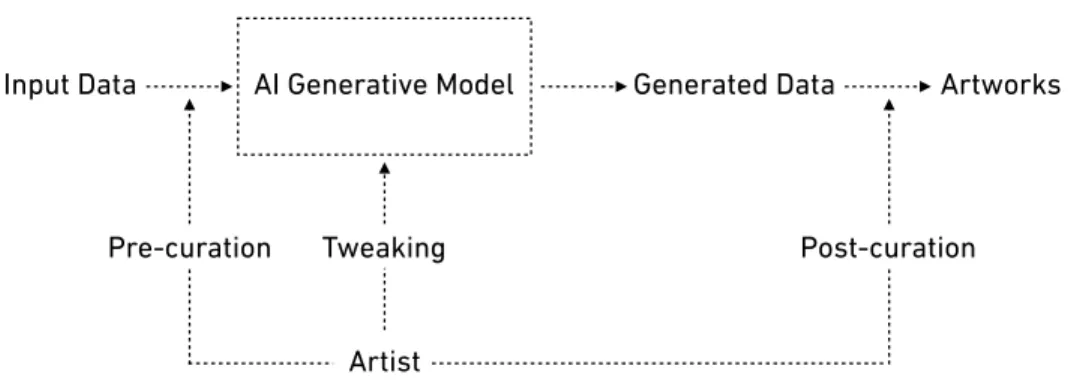
adapted as a tool for creating artistic images. Basically, it can learn aesthetics from input images and generate novel images representing similar aesthetic characteristics. Once the models are constructed, the workflow for users is clear that they can focus on curating input images and post-processing generated images. The simplicity of the workflow also applies to other popular deep learning techniques used in artistic explorations, like pix2pix [8] or sketch-rnn [9].
For reinforcement learning, the workflow for art creation is unclear. As reinforce-ment learning is to solve sequential decision-making problems, the outputs are usually a sequence of actions, which is not feasible to be applied directly on tasks like image generation. In an RL problem, an agent starts by randomly exploring the environment and learns an adaptive strategy to solve the problem. What is the creative process of adapting reinforcement learning for artistic activities? What are the possible emergent behaviors that can be resulted from such a process? What are the artists’ roles in the process? Those are questions that have yet been fully explored in previous research.
Reinforcement learning does share some similarities with generative art as essentially they are both driven by autonomous systems. Here I propose the term RL-based
gen-erative art to denote a novel form of generative art of which the use of RL agents is
the key element in such form. This dissertation investigates a conceptual framework for RL-based generative art, which consist of the following components: a formal definition and its relation to generative art, a comparative study of the creative process between RL-based generative art and deep learning art, a discussion of artist roles and emergent behaviors in RL-based generative art.
In order to participate more effectively in reinforcement learning, creators also need a set of tools that can guide their activities. The existing machine tools for creators, like ML5 or Runway ML1, primarily focus on supervised and unsupervised learning and
Introduction Chapter 1
provide a collection of trained models to help users to get started. Since each RL problem requires its own training environment to collect data, a trained RL model is not trans-ferable to another RL problem. Even in the same RL problem, a small change in the environment, such as the number of actions, requires the model to be re-trained. Hence, it’s pointless to provide pre-trained RL models to creators for artistic exploration as the models cannot be adapted to their own problems. On the other hand, current RL tools target on solving engineering-oriented problems or evaluating novel RL algorithms. This situation leads the dissertation to explore how to design an RL tool that is designated for artistic exploration. The tool should help developers focus on conceptually framing RL problems and rapidly prototyping RL environments.
1.3
Challenges
This section presents three main challenges when adapting reinforcement learning for generative art. Those challenges are not exclusively concerned by RL-based generative art but apply to reinforcement learning research in general. The following discussion focuses on their influences on the artistic exploration of reinforcement learning.
Training Efficiency
The recent successes of deep reinforcement learning rely on extremely expensive com-putational power and take days or even months to train. Dactyl[10], an AI system developed by OpenAI 2, used 384 machines that each machine contains 16 CPU cores to
train a robotic hand to manipulate a cube. To achieve their desired results, the system requires about 100 years of experience to learn to rotate a cube in simulation. DeepMind3
2https://openai.com/
trained RL polices to perform realistic locomotion behaviors[11] by using 64 machines for over 100 hours.
For artistic explorations, it’s neither always necessary to achieve the optimal perfor-mance of a task nor it’s realistic to have access to such expensive computational resources. One essential element in creative process is to rapidly prototype and test ideas. Experi-menting with different combinations of parameters is a common approach. Current RL libraries require developers to have an in-depth understanding of advanced RL algorithms in which each algorithm usually consists of more than 20 hyper-parameters. A small dis-crepancy in hyper-parameters may result in failed training. For example, DDPG[12], a RL algorithm for continuous action spaces, uses target networks to stabilize updates that a target network only copies a small portion from its original network. This process is controlled by a hyper-parameter 4 τ, which is usually set to 0.001. In Ape-X DDPG, a
distributed version of DDPG, τ is usually set to 1 to achieve the good performance as it uses another hyper-parameter target network update freq for stabilization.
Given the training inefficiency and the complexity of fine tuning RL algorithms, it’s not feasible for creators to efficiently explore reinforcement learning if they simply experiment with hyper-parameters of RL algorithms. A more engaged approach needs to be discovered.
Environment Design
In supervised learning or unsupervised learning, once a model is trained, it can be used as a tool by taking curated data and generating aesthetic results. Such straightforward workflow can encourage creators to experiment with different models trained under the same technique. The workflow of reinforcement learning is inherently more complicated
4In deep learning, parameters refer to coefficients of a model. To differentiate, the term
Introduction Chapter 1
because a training environment needs to be properly defined by developers to collect training data. That requires an in-depth understanding of RL concepts, like states, actions, and rewards. For example, to solve a CartPole problem5, the agent needs to
return the cart position, the cart velocity, the pole angle, and the pole velocity as states after the cart takes an action. This is considered as a fully observable environment. The problem is hard to be solved if one of the states is missing, unless a recurrent module is added to the neural network. In addition, debuggability is still an ongoing issue in deep learning that fixing a failed training heavily relies on the developer’s experience. Thus, designing a RL environment from scratch is impractical for non-experts.
A collection of simple RL environments could be a possible solution, but the en-vironments in the collection should be addable to a complex system for the purpose of experimenting RL environments. Currently, RL environments are usually not included in RL libraries that mostly focus implementing RL algorithms. Popular RL environments, like OpenAI Gym [13], are mainly designed for RL researchers to evaluate novel RL al-gorithms. Creators can benefit from a RL tool that focuses on simplicity and combines algorithms and environments into one framework.
Reward Function Design
Reinforcement learning uses a reward function to guide the agent to learn the desired behaviors without explicitly defining the rules. The benefit of learning is allowing the agent to be adaptive to uncertainties, but designing a reward function to precisely capture the developer’s intention is challenging as misspecifying a reward function could result in absolutely unexpected behaviors.
Typically, if a reward is given only when the agent achieves the goal but no reward at
5A cart is either moving to left or right to balance a pole on top of it. The problem will be elaborated
all other states, it’s a sparse reward function, which is easy to define but could be very inefficient in training because unsuccessful attempts in sparse reward function do not contribute useful information for optimizations. In contrast to sparse reward function, shaped reward function could give feedback on every step taken by the agent, which is usually considered to make the policy easier to be learnt than sparse reward function.
However, a misspecified shaped reward function can lead to reward hacking to cause unintended behaviors. A simple example is to train an agent moving from left to right to reach a target in a 2D environment. Intuitively, a reward function could be designed as the closer the agent gets to the target, the higher positive reward it receives. If no other constraints, this reward function may result in the agent to roam around the target but never reach it. In that case, the agent finds out that reaching the target will stop receiving further positive rewards. Such unintended behaviors may result in some harmful consequences in real-world applications, but they are not always unfavorable conditions in the context of artistic explorations. That said, the challenge of designing a reward function for artistic exploration is not precisely capture the developer’s intention, but to encourage the agent to develop more emergent behaviors. In the example in this paragraph, if a reward function is well defined, the agent could develop the optimal solution by moving straight to the target. However, this reward function is less interesting in comparison to a reward function that can guide the agent to develop different solutions every time it retrains. This area needs further studied.
1.4
Approaches
Since the concept of RL-based generative art hasn’t been fully explored, this dis-sertation will initially provide a formal definition of RL-based generative art, clarify its creative process, and discuss the emergent behaviors in RL-based generative art. This
Introduction Chapter 1
will lead to a discussion on several projects developed by the author in generative art, deep learning art, and reinforcement learning. The discussion will focus on their relation to RL-based generative art, conceptually and technically. With the new opportunities brought by RL-based generative art, the dissertation will develop a JavaScript library to improve the accessibility of reinforcement learning for creators. The library will be built on top of p5.js, a popular creative coding language. This allows developers to rapidly defining their RL environments and train RL policies without struggling with technical details of RL algorithms.
The library will be exercised with two pedagogical applications and two artistic ap-plications. The pedagogical applications will use the library as a platform to introduce the concepts of RL and encourage participants to build their RL environments with the library. A quantitative survey will be conducted to evaluate the library. The artistic applications will explore different aspects of reinforcement learning. One will be a solo practice and the other one will be a collaborative project.
1.5
Structure of The Dissertation
This dissertation consists of six chapters. Chapter 1 Introduction describes the pri-mary motivations, main challenges, problem statement, and approaches on bridging re-inforcement learning and generative art. Chapter 2 Background starts with a general introduction of reinforcement learning, including Markov decision process and RL core concepts, followed by three short surveys on RL applications, RL libraries, and RL envi-ronments, respectively. The chapter then discusses a group of curated generative artworks from the 1950s to 2010, a group of curated deep learning generative artworks based on three deep learning techniques, and a selection of machine learning tools designed for creativity. Chapter 3 Reinforcement Learning & Generative Art introduces a conceptual
framework of how reinforcement learning can be adapted for generative art by propos-ing a term RL-based generative art to denote such art form and discussing the creative process and emergent behaviors in RL-based generative art. The chapter also discusses several author’s practices on generative art and reinforcement learning. The practices explore various artistic experiments on generative art and technical improvements on reinforcement learning. Chapter 4 RL5: A p5.js Library for Reinforcement Learning in-troduces a JavaScript library that enables developers to train RL policies and prototype RL environments in web browsers. Specifically, the chapter describes three implemented RL algorithms, a collection of RL environments, core APIs, and a complete example of using the library to train and evaluate an RL agent. Chapter 5 Practices describes two pedagogical applications and two artistic practices of RL5. Lastly, Chapter 6 concludes with the results and future works of RL5.
Chapter 2
Background
This chapter is structured as follows. A general introduction of reinforcement learning (RL) is introduced in Sec 2.1, including Markov Decision Process and fundamental con-cepts of RL, followed by a brief survey of current RL applications in games and robotics, then a brief survey of current RL libraries and environments. In Sec 2.2, the scopes of generative art and deep learning art in this dissertation are defined, respectively. A group of curated generative artworks from the 1950s to the present is reviewed. A collection of deep-learning driven generative artworks is discussed based on three deep learning tech-niques: GANs, RNN, and CNN. Sec 2.3 reviews and discusses the current tools aiming to make deep learning accessible for creators and beginners.
2.1
Reinforcement Learning
2.1.1
Introduction
Reinforcement learning, one of the most active research areas in artificial intelligence, is a computational approach to learning whereby an agent tries
complex, uncertain environment.
- Reinforcement Learning: An Introduction by R. Sutton & A. Barto
Reinforcement learning is a family of methods aimed at training an agent to collect rewards from an environment. At each time step t, the agent is given information about
thestateof its environment in the form of anobservationstand then makes anaction
at. The agent’spolicy π(st) is the logic that takes state observations and returns action selections. After each action, the environment will return a new state observation st+1
and reward rt+1. This cycle is illustrated in Fig. 2.1.
Agent
Environment
Figure 2.1: In reinforcement learning, an agent interacts with an environment. At each time step, the agent receives a state and reward signal from the environment. Based on this information, the agent selects its next action.
The agent’s policy is parameterized by the tensorθ, giving it a more explicit notation of πθ(st). For example, in a linear model, the policy would have the form:
πθ(s) =θ1s1+θ2s2+· · ·+θmsm=θ>s, (2.1)
where the time step t has been dropped for notation clarity and m is the number of features in the state space. In a similar manner, a neural network would be parameterized by a parameter tensor. The goal of the agent is to maximize collection of rewards from the environment. In a finite time-horizon, the goal is accomplished by finding parameters
Background Chapter 2
θ? which provide this maximization:
θ? = arg max θ T−1 X t=0 r(st, at), (2.2)
where T −1 is the number of time steps experienced, and r(st, at) is the environment’s
reward function. In many real-world cases the reward function is not given as a closed-form expression, but must be sampled by the agent’s interactions with the environment. One of the strengths of reinforcement learning is its ability to learn using this experiential method.
Markov Decision Processes
Markov Decision Processes (MDP) are the environments which reinforcement
learning was developed to solve. A major aspect of MDPs is that they have states in which an agent exists, and the outcomes of actions depend only on the current state, not on past states and actions; in this sense MDPs are memoryless. The memoryless property is captured in the environment’s state-transition and reward function notation:
p(st+1|st, at, st−1, at−1, . . . , s0, a0) =p(st+1|st, at), r(st+1|st, at, st−1, at−1, . . . , s0, a0) =r(st+1|st, at).
(2.3)
The state-transition and reward functions in Eq. 2.3 state that function outcomes depend only on the current state and action, and are independent of past states and actions. A second major aspect of MDPs is that the state-transition and/or reward functions may
be stochastic, which means their return values are drawn from some underlying
prob-ability distributions. In standard RL settings, these distributions must be stationary
Figure 2.2: Example of Markov Decision Process. There are three states and two ac-tions. Unless otherwise indicated, the state transition probability is 1 and reward is 0. Transition froms0tos2 is the most interesting withr(s2|s0, a1) = 1 andp(s2|s0, a1) = .75.
Within an MDP, agents may observe their current state and make actions which attempt to affect the future state. The agent’s objective is to maximize collection of rewards. An example of 3-state MDP1 is given in Fig. 2.2. In this example, the initial
state is s0, and the agent has two action options: a0 and a1. If the agent chooses action
a0 it is guaranteed to stay in state s0, denoted by p(s0|s0, a0) = 1. If the agent chooses
actiona1, there is a 25% probability that it will transition tos1, denoted byp(s1|s0, a1) =
.25, and a 75% probability it will transition to s2, denoted by p(s2|s0, a1) = .75. The
environment returns reward of 0 for all state transitions except for s0 →s2, and in this
case it returns r(s2|s0, a1) = 1.
The agent’s only goal is to maximize collection of rewards. In the context of Fig. 2.2 the agent should always select action a1, as it is the only action that leads to a
non-zero reward. While we can see that is the solution, an agent must learn it. There are two general approaches for learning in RL: value iteration methods and policy
gradient methods. Value iteration is the classical approach to RL and includes the
1In the notation for this example, the subscripts denote “options”, versus the usual meaning, which
Background Chapter 2
Q-Learning algorithm and its descendents. Policy gradient methods directly optimize a policy through gradient ascent. Policy gradient methods perform well in many situations and they are relatively straightforward to implement.
Core Elements of Reinforcement Learning
A reinforcement learning system usually consists of the following core elements: an environment, one or multiple agents, a policy, states, actions, a reward function, a value function, and optionally, a model of the environment.
Environment & Agent: An RL environment hosts and interacts with one or more
RL agents and is partially influenced by the agents. At every step of interaction, the agent observes a state of the environment and takes an action base on the state. After each step, the environment changes based on how the agent acts and also on its own. On the agent side, it perceives a reward from the environment, which is usually a numeric value indicating how the state is. The goal of the agent in RL is always to maximize its cumulative rewards. An environment could be either in simulation or reality, determinis-tic or stochasdeterminis-tic, fully observable or partially observable, discrete or continuous, episode or sequential.
Reward Function: A reward function of an environment measures how good
state-action pairs are. The RL agent receives a numerical reward every time step, and the goal of the agent is to maximize the total rewards, also called return, in the long run.
State & Observation: A state is a complete description of the environment at
a particular step, and an observation is a partial description of a state. States or ob-servations are always represented by a group of data, like pixel data from a camera, joint angles and joint velocities of a robot, or the board state in a board game. If the agent can observe the complete state of the environment, then the environment is fully
Action Space: An action takes the agent from the current state to the next state. Action space is the set of all the valid actions and can be eitherdiscreteorcontinuous. Discrete action spaces indicate a finite number of actions are available, like Go, and continuous action spaces mean the actions are real-valued vectors, like the Cartesian-velocity controller of a robot. Policy: An RL policy maps from the received states of the environment to actions resulted from those states. Namely, it is a set of learned rules to guide an agent of what actions to take. It could be a look-up table, a simple function, or a sophisticated neural network. It could be deterministic or stochastic that the latter allows the agents to explore the environment without always taking the same action.
Value Function: In comparison to reward function, which evaluates the RL agent’s
behavior in an immediate sense, a value function evaluates what is good in the long term. The value of a specific state reflects the expected total rewards from that state to the end of the episode. Value functions are used in almost every RL algorithm.
Model of the Environment: A model of an RL environment calculates the
dy-namics of the environment. Given a state and action, the model will predict the next state, denoted by p(st+1|st, at). Depending on if a model is used during the training,
reinforcement learning can be categorized as model-free RL and model-based RL.
2.1.2
RL Applications
Reinforcement learning has been primarily applied in many fields of which games and robotics are most relevant to the creative community. Hence, a curated collection of the popular RL applications in those two fields are listed below.
Background Chapter 2
Games
Games are great but challenging domains for testing RL algorithms. On the one hand, games are ideal training environments as the rules are well defined and the moves involve sequential decision-making progress. On the other hand, without any enhancements, the basic reinforcement learning algorithms are insufficient to solve games due to rich search space.
AlphaGo [5], developed by DeepMind to play the board game Go, is considered as one of the most well-known applications of RL. The game of Go is known as the most challenging classical games for artificial intelligence because of its numerous search space. Previously, the strongest Go computer programs could only beat amateur human Go players. AlphaGo is the first computer program to defeat a Go world champion. It uses one deep neural network to evaluate board positions and another deep neural network to select moves. The networks are trained by a combination of supervised learning from human expert games and reinforcement learning from games of self-play. Later, DeepMind released a newer version called AlphaGo Zero [14], which did not use any prior knowledge of the game and took three days of self-play train to beat AlphaGo. The significance of this version is that it frees itself from the constraints of human knowledge, and it only used a single machine with 4 TPUs.
Before AlphGo, DeepMind presented DQN [15]: “the first deep learning model to successfully learn control policies directly from high-dimensional sensory input using reinforcement learning.” The same architecture of the model and the same algorithm were used to train seven Atari 2600 games. The results show that “it outperforms all previous approaches on six of the games and surpasses a human expert on three of them.” The states are raw pixels from the screen, and game scores and the actions are applied directly to the game agents. DQN is an off-policy model-free RL algorithm that the
model periodically samples transitions from a replay buffer for optimization.
Besides board games and classic video games, reinforcement learning is also studied in modern multiplayer online battle arena (MOBA) video games, like Dota or Warcraft. OpenAI Five [16] is a five-neural-network RL system designed to beat top human profes-sional teams at Dota 2. Its early version uses another off-policy model-free RL algorithm called Proximal Policy Optimization (PPO) [17] to train on 256 GPUs and 128,000 CPU cores. On April 13th, 2019, OpenAI Five “became the first AI system to defeat the world champions at an esports game.” In this version, they developed “a distributed training system and tools for continual training which allowed us to train OpenAI Five for 10 months”, which demonstrates that “self-play reinforcement learning can achieve superhuman performance on a difficult task.”
DeepMind chose another challenging Real-Time Strategy (RTS) game StarCraft II as the testbed for their novel reinforcement learning system named AlphaStar [18]. Unlike OpenAI Five that crafts information available to a human player in a set of data arrays, AlphaStar uses the raw game interface as state space. It was ranked above 99.8% of active players on Battle.net, the official game server of StarCraft II. To train a satisfying version, it took about 44 days running concurrently 16,000 matches and 16 actor tasks that each uses a TPU device with eight TPU cores.
Robotics
Robots have been heavily used in manufacturing and other industries; however, as they rely on pre-defined trajectories, they require precise calibration and fail to adapt to uncertainties. Adaptability to imprecision, varying conditions, and less structured environments is key to the future of automation. As most robotic problems can be framed as sequential decision-making problems, robotics can be seen as an important and challenging application platform for reinforcement learning to test in the real world.
Background Chapter 2
Recently, reinforcement Learning has led to a series of successes in solving robotic tasks, like assembly, control, or navigation.
Reinforcement learning has been studied actively in the area of high precision assem-bly as it can reduce human involvement and increase the robustness to uncertainties. Inout el al. [19] used a Q-learning based method with LSTM [20] for Q-function approx-imation to solve low-tolerance peg-in-hole tasks. Luo el at. [21] extended a model-based approach MDGPS [22] with haptic feedback for learning the insertion of a peg into a deformable hole. Fan el at. [23] combined DDPG [24] and GPS [25] to take advantage of both model-free and model-based RL [26] to solve high-precision Lego insertion tasks. Luo el at. [27] combines iLQG [28] with force/torque information by incorporating an operational space controller to solve a group of high-precision assembly tasks.
Training efficiency is a significant challenge of training real robots with reinforcement learning. Experience replay [29] has been used to improve training efficiency, particu-larly for model-free RL algorithms, as it is less sample efficient than model-based RL. The technique has become popular after it was incorporated in the DQN [30] agent play-ing Atari games. Prioritized experience replay [31] is a further improvement to prioritize transitions so agents can learn from the most ”relevant” experiences. Hindsight experi-ence replay [32] stored every transition in the replay buffer not only with the original goal but also with a subset of other goals to acquire a more generalized policy. DDPG from Demonstrations [33] modified DDPG to permanently store a set of human demonstrations in the replay buffer to solve a group of insertion tasks.
2.1.3
RL Libraries and Environments
Practically, to perform an RL task, an RL environment needs to be defined and an RL algorithm needs to be selected to match the action and state spaces of the RL
envi-ronment. For example, a pendulum environment has to be trained by an RL algorithm supporting continuous action spaces. An RL library usually refers to a set of implemen-tations of RL algorithms, and RL environments are usually developed and distributed separately from RL libraries.
A Survey of RL Libraries
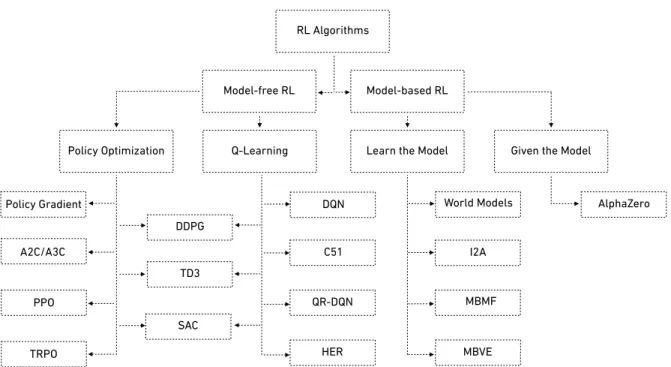
A lot of deep reinforcement learning libraries have been developed, but it is hard to determine the best one. This section gives a preliminary analysis based on the following criteria: implemented RL algorithms, documentation, flexibility with different RL envi-ronments, and accessibility of the codes. Fig 2.3 presents a non-exhaustive taxonomy of RL algorithms, adapted from OpenAI Spinning Up2. Most of the RL libraries
imple-mented model-free RL algorithms because the transition model of training environments could be agnostic, which improves the reusability of the algorithms.
OpenAI Baseline [34] implements a set of high-quality RL algorithms with Tensor-Flow, including A2C, ACER, ACKER, DDPG, DQN, GAIL, HER, PPO, and TRPO. However, the library neither comes with documentation nor the codes are commented. It is naturally compatible with OpenAI Gym environments but remains unclear of how to work with external environments. Since each algorithm was implemented in different styles, the codes were also challenging to be modified.
Tensorforce [35] is a deep reinforcement learning framework focusing on modular component-based design. Similar to OpenAI Baseline, it implements a majority of state of the art RL algorithms, including A2C & A3C, DQN and its improvements, Policy Gradient, PPO, and TRPO. The library misses DDPG, which is a popular algorithm for continuous action space. The library makes its algorithms agnostic to the type and structure of state and action, as well as the training environment, which is friendly for
Background Chapter 2
RL Algorithms
Model-free RL Model-based RL
Policy Optimization Q-Learning Learn the Model Given the Model Policy Gradient A2C/A3C PPO TRPO DDPG TD3 SAC DQN C51 QR-DQN HER World Models I2A MBMF MBVE AlphaZero
Figure 2.3: A non-exhaustive taxonomy of RL algorithms, adapted fromOpenAI Spinning Up.
external environments. The modular design improves the accessibility to modify the codes of which more comments are needed.
KerasRL [36] was designed to integrate with the deep learning library Keras seam-lessly. It implemented CEM, Continuous DQN, DQN, DDPG, and Deep SARSA, but it misses two important methods, Actor Critic and Proximal Policy Optimization. The codes are well-documented but are explicitly designed to work with OpenAI Gym. There-fore, modifications to the codes are required in order to use external RL environments. On the other hand, due to the separation between agents, policies, and memory, the modifications are relatively straightforward.
Stable Baselines [37] was developed on top of OpenAI Baseline as an improvement by providing a unified structure for all the algorithms. Besides the algorithms implemented by OpenAI Baseline, Stable Baseline includes SAC and Double DQN. It also creates a col-lection of pre-trained reinforcement learning agents, called RL Baseline Zoo. The library
provides a tutorial of how to train on self-defined environments, but the environments have to be wrapped as Gym-type environments.
Besides the aforementioned libraries, the most recent RL libraries are focusing on improving either scalability, like rllib [38] (a framework for distributed reinforcement learning), or compatibility, like rlpyt [39] (offering a shared and optimized infrastructure to build all three RL algorithm families). However, very few RL libraries were designed specifically for the creative community.
A Survey of RL Environments
In an RL system, an RL environment is as equally important as an RL algorithm as an environment needs to define state spaces, action spaces, reward function, and dynamic transitions. A small discrepancy in the environment design could lead to entirely different training results. Current available RL environments are primarily designed to test RL algorithms.
OpenAI Gym [13] is a diverse collection of RL environments, including toy texts, classic control, algorithmic, Atari, board games, and 2D and 3D robots. It was created for developing and comparing reinforcement learning algorithms. Since the environments have been released, they have become benchmarks for RL researchers to test and compare RL algorithms in RL literature. Below is a detailed introduction of the RL environments OpenAI Gym implemented:
• Classic control & toy text are small-scale but complete tasks from RL literature,
like CartPole, Pendulum, Acrobot.
• Algorithmic includes simple computational tasks, like adding multi-digit numbers
Background Chapter 2
• Atari plays classic Atari games, integrated from Arcade Learning Environment,
which will be introduced next.
• 2D & 3D robots simulates robots in 2D or 3D environment, using the MuJoCo [40]
physics engine, “which was designed for fast and accurate robot simulation”.
Arcade Learning Environment (ALE) [41] provides an interface to hundreds of Atari 2600 games for evaluating domain-independent agents of reinforcement learning or imita-tion learning. Specifically, “ALE provides a game-handling layer, which transforms each game into a standard reinforcement learning problem by identifying the accumulated score and whether the game has ended. By default, each observation consists of a single game screen (frame): a 2D array of 7-bit pixels, 160 pixels wide by 210 pixels high. The action space consists of the 18 discrete actions defined by the joystick controller.”
Taking one step further from ALE, Retro Learning Environment (RLE) [42] intro-duces a framework to enable training on the Super Nintendo Entertainment System (SNES), Sega Genesis, and several other gaming consoles. Developed and released by Nintendo in 1990, SNES is a video game console consisting of 783 games, which include some iconic ones, like Super Mario World. SNES increases the level of complexity and versatility of the video games for RL algorithms. Besides the defaults, more games and consoles can be added to the environment with the same interface as ALE, and the environment is compatible with Python and Torch.
AI Safety Gridworlds [43] is a suite of RL environments focusing on safety perspective of intelligent agents, like safe interruptibility, avoiding side effects, absent supervisor, or reward hacking. They have designed different environments for each safety perspective, but all the environments “use a grid of size at most 10x10. Each cell in the grid can be empty or contain a wall or other objects. These objects are specific to each environment
the grid. In every step, the agent takes one of the actions from the action set A =
{lef t, right, up, down}. Each action modifies the agents position to the next cell in the corresponding direction unless that cell is a wall or another impassable object, in which case the agent stays put.”
AI Habitat [44] and AirSim [45] both focus on providing photo-realistic and high-performance 3D simulator as an attempt to fill the gap between simulation and reality. AI Habitat has built-in support for Matterport3D [46] and Gibson [47]. It can render a scene from Matterport3D with several thousand frames per second on a single thread and over 10,000 frames per second on multiple threads, both running on a single GPU. AirSim, on the other hand, builds on Unreal Engine to focus on simulating drones and cars. “It is open-source, cross-platform, and supports hardware-in-loop with popular flight controllers such as PX4 for physically and visually realistic simulations.”
Unity ML-Agents Toolkit [48] provides a collection of environments implemented in Unity that “contains examples of single and multi-agent scenarios, with agents using either vector or visual observations, taking either discrete or continuous actions, and re-ceiving either dense or sparse rewards.” Developers can use those environments to design their environments in Unity. Additionally, it also implemented two RL algorithms, PPO and SAC. Conceptually, Unity ML-Agents is mostly close to the goal of this dissertation. However, it is primarily for game designers and the learning curve of using Unity and the toolkit is also steep.
Background Chapter 2
2.2
Deep Learning & Generative Arts
2.2.1
Generative Art
Definition of Generative Art
Generative art is a broad topic that could mean various art forms. In the scope of this dissertation, generative art refers to the definition proposed by Philip Galanter:
”Generative art refers to any art practice where the artist uses a system, such as a set of natural language rules, a computer program, a machine, or other procedural invention, which is set into motion with some degree of autonomy contributing to or resulting in a completed work of art.” [49]
In Galanter’s definition, the core element of a generative artwork is an autonomous system that is not directly controlled by the artist but is derived from a set of rules or a logic structure. The system ranges from order to disorder, like symmetry and tilling, fractals, L-system, genetic systems, stochastic L-system, stochastic fractals, or random-ization. Thus, generative art can be categorized as “highly ordered generative art, highly disordered generative art, and complex generative art”. The following section mostly introduces complex generative art in which the system combines order and disorder.
A Brief History of Generative Art
This section lists a group of curated generative artworks from the 1950s to the present to show the evolution of generative art.
Pithoprakta(1955-56) is a generative composition for string orchestra that each in-strument is treated as a gas molecule follows the Maxwell-Boltzmann distribution law [50]. An analogy was drawn between a string instrument through its pitch range and the
move-is recognized as one of the early pioneers of using mathematical models for music. The whole system was manually calculated by Xenakis himself rather than by a computer. On the highest level, although each component of the work was resulted from the generative system, the structure of the work was organized under the artist’s intention.
23-Ecke(Polygons of 23 Vertices, 1965) is a computer graphic created by randomly generating polygons that each polygon consists of 23 vertices, alternatively ”chosen in horizontal or vertical directions within the grid cell. The first and the last vertex are connected in whichever direction is determined by their positions.”[51]. The process led to the discovery of new images, and the graphic displayed the effects of change. Georg Nees, the creator of the piece, is considered as one of the founders of computer art. The project was based on the programming language ALGOL and the Siemens computer system 4004.
Random Ploygon 13/9/65 Nr.7.(1965) was created in the same year as23-Ecke
by Frieder Nake. The algorithm randomly chooses a direction and generate the length along that direction. “Only a discrete set of directions was permitted: horizontally left or right, diagonally in 60 or 120 degrees, both up and down, or more or less vertically within a small range of directions around the vertical. Lengths were also to be taken from a short distance range, a middle, and a long distance range.” [51] Although the two artworks are visually different, both of them explored polygons by randomly determining the positions of the vertices within a certain set of rules.
Calculated Movements(1985) is a 6-minute short film [52] to show a sequence of movements of 3D geometric shapes. Each element in the film follows a simple rule in motion, and the group of motions together creates a complex visual composition changing over time. The film was created by Larry Cuba using a programming language called GRASS, explicitly made for transnational and transformational animation.
Background Chapter 2
a robot painter AARON, which is considered as the first robot in human history to paint original art and the oldest continuously developed program in computing history. AARON was developed by Harold Cohen starting from the 1970s. The breakthrough idea of AARON was that a system makes its own decision based on its knowledge base, “declarative knowledge and procedural knowledge” [1]. The system has to build its internal representation of the developing drawing in order to make the next decision.
Pockets Full of Memories(2000-2007) is an interactive installation that uses the Kohonen self-organizing map algorithm to organize a database of objects by positioning the objects of similar value near each other in a two-dimensional map. The objects were collected from visitors by digitally scanning from a kiosk-like scanning station and describing them from a designed questionnaire. The installation was developed by George Legrady and Timo Honkela, and was premiered on the main floor of the Centre Pompidou in 2001 and attracted approximately 20,000 visitors who contributed over 3,300 objects in their possession. Later, the project was featured in Ars Electronica, Linz (2003), Aura, C3 Center for Culture & Communication, Budapest (2003), Museum of Contemporary Art Kiasma, Helsinki (2004), Cornerhouse Gallery, Manchester (2005), Frankfurt Museum of Communication (2006), and Museum of Contemporary Art, Taipei (2007).
2.2.2
Deep-learning Generative Arts
Definition of Deep-learning Generative Art
Based on the definition in this dissertation that generative art is driven by a sys-tem consisting of a set of rules, deep-learning generative art indicates that the rules are learned by deep-learning techniques, but not directly defined by artists. Therefore, the system behind deep-learning generative art is usually a deep generative model [53]. One of the popular generative models is generative adversarial networks (GANs), introduced
by Goodfellow in 2014 [3]. In contrast to conventional generative art of which the aes-thetics are realized by specific rules defined by artists, GANs learns aesaes-thetics from the given dataset and generates new data, such as images or sounds, that follow the learned aesthetics.
As summarised by Elgammal, the creative process in the procedure of creating deep-learning generative art is “primarily done by the artist in the pre- and post-curatorial actions, as well as in tweaking the algorithm.” [54] Namely, artists practice deep-learning generative art by preparing training data, adjusting hyperparameters of deep learning algorithms, and selecting generated data to form a presentation. However, this pipeline is not suited for agent-based generative art where the art is generated by the behaviors of the agent(s) in the system. On the other hand, reinforcement learning can be seen as an agent-based generative model, which has the potential to contribute to agent-based generative art. The relationship between agent-based generative art and reinforcement learning will be discussed in Chapter 3.
The next section lists a collection of recent deep-learning driven artworks from three different generative models in deep learning, which are GANs, Recurrent Neural Network (RNN) [4], and Convolutional Neural Network (CNN) [55].
GANs
GANs was initially invented as a generative model for unsupervised learning that the system consists of a generative network to generate increasingly convincing output and
adiscriminate network to distinguish real data from the artificially generated data. The
technique can generate new data with the same statistics as the given training dataset. A famous example is NVIDIA’s hyper-realistic face generator [56].
In art creation, GANs has been widely adapted by artists to examine creativity and culture. Portraits of Imaginary People(2017), created by Mike Tyka, explores
high-Background Chapter 2
resolution GANs-generated faces that focus on fine details of texture. Vanilla GANs usually produces images in the size of 256 x 256 pixels, while Tyka aims to create 4k printable images. To realize the goal, Tyka used a three-stage GANs architecture with roughly 20,000 high-resolution portraits from Flickr as his training dataset. Memories of Passersby I(2018), created by Mario Klingemann, is an autonomous system that uses multiple GANs to generate a sequence of never-ending and never-repeating artistic portraits of non-existing people. The system was trained based on thousands of portraits from the 17th to 19th centuries, and its aesthetic preferences, guided by the artist, were influenced by surrealist figures. The transformation between two images reveals the “thinking and struggling process” of the machine in real-time.
RNN
RNN is a kind of deep neural network where an output is not only determined by its current input but also affected by prior input(s). Namely, RNN can process temporal information, so it has been largely applied to tasks like speech recognition or handwriting recognition that only one input is usually ambiguous. The concept of RNN was originally developed from Rumelhart and his colleagues’ work in 1988 [4]. Since 2014, Long Short-Term Memory (LSTM) [20], an advanced architecture of RNN, has broken many records in speech recognition [57], machine translation [58], and language modeling [59].
Artists usually take advantage of RNN’s memories to embed temporal information into generative art. Drawing Operations Unit: Generation 2 (Memory)(2018) is a robotic art created by Sougwen Chung. The project was a collaboration between the artist and her robot that they drew simultaneously on a canvas, and the robot mimicked the artist’s gestures from her style and past movements. The outcome was a painting presenting a flower-like structure composed of curvy blue line. I Touch You and You
Jeffrey Thompson, this project explores human-machine daily interactions by feeding a robotic arm all the interactions between the artist and his cell phone in an entire month for the robot to learn the artist’s gestures, like swipes, taps, or typing. In both of the works, the artists explored how to work with the advancements in AI in their artistic endeavors, rather than how AI are trying to remove the need for human intervention in art creation.
CNN
CNN is similar to an ordinary neural network but makes an explicit assumption that the inputs are images. CNN started to get public’s attention in 2012 when AlexNet achieved a top-5 error of 15.3% in the ImageNet 2012 Challenge. [55] Since then, the technique has been widely applied to image recognition, video analysis, and natural language processing.
One research direction of CNN is to understand the decision-making process of CNN models by visualizing each layer in the model. This scientific research also results in many artworks. DeepDream(2015), created by Google engineer Alexander Mordvintsev, was a byproduct from a research to visually understand the emergent structure of deep neural networks [60]. After a CNN model is trained, it can be run in reverse to adjust the original image for yielding a higher confidence score. The adjusted images often show a hallucinogenic appearance. DeepDream is always considered as one of the first artistic applications of deep learning.
As it highly relates to vision, another research direction in CNN is exploring algo-rithmic understandings of how humans create and perceive images. A Neural Algorithm
of Artistic Style [61] directly targets artistic imagery by creating a system to separate
content and style of arbitrary images to achieve artists style transfer. This technique has also been widely adapted by artists. One example is Cubist Mirror(2015) created
Background Chapter 2
by Gene Kogan. It is an interactive installation feeding live stream from a webcam to a trained neural network, which outputs real-time videos in the Cubist style.
2.3
Creative Tools to Deep Learning
This section discusses popular creative coding tools specifically designed for artists to explore machine learning. Tools, like TensorFlow or PyTorch, can be used by artists to practice machine learning, but they are not in the scope of this discussion because their general purposes are not for artists. This goal of this section is not to provide an exhaustive survey of all the creative tools to deep learning, but to highlight the most foundational design choices in deep learning tools for artists. The tools discussed in this section reflect the progressions of ideas from the recent history of the field and also expose some of the trade-offs in designing deep learning tools for artists.
2.3.1
p5.js & ml5.js
p5.js is a JavaScript library created by Lauren McCarthy and maintained by the Processing Foundation3 and NYU ITP4, aiming to make coding accessible for creatives
and beginners [62]. Not originally designed for machine learning, p5.js is a powerful tool for visual art and has been chosen by many artists as their entry point for creative coding. After it was released in 2014, “it has been used and integrated into curricular around the world”.
One advantage of using p5.js, or JavaScript in general, is its ubiquitous support by all the modern web browsers so that p5.js programs can be run in any web browser. Fea-sibility is another feature of p5.js to help developers rapidly create prototypes. Vanilla
3
https://processingfoundation.org/ 4
p5.js supports basis data structures, drawing functionalities in 2D and 3D, and simple interactions and animations. InNature of Code [63] Chapter 10, Daniel Shiffman demon-strated how to build a basic neural network using native p5.js and several visualizations of how the neural network function. As the growing of p5.js community, it also provides a large number of libraries to support sound, physical simulation, external hardware, and so forth.
ml5.js also a JavaScript library specifically designed to make machine learning ap-proachable for non-experts [64]. Initially developed and maintained by NYU’s Interactive Telecommunications/Interactive Media Arts program, ml5.js was built on top of tensor-flow.js and provides a collection of pre-trained models on images, sounds, and texts. Users can experience real-time human pose estimation, real-time object detection, image-to-image translation, or auto draw. Since the models are pre-trained, it helps users to skip the algorithmic part of machine learning and focus on the creative part.
Since p5.js and ml5.js are both browser-based and p5.js heavily influences ml5.js’ APIs, the combination of the two libraries create an accessible web platform to apply machine learning techniques in visual art. However, it currently focuses on supervised and unsupervised learning but does not include any contents of reinforcement learning.
2.3.2
Magenta.js
Magenta.js is a JavaScript library developed by Google AI that intends to make machine learning more accessible by “abstracting away technical details, making it easier than ever for app developers to create new interfaces to generative models.” [65] The long-term goal of Magenta.js is to provide a suite of compositional tools, and their current packages focus on music, sketch, and image of which the latter two are at their early development.
Background Chapter 2
For Magenta.js/music package, it contains a JavaScript API for experimenting with note-based music generative models. The API supplies five model classes, MusicRNN, MusicVAE, DrumsRNN, PerformanceRNN, and ImprovRNN, and developers can choose either to use a pre-trained model or to train their models. Some implementations include converting raw audio to MIDI, or mapping 8-button input to a full 88-key piano in real-time. The library has a parallel Python version that also primarily focuses on generative models in music. The Magenta’s documentation mentions briefly about developing rein-forcement learning algorithms for generating songs and images, but no RL contents were found in their source codes and demos.
2.3.3
Runway ML
Runway ML is a standalone application also aiming to provide easy access to machine learning for creators. Unlike ml5.js or Magenta.js, Runway ML tries to be a platform for people without any coding experience to use machine learning in intuitive ways. The main feature of the application is providing a drag-and-drop interface to explore machine learning models from their curated model directory, which consists of motion capture, object detection, masking, style transfer, text synthesis, and audio generation. The interface also supports image, video, and text as inputs and outputs. Besides the standalone version, it can be integrated with Unity and Adobe Photoshop.
The efforts of entirely removing coding from the workflow further reduce the barrier between creators and machine learning, but it does not help to understand the mechanism of machine learning models. Currently, the application does not support training from users’ data, and it does not have any plan to integrate reinforcement learning.
2.4
Summary
This chapter provides a high-level introduction to reinforcement learning, including the core concepts of reinforcement learning, the timely popular RL applications in games and robotics, and the state-of-art RL libraries and environments. It also examines system-based generative art and deep-learning generative art by definitions and examples. Lastly, the chapter discusses several creative tools to make deep learning more accessible to artists. From the reviews, most of the efforts focus on applying supervised learning and unsupervised learning to generative art but barely touch reinforcement learning. As a generative model, however, an RL policy has a great potential for generative art. In the next chapter, the relationship between reinforcement learning and generative art will be discussed and a conceptual framework of adapting reinforcement learning for generative art will be introduced.
Chapter 3
Reinforcement Learning &
Generative Art
In this chapter, an attempt is made to offer a conceptual framework of adapting re-inforcement learning for generative art. First, the author proposes the term RL-based
generative art to denote a novel form of generative art of which the use of RL agents is
the key element. A formal definition of RL-based generative art is also provided. Classic autonomous agents in generative art follow a set of rules explicitly defined by artists, while RL agents learn their behaviors under the guidance of reward functions. This leads to a discussion of the creative process, the role of artists, and emergent behaviors in RL-based generative art. Finally, several authors practices on generative art, deep-learning art, reinforcement learning, and their relations to RL-based generative art are discussed. The practices have been critical parts for adapting reinforcement learning for generative art in both conceptual and technical aspects.
3.1
Definition of RL-based Generative Art
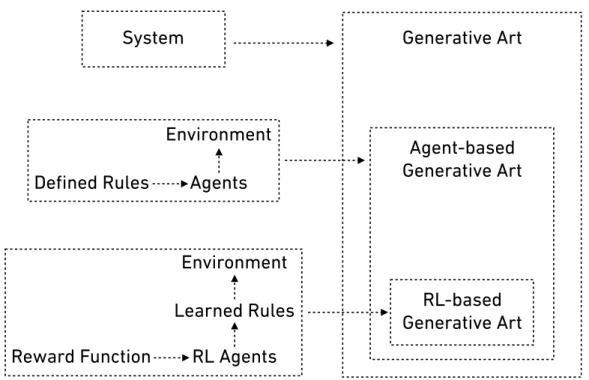
According to Galanter’s definition, the use of autonomous systems is a key element in generative art that artists partially or entirely define the rules of the systems. When a sys-tem contains autonomous agents, it derives a subclass of generative art that the artworks are generated by a sequence from behaviors of the autonomous agents in the system. An autonomous agent is considered as an entity “that makes its own choices about how to act in its environment without any influence from a leader or global plan” [63]. For example, artworks resulting from random walk [66], game of life [67], or diffusion-limited aggrega-tion [68] should be categorised in this subclass. Deep-learning artworks like DeepDream
or Portraits of Imaginary People should not be considered in this subclass because the
outcomes were not from a sequence of behaviors and the concept of autonomous agents were not clear in those scenarios. Here is an attempt to name this subclass asagent-based
generative art and the definition is:
Agent-based generative art is a subclass of generative art where the outcomes are generated by a sequence of behaviors from one or multiple autonomous agents in an environment, and the behaviors are controlled by a set of rules partially or entirely defined by artists.
In comparison to classic autonomous agents in generative art that follow a set of explicit rules, reinforcement learning agents can be seen as a kind of autonomous agents that learn the rules by interacting with their environments. Here the author proposes the term RL-based generative art to denote a novel form of generative art, which can be defined as:
RL-based generative art is a subclass of agent-based generative art that the outcomes are generated by a sequence of behaviors from one or multiple