Int. J. Innov., São Paulo, 8(1), p. 59 - 76, Jan. / Apr., 2020 59
Received on October 16, 2018/ Approved on December 21, 2018 Responsible Editor: Priscila Rezende da Costa
Evaluation Process: Double Blind Review e-ISSN: 2318-9975
https://doi.org/105585/iji.v8i1.343
-GOVERNMENT ADOPTION: A SYSTEMATIC REVIEW IN THE CONTEXT OF DEVELOPING NATIONS
1Anas Mustafa 2Othman Ibrahim 3Fathey Mohammed
ABSTRACT
Objective of the Study: This paper reviews the studies of e-government adoption in developing nations to come up with the factors that influence e-government adoption. Methodology/Approach: Secondary data was collected from the findings of other researches. Systematically, two reputable databases; Scopus and IEEE Explore were searched to retrieve studies of e-government adoption in developing nations.
Originality/Relevance: Adoption has a key role in the successful implementation of e-government initiatives in the context of developing nations. However, minimal research has been carried out to explore determinant factors of e-government services adoption among developing nations’ citizens.
Main Results: The theories and models applied in previous researches were identified. Moreover, the frequency of factors investigated in these studies was identified. The results showed that there are many studies investigated trust as an important factor of e-government adoption in developing nations, while there are other critical challenges such as security and awareness got less attention.
Theoretical/Methodological Contribution: This study results may open for future research based on the gap in theories applied and the factors investigated in the context of developing nations.
Keywords: E-government. Adoption. Factors. Developing Nations.
Cite it like this:
Mustafa, A., Ibrahim, O. & Mohammed, F. (2020). E-government adoption: a systematic review in the context of developing nations. International Journal Of Innovation, 8(1), 59-76.
http://dx.doi.org/10.5585/iji.v8i1.343.
1Universiti Teknologi Malaysia, Malaysia. [email protected]. 2Universiti Teknologi Malaysia, Malaysia. [email protected].
3School of Computing, Universiti Utara Malaysia (UUM), Malaysia. [email protected].
Int. J. Innov., São Paulo, 8(1), p. 59 - 76, Jan. / Apr., 2020 60
1
Introduction
E-Government enhances the access to government information, and delivery of services to citizens, partners, other organizations, and even government entities themselves. E-Government is considered as a tool for easy administrating of government functions and activities. It is defined as the use of Internet technology to enhance the accountability and functionality of the government functions, which include delivery of government services and information to citizens and businesses (DeBenedictis, Howell et al. 2002). E-Government can provide standard, efficient and convenient public services for both service provider and service recipient (Zheng, Chen et al.). Successful implementation and adoption of e-government insures low-cost, high speed, responsible, and reliable services to citizens, businesses and government agencies (Jaeger 2003, Jaeger and Thompson 2003, Ke 2004, Dwivedi, Papazafeiropoulou et al. 2006, Dwivedi and Williams 2008). E-Government implementation may require building a relatively highly cost infrastructure, but successfully adopting its services results in vast savings towards government’s operations. In addition, e-government can improve transparency, and reduce corrupt in public service delivery (Safeena and Kammani 2013).
For citizens, e-government offers a number of advantages. Citizens can interact with the government whenever and however they want (Kumar, Mukerji et al. 2007). They have the choice to access public information and receive services anywhere and anytime, instead of visiting an agency at a particular location at a particular time (Kumar, Mukerji et al. 2007). This can help mitigating the transaction costs of government services (Lee, Kirlidog et al. 2008). E-Government web portals provide information on government regulations, processes and services, so citizens can participate in democratic processes from anywhere at
any time. E-Government applications may include filling and submitting forms and applications for several services such as e-voting, e-visa, eID, and online bill and tax payment. Hence, various e-government projects have been implemented in different countries to offer services focusing on citizens' needs, and provide more accessibility of government services (Al-Obaithani and Ameen , Saha 2008). However, such advantages can only be realized if the e-government projects
considered successful from all
perspectives (Rana, Dwivedi et al. 2013). Indeed, following implementation, several governments faced many problems and do not get the expected benefits, and hence, most of them fail.
On the other hand, for those who need to use the technology they have to accept it (Al-Haderi 2013). Therefore, e-government has to carefully address the citizens’ perspective (Hujran, Al-dalahmeh et al. 2011). In order to develop citizen-centred e-services which provide citizens with accessible, relevant information and quality services, governments should first understand the factors that influence citizen adoption of this innovation (Carter and Belanger 2004). By understanding the motivation of citizens to use the e-government services, governments will be able to take strategic actions to increase the e-services adoption. Therefore, adoption is an important aspect to be considered for the success of e-government initiatives in developing nations. Accordingly, the government’s decision makers should understand the factors that would motivate the citizens to use electronic service delivery channels rather than traditional ones (Sharma 2015). Understanding the factors influencing citizens' behaviour toward adopting e-services provides a good guidance to implement e-government projects. Models of e-government adoption provide such an insight (Kanat and Ozkan 2009). However, most e-government projects have often low acceptance rate. In this regard, despite the considerable investments made by the government, majority of e-government initiatives often encounter
Int. J. Innov., São Paulo, 8(1), p. 59 - 76, Jan. / Apr., 2020 61
problems. Thus, the underlying factors that impact e-government services adoption and dissemination among citizens are still a favoured topic in research dedicated to IS (Kumar, Sachan et al. 2018). In addition, studies concerning citizen’s adoption in developing nations are still few and far between (Carter and Bélanger 2005, AlAwadhi and Morris 2008, Zhan, Wang et al. 2011, Ghazali, Mustapha et al. 2014). According to the U.N report (UN 2014), the developing nations citizens’ usage of e-services is still low, and although this is the case, e-government empirical studies are still confined to developed nations, while in the developing nations, IT studies are largely overlooked (Chatfield and Alhujran 2009, AlKhatib 2013). Therefore, the main aim of this study is to highlights the factors that affect the e-government services adoption in developing nations.
The road map in this paper is as follow. It starts with the introduction then E-government adoption, followed by the methodology applied in this research.
Next, E-government adoption in
developing nation based on the results of analysing the reviewed studies is discussed. Finally, the paper is concluded.
2
E-Government Adoption
In regarding to technology adoption, mainly the thought motivates the adoption. It means that adopters often adopt something perceiving that they will get benefit from it. In other words, the entity (whether organization or individual) has the freedom to decide to adopt or not. Among the challenges faced by adoption studies is determining situations whereby the actual adopter is the party that makes the adoption choice, because in majority of cases, the user of an innovation is not the same entity that makes the adoption decision (Conklin 2007). E-Government adoption is referred as the intention of the citizen to participate in government activity, access information and receive services from the government online
(Warkentin, Gefen et al. 2002). Carter & Belanger (2005) and Gilbert, Balestrini et al. (2004) describe e-government adoption as the intent to use or willingness to use e-government services. Although the phrases used to describe e-government may vary, they have the same meaning, which is the simple decision to use or not to use e-government services. To this end, the next e-government challenge is to make the citizen use the services frequently, since using e-government for example once a year would not be deemed as a meaningful use of its many applications (Safeena and Kammani 2013). Direct technology experience and technology acceptance drive the user to adopt the technology (Venkatesh, Morris et al. 2004, AlAwadhi and Morris 2008). Hence, the primary motive for e-government adoption in a country is that it enhances citizens’ access to the delivery of government services (Lofstedt 2012, Khanyako and Maiga 2013). E-Government services cover mail, tax, voting, health, banking, e-commerce, etc. Adoption of e-government entails the participation and contribution of entities from various stakeholders such as government implementers and end users because the definition of e-government is not satisfied unless the entire users are determined and addressed (Lowery 2001).
E-Government success depends on the adoption of its system and its actual use by the citizens (Khanyako and Maiga 2013). Promoting e-government benefits is among the primary goals of governments. In fact, benefits provided by e-government rather than traditional services have derived governments to invest in e-government service implementation. Following implementation, several governments face the problem of benefits falling short of their expectations, and hence, most of them fail. Therefore, it can be concluded that e-government projects’ success depends on support from government as well as its adoption by citizens (Ahmad 2013) which supports to the fact that it is significant for technology
Int. J. Innov., São Paulo, 8(1), p. 59 - 76, Jan. / Apr., 2020 62
users to accept the technology first (Al-Haderi 2013).
In many countries, e-government services adoption and use remain limited because of the fact that is primarily being guided by the factors on the supply side (Kolsaker and Lee-Kelley 2008, Verdegem and Verleye 2009). It is important for the governments to acknowledge that e-government success does not only hinge on the supplier side but also from the side of demand and the inclination towards online service adoption (Carter and Bélanger 2005). The adoption of information systems includes its adoption followed by use (post-adoption), with the former focused on the decision to implement information systems and the latter focused on the ongoing use and the process of diffusion (Daqing 2010). Therefore, it can be stated that one of the many issues of implementation any system is user’s adoption. This is significant in public organizations and it is one of the key issues that managers of organizations have to address (Shajari and Ismail 2013). In this regard, the government should be aware of the factors that could impact the successful e-services adoption (Zailani and Abd Salam 2006). Thus, understanding the influencing factors of e-government services adoption by citizens is crucial (Tanaka and Matsuda 2006).
In the first decade of this century, technology system implementation has been expansively studied but the successful adoption of IT has largely been ignored (Zailani and Abd Salam 2006). E-Government success depends on the way governments encourage citizens to use online public services (Daqing 2010). It is pertinent for decision makers to understand the factors that would boost citizens’ use of e-delivery channels. However, to date, studies dedicated to e-government services have been confined to developed rather than developing
nations (Titah and Barki 2006, AlAwadhi and Morris 2008). In this regard, adoption is a crucial aspect of e-government initiatives success in developing nations (Yonazi, Sol et al. 2010). However, as stated earlier, empirically studying the citizens’ adoption of e-government services in this part of the world has largely been ignored (AlAwadhi and Morris 2008, Alateyah, Crowder et al. 2013). Nevertheless, the factors that affect e-government services adoption and diffusion remains a popular topic in the field of IS in developing nations (Kumar, Mukerji et al. 2007, Akkaya, Wolf et al. 2012).
3
Methodology
This work is a preliminary review study, so secondary data collected from the findings of other researchers are used. Two reputable databases were used to search studies of e-government adoption in developing nations; Scopus and IEEE Explore. Government adoption” “E-Government services” and “E-“E-Government
to citizens” with “developing
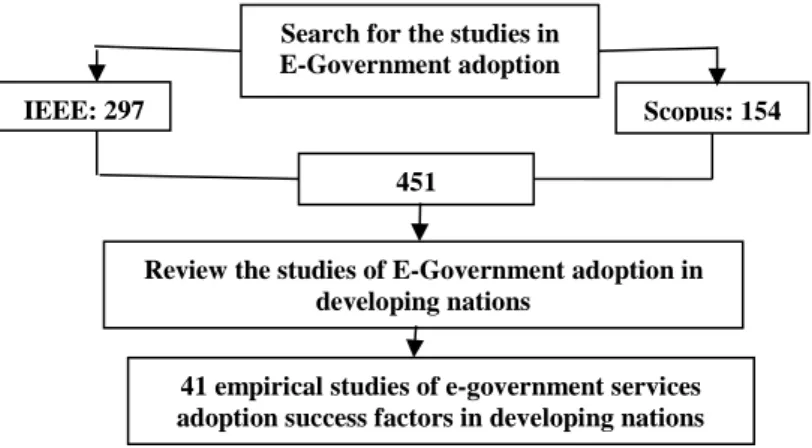
countries/nations” were used as the keywords to retrieve the related articles. The aim of this search was to find only research papers which are directly or indirectly related to the e-government adoption in developing notions to filter out the specific papers on the factors affecting e-government services adoption. A total of 451 (154 articles in Scopus and 297 articles in IEEE) on e-government adoption research was found. These studies were carefully analysed to get only those articles which have studied the success factors aspects of e-government services in developing nations. The investigation indicated that 41 of these studies focus on the e- government adoption success factors in developing nations as shown in Figure 1.
Int. J. Innov., São Paulo, 8(1), p. 59 - 76, Jan. / Apr., 2020 63
Fig1. - Methodology Process
4
E-Government Adoption in
Developing Nations
Scanning the reviewed papers across the years shows that the trend of
e-government adoption studies in developing countries starts in 2007 and the number of studies increases through the last years. Figure 2 represents the statistics of the number of publications since 2007 till 2018.
Fig2. - Papers distribution through the years (2007 – 2018)
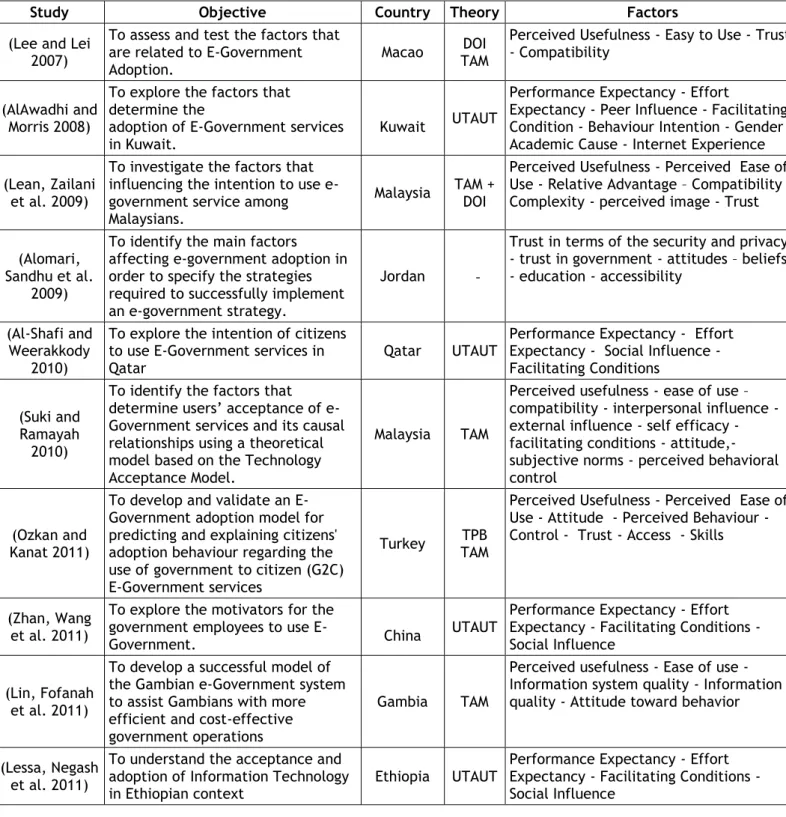
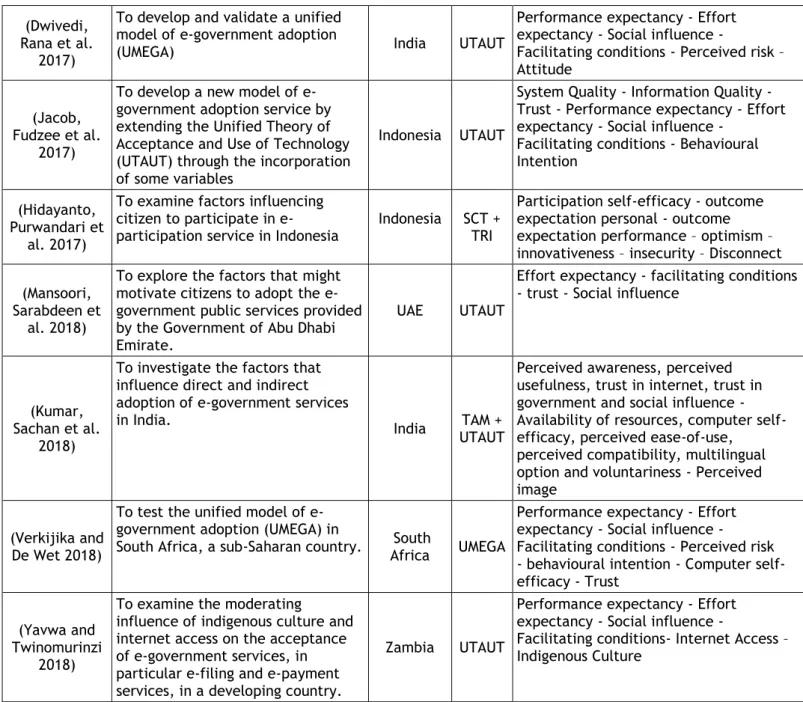
Table 1 shows e-government adoption studies that were conducted in some developing nations (2007-2018). Reviewing the literature indicates that
several models have been examined to determine the influencing factors of e-government services adoption in developing nations. Adoption models and
1 1 2 2 4 3 2 3 4 6 9 4 0 1 2 3 4 5 6 7 8 9 10 2007 2008 2009 2010 2011 2012 2013 2014 2015 2016 2017 2018
Search for the studies in E-Government adoption
Scopus: 154 451
Review the studies of E-Government adoption in developing nations
41 empirical studies of e-government services adoption success factors in developing nations IEEE: 297
Int. J. Innov., São Paulo, 8(1), p. 59 - 76, Jan. / Apr., 2020 64
theories, such as Theory of Reasoned Action (TRA), the Theory of Planned Behavior (TPB), the Technology Adoption Model (TAM), the Diffusion of Innovation (DOI), Social Cognitive Theory (SCT), e-government adoption model, Technology
Readiness Index (TRI) and the Unified Theory of Adoption and Use of Technology (UTAUT) were used to investigate the adoption of e-government services in developing nations.
Table 1 - E-Government Adoption Studies in Developing Nations
Study Objective Country Theory Factors
(Lee and Lei 2007)
To assess and test the factors that are related to E-Government
Adoption. Macao
DOI TAM
Perceived Usefulness - Easy to Use - Trust - Compatibility
(AlAwadhi and Morris 2008)
To explore the factors that determine the
adoption of E-Government services in Kuwait.
Kuwait UTAUT
Performance Expectancy - Effort
Expectancy - Peer Influence - Facilitating Condition - Behaviour Intention - Gender - Academic Cause - Internet Experience (Lean, Zailani
et al. 2009)
To investigate the factors that influencing the intention to use e-government service among Malaysians.
Malaysia TAM + DOI
Perceived Usefulness - Perceived Ease of Use - Relative Advantage – Compatibility - Complexity - perceived image - Trust
(Alomari, Sandhu et al.
2009)
To identify the main factors
affecting e-government adoption in order to specify the strategies required to successfully implement an e-government strategy.
Jordan
-Trust in terms of the security and privacy - trust in government - attitudes – beliefs - education - accessibility
(Al-Shafi and Weerakkody
2010)
To explore the intention of citizens to use E-Government services in
Qatar Qatar UTAUT
Performance Expectancy - Effort Expectancy - Social Influence - Facilitating Conditions
(Suki and Ramayah
2010)
To identify the factors that
determine users’ acceptance of e
-Government services and its causal relationships using a theoretical model based on the Technology Acceptance Model.
Malaysia TAM
Perceived usefulness - ease of use –
compatibility - interpersonal influence - external influence - self efficacy - facilitating conditions - attitude,- subjective norms - perceived behavioral control
(Ozkan and Kanat 2011)
To develop and validate an E-Government adoption model for predicting and explaining citizens' adoption behaviour regarding the use of government to citizen (G2C) E-Government services
Turkey TAM TPB
Perceived Usefulness - Perceived Ease of Use - Attitude - Perceived Behaviour - Control - Trust - Access - Skills
(Zhan, Wang et al. 2011)
To explore the motivators for the government employees to use
E-Government. China
UTAUT Performance Expectancy - Effort Expectancy - Facilitating Conditions - Social Influence
(Lin, Fofanah et al. 2011)
To develop a successful model of the Gambian e-Government system to assist Gambians with more efficient and cost-effective government operations
Gambia TAM
Perceived usefulness - Ease of use - Information system quality - Information quality - Attitude toward behavior
(Lessa, Negash et al. 2011)
To understand the acceptance and adoption of Information Technology
in Ethiopian context Ethiopia UTAUT
Performance Expectancy - Effort Expectancy - Facilitating Conditions - Social Influence
Int. J. Innov., São Paulo, 8(1), p. 59 - 76, Jan. / Apr., 2020 65
(Alomari, Woods et al.
2012)
To identify factors that affect E-Government adoption in the
developing country of Jordan. Jordan TAM DOI
Trust in Internet - Trust in Government - Attitudes – Beliefs - Internet and
Computer Skill – Website Design - Relative Advantage – Compatibility - Complexity - Perceived Ease of Use - Perceived Usefulness
(Rehman, Esichaikul et
al. 2012)
To identify critical factors that enable citizens to adopt e‐
Government services in a society, which is at a rudimentary stage of e‐
Government adoption.
Pakistan
-Quality of service - Web site design- Security and trust - E‐readiness- Level of e‐government
(Olatubosun and Madhava
Rao 2012)
To identify the determinants of civil servant users' adoption of
e-government services in four different ministries in Ondo State Nigeria
Nigeria UTAUT
Performance expectancy, self-efficacy, social influence and attitude behavior
(Alateyah, Crowder et al.
2013)
To identify the influential factors that affect the citizens' intention to adopt E-Government
Services in Saudi Arabia.
Saudi
Arabia TAM DOI
Quality of Service - Diffusion of Innovation - Computer Literacy - Culture –
Awareness - Technical Infrastructure - Website Design - Security - Privacy - Trust (Ahmad,
Markkula et al. 2013)
To study E-Government services in
Pakistan from the user’s point of
view.
Pakistan UTAUT Performance Expectancy - Effort Expectancy - Facilitating Conditions - Social Influence
(Alomari, Sandhu et al.
2014)
To explore how citizens socialize and network in relation to using and
adopting E-Government Jordan -
Trust in Internet - Religious Views - Internet and Computer Skills - Digital Divide - Word of Mouth – Favouritism -Resistance to Change - Relative Advantage (Ghazali,
Mustapha et al. 2014)
To identify which factors that may be consider in predicting the intention of people regarding the usage of the service.
Malaysia TPB
Subjective Norms - Perceived Behavioural Control - Behavioural Intention
(Freire, Fortes et al. 2014)
To explores the factors explaining the adoption of E-Government
platforms by Portuguese citizens. Portuguese -
Social influence - Perceived security - Trust - Perceived Privacy - Relative Advantage - Web Design - Perceived Ease Of Use - Behavioural Intention Adoption (Hujran,
Al-Debei et al. 2015)
To develop an integrative research model by extending extant TAM through the incorporation of a set of social, political, and cultural
constructs: trust, perceived public value, and national culture.
Jordan TAM
Perceived usefulness - Perceived ease of use – trust - perceived public value - national culture
(Ahmed, Alhadi et al.
2015)
To identify the factors influencing
citizens’ acceptance and intention
to use e-government in Sudan
Sudan TAM Perceived usefulness - Perceived ease of use - Perceived trust - Quality of service - Advertising
(Susanto and Aljoza 2015)
To investigate influence of PU, PEU, Social Norms, Facilitating
Conditions, and Trust toward individual acceptance of a new e-government service in a developing country.
Indonesia TAM
PU – PEU - Social Norms - Facilitating Conditions - Trust
(Mohajerani, Shahrekordi et
al. 2015)
To investigate the impact of factors influencing on trust in e-government and intention to use e-government system.
Iran
-Privacy – security - trust in technology - information quality
Int. J. Innov., São Paulo, 8(1), p. 59 - 76, Jan. / Apr., 2020 66
(Ibrahim and Zakaria 2016)
To determine the factors enhancing e-government adoption in a
developing nation (Iraq) from employee perspective.
Iraq UTAUT
website quality, awareness, computer self-efficacy, capability of IT workforce, Behavioural intention, Effort expectancy, Facilitating condition, Performance expectancy, Social influence, Training (ElKheshin and
Saleeb 2016)
To investigate determinants and factors necessary to enhance adoption of citizens for government services in developing countries, with particular focus on Egypt
Egypt TAM
Website design - Perceived Public Value - Trust in Government - Trust in the Internet - Perceived Ease of Use - Perceived Usefulness – Attitude - Behaviour intention
(Alharbi, Kang et al. 2016)
To examine a number of factors that may influence the intentions of citizens to engage in e-participation activities on e-government
websites.
Saudi
Arabia -
Trust - subjective norms
(Asmi, Zhou et al. 2016)
To investigate the citizens behaviour in terms of social
influence and trust in the existing e-services by the government while filing their tax online.
Pakistan TAM
Trust - Social Influence - Perceived Ease of Use - Perceived Usefulness
(Amagoh 2016)
To identify the benefits of
e-government, and examine factors of e-government diffusion in Nigeria.
Nigeria
TAM, DOI and UTAUT
Accessibility, efficiency, transparency and accountability, economic, democracy, reliability, Trust in Government, Trust in the Internet, Perceived Ease of Use, Perceived Usefulness, Relative Advantage, Compatibility, Digital divide,
Technological infrastructure, Skilled human capital
(Mutimukwe, Kolkowska et
al. 2017)
To investigates information privacy concerns, perceptions of privacy practices, trust beliefs and behavior intentions towards using
e-government services in Rwanda.
Rwanda -
Privacy - Trust
(Kurfalı,
Arifoğlu et al.
2017)
To investigate underlying factors that play role in citizens' decision to use e-government services in Turkey.
Turkey UTAUT
Trust of internet - Trust of government - Performance expectancy - Effort
expectancy - Social influence - Facilitating conditions
(Munyoka and Maharaj 2017)
To investigate those factors that
affect citizens’ decisions to use e
-government services in the SADC region.
SADC
Countries UTAUT
Facilitating conditions – e-government awareness - behavioural intention
(de Moraes, Hermínio et al. 2017)
To study which factors influence the
use of e-government in Brazil Brazil TAM - UTAUT
Perceived Benefit; Facilitating Conditions; Perceived Ease of Use; Social Influence; Perceived Security; Trust in the
Government and Habit. (Lallmahomed,
Lallmahomed et al. 2017)
To investigate the antecedents of e-Government adoption in a small
island developing state. Mauritius UTAUT
Performance expectancy - Effort expectancy - Social influence - Facilitating conditions - Price value –
awareness - Computer self-efficacy – Trust (Khanra and
Joseph 2017)
To study the users' perception about e-Government services and
investigate the key variables that are most salient to the Indian populace.
India
-Reliability – Security – Efficiency –
Int. J. Innov., São Paulo, 8(1), p. 59 - 76, Jan. / Apr., 2020 67
(Dwivedi, Rana et al.
2017)
To develop and validate a unified model of e-government adoption
(UMEGA) India UTAUT
Performance expectancy - Effort expectancy - Social influence -
Facilitating conditions - Perceived risk –
Attitude (Jacob,
Fudzee et al. 2017)
To develop a new model of e-government adoption service by extending the Unified Theory of Acceptance and Use of Technology (UTAUT) through the incorporation of some variables
Indonesia UTAUT
System Quality - Information Quality - Trust - Performance expectancy - Effort expectancy - Social influence -
Facilitating conditions - Behavioural Intention
(Hidayanto, Purwandari et
al. 2017)
To examine factors influencing citizen to participate in
e-participation service in Indonesia Indonesia SCT + TRI
Participation self-efficacy - outcome expectation personal - outcome expectation performance – optimism –
innovativeness – insecurity – Disconnect (Mansoori,
Sarabdeen et al. 2018)
To explore the factors that might motivate citizens to adopt the e-government public services provided by the Government of Abu Dhabi Emirate.
UAE UTAUT
Effort expectancy - facilitating conditions - trust - Social influence
(Kumar, Sachan et al.
2018)
To investigate the factors that influence direct and indirect adoption of e-government services
in India. India TAM +
UTAUT
Perceived awareness, perceived usefulness, trust in internet, trust in government and social influence - Availability of resources, computer self-efficacy, perceived ease-of-use, perceived compatibility, multilingual option and voluntariness - Perceived image
(Verkijika and De Wet 2018)
To test the unified model of e-government adoption (UMEGA) in
South Africa, a sub-Saharan country. South Africa UMEGA
Performance expectancy - Effort expectancy - Social influence -
Facilitating conditions - Perceived risk - behavioural intention - Computer self-efficacy - Trust
(Yavwa and Twinomurinzi
2018)
To examine the moderating
influence of indigenous culture and internet access on the acceptance of e-government services, in particular e-filing and e-payment services, in a developing country.
Zambia UTAUT
Performance expectancy - Effort expectancy - Social influence -
Facilitating conditions- Internet Access –
Indigenous Culture
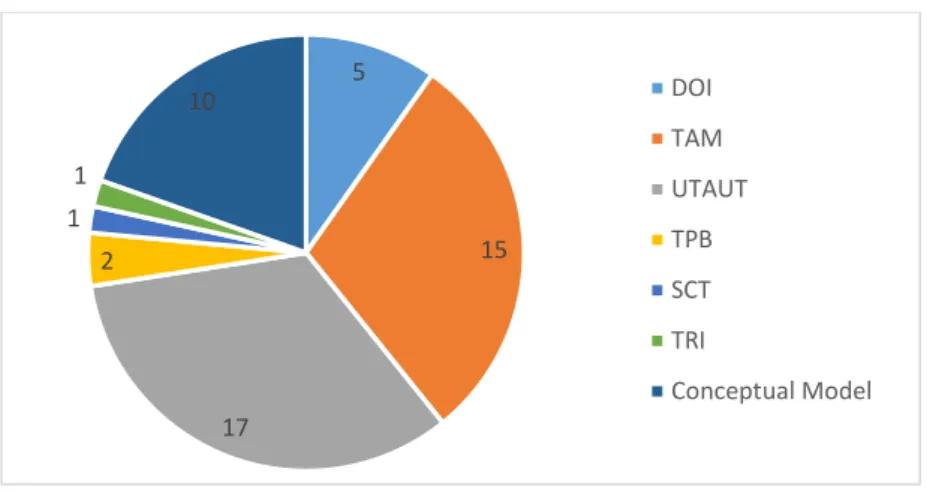
Fig 3 represents the frequency of applying each model in the related literature. It shows that UTAUT and TAM are the most models used to investigate the factors influencing e-government services in developing nations with 17 and 15 studies, respectively while 10 studies proposed a conceptual model and 5 studies
adopted DOI, 2 studies TPB, and 1 for SCT and TRI. Some of these studies integrated more than one theory with removing or adding other factors to come up with comprehensive model which can be fit to a specific country.
Int. J. Innov., São Paulo, 8(1), p. 59 - 76, Jan. / Apr., 2020 68
Fig3. - The frequency of models in the related literature
In addition, Table 1 shows that the studies were conducted in the context of different countries including Saudi Arabia, Jordan, China, Malaysia, Portuguese, Kuwait, Pakistan, Qatar, South Africa, Zambia, India, Brazil, Indonesia, UAE, Mauritius, Egypt, Iraq, Sudan, Nigeria, Ethiopia, Rwanda and Turkey.
Additionally, Table 1 presents the factors that were examined in each study. It can be noticed that in each study factors from the literature or from the context were added to the original model. These factors include quality of service, computer literacy, culture, awareness,
technical infrastructure, website design, security, privacy, digital divide, word of mouth, resistance to change, access, , interpersonal influence, external influence, level of e‐government, perceived public value, advertising, training, responsiveness, perceived risk,
outcome expectation, optimism,
insecurity, disconnect, multilingual option & voluntariness and trust. Many of these factors are repeated in many studies with different models. Table 2 explains the frequently factors used in developing nations based on the Table 1. Fig 4 represents the factors repeated 3 or more times in the investigated studies.
Table 2 - Frequently Factors Used in Developing Nations
Factors (A la teya h, Cro wd er et a l. 2 01 3) (A lo m ari , Woo ds et a l. 2 01 2) (Lee a nd Lei 20 07 ) (A lA wadhi a nd Mo rr is 2 00 8) (O zkan a nd Ka na t 20 11 ) (Less a, Ne ga sh et a l. 2 01 1) (O la tub os un and Ma dha va R ao 2 01 2) (Al -Sha fi a nd We era kk od y 20 10 ) (A hma d, Ma rkku la et a l. 2 01 3) (A lo m ari , Sa nd hu et a l. 2 01 4) (Z ha n, Wa ng et a l. 2 01 1) (G ha za li , Mus ta pha et a l. 2 01 4) (F rei re, F orte s et a l. 2 01 4) (Lean, Z ai la ni et a l. 2 00 9) (A lo m ari , Sa nd hu et a l. 2 00 9) (Suki and R am aya h 20 10 ) (Li n, F of ana h et a l. 2 01 1) (R ehma n, Es icha iku l et a l. 2 01 2) (Al -Huj ra n, A l-De bei et a l. 2 01 5) (A hmed, A lha di et a l. 2 01 5) (Sus ant o and A lj oz a 20 15 ) (Mo ha jera ni , Sha hrekor di et a l. 2 01 5) (Ib ra hi m a nd Z akar ia 2 01 6) (El Khes hi n and Sa leeb 2 01 6) (A lha rbi , Ka ng et a l. 2 01 6) (A sm i, Z hou et a l. 2 01 6) (A m ag oh 20 16 ) (Mutim uk we , Ko lkows ka et a l. 2 01 7) ( Kur fa lı , A ri fo ğlu et a l. 2 01 7 ) (Munyo ka and Ma ha ra j 20 17 ) (d e Mo ra es , Herm íni o et a l. 2 01 7) (La ll m ahom ed , La ll m ah om ed et a l. 2017 ) (Kha nra a nd Jos ep h 2017 ) (Dw iv ed i, R ana et a l. 2 01 7) (Jac ob , Fud zee et a l. 2 01 7) (Hi da ya nt o, Purw and ari et a l. 2 01 7) (Ma ns oo ri , Sa ra bd ee n et a l. 2 01 8) (Kum ar, Sa cha n et a l. 2 01 8) (Verki ji ka and De We t 20 18 ) (Y av wa and T wino m uri nz i 20 18 ) Quality of Service √ √ √ √ √ √ √ √ Computer skills √ √ √ √ Computer Literacy √ √ 5 15 17 2 1 1 10 DOI TAM UTAUT TPB SCT TRI Conceptual Model
Int. J. Innov., São Paulo, 8(1), p. 59 - 76, Jan. / Apr., 2020 69 Culture √ √ √ Awareness √ √ √ √ √ Website Design √ √ √ √ √ Security √ √ √ √ √ √ √ Privacy √ √ √ √ √ Trust √ √ √ √ √ √ √ √ √ √ √ √ √ √ √ √ √ √ √ √ √ √ √ √ √ Technical Infrastructure √ √ √ √ Relative advantage √ √ √ √ √ Beliefs √ √ Attitude √ √ √ √ √ √ √ √ Perceived Usefulness √ √ √ √ √ √ √ √ √ √ √ √ √ Complexity √ √ Perceived Ease of Use √ √ √ √ √ √ √ √ √ √ √ √ √ √ √ Compatibility √ √ √ √ √ √ √ Performance Expectancy √ √ √ √ √ √ √ √ √ √ √ √ √ √ Effort Expectancy √ √ √ √ √ √ √ √ √ √ √ √ √ Social influence √ √ √ √ √ √ √ √ √ √ √ √ √ √ √ √ √ √ √ Facilitating condition √ √ √ √ √ √ √ √ √ √ √ √ √ √ √ √ √ Behaviour Intention √ √ √ √ √ √ √ √ √ Access √ √ √ Perceived Behaviour Control √ √ √ Digital Divide √ √ Word of mouth √ Resistance to change √ Religious view √ Subjective norms √ √ √ Perceived image √ √ Self-efficacy √ √ √ √ √ √ √ Interpersonal influence √ √ External influence √ Level of e‐ government √ Perceived public value √ √ Advertising √ Training √ Habit √ Price value √ √ Responsiveness √
Int. J. Innov., São Paulo, 8(1), p. 59 - 76, Jan. / Apr., 2020 70 Perceived risk √ √ Outcome expectation √ Optimism √ Insecurity √ Disconnect √ Multilingual option & voluntariness √ Efficiency √ Transparency & accountability, √ Democracy √ Reliability √
Fig4. - The factors repeated 3 or more times in the investigated studies
Many factors are examined in most of the reviewed studies. Trust was tested in most of the studies and all of these studies found that there is a significant relationship between trust and adoption of e-government services. Some of the studies used trust as two parts: trust of e-government and trust of the internet
(ElKheshin and Saleeb 2016, Kurfalı, Arifoğlu et al. 2017, Kumar, Sachan et al. 2018). Social influence, facilitating conditions, perceived ease of use, perceived usefulness, performance expectancy and effort expectancy are also among the most examined factors in the related literature. 0 5 10 15 20 25 30
Int. J. Innov., São Paulo, 8(1), p. 59 - 76, Jan. / Apr., 2020 71
5
Discussion
Based on findings reported from different developing nations, the factors influencing e-government services depend largely on the context of the country, and hence, no clear classification of adoption factors exist (Safeena and Kammani 2013). Furthermore, willingness to adopt e-government is important to its success and relatively few studies have extensively examined citizens’ adoption of e-government in developing nations. So, governments in developing nations should consider e-government adoption as a challenge and it is important to know the factors that can encourage citizens’ adoption. In addition, the adoption challenge can be addressed through investigation and proposing a suitable framework of e-government adoption.
According to several researchers, although governments of developing nations are convinced of the benefits of e-government, challenges still exist and these include privacy, security, trust, culture, computer literacy and IT infrastructure. The study by (Ahmad, Markkula et al. 2013) mentioned that adoption challenges are: lack of appropriate support, lack of awareness and user data privacy. In this regard, adoption is a crucial aspect for e-government initiatives success in developing nations (Yonazi, Sol et al. 2010) but as stated, e-government services adoption by citizens in this part of the world has largely been ignored (AlAwadhi and Morris 2008, Alateyah, Crowder et al. 2013). Nevertheless, the factors that affect e-government services adoption remains a popular topic in the field of Information System (Kumar, Mukerji et al. 2007, Akkaya, Wolf et al. 2012). As has been shown in the results, the trend of these kinds of studies is growing. However, to reach the maturity, further investigating of the factors that affect citizens in these countries to adopt e-government services should be conducted.
The results also show that TAM and UTAUT are the most models applied to examine the affecting factors. In addition, factors were integrated to these two models or other and show significant effect. These two models can be integrated with other models to test more factors with different aspects.
Notably, many factors have been examined with different names and same meaning as explained by (Venkatesh, Morris et al. 2003). For example, the ease of use (perceived ease of use of TAM, technical complexity of DOI, effort expectancy of UTAUT) and the usefulness (perceived usefulness of TAM, relative advantage of DOI, and performance expectancy of UTAUT) are of these factors. These factors were used many times in the literature. Moreover, there are many factors were added to the theories such as (security, privacy, awareness, culture and trust). The trust was the most repeated factor in these studies. So, these factors should be considered in the future by designing new comprehensive theory for e-government adoption. Although there are many challenges of e-government adoption mentioned by many studies in developing nations, but most of these challenges are not used frequently as influence factors of e-government adoption in developing nations as shown in Table 2. Fo r example, security and privacy were mentioned as the most important challenges (Schaupp, Carter et al. 2010, Venkatesh, Sykes et al. 2011, Harby, Qahwaji et al. 2012, UN 2012, Ahmad, Markkula et al. 2013, Al-Aghbari, Abu-Ulbeh et al. 2015, Otieno and Omwenga 2015) in developing nations but only two times used in these studies.
6
Conclusion
This study reviewed the studies of e-government adoption in developing nations to come up with the most important challenges and success factors of e-government adoption. 41 studies were reviewed. The theories and models
Int. J. Innov., São Paulo, 8(1), p. 59 - 76, Jan. / Apr., 2020 72
applied in these studies were identified. The countries within which these studies were conducted also identified. Moreover, the factors tested in these studies were analysed. This study found that the most frequent factor added to the main models was trust, while there are other challenges in developing nations like security, privacy and awareness got less attention in the previous studies.
References
Ahmad, M. O., J. Markkula and M. Oivo (2013). "Factors affecting e‐ government adoption in Pakistan: a citizen's perspective." Transforming Government: People, Process and Policy 7(2): 225-239.
Ahmad, M. O. M., Jouni Oivo, Markku (2013). "Factors affecting e-government adoption in Pakistan: a citizen's perspective." Transforming Government: People, Process and Policy 7(2): 225-239.
Ahmed, T., N. Alhadi and M. E. Seliaman (2015). Acceptance of e-Government Services in Sudan: an Empirical Investigation. Cloud Computing (ICCC), 2015 International Conference on, IEEE.
Akkaya, C., P. Wolf and H. Krcmar (2012). Factors influencing citizen adoption of e-government services: A cross-cultural comparison (research in progress). System Science (HICSS), 2012 45th Hawaii International Conference on, IEEE.
Al-Aghbari, A., W. Abu-Ulbeh, O. Ibrahim and F. Saeed (2015). "The readiness and limitations of e-government in yemen." Jurnal Teknologi 73(2): 107-115.
Al-Haderi, S. M. S. (2013). "The Effect of Self-Efficacy in the Acceptance of Information Technology in the Public Sector." International Journal of Business and Social Science4.
Al-Hujran, O., M. Al-dalahmeh and A. Aloudat (2011). "The Role of National Culture on Citizen Adoption of eGovernment Services: An Empirical Study." Electronic Journal of e-Government 9(2).
Al-Hujran, O., M. M. Al-Debei, A. Chatfield and M. Migdadi (2015). "The imperative of influencing citizen attitude toward e-government adoption and use." Computers in human Behavior 53: 189-203.
Al-Obaithani, F. S. and A. A. Ameen "Toward Proposing SMART-Government Maturity Model: Best Practices, International Standards, and Six-Sigma Approach."
Al-Shafi, S. and V. Weerakkody (2010). "Factors affecting e-government adoption in the state of Qatar." European
and Mediterranean Conference on
Information Systems 2010.
Alateyah, S. A., R. M. Crowder and G. B. Wills (2013). Factors influencing citizen intention to adopt egovernment in Saudi Arabia. Information Society (i-Society), 2013 International Conference on, IEEE.
Alawadhi, S. and A. Morris (2008). The Use of the UTAUT Model in the Adoption of E-government Services in Kuwait. Hawaii International Conference on System Sciences, Proceedings of the 41st Annual, IEEE.
Alharbi, A., K. Kang and I. Hawryszkiewycz (2016). "The Influence of Trust and subjective Norms on Citizens Intentions to Engage in E-participation on E-government Websites." arXiv preprint arXiv:1606.00746.
Alkhatib, H. (2013). "E-government systems success and user acceptance in developing countries: The role of perceived support quality."
Alomari, M., P. Woods and K. Sandhu (2012). "Predictors for
e-government adoption in Jordan:
Deployment of an empirical evaluation based on a citizen-centric approach."
Int. J. Innov., São Paulo, 8(1), p. 59 - 76, Jan. / Apr., 2020 73
Information Technology & People 25(2): 207-234.
Alomari, M. K., K. Sandhu and P. Woods (2009). E-government adoption in the Hashemite Kingdom of Jordan: factors
from social perspectives. Internet
Technology and Secured Transactions, 2009. ICITST 2009. International Conference for, IEEE.
Alomari, M. K., K. Sandhu and P. Woods (2014). "Exploring citizen perceptions of barriers to e-government adoption in a developing country."
Transforming Government: People,
Process and Policy 8(1): 131-150.
Amagoh, F. (2016). "Determinants of e-government diffusion in Nigeria: An examination of theoretical models." Information Development 32(4): 1137-1154.
Asmi, F., R. Zhou and L. Lu (2016). "E-government Adoption in Developing Countries: Need of Customer-centric Approach: A Case of Pakistan." International Business Research 10(1): 42. Carter, L. and F. Belanger (2004). Citizen adoption of electronic government initiatives. System Sciences, 2004. Proceedings of the 37th Annual Hawaii International Conference on, IEEE.
Carter, L. and F. Bélanger (2005). "The utilization of e‐government services: citizen trust, innovation and acceptance factors*." Information Systems Journal 15(1): 5-25.
Chatfield, A. T. and O. Alhujran (2009). "A cross-country comparative analysis of e-government service delivery among Arab countries." Information Technology for Development 15(3): 151-170.
Conklin, W. A. (2007). Barriers to Adoption of e-Government. System Sciences, 2007. HICSS 2007. 40th Annual Hawaii International Conference on, IEEE. Daqing, Z. (2010). Chinese E-government systems Adoption: from Institutional theory. Business and
E-Government (ICEE), 2010 International Conference on, IEEE.
de Moraes, S. M., G. Hermínio and F. de Souza Meirelles (2017). "User’s Perspective of Eletronic Government Adoption in Brazil." Journal of technology management & innovation 12(2): 1-10.
DeBenedictis, A., W. Howell, R. Figueroa and R. Boggs (2002). "E-government defined: an overview of the next big information technology challenge." Issues in Information Systems 3(1): 130-136.
Dwivedi, Y. K., A.
Papazafeiropoulou, H. Gharavi and K. Khoumbati (2006). "Examining the socio-economic determinants of adoption of the &# 39; Government Gateway&# 39; initiative in the UK." Electronic Government, an International Journal 3(4): 404-419.
Dwivedi, Y. K., N. P. Rana, M. Janssen, B. Lal, M. D. Williams and M. Clement (2017). "An empirical validation of a unified model of electronic government adoption (UMEGA)." Government Information Quarterly 34(2): 211-230.
Dwivedi, Y. K. and M. D. Williams (2008). "Demographic influence on UK citizens'e-government adoption." Electronic Government, an International Journal 5(3): 261-274.
ElKheshin, S. and N. Saleeb (2016). A conceptual model for E-government adoption in Egypt. Computer Engineering & Systems (ICCES), 2016 11th International Conference on, IEEE.
Freire, M., N. Fortes and J. Barbosa (2014). Decisive factors for the adoption of technology in E-government platforms. Information Systems and Technologies (CISTI), 2014 9th Iberian Conference on, IEEE.
Ghazali, N., R. M. R. Mustapha and N. M. Mozie (2014). The adoption factors of using e-Government services:(Study
case in Malaysia). Technology,
Int. J. Innov., São Paulo, 8(1), p. 59 - 76, Jan. / Apr., 2020 74
and Environment (TIME-E), 2014 2nd International Conference on, IEEE.
Gilbert, D., P. Balestrini and D. Littleboy (2004). "Barriers and benefits in the adoption of e-government." International Journal of Public Sector Management 17(4): 286-301.
Harby, F., R. Qahwaji and M. Kamala (2012). "End-Users’ Acceptance of Biometrics Authentication to Secure E-Commerce within the Context of Saudi Culture: Applying the UTAUT Model." Globalization, Technology Diffusion and Gender Disparity: Social Impacts of ICTs: 225-246.
Hidayanto, A. N., B. Purwandari, R. Yuliansyah and M. Kosandi (2017). Factors
influencing citizen's intention to
participate in e-participation: Integrating Technology Readiness on Social Cognitive Theory. Informatics and Computing (ICIC), 2017 Second International Conference on, IEEE.
Ibrahim, O. A. and N. H. Zakaria (2016). "E-GOVERNMENT SERVICES IN DEVELOPING COUNTRIES: A SUCCESS ADOPTION MODEL FROM EMPLOYEES PERSPECTIVE." Journal of Theoretical & Applied Information Technology 94(2).
Jacob, D. W., M. F. M. Fudzee, M. A. Salamat, S. Kasim, H. Mahdin and A. A. Ramli (2017). Modelling end-user of electronic-government service: the role of information quality, system quality and trust. IOP Conference Series: Materials Science and Engineering, IOP Publishing.
Jaeger, P. T. (2003). "The endless
wire: E-government as global
phenomenon." Government Information Quarterly 20(4): 323-331.
Jaeger, P. T. and K. M. Thompson (2003). "E-government around the world: lessons, challenges, and future directions." Government Information Quarterly 20(4): 389-394.
Kanat, I. and S. Ozkan (2009). "Explaining Citizen Adoption of Government to Citizen Service: A Model
Based on Theory of Planned Behaviour (TPB)." EMCIS 2009, Turkey.
Ke, W. W., Kwok Kee (2004). "Successful e-government in Singapore." Communications of the ACM 47(6): 95-99. Khanra, S. and R. P. Joseph (2017). Adoption and Diffusion of e-Government Services: the Impact of Demography and Service Quality. Proceedings of the 10th International Conference on Theory and Practice of Electronic Governance, ACM.
Khanyako, E. and G. Maiga (2013). An information security model for e-government services adoption in Uganda. IST-Africa Conference and Exhibition (IST-Africa), 2013, IEEE.
Kolsaker, A. and L. Lee-Kelley (2008). "Citizens' attitudes towards e-government and e-governance: a UK study." International Journal of Public Sector Management 21(7): 723-738.
Kumar, R., A. Sachan and A. Mukherjee (2018). "Direct vs indirect e-government adoption: an exploratory study." Digital Policy, Regulation and Governance 20(2): 149-162.
Kumar, V., B. Mukerji, I. Butt and A. Persaud (2007). "Factors for successful e-government adoption: a conceptual framework." The electronic journal of e-Government 5(1): 63-76.
Kurfalı, M., A. Arifoğlu, G. Tokdemir and Y. Paçin (2017). "Adoption of e-government services in Turkey." Computers in Human Behavior 66: 168-178.
Lallmahomed, M. Z., N.
Lallmahomed and G. M. Lallmahomed (2017). "Factors influencing the adoption of e-Government Services in Mauritius." Telematics and Informatics 34(4): 57-72.
Lee, K. C., M. Kirlidog, S. Lee and G. G. Lim (2008). "User evaluations of tax filing web sites: A comparative study of South Korea and Turkey." Online information review 32(6): 842-859.
Lessa, L. F., S. Negash and D. L. Amoroso (2011). Acceptance of WoredaNet
Int. J. Innov., São Paulo, 8(1), p. 59 - 76, Jan. / Apr., 2020 75
E-Government Services in Ethiopia: Applying the UTAUT Model. AMCIS.
Lin, F., S. S. Fofanah and D. Liang (2011). "Assessing citizen adoption of e-Government initiatives in Gambia: A validation of the technology acceptance model in information systems success." Government Information Quarterly 28(2): 271-279.
Lofstedt, U. (2012).
"E-Government-Assesment of Current
Research and Some Proposals for Future Directions." International journal of public information systems 1(1).
Lowery, L. M. (2001). "Developing a successful e-government strategy." Retrieved May 28: 2010.
Mansoori, K. A. A., J. Sarabdeen
and A. L. Tchantchane (2018).
"Investigating Emirati citizens’ adoption of e-government services in Abu Dhabi using modified UTAUT model." Information Technology & People 31(2): 455-481.
Mohajerani, S., S. Z. Shahrekordi and M. Azarlo (2015). The impact of privacy and security concerns, trust in technology and information quality on trust in e-government and intention to use e-government. e-Commerce in Developing Countries: With focus on e-Business (ECDC), 2015 9th International Conference on, IEEE.
Munyoka, W. and M. Maharaj (2017). Understanding eGovernment utilisation within the SADC. IST-Africa Week Conference (IST-Africa), 2017, IEEE. Mutimukwe, C., E. Kolkowska and Å. Grönlund (2017). Trusting and Adopting E-Government Services in Developing Countries? Privacy Concerns and Practices in Rwanda. International Conference on Electronic Government, Springer.
Olatubosun, O. and K. Madhava Rao (2012). "Empirical study of the readiness of public servants on the adoption of e-government." International Journal of
Information Systems and Change
Management 6(1): 17-37.
Otieno, I. and E. Omwenga (2015). Citizen-centric critical success factors for the implementation of e-government: A case study of Kenya Huduma Centres. IST-Africa Conference, 2015.
Ozkan, S. and I. E. Kanat (2011). "e-Government adoption model based on theory of planned behavior: Empirical validation." Government Information Quarterly 28(4): 503-513.
Rana, N. P., Y. K. Dwivedi and M. D. Williams (2013). "Analysing challenges, barriers and CSF of egov adoption."
Transforming Government: People,
Process and Policy 7(2): 177-198.
Rehman, M., V. Esichaikul and M. Kamal (2012). "Factors influencing e-government adoption in Pakistan."
Transforming Government: People,
Process and Policy 6(3): 258-282.
Safeena, R. and A. Kammani (2013). E-Government Adoption: A Conceptual Demarcation. Advances in Computing and Information Technology, Springer: 67-76.
Saha, P. (2008). "Government e-service delivery: identification of success factors from citizens’ perspective."
Schaupp, L. C., L. Carter and M. E. McBride (2010). "E-file adoption: A study of US taxpayers’ intentions." Computers in Human Behavior 26(4): 636-644.
Shajari, M. and Z. Ismail (2013). Testing an Adoption Model for E-Government Services Using Structure Equation Modeling. Informatics and Creative Multimedia (ICICM), 2013 International Conference on, IEEE.
Sharma, S. K. (2015). "Adoption of e-government services: The role of service quality dimensions and demographic variables." Transforming Government: People, Process and Policy 9(2): 207-222.
Suki, N. M. and T. Ramayah (2010). "User acceptance of the e-government services in Malaysia: structural equation modelling approach." Interdisciplinary Journal of Information, Knowledge, and Management 5(1): 395-413.
Int. J. Innov., São Paulo, 8(1), p. 59 - 76, Jan. / Apr., 2020 76
Tanaka, K. and A. Matsuda (2006). Static energy reduction in cache memories using data compression. TENCON 2006. 2006 IEEE Region 10 Conference, IEEE.
Titah, R. and H. Barki (2006). "E-government adoption and acceptance: A literature review." International Journal of Electronic Government Research (IJEGR) 2(3): 23-57.
UN (2012). E-Government for the People. 7.
UN (2014). E-Government for the Future We Want 8.
Venkatesh, V., M. G. Morris, G. B. Davis and F. D. Davis (2003). "User acceptance of information technology: Toward a unified view." MIS quarterly: 425-478.
Venkatesh, V., M. G. Morris, T. A. Sykes and P. L. Ackerman (2004). "Individual reactions to new technologies in the workplace: the role of gender as a psychological construct." Journal of Applied Social Psychology 34(3): 445-467.
Venkatesh, V., T. A. Sykes and X. Zhang (2011). 'Just what the doctor ordered': a revised UTAUT for EMR system adoption and use by doctors. System Sciences (HICSS), 2011 44th Hawaii International Conference on, IEEE.
Verdegem, P. and G. Verleye (2009). "User-centered E-Government in practice: A comprehensive model for measuring user satisfaction." Government Information Quarterly 26(3): 487-497.
Verkijika, S. F. and L. De Wet (2018). "E-government adoption in
sub-Saharan Africa." Electronic Commerce Research and Applications 30: 83-93.
Warkentin, M., D. Gefen, P. A. Pavlou and G. M. Rose (2002). "Encouraging citizen adoption of e-government by building trust." Electronic markets 12(3): 157-162.
Yavwa, Y. and H. Twinomurinzi (2018). Impact of Culture on E-Government Adoption Using UTAUT: A
Case Of Zambia. eDemocracy &
eGovernment (ICEDEG), 2018 International Conference on, IEEE.
Yonazi, J., H. Sol and A. Boonstra (2010). Exploring issues underlying citizen adoption of egovernment initiatives in developing countries: The case of tanzania. Proceedings of the 10th European Conference on E-Government: National Center for Taxation Studies University of Limerick, Ireland.
Zailani, S. and R. Abd Salam (2006). The adoption of technology system in the Malaysian public sector. Information and Communication Technologies, 2006. ICTTA'06. 2nd, IEEE.
Zhan, Y., P. Wang and S. Xia (2011). Exploring the drivers for ICT adoption in government organization in China. Business Intelligence and Financial Engineering (BIFE), 2011 Fourth International Conference on, IEEE.
Zheng, D., J. Chen, L. Huang and C. Zhang (2013). "E-government adoption in public administration organizations: integrating institutional theory perspective and resource-based view." European Journal of Information Systems 22(2): 221-234.