A Simple Proposal for a "Debt-Sensitive
Stability Pact"
Francesco Saraceno
Paola Monperrus-Veroni
Observatoire Français des Conjonctures Économiques
June 1st, 2004
Abstract
The main rationale for fiscal policy rules is the concern for long term sustainability of public finances, that in a monetary union may affect the other members. Among many other criticisms, the Stability and Growth Pact (SGP) has been seen as contradictory or incomplete because it focuses on deficit rather than debt, the main indicator of public finances' soundness. Furthermore the few references to debt that were present in the treaties are essentially ignored in actual practices. Some of the reform proposals that came out lately have addressed the issue, and tried to embed a debt criterion in the Pact. We review these proposals, and put forward our own proposed modification: the deficit ratio countries should target is weighed by their relative debt. With respect to the other proposals taking into account debt, our own has the advantages of simplicity, symmetry, and low arbitrariness. To make it politically acceptable to high debt countries, nevertheless, could require to set the targets, at least initially, at level higher than the Maastricht criteria
Keywords: Stability Pact, Fiscal policy, Debt Sustainability JEL Codes: E62, H63, H87
1. Introduction
There is a wide consensus among economists on the need of fiscal rules in a monetary union. Fiscal discipline is called for in order to deal with externalities associated with the macroeconomic spillovers of both excessive deficits and high public debts on interest rates and inflation. Fiscal rules limit the risks linked to the potential costs of excessive deficit that could lead to unstable debt accumulation eventually causing default and constraining ECB policy. A major indicator of such risks, and in general of public finance sustainability is the ratio of general government debt over GDP. Paradoxically, though, reference to a debt criterion is quite vague in the two treaties defining the fiscal framework for the European Monetary Union, and almost absent from present enforcing procedures.
This paper presents a simple rule to explicitly embed the debt ratio in the Stability and Growth Pact (SGP)provisions.
The outline of the paper is as follows: In sections 2 and 3 we describe the current institutional setting, with particular reference to the debt criterion, and we illustrate the how debt has been taken into account in member countries' fiscal conduct and in the Commission surveillance. Section 4 briefly outlines the different reform proposals that have taken into account the debt criterion. Finally, in section 5 we illustrate our proposal for a debt related rule that stands out for simplicity, symmetry, automatic implementation, and lower arbitrariness.
2.
Debt and Deficit Criteria in the Maastricht and Amsterdam Treaties
Signing the Maastricht Treaty the Members of the European Community laid down some rules of conduct of their economic policies in the spirit of multilateral surveillance in view of the process of convergence to a single currency union. The purpose of the Maastricht Treaty was to select countries joining the EMU according to their convergence performance and to compliance with fiscal discipline.
Compliance with fiscal discipline referred to two criteria:
• The deficit to GDP ratio was not to exceed the reference value of 3% unless it had
declined substantially and continuously and reached a value close to the reference value or, alternatively, the excess was only exceptional and temporary and the ratio remained close to the reference value
• The government debt to GDP ratio was not to exceed the reference value of 60%
unless it was sufficiently diminishing and approaching the reference value at a satisfactory pace
The Maastricht Treaty thus gave numerical meaning to sustainability. The 60% reference value for debt was an arbitrary and merely factual numerical rule, with no theoretical foundation. It happened to be the average ratio of EMU candidate countries in 1991 (61% of
GDP for the UE-12 average). It was a common and undifferentiated target across countries, taking into account neither individual debt levels, nor implicit pension liabilities, potential growth rates, social and physical infrastructure needs.
The deficit norm depends directly on the debt ceiling, according to the steady-state debt accumulation equation. An average 3% deficit would stabilize the debt ratio at the 60% level, assuming a 5% increase in nominal GDP (roughly speaking 3% of potential growth and 2% of inflation). If the GDP elasticity of deficit is 0.5 (the average EU value as calculated by the Commission), the 3% target would allow a 6% deviation from potential growth.
While the provision concerning the deficit specified that the deficit to GDP ratio had to stay close to the reference value, the one addressing debt only stated that the debt ratio should be "sufficiently diminishing and approaching the reference value at a satisfactory pace" (Art 104c).
This vagueness resulted from the fact that in 1993 the debt to GDP ratio was still higher than 100% in several of the countries negotiating the Treaty, making it impossible for them to reduce such a substantial stock of debt to the reference value in a foreseeable future.
The Amsterdam Treaty (1997), better known as the Stability and Growth Pact, complements the Maastricht Treaty, in that its main objective is to make permanent the requirements for public finance soundness, thus impeding EMU members to jeopardize EMU stability by fiscal indiscipline. According to the SGP, each year, member countries have to present a "Stability and Convergence Program", stating: (a) A medium-term objective for the budgetary position of close to balance or in surplus1, the adjustment path and the expected path of the general government debt ratio. (b) The main assumptions about expected economic developments (growth, employment, inflation and other important economic variables) (c) A description of budgetary and other economic policy measures being taken and/or proposed to achieve the objectives of the program
The programs are examined by the Commission and by the European Council, the latter having the power to make "recommendations", to countries that do not comply with their engagements. The "Excessive deficit procedure" introduced with the Maastricht Treaty, and better defined by the Stability Pact, states what deviations from the 3% budget deficit target are acceptable, and gives the Council the (discretionary) right to sanction the countries not respecting it. However, when defining the operational content of the Treaty basic provisions, the SGP neglects to design sanctions for deviations from the 60% debt ratio ceiling and to explicitly define a numerical rule for the “satisfactory pace” of reduction in the debt ratio.
Thus, in the SGP the focus of fiscal discipline was on flow adjustments (deficits) rather than stock adjustments (debt). But if the debt criterion is overlooked, then the justification for the deficit criterion vanishes, as the latter is set consistently with a numerical target for the
1
debt. However the SGP does more than simply neglect debt criterion. By changing the deficit target from 3% to 0% it also redefines the long term debt target: A 60% debt-to-GDP ratio would be obtained with an average 3% deficit. The average balanced deficit imposed by the SGP would yield a debt-to-GDP ratio converging to zero2.
In November 2002 the Commission suggested a reinterpretation of the SGP which introduced more flexibility in the medium-term deficit target but also a more restrictive definition of the fiscal objective. This clearly stated that the medium-term target applies to the cyclically adjusted budget balance, thus allowing automatic stabilizers to operate over the cycle. However, it also required countries with structural deficits to improve their structural budget position of at least 0.5% of GDP each year until the “close-to-balance or surplus” target has been reached3. The Commission’s proposals, which were endorsed by the European Council in March 2003, shifted the attention to debt and to country specific circumstances:
• Countries with debt below the 60% of GDP reference ratio and that either have a
balanced underlying position, or are implementing structural reforms, are allowed for small deviations from the 3% deficit limit.
• The rate of reduction of structural deficit should be even more significant than 0.5 points of GDP in countries with debt exceeding the 60% of GDP reference ratio
• The debt reduction criterion should be taken into account and lead to excessive deficit procedure.
While the first three proposal are easy to implement, the fourth proposal, still necessitates an explicit numerical definition of the “satisfactory pace of debt reduction” in order to be operational.
3.
Debt Management in the First Years of the EMU
The SGP framework allows automatic stabilisers to operate for balanced budget positions. Countries entering the EMU with debt ratios higher than 60% and negative structural balances had to pursue restrictive policies, thus partially or even completely giving up the benefits of flexibility allowed for by the Pact during the first years of EMU. Most countries had to maintain primary surpluses, since disbursements for interest payments were larger than the maximum deficit allowed. In Italy, Belgium and Greece interest expenditure accounted for respectively 6.7%, 7% and 8.3% of GDP in 1999.
Almost all countries, with the exception of Portugal and Greece have reduced their debt to GDP ratio between 1999 and 2001. Implementation of the SGP has become more difficult
2
De Grauwe (2003) discusses at length the crucial but often unnoticed change of perspective from debt to GDP ratio stabilization at a 60%, as required by the Maastricht Treaty, and the convergence to a zero debt target imposed by the SGP.
since the 2001 downturn. Increases in the debt to GDP ratio have occurred in France and Germany since 2002, bringing their debt level slightly higher than 60% and in the Netherlands and in Finland in 2003, whose debt ratio is however still below the ceiling. Italy and Belgium have reduced their debt to GDP ratio at a faster pace (-2.1% and -3.4% respectively) than the euro zone average (-1.1%). Greece lagged behind with a slower average rate of debt reduction (-0.3%). So far, the excessive deficit procedure has not been launched for breaching the debt criterion alone. Among the various episodes during which the preventive and dissuading procedures of the SGP have been invoked (EDP for Portugal in 2001 and early warnings for Germany and France in 2002 and 2003) no reference to the debt has been made. The latest Council decision to put an end to EDP for France and Germany, in November 2003, came after a Commission recommendation calling for a rapid reduction in the debt to GDP ratio below the 60% reference value of the Treaty. The Commission recommendation to open up an excessive deficit procedure for Greece in May 2004, also showed concern for the slow pace of debt reduction. The debt issue has come for the first time explicitly to the fore in the recent early warning procedure recommended for Italy in April 2004; The Commission pointed out the failure to keep up to the planned decrease in the debt ratio to 100% of GDP in 2004. Recent developments in Italian debt figures (projected to be stable at 106% of GDP in 2004 despite privatisations), and the risk of a future higher interest burden, stand out as underlying motivations for the Commission recommendation. However no numerical hint as to the desired pace of debt decrease was provided.
Such a deterioration of fiscal positions has increased pressure on the SGP, and nourished a vast literature on its reform. To briefly summarize it, the SGP in its actual formulation lacks the flexibility required to respond to specific shocks ("too much stability, if any, and too little growth"); it is asymmetric, providing no incentive to reduce expenses or to increase revenues in "good times"; it has excessive uniformity of rules, notably between mature and catching-up countries, regardless of the rate and variability of growth, of investment needs, of contingent liabilities and of sustainability of public finances; it disregards the growth (and public investment) inter-temporal features; finally, and most importantly for our present purposes, it neglects the long term sustainability of public finances, by focussing on deficit rather than debt. Moreover, the SGP, by imposing a balanced budget over the cycle, leads to a 0% debt ratio in the long term, whose optimality is to be proven.
3
Communication from the Commission to the Council and the European Parliament: "Strengthening the Co-ordination of Budgetary Policies", Brussels, November 27th, 2002.
4.
Debt Related Reform Proposals
Proposals for revising the criteria of the SGP have multiplied at the same pace as criticisms. As we saw, the Commission itself is turning to cyclically adjusted as opposed to actual deficit, in order to assure flexibility in cyclical downturns. Proposals to compute deficits net of public investment (the 'golden rule') would allow to avoid the negative effects on potential output (Blanchard and Giavazzi, 2004).
Recently, a number of propositions have addressed the substantial neglect, in the current practices, of the debt criterion. This neglect is all the more incomprehensible when considering that the main argument in favour of some form of fiscal discipline is the necessity to guarantee long term sustainability of public finances.
The general idea underlying all the propositions is that for countries with a lower stock of debt the risk of jeopardizing their financial position, and stability of the union, is lower; As a consequence they should be given more room for business cycle stabilization, and at the limit for discretionary policies. The criteria should thus be modified in order to embed the different debt levels.
Shifting the focus from deficit to the debt level addresses both the issue of long term sustainability and of the excessive uniformity of rules. Higher growth and inflation rates in catching-up countries, allow them to run higher deficits without jeopardizing the sustainability of public finances. Mature countries with sound public finances may afford stronger stabilisation, that is greater scope for discretionary fiscal policy, than that allowed by automatic stabilisers in order to face asymmetric shocks.
A problem in designing a debt criterion is that neither the Maastricht Treaty, nor the SGP give a quantitative assessment of "sustainable debt". Gros (2003) proposes to quantify the "satisfactory pace" by referring to the actual figures given by the Treaty. The change in the debt-to-GDP ratio can be defined as
1
t t t
b d b g− t
∆ = − ,
where b is the debt ratio, d is the deficit-to GDP ratio, and g is the rate of growth of nominal GDP. then, assuming a nominal growth rate of 5%, and an average deficit level of 3%, the debt dynamics can be rewritten as
1
0.05 ( 0.6)
t t
b b−
∆ = − ⋅ − .
In other words, the "satisfactory pace" would be defined as one twentieth of the difference between current debt and the Maastricht value of 60%. At regular intervals (three years) the Commission would control the average rate of reduction, and sanction countries whose debt does not decrease quickly enough.
This proposal has two major shortcomings. The first, is that it may turn out to be cumbersome. What if the growth rate were not 5% but say only 4%? Should we redefine the satisfactory pace? Or should we keep the current definition, though not appropriate anymore?
The second shortcoming is that in the author's intentions, this criterion should not substitute the deficit one, but simply complement it. Thus, the proposed reform would result in reduced flexibility for high debt countries, but not in increased flexibility for low debt countries. As the current SGP, it would turn out to be "all stick and no carrot" (Bean,1998).
Pisany-Ferry (2002) and Coeuré and Pisany-Ferry (2003) propose a "Debt Sustainability Pact" for the eurozone. Each country may opt for obedience to the debt sustainability criteria, in which case the current provisions of the SGP would not apply, and it could run deficits above the 3% ceiling. Countries opting for the sustainability pact should first of all commit to a transparent assessment of their public finances, including implicit liabilities (as for example future pension claims)4. Then, they should assess the sustainability of their fiscal position; an assessment that would have to be validated by EU authorities. Finally, they should announce a target for their debt ratio, consistent with the sustainability assessment, and commit to a fiscal policy rule consistent with the medium term objective of reaching the debt target. On similar lines, Wyplosz (2002) argues that a country specific sustainability assessment should be conducted by independent authorities that would then set limits to medium term deficit. National governments would still have the power of deciding composition of fiscal policy, even if within the assigned targets.
The proposal has the advantage of increased flexibility (fiscal sustainability is assessed on a country-by-country basis), and of political feasibility (low debt countries could opt for the debt criterion, while high debt countries would be allowed to stick to the current criteria, for them more convenient). But it does not meet the requirement of operational simplicity5, in that the deficit level is not automatically displayed. Furthermore, the assessment of fiscal sustainability is quite arbitrary, and would likely lead to quarrels and disputes among countries and with the Commission. If, as proposed, countries also have to take into account implicit liabilities, the rule becomes even less simple and transparent.
The asymmetric effect of this scheme across countries may lead to an inappropriate aggregate fiscal stance. An unduly differentiated fiscal stance at the country level is difficult to forecast and to integrate in the ECB’s area-wide monetary reaction function.
An alternative proposal, following Calmfors and Corsetti (2003) and the European Economic Advisory Group (EEAG, 2003) is to impose a ladder of different deficit targets for different debt intervals (as shown in table 1). The latter proposal, where increases in the deficit ceiling for low-debt countries are matched by a reduction for high-debt countries, appears less politically realistic.
4
The ESA 95 accounting principles should of course be modified to account for these items 5
Kopits and Symansky (1998) define a number of desirable features of fiscal policy: Simplicity, transparency, flexibility, adequacy, enforceability, consistency. Buti, Eijffinger and Franco (2003) assess the current European setup against these criteria and conclude that it does not perform badly, the only serious shortcoming being the scarce enforceability, and the lack of incentives to structural reforms.
Table 1: Possible ways of conditioning the deficit ceiling on the debt ratio.
Calmfors and Corsetti (2003) Economic Advisory Group (2003)
Debt ratio Deficit ceiling Debt ratio Deficit ceiling Countries in the range >105 0.5 Italy (106.2) 95-105 1.0 Greece (103), Belgium (100.5) 85-95 1.5 75-85 2.0 65-75 2.5 Austria (65) >55 3.0 55-65 3.0 Germany (64.2), France (63), Portugal (59.4), 45-55 3.5 45-55 3.5 Netherlands (54.8), Sweden (51.8), Spain (50.8); Finland (45.3) 35-45 4.0 35-45 4.0 Denmark (45), UK (39.8) 25-35 4.5 25-35 4.5 Ireland (32) <25 5.0 <25 5.0 Luxembourg (4.9)
Source: Public Finances in EMU-2003. All figures in percentage of GDP
The asymmetric bias of the SGP is reduced by these proposals, since discipline and fiscal restraint are rewarded by increased room of manoeuvre and hence scope for stabilization in downturns On the other hand, the proposed thresholds further introduce arbitrariness and complexity in the design of the rule.
5.
A Simple Way to Take into Account Debt
The very concept of long term sustainability, that underlies the need for a fiscal rule, has to take into account debt; this is a major problem with the current European setting. On the other hand, the proposals we reviewed in the previous section lack the simplicity and transparency of the rules put in place by the Maastricht Treaty and the SGP.
It is possible to design a rule, simple and automatic, that reduces the risks of arbitrariness, and is symmetric. First, as suggested by De Grauwe (2003), the focus should be brought back from a "ceiling" level, to a "target", or average level, as originally required by the Maastricht Treaty. This would allow the flexibility needed to face cyclical downturns, and would clear the picture from the unwarranted objective of a long term zero debt ratio. Then, we suggest weighing the deficit target with “relative debt”, i.e. the ratio between the 60% Maastricht debt parameter and the country’s actual gross debt in term of GDP. The deficit target would thus be computed as 1 0.6 i t i t t d d b − = ,
where di and bi are deficit and debt of country i respectively, and d is the union wide parameter6. Table 2 shows what the target would have to be, at the 2003 debt levels, in the two cases of an union wide target of 3% and 4%.7
Table 2: Deficit ceilings weighed by relative debt ratios
Weighted deficit Weighted deficit Debt (2003)
(a) (b) Debt (2003) (a) (b)
Luxembourg 4.9 36.7 65.3 Portugal 59.4 3.0 5.4
Ireland 32 5.6 10.0 France 63 2.9 5.1
United Kingdom 39.8 4.5 8.0 Germany 64.2 2.8 5.0
Denmark 45 4.0 7.1 Austria 65 2.8 4.9
Finland 45.3 4.0 7.1 Belgium 100.5 1.8 3.2
Spain 50.8 3.5 6.3 Greece 103 1.7 3.1
Sweden 51.8 3.5 6.2 Italy 106.2 1.7 3.0
Netherlands 54.8 3.3 5.8
Source: Public Finances in EMU-2003. All figures in percentage of GDP
Column (a) takes union wide deficit target of 3%. Column (b) takes a union wide deficit target of 4% and a debt ratio target of 80%
Thus, for example the United Kingdom, that has a 39.8% debt-to-GDP ratio, could be allowed a 4.5% deficit-to-GDP ceiling, (8.0% in case of a 4% union wide target). Conversely, Italy, starting from over 100%, would have to keep its deficit average level at 1.7% (3%).
It may be interesting to look at what this implies for debt dynamics, especially for highly indebted countries. Debt dynamics can be written as
1 1 i i t t t t b b d g − = + + ,
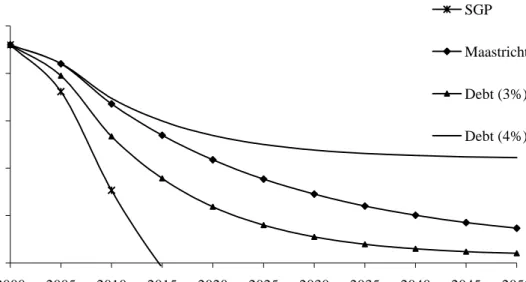
where g is the growth rate of nominal GDP. Let's assume, as commonly done in this type of exercises, that the nominal growth rate will average 5% in the next decades. And let's take the case of Italy, the country that has the highest debt ratio. The following figure shows the evolution of the debt ratio in the different cases.
i
6
Fiorito (2002) proposes a rule that is similar in spirit, i.e. to reduce the 3% Maastricht target by 1% of the
difference between the actual debt ratio and the 60% reference value: . With respect
to our proposal, this adds some arbitrariness, related to the choice of the convergence parameter (why 1%?). 1 0.03 0.01( 0.6) i t t d = − b− − 7
We added the 4% case because it would yield, for high debt countries, a less stringent limit. Thus, it would be politically easier to pass such a rule. Notice that, in that case, the target debt ratio has to change as well, and becomes 80% (the steady state level corresponding to an average deficit of 4%). In fact, with these two figures, Italy's current debt would imply a target deficit of 3%, as required by the Maastricht Treaty.
Figure 1. Debt Dynamics for Italy Under Different Rules 60% 70% 80% 90% 100% 110% 2000 2005 2010 2015 2020 2025 2030 2035 2040 2045 2050 D eb t Ratio SGP Maastricht Debt (3%) Debt (4%)
As we already noticed the SGP requirement of a budget balanced or in surplus over the cycle, implies convergence towards a zero debt ratio (the ratio would be below 20% in 2050). The Maastricht criterion of a 3% budget deficit (on average) yields the convergence to the 60% value, as would our 3% rule In the latter case, though, convergence would be faster. The 4% rule would converge to the steady state 80% level. Our proposal carries similar results in terms of the convergence path as the other debt-related rules put forward by respectively Fiorito, Calmfors and Corsetti and the EEAG (Figure 2).
Figure 2. A Comparison of Debt Dynamics for Italy Under Different Debt-Related Rules 60% 65% 70% 75% 80% 85% 90% 95% 100% 105% 110% 2003 2008 2013 2018 2023 2028 2033 2038 2043 2048 D e bt R a tio Maastricht our rule with 3% Fiorito
EEAG Calmfors and Corsetti
The advantage of this proposal lays in its operational simplicity, in the total absence of discretion (once we take for given the Maastricht parameters) in setting the deficit ceiling and
in the creation of rewards for fiscal discipline. In fact, governments are encouraged to be virtuous in good times, in order to gain leeway for stabilization in bad times. Thus our proposal, while yielding similar dynamics, has more appealing properties than the others. On the other hand, a shortcoming is its weak viability due to political vetoes which may com from high-debt countries. This is why, at least initially, a higher target (4% of deficit, and 80% of debt) could be envisaged, in order to gain the support of these countries.
References
Bean, C. (1998), "The Stability Pact: More Than a Minor Nuisance? Discussion", Economic Policy: A European Forum, 0(26), pp. 104-07.
Blanchard, O. J. and F. Giavazzi (2004), "Improving the SGP through a Proper Accounting of Public Investment", C.E.P.R. Discussion Papers CEPR Discussion Papers no. 4220. Buti, M., S. C. W. Eijffinger and D. Franco (2003), "Revisiting the Stability and Growth Pact:
Grand Design or Internal Adjustment?" C.E.P.R. Discussion Papers CEPR Discussion Papers no. 3692.
Calmfors, L. and G. Corsetti (2003), "How to Reform Europe's Fiscal Policy Framework", Mimeo, Stockholm - Rome, January.
Calmfors, L., G. Corsetti, J. Flemming, S. Honkapohja, J. Kay, W. Leibfritz, G. Saint-Paul, H.-W. Sinn and X. Vives (2003), "Eeag Report on the European Economy 2003", IFO Institute for Economic Research February.
Coeuré, B. and J. Pisany-Ferry (2003), "A Sustainability Pact for the Eurozone", Mimeo, Paris, February.
De Grauwe, P. (2003), "The Stability and Growth Pact in Need of Reform", Mimeo. University of Leuven.
Fiorito, R. (2002), "Più incompleto che stupido: osservazioni e proposte sul patto di stabilità e crescita", Università di Siena, Dipartimento di Economia Politica Quaderni, no. 371, Dicembre.
Gros, D. (2003), "A Stability Pact for Public Debt?" CEPS no. 30, January.
Pisany-Ferry, J. (2002), "Fiscal Discipline and Policy Coordination in the Eurozone: Assessment and Proposals", Mimeo.Université Paris-Dauphine, Paris, May.
Wyplosz, C. (2002), "Fiscal Discipline in Emu: Rules or Institutions?" Paper prepared for the April 16, 2002 meeting of the Group of Economic Analysis of the European Commission, April.