Temporal Opinion Mining
Thomas Hoberg Burnett
Eivind Bjørkelund
Master of Science in Computer Science Supervisor: Kjetil Nørvåg, IDI
Department of Computer and Information Science Submission date: June 2012
i
Abstract
This project explores the possibilities in detecting changes in opinion over time. For this purpose, different techniques and algorithms in opinion mining have been studied and used as a theoretic foundation when developing strategies towards detecting changes in opinions.
Different approaches to a system that detects and visualises changes in opinions have been proposed. These approaches include using machine learning techniques like the naive Bayes algorithm and opinion mining techniques based on SentiWordNet. Additionally, feature extraction techniques and the impact of burst detection have been studied. During this project, experiments have been carried out in order to test some of the tech-niques and algorithms. A data set containing hotel reviews and a prototype have been built for this purpose, allowing easy support for testing and validation. Results found high accuracy in opinion mining with the lexicon SentiWordNet, and the prototype can detect hotel features and possible reasons for changes in opinion. It can also show "good" and "bad" geographical areas based on hotel reviews.
For commercial use, the prototype can help analyse the massive amount of hotel informa-tion published each day by customers, and can help hotel managers analyse their products. It can also be used as a more advanced hotel search engine where users can find extra information in a map user interface.
Keywords: Semantical analysis, Opinion mining, Feature extraction, Temporal opinion mining.
iii
Sammendrag
Dette prosjektet utforsker mulighetene til å detektere forandringer i meninger over tid. Forskjellige teknikker og algoritmer innen meningsgraving har blitt studert og brukt som et teoretisk grunnlag til å utvikle strategier innen deteksjon av meningsforandringer. Forskjellige metoder til et system som detekterer og visualiserer meningsforandringer har blitt foreslått. Disse metodene inkluderer maskinlæringsteknikker som "naive Bayes"-algoritmen og meningsgraving basert på SentiWordNet. I tillegg har egenskapsuttrekking-steknikker og utbruddsdeteksjon blitt studert.
I løpet av dette prosjektet har eksperimenter blitt utført for å teste noen av disse teknikkene og algoritmene. Et datasett som inneholder hotellanmeldelser og en prototype har blitt bygget for å muliggjøre dette. Resultater viser høy korrekthet i meningsgraving med SentiWordNet-biblioteket, og prototypen kan detektere hotellegenskaper og mulige grun-ner for meningsforandringer. Den kan også vise "gode" og "dårlige" geografiske områder basert på hotellanmeldelser.
For kommersielt bruk vil denne prototypen kunne hjelpe å analysere den massive mengden av hotellinformasjon publisert hver dag av kunder, og den kan hjelpe hotellsjefer til å analysere deres produkt. Den kan også bli brukt som en avansert hotellsøkemotor, hvor brukere kan finne ekstra informasjon i et kart-grensesnitt.
Nøkkelord:Semantisk analyse, meningsgraving, egenskapsuttrekking, midlertidig menings-graving.
v
Preface
This report has been written by Thomas Hoberg Burnett and Eivind Bjørkelund as part of the master’s thesis at the Norwegian University of Science and Technology (NTNU) during the spring of 2012. The master’s thesis concludes our five year integrated study at the Department of Computer and Information Science (IDI). The purpose of the project is to study techniques and algorithms in temporal opinion mining, in an attempt to detect and visualise changes in opinion with a focus on hotel reviews.
We would like to thank our teaching supervisor, Kjetil Nørvåg (Professor) for his continu-ous support and constructive criticism throughout the project period. We really appreciate the opportunity to work with him on such an interesting subject.
Trondheim, 12th of June 2012
_ _ _ _ _ _ _ _ _ _ _ _ _ _ _ _ _ _ _ _ _ _ _ _ _ _ _ _ Thomas Hoberg Burnett Eivind Bjørkelund
Contents
1 Introduction 1
1.1 Motivation . . . 1
1.2 Problem Definition and Goals . . . 2
1.3 Contributions . . . 3 1.4 Project Scope . . . 4 1.5 Report Outline . . . 5 2 Background 7 2.1 Opinion Mining . . . 7 2.1.1 History . . . 8 2.1.2 Sentiment classification . . . 8 2.1.3 Previous Work . . . 9
2.1.4 Feature-based Opinion Mining and Summarisation . . . 11
2.1.5 Binary versus Multi-Polarity Analysis . . . 12
2.2 Temporal Opinion Mining . . . 13
2.2.1 Temporality Process . . . 13
2.2.2 Previous Work . . . 14
2.2.3 Opinion Spam . . . 15
3 Text Analysis 17 3.1 Part of Speech Tagging . . . 17
3.1.1 Introduction . . . 18
3.1.2 Tagging Approaches . . . 18
3.1.3 Part of Speech Tagging in Opinion Mining . . . 21
3.1.4 Part of Speech Tagging in our Application . . . 21
3.2 WordNet . . . 22
3.3 Word Sense Disambiguation . . . 22
3.3.1 Introduction . . . 24
3.3.2 Lesk Algorithm . . . 25
3.3.3 Usage in our Application . . . 25
4 Opinion Mining Techniques 27 4.1 Known Challenges . . . 27
viii CONTENTS
4.2 Knowledge-based Approaches . . . 28
4.2.1 SentiWordNet . . . 29
4.2.2 SentiWordNet in our Application . . . 30
4.3 Supervised Approaches . . . 31
4.3.1 Naive Bayes . . . 31
4.4 Unsupervised Approaches . . . 33
4.4.1 Supervised versus Unsupervised . . . 34
4.5 Language Models . . . 34
4.5.1 N-Gram Models . . . 35
4.6 Feature Extraction and Summary . . . 36
4.7 Temporal Aspects . . . 38
4.7.1 Burst Detection . . . 38
4.7.2 Opinion Visualisation . . . 39
5 Extracting Suitable Data Sets 41 5.1 Web Crawling . . . 41 5.1.1 Crawling Process . . . 41 5.1.2 Sources . . . 43 5.1.3 Politeness Policy . . . 48 5.1.4 Performance . . . 48 5.1.5 Locations . . . 49
5.2 Storing the Data Set . . . 49
5.2.1 XML Structure . . . 49
5.3 Preparing Data for Future Use . . . 50
5.4 Problems, Experiences, Setbacks . . . 53
5.4.1 Connection Problems . . . 53
5.4.2 Crawling Aggression . . . 54
5.4.3 Updating the Data Sets . . . 54
5.4.4 File Size . . . 55
5.5 Merging Data Sets . . . 55
5.5.1 Hotel Matching . . . 55
5.5.2 Name and GPS Matching . . . 55
5.6 Statistics . . . 57
6 Opinion Visualisation Prototype 61 6.1 Opinion Mining Framework . . . 61
6.2 Map Prototype . . . 62
6.2.1 Data Set Preparation . . . 62
6.2.2 Prototype Description . . . 62
6.2.3 Google Maps . . . 65
6.2.4 Area Sentiment . . . 66
6.2.5 Graphing Changes . . . 68
6.2.6 Feature Search . . . 69
CONTENTS ix 7.1 SentiWordNet Accuracy . . . 73 7.1.1 Standard SentiWordNet . . . 74 7.1.2 Simplified Lesk . . . 74 7.1.3 Five Categories . . . 76 7.2 Machine Learning . . . 77 7.3 Burst Detection . . . 77
7.4 Visualising Temporal Sentiment . . . 78
7.4.1 Temporal Sentiment . . . 78
7.4.2 Rating and Sentiment Correlation . . . 81
7.4.3 Area Sentiment . . . 82
7.4.4 Feature Search . . . 82
8 Discussion and Conclusion 85 8.1 Result Summary . . . 85
8.1.1 Burst Detection and Temporal Sentiment . . . 85
8.1.2 Feature Selection . . . 86
8.1.3 Sentiment Visualisation and Mapping . . . 87
8.1.4 Data Set Comparison . . . 87
8.2 Conclusion . . . 88
8.3 Future Work . . . 89
8.3.1 Prototype Performance . . . 89
8.3.2 Visualisation . . . 90
8.3.3 Feature Synonyms . . . 90
8.3.4 Expand Data Sets . . . 91
8.3.5 Other Pre-Processing Steps . . . 91
A List of Data Set Locations 93 B Class Diagrams 95 B.1 Package Overview . . . 95 B.2 Crawler . . . 96 B.3 Gatherer . . . 97 B.4 Output . . . 98 B.5 Processing . . . 99 B.6 Storers . . . 100 B.7 UI . . . 101
List of Figures
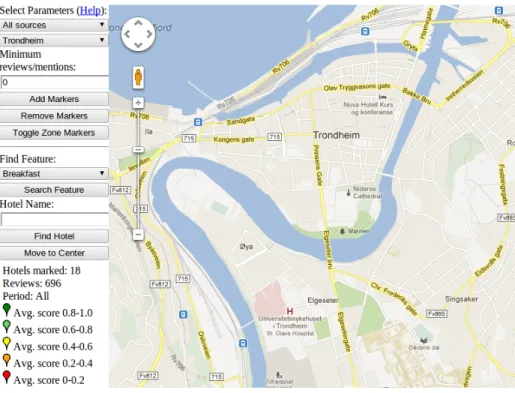
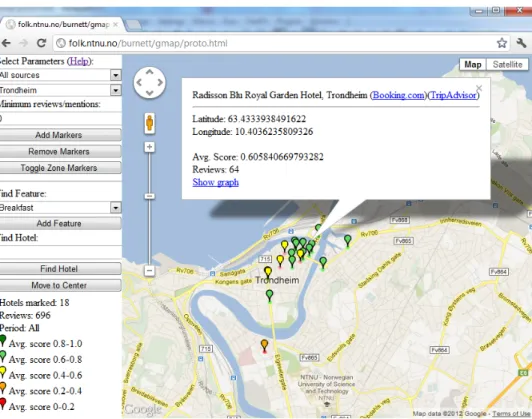
1.1 Screenshot of the prototype . . . 4
1.2 The project approach . . . 5
2.1 A summary example [23] . . . 12
3.1 Raw text before POS tagging . . . 18
3.2 Text after POS tagging . . . 18
3.3 Example of "that" rule in rule-based tagging . . . 20
3.4 Entry of "dog" in WordNet . . . 24
4.1 Entry of "adventurous" in SentiWordNet . . . 29
4.2 An example of a data set with a cluster structure from [37] . . . 34
4.3 A review consisting of pros and cons . . . 36
4.4 A review consisting of free text . . . 37
4.5 Example of summarisation for the feature breakfast from our test prototype 38 4.6 Pseudo code of our burst detection algorithm . . . 39
5.1 High level view of system flow in TripAdvisor and Booking.com crawlers 42 5.2 Positive review from Booking.com . . . 43
5.3 Search area used for finding locations . . . 44
5.4 Subset of search results . . . 44
5.5 Presentation of hotel information . . . 45
5.6 Subset of reviews . . . 45
5.7 Search area used for finding locations and services . . . 46
5.8 Subset of search results . . . 47
5.9 Presentation of hotel information . . . 47
5.10 Subset of reviews . . . 47
5.11 XML format of data sets . . . 50
5.12 Example of XML format of data sets . . . 50
5.13 Calculated review score output . . . 52
5.14 Average scores . . . 53
5.15 Distribution of review scores . . . 57
5.16 Percentage of hotels for each amount of reviews interval . . . 58 xi
xii LIST OF FIGURES
5.17 Difference in number of reviews per location . . . 58
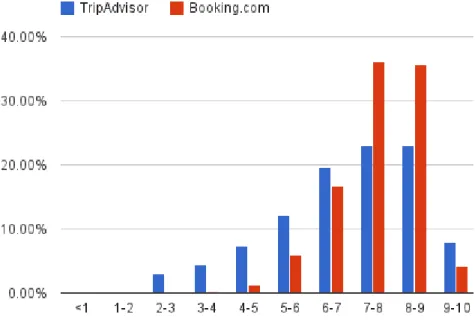
5.18 Score distribution for TripAdvisor and Booking.com hotels . . . 59
6.1 Command line menu for our opinion mining framework . . . 62
6.2 Map prototype layout . . . 63
6.3 Hotels in London from booking.com marked on map without area calcu-lations. See figure 6.5 for marker descriptions. . . 64
6.4 Map marker info . . . 65
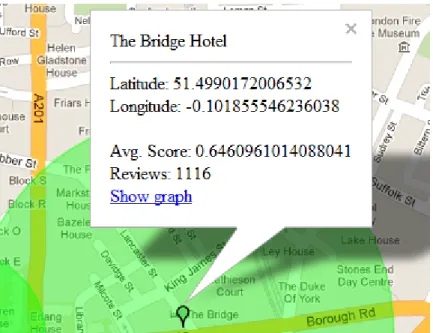
6.5 Map legend . . . 65
6.6 Control panel for the map prototype . . . 66
6.7 Hotels in London from booking.com marked on map with area calculations 67 6.8 Area marked as relatively positive . . . 68
6.9 Month by month score changes . . . 69
6.10 XML format for feature scores . . . 70
6.11 Selected feature "internet" with negative sentiment . . . 71
6.12 Selected feature "internet" with positive sentiment . . . 71
7.1 Accuracy of the Lesk algorithm vs Standard SentiWordNet for TripAdvisor 75 7.2 Accuracy of the Lesk algorithm vs Standard SentiWordNet for Booking.com 76 7.3 Graph from 1891 reviews about Park Plaza Westminster Bridge in London, UK . . . 80
7.4 Graph from 4250 reviews about St Giles Hotel & Leisure Club in London, UK . . . 80
7.5 Graph from 40 reviews about San Domenico House in London, UK . . . 81
7.6 Area with a mostly positive sentiment . . . 82
7.7 Area with a mostly negative sentiment . . . 83
7.8 Area with no clear one-sided sentiment . . . 83
7.9 Overview of different sentiments in neighbouring areas . . . 84
8.1 Selected feature ’internet’ with positive score, but clearly negative content 87 8.2 XML score structure in prototype . . . 89
8.3 A possible improvement of XML score structure . . . 89
B.1 Package map with dependencies . . . 95
B.2 Classes in crawler package . . . 96
B.3 Classes in gatherer package . . . 97
B.4 Classes in output package . . . 98
B.5 Classes in processing package . . . 99
B.6 Classes in storers package . . . 100
List of Tables
3.1 The Penn Treebank POS tag set . . . 19
3.2 Semantic relations in WordNet . . . 23
4.1 Sentiment classification with different keyword lists [48] . . . 30
5.1 Average crawler run time per hotel at TripAdvisor . . . 49
5.2 Average crawler run time per hotel at Booking.com . . . 49
5.3 XML tag explanation . . . 51
5.4 Number of services in each data set . . . 57
6.1 Circle colouring for area sentiment . . . 67
6.2 Percentage of reviews year by year . . . 69
6.3 List of features . . . 70
7.1 SentiWordNet accuracy results . . . 74
7.2 SentiWordNet accuracy results with a simplified Lesk Algorithm . . . 75
7.3 SentiWordNet accuracy results with five categories . . . 76
7.4 Result table for machine learning algorithms . . . 77
7.5 Result table for machine learning algorithms with five categories . . . 77
7.6 Burst detection results with different thresholds . . . 79
7.7 Features from Grand Midwest Express Hotel Apartments in Dubai from a positive burst month . . . 79
7.8 Features from Grand Midwest Express Hotel Apartments in Dubai month before burst . . . 79
7.9 Manually feature results based on whole sentences and sentence clauses . 82 8.1 List of features . . . 90
A.1 List of crawling locations . . . 93
Chapter 1
Introduction
This chapter provides an introduction to the project and the motivation behind it. Further, the problem definition and goals as well as project scope and contributions are listed. At the end of the chapter, a detailed outline of the report is provided.
1.1
Motivation
Text mining, and especially opinion mining, has received much attention in later years due to the many possibilities this technology provides. Most of the information available today is unstructured, especially on the Internet. Being able to find and extract relevant informa-tion from such large data sets, can be of great value for businesses. Everything from analysing customer opinion regarding their products, to creating knowledge resources from company documents, can be important for better business decision-making.
The emergence of text mining tools have thereby come as a result of the enormous interest and the quantity of data that is gathered and stored every day. Identifying and finding a use for all of the information and knowledge in this data is not an easy task. These huge amounts of data are too large for humans to comprehend and process manually, and thus text mining tools and techniques for performing automatic analysis and extraction of relevant data are of great interest. In addition, the growth and emergence of the World Wide Web has made data available regardless of geographical location, further increasing accessibility and volume.
One popular area amongst researchers and business analysts are the highly dynamic and changeable opinions of customers. The obvious motivation being to gain an advantage in knowledge about possible weaknesses about a product or service. Analysing opinions using various statistical tools or text mining techniques is still an ongoing field, and has seen an increasing interest and research in recent years. Still, no methods have yet been
2 CHAPTER 1. INTRODUCTION
discovered which can consistently accomplish such a task. Previous attempts have had limited success in some of these areas, but few, if any, have succeeded in creating an analysing tool together with a graphical user interface.
This project aims to further contribute to this research. This project will look at ways to use opinion mining techniques to analyse changes in opinions about hotels. Hotels as a customer-based service is an area where multiple factors may impact customer sen-timent. For instance noise, nearby construction, weather, even customer expectations. Such events may influence the overall sentiment at any given time, creating a dynamically changing sentiment. Managing to identify why changes occur in such a setting, may pro-vide both customers and hotel owners valuable information regarding the interpretation of large amounts of opinionated data.
Typical scenarios include:
• A user wants to detect up and coming areas
• A user wants to look at sudden changes in hotel sentiment
• A user wants to find hotels with the best breakfast
Opinion mining tools are used to identify and extract subjective information from user reviews, and then to determine the sentiment of the text. Three different techniques are looked at: feature extraction, burst detection and visualisation. Feature extraction is a technique to identify and extract product features, burst detection is used to detect and analyse abnormal changes and visualisation means to present the information graphically. Evaluation is performed by comparing the actual review scores with our sentiment scores.
1.2
Problem Definition and Goals
The assignment text is given below.
The aim of this project is to investigate various issues of temporal opinion mining in re-lation to hotel reviews, and to create a graphical prototype of the temporal information. Also an important aspect is the creation of a relevant data set containing user reviews and hotel information. In short, the project consists of five parts:
1. Perform a literature study of the field
2. Find and create a data set containing user reviews and hotel information 3. Identify new challenges to be solved and develop appropriate techniques 4. Create a protoype using temporal information
5. Evaluate the proposed techniques
As can be seen here, our main goal for this project is to try out different opinion mining techniques to automate extraction of important information about hotel reviews. Based on
1.3. CONTRIBUTIONS 3
that we will attempt to determine the effect on hotels over time. To that end we need to collect a large data set of relevant hotel information and hotel reviews. The results shall be presented visually to easier detect possible "hidden" information.
To achieve this goal, much of the project will be related to studying techniques and al-gorithms for extracting important textual information from documents and determine its affection. These documents need to be processed with respect to identifying relevant fea-tures and removing noise. Studying techniques for pre-processing of textual data is there-fore also of some relevance. Additionally, some visualisation theories will be looked at. However, our main focus will be on creating a modular framework for data set extraction using different opinion mining techniques and a prototype to analyse hotel reviews. The purpose of creating this framework and prototype is to make it easier and more efficient to test and validate these algorithms and techniques, as well as being a tool for future research in this area.
Minor goals are listed below.
• Identify relevant text analysis techniques for data pre-processing
• Identify relevant opinion mining techniques
• Identify relevant feature extraction techniques
• Develop and implement a prototype, utilising one or more of any researched algo-rithms
• Identify components and find a recommended approach for analysing hotels based on user reviews
• Identify interesting areas for further research
1.3
Contributions
Our main tool to detect changes in opinion mining was a web prototype we created to visualise possible changes. The prototype can be seen in figure 1.1. This provided a great way to detect "good" and "bad" areas based on hotel reviews in a user-friendly map view. Additionally, it includes a feature search, where users can find hotels based on features from user reviews. These scores are calculated based on user opinions, and is an effective way for users to filter sentiment data.
The prototype was tested on five different locations with a total of almost 800 000 reviews from 2004 to 2012. We had great success in deciding whether a hotel review is "good" or "bad". Usually we had around 70%-80% correctness depending on review source. How-ever, detecting changes in opinion over time based on external factors, proved to be diffi-cult, as external factors are unknown and one needs a huge amount of data to be able to detect them. It was therefore often unclear why such changes had occurred. Nevertheless,
4 CHAPTER 1. INTRODUCTION
Figure 1.1: Screenshot of the prototype
detecting more known, trivial features like decline in service or improvement in cleaning standard, were easier to detect.
Also, we created a data set with user reviews and hotel information. We combined infor-mation from two sources: Booking.com and TripAdvisor in a structured format. Since one needs a lot of data to substantially test opinion mining techniques and algorithms, this data set can be used for further research in this area, saving researchers time to gather relevant test data.
1.4
Project Scope
This project will be limited to studying techniques within opinion mining with temporal aspects. Only topics relevant to this project will be discussed and evaluated. The system to be implemented, will have limited functionality. The purpose of the prototype is to test and evaluate different algorithms and techniques to detect possible changes in time, as well as being a framework for future work.
1.5. REPORT OUTLINE 5
The focus of this project will be on automatic techniques and algorithms that might be used to extract temporal information about hotels. That is, to identify and extract meaningful document features and to determine its effect on hotels. Optimisation of techniques and algorithms, as well as identification of other and potentially more promising techniques, are left for further studying.
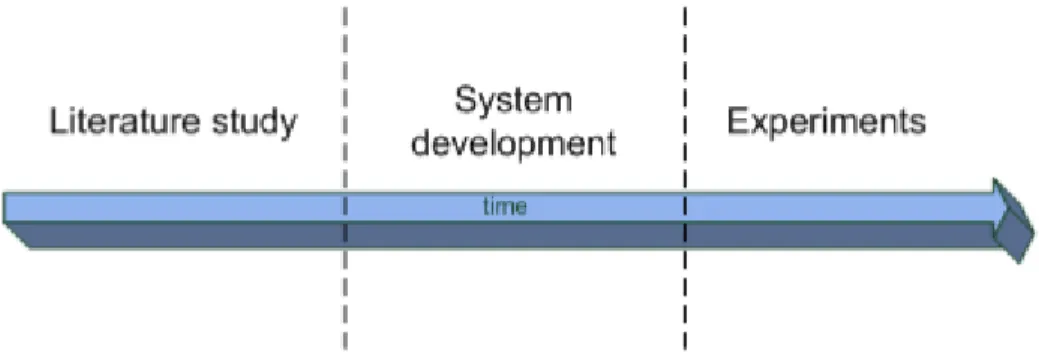
Note that it is not the goal of this project to necessarily find the best approach to analysing hotels, but to focus on an approach that might provide meaningful results. Additionally, the project aims to identify special challenges and aspects relevant for further study. The focus will be on a literature study, system development and experimentation, as pre-sented in figure 1.2.
Figure 1.2: The project approach
1.5
Report Outline
Chapter 1 - Introduction
This chapter provides an introduction to the project, the motivation behind it, the problem definition and the goals and the scope of the project.
Chapter 2 - Background
The chapter gives background information in relation with opinion mining and temporal opinion mining.
Chapter 3 - Text Analysis
This chapter presents different theories used in this project from the fields part of speech tagging, WordNet and word sense disambiguation.
Chapter 4 - Opinion Mining Techniques
In this chapter the opinion mining techniques used in this project are presented. This in-cludes challenges, knowledge-based approaches, supervised and unsupervised approaches, language models and time-aware aspects.
6 CHAPTER 1. INTRODUCTION
Chapter 5 - Extracting Suitable Data Sets
The data sets created are presented in this chapter. Everything from data crawling to how the data sets are structured to problems, experiences and setbacks are given.
Chapter 6 - Opinion Visualisation Prototype
An explanation of our prototype is given here, with focus on the graphical map prototype. A brief overview of our opinion mining framework is also presented.
Chapter 7 - Experiments and Results
The chapter will present the experiments performed in this project, and give an overview of the results.
Chapter 8 - Discussion and Conclusion
Discussion of the results together with the conclusion and suggestions for further work is presented in this chapter.
Chapter 2
Background
The first part of the project is to perform a literature study, identifying existing studies and potentially functioning systems which utilise opinion mining techniques. This chapter details this research. First, we take a look at the background of opinion mining, with an introduction about sentiment classification, along with a review of previous studies. These are included to better understand what opinion mining is, and what has been done in this field in the past. Following that is background information about advanced opinion mining techniques like feature-based opinion mining and multi-polarity classification.
The next section in this chapter contains information about temporal opinion mining. It describes previous studies about opinion mining with time-awareness, along with a short introduction to opinion spam.
2.1
Opinion Mining
Opinion mining or sentiment analysis involves classifying opinions in text into different categories, typically "positive", "negative" and "neutral" [36]. In other words, opinion mining aims to determine the attitude of a writer by identifying and extracting subjective information in a textual document. The attitude is the judgement, evaluation or emotional state of the writer toward something or someone, usually a product, service or a person. One example is an application that would be tracking what bloggers, discussion forums or tweets (post on Twitter) are saying about a brand like Toyota.
This section will first take a short look at the history of opinion mining and a quick presen-tation of what sentiment classification is. Following that, we will go more in-depth about previous work done in this field. In the end of this section, feature-based opinion mining and the difference between binary and multi-polarity opinion mining are explained.
8 CHAPTER 2. BACKGROUND
2.1.1
History
Textual information can be broadly classified into two categories, "facts" and "opinions". Facts are objective statements about entities and events in the world, while opinions are subjective statements that represent peoples attitude. Historically text mining procedures have focused on extracting factual information, examples include web search engines, information retrieval and many other natural language processing tasks. It is only recently opinion mining has enjoyed a burst of research activity, since there was little opinion related text to analyse before the World Wide Web. Most opinion data had to be gathered through manual surveys [36]. This created an extra barrier because of the extra resources needed to perform opinion analysis.
Commercially, opinion mining techniques have become increasingly popular in the busi-ness community through so called busibusi-ness intelligence. Busibusi-ness intelligence is a term describing computer-based techniques used for identifying, extracting and analysing busi-ness data.1 One of the objectives include understanding and analysing the companies strengths and weaknesses, and their relationship with customers. One thing is to analyse objective measures like a products weight, size or cost, but it is more difficult to measure a products subjective aspect like the design of the product or its usability. Opinion mining can help answer these kinds of subjective preferences from the customers.
A 2008 study by Horrigan [22] showed that 60% of Americans had at one time done an Internet search for a product they were considering to buy. A quarter of these did so on an average day. With the ever increasing growth of the Internet, it is natural to assume this number has not gone down since then. This highlights the value of having generally positive opinions on the web, and how much reach a negative review can have if published on frequently visited websites. This is not only relevant to online shopping, as another study [18] showed that consumers also used online web searches on products before offline purchases.
2.1.2
Sentiment classification
Given a set of documents D, a sentiment classifier categorises each document d into differ-ent classes, typically positive, neutral and negative [35]. Negative means that d expressed a negative opinion, neutral a neutral opinion and positive means that d is regarded as a pos-itive opinion. The main task of sentiment classification is to give a quick determination of the prevailing opinion about a subject in a textual expression. The task is similar to classic text classification based on topics, which classifies documents into different topic classes, for example sports, economy and culture and so on. But there is one main difference. In topic-based classification topic related words are very important, but in sentiment classi-fication those words do not have to be of any importance. The most important words in sentiment classification are words that indicate negative or positive opinions, like "good", "bad", "excellent", "horrible" et cetera. However, some topic-related words can be of some
2.1. OPINION MINING 9
importance when it comes to finding out what the expressed sentiment is geared towards. Also, one can extend classification down to the sentence-level. In other words, instead of classifying the whole document, each sentence is classified.
Mainly there are two different approaches to sentiment classification. The first one is to determine its classification based on sentiment phrases. This method uses positive and negative words and phrases contained in text to determine its classification. One good source is the approach of Turney [62]. We mostly use sentiment phrases to determine why there is a change in hotels over time. This is described more thoroughly in section 4.2. The second approach is by using machine-learning techniques with classic text classifica-tion algorithms like naive Bayes, support vector machine, k-nearest neighbor et cetera [49]. A more detailed description of these techniques can be found in section 4.3. Additionally, there have been classification approaches by using score functions [14]. These types of al-gorithms usually consist of counting terms and measuring probabilities, but have not been a big focus in this project.
2.1.3
Previous Work
One of the early projects, which can be counted as a forerunner of the opinion mining area as it deals with beliefs, was done by Carbonell [7]. He developed a computer model of subjective understanding called POLITICS. POLITICS could model the political beliefs and inferred expectations of either an American liberal or a conservative based on certain political stories related to United States and Russia and their international policies. Each ideology produces a different interpretation of the events, and POLITICS demonstrates its understanding by answering questions about what the American administration will decide to do in a situation where some of their goals are threatened by actions from the Russians. Other than some very early work from artificial intelligence studies, previous work within opinion mining can mainly be categorised into two categories: knowledge-based and sta-tistical [15]. The knowledge-based approach uses linguistic models or some other form of knowledge to get insight into the sentiment of a sentence. Later approaches apply statisti-cal or machine learning techniques for achieving sentiment classification. A brief look at previous work done in both areas follows.
Knowledge-Based Sentiment Classification
One of the earliest techniques within knowledge-based sentiment classification was devel-oped by Hearts. Models inspired by cognitive linguistics were used to decide the direction-ality, that is whether the agent is in favor of, neutral or opposed to a specific event [21]. A similar technique using a system called SpinDoctor, which identifies a news story’s point of view, was made by Sack [55].
Later, researchers such as Huettner and Subasic created a prototype system through manual or semi-manual construction of a discriminate word lexicon and fuzzy logic to categorise
10 CHAPTER 2. BACKGROUND
sentiments [25]. Also, Das and Chen used an English dictionary, a hand-picked finance word lexicon and a grammar corpus to extract investor sentiment from stock message boards [13]. This together with different classification algorithms coupled together by a voting scheme, resulted in accuracy levels similar to that of widely used Bayes classifiers. Tong presents a system for generating sentiment timelines [59]. This system tracks online discussions about movies, and shows a plot of the number of negative sentiment and pos-itive sentiment messages over time. Messages are then classified by looking for specific phrases that can indicate a sentiment towards the movie. Each phrase must be manu-ally added to a special lexicon with a corresponding tag indicating positive or negative sentiment. Hatzivassiloglou and McKeown focused more on semantic orientation of indi-vidual adjectives, rather than phrases containing adjectives or adverbs [19]. Their method achieves high precision, but it also relies on a large corpus that needs a big amount of manually tagged training data.
There has also been some research on negative/positive term counting methods provided by Turney and Littman [61]. They determined the similarity between two words by count-ing the number of results returned by web searches joincount-ing the words with a NEAR query operator, and based on that automatically determined if a term was negative or positive. The algorithm got an accuracy of around 80% with 3596 words tested.
Nasukawa and Yi took a different approach to sentiment analysis [42]. They illustrate an approach to extract sentiments from sentences that contain opinions for specific subjects from a document, instead of classifying the whole document into positive or negative. They first identify sentiment expressions in different texts, the polarity and strength of the expressions, and whether the expressions indicate a positive or negative opinion towards a subject. Also, they chose a particular subject of interest and manually defined a sentiment lexicon for identification. The prototype system achieved high precision of 75% to 95% correctness depending on the data. The test was performed on different web pages and news articles.
Statistical Sentiment Classification
One of the earlier works in statistical sentiment classification or so called modern opinion mining was done by Lee, Pang and Vaithyanathan [49]. They examined several supervised machine learning techniques for sentiment classification to a database of movie reviews. Three machine learning methods were used, namely naive Bayes, maximum entropy clas-sification and support vector machines, with eight different sets of words and n-grams as features. The best result was achieved using support vector machine with a unigram feature set. This produced an accuracy of 82.9%. Their naive Bayes classifier with a unigram fea-ture set achieved an accuracy of 81.0%. They concluded that machine learning techniques outperform the method that is based on human-tagged features, although the performance was lower compared to those reported for standard topic-based categorisation.
Pang and Lee continued their research by deciding whether a given text has a factual or opinion nature by implementing techniques for finding minimum cuts in graphs with the
2.1. OPINION MINING 11
assumption that sentences close to each other tend to have the same class [46]. Since a movie review consists of both objective and subjective sentences, their beliefs were that they only need to use the subjective portions of the review to decide overall sentiment. They achieved some success in this approach with accuracy better than or at least as ac-curate as the accuracy of the full text review, while only containing 60% the size of the original review.
Further research by Pang and Lee include classifying movie reviews as either positive or negative as before, and then decide its strength as ratings on a three or four star scale [47]. Also there has been performed an in-depth analysis of restaurant reviews by Snyder and Barzilay [58], which predicted ratings for various aspects of the given restaurant, such as the food and the atmosphere on a five-star scale.
2.1.4
Feature-based Opinion Mining and Summarisation
One of the problems studying texts at the document level, is that a document can contain positive loaded text on a particular object, but that does not necessarily mean that the author has positive opinions on every aspect of the object. Likewise, a negative opinionated text does not mean that the author dislikes everything about the object. For instance, in a movie review, the author usually writes about both the positive and negative aspect of the movie, although the overall sentiment might be gearing towards negative or positive. To separate the different opinions in a document, one can use feature-based opinion mining on the sentence level.
Three tasks have to be performed [23] [24] [50]:
1. Identifying and extracting features of the object that the authors have expressed their opinion on
2. Determining whether the opinions on the features are negative, positive or neutral 3. Summarising the results
For example in the sentence "the picture quality of this camera is terrible", the feature is "picture quality" and the opinion expressed on this feature is negative, since "terrible" is typically a negative word. After that each review is summarised. One example of how summarisation can be done can be seen in figure 2.1. In this example each review is summarised first by the product name, in this case "Digital_camera_1", and then each feature follows with number of positive and negative review sentences about that particular feature.
Blair-Goldensohn et alii have published a study called "Building a Sentiment Summariser for Local Service Reviews" [5]. They claim web-based opinions are becoming the main platform for measuring quality of most products and services. Therefore they present a system that summarises the sentiment of reviews regarding localised businesses. Sum-maries are determined by splitting different aspects of the service into smaller, focused parts. Text related to given aspects are then analysed for any form of sentiment. Each
12 CHAPTER 2. BACKGROUND
Digital_camera
_1:
Feature:
picture_quality
Positive: 253
<individual review sentences>
Negative: 6
<individual review sentences>
Feature:
size
Positive: 134
<individual review sentences>
Negative: 10
<individual review sentences>
...
Figure 2.1: A summary example [23]
aspect then receives a summarised sentiment based on all the relevant data from the data set.
2.1.5
Binary versus Multi-Polarity Analysis
Binary, or standard polarity analysis, means purely positive or negative sentiment. This means that there is nothing that is slightly positive or slightly negative. Each sentiment is either positive or negative. Studies on opinion mining using binary analysis include [49] [62]. An alternative to binary analysis is multi-polarity analysis, which results in degrees of sentiment, for instance slightly happy, very happy, a little sad and so on. Numeric values are often used to separate such polarities, for instance using anywhere between 0 and 1, where 0 is no relation to given sentiment and 1 is the complete opposite. Values in between describe the grade of sentiment. Wilson et alii [65] describe difficulties with this approach. Algorithmically a binary analysis is simpler than multi-polarity approaches. It is basically a check to see whether or not a given sentiment can be linked to the data set. Often basic classification algorithms can be successfully adapted to such sentiment mining tasks. With multi-polarity however, one needs to determine the degree to which each sentiment matches a data set, resulting in somewhat more complex calculations.
As part of a study by Pang and Lee [48], they looked at the differences between binary classification and multi-polarity classification. One thing they found was that neutral texts were often perceived to be more negative than neutral by readers. Also, classifying a data set as "neutral" does not necessarily mean the text is objective. A neutral opinion can be as strong as a negative or positive one [48].
2.2. TEMPORAL OPINION MINING 13
2.2
Temporal Opinion Mining
Temporal opinion mining is a relative new field and has many different names includ-ing time-aware opinion mininclud-ing, temporal sentiment analysis, opinion change mininclud-ing and opinion tracking, to mention a few of them. Temporal opinion mining is the process of monitoring and detecting possible changes to specific opinions over given periods of time, and can be seen as a continuation of opinion mining.
This section will first present the temporal process added to regular opinion mining. Then previous work is detailed, and lastly an interesting area closely related to temporal opinion mining called opinion spam is looked at.
2.2.1
Temporality Process
The basic process involves determining the average opinion on a given topic at two or more unique moments in time. Ideally this results in a complete time series, which is then mapped out with changes over time. The timeline can be presented by the predominant polarity [31] or as a graph based on sentiment value [17]. Any changes in opinion can then be identified, and may be used to find patterns [9]. This is one of main advantages compared to basic opinion mining. However, changes in opinion are by themselves not necessarily useful without something to compare them to. Therefore the usefulness of change detection becomes more apparent when combined with understanding why said change occurred.
To determine why an opinion has changed, one needs to find correlations between opinions and the textual content of a data set. This can be done by determining a set of association rules from each collected data set. These rules match textual tokens and map them to a certain opinion. This gives a set of tokens which are determined to belong to a given opinion. With enough such rules, a system can be taught to determine subjectivity of textual data sets. When utilising these rules and opinions when comparing data sets, it is theoretically possible to determine patterns in any changes of opinion. Different change patterns can be defined in several ways, but they mostly relate to whether or not changes match the rules for each data set.
Change is defined as either gradual or sudden, and based on any determined rules, expected or unexpected [9]. Gradual or sudden describe the degree in which an opinion has changed. An expected change is a change which corresponds to the rules for each data set. An unexpected change does not correspond to the specified rules. For instance, if two data sets have very similar rules, but completely different opinions attached to them, the change might be unexpected.
14 CHAPTER 2. BACKGROUND
2.2.2
Previous Work
Being a new field of study, there are relatively few studies done in this area. Temporal opinion mining continues the work done with opinion mining and adds the factor of time awareness into the process. Most studies utilise the opinion mining techniques described in section 2.1, but with added time awareness.
In a study by Fukuhara et alii [17], they looked at news and blog articles and produced two sets of graphs: a topic graph and an emotion graph. The topic version graphed out topics associated with a certain sentiment. With a specific sentiment, it was possible to see when certain events were highly associated with that sentiment. As such the graph illustrated which events had the greatest impact on the given sentiment at specific moments in time. The emotional graphs showed a range of sentiments over time regarding a given event. This approach is the more common way to illustrate temporal opinion mining results. Having a specific topic or event, and seeing how sentiment toward it changes and fluctuates as time goes by. Combining the analysis of these two types of graphs, the result is a solid visual representation of the association between sentiment and event. However, this approach requires both sentiment and event to be known prior to analysis. It does not attempt to discover and identify previously unknown events which might have had an effect on sentiment.
In another study, by Dipankar Das et alii, they created a prototype system called TempEval-2007 with the TimeML framwork.2 It is designed to create visualisations of opinions over time and track changes, but focuses on temporal relations between events associated with sentiments [12]. They employ a machine learning approach based on Conditional Random Field [32] for solving the identification problem of event-event relations, with the TimeML-based TempEval-2007 system and considering sentiment as a feature of an event. This is done by classifying the event pairs into their respective temporal classes. Like the study by Fukuhara et alii, this differs somewhat from our approach since it does not attempt to find unknown events based on changes in sentiment.
Prior to TempEval-2007, a system called MoodViews3was created by Mishne et alii [40]. The system tracks the mood of blogs hosted by LiveJournal.4 Conceptually similar to TempEval-2007, the system continuously downloads updates from thousands of blogs. It tracks moods, predicts what they might become and analyses them in an attempt to understand why specific changes in mood occur. The mood tracker follows moods in close to real time and creates graphs based on these time series. The mood predictor combines natural language processing with machine learning to estimate moods based purely on textual content. This is then compared to the actual mood data gathered from tagging and an accuracy statistic can be determined. Using language statistics it finally identifies terms which occur more often or less often than usual during certain peaks in mood.
2http://timeml.org
3http://www.moodviews.com/ 4http://www.livejournal.com/
2.2. TEMPORAL OPINION MINING 15
2.2.3
Opinion Spam
With the continued growth of the Internet, opinions on more or less any topic are easily available. This is especially true when it comes to consumer products [34], but is relevant for basically anything one may have an opinion on. Consumer opinion is therefore a valuable commodity for many companies. Swaying opinion regarding a certain product to be more positive, and negative for a competing product, can prove to be highly valuable. Due to this, creating fake opinions and spreading them online may be considered useful for several parties. Companies may use it to both improve opinion regarding their own products, as well as lowering opinion on competitor products. This, unfortunately, gives good incentives for opinion spam, which is human activity in the form of spam reviews that try to give undeserving positive opinions to some targets in order to promote their products or services, or undeserving negative opinions to other targets in order to damage their reputation [35] [45]. Opinion spam is an increasing problem both when performing opinion mining and in the more general case of a consumer assessing what the public opinion is about a certain product. The influx and impact of such spam has resulted in it being compared to web search spam in terms of disruption and annoyance [27].
Viewing opinions over time can make it easier to detect opinion spam [35]. It makes it easier to find rating spikes and rating and content outliers. Examples of more traditional spam detection techniques include duplicate detection, compare average ratings from mul-tiple sites and to compare review ratings of the same reviewer on products from different brands.
Chapter 3
Text Analysis
Techniques and tools for analysing and processing input text are an important aspect of any type of text mining. Any data set containing human-generated written text in its basic format only contains raw text. This is basically a long list of different characters, only contextually and semantically understandable by humans. The potentially large amounts of text however make it impossible to manually process it all. Therefore several techniques for automatically and correctly marking the data are required.
Put simply, this process can be broken down into three main steps. The first step is to find techniques for breaking down sentences into specific terms, marking the correct gram-matical context of each. What type of word it is makes it possible to extract the correct dictionary definition, which leads to the second step. A single word may have multiple meanings depending on context. Determining the correct one is therefore highly impor-tant. With the correct grammatical tagging in place, a dictionary look-up for selecting the most likely definition may be achieved. From there, it is possible to begin step three, which is to properly analyse and determine the sentiment of the textual subset. This chap-ter describes the first two steps in this process. Step three is described in chapchap-ter 4.
3.1
Part of Speech Tagging
Part of speech (from here on referred to as POS) tagging, also called grammatical tagging, is the process of marking up each word in a text as corresponding to a particular part of speech, based on its definition and relationship with related and close words in a phrase, sentence or paragraph [35].
This section will start with an introduction to what part of speech tagging is, and then go into more detail of different tagging approaches. In the end more practical uses of part of speech tagging is explained, both in opinion mining in general and in our application.
18 CHAPTER 3. TEXT ANALYSIS
Stayed at this hotel for one night due to business in Trondheim.
Figure 3.1: Raw text before POS taggingStayed_VBN at_IN this_DT hotel_NN for_IN one_CD night_NN due_JJ to_TO business_NN in_IN Trondheim_NNP ._.
Figure 3.2: Text after POS tagging
3.1.1
Introduction
A simplified form of part of speech tagging is typically the identification of words as nouns, verbs, adjectives et cetera. The eight common English part of speech categories are: noun, verb, adjective, adverb, preposition, pronoun, interjection and conjunction [28]. There are also more subcategories within those categories. For example an adjective can be an adjective in its base form, superlative form and so on.
POS tagging can be seen as a way to disambiguate part of speech, where the tagger al-gorithm returns the most likely tag for a word based on the surrounding context. If one consider the word "break", it can be used both as a noun, for instance "The break starts now", or as a verb, for example "I am going to break this chair". In other words POS tagging helps to figure out the meaning of a word being used.
Additionally, there are some differences between the tags returned for each word. The tags depend on which tag set is being used. However, most tag sets usually use at least some variant of the eight common English categories mentioned above, but many tag sets use more. Also, there are language differences. Japanese, for instance, has three different classes of adjectives, while English and Norwegian have one.
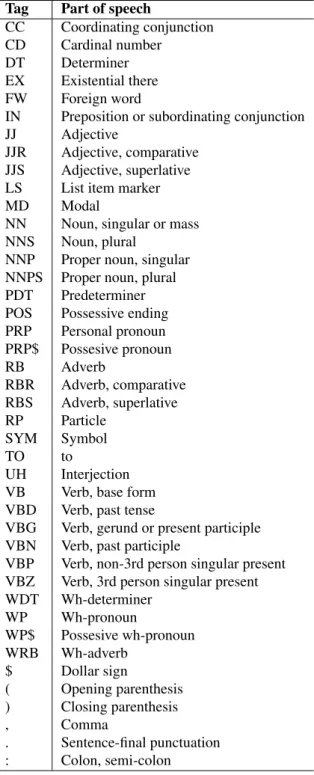
One of the most well known tag sets is the Penn Treebank tag set, which has over 40 different categories. Figure 3.1 shows a regular sentence before POS tagging, and figure 3.2 shows the same sentence after tagging with the Penn Treebank tag set. All the tags are explained in table 3.1.
3.1.2
Tagging Approaches
POS tagging algorithms are usually classified into two different groups: rule-based taggers and stochastic taggers. Rule-based taggers generally involve a manually created database where disambiguation rules apply, while stochastic taggers pick the most likely tag for a word based on probability. There are also taggers that try to have a combination of those two architectures, typically called transformation-based taggers. This section gives a brief description of each of these three approaches. For a more detailed presentation please see [28].
3.1. PART OF SPEECH TAGGING 19
Table 3.1: The Penn Treebank POS tag set
Tag Part of speech
CC Coordinating conjunction CD Cardinal number
DT Determiner EX Existential there FW Foreign word
IN Preposition or subordinating conjunction JJ Adjective
JJR Adjective, comparative JJS Adjective, superlative LS List item marker
MD Modal
NN Noun, singular or mass NNS Noun, plural
NNP Proper noun, singular NNPS Proper noun, plural PDT Predeterminer POS Possessive ending PRP Personal pronoun PRP$ Possesive pronoun RB Adverb RBR Adverb, comparative RBS Adverb, superlative RP Particle SYM Symbol TO to UH Interjection VB Verb, base form VBD Verb, past tense
VBG Verb, gerund or present participle VBN Verb, past participle
VBP Verb, non-3rd person singular present VBZ Verb, 3rd person singular present WDT Wh-determiner WP Wh-pronoun WP$ Possesive wh-pronoun WRB Wh-adverb $ Dollar sign ( Opening parenthesis ) Closing parenthesis , Comma . Sentence-final punctuation : Colon, semi-colon
20 CHAPTER 3. TEXT ANALYSIS Input word: "that"
if next word is adjective, adverb, or quantifier, and following which is a sentence boundary. And the previous word is not a verb like 'consider' which allows adjectives as object complements
then eliminate non-ADV tags
else eliminate ADV tag
Figure 3.3: Example of "that" rule in rule-based tagging
Rule-Based Taggers
Rule-based tagging is the earliest approach to assigning part of speech. It is based on a two-stage approach [28]. First, a dictionary is used to assign all possible tags for each word. The second stage consists of narrowing down the list to a single part of speech tag for each word. This is done through a large set of disambiguation rules. An example of such a rule is shown in figure 3.3.
One popular rule-based tagger is the ENGTWOL tagger [64].
Stochastic Taggers
Stochastic taggers usually resolve ambiguities by using a training corpus to compute the probability of a word having a given tag in a given context [28]. Stochastic taggers of-ten produce a reasonable output without seeming to know anything about the rules of a particular language. A stochastic approach includes most frequent tag, n-gram and Hid-den Markov Model (HMM). HMM is the stochastic model which is mostly used in part of speech tagging. Since we can not observe the sequence of tags, only the sequence of words can directly be observed, an HMM will enable us to estimate the sequence of tags, which is "hidden" from the observer, and then choose the most likely sequence with the highest probability. More formally HMM taggers choose the tag sequence which maximises the following formula:
P(word|tag)∗P(tag|previous n tags) (3.1) whereP(word|tag)is the most frequent tag (likelihood) andP(tag|previous n tags)is the N-gram (a prior).
The probabilities used in the formula above are collected from a tagged corpora. One example for the likelihood for a noun and a verb to appear after the word "race" in the Brown Corpus1is shown below.
P(N N|race) =.98
P(V B|race) =.02
3.1. PART OF SPEECH TAGGING 21
Transformation-Based Taggers
Transformation-based taggers is a combination of rule-based taggers and stochastic tag-gers. This kind of tagging is also sometimes called Brill tagging after Eric Brill who first came up with the method. It consists of three major stages [6]. First, it applies rules which specify what tag a word should be assigned, just like in rule-based taggers. Then it exam-ines every possible transformation of the rules and selects the one that results in the most improved tagging, similar to stochastic tagging. Lastly, it re-tags the data according to the rules, and this continues until a threshold is met.
3.1.3
Part of Speech Tagging in Opinion Mining
In opinion mining part of speech tagging is often used to extract adjectives. Research on subjectivity detection revealed a high correlation between the presence of adjectives and sentence subjectivity [20]. This finding has often been taken as evidence that adjectives are a good indicator of sentiment. However, this does not imply that other part of speech do not contribute to the sentiment. There have been studies that used only adjectives as features in machine learning algorithms, and they performed worse than using the same number of most frequent unigrams [49]. The researchers point out that also verbs like "love" and "like" can be strong signal for sentiment.
3.1.4
Part of Speech Tagging in our Application
In our case we use adverbs, nouns, verbs and adjectives to determine its sentiment, and disregard prepositions, pronouns and conjunctions, since they rarely contribute to the sen-timent. Interjections, however, can be more interesting to look at. For example the in-terjection "oooh" in the phrase "Oooh. Hotel Rica Bakklandet lies by the river Nidelva". Clearly for the human user this is a positive phrase because of the interjection, but in our application this phrase will be deemed objective, since the rest of the sentence states an objective fact. The reason for exclusion of interjections is two fold. SentiWordNet, which we use to calculate the sentiment value, and described in section 4.2.1, does not have sup-port for interjections, so if we are going to supsup-port it, we ourselves have to add scores for each interjections manually. Secondly, interjections are more used in conversions than in reviews, for example we checked interjections for all the reviews for London from Tri-pAdvisor. That data set includes 167 655 reviews and 26 068 271 words. There we found in total 11 437 interjections. In other words 0.044% of all the words are interjections. This is, however, something that could easily be added in the future.
We use Stanford Log-linear Part-Of-Speech Tagger2to perform the part of speech tagging. This tagger uses a Maximum Entropy model, which is similar to stochastic tagging, with the Penn Treebank tag set [60].
22 CHAPTER 3. TEXT ANALYSIS
3.2
WordNet
WordNet3 is a large lexical database for the English language, and was created and is being maintained at the Cognitive Science Laboratory at Princeton University [39]. It groups nouns, verbs, adjectives and adverbs into sets of synonyms called synsets. Each synset corresponds to one underlying lexical concept and a gloss describing the concept it represents.
For example, one of the synsets for the word dog is {dog, domestic dog, Canis familiaris} with the following gloss: "a member of the genus Canis (probably descended from the common wolf) that has been domesticated by man since prehistoric times; occurs in many breeds". In addition, many of the synsets contains examples of usage, for instance "the dog barked all night".
Most synsets are linked to other synsets through semantic relations. These relations vary based on whether the synset represents a noun, verb, adjective or adverb because they follow different grammatical rules. A short description of the different relations for the different word types are given in table 3.2.
WordNet is freely and publicly available, and can be accessed online through a web browser4or through download.5Figure 3.4 shows the result of performing a search for the word "dog" in the web interface of WordNet. As seen from the figure, there are 7 different synsets for "dog" as a noun and 1 synset as a verb. All these synsets show the different senses the word can have. To have a more precise meaning of a text, one has to determine which sense of a word is used. This is called word sense disambiguation, and is described in section 3.3.
We use WordNet as a lemmatisation tool and to get the specific word ID, so we can quickly find the sentiment value of the word through SentiWordNet, since SentiWordNet uses the same words and word ID as WordNet. It is also used in the word sense disambiguation process described in section 3.3. SentiWordNet is explained in section 4.2.1.
3.3
Word Sense Disambiguation
Word sense disambiguation (WSD) is the problem of identifying appropriate meaning or sense of a word used in a sentence when the word has multiple meanings [35]. This section will start with an introduction to word sense disambiguation, then go more in-depth with an algorithm called Lesk. Lastly, practical use in our prototype is detailed.
3http://wordnet.princeton.edu/
4http://wordnetweb.princeton.edu/perl/webwn 5http://wordnet.princeton.edu/wordnet/download/
3.3. WORD SENSE DISAMBIGUATION 23
Table 3.2: Semantic relations in WordNet
Type Relation Explanation Example
Nouns Hypernyms A is a hypernym of B if B is a kind of A
Canine is a hypernym of dog
Nouns Hyponyms A is a hyponym of B if A is a kind of B
Dog is a hyponym of ca-nine
Nouns Holonym A is a holonym of B if B is a part of A
Bicycle is a holonym of pedal
Nouns Meronym A is a meronym of B if A is a part of B
Air bag is a meronym of car
Verbs Hypernym The verb A is a hypernym of the verb B if the activity B is a kind of A
To perceive is an hyper-nym of to listen
Verbs Troponym The verb A is a troponym of the verb B if the activ-ity A is doing Y in some manner
To march is a troponym of to walk
Verbs Entailment The verb A is entailed by B if by doing B you must be doing A
To sleep is entailed by to snore
Adjectives Similar-to The adjective A is similar to the adjective B if A and B have similar meaning
Beautiful is similar-to pretty
Adjectives Pertainym The adjective A is a per-tainym of the adjective B if A is of or pertaining to B
Academic is a pertainym of academia
Adjectives Antonym The adjective A is an antonym of the adjective B if A means the opposite of B
Pretty is an antonym of ugly
24 CHAPTER 3. TEXT ANALYSIS
Figure 3.4: Entry of "dog" in WordNet
3.3.1
Introduction
Part of speech tagging can be seen as a crude form of word sense disambiguation, which is explained in section 3.1, but this section deals with more fined grained methods and algorithms. As an example consider the word "bridge" and two of its meanings:
• Bridge - a structure that allows people or vehicles to cross an obstacle such as a river or canal or railway etc.
• Bridge - any of various card games based on whist for four players Then consider these two sentences:
• The vehicle has to cross a bridge to reach its destination.
• Bridge is played with a standard deck of 52 playing cards.
For a human it is pretty obvious which sense of the word "bridge" is used in these two sentences, but to develop algorithms to replicate this human ability can often be a difficult task. The process of WSD can mainly be divided into two steps:
1. Find all senses for all relevant words that shall be disambiguated 2. Give each word its correct sense
The first step is straightforward, since there exists many computer-readable dictionaries or knowledge sources that may be used. WordNet is one such dictionary, which contains all
3.3. WORD SENSE DISAMBIGUATION 25
possible senses for each word, as described in section 3.2. The second step is accomplished by relying on the context or external knowledge sources [26]. The context can include both information within the text and extra-linguistic information, such as the situation. External knowledge sources like lexical or encyclopedic resources can also provide data useful for associating words with senses.
3.3.2
Lesk Algorithm
The Lesk algorithm is based on the hypothesis that words used together in text are related to each other, and that this relationship can be observed in the description of the words and their senses [33]. The algorithm therefore looks for overlaps in the descriptions, and chooses the sense that has most correlation in its description. The most simple version of the Lesk algorithm simply counts the number of same words in all the words definitions of every sense, and picks the sense that has the highest count. Consider an example with the context "bridge player" and with the following dictionary definitions:
1. Bridge - a structure that allows people or vehicles to cross an obstacle such as a river or canal or railway etc.
2. Bridge - any of various card games based on whist for four players 1. Player - a person who participates in or is skilled at some game 2. Player - someone who plays a musical instrument (as a profession)
If one count each of the word in those four definitions, only counting adjectives, subjec-tives, verbs and adverbs, one will found that the most likely sense is 2. bridge and 1. player with a count of 1. This is because "game" as a subjective is included in both the descrip-tions. None other words is included in other definitions, and therefore has a count of 0. This was of course a simplified example with very small context, but the same principle applies for more than 2 words, only with a longer and more complex computation. One of the challenges with this algorithm is to choose how many of the words in the context should be used in the disambiguation. The more words chosen, the longer time the calculations will take. On the other hand, to few context words lead to a higher error rate.
3.3.3
Usage in our Application
In our application we use a dictionary-based method. First we use WordNet to find all the senses for each word, and then we use the Lesk algorithm to determine the most likely sense. The results with this approach can be seen in section 7.1.2. We have also used the standard WordNet approach, which basically uses the most common sense for each word. This way it is possible to compare Lesk against the standard to see if one performs better. We did not find any libraries with the Lesk algorithm in Java, so we have so far only implemented the simple version from scratch, but in the future one can try to make a more advanced version, like the adapted Lesk algorithm [3]. Another reason for not focusing on
26 CHAPTER 3. TEXT ANALYSIS
improving the Lesk algorithm is that we already had very good results in opinion mining, as shown in section 7.1. A comparison of the two can also be found in that section.
Chapter 4
Opinion Mining Techniques
This chapter describes the theories and algorithmic techniques utilised in the project for analysing opinion. The goal is to find efficient methods for extracting the semantic con-text of documents. The chapter starts with describing some of the challenges with opinion analysis, then presents the two main approaches: knowledge-based and supervised. Other operations and techniques related to sentiment analysis like unsupervised learning, lan-guage models and feature extraction will also be presented.
Additionally, temporal aspects will be looked at. This part will describe ways to detect changes in opinion over time. Two aspects are described: burst detection and opinion visualisation.
4.1
Known Challenges
Most of the challenges in opinion mining are related to the authenticity of extracted data and the methods used [48]. Often a document contains sentences with mixed views. For example assume a news article about two different companies, say Statoil and SAS, con-tains positive news about Statoil, but negative news about SAS. Should this text be clas-sified as positive or negative? Or maybe neutral? Another issue is that a word could be considered positive in one situation and negative in another situation. For example the word rise, can be considered both positive and negative depending on the context. If the costs rise, that is definitely negative for the company, but if the value of the company or the revenue rises then that is positive. This example is maybe more of a general text mining problem than pure opinion mining, but the same will apply to subjective opinions. To only look at opinions as simply negative or positive is one form of evaluation, but it overlooks the comparing factor. Comparisons may be objective or subjective. For exam-ple, an objective sentence is "this cellphone is 10 grams heavier than iPhone 4S". This is a
28 CHAPTER 4. OPINION MINING TECHNIQUES
stated fact, and does not necessarily have an impact on which cellphone is the better one. A subjective sentence can for example be the sentence "this cellphone is better than Sony Ericsson Xperia Play, but worse than iPhone 4S". Is this a positive sentence? Or a nega-tive sentence? Clearly, the cellphone is regarded, according to the author, better than Sony Ericsson Xperia Play, so that is a positive evaluation, but worse than iPhone 4S, which is a negative statement.
Additionally, opinions may change over time. If a lot of customers complain about a prod-uct, the company will eventually take notice and try to fix it. In other words opinions can be outdated after some time. Other challenges include misleading opinions like sarcasm and irony and that people have different writing styles. A person can, for example, use a word that can be regarded negative for some, but neutral or even positive for others. Determining subjectivity and sentiment of a document is one thing. Finding the general sentiment in huge collections of data sets is quite another. What one person thinks of a product is often not interesting. What 10,000 people think of the same product almost always is. Due to this, along with the sheer amount of information available at times, the need to summarising opinions [4] regarding given topics arises.
Another problem is domain dependence, that is that the general notion of positive and negative opinions can be different depending on the domain. For example the sentence "go read the book" can be a positive sentence in book reviews, but negative in movie reviews. One way to deal with this was provided by Yang et alii, who saw if the features were good domain-independent indicators by checking that the features were good in two different domains, in this case movie reviews and product reviews [66].
It is also worth mentioning that human classification has around 70% correctness because human raters typically agree about 70% of the time [38]. Thus, a system that has around 70% accuracy is as good as human raters, even though it may not sound too impressive. If a program were "right" 100% of the time, the average human would still disagree with it around 30% of the time.
4.2
Knowledge-based Approaches
A number of approaches to opinion mining take the effort of first creating an opinion lexicon. This can be done in many ways. The simplest method is to manually decide the degree of positivity and negativity of words, and then have some way of calculating the sentiment for each sentence or whole text based on the values of the words. This can of course be tricky because it is difficult to set a sentiment value on a simple word, since many words can be both positive and negative depending on the context. Adding word phrases and have some form of word disambiguation can help improve the results, but it will still be extremely time consuming doing this manually.
In the other extreme, one can create an opinion lexicon in an unsupervised manner. An example of that can be found in [62], where adjectives and adverbs are first extracted.
4.2. KNOWLEDGE-BASED APPROACHES 29
Figure 4.1: Entry of "adventurous" in SentiWordNet
Then the semantic orientation is decided by an algorithm that uses mutual information as a measure of the strength of semantic association between two words [10]. The last step is to calculate the average semantic orientation of phrases in the given text based on the created lexicon, and classify the text as positive or negative.
An approach that combines both manually and automatically labelling is SentiWordNet, which is the main approach we use in our application. SentiWordNet is a good sentiment lexicon with very high accuracy, as shown in section 7.1.
4.2.1
SentiWordNet
SentiWordNet is a publicly available lexical resource for opinion mining and is freely available for research purposes [16]. It can also be accessed through a web-based graph-ical user interface,1 as can be seen in figure 4.1. SentiWordNet is based on the lexical database of WordNet, and automatically annotates each synset of WordNet according to three sentiment scores: positivity, negativity, objectivity, describing how positive, negative and objective the terms contained in the synset are. In SentiWordNet 3.0 only the positive and negative scores are included in the database, so the objectivity score is calculated as:
ObjScore= 1−(P osScore+N egScore)
Terms may also have different senses, and thus possibly different sentiment properties. For example the synset "estimable" with the sense "may be computed or estimated" has 1.0 in objectivity and 0.0 in negativity and positivity. Another synset "estimable" with the sense "deserving of respect or high regard" has a positivity score of 1.0, and negativity and objectivity of 0.0. Each of the three scores range in the interval from 0.0 to 1.0, and their sum is 1.0 for each synset. Additionally, a synset may have a n
![Figure 4.2: An example of a data set with a cluster structure from [37]](https://thumb-us.123doks.com/thumbv2/123dok_us/502879.2559330/49.748.166.513.179.506/figure-example-data-set-cluster-structure.webp)