Master Thesis
Computer Science
Thesis no: MCS-2011-04
January 2011
School of Computing
Blekinge Institute of Technology
Box 520
SE – 372 25 Ronneby
User Experience Evaluation in Mobile
Industry
Ali Mansoor, Zahid Mahboob
School of Computing
Blekinge Institute of Technology
SE-371 79 Karlskrona
Contact Information:
Author(s):
Ali Mansoor
Zahid MahboobE-mail:
[email protected] [email protected]University advisor(s):
Dr. Kari Rönkkö
Jeff Winter
School of Computing
Internet : www.bth.se/com
Phone
: +46 457 38 50 00
Fax
: + 46 457 102 45
This thesis is submitted to the School of Computing at Blekinge Institute of Technology in
partial fulfillment of the requirements for the degree of Master of Science in Computer Science.
The thesis is equivalent to 20 weeks of full time studies.
School of Computing
Blekinge Institute of Technology
SE-371 79 Karlskrona
A
BSTRACT
Context: The Telecommunication industry has experienced a great revolution since last decade. Mobile devices become the new fashion trend and play a vital role in every one´s life. Due to this reason, major industry experts predict the upcoming time to be the time of Mobile Industry. The success of mobile industry is by and large dependent on its consumers. Therefore it is necessary for the vendors to focus on their target audience i.e. what are the needs and requirements of their consumers and how they feel and perceive about their products. UX evaluation of mobile products and services (MPS) can help the organizations for developing more user friendly products and services that can meet the user expectations, needs and acceptance.
Objectives: In this thesis study, one of our main focuses was to explore different definitions and concepts of UX present in academia, ISO and other standards. Also, we were interested to identify different UXEMs and the UX role in mobile industry in order to develop a better understanding about the importance of UX in the success of Mobile products and services (MPS).
Methods: An exploratory case study was carried out to answer the research questions of this thesis study. At the end, the results of the case study were evaluated from a workshop, held at Ericsson AB (Karlskrona). On the basis of case study and workshop, final results are presented.
Results: During this thesis study, we have proposed an initial framework to understand UX. We have also proposed a toolkit of UXEMs that can provide guideline about UXEMs i.e. which UXEM is suitable for which factor of UX and during which phase of development life cycle.
Conclusions: In academia (literature), different definitions and terminologies are present for UX but still no consensus is found on one single definition of UX. In academia, different authors have identified different UX factors that may influence the UX in adoption of MPS. Through Case Study, we identified different UXEMs and UX evaluation criteria that are used to capture the UX. We have presented different UX factors that need to be focused for evaluating UX in Mobile Industry. We conclude that there is a need of such UXEM or UXEMs that can capture the broader picture of UX as most of the identified UXEMs were only useful to measure some of the UX factors. After conducting workshop at Ericsson AB (Karlskrona), we conclude that there is need to make industry and academia more closer for developing good understanding about UX i.e. still industry people are not much familiar with different UXEMs and UX factors .
Keywords: User Experience, Mobile Industry, User Experience Evaluation, User Experience Evaluation Methods.
A
CKNOWLEDGMENT
In the name of ALLAH almighty who is the most Generous and Beneficent in this Universe.
First of all, we would like to show our humbleness towards the Pride and Greatness of
ALLAH almighty whose blessings gave us the strength to complete this thesis study.
We feel honored to record our gratitude to our respected and honorable supervisors Dr. Kari Rönkkö and Mr. Jeff Winter for their continuous support and encouragement during thesis work. They provided us full guidance and detail feedbacks at every stage of this thesis study in order to improve the quality of thesis. We want to specially thank our supervisors for their support and presence during the workshop held at Ericsson AB, Karlskrona.
We feel privileged to convey our special thanks to Ericsson AB, Karlskrona which provide us the chance to present our work and provided us the feedback to evaluate the quality of our thesis study.
I would like to say thanks to all of my family members specially my mother, my elder sister and brother in law Murtaza Hussain for their prayers, affection, love, care and support that was the continuous source of encouragement for me. I also want to appreciate the love, prayers and support of my Fiancee, throughout this thesis study. At the end, I want to mention my friends especially Tabassum, Sheraz, Abdul Rauf and Malik Qaiser whose support and motivation gave me energy to complete this thesis study.
(Ali Mansoor)
I owe my parents for their encouragement and support that is a key factor in every achievement that I have ever made in my life. I am indebted to my brothers for their encouragement and patience during this course of Master of Science in Computer Science. I am also obliged to my home town school teachers, class fellows and friends for their continuous encouragement and motivation that I always find from their suggestions. This dissertation is dedicated to my mother for her love, support, patience and enthusiastic encouragement at all times.
L
IST OF
T
ABLES
:
Table 1: Abbreviations and Definitions
... 7
Table 2: Types of Case Study
... 17
Table 3: Resources Searched Results
... 21
Table 4: UX factors identified from different definitions and standards
... 25
Table 5: Two Perspectives on Experience based on Hassenzahl´s Model
... 27
Table 6: UX Attributes and their Sub Attributes
... 28
Table 7: Building blocks of QoE
... 29
Table 8: User Centric Issues
... 29
Table 9: Components of User Perceptions about Product
... 30
Table 10: UX factors identified from different UX definitions and Concepts
... 31
Table 11: The Classification of Behavioral Data and Motivational Data
... 35
Table 12: UX factors that influence UX in adoption of MPS
... 36
Table 13: Measurement areas in UX lifecycle [82]
... 38
Table 14: Major measurement areas and their sub-measurement areas in UX life
cycle
... 38
Table 15: Characteristics of good UXEM [104]
... 40
Table 16: Characteristics of Objective & Subjective Measures [96]
... 41
Table 17: UX Evaluation Methods (UXEMs)
... 42
Table 18: Ten Neilson‟s Heuristics
... 54
Table 19: Information Required for Cognitive Walkthrough (CW)
... 55
Table 20: Contributing Factors to UX
... 58
Table 21: Number of times a UX factor found in Literature
... 59
Table 22: Factors that influence UX of user in the adoption of MPS
... 60
Table 23: Factors that influence UX in adoption of MPS
... 61
Table 24: User Experience Evaluation Methods
... 64
Table 25: UX Factors addressed by UXEMs
... 65
Table 26: UX Factors addressed by UXEMs
... 65
Table 27: Different factors of Users and PS
... 66
Table 28: Toolkit of UXEMs
... 67
Table 29: Workshop Participants
... 70
Table 30: Key points of discussion
... 71
L
IST OF
F
IGURES
:
Figure 1:
Interactive system components
... 11
Figure 2: Overview of Case Study
... 19
Figure 3:
Detail Research Methodology
... 22
Figure 4: Technology Acceptance Model
... 26
Figure 5: User Experience Factors
... 27
Figure 6: Mobile Service Model Framework
... 34
Figure 7: UX Time Line
... 40
Figure 8: User Experience Evaluation Methods (UXEMs)
... 41
Figure 9: Scale Adoption Framework for Evaluation (SAFE)
... 50
Figure 10: an initial framework to understand User Experience in Mobile Industry
62
L
IST OF
C
HARTS
A
BBREVIATIONS
A
ND
D
EFINITIONS
:
Table 1: Abbreviations and Definitions
Abbreviations Definitions
UX User Experience
MPS Mobile Products and Services
UEM Usability Evaluation Methods
UXEM User Experience Evaluation Method
UXEMs User Experience Evaluation Methods
HCI Human Computer Interaction
HCD Human Centered Design
UCD User Centered Design
DRUM Diagnostic recorder for Usability Measurement MUSiC Measuring the Usability of Systems in Context SUMI Software Usability and Measurement Inventory
QoE Quality of Experience
MIS Mobile Internet Services
UI User Interfaces
GSR Galvanic skin response
HR Heart Rate
EDR Electrodermal Response
PGR Psychogalvanic Reflexes
SCR Skin conductance Response
RGT Repertory Grid Technique
RG Repertory Grid
EP Experimental Pilot
SAFE Scale Adoption Framework for Evaluation
HE Heuristics Evaluation
CW Cognitive Walkthrough
Table of Contents
USER EXPERIENCE EVALUATION IN MOBILE INDUSTRY ...I
ABSTRACT ... 2
ACKNOWLEDGMENT ... 3
LIST OF TABLES: ... 4
LIST OF FIGURES: ... 5
LIST OF CHARTS ... 6
ABBREVIATIONS AND DEFINITIONS: ... 7
SECTION I – OVERVIEW ... 10
1 CHAPTER: INTRODUCTION ... 11
1.1 BACKGROUND... 11
1.2 PROBLEM DEFINITION: ... 13
1.3 AIMS &OBJECTIVES ... 14
1.4 RESEARCH QUESTIONS ... 14
1.5 EXPECTED OUTCOMES ... 15
1.6 THESIS OUTLINES: ... 15
2 CHAPTER: RESEARCH METHODOLOGY ... 17
2.1 CASE STUDY: ... 17
2.1.1 Types of Case Study: ... 17
2.1.2 The norm to use Case Study: ... 17
2.1.3 Design and Planning: ... 18
2.1.4 Analysis and Interpretations: ... 21
2.2 WORKSHOP: ... 21
2.2.1 Questionnaire: ... 22
SECTION II – CASE STUDY ... 23
3 CHAPTER: USER EXPERIENCE (UX) ... 24
3.1 DIFFERENT DEFINITIONS FOR UX FROM LITERATURE AND STANDARDS: ... 24
3.1.1 Definitions from Literature: ... 24
3.1.2 ISO definition for UX:... 25
3.2 DIFFERENT CONCEPTS OF UX FROM LITERATURE: ... 26
4 CHAPTER: UX ROLE IN MOBILE INDUSTRY ... 32
4.1 MOBILE PRODUCTS AND SERVICES (MPS)... 32
4.2 ROLE OF UX IN MOBILE INDUSTRY ... 33
5 USER EXPERIENCE EVALUATION ... 37
5.1 UXEVALUATION ... 37
5.2 UXEVALUATION CRITERIA: ... 37
5.2.1 Exploring User Experience Measurement Needs: ... 37
5.2.2 Evaluating User Experience of Early Product Concepts: ... 38
5.2.3 User experience Evaluation in Nokia: ... 40
5.3 TYPES OF UXEMS: ... 40
6 UX EVALUATION METHODS (UXEMS): ... 43
6.1 NEED FOR UXEMS: ... 43
6.2 TYPES OF UXEMS: ... 44
6.2.1 Objective Type UXEMs: ... 44
6.2.2 Subjective Type UXEMs: ... 47
SECTION III – EMPIRICAL ANALYSIS ... 57
7.1 DEFINITIONS AND CONCEPTS OF UX: ... 58
7.1.1 Context of Use: ... 59
7.1.2 Expectations: ... 59
7.1.3 Pragmatic, hedonic, Emotions and Satisfaction in use: ... 59
7.1.4 Aesthetic Attributes: ... 59
7.2 ROLE OF UX IN MOBILE INDUSTRY: ... 60
7.2.1 UX Factors that influence the adoption of MPS: ... 60
7.2.2 UX Challenges faced by Mobile Industry: ... 61
7.3 AN INITIAL FRAMEWORK TO UNDERSTAND THE UX IN MOBILE INDUSTRY: ... 62
7.3.1 Important things to be considered before UX evaluation: ... 63
7.4 THE UXEMS FOR MOBILE INDUSTRY: ... 64
7.5 THE UXEVALUATION CRITERIA FOR MOBILE INDUSTRY: ... 66
7.6 DISCUSSION OF THE RESULTS: ... 67
8 WORKSHOP ... 69
8.1 AN OVERVIEW: ... 69
8.2 AIMS AND OBJECTIVES: ... 69
8.3 PARTICIPANTS:... 69
8.4 ACTIVITIES: ... 70
8.4.1 Welcome: ... 70
8.4.2 Introduction of the participants: ... 70
8.4.3 Presentation:... 70 8.4.4 Discussion Session:... 70 8.5 QUESTIONNAIRE: ... 71 8.6 FEEDBACK: ... 72 9 VALIDITY ... 74 9.1 VALIDITY THREATS: ... 74 9.1.1 Credibility: ... 74 9.1.2 Transferability: ... 75 9.1.3 Dependability: ... 75 9.1.4 Confirmability: ... 76
SECTION IV – CONCLUSION AND FUTURE WORK ... 77
10 CONCLUSION AND FUTURE WORK ... 78
10.1 CONCLUSION: ... 78
10.1.1 Research Questions Revisited: ... 79
10.2 FUTURE WORK: ... 80
10.2.1 Identification of a proper relationship between Quality and UX: ... 80
10.2.2 Motivation towards UX Evaluation: ... 80
REFERENCES ... 81
SECTION V – APPENDIXES ... 86
APPENDIX A: WORKSHOP QUESTIONNAIRE ... 87
S
ECTION
I
–
O
VERVIEW
Chapter 1 - Introduction1
C
HAPTER
:
I
NTRODUCTION
This chapter provides a brief overview of this thesis. The Background of thesis is described in section 1.1 whereas Problem Definition of this thesis study is presented in section 1.2. Aims & Objectives of thesis are mentioned in section 1.3 whereas the Research Questions and their description are discussed in section 1.4. The Expected Outcomes are explained in sections 1.5 and section 1.6 is based on the complete Outlines of thesis.
1.1
Background
Computer science took almost more than 20 years to prove its identity amongst different disciplines of science such as Physics, Chemistry, and Mathematics [1]. According to Lewis and Smith [2], computer science scholars spent more than 50 years to define Computer Science but unfortunately have not reached any consensus.
Computing Curricula 2008 [1] has described Computer Science as a body of Knowledge. It further identifies 14 sub-areas of knowledge that are; Algorithms and Complexity, Architecture and Organization, Computational Science/Numeric Methods, Discrete Structures, Graphics and Visual Computing, Human-Computer Interaction (HCI), Information Management, Intelligent Systems, Net-Centric Computing, Operating Systems, Programming Fundamentals, Programming Languages, Social and Professional Issues and Software Engineering.
Computer science as a discipline is changing with the passage of time by the rise in recognition of computer science as an empirical science where data collection and analysis are considered as important as are formal proofs [3]. An increasingly important task of computer science is to support the analysis and design of computers in order to make things learn quickly, as tools to be useful in one's work and as medium of interaction with other people. HCI is the specialized area that addresses this issue [4].
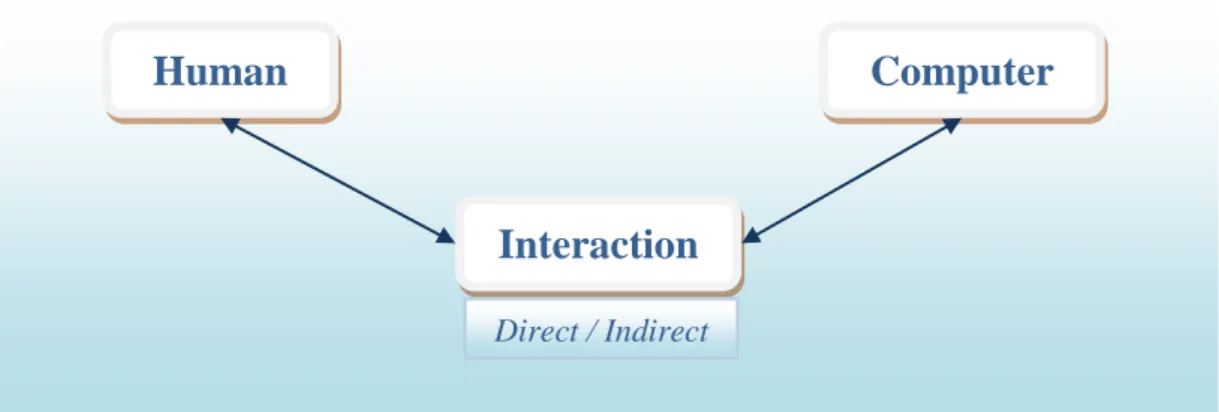
HCI entertains the design, implementation and assessment of interactive systems in the environment of the user‘s task [5]. The core objective of HCI is to design such computer systems that can allow the user to focus on the task without any disturbance due to the poor interface by helping them to go through the task. The interactive system components [5] are Human, Computer and their Interaction as shown in Figure 1 and is adapted from [6]. The interaction design has different qualities such as Usability, Utility, Satisfaction, Communication and Sociability [6].
Human
Computer
Interaction
Direct / Indirect
Recently, HCI has emerged as a critical part of computer science research and development. It has discovered many problems and has provided well designed solutions such as user interface management systems, task oriented help and instruction. People belonging to different cultures are also a key factor. This factor deals with the context, how people from different areas, perceive computing technology and the impact of that technology on their lives. That all makes HCI a viable part of computer science [4].
Usability is considered to be an important attribute of interactive design that plays a vital role in the development of any product. Usability can be considered in different scenarios like task performance, ease of use and ease of learning etc. A lot of research has been carried out on the usability and perceived user experience. The ISO standards define usability in ISO 9124-11 as ―The extent to which a product can be used by specified users to achieve specified goals with effectiveness, efficiency and satisfaction in a specified context of use‖
[7]. Furthermore different definitions of usability are present in the literature.
Dix [8] defines usability in terms of Learnability, Flexibility and Robustness. In the same way, Shackel [9] defines usability fusion of five components i.e. Efficiency (Speed), Learnability (Time to learn), Learnability (Retention), Effectiveness (Errors) and Attitude. Moreover, there are a number of usability concepts and definitions presented by different authors in different scenarios.
Regarding usability of software products, [8] further carried out this discussion towards the relationship between the Functionality (product), Usability (interaction between product and user), and the User satisfaction (user experience). According to these authors, although these are three independent elements but they affect each other in some way. For example, a poor usability of the product creates a negative user experience that may create frustration, annoyances and bad impression towards the product.
The quick advancement of information technology results into different challenges such as, how to meet user requirements and the problem of availability [10]. The product‘s availability is very important, and at the same time the User Experience (UX) has more far reaching implications.
Different authors have provided different definitions of UX. Preece et al. [11] consider UX as Satisfaction, Enjoyment, Entertainment, Helpful, Motivating, Aesthetically, Pleasing, Supportive of Creativity, Rewarding, Emotionally, Funny and Fulfilling.
UX has been a burning issue in HCI from last few years. Generally, different techniques [12] such as interviews, observations, surveys, storytelling, and diaries are being used to capture UX but in the HCI research area the perception of user experience and its assessment has not been achieved yet and still there are many things to be done in addressing this issue.
During the last several years, a mounting interest for ―designing the user experience‖ has been taken into account by business people, designers, interaction design firms and e-business strategy providers. The term ―Designing the user experience‖ explains the need to identify users and their requirements for making interaction design and product design capable of achieving specific user experience goals [10]. Although a few theories of user experience [13-15] exist but the term ―UX‖ is interpreted into a wide range of meanings due to which no consistent theory of experience is present for the designers [16]. Therefore, to assist the design community, a lot of work is required for developing a clear understanding about UX, its components and the efforts to design for it [10].
According to [17], there are many competing definitions of the term ―user experience‖ but scholars and practitioners are agreed that a user experience is not a directly measurable event. Different people have different perceptions about a proper definition of the UX but so
far have not reached a consensus. One reason might be that, UX is a collection of an infinite amount of smaller experiences that are relating to some contexts, people and products. Due to this, it is hard to collect and analyze data that is based on the complex process of interaction among users and the world that exists in user minds.
Sales figures, customer satisfaction and recommendation scores, consumer and technical reviews, and user feedback from usability tests are the existing examples of experience measurement [18]. These methods help project teams in a reflective way by providing little insight into user‘s feelings about their experience with a particular product and even less insight to project team members who must make experience design decisions about a product that has not yet been released.
The Telecommunication industry has experienced a great revolution since last decade. Now [19], traditional wired telephones and their services have became a part of history. This leads to a change of infrastructures to data based services, homogeneous to heterogeneous networks and non intelligent devices to smart handhelds, personal digital assistants, and mobile computers.
Mobile implies portability and refers to devices that are capable of communicating voice, text, data, and video [20]. These communication devices include smart phone, personal digital assistant (PDAs), laptop, global positioning systems (GPS) and mobile payment (m-payment) systems. Mobile consumers are facilitated to perform different activities such as trading, banking, shopping, bill payments, and other services without being connected to wires or fixed in a particular location.
Mobile devices [21] have become a necessary part of every one´s life due to which major industry experts think that the upcoming time is likely to be the time of Mobile Industry and its success is by and large based on consumers‘ buy in, and therefore vendors should focus their target audience who will be using such a technology. Therefore, the use and operation of it should be as simple as possible that can be easily understandable for everyone.
The study of HCI for mobile devices [4] is comparatively a new research field due to which a short history of leading conferences and commercially successful devices can be found that are available for less than a decade. Mobile HCI field was not given so much attention in the past due to which a little knowledge is available about the research field.
Quality can be considered as a standard that satisfies the user by gathering all the functional and non functional requirements of the system [22]. In both Mobile Software‘s and traditional software development, the quality of product has a key role. User satisfaction and interest in a product represents the quality of that product. According to ISO 9126 [22], Functionality, Reliability, Efficiency, Maintainability, Portability and Usability are the six main attributes of quality.
1.2
Problem Definition:
According to [10], during processes of product design and development, the word ―experience‖ and the UX concept are interpreted as ambiguous buzzwords. Experience usually refers to as experience [23], an experience [24] and experience as story [25]. Richard Carlson [23] presented a theory of consciousness where he defined experience as self narration i.e. the continuous flow of the moments of consciousness usually known as Experienced Cognition. On the other hand, John Dewey [24] defined his theory of experience as, ―an experience has a beginning and an end, and changes the user, and sometimes, the context of the experience as a result‖. However, Roger Schank [25] discussed experience as the way to narrate experience as story. Stories are helpful to remember
experience and as they are naturally communicative, therefore they are easy to share experiences amongst different audiences.
Different technologies are playing helpful role in our daily lives. Mobile phone [22] can be considered as the most fashionable and necessary technology carrying by people with themselves ubiquitously. Currently, companies are facing different challenges such as:
How to meet user requirements [10]? How to make user friendly products [10]?
How mobile products and services are perceived, and how the experience can be measured and optimized [26].
In order to increase the value of mobile products and services, the companies are interested to develop complete understandingabout [27]:
User requirements User interests User acceptance
The complete understanding of the user requirements, user interests and user acceptance are the main features in order to increase the value of a mobile product and service for customers [27].
The participation of users in the development of a mobile product(s) or service(s) involves complete understanding of users and their needs that may result into more successful and user satisfaction system. User participation can also raise customer reliability and help in sustaining long term relationships with users. By and large, understanding and serving the users or user groups could act as a source of viable advantage and should not be ignored.
1.3
Aims & Objectives
The overall aim of this research is to investigate User Experience Evaluation for MPS (Mobile Product(s) and Service(s)). In order to facilitate companies about the understanding of UX, there is need of a framework that can help to identify different UX factors and interpretations of UX. Followings are the main objectives:
Identification of different terminologies, concepts and definitions of User Experience (UX) in literature, models and ISO standards.
Investigation of the UX Role in Mobile Industry that is present in literature. Investigation of the recent UX challenges faced by the mobile industry. Identification of different UXEMs present in literature and how they are used.
1.4
Research Questions
Followings are the research questions that will be addressed:
RQ 1: What are the different definitions and concepts for UX in literature?
With the help of case study, different definitions and concepts for UX will be specified. This question will be helpful to identify the different definitions and concepts for UX by different authors presented in different contexts.
RQ 2: How is the role of UX in the Mobile Industry described in literature?
This question will also be answered through case study. The question will help to investigate the role of UX in different areas of Mobile Industry according to different authors. This will also facilitates to highlight the importance of UX in Mobile Industry in the point of view of different people of Mobile Industry.
RQ 3: What are the currently published UX Evaluation Methods (UXEMs) and how are they used?
With the help of case study, this question will be used to figure out different UXEMs present in literature. In order to make firm foundation for the UX evaluation during different development phases of product and services, the pros and cons along with the applicability to different UX aspects of studied UXEMs will be investigated in this research question. RQ 4: What kind of framework can be developed to understand UX and to customize the number of measures used for UX evaluation in mobile industry?
This question will help to develop a framework on the basis of the findings of first three research questions. The developed framework will help to understand the UX phenomenon and different measures for UX evaluation. This framework will also try to facilitate UXEMs for the UX measurement by identifying different measures of UX.
1.5
Expected Outcomes
The expected outcomes will be:
Different concepts and definitions of UX present in different models, ISO and literature.
UX Role in mobile industry, identified by different authors with respect to MPS. List of UXEMs that can be used during the development phases of MPS.
List of UX challenges in requirement capturing and producing design solutions for MPS.
A framework developed from this study will be helpful to: Understand UX phenomenon
Identify different factors of UX. Identify different Measurable Entities Identify different interpretations of UX
Identify different measures for UX evaluation.
How the developed framework can assist the UXEMs for UX testing, an analysis of the obtained results.
Suggestions for organizations.
Discussion about the experience of authors related to developed framework.
1.6
Thesis Outlines:
This section presents the outline of the remaining thesis report. The thesis report is divided into 5 sections.
This section provides the overview of thesis. The background of Research Area, Research Questions, Aims and Objectives, Expected Outcomes and Research Methodology are the main part of this section. The following chapters are the part of this section.
Chapter 1 – Introduction
Chapter 2 – Research Methodology Section II: Case Study
This thesis is based on the Case Study approach. As it is an exploratory Case Study for which we have used Independent Method (Documentation Analysis), therefore, we have conducted a Literature review for document collection, which is presented in this section. The concepts and definitions about UX, Mobile Industry and MPS are presented in this section. Also, the role of UX in mobile industry along with the different UXEMs is provided in this section. The included chapters in this section are:
Chapter 3 - User Experience (UX)
Chapter 4 - UX Role in Mobile Industry
Chapter 5 - UX Evaluation
Chapter 6 - UX Evaluation Methods (UXEMs)
Section III: Empirical Analysis
Chapter 7- Analysis and Interpretations of Case Study
Chapter 8 - Workshop
Chapter 9- Validity
Section IV: Conclusions and Future Work Chapter 10: Conclusions and Future Work
References
Section V: Appendixes
Appendix A: Workshop Questionnaire
2
C
HAPTER
:
R
ESEARCH
M
ETHODOLOGY
In this thesis study, we have used a Case Study approach [28].2.1
Case Study:
According to [28], Case studyis an empirical investigation about a contemporary event that exist in its real life context. It is more suitable when the boundaries are not clearly evident between that event and context.
2.1.1
Types of Case Study:
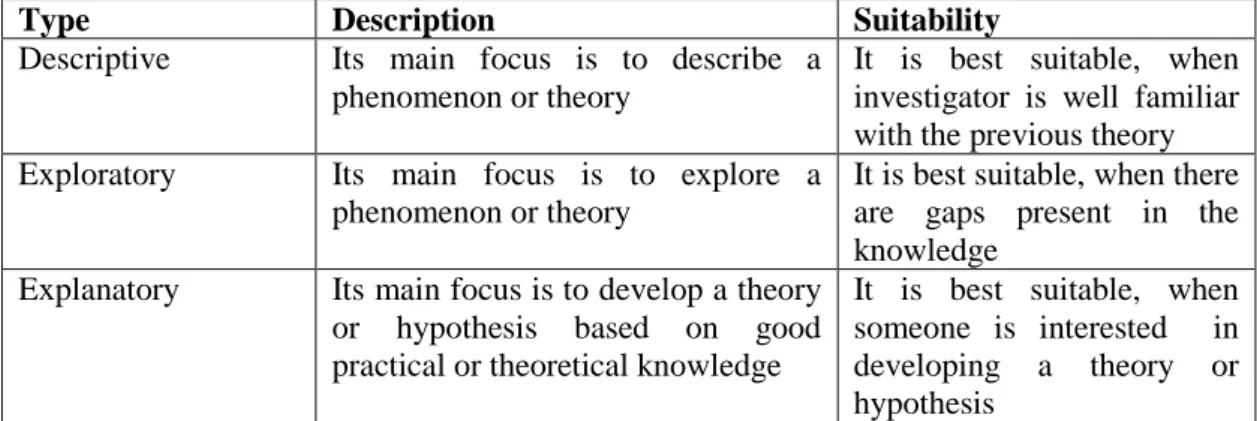
According to [28], three types of case studies are used for research named as explanatory, descriptive and exploratory and are presented in the Table 2 below:
Table 2: Types of Case Study
Type Description Suitability
Descriptive Its main focus is to describe a phenomenon or theory
It is best suitable, when investigator is well familiar with the previous theory Exploratory Its main focus is to explore a
phenomenon or theory
It is best suitable, when there are gaps present in the knowledge
Explanatory Its main focus is to develop a theory or hypothesis based on good practical or theoretical knowledge
It is best suitable, when someone is interested in developing a theory or hypothesis
Yin [28] has defined the followings five major steps to perform case study:
Design of Case study
Data collection preparation
Evidence collection
Data Analysis
Reporting
2.1.2
The
norm
to use Case Study:
Case studies are suitable for the investigation of some contemporary phenomenon of the real world when the investigator has a low or no control over the events [28]. In our case, UX is comparatively an immature concept, as there are shortcomings of the empirical research (qualitative or quantitative) in this area that further restricts our understanding about the concept of UX and its aspects [29]. In real world, UX is considered to be very complex phenomenon due to the following reasons:
People exercise their experience all the time.
People live in a world where they have to interact with different people and different things.
Due to the above reasons, we decided to choose case study approach for the investigation of UX evaluation in Mobile Industry.
2.1.2.1 Exploratory Case Study:
A sufficient knowledge about the research area is not present as the research area is relatively new; therefore we have decided to perform Exploratory Case Study in order to explore the UX phenomenon and to figure out the knowledge gap for UX Evaluation in Mobile Industry i.e. UXEMs and UX Evaluation Criterias.
2.1.3
Design and Planning:
2.1.3.1 Objectives:
The authors were interested in the followings:
Identification of different terminologies, concepts and definitions of UX in literature, models and ISO standards.
Investigation of UX Role in the Mobile Industry, present in literature. Identification of UX evaluation criteria present in literature.
Identification of different UXEMs present in literature and how they are used. Investigation of recent UX challenges faced by mobile industry.
2.1.3.2 The Case:
The case study was performed on the area of UX evaluation in Mobile Industry. UX has been a sizzling issue in HCI from last few years. The term ―Designing the user experience‖ explains the need to identify users and their requirements for making interaction design and product design capable of achieving specific user experience goals [10]. Although a few theories of user experience [13-15] exist but the term ―UX‖ is interpreted into a wide range of meanings due to which no consistent theory of experience is present for the designers [16]. Therefore, to assist the design community, a lot of work is required for developing a clear understanding about UX, its components and the efforts to design for it [10].
A complete understanding of the user requirements, user interests and user acceptance are the main features in order to increase the value of a mobile product and service for customers [27]. The participation of users in the development of a mobile product(s) or service(s) involves complete understanding of users and their needs that may result into more successful and user satisfaction system. User participation can also raise customer reliability and help in sustaining long term relationships with users. By and large, understanding and serving the users or user groups could act as a source of viable advantage and should not be ignored.
2.1.3.2.1 Unit of Analysis:
We have performed an Embedded Case Study [28] where, we put UX case in one context i.e. to evaluate UX in mobile industry by included multiple units of analysis. This study included main & smaller units at different levels but within a case.
2.1.3.2.1.1 Case UX definitions and concepts:
UX has become an important factor in the success of every product and technology today [30]. Even high level usability is not enough to engage people with a product or service. In order to fill the gap between an engaging and a usable product, UX research has been introduced. UX is discussed differently in the literature; therefore this case was selected to perform the case study.
2.1.3.2.1.2 Case UX Role in Mobile Industry:
Recently, an enormous growth in mobile applications is carried out due to which designers and companies are trying to address: ―how these applications are perceived, and how the experience can be measured and optimized” [26]. In order to address this question, this case was selected for case study.
2.1.3.2.1.3 Case UXEMs:
This case was selected for case study in order to elaborate the UXEMs that can help to understand that how users do experience while using a designed system. This is considered to be a general requirement for all UXEMs, but there might be a variety of methods that are used for different purposes.
2.1.3.3 Case Study Protocol:
The case study protocol acts as a guideline to make decisions for design. Case study protocol is also helpful to provide a systematic manner for the collection of data. It is also used to build concrete research during the planning phase, which plays an important role to select data sources. In this thesis study, case study protocol is comprised of the following contents, which played an important role to execute the case study:
The Research Questions for performing the case study, which are described in the Chapter 1, section 1.4.
The data collection methods which were used for collecting the data for executing the case study and are presented in the section 2.1.3.4.
Objectives that we wanted to achieve from Case Study are provided in section 2.1.3.1.
The documentation of the case UX that helped to develop an initial framework to understand UX in Mobile Industry (See Chapter 7, Section 7.3), a toolkit for UXEMs (See Chapter 7, Section 7.4) and extended UX evaluation criteria (See Chapter 7, Section 7.5).
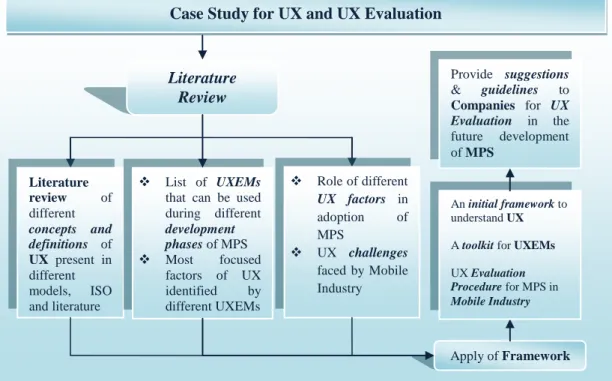
The overview of our case study is presented in Figure 2 below: Case Study for UX and UX Evaluation
Literature Review Literature review of different concepts and definitions of UX present in different models, ISO and literature List of UXEMs
that can be used during different development phases of MPS Most focused factors of UX identified by different UXEMs Apply of Framework An initial framework to understand UX
A toolkit for UXEMs UX Evaluation Procedure for MPS in Mobile Industry Provide suggestions & guidelines to Companies for UX Evaluation in the future development of MPS Role of different UX factors in adoption of MPS UX challenges faced by Mobile Industry
2.1.3.4 Data Collection Types used for Our Case Study:
Three types of methods are used to conduct a case study [31], and are: Direct Method i.e. Interviews
Indirect Method i.e. Observations
Independent i.e. Documentation Analysis
For this thesis study, we have used exploratory case study. To investigate our research area, we were interested in collecting all the possible available document evidences (Articles, Journals, Conferences, and Books etc). Therefore, the Independent Method was followed in this thesis study. As, this thesis study is exploratory in nature and exploratory research is basically based on literature review [32], therefore, a literature review was conducted to collect different documents from academia. In this thesis study, we used the guidelines of case study to collect and analyze the data that was extracted from the documents, which were found after conducting literature review.
Firstly, different definitions and concepts of UX were explored in the literature provided by different authors. Secondly, role of UX in mobile industry was examined from literature. Thirdly, different UX evaluations Criterias were discovered from literature. At the end, different UXEMs were explored from the literature.
2.1.3.5 Identification of the Need of Literature Review:
According to [33], literature review is helpful in acquiring all the available document evidences. A better understanding might be developed through literature review of past research studies in currently under examined area, based on different theoretical propositions.
A literature review was conducted to develop basics for a conceptual model based on theoretical foundations. A high quality literature review should be completed from every aspect and must be concept based. As the concepts establish the organizing framework of a review therefore we conducted a concept centric literature review.
The definitions of different key words of the research area were elaborated to set the boundaries of this thesis study. These boundaries have included issues like contextual limitations, levels of analysis and the scope of the work. All the relevant literature on the topic is covered by following the recommended structured approach [34] in order to acknowledge the source material for the review.
2.1.3.6 Search Strings:
For unbiased and comprehensive Literature Review, selection and formulation of key words is considered to be a vital step. For identifying keywords, the major source was the recent work in the interested research area that contains main keywords.
The mainly used key terms are: ((HCI) AND (Usability)) OR ((Usability) AND (Usability Evaluation)) OR ((HCI) AND (User Experience)) OR ((User Experience) AND (Mobile Industry)) OR ((User Experience) AND (Mobile products and services)) OR ((User Experience) AND (User Experience Evaluation Methods)) OR ((User Experience) AND (Challenges faced by Mobile Industry)). At the end, all the possible combinations of keywords were applied in the search with an aim to occupy whole research area.
2.1.3.7 Resources:
At first, we began with Google Scholar and Inspec/Compendex, but the set of results was massive and redundant. It was also found that, the results in Google Scholar and Inspec/Compendex were also found in ACM, Springer, Science Direct, Jstor and IEEE. For
this Literature Review, we tried to have more focus on IEEE and ACM in particular as these sources are more reliable and trustworthy. But, as the arc of study was claimed [17] to be diverse and immature due to which there did not exist a coherent view. Therefore, we searched different other sources like Springer, Science Direct, and Jstor (we called them “Others” in the Table 3) as well for collecting all possible information in order to understand this area.
We also preferred most concerned conferences to their research area, especially Human Computer Interaction (HCI) journals and conferences were searched to get the most valuable results as shown in the Table 3 under name ―Manual Search‖.
2.1.3.8 Data Extraction:
On the basis of search strings, the search was performed to extract data from the sources. Following Table 3 presents the results of the conducted search.
Table 3: Resources Searched Results
Source Name Total Articles Selected Articles
IEEE 123 18
ACM 162 30
Others 134 55
Manual Search 360 23
Total : 779 126
2.1.4
Analysis and Interpretations:
The case study was performed on the basis of objectives as discussed in section 2.1.3.1. We started performing case study on the basis of units of analysis as discussed in section 2.1.3.2.1. After analyzing different definitions and concepts of UX, different factors of UX have been identified as presented in Table 20 (See Chapter 7, Section 7.1). From Case Study, different factors have been identified that influence the UX in adoption of MPS as presented in the Table 22 (See Chapter 7, Section 7.2). We did analysis to rank each factor that influences the UX in adoption of MPS (See Chapter 7, Section 7.2). In Chapter 7, Section 7.2.2, different UX challenges faced by Mobile Industry are also identified. Through literature, different UXEMs were collected and are presented in Table 24 (See Chapter 7, Section 7.4). Table 22 shows different identified UXEMs that are implementable on the different phases of MPS development lifecycle.
We have also identified different UX evaluation criterias (See Chapter 5, Section 5.2) along with the different UX factors focused by different UXEMs (See Chapter 7, Section 7.4). On the basis of this analysis, we have extended the systematic criteria for evaluating UX presented by Roto et al. [35] in the Chapter 7, Section 7.5. The Chapter 7 provides a detailed discussion about the analysis and results of Case Study.
2.2
Workshop:
In order to present and evaluate the thesis study, a workshop was organized at Ericsson AB (Karlskrona). The participants of the workshop were a professional audience i.e. a team of Ericsson AB (system engineers and designers) and the supervisors of this thesis Dr. Kari Rönkkö and Mr. Jeff Winter. On the whole, the major goal of the workshop was to get the feedback on the results of the Case Study i.e. by presenting the proposed framework of UX and toolkit of UXEMs. More specifically, we were interested to investigate the perception and opinion of industrial experts about UX and role of UX in the industry.
We planned this workshop by following the guidelines of Rollins [36]. In the beginning, we started with a brief introduction about ourselves, our supervisors and research area along with the related work of the research study. This was followed by a demonstration of proposed UX framework, UX evaluation criteria and toolkit of UXEMs. During the presentation, participants were encouraged to question about the proposed work. At the end of presentation, a discussion was carried out upon the proposed study. At the end of discussion session, a questionnaire was distributed amongst the participants.
2.2.1
Questionnaire:
We collected feedback from the participants of the workshop through a structured questionnaire consisted of:
Some questions of Likert Scale Type [37] of four points for each. Some open ended questions.
The questionnaire was composed of seven questions as provided in the appendix A. The feedback of the participants provided us an opportunity to evaluate the presented work. The questionnaire was divided into two parts i.e. UX and UXEMs. The usefulness of the proposed initial framework to understand UX and toolkit of UXEMs was determined through the questionnaire. Different UX factors were also presented in the questionnaire, which participants ranked according to their usefulness. The detail research methodology is shown in Figure 3 below:
Literature review of different concepts and
definitions of UX present in different models, ISO and literature
UX Role in mobile industry, identified by
different authors with respect to MPS
Different factors that influence the
adoption of MPS
List of challenges faced by Mobile Industry
List of UXEMs that can be used during the
development phases of MPS
List of different factors of UX that needs to
be evaluated for better UX
RQ 1
RQ 2
RQ 3
RQ 4
Case Study
a) An initial framework to understand UX, to provide the followings:
Different factors of UX
Different interpretations of UX
Different Measurable Entities
b) Different factors that influence the adoption of MPS
c) List of UX challenges faced by Mobile Industry
d) Different UX factors for UX evaluation.
e) Toolkit of UXEMs f) UX Evaluation Criteria
UX & UX Evaluation
Workshop to Evaluate the Framework of UX and toolkit of UXEMs
Suggestions and recommendations to improve the UX Evaluation for MPS
Literature Review
S
ECTION
II
–
C
ASE
S
TUDY
Chapter 3: User Experience (UX)Chapter 4: UX Role in Mobile Industry Chapter 5: UX Evaluation
3
C
HAPTER
:
U
SER
E
XPERIENCE
(UX)
Human always do experiences on daily basis such as: fun, attraction, frustration, boredom, joy, positive and negative experience and so on. Human formulate their experience all the time, because they live in a world where they have to interact with different people and different things. Due to this reason, Human experience is considered as very complex. UX has become an important factor in the success of any product and technology today [30]. Even high level usability is not enough to engage people with a product or service. In order to fill the gap between an engaging and a usable product, UX research has been introduced. UX is discussed differently by different authors in the literature. Different definitions and concepts of UX are provided in the following sections 3.1 and 3.2 respectively.
3.1
Different Definitions for UX from Literature and
Standards:
3.1.1
Definitions from Literature:
According to Alben [13], ―All the aspects of how people use an interactive product: the way it feels in their hands, how well they understand how it works, how they feel about it while they are using it, how well it serves their purposes, and how well it fits into the entire context in which they are using it‖.
In 2007, Desmet et al. [38] identify UX as, ”The entire set of affects that is elicited by the
interaction between a user and a product including the degree to which all our senses are gratified (aesthetic experience) the meanings we attach to the product (experience of meaning) and the feelings and emotions that are elicited (emotional experience)”.
Macarthur et al. [39] have defined UX as, ”the value derived from interaction(s) [or
anticipated interaction(s)] with a product or service and the supporting cast in the context of use (e.g. time, location, and user disposition)”.
According to Jetter et al. [40], ―UX incorporates not only the traditional qualities like reliability, functionality or usability but also novel and hard-to-grasp concepts from visual or industrial design, psychology or marketing research e.g., attractiveness, stimulation, fun, coolness, sexiness or the successful delivery of the brand proposition‖.
In [41], Henke has identified UX as, ―theuser experience can be defined simply as the sum total of everything that the user experiences while interacting with any aspect of the product‖.
Nielsen-Norman Group [123] defines UX as, “All aspects of the end-user's interaction with
the company, its services, and its products. The first requirement for an exemplary user experience is to meet the exact needs of the customer without fuss or bother. Next come simplicity and elegance that produce products that are a joy to own, a joy to use. True user experience goes far beyond giving customers what they say they want or providing checklist features‖.
UPA (Usability Professionals‘ Association) [124] have elaborated UX as, ―Every aspect of the user's interaction with a product, service, or company that make up the user's
perceptions of the whole. User experience design as a discipline is concerned with all the elements that together make up that interface, including layout, visual design, text, brand, sound, and interaction. UE works to coordinate these elements to allow for the best possible interaction by users‖.
Shedroff [125] has discussed UX as, ―The overall experience, in general or specifics, a user, customer, or audience member has with a product, service, or event‖. Shedroff further
defines experience individually as ―the sensation of interaction with a product, service, or event, through all of our senses, over time, and on both physical and cognitive levels‖.
In 2006, Hassenzahl [29] defined UX as, ―A consequence of a user‟s internal state (predispositions, expectations, needs, motivation, mood, etc.), the characteristics of the designed system (e.g. complexity, purpose, usability, functionality, etc.) and the context (or the environment) within which the interaction occurs (e.g. organizational/social setting, meaningfulness of the activity, voluntariness of use, etc.)‖. This will be discussed in detail
later on.
According to Mäkelä et al. [42], UX is ―a result of motivated action in a certain context. The user‟s previous experiences and expectations influence the present experience, and the present experience leads to more experiences and modified expectations‖. The whole
phenomenon is presented in figure 10 and is adapted from [42].
According to Roto [43], UX can be perceived as, ―a term that describes user‟s feelings
towards a specific product, system, or object during and after interacting with it. Various aspects influence the feelings, such as user‟s expectations, the conditions in which the interaction takes place and the system‟s ability to serve user‟s current needs‖.
3.1.2
ISO definition for UX:
In 2008, ISO 9241-210 [44] has defined UX as, ―a person's perceptions and responses that result from the use or anticipated use of a product, system or service‖. This definition
classifies UX on the instantaneous consequences of interaction (responses and perceptions) by introducing the perception of ‗anticipated use‘.
In this section, we have explored different UX definitions presented by different authors in academia. These definitions of UX provide different interpretations of UX. From these definitions, we have identified different UX factors and are presented in Table 4 below:
Table 4: UX factors identified from different definitions and standards
UX Factor Description
Aesthetics Beauty, Attractiveness, Coolness, Sexiness Emotions Joy to own, Joy to use, Fun
Feelings To judge, To think, Opinions
Expectations Previous experiences make expectations
User Needs User requirements
Context in Use Environment, Social and Cultural issues Usability Functionality, Learnability
We have provided a
generalized definition
1as a service to the reader i.e. the different
definitions found from literature are summed up at one place to facilitate the reader
for having a better picture of the UX and its different factors.
3.2
Different Concepts of UX from Literature:
UX can be defined by many perspectives. Different authors have presented different concepts, theories and models to define and describe UX in different contexts, some of which are presented in this section.
Roto [45] has identified UX concept as, the user´s approach and expectations from the product. The authors figured out some factors that can be used to analyze the feelings and behavior of the user. These factors are as follows;
User‘s perceptions about the product.
The cultural issues where the product is intended to be used.
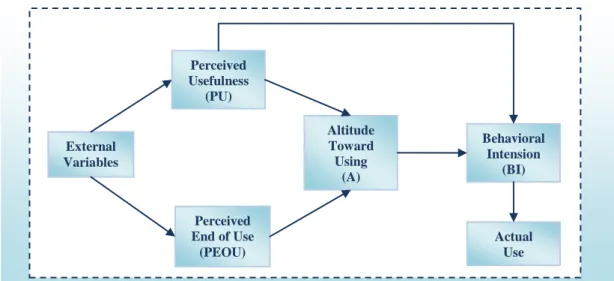
In 1989, Davis proposed TAM (Technology acceptance model) [46] to highlight the importance of user perceptions about technology. This model is constructed on two specific blocks i.e. perceived usefulness and perceived ease of use which plays an important role in technology acceptance. Both of them predicts attitude about the use of some technology. The attitude toward using that technology identifies the behavioral purpose to use. At the last, the purpose defines the actual use of that particular technology [46].
In summing up, TAM is comprised of five concepts: usefulness, ease of use, attitudes towards use, actual use and intention to use, as shown in Figure 4. Figure 4 is adapted from Davis‘s original TAM model [85].
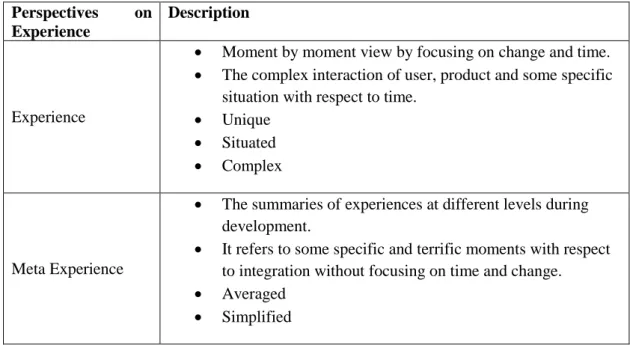
According to [47], UX has become the core issue of Product development due to which, it is not enough to implement features and test the usability of a product. Due to this, one must have to understand the daily lives of target audience while designing a product. Now, many growing industries have accepted that providing products and services is not sufficient to satisfy the customers, but providing experience play the key role for the success of any product and service [48]. Hassenzahl [49] has defined the two percpectives of experience i.e. experience and meta experience, in order to elaborate the concept of UX, based on his hedonic/pragmatic model of UX and these are discussed in Table 5 below:
Perceived Usefulness (PU) External Variables Perceived End of Use (PEOU) Altitude Toward Using (A) Behavioral Intension (BI) Actual Use
Table 5: Two Perspectives on Experience based on Hassenzahl´s Model
Perspectives on Experience
Description
Experience
Moment by moment view by focusing on change and time.
The complex interaction of user, product and some specific situation with respect to time.
Unique
Situated
Complex
Meta Experience
The summaries of experiences at different levels during development.
It refers to some specific and terrific moments with respect to integration without focusing on time and change.
Averaged
Simplified
In [50], authors suggested different attributes for UX i.e. funny, entertaining, satisfying, helpful, motivating, supportive of creativity, rewarding, aesthetically pleasing and emotionally fulfilling. In [16], three factors are also proposed that help to analyze the UX and are User Centered, Product Centered and Interaction Centered.
However, for analyzing UX, Hassanzahl and Tractinsky[29] have also presented three major factors i.e. the characteristics of the designed system, the context of interaction and the user‘s internal state. Figure 5 explains these factors in detail and is adapted from [29].
Examples Factors
UX
Designed System Characteristics User´s Internal State Context of Interaction Purpose Functionality Usability etc Expectations Moods Needs etc Cultural Issues Organizational Issues etcThe above figure suggests that UX is an outcome of a user‘s internal state, the characteristics of the designed system and the context (or the environment) where the interaction happens. The user´s internal state can be defined by different attributes such as predispositions, motivation, mood, expectations, needs, etc. On the other hand, complexity, functionality, purpose, usability, etc can be considered as examples of the characteristics of the designed system whereas, the context of use may includes social/organizational settings, voluntariness of use and meaningfulness of the activities, etc. At the end, this all point out towards countless design and experience opportunities.
In [30], McCarthy and Wright have presented a framework comprised of four threads of experience as follows:
Compositional: the components of an experience.
Sensual: how we feel about the texture, design and atmosphere?
Emotional: the tendency to remember the experience e.g., fun, frustration or exciting etc.
Spatio-Temporal: how time and location affects our experience?
Kerkow [51] has defined different properties of UX such as: influenceable, simplifiable, discriminable, intersubjective and probably biased.
In [52], different guidelines have been proposed to design products according to the UX of the actual users. Firstly, consider the cultural background of users. Secondly, convert this cultural background into design information. Lastly, use this information to produce a particular product for a particular user.
According to Jetter and Gerken [40], the concept of UX is not only the permutation of the quality attributes as explained in ISO quality model standard 9126-1, but it also involves some other factors such as: usability, functionality, reliability, attractiveness, visual design, coolness, fun, stimulation, and the other attributes that play an important role for the success of any product.
In 2008, Roto [43] has also proposed three attributes that play a vital role for analyzing UX i.e. system, user and context. The author used these three attributes in mobile industry for testing UX of MPS. These attributes have some sub attributes that are also associated to UX and are defined in Table 6 below:
Table 6: UX Attributes and their Sub Attributes
User System Context
Needs/Requirements Service Involved Physical
Experiences People Involved Temporal
Expectations Product Involved Task
Emotional State Objects Involved Social
According to Battarbee and Forlizzi [16], UX term can be associated with an extensive range of meanings. They further identified the UX as the interaction of user with products and other people which results into some emotions and experiences. These emotions and experiences can help to improve the lives of the users of those products and systems. Similarly, Davis [53] argued that, although, it is possible to define the concept of UX but it is very difficult to be captured, transmitted and storedas it exists in human minds.
In [54], the scope of QoE (Quality of Experience) has been identified into five different building blocks. These building blocks constitute different aspects that influence UX and are presented in Table 7 below:
Table 7: Building blocks of QoE
Building Blocks Description
Quality of Effectiveness How well an application, service or device is performing to meet its do-goals?
Quality of Efficiency How well an application, service or device serves the user? Usability It deals with how easily user has performed his/her tasks. Expectations The QoE is directly Measurable to the degree to which user
expectations are fulfilled.
Context UX can be influenced by different contexts such as: the environment, the cultural context, the social context, etc. According to Yu and Shouqian [55], the active involvement of the interactive information related to user and product such as; social, emotions, expectations and other factors make UX a complex phenomenon. They further elaborated UX as the interaction of users with a particular product, perceptions and feelings about that product, reaction to the expectations, the memory left, feelings and altitude after the use of that product.
In [55], UX is identified as, ―the subjective feeling of the product and is the sum of received feels in the process of using the product‖ and particularly for the software products, it is
referred as, ‖the use value and aesthetic value; it is based on the user-centric point of view”. Miller [56] has further explained different user centric issues that play an important role for analyzing UX. These user centric issues are; business constraints, social issues, security, performance, accessibility, from design to fashion and design´s cultural aspects as discussed in Table 8 below:
Table 8: User Centric Issues
Issues Description
Business Constraints Shall the people accept the technology in the way they currently run their business, or they have to change their business processes? Social Issues Shall people accept new technology as a part of their lives or not? Performance People always prefer good performance over bad performance but
sometimes they have to sacrifice different other things to attain good performance. Will they sacrifice that?
Security What users have to do in order to use technology safely and effectively?
Accessibility In case of limited vision, memory or physical dexterity, what will be the behavior of your product?
Design to Fashion Design may play a decisive role while choosing a product among many products.
Design´s Cultural Aspects
Does a specific design match the users‘ cultural values?
How interface designs and physical objects be supposed to look and function?
What is the use of product?
Who will use the product?
Miller [56] classified UX as collection of the above user centric issues that must be answered in order to analyze UX.
Marika and Leena [12] have described UX as the experience of a user after his/her interaction with a product in some specific conditions. The authors explain different aspects of several kinds of people, environments and products that may influence the experience during interaction.
In 2002, Hiltunen and Laukka [57] presented a UX Cycle Model where Expectations were listed as a vital building block of UX. The authors designed UX Cycle Model [57] by following the guidelines of Neisser [58]. The different components of the User Perceptions about the use of a product/service are defined in Table 9 below. These components are interpreted before the analysis of UX.
Table 9: Components of User Perceptions about Product
Component of Perception
Definition/Description
Utility The user perception about the kind of services that seems to be valuable. Usability ―The extent to which a product can be used by specified users to achieve
specified goals with effectiveness, efficiency and satisfaction in a specified context of use‖ [59].
Availability The service/resource should be available when required.
Aesthetics The look and feel of the product/service should be attractive and appealing.
Offline issues This contains different things such as brand/Vendor of the product/service and the different supporting backend trade processes. In order to manage and measure UX , The hedonic/pragmatic model of user experience [49] was presented. According to this model, it is assumed that user classify interactive products into two different proportions i.e. Pragmatics and Hedonics. Pragmatics defines the product's supposed ability to assist the do-goals achievement, such asmaking a phone call or searching a book on internet, whereas, the hedonicsdeals with the product's supposed ability to help in achieving be-goals, such as being special or being competent.
The guidelines of The hedonic/pragmatic model of UX [49] influence actual experience in four different ways by making experience an important part of this model. Firstly, it is assumed that actual experiences influence the product perceptions. The first impression of the product may provide users an idea about the product's ability to assure do-goals and be-goals, but any perception may be modified by the actual experience. Secondly, user may exercise perceptions repeatedly for the sake of experience to know whether they change with time or not. Thirdly, this model clearly differentiates between global evaluation (good or bad, satisfaction, etc) and perception. Fourthly, the analysis of the general state of users, by using two different usage modes: action and goal mode. In action mode, the action is given highest priority whereas, in goal mode, the accomplishment of specific do-goals is placed at highest priority.
In 2008, Wright, Wallace, and McCarthy [60] presented a framework to understand the UX with the help of the ―sense making‖ process of humans during their experiences. The whole process of ―sense making‖ is further split up into six processes, where each of these processes is divided into two sub-parts. This customized set of processes is comprised of the following elements and are adapted from [77].
Anticipating: The type of experience, people´s expectations and their satisfaction. Connecting: The sudden response with any product or service while first interaction. Interpreting: It may involve the actual experience instead of anticipated experience.
Immediate Reflecting: The very first judgment of initial experience and then assign some value to it.
Future Reflecting: The judgment or prediction about future experiences, how different they will be as compared to present ones.
Recounting: Explaining experience to other people and get their response in order to modify perceptions about the experience.
Appropriating: Designing a personal tradition/mythology around a specific product in order to settle one´s life around that particular experience or product.
With the help of Case Study, different definitions and concepts of UX were explored from different sources and standards. In this chapter, we have identified different factors from different definitions and concepts of UX. The identified factors of UX are presented in Table 10 below:
Table 10: UX factors identified from different UX definit