Testing and Implementation Process in Automation of a
University with Agile Environment
1
Vaibhav Sharma,
2Jyoti Singh,
3A. S. Zadgaonkar
1,3Dept. of IT, Dr .C. V. Raman University, Bilaspur, Chhattisgarh, India
2Directorate of Technical Education, Raipur, Chhattisgarh, India
Abstract
Automation of any organization is much needed for its development in today’s world. Education institutes like university are also need to get automated and improve their working manner through automation. Testing is the major part of the installation of automated environment to assure the quality of the university and its department. In this paper the tester’s side efforts are presented for the testing of automated software in agile environment which is developed for the fast testing process at low cast to check the automation process of a university. The purpose of this paper is to propose an Agile Environment with the Genetic Algorithm for the testing of automation process of a university. The agile environment comes with Genetic Algorithm for the testing process can provide an accurate error free environment for the automation of university. It improves the speed of testing procedure, reduced its cast and establishes an error free automated environment for the university.
Keywords
Testing techniques, Agile Environment, Genetic Algorithm, Testing Automation, Data Set
I. Introduction
As per Douglas Hoffman, (1999) Automation is the use of machines, control systems and Automation is the use of machines, control systems and information technologies to optimize productivity. In
many cases automation has provided the desire benefits and has
extended functionality well beyond existing human capabilities. As per James Bach, The “agile development” movement has emerged
from obscurity and has begun to have a significant impact on the
culture of software development in the U.S., particularly among commercial software companies. I have been involved in this movement since the late eighties. Most of my writing comes from an agile perspective. Agile test automation is the application of agile development principles to the test automation problem. As per Dan Young in (2000), Automated system provide superior reliability, improved performance and reduced cost for the performance of many function, so the automation process should be implemented
and its testing in the field of higher education such as universities to
simplify the working manner of all the department of the university that helps to boost the working manner of the university. To establish successful automated system for any organization, it is necessary to test the automation software in various conditions and hence software testing becomes an important component of the software development and implementation process. As per Roger Pressman in 2007 from his book Software Engineering Testing is to detect software errors/problems so that the defects may be discovered and corrected before establishment of the automated software. Thus testing of automation process of a university plays an important role in establishing an automated system. Testing effectiveness can be achieved by the use of different testing methods, strategies and techniques. But the process of testing of a software system is an enormous task which is time consuming, lengthy and costly. To overcome from this drawback of testing, proposed approach work
as the key method from the tester’s scenario. The combination of Agile Development framework and Genetic Algorithm (GA) for the test automation process may sound like a contradiction in terms, but it is new testing methodology that can revolutionize the world of application testing, bringing with it order of magnitude gains in time, cost and risk management. The purpose of this paper
is to redefine the testing process and make it simpler, faster and
cost effective with the use of proposed method. Proposed approach will work to identify most of the errors in the automated system and make it reliable for the university in a very low amount of time and cost. This paper structured as: Section II describes the Agile
Environment and Genetic Algorithm (GA), section III defines
the proposed approach, section IV describes the Analysis part and Limitation of the proposed work and section V concludes the paper.
II. Agile Environment and Genetic Algorithm
As per James Bach, Agile development is a practitioner-centered methodology, very close contact with customers, numerous small milestones, and a welcoming attitude about change. As per Mustafa M. Khaled, Rafa E. Mohammad Al-Qutaish (2009), Automation is the use of machines, control systems and information technologies to optimize productivity. Over the last ten year the “Agile Development” movement has emerged from obscurity and
has begun to have a significant impact of product development life
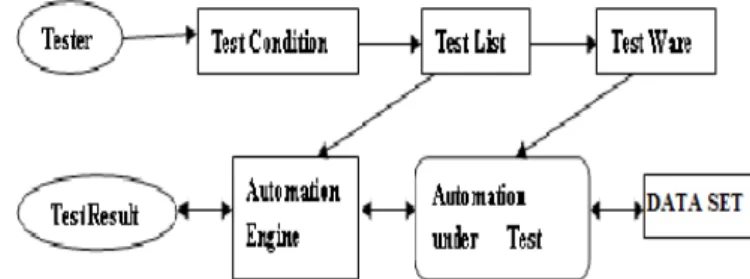
cycle and automation processes. As per Sharma Vaibhav, Singh Jyoti and Zadgaonkar S. A., Agile development approaches are enjoying acceptance by companies seeking to reduce cycle times while improving quality. Fig. 1, shows the working manner of automation process model and its bond with Automation under
Test Unit (AUT). In the figure Testers are those who perform the
testing phase on the automated system, and the test conditions are the limitations and environment which help testers to perform testing process in the automated system. Test List describes the testing strategies and methods which are going to be implement in the testing phase.
Fig. 1: Automation Process Model with AUT
Test ware is the term used to describe all the term used to describe all of the materials used to perform testing process. Test result
is the final set of testing which help to analyze the outcomes
according to the expected outcomes. Automation engine used to describe the automation software which is tested by the testers. Automation under test is the framework where all the process of automation testing are tested and the data set are the set of data
record which is given inputs by the testers to check the working manner of the automation software.
As per Whittaker J A (2000), It has been identified that one of the Software Engineering areas with a more prolific use of Artificial
Intelligence techniques is software testing. The focus of these techniques includes the applications of Genetic Algorithms (GA). In (1996) Jones B F, Sthamer H.-H and Eyres D.E commented, A Genetic Algorithm starts with guesses and attempts to improve the guesses by evolution. As per Chat S. Genetic Algorithm will
typically have five parts: (1) a representation of a guess called a chromosome, (2) an initial pool of chromosomes, (3) a fitness
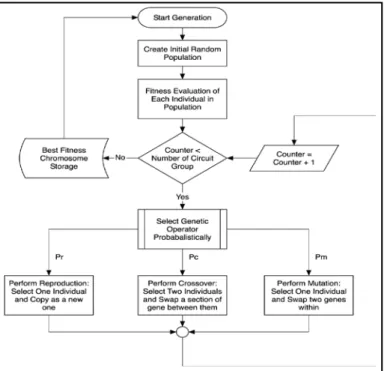
function, (4) a selection function and (5) a crossover operator and a mutation operator. As per Mitchell, M (1996), Genetic algorithms operate on a set of possible solutions. Because of the random nature of genetic algorithms, solutions found by an algorithm can be good, poor, or infeasible [defective, erroneous], so there should be a way to specify how good that solution is. As per Simon Burton, Clark John and McDermid John Figure 2 present
the flow of genetic algorithm and describe its process. As per Gupta N K and Rohil M K, In the algorithm population defines
the number of input data which the number of candidate whose going to enroll in a university.
A basic algorithm for a GA is as follows: The pseudo code for GA is:
Initialize (population) Evaluate (population)
While (stopping condition not satisfied) do
{ Selection (population) Crossover (population) Mutate (population) Evaluate (population) }
As per Srivastava Praveen Ranjan and Tai-hoon Kim (2010) the algorithm will iterate until the population has evolved to form a solution to the problem or until a maximum number of iterations have taken place.
Fig. 2: Flow Chart of Genetic Algorithm
The integration of Agile Development Framework and Genetic Algorithm based technique provide fast, agile and cost effective model for the testing process of automation for the university according to the tester’s scenario. As per Yoonsik Cheon, Myoung Yee Kim, Ashaveena Perumandla (2005) This combination of test automation process may sound like a contradiction in terms, but it is new testing methodology that can revolutionize the world of application testing, bringing with it order of magnitude gains in time, cost and risk management. As per Pettichord Bret (1996) Testing of User Interface is always challenging and has been mostly manual till now.
III. Proposed Approach
In this paper the tester’s side efforts are presented for the testing of automated software in agile environment which is developed for the fast testing process at low cast to check the automation process of a university. Here we proposed a framework Called AUT (Automation under Test) to create Agile Environment for the Testing of automation process for the university. From the testers approach this framework provides agile process for the testing phase of the automation process of a university. This framework works with Genetic Algorithm based technique for the testing to produce fast result in a short amount of time with the low cost. As per Mathur A P,”Foundation of Software Testing” (2008) Genetic
Algorithm based testing technique can automatically find out all
the errors and agile environment provides fast process to perform testing operation for the automation process to establish an error free environment for the university. As per Jones B et al (1996)
Genetic Algorithm based technique has four steps to finish the
testing process:-Initialization • Selection (Sp) • Mutate (Mp) • Evaluation(Ep) • A. Initialization
Maximum number of seat for every course: N
Then we select the inputs Ip and initialize them for the selection process. There is one condition should be checked that is:
If N=>Ip Accept input Else
Stop the input process
After the initialization the next process is to select the student according to their percent and have to check their all necessary
document for the admission. In this part we filter the inputs
(population) and proceeds to our next step. B. Selection (Sp)
All the fields are tested sequentially if the conditions are not satisfied by the input then the Ip is cancelled. After the verification
Ip goes for its next step.
Sp <= N
Sp = ∑Ip
After the selection process inputs are pass for the mutate step for
the verification.
Mutate (Mp)
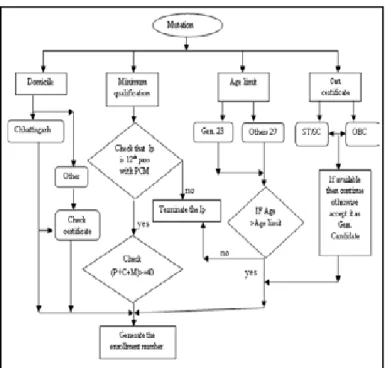
Mutation means checking and verification of all fields related to a
particular student. Mutation is performed on every input. Every input (record of student) has an equal chance to mutate.
While (Ip=N)
{ Mp start from Ip (1) Ip++ }
Fig. 3: Represent the Flow Diagram of Mutation Process in Which the Working Manner of Mutate State Has Been Described
Fig. 3: Flow Diagram of Mutation D. Evaluation (Ep)
In this section Ip got an automatic generated number which is unique for the every student who got admission in the university and it is applicable for the every stream which is offered by university. Ep= 00000000 Ip=1 While (Ip<=N) { Ip++ Ep++ }
The registration ID starts with the AA000001 and so on. Fig. 4 presents the overall process of Genetic Algorithm technique.
Fig. 4: Overall Process of Genetic Algorithm
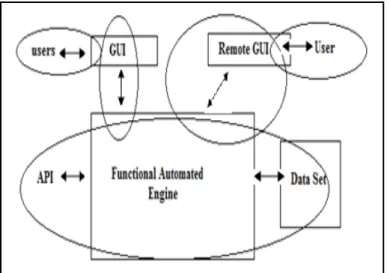
Now above process will be performed by the testers in an integrated agile environment with the framework called AUT (Automation under Test). This entire program will be under submission of the AUT framework. Fig. 5 shows the AUT model and its interconnection.
Fig. 5: Automation Under Test Framework
According to this model Here in the presented model we describe the GUI testing which becomes an exercise to see that values
typed into fields are fed into the backend correctly, that value
passed from the backend are displayed correctly and windows are traversed based on the rules for GUI navigation. This provides an agile environment to check out the errors and bugs in the testing process of an automated university and also the implementation of the automation process of any university. As per Srivastava Praveen Ranjan and Tai-hoon Kim (2009) Genetic Algorithm based function for testing phase will perform their operation in the same manner. Figure 6 describes the working manner of agile development model integrated with the Genetic Algorithm. In this model Genetic Algorithm (GA) Based technique and Automation under Test (AUT) framework are integrated to provide agile development framework for the testing of automated software. Every part and factors of the testing are interconnected with the AUT. At the last generated result will also undergoes through the testing process in this framework and it will be compared with the expected outcomes.
Fig. 6: Working Manner of the Framework
This proposed approach provides an agile environment to perform the Genetic Algorithm based technique in a very low amount of time for the automation process of university.
IV. Analysis of Proposed Approach
As per Adele E, Howe, Anneliese and Von Mayrhauser (1997), Genetic Algorithm starts with guesses and attempts to improve the guesses by evolution. Jones B F, Sthamer H.-H. And Eyres D.E. (1996) Testing automation process is more than a set of test to generate apparent results which is based on guesses and the facts from the practical approach; it simply means that running test generates data much more quickly and accurately than any other testing. To achieve this we need an agile environment which works with the Genetic Algorithm (GA) to test the automation process of a university in a very low amount of time and money. Fig. 7 illustrate the testing problem and complexity.
Fig. 7: Splitting Testing Problem
In agile development process with GA based technique, AUT work with GA. In this model testing factors connected with each other and become effective to solve this problem and complexity. Following action will be performing by the AUT with GA for the automation process of the university.
It works on tester’s scenario.
•
Test the installation of automated environment.
•
Test the database and its information.
•
It covers the Client’s (University) requirements
•
Test the generated results.
•
It establishes an error free automated campus for the
•
university. Limitation
Proposed approach of Agile development framework AUT for the testing process of the automation process of the automation of university is cannot possible for the web based application because of the Genetic Algorithm technique which is not feasible for the embedded and web based application; so when it comes to online and real time testing of an automated environment for the testing of an automation process of any organization it does not provide full coverage for all kind of transition.
V. Conclusion
Proposed framework of Agile Environment and Genetic Algorithm based technique is much more than to just test a program, it includes the tester’s scenario to understand the requirement and outcomes of the automation projects. This framework works on
the whole area to find out errors and bugs to establish an error
free accurate automated system for the university campus. The concept of Agile Environment with Genetic Algorithm help us to
refine the effort of testing in all manner and all this comes in a low
cost with fast process this help us to provide an secure automated system for the university.
References
[1] Sharma Vaibhav, Singh Jyoti and Zadgaonkar S. A., “Testing and Implementation Process in Automation of a University”, International Conference ICACNI, Raipur(CG), India, 2013.
[2] Jones B F, Sthamer H.-H. and Eyres D.E.. “Automatic structural testing using genetic algorithms”, Software Engineering Journal, pages 299-306, September, 1996. [3] Sharma Vaibhav, Singh Jyoti and Zadgaonkar S. A.,
“Agile Environment for Test Automation Architecture of a University”, National Conference ICCAT, Bilaspur (CG), India, 2013.
[4] Srivastava Praveen Ranjan and Tai-hoon Kim, “Application of Genetic Algorithm in Software Testing”, International Journal of Software Engineering and Its Applications, Vol. 3, No.4, October 2009.
[5] Srivastava Praveen Ranjan and Km Baby, “Automated Software Testing Using Metahurestic Technique Based on An Ant Colony Optimization”, Electronic System Design (ISED), 2010 International, Symposium on, Issue Date: 20-22 Dec. 2010 On page(s): 235 – 240.
[6] Mitchell, M.:”An Introduction to Genetic Algorithms”, MIT Press, 1996.
[7] Simon Burton, Clark John and McDermid John, “Testing, Proof and Automation, An Integrated Approach”, Department of Computer Science, University of York Heslington, www. sciencedirect.com.
[8] Mustafa M. Khaled, Rafa E. Mohammad Al-Qutaish,
“Classification of Software Testing Tools Based on the
Software Testing Methods”, 2009 second international conference on Computer and Electrical Engineering. [9] Chat S., Performance Management of Software Architecture,
online: http://www.findwhitepapers.com/whitpaper , 2009. [10] Whittaker J A., “What is Software Testing? And Why Is It
So Hard?”, IEEE Software, January 2000, pp. 70-79. [11] Beizer B, “Software Testing Technique”, second edition, Van
Nostrand Reinhold, Company Limited, 1990, ISBN 0-442-20672-0.
[12] Dan Young,“TEST AUTOMATION: AN ARCHITECTED APPROACH”, Schwab Performance Technologies, Raleigh, NC. USA, 2000, www.research.com.
[13] ADELE E. HOWE, ANNELIESE VON MAYRHAUSER, “Test Case Generation as an AI Planning Problem”, Automated Software Engineering, 4, 77–106 (1997) °c 1997 Kluwer Academic Publishers, Boston. Manufactured in The Netherlands.
[14] Pettichord Bret, “Success with Test Automation”, Revised version of a paper originally presented at Quality Week, San Francisco, May 1996. Version of 28 June 2001.
[15] Gupta N K and Rohil M K, “Using Genetic Algorithm for Unit Testing of Object Oriented Software”, IJSSST, Vol. 10, No. 3, ISSN: 1473-804x online, 1473-8031 print.
[16] Jones B et al. “Automatic Structural Testing Using Genetic Algorithms”, Software Engineering Journal, Vol.11, No.5, 1996.
[17] Kent John, “Test Automation: From Record/Playback to Frameworks” , Web: http://www.simplytesting.com, Vol 1.0.
“A Complete Automation of Unit testing for Java Programs, Department of Computer Science The University of Texas at El Paso, 2-1-2005.
[19] Mathur A P,"Foundation of Software Testing”, 1st edition Pearson Education 2008.
[20] Douglas Hoffman,“Test Automation Architecture: Planning for Test Automation”, International Quality Week 1999.