Overview of the DOE-EM Packaging Certification Program — 9417 M. R. Feldman
National Transportation Research Center, Oak Ridge National Laboratory M. E. Bennett
Eagle Research Group, Inc. J. M. Shuler
Manager, DOE Packaging Certification Program, EM-63 ABSTRACT
The U.S. Department of Transportation, in 49 CFR 173.7(d) grants the U.S. Department of Energy (DOE) the power to use “packagings made by or under the direction of the U.S. Department of Energy… for the transportation of Class 7 materials when evaluated, approved and certified by the Department of Energy against packaging standards equivalent to those specified in 10 CFR part 71.” Via DOE Order 460.1B, DOE has established the DOE Packaging Certification Program (PCP) within the Department of
Environmental Management for purposes including the certification of radioactive materials packages for DOE use. This paper will provide an overview of the programs and activities currently undertaken by the PCP in support of the safe transport of radioactive materials, including technical review of Safety
Analysis Reports for Packaging, development of guidance documents and training courses, a quality assurance audit and field assessment program, database and docket management, and testing and test methodology development. The paper will also highlight the various organizations currently utilized by the PCP to meet the requirements of DOE O 460.1B, as well as some creative and effective methods that are being used to meet program objectives.
INTRODUCTION
The U.S. Department of Transportation, in 49 CFR 173.7(d) grants the U.S Department of Energy (DOE) the power to use “packagings made by or under the direction of the U.S. Department of Energy… for the transportation of Class 7 materials when evaluated, approved and certified by the Department of Energy against packaging standards equivalent to those specified in 10 CFR part 71.”[1, 2] Via DOE Order 460.1B, DOE has established the DOE Packaging Certification Program (PCP) within the Department of Environmental Management for purposes including the certification of radioactive materials packages for DOE use.[3] The scope of the PCP includes six specific functions:
Technical review of Safety Analysis Reports for Packaging (SARPs), Development of Guidance documents,
Training,
Packaging quality assurance (QA) audit and field assessment, Database and docket management, and
Testing methods and development.
Each of these six functions is described in greater detail below. TECHNICAL REVIEW OF SARPS
The primary function of the PCP is to certify Type B and Type A Fissile Material packages for the shipment of radioactive materials. The process through which such certification is accomplished is the review of the safety basis document for the package or SARP. A SARP is submitted to the PCP by an applicant (typically, the end user) as part of the application process for package certification. The SARP is a nine-chapter document, the first eight chapters of which are based on the U.S. Nuclear Regulatory Commission’s (NRC’s) Regulatory Guide 7.9.[4] The ninth chapter covers Quality Assurance Aspects of the package. The first eight chapters are, in order, General Information, Structural Aspects, Thermal Aspects, Containment Aspects, Shielding Aspects, Criticality Safety Aspects, Package Operations, and Acceptance Testing and Maintenance Program. Each of the nine chapters must be reviewed by a subject-matter expert (SME) to ensure all of the requirements contained in 10 CFR 71 are met. This process, known as the PCP Certification Process, is described below.
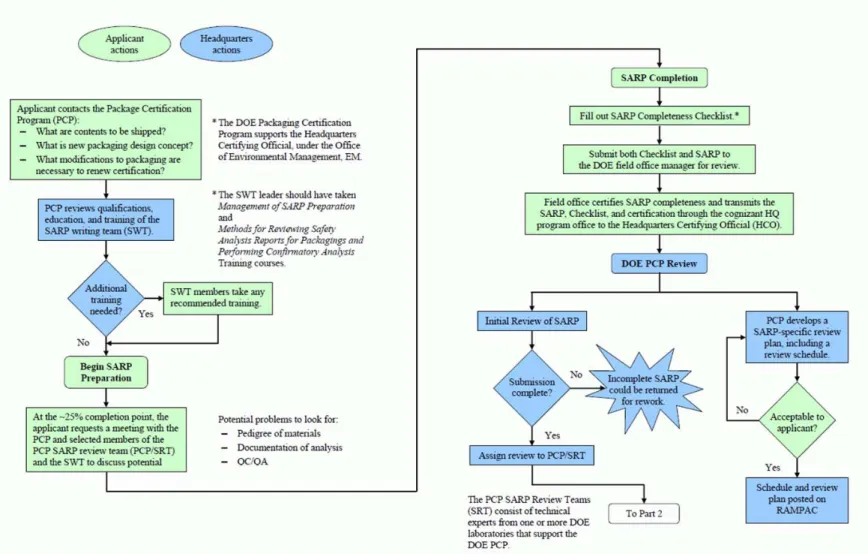
The certification process begins long before the SARP is submitted for review. Initially a prospective applicant contacts the PCP to inform its staff of a plan to transport materials that are not currently
included in any active Certificate of Compliance (CoC). The prospective applicant supplies the PCP with information regarding the contents to be shipped, concepts of the new packaging design (if applicable), and/or the modifications that will be made to existing packagings in pursuit of the CoC. The prospective applicant also provides the PCP with information regarding the team members that will be involved in the development of the SARP. If any of the materials presented by the applicant blatantly violates federal regulations or appears to be unlikely to be certifiable, the PCP informs the applicant that certification of the concept is unlikely. Subsequently, the PCP reviews the qualifications, training, and education of the SARP writing team (SWT) to determine if additional training is required. If necessary, the SWT takes necessary training to meet the minimum SWT requirements (PCP training programs are discussed later in this paper). Once the SWT team has all of the required training, the actual writing of the SARP may begin.
When the SARP is about 25% complete, the applicant requests a meeting with the PCP; the PCP includes key members of the PCP SARP Review Team (SRT) at this meeting. The primary reason for the meeting is to discuss potential problems in the SARP preparation process that may lead to issues during the review process. Potential problems that may need to be addressed at the meeting include, but are not limited to, pedigree of materials, documentation of analyses, and quality control/QA issues.
When the SARP is complete, the SWT fills out the SARP Completion Checklist and submits both the SARP and the checklist to the appropriate DOE Field Office Manager for review. Once this review process is complete, the DOE Field Office certifies the completeness of the SARP and transmits the SARP and the checklist to the Headquarters Certifying Official (HCO). At this point the PCP Technical Review officially begins.
Simultaneously, the PCP performs an initial cursory review of the SARP to determine completeness and develops a SARP-specific review plan that includes a review schedule. If the submission is found to be incomplete, the SARP is returned for rework; otherwise, the review is assigned to an SRT. This team comprises technical experts from one or more of the DOE laboratories that support the PCP [Lawrence Livermore National Laboratory (LLNL), Argonne National Laboratory (ANL), Savannah River National Laboratory (SRNL), and Oak Ridge National Laboratory (ORNL)]. The SARP-specific review plan is presented to the applicant and, if it is acceptable, the review plan is finalized.
The SRT begins an in-depth review of all sections of the SARP. The primary basis for the review is the Packaging Review Guide for Reviewing Safety Analysis Reports for Packaging, UCID-21218, Rev. 3.[5] This document, based on NRC Regulatory Guide 7.9 for chapters 1 through 8, provides an outline of the information required in chapter 9 regarding QA. The PCP SRT, based on this review guide, develops a first round of questions for the applicant. The PCP Manager reviews and approves these comments and the HCO transmits the comments to the applicant.
In addition to comments generated through use of Review Guide UCID-21218, some comments are generated through the confirmatory analyses process. In this process, computer analyses presented in the SARP to establish the package safety basis are independently verified by the review team. That is, the review team creates its own computer models and analyzes various input parameters to determine if the results of the analyses presented in the SARP are reasonable. The key factors in the confirmatory analyses are the model assumptions for the bounding cases and the associated uncertainties. The
reviewers may also create models that capture the basic features of the geometry of the component being analyzed while ignoring the unessential details. In this manner, the reviewer can determine quickly if the analysis results presented in the SARP are reasonable before engaging in full-fledged, three-dimensional analysis. This process may lead to the SRT questioning the results of the analyses presented in the SARP submitted for review, or it may make the reviewer aware of anomalies or topic-specific details that are not adequately covered in the SARP being reviewed.
Once the SWT has reviewed the comments, a teleconference or, in some cases, a face-to-face meeting occurs during which the applicant can ask for clarification of any of the comments, discuss specific comments the applicant thinks may have been misunderstood, and present possible comment response strategies to see if the SRT is amenable to such approaches.
The SWT creates responses to the comments and submits them to the PCP and then forwards them to the SRT for review. Typically, the responses consist of not only a discussion of how the comment will be resolved but also a verbatim proposed revision to the SARP. The SRT reviews these comment responses and determines their adequacy. Typically, most responses are accepted, especially if the SWT has implemented the SRT’s suggestions. Of the remaining responses, some may require only minor revision and some may require significant changes before being accepted by the SRT.
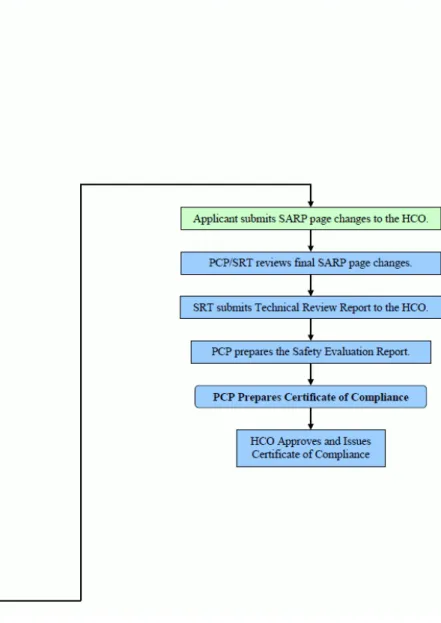
The SRT may then develop additional comments. Although the goal of the review is to get all questions on the table during the first round of comments, this is not always possible. It may be that between the issuance of the initial set of comments and the receipt of the responses to these comments, SRT members realize there are additional safety issues that have not yet been addressed. Another possibility is that the responses to the initial round of comments may create additional questions in the reviewers’ minds. Once all comments are resolved, the applicant submits SARP page changes to the HCO. Both the PCP and the SRT review the final SARP page changes to ensure all agreed-upon changes to the SARP have been incorporated and no unexpected changes have been made. Once satisfied with page changes, the SRT submits its Technical Review Report to the HCO. The PCP prepares the Safety Evaluation Report (SER) and the CoC. The CoC is then forwarded to the HCO, by whom it is approved and issued. The SARP technical review process described is graphically shown in a flowchart in Figures 1 and 2.
4
The PCP strives to focus the review process, and therefore reviewer comments, on safety-related items. That is, the goal of the review process is to produce not a perfect SARP, but rather a SARP that ensures all aspects of the safe transport of radioactive materials in the public sector are addressed and all federal regulations are met. The safety of workers, the public, and the environment is the ultimate concern of the PCP. Therefore, during the review process, the SRT leader reviews all comments before they are
forwarded to the PCP to ensure that each comment is related to a specific federal regulation and addresses one or more safety concerns. The PCP manager may also choose to challenge a reviewer comment before it is issued to the applicant if he feels the comment does not address a safety bases issue.
At times during past reviews, an impasse of sorts has developed between the SRT and the applicant. The applicant has felt it is unnecessary to make changes to the SARP based on some of the comments
received, whereas the SRT has remained adamant that the comments must be addressed in a manner that results in changes to the SARP. In one case like this several years ago, in order to keep the certification process moving forward, the PCP manager appointed a second team, qualified to perform a SARP technical review, to act as arbitrator and/or mediator between the applicant and the SRT to assist in finding common ground for comment resolution.[6] The outstanding comments were successfully resolved and the package was subsequently certified for use. This experience led to the development of the concept of an Assist Team. An Assist Team is now regularly assigned to applicants with little or no package certification experience to help guide them through the SARP review process. The Assist Team helps the applicant and its SWT understand the comments when they are issued; helps devise strategies for responding to the comments; mediates between the SWT and the SRT during teleconferences or face-to-face meetings; reviews comment responses before they are issued to the PCP to ensure they are complete, likely to be accepted, and do not contain language that could be considered inflammatory; and in some case even helps the applicant challenge comments that are felt to be outside the scope of the review. The Assist Team concept has been applied to several SARP technical reviews over the past 2 years. It has resulted in better working relationships between the SWTs and SRTs and, most important, faster, more efficient completion of the packaging reviews.
Figure 1. SARP Technical Review Flowchart Part 1.
6
Another innovative approach employed by the PCP for the efficient certification of packages is the virtual laboratory concept. As mentioned earlier, the PCP uses review teams from LLNL, ANL, SRNL, and ORNL to support SARP technical reviews. Each of these laboratories maintains staff who are considered to be SMEs and are fully trained and qualified to support the SARP technical review process.
Additionally, each of these laboratories has specific areas of expertise that may or may not exist at the other laboratories. Historically, each SARP technical review has been assigned to a specific laboratory and the SRT has been made up exclusively of personnel from that lab. Recently, the PCP has assigned review responsibilities not to one lab specifically but to two or more laboratories and encouraged these laboratories to work together to form a team that will ensure the most cost-effective and timely
completion of the SARP review process. Additionally, at times when a single laboratory is assigned to perform the review, the PCP encourages it to place individuals from other laboratories on the SRT when their specific expertise may be useful. The use of this “virtual laboratory” concept has allowed for more timely, efficient, and cost-effective completion of the review process.
DEVELOPMENT OF GUIDANCE DOCUMENTS
The PCP has been proactive in the development of guidance documents to assist the applicant, the SRT, and the package user in all aspects of package certification, use, and even decertification. This section describes several guidance documents developed by the PCP.
DOE Guide 460.1-1, Packaging and Transportation Safety, provides guidance on meeting the
requirements of DOE Order 460.1.[7] The current version was specifically developed as a guide to help the user navigate all interfaces with the PCP while DOE O 460.1A was in effect. The guide was not updated when the Order was revised to 460.1B. However, a revised draft is currently undergoing a review and comment cycle so that it will be ready for simultaneous release when the order is again revised to 460.1C. This document provides guidance to the end user on all aspects of DOE O 460.1. The revised guide will include sections on Offsite Packaging and Transportation Safety, Guidance for
Department of Energy Exemptions, Guidance for Department of Transportation Special Permits, Special Packaging for Radioactive Materials, Onsite Transportation Safety Requirements, and Quality Assurance. The SARP Completeness Checklist is provided to help the applicant and the SWT in producing a
high-quality SARP that will shorten the review process. This checklist is organized by SARP section based on NRC Regulatory Guide 7.9. For each SARP section, requirements and the bases for these requirements are listed. Three blank columns are provided for the user to indicate where in the SARP the information meeting each requirement is found, indicate whether the requirement is adequately addressed, and reference additional comments regarding the specific requirement. This checklist is intended
primarily for the use of the SWT and the DOE Field Office pre-submission review. However, it is also utilized by the SRT to ensure that all requirements are met.
The Packaging Review Guide for Reviewing Safety Analysis Reports for Packaging, UCID-21218, Rev. 3 was issued in February 2008. This guide, as mentioned earlier, provides the technical basis for the technical review of SARPs during the packaging certification process. As such, it is the SRT’s primary guidance in performing a SARP technical review. Like the SARP Completeness Checklist, the reviewer’s guide is based on NRC Regulatory Guide 7.9. The reviewer’s guide provides a section-by-section in-depth description of the information required in a SARP in order for the certification process to be completed. Because this guide is the basis for the SRT, it is also an excellent aid for the SWT: if the
SWT uses the guide to ensure that the SARP when initially submitted contains all of the material the SRT is looking for, then the review process should be expedited and a limited number of comments issued. SARP Submittal Guidelines are provided in the RAMPAC Web site (see Database and Docket
Management later in this document for more information on RAMPAC). As the name implies, the Web page provides all the information needed to submit a SARP to the PCP for review, including publishing requirements (binding, legibility, etc.); document requirements, including the number of copies needed and the form they should take (hard copies and electronic copies); and submission addresses for the PCP, Eagle Research Group, Inc. (PCP docket and database management), and SRTs.
Similarly, the Packaging Decertification Checklist is a RAMPAC Web page that provides a five-step process for the decertification of packages. Within these five steps are all of the processes that must be completed for package decertification.
TRAINING PROGRAMS
The PCP sponsors many training programs to ensure that the PCP staff and users of PCP services are knowledgeable and competent in performing their PCP-related tasks. Several PCP training programs are listed and briefly described in this section.
The DOE SARP Review Training Course is a 2-week intensive training program, originally developed many years ago, specifically intended to train SMEs to perform technical reviews of SARPs submitted in support of package certification. However, over time it has become a staple in the training of not only reviewers but also applicants and SARP writers. The course is also used by the NRC to train its personnel for reviewing Safety Analysis Reports submitted in support of package certification in the private sector. This training course includes lessons on each of the nine chapters included in a SARP, as well as other areas of expertise such as confirmatory calculations and welding issues. The course also includes many group participation exercises that simulate the interactions involved in an actual SRT. Toward the end of the 2-week course, each student must take a comprehensive exam and earn a satisfactory grade on it to receive the class completion certificate. This course is presented annually, typically in April or May, by LLNL staff and is usually held somewhere in the greater California Bay Area.
Another longstanding PCP training course is Application of ASME Code to Radioactive Material Transportation Packaging.[8] This course is a 2.5-day training program that explores all aspects of how the ASME code is applied to the design and development of containment vessels in radioactive material shipping packages. The course is hosted by the ANL review team and is usually held on the ANL campus. In addition to the ANL staff, guest presenters are usually included to bring new perspectives to the classroom experience. The course is held annually, usually in the month of June.
ANL also hosts the DOE QA Training Course for Radioactive Material Packaging. This 2.5-day course explores all aspects of QA requirements for packagings. Discussions include the application of QA requirements to the design, manufacture, and use of radioactive material packages. The course is held annually on the ANL campus and is typically presented in late March or early April.
Management of SARP Preparation is a training course developed recently and now presented regularly on an annual basis. The course is intended for individuals who will lead an SWT in the development of a
SARP for submission to the PCP in support of package certification, although various SMEs who anticipate being part of an SWT are also welcome to attend. The course is intended to guide the SWT lead through the myriad regulatory, managerial, and technical issues that make up the SARP writing process. This course is presented by the SRNL PCP support staff on an annual basis and is typically held in the greater Savannah River Site area.
In addition to these annual courses, the PCP is always developing new courses as the need becomes evident based on user-community input. One such new course being developed by the PCP is Packaging Operation and Maintenance. It is designed for package users and is meant to inform them of the
requirements associated with handling shipping containers at a user facility. Topics to be covered include package contents, loading, unloading, storage, torque requirements, maintaining records, addressing abnormal conditions, leakage rate testing, replacement parts, and lessons learned. This new course is expected to be presented by SRNL staff in the greater Savannah River Site area in late summer 2009. PACKAGING QUALITY ASSURANCE AUDIT AND FIELD ASSESSMENT
When a CoC is issued for a specific package, the QA systems and activities described in Chapter 9 of the SARP for that package become requirements that must be enacted throughout the lifecycle of the
package. To ensure that these activities take place, the PCP regularly performs field assessments and audits of users’ QA programs. An assessment consists of reviewing all documents that implement the packaging-specific QA requirements to determine if they are sufficient to ensure that all of the
requirements of 10 CFR 71 Subpart H, as described in Chapter 9 of the SARP, are met. An audit consists of examining various pieces of QA documentation generated during any phase of the package use process to ensure that the QA requirements described in the SARP are indeed being performed. The PCP forms audit and assessment teams, usually consisting of two to four individuals. These teams may be from one specific laboratory that supports the PCP mission, or the virtual laboratory concept may be applied with the formation of a team from two or more of the support laboratories. A typical assessment or audit is completed in a 2 to 4 day visit to a user site, with an exit meeting to summarize the findings and observations. An audit report for concurrence follows, typically within 4 to 6 weeks after the visit.[9]
DATABASE AND DOCKET MANAGEMENT
The PCP provides the RAMPAC database (http://rampac.energy.gov) to support packaging and transportation actions operations. Although designed to support use by DOE and DOE contractors, the RAMPAC database is also used daily by other government agencies, commercial shippers and packaging personnel, packaging designers and fabricators, students, and international packagings and transportation personnel. The Certificate Retrieval Web page displays all current NRC CoCs (except those issued to Naval reactors), all DOE CoCs and Letter Amendments issued by the PCP, all Department of
Transportation (DOT) International Atomic Energy Agency (IAEA) Certificates of Competent Authority issued by DOT for special forms, and all DOT-issued Competent Authority Certifications issued for international shipments to and from the United States. It also identifies certificates that will expire in less than one year and identifies NRC CoCs that are currently under timely renewal. The Web site containing SERs for DOE Certified Packages has copies of the SERs issued by the PCP. The Web site containing requirements for DOE SARPs provides guidance for submitting SARPs for DOE CoCs issued by the PCP. The Web site containing guidance and requirements for use of NRC and DOT-IAEA Certificates provides guidance to DOE contractors for using NRC and DOT certificates.
The “Packaging Decertification Check List” Web page provides guidance for decertification efforts. The “DOE Directives and Federal Regulations” Web page provides links for these items. The Web site “Packaging Body of Knowledge” is a great source of information from DOE, NRC, and DOT on items of interest for packaging and transportation personnel. The “Radio Frequency Identification (RFID)
Technology” site provides information on RFIDs and their use in supporting packaging storage and transportation.[10, 11] The Web site “Docket and Statics” provides information on open dockets, points of contacts for DOE dockets, DOE CoCs, NRC CoCs for which DOE is the certificate holder, NRC CoCs for which DOE is a registered user, and DOT certificates for which DOE is the certificate holder or a registered user. The list of DOE contractor registered users is also provided on these Web pages. The “Packaging Certification News” Web page has notices and news items from the DOE PCP, NRC, DOT, and IAEA. The site “DOT Special Permits” contains a list of the current DOT Special Permits used by DOE and a link to the DOT web page for DOT-SPs. “Non Certified Packaging” contains data on DOT 7A Type A packaging and some historical information on DOT Specification 6M packagings. The Web sites “Scale Newsletter” and “PCP Support” contain links to other related Web sites. The site “Frequently Asked Questions” provides information on questions associated with use of the database. Users can conduct database searches on the general data contained in the certificates and Internal searches on the web pages.
The document management process is conducted in compliance with NQA 14.1 requirements. Dockets are assigned for all formal actions by the DOE PCP. These actions include but are not restricted to the issuance of new, renewed, and revised DOE CoCs, NRC CoCs for which DOE is the certificate holder, and DOT certificates for which DOE is the certificate holder; requests to DOT for DOT-Special Permits; formal actions such as requests for regulation interpretation with DOT, NRC, and the IAEA; requests from the field for interpretation of DOE O 460.1B; requests to be listed as a user of NRC and/or DOT certificates; Letter Amendments to DOE CoCs; and DOE Exemptions. Documentation management includes maintaining copies of older revisions of DOE, NRC, and DOT certificates. Copies of the SARPS and other supporting documents for all DOE Certificates are maintained. Copies, including document control copies, of the support documents required for use of a given NRC CoC or DOT
certificate are maintained. An internal list of DOE contractors that use DOE, NRC, and DOT certificates is maintained. Open dockets are tracked on RAMPAC. A list of contacts for certificates used by DOE contractors is maintained on RAMPAC. Although the document management process for the PCP began with the establishment of a DOE central packaging certification in the 1986/87 time frame, archives from DOE packaging and transportation dating from before the 1960s are also available from Document Management. General files that are not directly related to dockets are also maintained by Document Management. The document management process is used to store and handle classified materials. TESTING METHODS AND DEVELOPMENT
As part of the package certification process, both Type B and Type A fissile packages must be tested according to the testing requirements found in 10 CFR 71.71 for Normal Conditions of Transport and in 10 CFR 71.73 for Hypothetical Accident Conditions. The PCP has been supportive of codes and standards work that is directly related to testing of Type B and Type A fissile packages. This includes support of ASME code development that helps to establish material pedigree requirements for radioactive material packages and support of ANSI N14 standards development that helps to establish testing
methods, including leak test methods for radioactive material packages. SUMMARY
The DOE Package Certification Program’s primary function is to perform technical reviews of SARPs in support of the packaging certification process to ensure that the maximum protection is afforded to the public, all federal regulations are met, and the process is as time-effective and cost-effective as possible. Five additional specific functions are also supported by the PCP: development of guidance documents, training courses, a QA audit and field assessment program, database and docket management, and testing methods development. Each of these functions individually contributes to the overall mission of the PCP as defined in DOE O 460.1B. Taken as a whole, these functions represent a robust program to ensure the safety of workers, the public, and the environment when DOE materials are shipped over public
roadways. NOTICE
This submission was sponsored by a contractor of the United States Government under contract DE-AC05-00OR22725 with the United States Department of Energy. The United States Government retains, and the publisher, by accepting this submission for publication, acknowledges that the United States Government retains, a nonexclusive, paid-up, irrevocable, worldwide license to publish or
reproduce the published form of this submission, or allow others to do so, for United States Government purposes.
REFERENCES
1. U.S. Department of Transportation, Code of Federal Regulations, Title 49, Transportation, Parts 100–185, Washington, D.C., October 1, 2008.
2. U.S. Nuclear Regulatory Commission, Code of Federal Regulations, Title 10, Energy, Part 71, Washington, D.C., January 1, 2008.
12
3. U.S. Department of Energy, Packaging and Transportation Safety, DOE Order 460.1B, Washington, D.C., 2003.
4. U.S. Nuclear Regulatory Commission, Standard Format and Content of Part 71 Applications for Approval of Packages for Radioactive Material, Regulatory Guide 7.9 (RG 7.9), Revision 2, Washington, D.C., March 2005.
5. Lawrence Livermore National Laboratory, Packaging Review Guide for Reviewing Safety Analysis Reports for Packaging, UCID-21218, Revision 3, Livermore, CA, 2008.
6. Y. Liu, S. Bellamy, and J. Shuler, “Certification of Safeshield 2999A,” in 2006 Proceedings of the ASME Pressure Vessels and Piping Conference, New York, 2006.
7. U.S. Department of Energy, Implementation Guide for Use with DOE O 460.1A, Packaging and Transportation Safety, Washington, D.C., 1997.
8. V. N. Shah, B. Shelton, B. Fabian, Y. Y. Liu, and J. Shuler, “Application of the ASME code to radioactive material transportation packaging,” Proc. PVP 2005, Denver, July 17–21, 2005. 9. Bud Fabian, Vik Shah, Shiu-wing Tam, Roberta Riel, and Y. Y. Liu, “Quality assurance audit
for radioactive material transportation packaging,” Proc. PATRAM 2007, Miami, Oct. 21–26, 2007.
10. Y. Liu, S. Bellamy and J. Shuler, “Life cycle management of radioactive materials
packaging,” Packaging, Transport, Storage & Security of Radioactive Materials 18(4) (2007). 11. H. C. Tsai, K. Chen, Y. Liu, J. P. Norair, S. Bellamy, and J. Shuler, “Applying RFID
technology in nuclear materials management,” Packaging, Transport, Storage & Security of Radioactive Material 19(1) (2008).