Visual Data
Tu Bui
Department of Electronic Engineering
University of Surrey
This dissertation is submitted for the degree of
Doctor of Philosophy
I hereby declare that except where specific reference is made to the work of others, the contents of this dissertation are original and have not been submitted in whole or in part for consideration for any other degree or qualification in this, or any other university. This dissertation is my own work and contains nothing which is the outcome of work done in collaboration with others, except as specified in the text and Acknowledgements. This dissertation contains fewer than 65,000 words including appendices, bibliography, footnotes, tables and equations and has fewer than 150 figures.
Tu Bui January 2019
I would sincerely like to thank my supervisor, Prof. John Collomosse, for all the support both technically and mentally he has provided. Working under John’s supervision has been an extraordinary experience that I hope will continue. From undergraduate to the current PhD program, John has provided countless advice, care and encouragement which helped me to progress. I would also like to thank Dr. Moacir Ponti and Leonardo Ribeiro from ICMC (University of Sao Paulo) for their collaborations at both Surrey and Sao Paulo. Additionally my gratitude goes to those in John’s research group that I have become close collaborators with: Andy, Matt, Yifan, Kary, Louise, Stuart, JD, Rui and Charles.
My special thanks to my office mates in 11AB05 and 05BB00: Fatemeh, Marco, Evren to name just a few, for being not only colleagues but friends. I would like to thank all of CVSSP that have supported me continuously, from the cheerful Mirek to the always-available-admins Nan, Emma in addition to IT-saviors John and Bevis, and many more.
Last but not least, great thanks to my family and Linh Ngo for their love and support. To them I dedicate this work.
The deluge of visual content on the Internet – from user-generated content to commercial image collections - motivates intuitive new methods for searching digital image content: how can we find certain images in a database of millions?
Sketch-based image retrieval (SBIR) is an emerging research topic in which a free-hand drawing can be used to visually query photographic images. SBIR is aligned to emerging trends for visual content consumption on mobile touch-screen based devices, for which gestural interactions such as sketch are a natural alternative to textual input.
This thesis presents several contributions to the literature of SBIR. First, we propose a cross-domain learning framework that maps both sketches and images into a joint embedding space invariant to depictive style, while preserving semantics. The resulting embedding enables direct comparison and search between sketches and images and is based upon a multi-branch convolutional neural network (CNN) trained using unique parameter sharing and training schemes. The deeply learned embedding is shown to yield state-of-art retrieval performance on several SBIR benchmarks.
Second, under two separate works we propose to disambiguate sketched queries by combining sketched shape with a secondary modality: SBIR with colour and with aesthetic context. The former enables querying with coloured line-art sketches. Colour and shape features are extracted locally using a modified version of gradient field orientation histogram (GF-HoG) before globally pooled using dictionary learning. Various colour-shape fusion strategies are explored, coupled with an efficient indexing scheme for fast retrieval perfor-mance. The latter supports querying using both a sketched shape accompanied by one or several images serving as an aesthetic constraint governing the visual style of search results. We propose to model structure and style separately dis-entangling one modality from the other; then learn structure-style fusion using a hierarchical triplet network. This method enables further studies beyond SBIR such as style blending, style analogy and retrieval with alternative-modal queries.
Third, we explore mid-grain SBIR – a novel field requiring retrieved images to match both category and key visual characteristics of the sketch without demanding fine-grain, instance-level matching of specific object instance. We study a semi-supervised approach that requires mainly class-labelled sketches and images plus a small number of instance-labelled
sketch-image pairs. This approach involves aligning sketch and image embeddings before pooling them into clusters from which mid-grain similarity may be measured. Our learned model demonstrates not only intra-category discrimination (mid-grain) but also improved inter-category discrimination (coarse-grain) on a newly created MidGrain65c dataset.
List of figures xiii
List of tables xvii
List of Abbreviations xix
1 Introduction 1
1.1 The deluge of visual media and the management problem . . . 1
1.2 Sketch-based image retrieval . . . 2
1.3 Research questions . . . 2
1.4 Thesis contributions . . . 4
1.4.1 Learning visual representations for SBIR . . . 4
1.4.2 Enriching sketch queries with additional modalities . . . 6
1.4.3 Mid-grain SBIR . . . 7
1.4.4 New datasets . . . 8
1.5 Thesis structure . . . 8
2 Literature review 11 2.1 Content Based Image Retrieval . . . 11
2.1.1 Shallow features . . . 12
2.1.2 Deep features . . . 18
2.1.3 Indexing . . . 20
2.1.4 Query expansion and relevance feedback . . . 21
2.1.5 CBIR applications . . . 22
2.2 Sketch based image retrieval . . . 23
2.2.1 SBIR descriptors: from model fitting to deep learning . . . 23
2.2.2 Real time retrieval in SBIR . . . 28
2.2.3 SBIR with multiple modalities . . . 29
2.3 Summary . . . 30
3 Scalable Sketch-based Image Retrieval using Colour Gradient Features 33 3.1 Introduction . . . 33
3.2 Feature extraction . . . 35
3.2.1 Classical GF-HoG for shape encoding . . . 35
3.2.2 Colour extraction . . . 37
3.3 Inverted index . . . 39
3.3.1 Similarity metric . . . 40
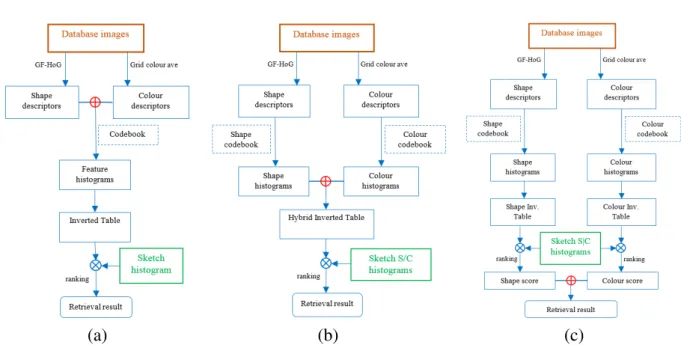
3.3.2 Early fusion . . . 41
3.3.3 Hybrid inverted table . . . 42
3.3.4 Late fusion . . . 42 3.4 Experiments . . . 42 3.4.1 Evaluation of accuracy . . . 44 3.4.2 Query-time performance . . . 46 3.4.3 Failure cases . . . 47 3.5 Conclusion . . . 49
4 Sketch-based Image Retrieval with Convolution Neural Neural Networks 51 4.1 Introduction . . . 51
4.2 Sketch-Edgemap matching with pure regression . . . 54
4.2.1 Triplet CNNs . . . 54
4.2.2 Loss function and the gradient collapsing problem . . . 57
4.2.3 Dimensionalily reduction . . . 60
4.2.4 Image pre-processing and data augmentation . . . 61
4.3 Sketch-Photo matching with multi-stage regressions . . . 63
4.3.1 Network architecture . . . 63
4.3.2 Training procedure . . . 64
4.3.3 Dimensionality reduction . . . 66
4.3.4 Image pre-processing and data augmentation . . . 67
4.4 Experiments . . . 68
4.4.1 Datasets and experimental settings . . . 69
4.4.2 Generalisation . . . 71
4.4.3 Sketch-Edgemap matching . . . 74
4.4.4 Sketch-Photo matching . . . 77
4.4.5 State-of-art comparison . . . 82
5 Visual Search with Sketches and Aesthetic Context 89
5.1 Introduction . . . 89
5.2 Hierarchical triplet for shape and style modelling . . . 91
5.2.1 Style network . . . 91
5.2.2 Structure network . . . 92
5.2.3 Hierarchical (Multi-modal) network . . . 94
5.2.4 Visual Search with Aesthetic Context . . . 95
5.3 Experiments . . . 95
5.3.1 Datasets . . . 95
5.3.2 Evaluating Visual Search: Style only . . . 97
5.3.3 Evaluating Visual Search: Sketch+Style . . . 99
5.3.4 Alternative query modalities . . . 105
5.3.5 Fine-grain style analysis . . . 106
5.4 Conclusion . . . 109
6 Deep Manifold Alignment for Mid-grain Sketch-based Image Retrieval 111 6.1 Introduction . . . 111
6.2 Deep representation for Mid-grain similarity . . . 113
6.2.1 Sketch-Image manifold alignment . . . 115
6.2.2 Intra-category clustering . . . 118
6.2.3 Magnet loss . . . 119
6.2.4 Training procedure . . . 120
6.3 Experiments . . . 121
6.3.1 Datasets . . . 121
6.3.2 Clustering and alignment methods . . . 123
6.3.3 Baseline comparison . . . 124
6.4 Conclusion . . . 128
7 Conclusion 131 7.1 Summary of contributions . . . 131
7.1.1 Class-level SBIR with deep neural networks: Chap. 4 . . . 131
7.1.2 Multi-modality SBIR: Chap. 3,5 . . . 134
7.1.3 Mid-grain SBIR: Chap. 6 . . . 134
7.2 Future work . . . 135
Appendix A SBIR demos 137 A.1 SketchSearch . . . 137
A.2 SketchStyle . . . 138
Appendix B Publications 139
1.1 Sketch examples. . . 3
2.1 Query by example (QVE) framework. . . 12
2.2 Bag of Visual Words framework. . . 17
2.3 CNN pipeline. . . 19
2.4 SBIR applications. . . 32
3.1 Examples of free-hand drawing sketches. . . 34
3.2 GF-HoG gradient field visualisation. . . 37
3.3 CIELab luminance transfer function. . . 38
3.4 GF-HoG colour interpolation for sketches. . . 39
3.5 Inverted index concept. . . 40
3.6 Three fusion techniques for colour GF-HoG. . . 41
3.7 A problem of the hybrid fusion approach. . . 43
3.8 Impact of codebook size on the three fusion approaches on Flicrk15K. . . . 44
3.9 Accuracy performance of the three fusion approaches on Flickr15K. . . 45
3.10 Speed performance of the three fusion approaches on Flickr15K. . . 46
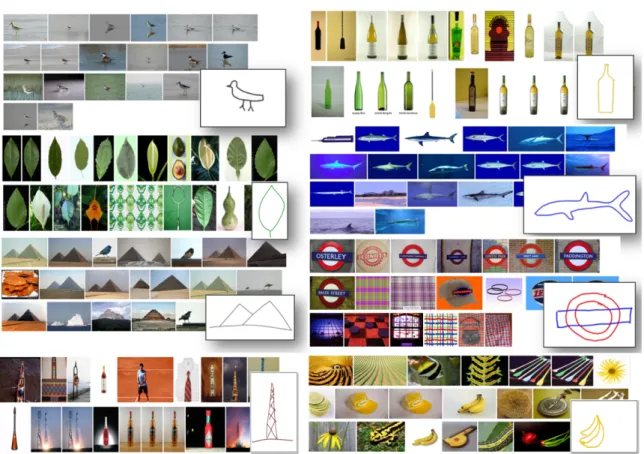
3.11 SBIR examples on Flickr3M. . . 47
3.12 SBIR examples on ImageNet. . . 48
4.1 Difference between sketches, images and their edgemaps. . . 52
4.2 The concept of triplet objective function. . . 54
4.3 A partial-sharing triplet network. . . 56
4.4 The gradient collapsing problem. . . 57
4.5 Gradient collapsing toy examples. . . 59
4.6 Image preprocessing. . . 62
4.7 Multi-stage training procedure. . . 65
4.8 Plots of training losses. . . 67
4.10 Examples of train and test datasets. . . 70
4.11 Generalisation experiments. . . 72
4.12 T-SNE visualisation before and after training. . . 73
4.13 First convolutional layer visualistion. . . 74
4.14 Exploring training meta-parameters. . . 75
4.15 Top retrieval results for several query examples on Flicrk15K. . . 76
4.16 Dimensionality reduction experiments for sketch-edgemap matching. . . 77
4.17 Multi-stage vs. single stage training. . . 78
4.18 Weight sharing experiments for sketch-photo matching. . . 80
4.19 Edgemap vs. photo matching. . . 80
4.20 Experiments of output dimensions. . . 81
4.21 SBIR examples on Flickr15K for sketch-photo matching. . . 83
4.22 T-SNE visualisation for sketch-photo matching. . . 84
4.23 PR curve on Flickr15K. . . 87
4.24 Average retrieval precision on Saavedra-SBIR benchmark. . . 87
5.1 The concept of SBIR with aesthetic context. . . 90
5.2 The triplet convnet for learning the style model. . . 92
5.3 Hierarchical triplet convnet. . . 93
5.4 Examples of style images used in the test set. . . 96
5.5 Style retrieval performance @ K=15. . . 97
5.6 Discrimination and decorrelation in the style and semantic spaces. . . 98
5.7 Representative structure+style visual search results. . . 100
5.8 T-sne visualisation of watercolor style embedding. . . 101
5.9 Style analogies. . . 102
5.10 Top-1 structure+style retrieval examples. . . 103
5.11 Relative performance of the proposed method vs. baselines. . . 104
5.12 Blending visual styles. . . 105
5.13 Alternative query modalities. . . 106
5.14 Fine-grain style triplet examples. . . 107
5.15 Failure cases from top-15. . . 108
6.1 Problems with a fine-grained dataset. . . 112
6.2 Data alignment within deep convnet. . . 114
6.3 Mid-grain SBIR pipeline. . . 115
6.4 Data alignment methods. . . 116
6.6 Alignment vs. clustering methods . . . 123
6.7 A failure case of LTM. . . 124
6.8 Data distribution before and after training. . . 125
6.9 Mid-grain SBIR examples . . . 127
2.1 SBIR approaches benchmarked on Flickr15K. . . 26
4.1 Classification accuracy vs. network architectures. . . 78
4.2 SBIR vs. network architectures. . . 79
4.3 Experiments of dimensionality reduction. . . 81
4.4 SBIR on Flicrk15K benchmark. . . 85
4.5 SBIR on TU-Berlin-Retr benchmark. . . 86
4.6 SBIR on Saavedra benchmark. . . 86
5.1 Style-only retrieval performance. . . 99
5.2 Retrieval performance per style categories. . . 101
5.3 Fine-grain style retrieval. . . 109
6.1 The Common65c training dataset. . . 121
Roman Symbols
AFM Asymmetric Feature Map
ANN Approximate Nearest Neighbour BoVW Bag of Visual Words
CBIR Content-based Image Retrieval
CGAN Conditional Generative Adversary Network CNN Convolutional Neural Network
CSS Curvature Scale Space CV Computer Vision DoG Difference of Gaussian EHD Edge Histogram Descriptor
FAST Features from Accelerated Segment Test FC Fully Connected
FD Fourier Descriptor FFT Fast Fourier Transform
GF-HoG Gradient Field of Orientation Histogram GMM Gaussian Mixture Model
HoG Histogram of Oriented Gradient HTD Homogeneous Texture Descriptor
ILSVRC Imagenet Large Scale Visual Recognition Challenges IQR Inter-Quartile Range
IR Information Retrieval
LRN Local Response Normalisation LSH Locality Sensitive Hashing mAP Mean Average Precision ML Machine Learning
OCM Oriented Chamfer Matching PCA Principal Component Analysis PQ Product Quantisation
PR Precision Recall QE Query Expansion QKW Query by Keywords QVE Query by Visual Example RF Relevance Feedback
SBIR Sketch-based Image Retrieval SBSR Sketch-based Sketch Retrieval SIFT Scale-Invariant Feature Transform SVM Support Vector Machine
TBD Texture Browsing Descriptor
TF-IDF Term Frequency - Inverse Document Frequency VLAD Vector of Locally Aggregated Descriptors
Introduction
1.1
The deluge of visual media and the management
prob-lem
The Internet is awash with digital imagery, and the rate of content generation is staggering with Cisco [28] predicting that by 2021, 82% of Internet traffic will comprise visual content. Every hour millions of photos (Facebook 15m [108], Instagram 2.5m [112]), and video (Youtube 500 video hours per minute [113]) are published. These figures are only set to increase as behavioural trends such as life-logging gain traction, and social media use penetrates developing nations. The growth in popularity of image capturing devices such as cameras and CCTVs also assists in the boom of visual content. It is fair to say that billions of images available nowadays compose a dense sampling of the visual world.
Unfortunately technology for the management of visual media has not kept pace with its generation. Current search engines (e.g. Google) are predominantly still using textual queries to search visual media. Text-based image search is often not reliable as its average accuracy is reportedly just 15% [46]. The reasons behind its poor performance are probably (i) word polysemese.g. “crane” can be a bird or a machine and (ii) more importantly, visual content is not searched directly. While the former is a linguistic problem and could be improved by using more detailed text queriese.g. “crane machine” or “crane (bird)”, the latter is more systematic. Most search engines retrieve images by matching text queries against keywords present in a secondary meta-data stream such as user-tagged keywords or text nearby the image on a web-page. This indirect search often leads to many unrelated images among the returned results.
Another problem of text-based image search is the unparalleled expressive power between text and image. Whilst text efficiently conveys semantic concepts (e.g. find me an image
containing a flower) it is neither intuitive nor concise to describe appearance in this manner (e.g. find me a flower that looks like this, or a video containing movement like this). Rather, a visual query “paints a thousand words” and can communicate such concepts efficiently. Content-based Image Retrieval (CBIR, also referred asvisual search) addresses these shortcomings, enabling direct search on image content rather than tags. The most common form of CBIR,query by visual example(QVE), encodes image content into vectors so calleddescriptorsorfingerprints. Visual similarity between two images is determined by the distance between their corresponding descriptors. The idea of CBIR/QVE attracts great research interest, resulting in the release of the MPEG-7 international standard in 2001 [154]. MPEG-7 standardises a set of low-level visual cues such as colour, shape, texture and motion (for video) as compact descriptors for the purpose of browsing, filtering and identifying visual content. Most QVE algorithms accept a photograph as input, which gives equally illustrative power to the queries. However, users often wish to search for an image that they do not currently have, making QVE impractical when the visual example exists only within “the mind’s eye”.
1.2
Sketch-based image retrieval
SBIR is an emerging research topic within CBIR/QVE that enables users to provide a free-hand sketch as the query to search for similar photo images. This concept unifies the advantages of both CBIR (the illustrative power of visual queries) and text search (the effortless procedure of query generation). Sketching is an innate human ability; an efficient means for abstracting and communicating ideas since pre-historic times. Children can draw simple objects before learning their first language, and sketches in the form of hieroglyphics were employed in some of the oldest language systems such as Sumerian and Egyptian hieroglyphs (Fig. 1.1). Creating a drawing is also a natural and intuitive act – all needed materials are a pointed toole.g. pen, chalk, finger, and a surfacee.g. paper, board, sand. The advent and popularity of touch-screen based technologye.g. tablets and smart phones that do not have a keyboard as their primary input device makes SBIR a timely research area.
1.3
Research questions
SBIR inherits all the classical challenges from CBIR, in addition to the challenges of cross-domain matching as well as unique problems such as ambiguity arising from the medium of sketch itself. This gives rise to several core research questions addressed by this thesis:
(a) Sketches in ancient hieroglyphs. Source: Wikipedia.
(b) Various drawing methods in ancient and modern arts. Figure 1.1: Sketching is a human’s gifted talent.
Discriminative and compact representation.Most scalable visual search systems operate by learning a metric embedding (or search space) in which visual queries and database images may be easily compared via vector math (e.g.L2norm). How can we encode sketches and images into a common embedding space? The embedding must retain local visual similarity between samplesi.e. similar images are close in the embedding space, yet being invariant to depictioni.e. sketches and images of the same conceptual structure are close to each other regardless of its visual appearance. Moreover, the embedding must be as compact as possible to support scalability over web-scale collections (comprising millions of images). A practical SBIR solution should support querying at interactive-speedi.e. ideally less than 1 second per query, either implicitly via compact encoding or explicitly via engineering optimisations such as efficient indexing and/or distributed computing.
Sketch ambiguity. Although sketching is an intuitive and convenient means of describing visual content, an average sketcher is not a faithful artist. Sketches are usually messy and non-linearly deformed due to either limitation in users’ drawing skill, or the nature of the casualthrowawayact of a posing a search query limiting the time a user spends on generating a sketch. Differences in drawing styles also lead to great variance in the level of abstraction – some users like drawing very detailed objects while others tend to draw only silhouette contours, causing the resulted sketch to match multiple objects. Other forms of sketch deformation include caricature (certain features are exaggeratede.g. a cat has long whiskers), anthropomorphism (animals/static objects have human traitse.g. smiling spider)
and simplification (e.g. limbs and legs are represented as single strokes). How can we tolerate such deformations yet still being able to capture subtle, fine-grain details in a sketched query?
Singular modality. While colour, shape and texture are rich sources of information in photo images, sketches (especially free-hand line-art drawings) rely on shape as the dominant modality to store information. It is difficult to enclose other entities such as colour or style within a sketch, which limits user’s flexibility in seeking their target images. Could the querying mechanism be enriched as an additional way to combat sketch ambiguity and to enhance user experience?
Lack of sketch datasets. SBIR is still an emerging technology, and not as prevalent as photographic visuals search. While photo datasets can reach millions in size and thousands of categories, it is costly to create a high quality and diverse collection of example sketches. This limitation particularly affects the training of SBIR models that involves machine learning, such as the algorithms contributed in this thesis. It is interesting to explore how the training sketch volume influences the retrieval performance, and explore how best to augment or otherwise build successful training methodologies for SBIR given the limitations of existing sketch datasets.
1.4
Thesis contributions
To address the above research questions, this thesis makes several novel contributions through novel SBIR algorithms and extensive experimental studies of their performance, along with the creation of several new datasets. We list each of the technical contributions below, and describe against each the research hypotheses addressed:
1.4.1
Learning visual representations for SBIR
The major focus of this thesis is the development of novel SBIR algorithms that exploit machine learning to create search embeddings. The ability to distil the information in a sketch, or image, to a point in a metric search embedding is fundamental to scalability, since identifying the nearest neighbours to a query in such a space (ranking these on distance using a metric such asL2norm) underpins most contemporary search algorithms. For visual search to be practical, it must operate over diverse object classes; a user sketching a particular object expects to see similar objects return. This requirement fits well under class-level SBIR which aims to match sketches and images at category leveli.e. a returned image is considered as relevant if it belongs to the same category as the query sketch’s. We present several novel
training frameworks that support learning from (in some cases several) sketch-image datasets. The development of these algorithms explores the following research hypotheses:
[H1] Learning direct matching between sketches and images might be better than in-directly matching via an intermediate representation such as edgemap.
At the time of embarking upon this research, no prior SBIR work had exploited the growing trend in deep learning within Computer Vision. Concurrent with our work in Chapter 4, which for the first time exploited deep neural networks (specifically, multi-branch ‘triplet’ networks) for SBIR, initial frameworks were presented for sketched object recognition
e.g. [202]. Due to large domain gap between sketches and image, many existing algorithms (including many of these early algorithms) chose an indirect approach – matching sketches with an intermediate representation of images, notably edge maps derived from operators such as Canny [19].
These approaches are backed from two arguments. First, a sketch carries only shape information; thus there is no need to encode other modalities of an image such as colour or texture in a SBIR task. Second, image edgemaps and sketch are statistically closer (both are binary masks, and encode only structural information) so similar feature extraction methods might be applied to both domains in the early stages of a deep network. On the other hand, direct sketch-image matching without a heuristic pre-process such as edge extraction, ensures no information islostvia pre-processing giving the network the opportunity to learn from all visual cues available. We test this hypothesis using one of the state-of-art methods for edge extraction and a popular deep network for feature learning and extraction; then evaluate on a defacto class-level SBIR benchmark. We demonstrate in Chapter 4 superior performance at sketch-edgeimage matching versus baselines available at that time (circa 2016) and later show that a direct sketch-image matching can surpass that benchmark too yielding current state of the art performance.
[H2] A deep SBIR model could generalise better if it is exposed to more diverse training datasets.
It is well known that the volume of training data has a significant impact on the perfor-mance of a deep network due to the high number of learnable parameters, which usually number in the tens of millions. Yet there is not much research in SBIR literature regarding how the training size affects retrieval performance, despite the difficulty of building large datasets of hand-drawn sketches. Additionally, deep models are often trained and evaluated on the training and test sets from the same dataset, which might introduce bias towards seen categories. In Chapter 4 we evaluate the generalisation capability of SBIR not only across domain (sketch to image) but also across sketch datasets whose classes were unseen during
model training, whilst also measuring the impact of varying the volume of the training data available.
[H3] It might be possible to obtain both ‘discriminative’ and ‘compact’ representation through an end-to-end learning framework.
Discriminative representations underpin accurate visual search, since similar sketch-image and sketch-image-sketch-image pairs are brought together (and conversely dissimilar pairs separated) in a discriminative search embedding. Compact representations are often achieved in scalable search pipelines via dimensionality reduction. In a traditional shallow SBIR framework the two processes are independent to each other with feature extraction being followed by dimensionality reduction (if available). In a deep network it is usual to sample activations from late fully connected (FC, ordense) layers, as a high dimensional search embedding — and dimensionality reduction is often omitted. In Chapter 4 we examine the possibility of combining both feature extraction and dimensionality reduction in an end-to-end framework, and test whether it is better than implementing the two processes separately.
[H4] The performance of deeply learned representations could be improved if sketch and image models share certain parameters.
It is controversial whether sketch and image models should share parameters in SBIR. Most existing approaches either share all parameters (since a large amount of trainable parameters in deep networks allows one model that fits all) or do not share any (because sketch and image are two distinct domains thus two separate models, and so different functions mapping to the joint embedding, are required). Within the scope of this work and given H1-3, we test the hypothesis of partial sharing between the two models. A training procedure is specially designed promoting this configuration and tests are carried on several well-known network architectures to determine the optimal level of parameter sharing between models (network branches).
1.4.2
Enriching sketch queries with additional modalities
We explore novel approaches to resolve ambiguity in sketch via incorporating multiple modalities within the query. In two independent studies we tackle fusion of sketched shape with two separate modalities that have not been explored in previous SBIR work.
SBIR with coloured line-art queries.
Colour is an important modality in definition and discrimination of different objects. Integrating colour into sketches has been explored in few SBIR studies, where ‘sketches’ take the form of paintings comprising coloured blobs and are treated as photographic images during matching. We instead investigate the integration of colour within line-art drawings,
which are more aligned with typical user sketches [31], and propose a novel feature extraction algorithm for colour. In Chapter 3, different fusion techniques for colour and shape features are studied, which gives rise to a global search embedding enabling for the first time colour-sketch based search.
SBIR with aesthetic context.
In Chapter 5 we develop a SBIR algorithm with the unique ability to take a desired visual style (aesthetic) of the target images into account as search context. Users provide a sketch as the structural query along with one or more images as the contextual query. The contextual queries which might resemble the style of artwork desired, may be easily found on the Internet or from personal image collections and epitomise thevisual styleoraestheticof the search results. By defining the ‘styles’ to be retrieved, we extend SBIR beyond photographic images to various artistic mediae.g. painting, comic, graphite which have received no prior study in the SBIR literature. As with colour, the ability to supply additional search constraints through orthogonal search modalities helps to disambiguate the sketched query and improve the relevance of results.
1.4.3
Mid-grain SBIR
Existing SBIR approaches in general fall into either of two camps according to granularity at which matching is performed: (i) class-level (coarse-grain) SBIR where a sketch query of a given object must return images of the same object; and (ii) instance-level (fine-grain) SBIR where a detailed sketch of an object must return that specific object only. Both camps have their own advantages and drawbacks. Class-level SBIR is efficient at retrieval of semantic objects but does not utilise the whole illustrative power of sketches (it ignores intra-class variance). Instance-level SBIR is desirable but requires unrealistic approximation of the target image within the sketch query (c.f. sec.1.3 the challenge of sketch imperfection). In practice, class-level SBIR does not convince users to switch from text-based image search while instance-level SBIR requires expensive fine-grain labelled data for training.
In Chapter 6, we propose an intermediate level of granularity, referred asmid-grain, in which the SBIR algorithm recalls images sharing both the object category and key visual characteristics of the sketched query but without requiring a precise sketch. Under mid-grain SBIR, images are relevant if they share the same category and also same canonical view or subtype with the sketch. We explore several supervised and unsupervised methods to deliver visual search within this new framework.
1.4.4
New datasets
As an additional contribution, this thesis contributes two new datasets to the SBIR literature. The first, Flickr25K, is an image dataset analogous to a popular sketch dataset. This dataset contains clean images from a large pool of categories manually harvested from the Internet, which is suitable for training class-level SBIR algorithms (used in Chapters 4-5). The second one, MidGrain65c, which is also manually constructed is the first sketch-image set labelled at mid-grain level (used in Chapter 6).
1.5
Thesis structure
The thesis structure is outlined as follows, along with a brief description of contributions of each:
Chapter 2 – Literature review
In this Chapter we present a comprehensive survey of existing work in the field of SBIR. We identify common trends in the field spanning three different ages of SBIR algorithm, from classical optimization based approaches to shallow-learning to the most recent deep learning based approaches.
Chapter 3 – Scalable Sketch-based Image Retrieval using Colour Gradient Features
We present a SBIR algorithm that for the first time fuses colour with shape to enable coloured-sketch based visual search of photographic collections. At the time of writing this was the first algorithm to enable scalable search to tens of millions of photographs (specifically we demonstrate search of ImageNet, a dataset of 12M images typically used for object classification) within a few seconds. The technical contributions include a comprehensive study of various fusion approaches to combined colour and shape information, coupled with an efficient indexing strategy for fast query time.
Chapter 4 – Sketch-based Image Retrieval with Convolutional Neural Networks
We present a class-level SBIR framework delivering with state-of-art performance. The Chapter begins by outlining the first triplet CNN based approach to SBIR, expanding upon early results on sketch-edgemap matching to build a state-of-the-art framework capable of direct sketch-image matching. Extensive studies on generalisation, dimensionality reduction and parameter sharing are presented.
Chapter 5 – Visual Search with Sketches and Aesthetic Context
We present a technique capable of dis-entangling the structure and the visual style of an image. This enables both structure and style to be separately specified in a visual search
system. This capability is instantiated via an SBIR system where the structure of the desired object (such as a dog) may be sketched, and accompanying that sketched query, a handful of images epitomising the desired visual style (such as a particular watercolour look and feel) constrain the search to return results with that particular aesthetic (such as watercolour dogs). We further enhance the system with a study of fine-grain style discrimination trained using crowd-sourced data. Enabling SBIR with aesthetic context is a unique contribution of this work.
Chapter 6 – Deep Manifold Alignment for Mid-grained Sketch-based Image Retrieval
We introduce and explore the concept of mid-grain SBIR; a half-way house between coarse grain (category-level) retrieval and fine-grain (instance-level) retrieval. We propose a semi-supervised approach that utilises mainly class-level datasets to learn mid-level discrimi-nation.
Chapter 7 – Conclusion
We summarise the contributions of this thesis including our key findings and identify ongoing research questions for future study.
Literature review
The contributions of this thesis are within the fields of Information Retrieval (IR), Computer Vision (CV) and Machine Learning (ML), particularly into the sub-fields of CBIR and SBIR. In this Chapter we present a comprehensive review of techniques used in CBIR and SBIR with primary focus on sketch-related algorithms. This Chapter begins with a review of CBIR followed by a more specific focus on SBIR. The review then tackles other sketch-related work such as sketched object recognition. Finally, a survey on existing commercial sketch applications available to date is conducted.
2.1
Content Based Image Retrieval
The oldest reported image management system is probably the works of Prasadet al. [130], which was built by MIT in 1987 and was a query-by-keyword (QKW) system. Nowadays the most popular method for searching images on the Internet is still via text queries. Searched keywords are matched against meta data such as tagged keywords, image captions or the whole web articles containing the indexed images. Image search is conveniently converted into text search. However, the lack of direct search into image content and the costly process of image annotation give rise to CBIR. In CBIR, image search is conducted through mathematical models that reflect image content rather than through meta data. Among several forms of CBIRe.g. categorical browsing, content-based visual clustering, query by attributes,
etc., QVE (commonly known as Reverse Image Search) is arguably the most popular. QVE allows users to submit a visual query in search of the objects of interest. Fig. 2.1 describes the general framework of a QVE system. QVE works by encoding the content of an image into a compact representation – usually a high dimensional vector called descriptor. The descriptors of an image database are stored and indexed in a way that benefits management and retrieval activities. Visual similarity between two images is defined under a distance
Figure 2.1:Structure of a simple QVE system.
metric comparing the corresponding descriptors. At query time, the descriptor of the query is computed and matched against those in the database. Finally, the images whose descriptors areclosestto the query under the distance metric are returned.
In this section we review the development of CBIR/QVE over years. We build upon recent surveys [61, 1, 178, 157] focusing on feature extraction which is the core process in every CBIR system. In general feature extraction approaches can be categorised into two groups. The first group of approaches involves shallow features – image descriptors are constructed under specific rules based on low- or mid-level features such as colour, texture and shape. These rules are manually crafted either at local or global levels. On the other hand, the second group of approaches involves machine learning to deliver understandings of image content from pixel levels. The learning process requires a deep multi-layered network to interpret visual content in a hierarchical order from low to high conceptual levels. The resulting image features are therefore calleddeep features.
2.1.1
Shallow features
Shallow features, whether at low- or mid-level, are often developed from the most fundamen-tal visual cues in images: colour, texture and shape. Low-level features are often computed directly from these cues. In contrast, mid-level features are often inferred from low-level local features using a dictionary learning technique.
2.1.1.1 Colour features
Visual search is based on colour similarity. Each image is analysed to produce a colour histogram as the image descriptor. Colour histogram can be built directly by quantising
values of the image pixels into a set of bins for each colour channel [167, 122, 45]. Global colour histogram is fast to compute but (i) not robust against illumination change and (ii) has poor performance on large datasets where the chance of having different images with similar colour histograms is substantial. The former problem can be addressed using a colour constancy algorithm [52, 47, 177], for example Funt and Finlayson [52] proposed quantising colour ratios by histogramming the first derivative of the original RGB image. To deal with the latter problem, significant efforts have been devoted to encode the spatial distribution of colour. Smithet al. [158] and Hsuet al. [68] segmented an image into different colour regions and constructed the image descriptor from their colour histograms and coordinates. Alternatively, Chuaet al. [26] and Gonget al. [57] split image into an equal-sized grid and compute histogram for each cell separately, while Alamdaret al. [2] and Lu et al. [105] built a quad-tree according to colour distribution across the image from which a histogram is computed for each tree level.
Improvement in histogram quantisation and spatial distribution of colour was proposed in the work of Manjunathet al. [107], later became MPEG-7 standards. Under the MPEG-7 Dominant Colour Descriptor (DCD), salient colours are clustered into a small number of bins, each contains the entity, percentage, variance and spatial coherence of a dominant colour [154]. MPEG-7 also supports Colour Layout Descriptor (CLD) which is histogram-based but provides more accurate spatial layout of the dominant colours. The DCD and CLD were later improved by Wonget al. [195], creating a compact Dominant Colour Structure Descriptor (DCSD).
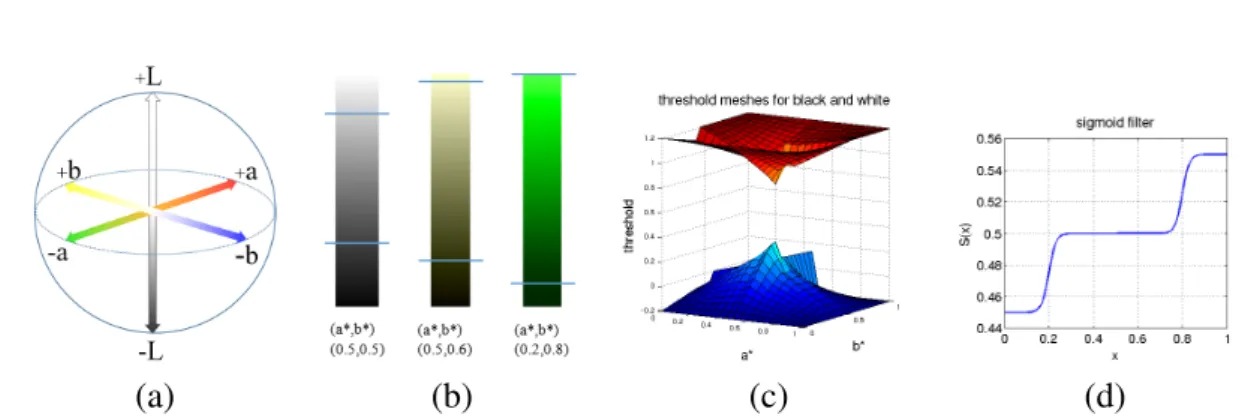
Choosing which colour space to be used is also a challenge. RGB is widely used in [48, 39, 122, 52] since it is compliant with computer display. However, RGB is not perceptually uniformi.e. the distance between two colours in RGB space does not reflect their difference in visual importance. Other transformations of RGB such as HSV and HSL are also criticised for lack of perceptual uniformity, thus are only commonly used in computer graphic, image editing and image segmentation [25]. Several authors sought to use colour spaces that approximate human vision such as CIELuv [195] or even designed a new colour spacee.g. Hue Min Max Difference (HMMD) [107].
Although being an important modality, colour features alone do not work well in CBIR because its representation depends solely on the colour of the object being learned whilst many objects do not have a fixed colour. For example, an apple can be green or red, or a t-shirt can have any kind of colour. A more common practice is to combine colour-based feature with other modalities such as texture or shape.
2.1.1.2 Texture features
Texture is often defined as a structural pattern of more or less random textons too great in number to be considered as isolated objects [157]. The earliest texture analysis involves characterising patches’ structure statistically with the classical co-occurrence matrix [64] that measures the neighbouring relationship between any two intensity’s values. From co-occurrence matrix one can obtain useful information like energy, entropy, homogeneity and contrast. Other texture properties such as directionality, periodicity, coarseness and regularity were explored by Tamura et al. [169] and Liu et al. [102]. Texture-based transformation approaches were also well studied. Gabor filter [13, 78] and wavelet transform [159] both utilise space-frequency deformation to explore the characteristic of texture although each has its own strengths and weaknesses [110]. Supported texture features under MPEG-7 standards are Texture Browsing Descriptor (TBD) and Homogeneous Texture Descriptor (HTD) [107]. The former is a compact descriptor characterising irregularity (2 bits), directionality (6 bits) and coarseness (4 bits). The latter computes mean and variance of the filtered image in frequency domain.
Texture descriptors were well employed in image analysis, synthesis, classification and segmentation rather than image retrieval since they offer little semantic reference.
2.1.1.3 Shape features
Shape is another important visual cue for identifying similar objects. In general shape features are either contour-based or region-based. Fourier descriptor (FD) is a notable representative of the former. FD describes contoured object in frequency domain, thus exhibits affine transformation and is robust to noise. Various FDs have been developede.g. centroid-distance [205], elliptic [92], cumulative angle [203], Perimeter Area Function (PAF) [180], etc. and there has been a comparative study about them [206]. FDs achieve high speed performance thanks to Fast Fourier Transform (FFT), however they rely on non-robust contour extractors such as chain code. Another popular contour descriptor is convex hull that describes a shape as a set of convex polygons in a recursive tree graph [156]. Convex hull descriptor is compact, robust to noise and can be affine invariant however the process of constructing its graph descriptor can be difficult.
Contour descriptors are capable of exploiting boundary information but often fail to capture interior content or disjoint shapes with irregular structures. Region-based descriptors can overcome that by considering all pixels constituting the objects. A simple example of region-based approaches is grid descriptor (GD) and its variants [43]. Under GD, an object silhouette is overlayed on a grid where each cell is labelled ‘1’ if a majority of pixels belongs
to that object, ‘0’ otherwise. The resulting binary grid can be used as a descriptor. Hu [70] first came up with seven affine invariant Moments built from the 2nd and 3rdcentral moments. Later, Zernike Moments developed from Zernike polynomials is claimed to outperform other moment-like descriptors [88, 172]. In general, region-based descriptors are useful in CBIR applications involving binary objects such as logos, trademarks, clip-arts and silhouettes.
The shape descriptor introduced in MPEG-7 is EHD [107] similar to colour histogram but is applied on edges instead (MPEG-7 categorises EHD as the third texture descriptor besides TBD and HTD, however it is more reasonable to consider EHD as a shape descriptor). To compute EHD, an image is gridded into 4x4 blocks whose edge orientation is quantised into 5 equal bins of angles 0°- 180°, resulting in an 80-D descriptor.
Shape descriptors have been studied extensively in the sub-field SBIR. We cover shape descriptors in more details in subsec. 2.2.1.
2.1.1.4 Mid-level features
Mid-level features started gaining traction and quickly became dominant during the first decade of 2000s. Approaches based on mid-level features aim to represent more abstract information other than image-level features (colour, text, texture). Mid-level features are constructed via two steps: acodingstep that involves computing local features followed by apoolingstep that builds global features upon the local ones. This procedure closely resembles the way human portray objects in nature – an object can be described from its partse.g. a rectangle has 4 right corners and several straight lines; a car is made up of wheels, lights, bumpers and so on.
Coding
Various local descriptors have been studied for the coding step, some include methods for detecting localkey points– a term refers to important locations within an image that is rich of visual information and could help identify the objects of interest. Corner is an example of key points. Harris and Stephens [65] introduced a robust corner detector using structure tensor to detect rapid change of pixel intensity in both vertical and horizontal direction. After Harris detector, Rostenet al. [142] proposed a real time corner detector, Features from Accelerated Segment Test (FAST), that examines the relative values of a limited set of pixels on a circle surrounding the candidate corner pixel. These detectors together with other corner detectors like Förstner [50] and SUSAN [160] are useful in not only CBIR but also stereo matching, tracking and recognition applications.
There were attempts to develop generalised key-point detectors rather than corner detec-tion only. Lowe [104] implemented a Scale-Invariant Feature Transform (SIFT) key-point detector and also a SIFT descriptor. The SIFT detector finds key-points by looking at the
extrema of Difference of Gaussian (DoG) functions at multiple scales discarding low contrast key-points. The SIFT descriptor computes gradient orientation of a 4x4 grid centred at the key-point, quantises each cell within the grid into 8 orientation bins to form a 128-D vector depicting that local key-point. Several advantages of SIFT descriptors apart from being a local descriptor are robustness to noise, fast computation (thanks to DoG) and affine invariance. There were attempts to improve SIFT further. For example Keet al. with PCA-SIFT [87] employed Principal Component Analysis (PCA) to linearly project the normalised gradient patch from high to low dimensional space, effectively reducing feature descriptor’s length. Mehrotraet al. with F-SIFT [114] applied Fourier Transform on the key-point patch and phase-based key-point matching in iris recognition. Bay et al. [8] with Speeded Up Robust Features (SURF) used Hessian detector with DoG to detect key-points, and computed Haar-wavelet responses within the key-points for the descriptor.
Besides SIFT-like descriptors, another popular local descriptor is Histogram of Oriented Gradient (HOG) [35] which is computationally similar to SIFT but applied on dense over-lapped regions of the image instead of interest points. HOG can be encoded over grids with multi-resolution, resulting in pyramid-HOG [96]; or the grid’s shape over which HOG is computed can be log-polar in [116]. These SIFT/HOG-like descriptors tend to perform better than other descriptors thanks to their ability to capture rich information about the spatial patterns within the region of interest whilst being robust to partial deformation, as shown in Mikolajczyk and Schmid’s studies [116].
Pooling
Pooling is in fact a quantisation technique that groups arbitrary similar local features together to construct a fixed-length histogram-like global descriptor. The most popular pooling strategy is Bag of Visual Words (BoVW) (Fig. 2.2). BoVW uses a clustering technique to construct a dictionary from the collection of local features in the whole image database. Every image will then have each local feature assigned to one of thevisual words in the dictionary, resulting in abag of features- a frequency histogram that counts the number of occurrences of the visual words in the image. BoVW can be modified to usesoft-assignment
during the histogram construction process [54]. Here, a local feature contributes score to all visual words with weights inversely proportional to the distance between the feature vector and the visual words (cluster centres). This approach seems more effective than the
hard-assignmentapproach because some features may lay close to the boundary decision separating several visual words, thus it is more intuitive for these features to be assigned with multiple code words. Finally, the global histogram could be normalised using either city-block (L1), Euclidean (L2) or term frequency- inverse document frequency (TF-IDF) normalisation techniques.
Figure 2.2: The concept of Bag of Visual Words.
Clustering is the core technique to build dictionary in BoVW. The most widely used method is K-means [106]. K-means is an unsupervised learning algorithm that can automati-cally learn the distribution of data in feature space and partition them into a fixed number of clusters. Given K as the cluster number, the standard K-means (Lloyd) first selects random K points as the centroids and assigns the rest of the data to these points as their nearest neighbours. In the next iteration, these centroids are updated by computing the means of the new clusters. The process is repeated until no new assignment is made (the algorithm has converged) or the maximum number of iterations (or minimum energy required to move the clusters) is reached. K-means is robust since it is guaranteed to converge. To avoid local optima, K-means can be run multiple times with different centroid initialisations, and the one having the lowest Sum-of-Distance energy is selected as the optimal result. Alternatively, an initialisation function can be applied to initialise the maximally diverse centroids e.g. k-means++ [5]. To improve computation speed, Approximate Nearest Neighbour (ANN) can be implemented instead of exhausted search in Nearest Neighbour. To reduce the effect of outliers, each centroid can be determined as the most centric data point in the new cluster during the update phase rather than the implicit mean which might not belong to the cluster, resulting in the so-called K-medoids approach [86]. K-means can also be combined with a top-down hierarchical clustering technique to build a decision tree where each level of the tree is constructed by K-means partitioning the data of every nodes from the parent level, as demonstrated in [121]. Despite being one of the fastest clustering methods, K-means is still computationally expensive on large data (the complexity of the standard K-means is O(KiNd) for K clusters,iiterations, N data points andd dimensions of feature vector). In practice, only a sub-sample of the data might be employed to generate the codebook.
A well-known alternative to K-means clustering is Gaussian Mixture Model (GMM) [139]. GMM employs asoft-assignmentapproach which assumes all data is generated from a mix of several Gaussian distributions. GMM works on the basis of expectation maximisation – finding model parameters M (means, covariance matrices, priors) that maximises the
likelihood of the input data being generated by M. GMM is computed via an iterative process just like K-means and it is a common practice to use K-means as an initialisation step for GMM. The global descriptor of an image could be obtained by pooling that image’s local features over the GMM posteriors. Alternatively, a better approach is to encode the second order statistics instead – which direction the GMM parameters should be changed to best fit an image’s local descriptors. The resulting global descriptors, named Fisher Vectors, were among the most powerful mid-level descriptors and proved useful in both CBIR and classification tasks [126, 127].
2.1.2
Deep features
Deep learning approaches started gaining momentum after the success of AlexNet in the 2012 Imagenet Large Scale Visual Recognition Challenges (ILSVRC) [91] and are still trendy to date. Deep learning aims to learn high level features from raw image pixels via an end-to-end framework. The most popular type of deep networks for visual classification and retrieval is CNN. CNN consists of multiple cascading layers with each layer’s output being the input of the next one. A typical CNN layer contains a bank of linear filters (convolution) followed by a non-linear activation function (sigmoid, ReLU). Bottom layers often have additional spatial sub-sampling functions (max/average pooling) to compress the activated output (Fig. 2.3), and sometimes normalisation functions (LRN, batch-norm) to prevent certain filters/neurons from dominating the others. Following the top convolution layer (fully-connected) is a loss layer that controls the learning objectives. The layer weights are learned by back-propagating the loss’s gradient from top to bottom using chain rules. A CNN model often has millions of parameters e.g. 60M for AlexNet [91], 4M for GoogleNet [168] and 138M for VGG [155]. Therefore huge training data with data augmentation are explicitly required, along with weight regularisation and Dropout as implicit methods to combat overfitting. CNN works well with stochastic gradient descent in many tasks but more advanced optimisation techniques such as RMSprop and Adam [89] are also algorithms of choice. During the training of a CNN model, the convolution layers learn activations to certain input signals that resemble hierarchical distributed representations. As shown in DeconvolutionNet by Zeiler
et al. [204], the bottom layers learn image-level features such as colour and edge patterns while the top layers can capture higher levels of concepts like eyes, wheel, face,etc.
Thanks to its capability of encoding high level concepts, deep CNN models trained for classification tasks can be employed directly for CBIR by taking outputs of one of the top layers as image descriptors [137, 6]. More often the extracted features are refined with similarity learning; or the whole models are finetuned on new datasets for better generalisation as shown by Wanet al. [179]. Rather than taking the highest layer outputs for descriptors,
Figure 2.3: Pipeline of a simple CNN.
Toliaset al. [175] proposed R-MAC descriptors that aggregate the max-pooled activations of multiple image regions at different scales across multiple CNN layers, leading to a significant performance boost in object retrieval and localisation tasks. For example, an approach based on R-MAC and its hierarchical version REMAP has become the winner of the recent Google Landmark Retrieval Challenge 2018 [34].
Objective functions based on regression such as contrastive loss and triplet loss prove successful in achieving better image representations, as shown in [59, 185, 150, 187, 66, 134]. It is still unclear whether or not triplet loss performs better than contrastive loss, with Hoffer
et al. [66] supporting the former while Radenoviet al. [134] backing the latter. Other authors adopted a mid-level extraction framework for CNNs, for example Gonget al. [58] proposed a multi-scale orderless pooling (MOP-CNN) approach similar to spatial pyramid matching that extracts CNN features at multiple scales and aggregates using Vector of Locally Aggregated Descriptors (VLAD).
There have been attempts for binarising deep features as well as unsupervised learning for CBIR. Linet al. [100] set the first stone on deep learning of binary hash code by applying a sigmoid function after the latent layer, although this simple trick can only produce hash-like representation i.e. output values approximate{0,1}and no additional constraint is set to regularise the hashes. As the results, the hash-like representations can only be used for coarse-retrieval which is followed by a refining search using outputs of a previous layer as the secondary descriptors. Gao et al. [53] integrated CNNs with binary hashing in an end-to-end framework for multimedia retrieval. Linet al. [99] went further on completely unsupervised deep hashing that utilises only label-less objective functions such as minimal quantisation loss (make CNN outputs close to binaries), even distributed code (make ‘1s’ and ‘0s’ in the binary codes evenly distributed) and rotation invariant (bring representations of rotation variants of the same images together). Doerschet al. [38] studied an alternative unsupervised approach using spatial context to train a model predicting relative positions of two patches in an image.
Overall, approaches based on deep CNNs have become favourable in recent years, significantly outperforming traditional approaches in most CBIR tasks. A drawback of deep CNNs, as opposed to shallow-learning approaches, is that it requires large amount of training data. A part of this thesis is dedicated to find out the effects of training data size on performance of a retrieval system.
2.1.3
Indexing
Indexing is the process of organising data in an efficient manner that enables fast and accurate retrieval. The most naive and probably least efficient method is indexing by flat ID of images. At querying time, the query’s signature vector must be compared with every candidate image’s in the dataset, leading to the complexity of O(N) where N is the database size. This exhaustive search is not desirable if the dataset grows to millions of images. Especially in CBIR, a practical system should have the optimal querying time of less than a second.
Hierarchical Tree
Among the indexing techniques, the tree-like methods e.g. H-tree, R-tree, quad-tree, etc. can achieve sub-linear retrieval speed. B+-tree is used in the work of Luet al. [105] where a multi-way search tree is constructed and searched using attribute-value pairs. Yianilos designed a tree structure called Vantage Point Tree (VP-tree) which was used in CBIR in [199, 152]. First, a Vantage pivot point is chosen and the data points are divided into two sub-spaces according to the relative distance to the Vantage point, effectively creating the first level of the VP-tree. Next, a new Vantage point is selected at each sub-space and the process is repeated until all data points are separated. The created binary tree ensures the retrieval complexity ofO(log2N)at the querying stage, however the selection of the Vantage points still remains questionable.
Friedman et al. [51] developed a kd-tree that attains similar speed performance. The data points are recursively bisected on the basis of their distribution in the feature space, following thedivide and conquerstrategy. Given the dimension with the largest variance, the
cut positionhappens at the median point of the projected data along that dimension. Each node maintains the upper and lower limits of the co-ordinate i.e. the cut positions of the parent nodes, which let it conquer a cell in the data space. During querying time, the query travels along the kd-tree, finds which cell it belongs to and compares with all data points in that cell. A list ofmclosest points is updated (mis number of data points the user wants to retrieve), and thebounds-overlap-ballis checked to decide if the query needs to process to the opposite branch of the current node. Although efficient in terms of accuracy, the speed performance of kd-tree is quite poor for high-dimensional data.
Hashing
Similar to tree index, hashing splits the data points into an array of bucketsusing a hash function, so that data points in the same bucket are spatially close to each other. At search time, the query is passed to the hash function to locate which bucket it belongs to. A sequential search can be implemented within the bucket to find the best matches. The most notable method is Locality Sensitive Hashing (LSH) [56, 93]. The LSH is based on the idea of projection that any two nearby data points remain close to each other after projecting them to a lower-dimensional space. In practice, the LSH performs adotproduct between the data points and a random vector, then quantising the scalar results into a set of bins (buckets). To reduce the chance that unrelated points fall to the same bucket, multipledot products are implemented with different random vectors. As the results, the true related points will have a high probability to be hashed to the same buckets all the time. The quantisation bucket width can be controlled to approximate the amount of collisionsi.e. number of points falling to the same bucket. Thus, there is a trade-off between a big hash-table with small effort spent on linear search, or a compact hash-table with more points to compare in the final search.
Inverse index
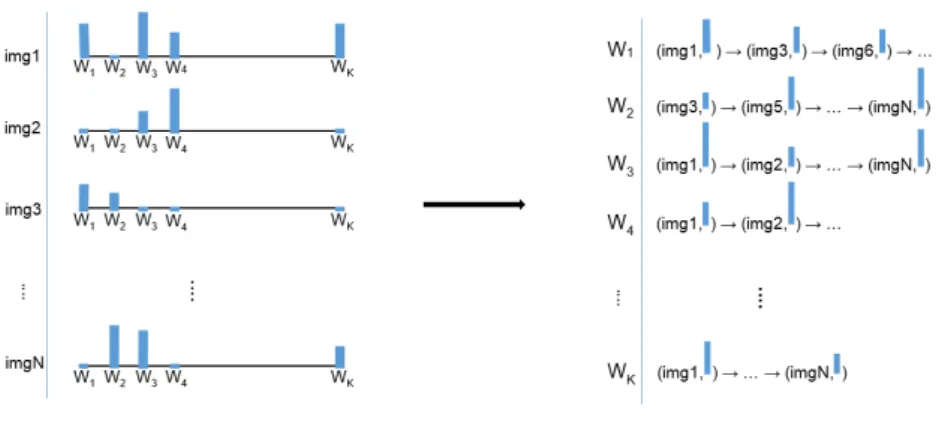
Inverse index is the well-known strategy in the field of text-based document retrieval, and has been used in practical search engines like Google and Bing. In CBIR, inverse index is adopted in several studies [128, 207, 133]. Unlike the traditional forward index whose index file contains a list of image ID mapping to the associated signatures, the inverse index method stores the mapping from image content, such as visual word. It maintains an inverted table with Klistings(K is the length of the image signature vectors). Each listing is a visual word ID mapped to a list of images having at least one occurrence of that visual word. At retrieving time, the query needs only to visit the listings associated with the visual words present in itsbagand ignore the rest. An image can be visited multiple times if it shares multiple visual words with the query, and the similarity score is accumulated for each visual word. This approach is beneficial as the inverted table can be built incrementally and unlike the tree method it does not require any knowledge of data distribution.
2.1.4
Query expansion and relevance feedback
Query expansion (QE) is a process of reformulating a search query to improve retrieval performance without the needs of interactive user input. Under QE, highly relevant images to the original query are selectively added as the new queries. An additional mechanism such as spatial verification could be added to avoid false positives in the query pool [27]; also a new query model could be derived from the new set of queries that further regularises the
query expansion process [75, 3]. QE could be run in an iterative fashion and proves efficient at boosting retrieval performance at the cost of computing time and resources.
Relevance feedback (RF) is a useful method to close the unavoidable semantic gap between human’s powerful contextual language with low level computer representation. Different people can interpret an image in different ways under different situations while a CBIR system for a particular application has only one representation of that image (since the image is static and processed under specific rules). Consequently, even a well-designed CBIR can fail to meet user’s requirements even if the query and the returned images have similar representations. In order to reduce the semantic gap, CBIR needs to also focus on user intention besides image visual properties. One solution is interactive feedback that allows a user to guide the system through a consecutive refining procedure.
For CBIR systems supporting multi-attribute searche.g. colour, shape, tags and images having separate signatures for each of these attributes, the user can control the weights of each attribute for their specific needs, as in QBIC [48]. However, a more generic and convenient relevance feedback system should let the user assess the results by just marking the returned images relevant or not. Based on few positive-negative examples marked by the user, the retrievals are updated accordingly. Early approaches chose to update the distance metric,e.g. add a weight matrixW to the L2 distance function(Q−D)TW(Q−D)and update it every feedback iteration by minimizing the distance between the query and the positive examples [173]. Alternatively, the update is applied to the spatial location of the query itself so that itmovestowards the positive examples and far away from the negative examples [164]. In other approaches, the bins of the image signatures are weighted differently and updated using
e.g. Bayesian belief network [196]. Recent methods tend to use kernel models like Support Vector Machine (SVM) to give preference weights to relevant images based on their distances to the separating hyper-plane [67, 170].
Both query expansion and relevance feedback are not studied within the scope of this thesis.
2.1.5
CBIR applications
CBIR is an active research area and has demonstrated significant success in recent years. A number of CBIR systems are now available either for demonstration or business-ready commercial packages.
Chabot [122] is one of the pioneering CBIR applications for demonstration. Chabot combines text-based descriptions with colour histograms for image search; and visual queries are somewhat limitede.g. users can only specify “some green” or “mostly red”. Photobook [125] and its successor FourEyes [118] support shape, texture and human face features (via
Eigen decomposition) and also relevance feedback. Another application is VisualSEEk [160] (also WebSEEk, MetaSEEk and VideoQ from the same developers) that offers searching objects by colour, shape and location along with keywords. These applications are mainly created and maintained by academic institutions as demos for newly developed CBIR algorithms.
Commercial search engines have long been using traditional QKW but many are turning to CBIR as a secondary search method. QBIC [48] is probably the first commercial CBIR system, allowing users to search by providing keywords, an example image or even a free-hand sketch. Virage [7] lets users define their own search primitives which can be colour, shape, texture or their combinations. Relevance feedback and sketch queries are also supported in the app’s user interface. Microsoft built a scalable CBIR system, named Arista [189], using low level visual features for similar- and duplicate-search within 2 billion images. Ebay reportedly employs a deep CBIR system based on ResNet-50 for its visual search service [198]. Pinterest uses AlexNet fc6 and VGG fc8 deep features along with CIELAB saliency colour features as descriptors [83]. Other popular search services e.g. Google, Bing and TinEye also integrate QVE although the detailed methods are not fully disclosed.
2.2
Sketch based image retrieval
As a sub-field of CBIR, SBIR inherits every CBIR problem. However it is unwise to apply pure CBIR solutions to a SBIR task. Unlike CBIR, SBIR is a cross-domain matching problem with sketch and image being two visually distinct domains. Also sketch is so sparse that traditional image features often need to be tweaked to accommodate sketched input. In this section we review the development history of SBIR descriptors followed by the problem of real time retrieval in SBIR. An overview of multi-modality in SBIR is also discussed.
2.2.1
SBIR descriptors: from model fitting to deep learning
Shallow features
The earliest SBIR studies dated back in the 90s with the work of Katoet al. [85] and Bimbo and Pala [12]. Katoet al. studied cross-correlation between neighbour patches in sketches and image edgemaps. Bimbo and Pala used elastic matching to fit the sketched query to a candidate image minimising deformation energy. The energy required to fit the sketch to image is then used as the ranking score. These approaches, to some extent, can compensate
human imprecision when drawing sketch. However, model fitting must be computedon the flyso it is not desirable for real time SBIR.
Several approaches work on blob-based sketches – a type of drawing that describes objects via coarse attributes of colour, texture and shape usinge.g. paint brush (see Fig. 3.1 (a) in Chapter. 3 for examples of this sketch type). As blob-based sketches look similar to photo images, the same image descriptors can be used on sketches. Jacobet al. [77] used Haar wavelet decomposition, keeping only the average colour together with sign and indices of few largest Haar coefficients. TheQBICsystem [48] utilises global colour histogram to extract colour, moment for shape, and coarseness and contrast for texture description. The
VisualSEEksearch engine [160] encodes colour sets together with size and location of the blobs as well as their spatial distances, then performs exhaust search to find the best matched image. InDrawSearch[36], colour is averaged on a 4x4 grid and shape is extracted using Fourier descriptor. DrawSearchalso supports relevant feedback by iteratively updating the query’s signature close towards the positive examples in the feature space.
Major SBIR studies were dedicated to line-art sketches (see Fig. 3.1 (b,c) for examples of this type). To deal with the cross-domain problem, early approaches chose to extract edgemaps from photo images then match against sketches assuming a unified domain between them. Extensive research has been focused on extracting structural information from sketches and edgemaps. Matusiaket al. [111] applied Curvature Scale Space (CSS) to describe object contour. CSS is affine invariant and can be applied in real time system, however it assumes that the image is already segmented and represented by its contour. Rajendranet al. [136] also achieved affine invariance by performing multi-scale decomposition on the strongest edges before extracting curvature direction histogram from it. These approaches both use global descriptors which are not robust against spatial deformation, commonly found in sketches.
Following the introduction of the MPEG-7 standards, Edge Histogram Descriptor (EHD) and its variants were quickly adopted in SBIR. Under EHD-related methods, images are gridded and features are extracted from individual cells and concatenated to form a global descriptor. Eitzet al. [41] expresses each cell as a single unit vector with dominant orientation using structure tensors. Chalechaleet al. [22] grids the images into angular partitions and collects 1-D discrete Fourier Transform of the polar edge points in every partition, thus able to achieve affine invariance.
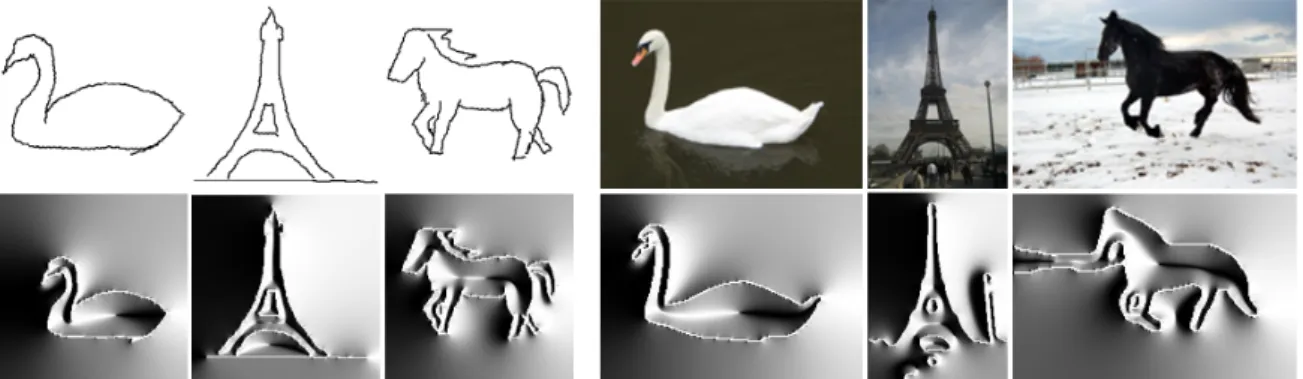
Following the success of BoVW framework for photographic search in the mid-2000s, BoVW was first extended to SBIR by Huet al. [71]. Huet al. [71, 72] extrapolates edge orientations from strokes to produce a dense gradient field, computing multi-scale HoG descriptors (GF-HOG) local to strokes that is later quantised within a hard-assignment