Challenges for Quality of Service (QoS) in
Wireless Sensor Networks
RAJSHREE S. DUBEY1,
Rajiv Gandhi Proudyogiki Vishwavidyalaya Sagar Institute of Research & Technology-Excellence
Assistant Prof., Dept. of CSE, Bhopal- 462041, India [email protected],
RAJNISH CHOUBEY2 ,
Rajiv Gandhi Proudyogiki Vishwavidyalaya Thakral College of Technology
Assistant Prof., Dept. of CSE, Bhopal- 462021, India [email protected]
AMIT DUBEY3
Rajiv Gandhi Proudyogiki Vishwavidyalaya Thakral College of Technology
Assistant Prof., Dept. of CSE, Bhopal- 462021, India [email protected]
Abstract- A wireless sensor network is a special network with large numbers of nodes consisting embedded processors,
sensors, and radios. These nodes cooperate to achieve a common goal or perform a common task such as environment monitoring or asset tracking. A lot of research has been done in the area of routing techniques and power consumption in sensor network but real-time communication with the Quality of Service (QoS) concept in wireless sensor networks is still unexplored. Most protocols either ignore real time or simply attempt to process as fast as possible. QoS in wireless sensor networks can be characterized by reliability, timeliness, robustness, availability, and security between all others. Recently, the design of sensor networks has become very important, due to several civil and military applications. Emerging sensor applications include habitat monitoring, pollution detection, weather forecasting, and monitoring disasters such as earthquakes, fires, and floods. In these new areas, similar to normal IP networks, there is real-time and non-real-time traffic in the sensor networks. Each type of traffic requires a different treatment from the network to meet the objective QoS (Quality of Service). Queuing and scheduling have a direct impact on QoS characteristics. Many excellent protocols have already been developed for ad-hoc networks but providing QoS guarantees for real time traffic in sensor networks are still very immature.
Keywords: QoS, 3GPP, GSM, Routing, Queuing.
1. Introduction
monitored, such as by dropping them from an aircraft. The self-organization feature of sensor networks includes both communications self-organization and positioning self-organization [7]. In this manner, a large number of sensor nodes are spread over the environment, without having prior information about the placement of each individual sensor [12]. Sensor nodes have a short transmission range due to their limited radio capabilities. Therefore, the data must be relayed using intermediate nodes towards the sink. In addition, it may be advantageous to use a multi-hop path, consisting of shorter links rather than a single long connection, to the sink node. The area of sensor network quality of service (QoS) remains largely open. This is a rich area for research, because sensor deaths and sensor replenishments make it difficult to specify the optimum number of sensors that should be sending information at any given time [15]. The available energy of the sensor nodes is the most critical resource in the sensor network. The limitation of the energy source is the battery, but this is the only source of power for the nodes, which can supply the sensor with energy. The sensors cannot operate with exhausted batteries. Moreover, since sensor nodes behave as relay nodes for data propagation of other sensors to sink nodes, network connectivity decreases gradually. This may result in disconnected sub-networks of sensors. Therefore, the level of power consumption must be considered at each stage of a wireless sensor network’s design. Future military applications will increasingly feature communication scenarios involving a data-gathering or intelligence-gathering wireless sensor network. Several survey papers are presented with intense background research on sensor networks [17, 18, 19].
2.Challenges and Role of QoS in wireless sensor networks
Several protocols and algorithms have been proposed for routing QoS in wire based networks [23-24]. However, they cannot be directly applied to wireless networks due to the inherent characteristics that distinguish the two types of networks [13]. In addition, the nature of sensor networks poses unique challenges compared to general wireless networks and, thus, requires special attention. The type of target application can play an important role for QoS in wireless sensor networks. QoS in wireless sensor networks can be characterized by reliability, timeliness, robustness, availability, and security between all others [1]. The throughput, delay, jitter, and packet loss rate are the most fundamental parameters [10, 2] and may be used to measure the degree of satisfaction of these services. 3. Related Work
Communication systems have been studied as a network of queues over the past years. H. Takagi introduced a standard notation for classifying queuing systems into different types [29]. Systems are described by the notation- Distribution of inter-arrival times of customers (packets), Distribution of service times, Number of Servers, Maximum total number of customers (packets) that can be accommodated in the system, calling population size. The 3rd Generation Partnership Project (3GPP) develops specifications for a 3G system based on the UTRA (Universal Terrestrial Radio Access) radio interface and the enhanced GSM core network [6, 5]. The main objectives are to provide GSM with higher bit-rates, add different QoS classes for packet data, and contribute simultaneous usage of both circuit- and packet-switched services. The Universal Mobile Telecommunications System (UMTS) is envisioned as the successor to the Global System for Mobile Communications (GSM). UMTS signals the move into the third generation (3G) of mobile networks. UMTS also addresses the growing demand of mobile and Internet applications for new capacity in the overcrowded mobile communications sky. This new network increases transmission speed to 2 Mbps per mobile user and establishes a global roaming standard [16]. The basic polling model is a queuing model composed of a set of queues and a single server that serves the queues in cyclical order [25]. Polling models have been used in a variety of contexts since the 1960s. The advent of computer communication networks and digital communication opened up new applications for polling models. For example, over the last two decades, polling models have been studied extensively to analyse the performance of Local Area Networks (LANs) employing different forms of token passing [27].
4. Multiple Classes of Traffic and Support
Different types of queuing tools, such as Priority Queuing (PQ), Custom Queuing (CQ) [3], Weighted Fair Queuing (WFQ), Class-Based Weighted FairQueuing (CBWFQ) [4] and Low Latency Queuing (LLQ), have been developed to provide different services to heterogeneous traffic classes [11]. The communication between sensor nodes in a sensor network that builds a cluster depends on a number of factors, such as communication range, number and type of sensors, and geographical location. The efficiency of the network itself depends on the sink location, which directly affects the lifetime of the sensor network. Every cluster has a sink node that is responsible for managing the sensors in the cluster. However, the sensors within a cluster communicate with the sink via short-range wireless communication links, as illustrated in Figure. The sensor nodes need elegant and uncomplicated queuing techniques, since they usually work as small routers. The implementation of Priority Queuing (PQ) in a sensor node. The M/G/1 queuing system is exploited to calculate the queuing delay for two different kinds of traffic in a sensor node. The existence of heterogeneous sets of sensors creates challenges for multiple traffic QoS support. For example, several applications may require a diverse combination of sensors for monitoring temperature, pressure, and humidity of the surrounding environment; detecting motion via sound signatures; and capturing the images of moving objects.
Figure: Multi-link clustered network sensors
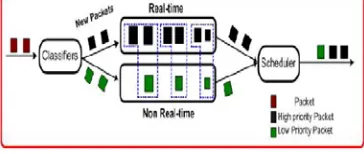
To overcome the limitations of the FIFO queuing discipline, Priority Queuing (PQ) is suggested as one of the applicable solutions to meet the desired QoS for real-time traffic. In this work, two queues in a sensor node are considered: high-priority and low-prior here, the scheduler uses strict priority logic. That is, it always serves the high-priority queue first. If there is no packet waiting in the high-priority queue, it will serve the low-priority queue. In this technique, the scheduler of the sensor node is serving different output queues, simultaneously and, hence, is behaving similarly to a multiple-queue/single server system.
5. Guaranteed QOS through Limited Service Polling Models
Micro electro-mechanical systems (MEMS), digital electronics, and wireless communication have enabled the development of a new generation of large-scale sensor networks, in which small nodes communicate with each other over short distances with low-power consumption. These networks are suitable for a wide range of applications [22-21, 20].Recently; the design of sensor networks has become more important, due to several civil and military applications. Emerging sensor applications include habitat monitoring, pollution detection, weather forecasting, and monitoring disasters such as earthquakes, fires, and floods. Just like a normal IP network, a wireless sensor networks also has real-time and non-real-time applications, each requiring a different kind of treatment from the network in terms of QoS. The communication between sensor nodes in a sensor network that builds a cluster depends on a number of factors, such as communication range, number and type of sensors, and geographic location. The efficiency of the network itself depends on the sink location, which directly affects the lifetime of the sensor network. Every cluster has a sink node that is responsible for managing the sensors in the cluster. The sensors within a cluster communicate with the sink via short-range wireless communication. The sensor nodes need elegant and uncomplicated queuing techniques, as they usually work as small routers. In many applications, sensor data must be delivered with time constraints to make appropriate real-time actions possible [9].
6. Polling Models
Over the last two decades, the polling model has been studied extensively to analyse the performance of Local Area Networks (LANs) employing different forms of token passing [21, 27]. The basic polling model is a queuing model composed of a set of queues and a single server that serves the queues in a cyclical order [26]. The exact details of the systems are beyond the scope of this paper. Instead, readers are referred to [28] for a detailed discussion of polling systems. This paper briefly explains only the limited-service polling model, because it is related to our system. In the limited-service system, a queue is served until either:
- The buffer is emptied, or
-A specified number of packets are served, whichever occurs first. If, at most, k packets are served in one cycle, it is referred to as a k-limited polling model.
The case in which k = 1 results in a simpler model, referred to as a 1-limited polling model, in which the server serves one packet from each queue in an alternating fashion during each cycle.
Figure : k-limited polling model in a sensor node
7. Constraints in Designing Multiple Level Stateless Protocol
In flat routing, all routes have equal responsibility for maintaining the routing information. Routing algorithms in this category can be further classified into three groups: (1) Proactive, (2) Reactive, and (3) Geographical [14]. 8. Conclusion
Wireless Sensor Networks can be assumed as distributed computing platforms with many severe constraints, including limited CPU speed, small memory size, low power constraints, and narrow bandwidth. Transmission of data in Wireless Sensor Networks with imaging and video sensors, requires both energy- and QoS-aware network management in order to ensure efficient usage of the sensor resources and effective access to the gathered measurements.
Wireless Sensor Networks have applications include habitat monitoring, pollution detection, weather forecasting, and monitoring disasters such as earthquakes, fires, and floods. Just like a normal IP network, a wireless sensor networks also has real-time and non-real-time applications, each requiring a different kind of treatment from the network in terms of QoS. Queuing and scheduling have a direct impact on QoS characteristics different types of queuing tools, such as Priority Queuing (PQ), Custom Queuing (CQ), Weighted Fair Queuing (WFQ), Class-Based Weighted Fair Queuing (CBWFQ) and Low Latency Queuing (LLQ), have been developed to provide different services to heterogeneous traffic classes.
Reference
[1] F. Xia, "Review: QoS Challenges and Opportunities in Wireless Sensor/Actuator Networks " Sensors, vol. 8, pp. 1099-1110 21 February 2008.
[2] Y. J. Li, C. S. Chen, Y.-Q. Song, and Z. Wang, "Real-time QoS support in wireless sensor networks: a survey," in 7th IFAC Int Conf on Fieldbuses & Networks in Industrial & Embedded Systems (FeT'07), Toulouse, France, Nov. 2007
[3] Aalsalem, M. Y., Zomaya, A., Iftikhar, M., and Taheri, J., “A QoS framework for wireless sensor networks,” Journal of IEEE Transactions on Mobile Computing, 2008.
[4] "CBWFQ(CiscoIOSSoftwareRelease12.0.5T),"inhttp://www.cisco.com/univercd/cc/td/doc/product/software/ios120/120newft/120t/120t5/cb wfq.htm, March, 2005.
[5] 3GPP, "www.3GPP.org," 2005.
[6] Nokia, "A History of Third Generation Mobile 3G , www.nokia.com," 2004.
[7] D. Niculescu, "Positioning in ad hoc sensor networks," IEEE Network, vol. 18 (4), pp. 24-29, 2004.
[8] F. Zhao and L. J. Guibas, Wireless sensor networks : an information processing approach. Amsterdam ; San Francisco: Morgan Kaufmann, 2004.
[9] J. A. Stankovic, "Research Challenges for Wireless Sensor Networks," SIGBED Review: Special Issue on Embedded Sensor Networks and Wireless Computing, 1(2), July 2004.
[10] El-Gendy, M. A. Bose, A. Shin, and K. G, "Evolution of the Internet QoS and support for soft real-time applications," the IEEE, vol. 91, pp. 1086- 1104, 2003.
[11] "LLQ (Cisco IOS Software Release 12.0.7T),"
http://www.cisco.com/univercd/cc/td/doc/product/software/ios120/120newft/120t/120t7/pqcbwfq.htm, Ed., Jan, 2003.
[12] Yuen, W. H., and C. W. Sung, "On Energy Efficiency and Netowk Connectivity of Mobile Ad Hoc Network," in 23rd International Conference on Distributed Computing System (ICDCS 2003), Providence, Rhode Island, USA, May 2003.
[13] Y. Ge and J. Hou, "An analytical model for service differentiation in IEEE 802.11," in ICC '03, 2003.
[14] J. Stankovic, T. Abdelzaher, L. Chenyang, L. Sha, and J. C. Hou, "Real Time Communication and Coordination in Embedded Sensor Networks," IEEE, vol. 91 No.7, July 2003.
[15] R. Iyer and L. Kleinrock, "QoS Control For Sensor Networks," in Communication, 2003 ICC03, IEEE Intrnational, Los Angeles, 11-15 May 2003, pp. 517-521.
[16] Mobile Streams, "www.mobilegprs.com," Newbury, Berkshire, ENGLAND, 2002.
[17] I. F. Akyildiz, W. Su, Y. Sankarasubramaiam, and E. Cayirci, "Wireless Sensor Networks: a Survey," ELSEVIER Computer Networks, vol. 38, pp. 393-422, 2002.
[18] I. F. Akyildiz, W. Su, Y. Sankarasubramaiam, and E. Cayirci, "A Survey on Sensor Networks," in IEEE Communication Magazine. vol. 40, no 8, August 2002, pp. 102-114.
[19] K. Krauter, R. Buyya, and M. Maheswaran, "A Taxonomy and Survey of Grid Resource Management Systems for distributed Computing,"
International Journal of Software: Practice and Experience (SPE), Wiley Press, New York, USA, May 2002
[20] G. J. Pottie and W. J. Kaiser, "Wireless Integrated Network Sensors," Communication of the ACM, vol. 43, pp. 51-58, May 2000. [21] Aalsalem, M. Y., Iftikhar, M., Taheri, J., and Zomaya, A., “On the provisioning of guaranteed QoS in wireless sensor network through
limited service polling models” in proc. of IEEE WOCN 2008.
[22] Kahn, J. M., R. H. Katz, and K. S. J. Pister, "Next Century Challenges: Mobile Networking for Smart Dust," in Proceedings of the Fifth Annual ACM/IEEE International Conference on Mobile Computing and Networking (MOBICOM '99), Seattle , Washington , USA, August 1999, pp. 271-278.
[23] Z. Wang and J. Crowcraft, "QoS-based Routing for Supporting Resource Reservation," IEEE Journal on Selected Area of Communications,
Sept 1996.
[24] Q. Ma and P. Steenkiste, "Quality-of-Service routing with Performance Guarantees," in Proc. of the 4th IFIP Workshop on Quality of Service, May 1997.
[26] J. A. Weststrate, "Analysis and Optimization of Polling Models," PhD Thesis, Feb. 1992.
[27] W. P. Gronenenkijk, "Conservation Lawsin Polling Systems," PhD Thesis,University of Utrecht, 1990.
[28] O. J. Boxma and B. W. Meister, "Waiting-Time Approximations in Multi-Queue System with Cyclic Service," Performance Evaluation 7,
pp. 59-70, 1987.