e-ISSN: 2348-6465
Original Article
Formulation and Evaluation of Domperidone Fast Dissolving
Film by Using Different Polymers
Sarita Rana*, L. Raju, Vinay Dhatwalia,Virendra Yadav
Vinayaka College of Pharmacy, Kullu, Himachal Pradesh, India
A R T I C L E I N F O A B S T R A C T
_______________________________________________________________________________
1. INTRODUCTION
Oral films disintegrate rapidly within seconds when it
comes in contact with saliva without the need of water.
Oral fast dissolving films are useful for the geriatric
and paediatric patients and also for the patients
suffering from emesis, diarrhoea, allergic attacks,
cough, mental disorder, bedridden patients etc. Oral
films are also used for local effects like local
anaesthetics for oral ulcers, toothaches, cold scars and
teething.1
International Journal of Pharma Research and Health Sciences
Available online atwww.pharmahealthsciences.net
Received: 12 Sept 2014
Accepted: 20 Oct 2014 The present study deals with the investigation carried out on developing a fast dissolving delivery system releasing Domperidone concomitantly in stomach for treating vomiting and motion sickness. Domperidone FDOF was prepared by solvent casting principle. Different concentration of film forming polymer i.e. Domperidone with and without solubilising agent tween 80 was used to formulate FD of Domperidone. The films formulated by incorporating a solubilising agent i.e. tween 80 had better. Korsmeyer-peppas model was found to be best fit kinetic in which all formulation showed good linearity (R2: 0.906 to 0.989), with slope (n) values ranging from 0.655 to 0.981.In Korsmeyer-Peppas model, ‘n’ is the release exponent indicative of mechanism of drug release. The ‘n’ values ranged from 0.5-1.0 indicate Anomalous transport (non-fickian) diffusion where drug release is both diffusion and swelling controlled.
Key Point:FDOF, Korsmeyer-Peppas Model, Polymers, Solublising Agent.
Corresponding author *
Sarita Rana, Vinayaka College of Pharmacy, Kullu, Himachal Pradesh, India. E mail: [email protected]
www.pharmahealthsciences.net
1.1 Fast dissolving films
However, the fear of taking solid tablets and the risk of
choking for certain patient population still exist despite
their short dissolution/disintegration time. Recent
development in novel drug delivery system aims to
enhance safety and efficacy of drug molecules by
formulating a convenient dosage form for
administration. One such approach is rapidly
dissolving film. It consists of a very thin oral strip,
which releases the active ingredient immediately after
uptake into the oral cavity. Rapid film combines all the
advantages of tablets (precise dosage, easy application)
with those of liquid dosage forms (easy swallowing,
rapid bioavailability). The delivery system is simply
placed on a patient’s tongue or any oral mucosal tissue.
Instantly wet by saliva, the film rapidly hydrates and
dissolves to release the medication for oromucosal
absorption.2, 3
Salient features of melt in mouth films
The drug to be incorporated should have low dose
up to 40 mg.
The drugs with smaller and moderate molecular weight are preferable.
The drug should have good stability and solubility in water as well as in saliva.
It should be partially unionized at the pH of oral cavity.
Not require water to swallow, but it should dissolve or disintegrate in the mouth in matter of
seconds.
Advantages of fast dissolving film
Oral dissolving films can be administered without water, anywhere, any time.
Due to the presence of larger surface area, films provide rapid disintegrating and dissolution in the
oral cavity.
Oral dissolving films are flexible and portable in nature so they provide ease in transportation.
Suitability for geriatric and pediatric patients, who experience difficulties in swallowing mentally ill,
the developmentally disable and the patients who
are un-cooperative, or are on reduced liquid intake
plans or are nauseated.
Beneficial in cases such as motion sickness, acute pain, suede episodes of allergic attack or coughing,
where an ultra rapid onset of action required.
Stability for longer duration of time, since the drug remains in solid dosage form till it is consumed.
So, it combines advantage of solid dosage form in
terms of stability and liquid dosage form in terms
of bioavailability.
The sublingual and buccal delivery of a drug via thin film has the potential to improve the onset of
action, lower the dosing, and enhance the efficacy
and safety profile of the medicament.
2. MATERIAL AND METHODS
Domperidone, Hydroxy propyl methyl cellulose, PEG
4000, Tween 80, Methanol, Glycerine these were
gifted by respective industries such as Morpan Pharma,
and Loba Chemicals Mumbai. Sonicator used for
mixing of polymers and drug. All the formulations of
Domperidone FDOF displayed optimum folding
endurance above 100 folds, which indicate the
formulation prepared can withstand sufficient rough
handling during transportation and handling of the
formulation. The folding endurance was measured
manually, films were folded 125 times maximum in
Formulation F4 and if the film shows any cracks it was
taken as end point. The folding endurance was better in
F4 formulations.
2.1 Dissolving Time
The disintegration test performed using Petridis
method reviled that F7 disintegrated faster in 10 sec
whereas F4 disintegrated in 18 sec. The formulation
F5, F6 and F8 disintegrated in 13, 12 and 14 sec
respectively. Formulation F1, F2 and F3 disintegrated
in 15, 16 and 17 sec respectively.4, 5
Table 1: Dissolving Time
Formulation code Time (Sec)
F1 15±3.51
F2 16±3.06
F3 17±3.16
F4 18±3.61
F5 13±2.51
F6 12±3.06
F7 10±2.53
F8 14±3.17
2.2 Drug content Estimation
The drug content of Domperidone FDOF showed that
all the formulations were containing Domperidone in
the range of 89.37 to 98.09%.
Table 2: Drug content Estimation
Formulation code %drug content in 2.5 × 2.5 cm
F1 89.37±0.962
F2 97.06±1.272
F3 93.78±1.442
F4 95.91±0.481
F5 90.89±1.733
F6 97.54±0.481
F7 92.56±0.470
F8 98.09±1.721
Fig 2: Drug content estimation study of formulated batches
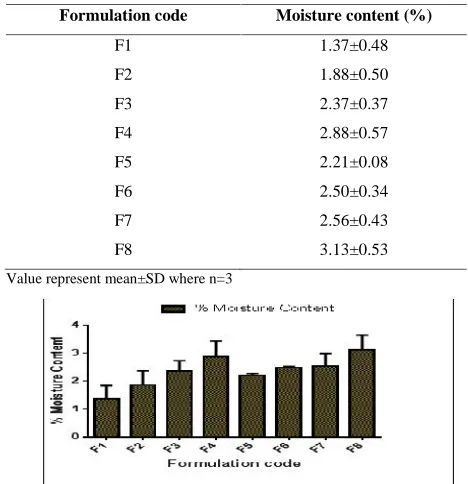
2.3 Moisture content
Moisture loss is defined as the quantity of moisture
transmitted through unit area of film in unit time. The
moisture content study gives an idea about films
stability nature and ability of films to withstand its
physicochemical properties under normal conditions.It
also gives idea about hydrophilicity of film
formulations. The obtained values are almost uniform
and ranges from 1.37±0.48% to 3.13±0.53%. F8
formulation showed high % moisture content while F1
and F2 formulations showed low % moisture content
.Higher concentration of Polymers in F8 may be the
reason for higher percentage of moisture content.6, 7
Table 3: Moisture content estimation
Formulation code Moisture content (%)
F1 1.37±0.48
F2 1.88±0.50
F3 2.37±0.37
F4 2.88±0.57
F5 2.21±0.08
F6 2.50±0.34
F7 2.56±0.43
F8 3.13±0.53
Value represent mean±SD where n=3
Fig 3: Moisture content study of formulated batches
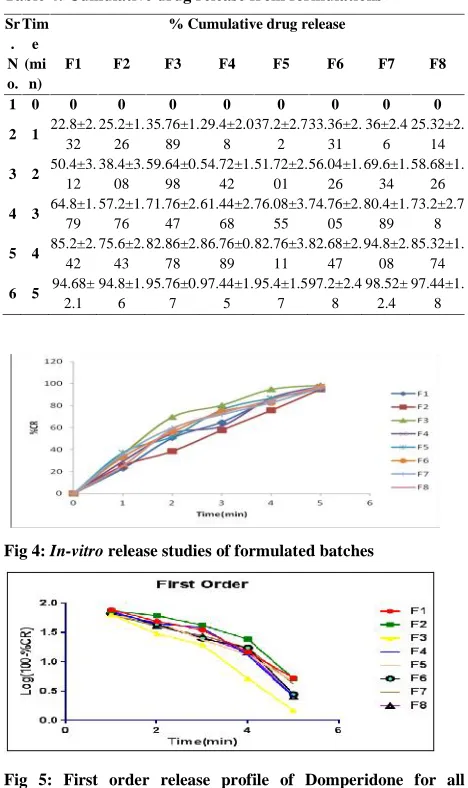
2.4 In-vitro release study
The dissolution studies were conducted using
phosphate buffer pH 6.8.Each film strip (containing
drug equivalent to 5 mg) was then submerged into the
dissolution medium. The dissolution study was carried
out using dissolution test apparatus USP type-II at
37˚C, at 50 rpm, using 900 ml phosphate buffer (pH
6.8) as dissolution medium. Test samples were
spectrophotometrically at 284 nm. The absorbance
values were transformed into concentration using
standard graphic. In vitro drug dissolution study of the
Domperidone film was conducted in phosphate buffer
6.8 solution.The rate and extent of drug release from
the dissolving film was found to be of the order F1<
F2< F5<F3<F4< F6< F8<F7. The drug release was
found to be slower in formulations with increasing
polymers concentration. The Batch F1 showed 94.68 %
drug release within 5 min in phosphate buffer 6.8.
Batch F1 showed minimum 94.68 % drug release
within 5 min and F7 showed maximum drug release
within 5min.F7 showed maximum 98.52 % drug
release within 5 min.8-10
Table 4: Cumulative drug release from formulations
Sr . N o. Tim e (mi n)
% Cumulative drug release
F1 F2 F3 F4 F5 F6 F7 F8
1 0 0 0 0 0 0 0 0 0
2 1 22.8±2. 32 25.2±1. 26 35.76±1. 89 29.4±2.0 8 37.2±2.7 2 33.36±2. 31 36±2.4 6 25.32±2. 14
3 2 50.4±3. 12 38.4±3. 08 59.64±0. 98 54.72±1. 42 51.72±2. 01 56.04±1. 26 69.6±1. 34 58.68±1. 26
4 3 64.8±1. 79 57.2±1. 76 71.76±2. 47 61.44±2. 68 76.08±3. 55 74.76±2. 05 80.4±1. 89 73.2±2.7 8
5 4 85.2±2. 42 75.6±2. 43 82.86±2. 78 86.76±0. 89 82.76±3. 11 82.68±2. 47 94.8±2. 08 85.32±1. 74
6 5 94.68± 2.1 94.8±1. 6 95.76±0. 7 97.44±1. 5 95.4±1.5 7 97.2±2.4 8 98.52± 2.4 97.44±1. 8
Fig 4: In-vitro release studies of formulated batches
Fig 5: First order release profile of Domperidone for all formulations
Fig 6: Higuchi release profile of Domperidone for all formulations
3. DISCUSSION
All the formulations are found to be in acceptable
physical and dissolving properties. The shape, size,
buoyancy, tensile strength, percent elongation and
in-vitro release of batch F7 had good characteristics of an
ideal dissolving formulation. Also the cumulative drug
release of batch F7 was found to have good release
characteristics with 36 % at 1 min and release upto
98.5 % in 5 min & also be concluded that presence of
tween 80 increases the rapid release of Domperidone.
Hence selected as an optimized formulation and the
release kinetic graph.11-14
4. CONCLUSION
It can be concluded Domperidone FDOF with optimum
physical appearance, disintegration and drug release
can be formulated successfully by using HPMC
Glycerine as film forming agent and tween 80 as a
solubilising agent. Korsmeyer-peppas model was found
to be best fit kinetic in which all formulation showed
good linearity (R2: 0.906 to 0.989), with slope (n) values ranging from 0.655 to 0.981.In
Korsmeyer-Peppas model, ‘n’ is the release exponent indicative of
mechanism of drug release. The ‘n’ value ranged from
0.5-1.0 indicates Anomalous transport (non-fickian)
diffusion where drug release is both diffusion and
swelling controlled.
5. REFERENCES
1. Slowson M, Slowson S. What to do patients cannot
swallow their medications. Pharma times 1955,
2. Rani V. A brief review on oral film technology .Int
J Res Ayurveda & Pharma 2011; 2(4): 1138-1147.
3. Corniello C. quick dissolving strips: from concept
to commercialization. Drug Del technology 2006;
6(2): 68-71
4. Patel R, Prajapati S. Fast dissolving films as a
newer venture in fast dissolving dosage form Int J
of drug develop and Res 2010; 232-236
5. Karithikeyan M, Kumar SA, Fast dissolving drug
delivery system: A review Journal of global trend
in Pharmaceutical Sciences 2010; (1): 92-110
6. Kumar MV, Sethi P, Orally disintegrating tablets:
International journal of Pharmacy 2011:
2(4):16-22.
7. Arya A, Chandrai A, fast dissolving film : An
innovative drug delivery system and dosage form
.International Journal of Chem tech Research 2010;
2(1): 516-583
8. Dixit RP, Puthli SP, Oral strip technology:
overview an future potential Journal of controlled
release 2009; 139(2): 94-107
9. Dahiy, Meenu, Saha S. Review on mouth
dissolving film current drug delivery. Current Drug
Delivery 2009; 6(5): 469-476.
10. Malke M, Kadam VJ. Formulation and evaluation
of oxacarbazine fast dissolving tablets: Indian
Journal of Pharmaceutical Sciences 2007; 69(2):
211-214
11. Vyas SP, Khar AK, Controlled drug delivery
concepts Advances, New Delhi: Vallabh Prakashan
2002; 1: 157-160
12. Gandhi SD, Umbarkar R, Mucoadhesive drug
delivery system an usual for site specific drug
delivery system: International J pharm 2012; 4:
128-133
13. Peter A, Adam C.W. Transdermal granisetron
US7, 8, 08,282 B2 2009, 1-11
14. Ghosh Tk, Jasti BK, Theory and practice of
contemporary pharmaceutics Crc Press: 2005,