The effect of Organizational Commitment and Job Pressure to Job Performance through the Job Satisfaction in Employees Directorate transformation Technology Communication and Information Indonesia
Waluya Winarja
Student Master of Management Krisnadwipayana University Jakarta
Campus UNKRIS Jatiwaringin P.O.Box 7774/Jat CM. Jakarta 13077
Indonesia
Akhmad Sodikin
Lecturer
Faculty of Economics Krisnadwipayana University Jakarta
Campus UNKRIS Jatiwaringin P.O.Box 7774/Jat CM. Jakarta 13077
Indonesia
Djoko Setyo Widodo
Lecturer Faculty of Economics
Krisnadwipayana University Jakarta Campus UNKRIS Jatiwaringin P.O.Box 7774/Jat CM. Jakarta 13077
Indonesia
Abstract
This study aims to determine the effect of organizational commitment and the Job Pressure of the Job Performance partially determine the effect of organizational commitment the performance of employees through job satisfaction variables and determine the effect of work stress on job performance through job satisfaction. The study was conducted on the employees of the Directorate of transport and communications and information technology. The sampling technique using saturated samples involving 83 people. Analysis of data using path analysis.
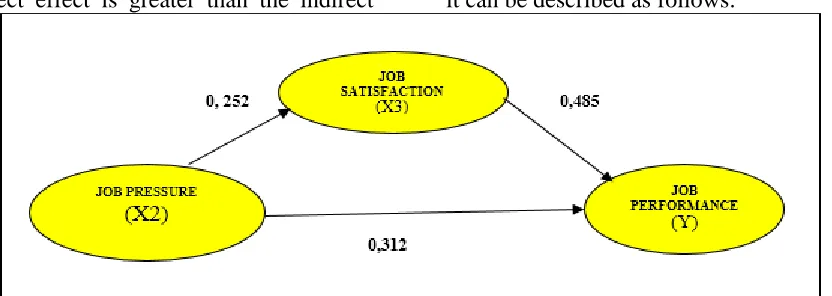
The results of this study variables organizational commitment and job stress affect the performance of employees simultaneously variables affect organizational commitment to Job Performance partially. Variable Job Pressure affects the performance of employees partially. Satisfaction variables affect the performance of employees in the organization's commitment to partial Job Performance. Influence is 0.558. The influence of the organization's commitment to Job Performance through Satisfaction is 0.390X0,485=0.189. In this case, the direct effect is greater than the indirect effect that variables satisfaction as an intervening variable. The direct effect of work stress on Job Performance is 0.365. While the Job Pressure effect on Job Performance through Job satisfaction is 0.252X0,485=0.122. In this case, the direct effect is greater than the indirect effect that variables satisfaction as an intervening variable.
Keywords: Organizational Commitment, Job Pressure, Job Satisfaction, Job Satisfaction 1. Introduction
Organizational commitment is needed for every employee who works in an organization. Organizational commitment to these employees can lead to high performance. Organizational
Organizational commitment expressed by the scale of organizational commitment. Aspects of the commitment expressed through the aspects raised Schultz and Schultz(2000), namely: "(1) acceptance of the values and goals of the organization (2) a willingness to strive for the organization and (3) have a desire to affiliate with the organization."
Job satisfaction is also an important thing in improving performance. Job satisfaction is related to the working conditions of employees in work whether she is expected to be fulfilled or not. If met, the employee can achieve satisfaction in work. Employees who gain satisfaction in work the employee will have a great motivation to work.
Research conducted by Syauta et al (2012) stated: "that affect organizational commitment to Job Performance." The research was conducted on a number of employees in Jayapura, Papua, Indonesia. Kotteeswari and Sharief (2012) "states that the Job Pressure on the performance of employees who work at the company." Other studies conducted by Zafar et al (2015). This research resulted in the conclusion that the work on the performance of employees. The research was done at a number of companies in the state of Pakistan.
2. Review of Literature
2.1 Job Performance
According Simamora(2003:45) performance is a "measure of the success of the organization in achieving its mission." While Shadily (1992:425), said the performance or performance is "useful achievements or results." Kumorotomo (1996) imposes limits on the concept of the performance of public organizations at least closely related to
efficiency, effectiveness, fairness, and
responsiveness. "
This means that performance is an act that can be seen, observed and it is possible to achieve the expected things (destinations). Performance can also be said to be a combination of ability, effort and opportunity can be judged from their work acquired during a specific time period.
To determine the size of the organization's performance appraisal performance. The performance assessment is the process of evaluating how well employees perform their jobs when compared to a
standard and then communicate this information to employees.
Based on the above understanding can be concluded that employees are people who work at a place that officially, have personal data and to have the force of law, Place the work in question is an organization, institution, or other entity associated with employee.
Work Assessment Methods
Gibson (1994:110) reveals some performance assessment method, comprising:
1. Method of Assessment Scale Graph The scale of assessment methods scale
chart that lists a number of
characteristics and range performance for each employee then assessed by identifying the score that best illustrates the level of performance for each trait.
2. Methods Behavioral Assessment Scale Behavior rating scale method is a method of assessment that aims to combine the benefits of critical incidents and an assessment based on the quantity to reach causality scale based on specific examples of good and bad performance.
3. Methods of Management by Objectives This method covers the determination of specific goals that can be measured with each employee and then periodically review the progress achieved.
The Elements of Job Performance
According Pasolong (2010:177) concluded that the employee's performance has several elements, namely:
1) The work accomplished individually or institutionally, meaning that performance is the final result obtained individually or groups.
2) In performing its duties, the person or institution is given the authority and responsibility, which means a person or institution, is given the right and power to act upon so that the work can be done well.
3) Work must be done legally, which means the individual or institution carrying out the task, of course, have to follow the rules that have been set.
4) Work is not contrary to morals or ethics, which means that in addition to following the rules that have been established, of course, the work must be in accordance morals and ethics generally accepted ".
Dimensions of Job Performance
According to Mathis (2002) as indicators in measuring Job Performance or achievements are as follows:
a. The quantity of work
b. Quality of work
c. Utilization of time.
d. Cooperation
2.2 Organizational Commitment
According Cherrington (2000) in Khikmah (2005)"organizational commitment as personal value, which is sometimes referred to as a gesture of loyalty to the company." Robbins (2003) "expressed the commitment of the organization is one of the attitudes that reflect feelings of like or dislike for the organization workplace."
According Mowday (1982) in Sopiah
(in2008)"The commitment to work as another term organizational commitment". Organizational commitment is an important behavioral dimension that can be used to assess the tendency of
employees to remain a member of the
organization.Organizational commitment is the identification and engagement of a person who is relatively strong against the organization. Organizational commitment is the desire of members of the organization to maintain their membership in the organization and is willing to strive for the achievement of organizational goals. According to Lincoln (2000) in Sopiah, (2008), "organizational commitment includes members pride, loyalty members, and the willingness of members of the organization."
Aspects of the commitment expressed through the aspects raised Schultz and Schultz(2000), namely: "(1) acceptance of the values and goals of the organization (2) a willingness to strive for the organization and (3) have a desire to affiliate with the organization."
Employee Commitment Factors in Organizations
According to David (1997th) in Sopiah,(2008:163) suggests four factors that influence employee commitment to the organization, namely:
1. Personal factors such as age, gender, level of education, work experience, personality, etc;
2. Characteristics of the job, such as the scope of the office, challenges, conflicts, the role, the level of difficulty in work, etc;
4.Structural characteristics, such as
large/small organization, forms of
organization(centralization/decentralization) , the presence of trade unions;
5.Work experience. Employee work
experience greatly affects the level of employee commitment to the organization. "
Dimensions of Organizational Commitment
Meyer and Allen (2000) suggest three components of organizational commitment:
a. Affective Commitment
b. Continuance Commitment
c. Normative Commitment
2.3 Job Pressure
Quick and Quick (1984) categorize the types of stress into two, namely:
1.Eustress, which is the result of the response to stress that is healthy, positive, and constructive (constructive). This includes the well-being of individuals and organizations associated with the growth, flexibility, adaptability, and a high level of performance.
2.Distress, which is the result of the response to stress is unhealthy, negative, and destructive. This includes individuals and
organizations consequences such as
cardiovascular disease and absenteeism is high, which is associated with sickness, decline, and death.
Causes of Job Stress
According to Robbins (2003), there are three things work stress-causing factors, namely:
1. Environmental Factors.
2. Factors organization
3. Individual Factors
Dimension Job Pressure
a. Changes in the environment: business, technology, terrorism.
b. Organizational factors: task, relationship, personal demands,
c. Individuals: family, economic, personal
2.4 Job Satisfaction
Job satisfaction by Martoyo(1992:115), "is basically one of the psychological aspects that reflects one's feelings toward his work, he will be satisfied with the fit between the capabilities, the skills, and expectations with the job he faces." Satisfaction is actually a state of nature is the result of a conclusion of a comparison of what is received by an employee from work, as it is worthy or entitled to it. While every employee is satisfactory.
According to Tiffin (1958) in As'ad (1995:104) "job satisfaction is closely related to the attitude of the employees toward his own work, the work situation, the cooperation between the leadership and employees". Meanwhile, according to Blum (1956) in As'ad (1995:104) "suggests that job satisfaction is the general attitude is the result of some special attitude toward factors work, adjustment and individual social relationships outside of work."
In the opinion of Robbins(2003:91), the term "satisfaction work refers to an individual's general attitude towards the work he does." A person with a high level of job satisfaction shows a positive attitude towards the work; someone who is not satisfied with his work shows a negative attitude to work it, because in general, when people talk attitude employees, more often they mean job satisfaction.
Hasibuan(2006:202)"job satisfaction is a pleasant emotional attitude and loves her job." This attitude is reflected by morale, discipline, and work performance. Job satisfaction in the job, off the job,
and the combination between the two.
Rival(2004:475) "which describes the evaluation of a person's satisfaction is a top feeling of happy or not satisfied with attitude to work". Meanwhile, according to Cherington(2010) "job satisfaction basically refers to how much an employee enjoys his work"
Theory of Job Satisfaction
The theory of job satisfaction has been quite well-known are:
1. Theory of Conformity (Discrepancy theory).
This theory measure job satisfaction difference between someone with something that should calculate the perceived reality. So if satisfaction got beyond what they want, then people will be more satisfied longer, so there disparity, but is a positive disparity. One's work satisfaction depends on the difference between something considered to be obtained by what was achieved.
2. Theory of Justice (Equity theory).
These theories suggest that people who will feel satisfied or dissatisfied, depending on whether or not the presence or absence of justice in the situation. Particularly the employment situation. According to this theory, the main component in the theory of justice is input, the result of justice and injustice. The inputs are a valuable factor for employees who are looking to support the work such as education, experience, process, the number of tasks and equipment used to perform the work. The result is something that is considered valuable by an employee who derived from his work as wage/salary, fringe benefits, symbol, status, awards and the opportunity to succeed or actualization himself. While people always compare someone in companies that may be the same, or elsewhere or can also with him in the past. According to this theory, every employee will compare other people input ratio results. If the comparison is considered fair, the employee will feel satisfied. If the comparison is not balanced but profitable bias leads to satisfaction, but can also be no. But if the comparison is not balanced there will be dissatisfaction.
3. The Theory of Two Factors.
opportunity for achievement, the opportunity to gain rewards and promotions.
4. Motivator-Hygiene Theory (MH)
One of the theories that explain the job satisfaction is the motivator-hygiene theory (MH) developed by Herzberg. HM theory actually leads to job satisfaction. However, research shows the positive relationship between job satisfaction and turnover of human resources and labor and commitment of human resources. In between the essence satisfaction, the theory HM is less agree with the provision of a high remuneration, such as golden handcuff strategy, because of the remuneration that high able to eliminate job dissatisfaction and be able to bring job satisfaction (fringe benefits are hygiene factors, not motivators).
Factors That Affect Job Satisfaction
Factors that influence job satisfaction can basically into two parts: extrinsic factors: factors derived from outside the self-employees include corporate policies, the physical condition of the working environment, interaction with other employees, the payroll system, and so on. Theoretical factors that can affect the work satisfaction are numerous, such as leadership styles, behavior, the locus of control fulfilling expectations payroll and work effectiveness.
Factors that are typically used to measure job satisfaction of an employee is: "(a) the content of the work, the appearance of an actual job duties and as control of work; (b) supervision; (c) organization and management; d) the opportunity to go forward; (e) the salaries and other financial advantages in the
fields of incentives; (f) co-workers; and (g) conditions of employment (Chruden & Sherman 1972: 312-313).”
According to Hasibuan (2004: 203) employees' job satisfaction is influenced by the following factors:
1. Remuneration decent and fair
2. Proper placement in accordance with the expertise
3. Heavy-light work
4. The atmosphere and the work environment.
Dimensions of Job Satisfaction
Nelson and Quick (2006) point out the dimensions of job satisfaction, including:
a. Salary b. Promotion c. Supervision d. Co-workers
3. Methodology
3.1 Research Design
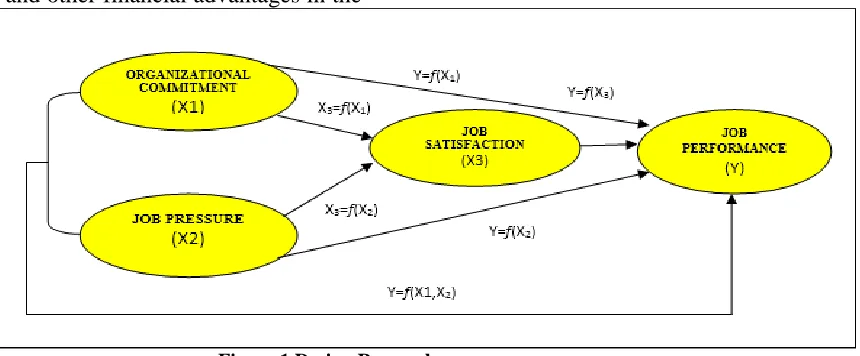
This study uses an explanatory analysis approach. This means that each of the variables presented in the hypothesis will be observed by testing the causal relationship of independent variables on the dependent variable. "Relationships between variables can be depicted in the diagrammatic form of path analysis (path analysis) as follows:
3.2 Population and Sample
The population is a "region of generalization which consists of object/subject that has the quantity and specific characteristics defined by the researchers to learn and then drawn conclusions (Sugiyono,2005)." The sample is "towing part of the population to represent the entire population (Surakhmad,2000 ). "
The sample used by the author in this study was employees of the company, the total number of employees 83 people. The number of employees fully involved in this study. So that this sampling method saturated samples.
3.3 Data Collection Techniques
To obtain a concrete and objective data that must be made a study of the problems examined, while the steps that researchers take in data collection are:
a. Primary data
Primary data is data obtained directly from the research object; In this case, primary data obtained from field research is the method of data collection does research premises directly on the object of study in question. "
b. secondary data
Secondary data is data that obtained indirectly from the object of research. In this case, the secondary data obtained from library research is the method of the collection of data is done by studying and understanding the books of literary works of the authors who can be responsible for the basic theory."
3.4 Data Processing Techniques
In order for research analysis produces the correct information because the data-the data received is still a raw material, then the data must be processed first. As there are two data processing techniques, among other things:
a. Validity test
Validity or validity indicates the extent to which a measuring instrument is able to measure what you want to be measured (a valid measure if it successfully measures the phenomenon) (Syofian,2013). In a study using the instrument in the form of a questionnaire, the validity of the test is used to see how much ability can find out respondents' answers questions.The higher level of validity of a measuring instrument, the more precise the measurement tool to measure well, how that can be used to search for the homogeneity of the measuring instrument is to correlate the measurement value to the total value. A questionnaire considered valid if the questions in the questionnaire were able to reveal something that will be measured by the questionnaire (Ghozali,2006).
b. Test Reliability
Reliability test is a tool to measure a questionnaire which is an indicator of variables or constructs. A questionnaire is said to be reliable or reliable if someone answers on the statement are consistent or stable over time. Reliability measurement is done by one shot or measurements once with SPSS statistical test Cronbach Alpha (α). A constructor a variable is said to be reliable if the value CronbachAlpha>0.60(Nunnally in Ghozali,2006).
4. Results and Discussion
4.1.1 Analysis of Organizational Commitment Variables
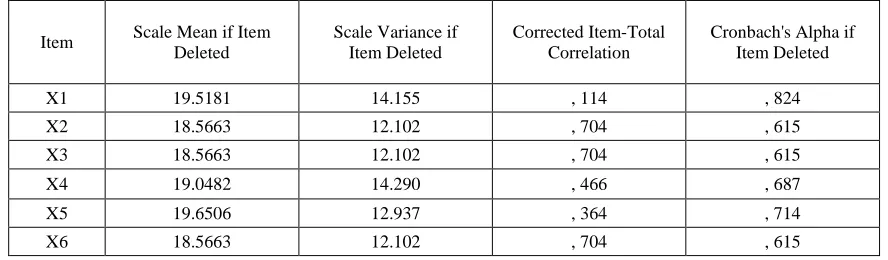
Variables include the organization's commitment 6 questions drawn from numbers 1 through 6. The question is then submitted to 83 employees. Before further analyzed the results of the questionnaire seen its validity and reliability. The validity of the test results can be seen in the following table.
Table 1. Commitments question the validity of the organization
Item Scale Mean if Item
Deleted
Scale Variance if Item Deleted
Corrected Item-Total Correlation
Cronbach's Alpha if Item Deleted
X1 19.5181 14.155 , 114 , 824
X2 18.5663 12.102 , 704 , 615
X3 18.5663 12.102 , 704 , 615
X4 19.0482 14.290 , 466 , 687
X5 19.6506 12.937 , 364 , 714
X6 18.5663 12.102 , 704 , 615
Based on table 1, it is known that the correlation between multiple items with a total greater than the value 0.2159. This value is taken from r table with the level df = 83-2 = 96. This means that all items are valid questions that can be used for further analysis.
Additional testing needs to be done to look at the quality of data are to perform reliability testing. The test is performed by comparing the value of Cronbach's alpha with a value of 0.6. If the Cronbach alpha values greater than 0.6, it can be said that the question to be reliable. Calculating Cronbach's alpha using SPSS version 21 with the following results .
Table 2. Results of the reliability of the organization's commitment question Cronbach's Alpha N of Items
, 721 6
Source: Primary Data Processed Year 2017
Based on Table 2, data it is known that the Cronbach Alpha value of 0.721. The value of greater than 0.6 so that it can be said that the question of organizational commitment variables is reliable.
4.1.2. Analysis of Variable Job Pressure
The variable Job Pressure includes five questions prepared from number 7 to 11. The question is then submitted to 83 employees. Before further analyzed the results of the questionnaire seen its validity and reliability. The validity of the test results can be seen in the following table.
Table 3. Results of the validity of the question in the variable Job Pressure
Item Scale Mean if Item Deleted
Scale Variance if Item Deleted
Corrected Item-Total Correlation
Cronbach's Alpha if Item
Deleted
X7 11.8675 10.897 , 420 , 603
X8 12.4217 8.052 , 575 , 395
X9 12.6024 11.779 , 439 , 634
X10 12.2410 10.356 , 471 , 579
X11 12.2651 8.319 , 571 , 403
Source: Primary Data Processed Year 2017 Based on the above table it is known that the
correlation between the items with a total greater than the value 0.2159. This value is taken from r table with the level df = 83-2 = 81. This means that all items are valid questions that can be used for further analysis.
Additional testing needs to be done to look at the quality of data is to perform reliability testing. The test is performed by comparing the value of Cronbach's alpha with a value of 0.6. If the Cronbach alpha values greater than 0.6, it can be said that the question to be reliable. Calculating Cronbach's alpha using SPSS version 21 with the following results.
Table. 4. The result of the calculation work stress variables Cronbach Alpha Cronbach's Alpha N of Items
, 692 5
Source: Primary Data Processed Year 2017
Based on the above data it is known that Cronbach Alpha value of 0.692. the value is greater than 0, 6 so that it can be said that the question of job stress variables is reliable.
4.1.3. Analysis of Variable Satisfaction Results
Satisfaction Variables include 6 questions drawn from number 12 to 17. The question is then submitted to 83 employees. Before further analyzed
the results of the questionnaire seen its validity and reliability. The validity of the test results can be seen in the following table.
Table 5. Results of the validity of the question in the variable Satisfaction
Item Scale Mean if Item Deleted
Scale Variance if Item Deleted
Corrected Item-Total Correlation
Cronbach's Alpha if Item
Deleted
X12 16.1325 14.433 , 593 , 558
X13 16.2530 11.411 , 554 , 378
X14 16.0120 11.695 , 565 , 375
X15 16.2048 8.799 , 605 , 537
X16 16.3133 13.267 , 507 , 519
X17 16.3133 10.096 , 371 , 599
Source: Primary Data Processed Year 2017
Based on the above table it is known that the correlation between multiple items with a total greater than the value 0.2159. This value is taken from r table with the level df = 83-2 = 81. This means that all items are valid questions that can be used for further analysis.
Table 6. Results of calculation variables Cronbach Alpha Job Satisfaction
Cronbach's Alpha N of Items
, 644 6
Source: Primary Data Processed Year 2017 Based on the above data it is known that Cronbach
Alpha value of 0.644. The value of greater than 0.6 so that it can be said that the question of organizational commitment variables is reliable.
4.1.3. Analysis of Variable Job Performance
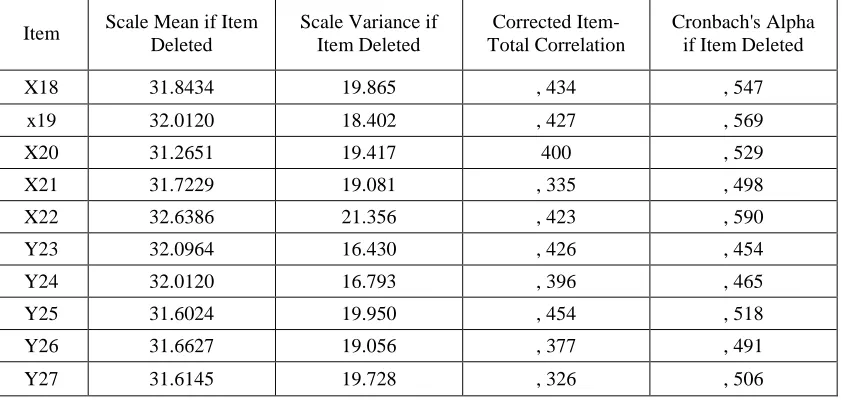
Job Performance variables include 9 questions compiled from numbers 18 to 27. The question is then submitted to 83 employees. Before further analyzed the results of the questionnaire seen its validity and reliability. The validity of the test results can be seen in the following table.
Table 7. Results of the validity of the question in the variable Job Performance
Item Scale Mean if Item
Deleted
Scale Variance if Item Deleted
Corrected Item-Total Correlation
Cronbach's Alpha if Item Deleted
X18 31.8434 19.865 , 434 , 547
x19 32.0120 18.402 , 427 , 569
X20 31.2651 19.417 400 , 529
X21 31.7229 19.081 , 335 , 498
X22 32.6386 21.356 , 423 , 590
Y23 32.0964 16.430 , 426 , 454
Y24 32.0120 16.793 , 396 , 465
Y25 31.6024 19.950 , 454 , 518
Y26 31.6627 19.056 , 377 , 491
Y27 31.6145 19.728 , 326 , 506
Based on the above table it is known that the correlation between the items with a total greater than the value 0.2159. This value is taken from r table with the level df = 83-2 = 81. This means that all items are valid questions that can be used for further analysis.
Additional testing needs to be done to look at the quality of data are to perform reliability testing. The test is performed by comparing the value of Cronbach's alpha with a value of 0.6. If the Cronbach alpha values greater than 0.6, it can be said that the question to be reliable. Calculating Cronbach's alpha using SPSS version 21 with the following results.
Table 8. Results of calculation of Cronbach Alpha variable Job Performance
Cronbach's Alpha N of Items
, 645 10
Source: Primary Data Processed Year 2017
Based on the above data it is known that Cronbach Alpha value of 0.645. The value of greater than 0.6 so that it can be said that the question of Job Performance variables is reliable.
4.2. Discussion
4.2.1. Testing hypothesis
Pressure Influence Organizational Commitment And Work On Job Performance
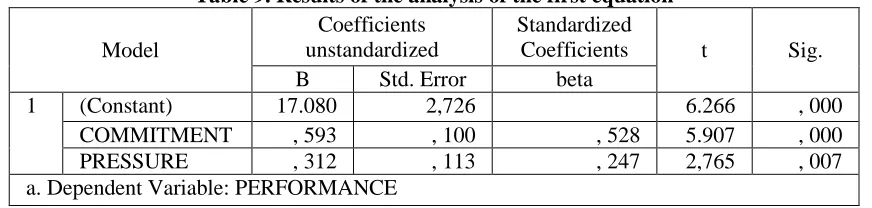
Linear analysis model can be based on calculations using SPSS program as follows.
Table 9. Results of the analysis of the first equation
Model
Coefficients unstandardized
Standardized
Coefficients t Sig. B Std. Error beta
1 (Constant) 17.080 2,726 6.266 , 000
COMMITMENT , 593 , 100 , 528 5.907 , 000 PRESSURE , 312 , 113 , 247 2,765 , 007 a. Dependent Variable: PERFORMANCE
Source: Primary Data Processed Year 2017
Based on the tables above, the simultaneous structural equations can be described as follows Y = 0,528X1 + 0,247X2
F count can be obtained from the following table:
Table 10. Calculate the F value equations simultaneously
Model Sum of
Squares df Mean Square F Sig. 1 Regression 680.563 2 340.281 23.649 , 000b
residual 1151.100 80 14.389 Total 1831.663 82
a. Dependent Variable: PERFORMANCE
b. Predictors: (Constant), PRESSURE, COMMITMENT
Source: Primary Data Processed Year 2017
Based on the above table it is known that calculated F value of 23.649 and significance of 0.05. This value is less than 0.05. This means that the variable organizational commitment and job
stress affect the performance of employees simultaneously. The magnitude of the effect of the independent variable on the dependent variable can be seen from the value of r squared as follows:
Table 11. R-value squared regression model first
Model R R Square Adjusted R
Square
Std. Error of
the Estimate Durbin-Watson
1 , 610A , 372 , 356 3.79325 1.271
a. Predictors: (Constant), PRESSURE, COMMITMENT b. Dependent Variable: PERFORMANCE
Source: Primary Data Processed Year 2017
verity in the above table it is known that the value of r squared of 37.2% means that variable organizational commitment and job stress affect the Job Performance is 37.2% while the rest influenced by other variables that are not incorporated into the model equations.
Analysis of the Effect of Organizational Commitment to Job Performance Partially
The analysis results the organization's commitment to performance can be partially seen in the following table. Table 12. Results of the analysis of the second regression equation
Model
Coefficients unstandardized
Standardized
Coefficients t Sig.
B Std. Error beta
1 (Constant) 21.085 2.402 8.779 , 000
COMMITMENT , 628 , 104 , 558 6,053 , 000
a. Dependent Variable: PERFORMANCE
Source: Primary Data Processed Year 2017
Structural equation of the above data can be seen as follows Y = 0,558X1
Based on the chart above it is known that the coefficient of organizational commitment at 0.558. T value of 6,053. The significant value of 0.00. The significance value smaller than 0.05. This means that variables influence organizational commitment to Job Performance partially. The amount of influence leadership to Job Performance can be seen in the following table.
Table 13. R-value squared second equation
Model R R Square Adjusted R Square Std. Error of the Estimate
1 , 558a , 311 , 303 3.94584
a. Predictors: (Constant), COMMITMENT
Source: Primary Data Processed Year 2017
Based on the above table it can be seen r squared value of 0.311. This means that the effect of variable Job Performance of the organization to the commitment of 31.1% and the rest influenced by other variables not included in the model equations.
Analysis of the Effect of Job Pressure On Job Performance Partially
The analysis results on the performance of Job Pressure can be partially seen in the following table.
Table 14. Results of the analysis of the third regression equation
Model
Coefficients unstandardized
Standardized
Coefficients t Sig.
B Std. Error beta
1 (Constant) 29.336 2,105 13.936 , 000
PRESSURE , 394 , 133 , 312 2,957 , 004
a. Dependent Variable: PERFORMANCE
Source: Primary Data Processed Year 2017
Structural equation of the above data can be seen as follows Y = 0,312X2
Based on the chart above analysis it is known that the Job Pressure coefficient of 0.312. T value of 2.957. The significant value of 0.00. The
significance value smaller than 0.05. This means that the variable pressure on the performance of employees works partially. The magnitude of the effect of work stress on Job Performance can be seen in the following table.
Table 15. R-value squared second equation
Model R R Square Adjusted R Square Std. Error of the Estimate
1 , 312a , 097 , 086 4.51771
a. Predictors: (Constant), PRESSURE
Source: Primary Data Processed Year 2017
Based on the above table it can be seen r squared value of 0.097. This means the effect of job stress variables on the performance of employees by 9.7% and the rest influenced by other variables not included in the model equations.
Analysis of the Influence of Satisfaction on Job Performance Partially
The analysis results of the job satisfaction partially performance can be seen in the following table. Table 16. Results of the fourth regression equation analysis
Model Coefficients
unstandardized
standardized Coefficients
t Sig.
B Std. Error beta
1 (Constant) 23.907 2,347 10.186 , 000
SATISFACTION , 590 , 118 , 485 4.986 , 000
a. Dependent Variable: PERFORMANCE
Source: Primary Data Processed Year 2017
Structural equation of the above data can be seen as follows Y = 0,485X3
Based on the chart above analysis it is known that satisfaction at 0.485. T value of 4.986. The significant value of 0.00. The significance
value smaller than 0.05. This means that variables affect the performance of an employee satisfaction partially. Satisfaction level of influence on Job Performance can be seen in the following table.
Table 17. R-value squared fourth equation
Model R R Square Adjusted R Square Std. Error of the Estimate
1 , 485a , 235 , 225 4.15960
a. Predictors: (Constant), SATISFACTION
Source: Primary Data Processed Year 2017
Based on the above table it can be seen r squared value of 0.235. This means that the effect of variable satisfaction with the performance of employees is 23.5% and the rest influenced by other variables not included in the model equations.
Analysis of the Effect of Organizational Commitment to Job Performance through Variable Satisfaction
Based on the partial path analysis above, it can be described as follows. The analysis is an analysis online with the structure of this sub-image.
Figure 2. Analysis of the influence lines X1 to Y via X3
Commitment influence coefficient of organization to Job Pressure can be seen in the following table
Table 4:21. Influence of Organizational Commitment to Satisfaction
Model
Coefficients unstandardized
Standardized
Coefficients t Sig.
B Std. Error beta
1 (Constant) 11.233 2,188 5.135 , 000
COMMITMENT , 360 , 094 , 390 3,817 , 000
a. Dependent Variable: SATISFACTION
Source: Primary Data Processed Year 2017
Based on the picture above can be seen that the influence of the organization's commitment to Job Performance is 0.558.T he influence of the organization's commitment to Job Performance through Satisfaction is 0.390X0,485 = 0.189. In this case, the direct effect is greater than the indirect
effect that variables satisfaction as an intervening variable.
Analysis of Effect of Job Pressure on Job Performance through variable Satisfaction
Based on the partial path analysis above, it can be described as follows:
Figure 3. Analysis of the influence lines X2 to Y via X3
The coefficient of organizational commitment to the pressures of work can be seen in the following table:
Table 4:22. Coefficient of influence of the Job Pressure to the satisfaction
Model
Coefficients Unstandardized
Standardized
Coefficients t Sig. B Std. Error beta
1 (Constant) 15.437 1,760 8.769 , 000
PRESSURE , 261 , 111 , 252 2,343 , 022
Based on the picture above it can be seen that the direct effect of work stress on Job Performance is 0.365. While the Influence of pressure on work on
Job Performance through Satisfaction is
0.252X0.485 = 0.122. In this case, the direct effect is greater than the indirect effect that variables satisfaction as an intervening variable.
5. Conclusions and Suggestions Conclusion
Variable Organizational commitment and job
stress affect the performance of employees simultaneously. Calculated F value of 23.649 and significance of 0.05. This value is less than 0.05. R squared value of 37.2% means that the organizational commitment and job stress affect the Job Performance is 37.2% while the rest influences by the equations.
Organizational commitment variables affect the performance of employees partially. T value of 6,053.The significant value of 0.00. The significance value smaller than 0.05. R squared value of 0.311. This means that the effect of variable Job Performance of the organization against the commitment of 31.1% and the rest influenced by other variables not included in the model equations.
Variable Job Pressure affects the performance of employees partially. T value of 2,957. The significant value of 0.00. The significance value smaller than 0.05. R squared value of 0.097. This means the effect of job stress variables on 9.7% and the rest influenced by other variables not included in the model equations.
Satisfaction variables affect the performance of employees partially. T value of 4.986.The significant value of 0.00. The significance value smaller than 0.05. R squared value of 0.235. This means that the effect of the satisfaction of the employees is 23.5% and the rest influenced by other variables not included in the model equations.
The influence of organizational commitment towards Job Performance is 0.558. The influence of the organization's commitment to Job Performance through Satisfaction is 0.390X0,485 = 0.189. In this case, the direct effect is greater than the indirect effect that variables satisfaction as an intervening variable.
The direct effect of work stress on Job Performance is 0.365. While the Job Pressure effect on Job Performance through Job satisfaction is 0.252X0,485 = 0.122. In this case, the direct effect is greater than the indirect effect that variables satisfaction as an intervening variable.
Suggestion
Organizational commitment to consider in developing Job Performance. Commitment can be improved by taking into account the elements that
reinforce effective commitment, normative commitment, sustained commitment, and commitment. Affective
commitment can be improved by realizing the presence of employees at organizations that are part of the organization. Sustained commitment can be made by increasing the employee wishes to remain in the organization and normative commitment to realize that every employee must defend his organization.
Besides management organizations need to pay attention to the Job Pressure of employees. The Job Pressure needs to be revisited. Job Pressure is too high can lead to employees feeling stress at work but also the impact of employee impact on the unpreparedness of employees in completing the work. Work becomes very slow penyelesainnya.
Job satisfaction also needs to be improved. Satisfaction would happen if all the required employee. However, the organization also needs to consider the organization's ability to meet the wishes of these employees.
References
Amiroso, J dan mulyanto. 2015. Influence Discipline, Working Environment, Culture Of Organization And Competence On Workers Performance. International Knowledge Sharing Platform, Vol. 7, no. 36
As’ad M. 1995. Psikologi Industri. Yogyakarta: Liberti.
Azwar, Saifuddin. 2004. Sikap Manusia : Teori dan Pengukurannya. Yogyakarta: Liberty.
Baron, Robert, and Jerald Greenberg. 2003, Organizational Behavior, 6th Edition, Prentice Hall, New Jersey
Barorah, A. 2013. Pengaruh Pengembangan Karir Dan Motivasi Terhadap Kinerja Dengan Kepuasan Kerja Sebagai Variabel Intervening (Studi kasus pada Politeknik Ilmu Pelayaran Semarang.
www.academia.edu
Bemardin, H. John, 2003, Human Resources Management: An Experiential Approach 3rd edition, McGraw-Hill/Irwin, New York
Caroline dan Susan. 2014. Influence Of Career Development Of Employee Performance Int He Public Of University, Acase of Kenyatta University. International Journal Of Social Science Management And Entrepreneurship 1 (2), 1-16
Darwish A. Yousef, 2000. "Organizational Commitment: A Mediator of Relationship of Leadership Behavior with Job Satisfaction and Performance in a non - Western Country. Journal of Managerial Psychology. 15.1
Davis, Keith and John W. Stroom. 2004. Organizational Behavior, HumanBehavior at Work, 10th Edition, International Edition, McGraw-Hill, New York.
Dessler Gary, 2005. Manajemen Sumber Daya Manusia, PT. Indeks Kelompok Gramedia, Jakarta
Dessler, Gary, 2000, Human Resources Management, 8th Edition, Prentice hall, International Inc.
Faustino Cardoso Gomes. 2004. Manajemen Sumber Daya Manusia, Andi Offset, Yogyakarta
Fred Luthans. 2006. Perilaku Organisasi – Edisi Sepuluh, Penerbit Andi, Yogyakarta
George, J., & Jones, G. 2002. Organizational Behavior – 3rd edition, Prentice-Hall, USA
Gibson, James L., John M.Ivancevich, and James H.Donnelly, 2006, Organization Behavior-Structure-Process, 7th Edition, Erwin Homewood, Boston.
Gie, The Liang. 2006. Manajemen Perkantoran, Trigenda Karya, Bandung
Gozhali Imam, 2005, Aplikasi Analisis Multivariate Dengan Program Spss, Badan Penerbit Universitas Diponegoro.
Grewal, Lopes, Kadis, Gall dan Salovey, P. 2006. Evidence That Emotional Intelligence Is Related To Job Performance And Effect And Attitude At Works. Journal Psicothema, Vol. 18, Suppl. pp. 132-139.
Hadari Nawawi. 2003. Manajemen Sumber Daya Manusia Untuk Bisnis yang Competitif, Gajah Mada University Press, Yogyakarta
Hamid. 2006. Motivasi Kerja Karyawan, Armico, Bandung
Handoko, T. Hani . 2003. Manajemen Sumber Daya Manusia, BPFE, Yogjakarta
Hasibuan, H. Malayu S.P, 2012. Manajemen Sumber Daya Manusia, Edisi Revisi Kedua, Penerbit BPFE-UGM, Yogyakarta.
Hasibuan, M. 2005. Manajemen SDM. PT Bumi Aksara, Jakarta
Hasibuan, Malayu S.P. 2003. Manajemen : Dasar, Pengertian dan Masalah. Jakarta: Bumi Aksara.
Imam Ghozali. 2001. Aplikasi Analisis Multivariate Dengan Program SPSS. Semarang: Badan Penerbit Univ Diponegoro
Ivancevich dan John M. 2007. Human Resources Management. Mc.Graw Hill
Jeffrey A. Mello. 2002. Strategic Human Resource Management, South-Western College Publisher, USA
Johan M. Ivancevich. 2006. Perilaku dan Manajemen Organisasi, Penerbit Erlangga, Jakarta
Keith Davis, John Newstrom. 2001. Organizational Behavior – Human Behavior at Work, McGraw Hill Higher, International Student Edition
Kevin R. Murphy, Jeanette N, Cleveland, 2002. Understanding Performance Appraisal, Sage Publication - Prentice-Hall, USA
Khagendra Nath Gangai, Mahakud Chandra dan Sharma Vikas. 2016. Associationbetween locus of control and job satisfaction in anemployee: A Critical Review. Vol. 3. Issue 2, No. 10.
Khan, R., Ziauddin., Ahmed Jam, F., dan Ramay, M.I. Impact Of Organizational Commitment On Employee Job Performance. European Journal Of Social Sciences, No. 3.
Khikmah, Siti Noor. 2005. Pengaruh Profesionalisme Terhadap Keinginan Berpindah Dengan Komitmen Organisasi dan Kepuasan Kerja Sebagai Variabel Intervening. Jurnal Maksi Undip, Vol. 5 Agustus.
Kopelman, Brief dan Guzon. 1999. Organization Learning : Climate and Culture. San Francisco : Jossey - Bass.
Kotteeswari, M dan Sharief T. 2014. Job Stress And Its Impact On Employees Performance A Study With Reference To Employees Working in BPOS. International Journal Of Business And Administration Research Review, Vol. 2, issued 4.
Kreitner, Robert dan Kinicki, Angelo. 2005. Perilaku Organisasi, buku 1 dan 2, Jakarta : Salemba Empat.
Kumorotomo, Wahyudi. 1996. “Meningkatkan Kinerja BUMN: Antisipasi Terhadap Kompetisi dan Kebijakan Deregulasi”. JKAP No. 1. Yogyakarta
Lopopolo, Rosalie B. 2002. The Relationship Of Role Related Variables To Job Satisfaction And Commitment To The Organization In A Restructured Hospital Environmental. Physical Therapy, Washington, Vol. 82, Iss 10. pp 984-99
Luthans, Fred, 2002, Organizational Behavior, 7th Edition, McGraw-Hill.Inc, New York.
Malayu S.P. Hasibuan. 2007. Manajemen Sumber Daya Manusia, Dasar dan Kunci Keberhasilan, CV. Haji Masagung, Jakarta
Maltby, J., Day, L., Macaskill, A.(2007).Personality, Individual Differences and Intelligence. at
http://en.wikipedia.org/wiki/Locus_of_control
Mangkunegara, Prabu Anwar. 2002. Manajemen Sumber Daya Manusia Perusahaan, Penerbit PT. Remaja Rosdakarya, Bandung
Mangkunegara. A.P. 2005. Manajemen Sumber Daya Manusia Perusahaan. Cetakan Pertama. Jakarta. PT. Rosda Karya.
Manileti. 2013. Pengaruh Pengembangan Karir Terhadap Kepuasan Kerja Karyawan Human Reosurces Area 09 PT. Telkom, Tbk, Bandung. Hasil penelitian tidak dipublikasikan pada jurnal. Sumber: www.academia.edu
Mansoor, Jinnah, Fida, S, dan Ahmad, Z. 2011. Impact of job stress on employee job satisfaction, A study on telecomunication sector of Pakistan. Journal of business studeis quartely, Vol. 2, No. 3, pp. 50-56.
Marihot AMH Manullang. 2004. Manajemen Personalia, Gadjah Mada University Press, Yogyakarta
Martoyo, K.S. 1992. Manajemen Sumber Daya Manusia. Yogyakarta : BPFE – Yogyakarta.
Mathis, Robert L. dan Jackson, John R, 2004, Human Resources Management, 10th edition, South-Western, Ohio - Penerjemah: Diana Angelica, 2006., Penerbit Salemba Empat, Jakarta
Meyer, John., Allen & Irving. 1998. Examination of the combined effects of work values and early work experiences on organizational commitment. Journal Of Organizational Behavior. 19 (1): 29-52.
Miner, J. 2008. Organizational Behavior, Performance,and Productivity. Random House Business Division. NewYork.
Moch. As’ad, 1995. Psikologi Industri. Jakarta: Liberty
Moeljono, Djokosantoso. 2003. Budaya Korporat dan Keunggulan Koperasi. Jakarta: Elex Media Komputindo
Mowday, Porter dan Dubin, 1974, Organizational Behavior Prentice Hall Inc
Mowday, R.T., Porter, L.W., & Steers, R.M. 1979. Employee-Organizational Linkages: The Psychology Of Commitment, Absenteeism, And Turnover. New York:Academic Press
Murdiyanto, A. 2016. Influence Of Leadership, Motivation And Career Development On The Performance Of Employees At Muamalat Bank Branch Semarang. Proceeding ICOMABE.www.Unisbank.ac.id/ojs
Mutia S. Panggabean. 2004. Manajemen Sumber Daya Manusia, Ghalia Indonesia, Bogor
Nganga, James. 2015. The impact of organizational culture on theperformance of educational. journal IJBSSnet.com journal Vol 3 No. 8.
Noe, Raymond A, et al., 2003, Human Resources Management: Gaining a Competitive Advantage, 4 edition, McGraw-Hill/Irwin, New York
Noto Atmodjo, Soekidjo, 2012. Pengembangan Sumber Daya Manusia, Cetakan Ke-2, Penerbit
Pamudji. 2003. Studi Organisasi , Penerbit Andi, Yogyakarta
Pasolong, Harbani. 2010. Teori Administrasi Publik. Alfabeta, Bandung
Payaman J. Simanjuntak, 2005. Manajemen dan Evaluasi Kerja. Lembaga Penerbit FEUI, Jakarta
Payaman J.Simanjuntak,. 2005. Manajemen Sumberdaya Manusia, Penerbit BPFE-UI, Jakarta
Pervez, Ali. M. 2010. Impact of Emotions On Employee Performance: An Evidence From Organization of Pakistan. OIDA International Journal Of Sustainable Development.
Ponnu, D dan Hassan, Zubair. 2015. The Influences Of Organizational Culture On Performance Management.
International Journal Of Accounting, Business AndManagement .Vol 1 (No. 1) April, 2015
Pranoto, P. 2012. Pengaruh Kepuasan Kerja Dan Komitmen Organisasi Terhadap Kinerja Karyawan PT. Sekawan Karyatama Mandiri Sidoarjo. Karya tulistidakdipublikasikan.
Quick, J. C., & Quick, J. D. (1984). Organizational Stress And Preventive Management. USA: McGraw-Hill, Inc. Rice, P. L. (1999). Stress and Health (3rd ed.). California: Brooks Cole Publishing Company.
Rashid, A., Sambasivan, M dan Johari, J. 2002. The Influence Of Corporate Culture And Organizational Commitment On Performance. Journal Of Management Development, Vol. 22, No. 8. pp. 708-728.
Ricky W. Griffin. 2004. Manajemen, Penerbit Erlangga, Jakarta
Riduwan, 2009. Dasar Dasar Statistika. Alfabeta, Bandung
Risma, D. 2012. Pengaruh Kecerdasan Emosional Terhadap Kinerja Karyawan. Educhild, Vol. 01, No. 1.
Rivai, Veithzal. 2011. Manajemen Sumber Daya Manusia Untuk Perusahaan Dari Teori Ke Praktek. PT. Raja Grafindo Persada, Jakarta
Robbbins dan Judge. 2007. Perilaku Organisasi, Jakarta : Salemba Empat
Robbins, P.Stephen, 1998, Organizational Behavior, 8th Edition, Prentice Hall, International.Inc., New Jersey.
Robbins, Stephen P. 2004. Perilaku Organisasi: Konsep, Kontraversi, Aplikasi, Edisi Bahasa Indonesia, Alih Bahasa : Pujatmoko, Prehallindo, Jakarta
Robbins, Stephen P. Judge, Timothy A. 2008. Perilaku Organisasi. Buku 1, Salemba Empat, Jakarta Robbins. 2006.
Robert L. Mathis, John H. Jackson. 2002. Manajemen Sumber Daya Manusia, PT. Salemba Emban Patria, Jakarta
Rosemary Harrison. 2003. Human Resources Management, Addison Wesley, USA,
Sancoko. 2013. Pengaruh Motivasi Dan Penilaian Kinerja Terhadap Kepuasan Kerja PT. Pos Indonesia. Hasil penelitian tidak dipublikasikan pada jurnal.
Santoso, E. 2012. Pengaruh Kepemimpinan, Motivasi, Kompensasi Dan Disiplin Kerja Terhadap Kinerja Karyawan Di Bank Central Asia Kudus. Penelitian dipublikasikan. http:// e-print.dinus.ac.id
Sasrohadiwiryo, B,S, 2005. Manajemen Tenaga Kerja Indonesia Pendekatan Administrasi dan Operasional. Jakarta. PT. Bumi Aksara
Schultz, Duane dan Sydney E. Schulz. 1993. Theories of Personality. Brook/Cole Publishing Company : California
Sedarmayanti, 2003, Sumber Daya Manusia dan Produktivitas Kerja, Penerbit Ilham Jaya, Bandung.
Sekaran, U. 2000. Research Methods for Business A Skill Building Approach, Third Edition. John Willy & Sons, Inc.
Sentanu. K, 2003. Komunikasi Dalam Organisasi, BPFE, Yogyakarta
Siagian, Sondang P. 2005. Kiat Meningkatkan Produktivitas Kerja. CV. Alfabeta, Bandung
Simamora, Henry, 2001, Manajemen Sumber Daya Manusia, Edisi Kedua., Yogyakarta, STIE YKPN.
Siregar, Syofian. 2013. Statistik Parametrik untuk Penelitian Kuantitatif. Jakarta. PT. Bumi Aksara
Soebagio Atmodiwirio, 2002. Manajemen Pendidikan, Balai Pustaka, Jakarta,
Soebagio Sastrodiningrat, 2002 Perilaku Administrasi, PT Karunika, Jakarta,
Soegiarto Soekidjan, Sp. KJ. 2009. Komitmen Organisasi Sudahkah Menjadi Bagian Dari Kita.
Sofyan, M, Rhman, Jobhar Bima dan Nujum, S. 2016. The Effect Of Career Development And Working Discipline Towards Working Satisfaction And Employee Performance In The Regional Office Of Minsitry Of Religious Affairs N South Sulawesi. International Journal of Scientific an Technology Research, Vlo. 5, issued 03, March 2016
Sondang P. Siagian, 2008. Manajemen Sumber Daya Manusia, Bumi Aksara, Jakarta,
Sondang P. Siagian. 2002. Teori Motivasi dan Aplikasinya, PT. Rineka Cipta, Jakarta,
Sopiah. 2008. Perilaku Organisasi. Yogyakarta : Penerbit And
Sri, Harjanti. 2013. Pengaruh kompleksitas tugas, locus of control terhadap kepuasan kerja auditor (Studi kasus auditor KAP se Jateng dan DIY). http://eprints.uns.ac.id/id/eprint/10439
Styanti, Prihatini dan Nareswari. 2015. Determinant of Career Development Through Intervening Of Performance And Promotion On Employee: Evidence From Indonesia. International Journal Of Business And Management Invention, 2319-8028, vol 4, issue 6
Sudjana, 2003. Teknik Analisis Korelasi dan Regresi, Tarsito, Bandung,
Sugiyono. 2007. Metode Penelitian Administrasi , Edisi - 2, Alfabeta, Bandung
Sugiyono. 2008. Metode Penelitian Bisnis, CV. Alfabeta, Bandung,
Sumarni. Murti, John Soeprihanto.1998. Pengantar Bisnis.Yogyakarta:
Susilo Martoyo, 1992. Manajemen Sumber Daya Manusia. Jakarta : BPFE
Sutrisno. 2012. Sumber Daya Manusia, Gramedia, Surabaya
Suwatno. & Priansa, D. 2011. Manajemen SDM dalam Organisasi Publik dan Bisnis. Bandung: Alfabeta.
Syahu Sugian, 2006. Kamus Manajemen (mutu). Jakarta. PT Gramedia Pustaka Utama
Syauta, J. H., et al. 2012. The Influence of Organizational Culture, Organizational Commitment to Job Satisfaction and Employee Performance. International Journal of Business and Management Invention. 1 (1): 69-76.
T. Hani Handoko. 2004. Manajemen Personalia dan Sumberdaya Manusia, Penerbit BPFE, Yogyakarta
T. Hani Handoko. 2004. Manajemen, Penerbit BPFE, Yogyakarta
Terry, George R. 2003. Prinsip-prinsip Manajemen. Cetak ketujuh, Bumi aksara, Jakarta
Tika, Pabundu. 2006. Budaya Organisasi dan Peningkatan Kinerja Perusahaan. Jakarta : PT. Bumi Aksara.
Tobing, Diana. 2016. Pengaruh Komitmen Organisasional Dan Kepuasan Kerja Terhadap Kinerja Karyawan PT. Perkebunan Nusantara III di Sumatera Utara
Umar, Husein. 2002. Riset Pemasaran dan Perilaku Konsumen. PT. Raja Grafindo Persada, Jakarta
Umar, Husein. 2004. Metode Penelitian Untuk Skripsi Dan Tesis Bisnis, PT. Raja Grafindo Persada, Jakarta
Umar, Husein. 2004. Metode Penelitian Untuk Skripsi dan Tesis Bisnis, PT. Raja Grafindo Persada, Jakarta
Veithzal Rivai & Ahmad Fawzi Mohd Basri. 2005. Performance Appraisal Sistem Yang Tepat Untuk Menilai Kinerja Karyawan Dan Meningkatkan Daya Saing Perusahaan. PT. Raja Grafindo Persada, Jakarta.
Veithzal Rivai. 2004. Manajemen Sumber Daya Manusia Untuk Perusahaan: Dari Teori Ke Praktik. PT. Raja Grafindo Persada, Jakarta.
Vivi & Rorlen. 2007. Pengaruh Iklim Organisasi dan Kedewasaan dengan Kinerja Karyawan pada PT. Graha Tungki Arsitektika Jakarta, Business Management Journal, Vol. 3. No. 1 Maret 2007.
Wahyudi, 2002, Manajemen Sumber Daya Manusia, Sulita, Bandung
Wibowo. 2007. Manajemen Kinerja. PT. Raja Grafindo Parsada: Jakarta.
Winardi, J. 2003. Teori Organisasi dan Pengorganisasian. Jakarta: PT. Raja Grafindo Persada.
Winarno Surakhmad, 1990, Pengantar penelitian Ilmiah, Tarsito, Bandung.
Zafar, Q., Ali, A., Hameed, T., Ilyas, T dan Younes, I. 2015. The Influence Of Job Stress On Employees Performance In Pakistan. American Journal Of Social Science Research,Vol. 1, No. 4. pp. 221-225
Zafar. N, et al. 2014.Determinant Of Employee Motivation And Its Impact On Knowledge Transfer And Job Satisfaction. International Journal of Human Resource Studies, 4, 50-69.