A Hybrid TS-DE Algorithm for Reliability
Redundancy Optimization Problem
Yubao Liu
College of Computer Science and Technology, Jilin University, Changchun, China College of Computer Science and Technology, Changchun University, Changchun, China
Email: [email protected], [email protected]
Guihe Qin*
College of Computer Science and Technology, Jilin University, Changchun, China
Key Laboratory of Symbolic Computation and Knowledge Engineering of Ministry of Education, Jilin University, Changchun, China
Email: [email protected]
Abstract—In this paper, a hybrid TS-DE algorithm based on
Tabu search and differential evolution algorithm is proposed to solve the reliability redundancy optimization problem. A differential evolution algorithm is embedded in Tabu search algorithm. TS is applied for searching solutions space, and DE is used for generating neighborhood solutions. The advantages of both algorithms are considered simultaneously. And an adaptive hybrid TS-DE approach is developed to solve three benchmark reliability redundancy allocation problems. By comparing with other algorithms reported in previous literatures, experimental results show that the proposed method is effective and efficient for solving the reliability redundancy optimization problem.
Index Terms—nonlinear programming, Tabu search,
differential evolution, reliability optimization, redundancy allocation
I. INTRODUCTION
The reliability optimization problem is very important in industry and has attracted attention in academic field and engineering fields. In general, two major ways have been used to improve system reliability. The first way is by increasing the reliability of components, and the second way is by using redundant components in the subsystems. In the first way, sometimes it cannot meet our requirements even though the currently highest reliable components are used. The second way is by choosing the components reliability combination and redundancy levels to arrive the highest system reliability. But the cost, weight, volume are all increased. So it is necessary that a trade-off is achieved between these two options for constrained reliability optimization. Such reliability allocation and redundancy allocation problem is called as RRAP (reliability-redundancy allocation problem) [1, 2, 3].
A reliability redundancy allocation problem of maximizing the system reliability subject to multiple nonlinear constraints [4, 7, 8, 9] belongs to mixed-integer programming problems. It can be formulated as following model uniformly:
Max Rs = f(r, n)
s.t. gj(r, n) ≤ bj, j = 1.. m; nj∈positive integer, 0≤rj≤1 (1) Where ri is the reliability of subsystem i, and ni is the
number of components of subsystem i. The f (.) is the objective function for the system reliability; the gj (.) is the jth constraint function and bj is the jth upper limitation of the system; the m is the number of subsystems. The goal is to determine the number of redundant components and the components’ reliability in each subsystem so as to maximize the overall system reliability.
RRAP has been proven to be NP-hard problem. There are many different optimization technologies have been presented to resolve it. The approaches called heuristics and meta-heuristics have been widely researched and applied [5, 6, 12].They offer feasible solution within reasonable computational time. Hsieh [5] used a linear programming approach to solve the RRP-MCC with nonlinear constraints. Coit and Smith [13] presented a genetic algorithm (GA) to solve the Reliability-Redundancy problem. Hsieh et al. [14] used genetic algorithm to solve reliability design problems of series systems, series-parallel systems and complex (bridge) systems. You and Chen [15] proposed a greedy genetic algorithm for series–parallel redundant reliability problems. Ta_Cheng Chen[16] used an immune algorithm-based approach to solve the RRP-MCC problem of series system, series–parallel system, and complex(bridge) systems and overspeed protection system. Hsieh and You [17] presented an immune based two-phase approach to solve the reliability-redundancy allocation problem. First, an immune algorithm (IA) is used to get preliminary solutions. Second, the quality of solutions was improved by a procedure to obtain the last solutions. The result showed that the solutions are
Manuscript received September 16, 2013; revised February 18, 2014; accepted March, 2014..
superior to those best solutions of other approaches in the literature. Liang and Chen[18] proposed a variable neighborhood search (VNS) with an adaptive penalty function. This method improved the performance and the solution quality were as good as others. Zavala et al.[21] proposed a particle swarm optimization (PSO) approach named PESDRO to solve a bi-objective redundant reliability problem; And the reliability redundant problems of series system, parallel system and K-out-of-N system are resolved. Zou et al. [19,20] used global harmony search algorithm to solve RRAP. Leandro dos Santos Coelho [22] presents a PSO approach based on Gaussian distribution and chaotic sequence (PSO-GC) to solve the reliability–redundancy allocation problems of complex (bridge) system and overspeed protection system. The PSO-GC has got better solutions than the classical PSO. Harish Garg and S.P. Sharma [23] used PSO to solve multi-objective reliability redundancy allocation problem of a series system. Agarwal and Sharma [24] applied ant colony optimization (ACO) algorithm with an adaptive penalty function to redundancy allocation problem. Nabil Nahas et al. [25] coupled ant colony optimization algorithm with degraded ceiling local search method for redundancy allocation of series–parallel systems. Mohamed Ouzineb [26] presented Tabu search (TS) approach to solve the redundancy allocation problem for multi-state series– parallel systems. Afonso et al. [27] used imperialist
competitive algorithm (ICA) to resolve RRAP. Recently some hybrid meta-heuristic methods have
been proposed to solve the reliability redundant allocation problems. Nima Safaei et al. [28] presented an Annealing-based PSO (APSO) method. Even though APSO didn’t obtain the better solution than other well-known meta-heuristic method, it applied Metropolis-Hastings strategy and affected the performance of the basic PSO. Wang and Li [29] presented a coevolutionary differential evolution with harmony search algorithm (CDEHS) to solve the reliability redundancy optimization problem. The method divided the problem into two parts: the continuous part and the integer part. The continuous part evolved by differential evolution algorithm, and the integer part evolved by harmony search approach. Thus two populations evolve simultaneously and cooperatively to get the solutions. Shi-Ming Chen et al. [37] proposed SAABC algorithm coupled simulated annealing algorithm(SA) with artificial bee colony (ABC) algorithm. The SAABC outperformed ABC and GABC in terms of convergence speed and accuracy.
Although the above methods can get the near optimal solution in a limited computational time, generally there are some problems such as slow convergence speed and low precision of the and so on. Moreover some methods can not consider the problem on the balance of convergence speed and accuracy.
In this paper, a hybrid Tabu search and differential evolution algorithm is proposed. DE algorithm has quick convergence speed, but it will lose the information of no selected individual. On the contrary, TS method has strong memory function, and it can get higher accuracy
solution. Whereas its convergence speed is slow. This method considers the advantages of both algorithms simultaneously. It is used to solve three problems on reliability redundancy optimization. The experimental results show that the proposed TS-DE method has higher precision, faster convergence speed, and is more effective for reliability redundancy optimization problem.
The paper is organized as follows. Section 2 provides the general procedure of the original Tabu search (TS) and differential evolution algorithm (DE). In Section 3, a hybrid TS-DE algorithm based on TS and DE is proposed. The simulation results and comparisons are provided in Section 4. Finally, the conclusion of the paper is summarized and the future work is directed in Section 5.
II. THE HYBRID ALGORITHM BASED ON TS AND DE
A. The Tabu Search Algorithm (TS)
Tabu search is a metaheuristic algorithm that has become the methods of choice for solving many complex applied optimization problems. It combines local search with a Tabu list in order to avoid searching the same solutions repeatedly. It has been proved to be very effective in many optimization problems.
Tabu search is an iterative procedure where moving from a current solution to a new solution in a neighborhood at each iteration. The steps are described as follows:
Step 1. The initial solution is generated randomly. The parameters are initialized. The Tabu list is set null.
Step 2. The stop criterion is checked. If it is satisfied, the search is terminated and the current best solution is accepted. Otherwise, continue to the following steps.
Step 3.Generating all (or some) neighborhood solution, and choosing some candidate solutions.
Step 4.The aspiration criterion is checked. If one candidate solution satisfies aspiration criterion, it is accepted to be new current best solution, then return to step 2. Otherwise continue to the following steps.
Step 5. Choosing the best status from the candidate solutions to be current best solution and updating Tabu list.
Step 6. Go to step 2.
B. Differential Evolution Algorithm (DE)
Differential evolution algorithm was first presented by Price and Storn in 1995. It is a kind of evolutionary algorithm using real number code. Compared with the traditional genetic algorithm, differential evolution algorithm generates new species by mutation and crossover operations on the current population, and then adopts the competition strategy of one-to-one to update the population. So DE is simple, effective and efficient method for solving optimization problems[30,31,32]. At present, a variety of the DE algorithms have been proposed. Among them the DE/rand/1/bin has been widely used[32]. Here, we choose DE/rand/1/bin with mutation, crossover and selection operations. The procedure is described as follows:
The parameters are: F, CR and M. Where F is scale factor, CR is crossover rate; M is the size of population.
Step 2: Randomly generating initial population of individuals.
Step 3: Evaluate all individuals of the population. Step 4: Mutation.
The mutation operator is:
Vik+1 = xi3k + F× (xi1k – xi2k) (2) vi k+1 is the trial vector. The xi1k, xi2k, xi3k are three different individuals randomly selected from kth generation population, i1,i2,i3 is random number ranged from 1 to M, and mutation factor F is a scale coefficient.
Step 5: Crossover. The crossover operator is:
vi,jk+1 if rand < CR or j = rd
ui,jk+1 = (3) xi,jk otherwise
uk+1 is the offspring vector. Where, r
d is a random integer between 1 and D (D is the number of variables). CR is a real number between 0 and 1.
Step 6: Selection.
The selection operation is performed as follows: uik+1 if f (uik+1) < f (xik)
xik+1 = (4) xik otherwise
If the fitness of the offspring is better than that of the parent, the offspring u i k+1 is selected to replace the parent xik.
Step 7: stopping criterion.
If the stopping criterion is met, the process is end. Otherwise, go back to Steps 4.
III. THE HYBRID TS-DEALGORITHM BASED ON TS AND
DE
In DE algorithm, if an individual is not selected the information of that individual is lost, but TS algorithm has memory ability. In DE algorithm the new candidate solution is generated randomly from the population. This method can increase the ability of getting the global optima, but it cannot ensure a better solution, TS can promote the search for an optimal solution. But TS may waste resources on poor individuals without a selection operator.In order to increase the convergence speed and to produce better quality solution, a differential evolution algorithm is embedded in Tabu search algorithm. TS is applied for searching solutions space, and DE is used for generating neighborhood solutions. In this way the TS can help getting a better solution of each generation in DE algorithm, and accept the best current solution by using aspiration criterion. These consider the advantages of both algorithms simultaneously.
In the original DE algorithm, scale factor F and crossover rate CR are set to fixed values for all solutions. In order to improve the performance of DE algorithm, we have introduced adaptive parameters to get better feasible solutions. So an adaptive adjustment strategy of modifying scale factor F and crossover rate CR is developed. The formulas are described as follows:
F=F0+η×sin(K/MAXCOUNT×2π) (5) CR=CR0×sin(K/MAXCOUNT×π/2) (6)
Where k is the current number of iterations, MAXCOUNT is the total counts of iterations. And η is the coefficient between 0 and 1. F0 and is the initial value of F, CR0 is the initial value of CR. And we assumed that the values of F and CR are in the range of [0.0, 2.0] and [0.0, 1.0] respectively.
The hybrid approach is described as follows:
Step 1. Initializing parameters. The Tabu list is set null. Step 2. Initializing a random population x, Generate current best solution xbest from x.
Step 3.The stop criterion is checked. If it is satisfied, the search is terminated and the current best solution is accepted. Otherwise, continue to the following steps.
Step 4.Generating neighborhood solution by DE algorithm, and choosing the best one from candidate solutions.
Step 5.The aspiration criterion is checked. If one candidate solution satisfies aspiration criterion, it is accepted to be new current best solution, then return to step 2. Otherwise continue to the following steps.
Step 6. Choose the best status from the candidate solutions to be current best solution and updating Tabu list. Go to step 3.
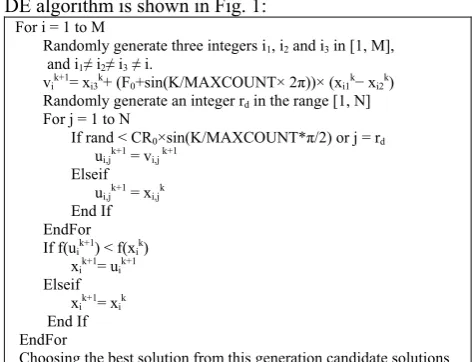
The main procedure of Generating neighborhood by DE algorithm is shown in Fig. 1:
For i = 1 to M
Randomly generate three integers i1, i2 and i3 in [1, M],
and i1≠ i2≠ i3≠ i.
vik+1= xi3k+ (F0+sin(K/MAXCOUNT× 2π))× (xi1k− xi2k)
Randomly generate an integer rd in the range [1, N]
For j = 1 to N
If rand < CR0×sin(K/MAXCOUNT*π/2) or j = rd
ui,jk+1 = vi,j k+1
Elseif ui,jk+1 = xi,jk
End If EndFor If f(uik+1) < f(xik)
xik+1= uik+1
Elseif xik+1= xik
End If EndFor
Choosing the best solution from this generation candidate solutions
Figure 1.Pseudo code of Generating neighborhood by DE algorithm
IV. SIMULATIONS AND COMPARISONS
In this section, we implement the simulations based on three benchmark problems to test the performances of the proposed TSDE for reliability-redundancy optimization problems. And we compared the TSDE with some other typical algorithms from the literatures.
A penalty function method is used to handle constrains, it is described as follows:
∑
=λ + − =
p
1 j
2
)}
x
(
g
,
0
{
jmax )
x ( f ) x ( F
min (7)
1 2
3 5
4
Gas Turbine
Air Fuel Mixture V1
Mechanical and electrical overspeed detection
V2 V3 V4
A. Problem1: Series-parallel System
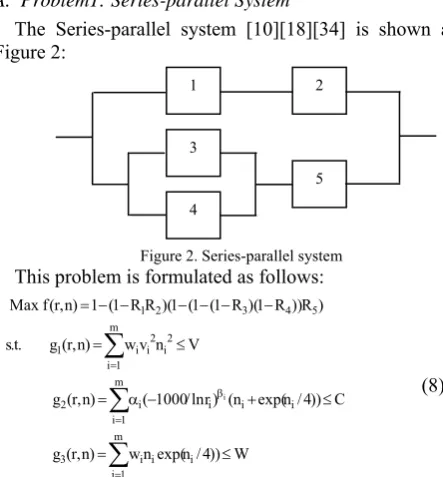
The Series-parallel system [10][18][34] is shown as Figure 2:
Figure 2. Series-parallel system
This problem is formulated as follows:
∑
∑
∑
= = β = ≤ = ≤ + − α = ≤ = − − − − − − = m 1 i i i i 3 m 1 i i i i i 2 m 1 i 2 i 2 i i 1 5 4 3 2 1 W )) 4 / n exp( n w ) n , r ( g C )) 4 / n exp( n ( ) r ln / 1000 ( ) n , r ( g V n v w ) n , r ( g .t . s ) R )) R 1 )( R 1 ( 1 ( 1 )( R R 1 ( 1 ) n , r ( f Maxi (8)
Where m is the number of subsystems, ni is the number of components of subsystem i, Ri ( ni ) is the reliability of subsystem i, f ( r , n) is the reliability of the system; The wi is the weight of each component in subsystem i, vi is the volume of each component in subsystem i; The ri is the reliability of each component in subsystem i; The item αi(-1000/lnri)βi is the cost of each component in subsystem i, the parameters αi and βi is the constant value(usually assume that have been given),1000 is the task time of the components(it is commonly expressed in Tm); The V is the upper limit of total volume of the system, C is the upper limit of total cost of the system, W is the upper limit of total weight of the system. The parameters for this problem are listed in Table Ⅰ:
TABLE I.
THE PARAMETERS OF SERIES-PARALLEL SYSTEM.
Subsystem i 105α
i βi wivi2 wi V C W
1 2.500 1.5 2 3.5 180 175 100
2 1.450 1.5 4 4.0
3 0.541 1.5 5 4.0
4 0.541 1.5 8 3.5
5 2.100 1.5 4 4.5
B. Problem 2: Complex (bridge) System
The complex (bridge) system [33,35] is shown as Figure 3:
Figure 3. Complex (bridge) system
This problem is formulated as follows:
5 4 3 2 1 5 4 3 2 5 4 3 1 5 4 2 1 5 3 2 1 4 3 2 1 5 3 2 5 4 1 4 3 2 1 R R R R R 2 R R R R R R R R R R R R R R R R R R R R R R R R R R R R R R ) n , r ( f Max + − − − − − + + + = (9)
The constraints are the same as series system. The parameters for this problem are listed in Table Ⅱ:
TABLE II.
THE PARAMETERS OF COMPLEX (BRIDGE) SYSTEM.
Subsystem i 105α
i βi wivi2 wi V C W
1 2.33 1.5 1 7 110 175 200
2 1.450 1.5 2 8
3 0.541 1.5 3 8
4 8.050 1.5 4 6
5 1.950 1.5 2 9
C. Problem 3: Overspeed Protection System
The problem is used to overspeed protection of a gas turbine. When the overspeed occurs, the system will be cut off. The overspeed protection system [36] is shown as Figure 4:
Figure 4. The overspeed protection system of a gas turbine
The control system can be viewed as an N-stage (N=4) mixed series-parallel systems. The model is formulated as follows: + − + = = = = ∈ − ≤ ≤ ∈ ≤ ≤ ≤ = ≤ + ⋅ = ≤ = − − =
∑
∑
∑
∏
R r , 10 1 r 5 . 0 Z n , 10 n 0 . 1 W ) 4 / n exp( n w ) n , r ( h C )] 4 / n exp( n [ ) r ( C ) n , r ( h V n v ) n , r ( h . t. s ] ) r 1 ( 1 [ ) n , r ( f Max i 6 i i i m 1 i i i i 3 i i m 1 i i 2 m 1 i 2 i i 1 m 1 i n i i (10) Here i i ii T r
r
C( ) = α (− /ln )β , T is the task time of
the components, the parameters αi and βi is the same as series system.
The parameters for this problem are listed in Table III
TABLE III.
THE PARAMETERS OF OVERSPEED PROTECTION SYSTEM.
Subsystem i 105
αi
βi vi wi V C W T
1 1 1.5 1 6 250 400 500 1000
2 2.3 1.5 2 6
3 0.3 1.5 3 8
4 2.3 1.5 2 7
To analyze the performance of the TSDE, the TS and DE are developed as well for comparison. For the TS algorithm, the maximum number of iterations is set to 1500, and the length of Tabu list is set to 24. For the DE
1 2
3
4
and TSDE algorithms, set F0=0.1, CR0=1.0, η=1, population size M=40, and the maximum number of iterations is set to 1500. Every algorithm runs 50 times independly for each problem, and the statistical results are listed in Table IV,Table V, and Table VI, including the best results(Best), the worst results(Worst), the mean results (Mean)and standard deviation(SD).
TABLE IV.
RESULTS OF THE SERIES PARALLEL SYSTEM USING THREE ALGORITHMS
Algorithm Best Worst Mean SD
TS 0.999972
5346 0.9928314610 0.9991606706 1.3553e-03
DE 0.999898 4359
0.983580 3872
0.997535 6371
2.8176e-03
TSDE 0.999976 6491
0.999964 7634
0.999976 2814
1.8994e-06
TABLE V.
RESULTS OF THE COMPLEX (BRIDGE) SYSTEM USING THREE ALGORITHMS
Algorith
m Best Worst Mean SD
TS 0.99982818 44
0.96688487 87
0.99496166 16
7.3952e -03 DE 0.99957392
26
0.96176637 90
0.99123325 20
9.6013e -03 TSDE 0.99988963
76 0.9998893505 0.9998894366 1.3290e-07
TABLE VI.
RESULTS OF THE OVERSPEED PROTECTION SYSTEM USING THREE ALGORITHMS
Algorithm Best Worst Mean SD
TS 0.99991922 16
0.9136394 661
0.98419501 04
2.2715e -02 DE 0.99881030
68 0.9523992418 0.9876744210 1.1077e-02
TSDE 0.99995467 47
0.9999461 512
0.99995450 42
1.2504e -06
TABLE VII.
BEST RESULTS COMPARISON ON SERIES PARALLEL SYSTEM
Parameter Hikita et al. [34] Hsieh et al. [14] Chen [16] This paper
n1-n5 (3,3,1,2,3) (2,2,2,2,4) (2,2,2,2,4) (2,2,2,2,4)
r1
r2
r3
r4
r5
0.838193 0.785452 0.812485 0.819659
0.855065 0.842998 0.843155 0.844981
0.878859 0.885333 0.897385 0.895507
0.911402 0.917958 0.894516 0.895506
0.850355 0.870318 0.870590 0.868448
f(r,n) 0.99996875 0.99997418 0.99997658 0.9999766491
MPI (%) 25.2771 9.5627 0.2950 -
Slack(g1) 53 40 40 40
Slack(g2) 0.000000 1.194440 0.002627 0.000000
Slack(g3) 7.110849 1.609289 1.609829 1.609289
Note: (1) the bold values denote the best values of those obtained by all the algorithms. (2)Slack is the unused resources.
TABLE VIII.
BEST RESULTS COMPARISON ON COMPLEX (BRIDGE) SYSTEM
Parameter Hikita. et al. [34] Hsieh et al. [14] Chen [16] Coelho[22] This paper
n1-n5 (3,3,2,3,2) (3,3,3,3,1) (3,3,3,3,1) (3,3,2,4,1) (3,3,2,4,1)
r1
r2
r3
r4
r5
0.814483 0.814090 0.812485 0.826678 0.828086
0.821383 0.864614 0.867661 0.857172 0.857805
0.896151 0.890291 0.861221 0.914629 0.914241
0.713091 0.701190 0.713852 0.648918 0.648146
0.814091 0.734731 0.756699 0.715290 0.704162
f(r,n) 0.9997894 0.99987916 0.99988921 0.99988957 0.9998896376
MPI (%) 47.5962 8.6706 0.3860 0.0612 -
Slack(g1) 18 18 18 5 5
Slack(g2) 1.854075 0.376347 0.001494 0.000339 0.000000
Slack(g3) 4.264770 4.264770 4.264770 1.560466 1.560466
Note: (1) the bold values denote the best values of those obtained by all the algorithms. (2) Slack is the unused resources.
TABLE IX.
BEST RESULTS COMPARISON ON OVERSPEED PROTECTION SYSTEM
Parameter Yokota et al. [35] Dhingra[36] Chen[16] Coelho [22] This paper
n1-n4 (3,6,3,5) (6,6,3,5) (5,5,5,5) (5,6,4,5) (5,6,4,5)
r1
r2
r3
r4
0.965993 0.81604 0.903800 0.902231 0.901615
0.760592 0.80309 0.874992 0.856325 0.849921
0.972646 0.98364 0.919898 0.9481450 0.948141
0.804660 0.80373 0.890609 0.883156 0.888223
f(r,n) 0.999468 0.99961 0.999942 0.999953 0.9999546747
MPI (%) 91.4802 88.3781 21.8529 3.5632 -
Slack(g1) 92 65 50 55 55
Slack(g2) 70.733576 0.064 0.002152 0.975465 0.000000
Slack(g3) 127.583189 4.348 28.803701 24.801882 24.801882
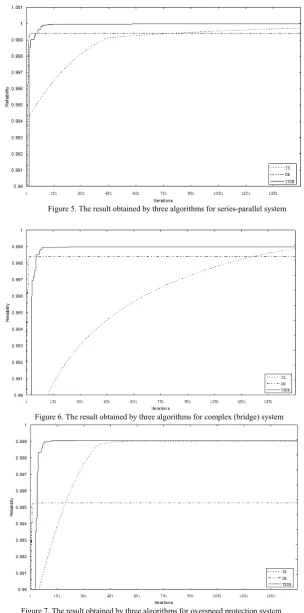
Figure 5. The result obtained by three algorithms for series-parallel system
Figure 6. The result obtained by three algorithms for complex (bridge) system
Figure 7. The result obtained by three algorithms for overspeed protection system
Table VII, Table VIII and Table IX compare the best result obtained in this paper with those of other methods in the literature.
It can be clearly seen from Table IV, Table V and Table VI that the best, worst, mean results obtained by TSDE are superior to those obtained by TS and DE for three benchmark problems. The best values obtained by
mentioning that the adaptive parameters F and CR make TSDE have better capacity of solution space exploration.
Table VII, Table VIII and Table IX compare the best results obtained by TSDE for three reliability optimization problems with those reported in the literature. It can be seen that the proposed algorithm can get a better solution than any other methods presented in literature. MPI (maximum possible improvement) is used to measure the amount improvement of the solutions obtained by the presented method to the best solutions found by other best known methods, and it is described as: MPI (%) = (f − fother)/ (1 − fother), where f represents the best value obtained by the proposed algorithm, and fother represents the best value obtained by one of the other methods in literature. It should be emphasized that even very small improvements in reliability are critical and beneficial in high reliability applications.
It can be seen from Table Ⅶ, that the best results reported by Hikita et al. [34], Hsieh, et al. [14] and Chen[16] were 0.99996875, 0.99997418 and 0.99997658 for the series–parallel system respectively. The result obtained by TSDE is better than the above three best solution, and the corresponding improvements made by the presented method are 25.2771%, 9.5627% and 0.2950% respectively.
It can be seen from Table Ⅷ, that the best results reported by Hikita et al. [34], Hsieh et al. [14], Chen [16] and Coelho [22] were 0.9997894, 0.99987916, 0.99988921 and 0.99988957 for the complex (bridge) system respectively. The result obtained by TSDE is better than the above four best solution, and the corresponding improvements made by the presented method are 47.5962%, 8.6706%, 0.3860% and 0.0612% respectively.
It can be seen from Table Ⅸ, that the best results reported by Yokota, et al. [35], Dhingra[36], Chen [16] and Coelho[22] were 0.999468, 0.99961, 0.999942 and0.999953 for the overspeed protection system respectively. The result is better than the above four best solution, and the corresponding improvements made by the presented method are 91.4802%, 88.3781%, 21.8529% and 3.5632% respectively.
In short, the proposed TSDE is an effective algorithm, and it outperforms the other methods in literature for reliability optimization problems.
V. CONCLUSION
In this paper, we proposed a hybrid TS-DE algorithm to solve the reliability redundancy optimization problems. The proposed approach benefits from advantages of both Tabu search algorithm and differential evolution algorithm. The adaptive parameters F and CR in DE make the algorithm have higher exploration capability of solution space. Simulation experiments based on three benchmark problems and compared with some algorithms in the literature. The results showed that the TS-DE algorithm was effective, efficient and performed better than the other methods in the literature. The future work
is to apply it to solve other more complex mixed-integer programming problems.
ACKNOWLEDGMENT
The authors wish to thank Department of education of Jilin Province, China. This work was supported by the science research project of Department of education of Jilin Province, China (No. 2013461).
REFERENCES
[1] K.B. Misra, and J. Sharma, “A new geometric programming formulation for a reliability system, ” International Journal of Control, vol. 18, pp. 497–503, 1973.
[2] M.S. Chern, “On the computational complexity of reliability redundancy allocation in a series system,” Operations Research Letters, vol. 11, pp. 309–315, June 1992.
[3] W. Kuo, and V.R. Prasad, “An annotated overview of system-reliability optimization,” IEEE Transaction on Reliability, vol. 49 (2), pp. 176–187, June 2000.
[4] Peifeng Wu et al., “An improved particle swarm optimization algorithm for reliability problems,” ISA Transactions, vol. 50, pp. 71-81, Jan 2011.
[5] Y.-C. Hsieh, “A linear approximation for redundant reliability problems with multiple component choices,” Computers and Industrial Engineering, vol. 44, pp. 91– 103, 2003.
[6] Y. Nakagawa, and S. Miyazaki, “Surrogate constraints algorithm for reliability optimization problems with two constraints,” IEEE Transaction on Reliability, vol. R 30, pp. 175–180, 1981.
[7] K.S. Park, “Fuzzy apportionment of system reliability,” IEEE Transactions on Reliability, vol. R 36, pp. 129–132, 1987.
[8] Z. Xu, W. Kuo, and H.H. Lin, “Optimization limits in improving system reliability,” IEEE Transactions on Reliability, vol. 39, pp. 51–60, 1990.
[9] V.R. Prasad, and W. Kuo, “Reliability optimization of coherent system,” IEEE Trans. Reliab, vol. 49, pp. 323– 330, 2000.
[10] Lu Xiong, Shen-guang Gong, “Reliability Allocation of Underwater Experiment System Based on Particle Swarm Optimization,” Journal of Networks, vol. 8, pp. 1292– 1299, June 2013.
[11] W. Kuo, V.R. Prasad, F.A. Tillman, and C.L. Hwang, Optimal Reliability Design: Fundamentals and Applications, Cambridge University Press, Cambridge, 2001.
[12] Kuo W, Hwang CL, and Tillman FA, “A note on heuristic methods in optimal system reliability,” IEEE Transactions on Reliability, vol. R-27(5), pp. 320–324, 1978.
[13] D.W. Coit, and A.E. Smith, “Reliability optimization of series–parallel systems using a genetic algorithm, ” IEEE Transactions on Reliability, vol. 45, pp. 254–260, 1996.
[14] Yi-Chih Hsieh, Ta-Cheng Chen, and Dennis L. Bricker, “Genetic algorithms for reliability design problems,” Microelectronics Reliability, vol. 38, pp. 1599-1605, 1998. [15] P.S. You, and T.C.Chen, “An efficient heuristic for
series–parallel redundant reliability problems,” Computers and Operations Research, vol. 32(8), pp. 2117–2127, 2005.
and Computation, vol. 182(2), pp. 1556-1567, 2006. [17] Y.-C. Hsieh, and P.-S. You, “An effective immune based
two-phase approach for the optimal reliability– redundancy allocation problem,” Applied Mathematics and Computation, vol. 218, pp. 1297–1307, 2011. [18] Y.C. Liang, and Y.C. Chen, “Redundancy allocation of
series–parallel systems using a variable neighborhood search algorithm,” Reliability Engineering and System Safety, vol. 92, pp. 323–331, 2007.
[19] Dexuan Zou, Liqun Gao, Jianhua Wu, Steven Li, and Yang Li, “A novel global harmony search algorithm for reliability problems,” Computers & Industrial Engineering, vol. 58, pp. 307–316, 2010.
[20] Dexuan Zou, Liqun Gao, Steven Li, and Jianhua Wu, “An effective global harmony search algorithm for reliability problems,” Expert Systems with Applications, vol. 38, pp. 4642–4648, 2011.
[21] A.E.M. Zavala, E.R.V. Diharce, and A.H. Aguirre, “Particle evolutionary swarm for design reliability optimization,” Lecture Notes in Computer Science 3410, Presented at the Third International Conference on Evolutionary Multi-Criterion Optimization, Guanajuato, Mexico, pp. 856–869, March 9–11, 2005.
[22] Leandro dos Santos Coelho, “An efficient particle swarm approach for mixed-integer programming in reliability– redundancy optimization applications,” Reliability Engineering and System Safety, vol. 94, pp. 830–837, 2009.
[23] Harish Garg, and S.P. Sharma, “Multi-objective reliability-redundancy allocation problem using particle swarm optimization,” Computers & Industrial Engineering, vol. 64, pp. 247–255, 2013.
[24] Manju Agarwal, and Vikas K. Sharma, “Ant colony approach to constrained redundancy optimization in binary systems,” Applied Mathematical Modelling, vol. 34, pp. 992–1003, 2010.
[25] Nabil Nahas, Mustapha Nourelfath, and Daoud Ait-Kadi, “Coupling ant colony and the degraded ceiling algorithm for the redundancy allocation problem of series–parallel systems,” Reliability Engineering and System Safety, vol. 92, pp. 211–222, 2007.
[26] Mohamed Ouzineb, Mustapha Nourelfath, and Michel Gendreau, “Tabu search for the redundancy allocation problem of homogenous series–parallel multi-state systems,” Reliability Engineering and System Safety, vol. 93, pp. 1257–1272, 2008.
[27] Leonardo Dallegrave Afonso, Viviana Cocco Mariani, and Leandro dos Santos Coelho, “Modified imperialist competitive algorithm based on attraction and repulsion concepts for reliability-redundancy optimization,” Expert Systems with Applications, vol. 40, pp. 3794–3802, 2013. [28] Nima Safaei, Reza Tavakkoli-Moghaddamb, and Corey
Kiassat, “Annealing-based particle swarm optimization to solve the redundant reliability problem with multiple
component choices,” Applied Soft Computing, vol. 12, pp. 3462–3471, 2012.
[29] Ling Wang, and Ling-po Li, “A coevolutionary differential evolution with harmony search for reliability-redundancy optimization,” Expert Systems with Applications, vol. 39, pp. 5271–5278, 2012.
[30] R. Storn, and K. Price, Differential evolution: a simple and efficient adaptive scheme for global optimization over continuous spaces, Technical Report,TR-95-012, International Computer Science Institute, Berkeley, USA, 1995.
[31] Storn R., and Price K., “Differential evolution-A simple and efficient heuristic for global optimization over continuous spaces,” Journal of Global Optimization, vol. 11, pp. 341–359, 1997.
[32] Price K.V., Storn R.M., and Lampinen J.A., Differential evolution: A practical approach to global optimization (natural computing series) (1st ed.). New York: Springer, 2005.
[33] K. Gopal, K. Aggarwal, and J.S. Gupta, “An improved algorithm for reliability optimization,” IEEE Trans. Reliab, vol. 27, pp. 325–328, 1978.
[34] M. Hikita, Y. Nakagawa, and H. Harihisa, “Reliability optimization of systems by a surrogate constraints algorithm,” IEEE Trans. Reliab, vol. 41, pp. 473–480, 1992.
[35] T. Yokota, M. Gen, and Y.X. Li, “Genetic algorithm for non-linear mixed integer programming problems and its applications,” Comput. Ind. Eng, vol. 30, pp. 905–917, 1996.
[36] Anoop K. Dhingra, “Optimal Apportionment of Reliability & Redundancy in Series Systems Under Multiple Objectives,” IEEE Transactions on Reliability, vol. 41(4), pp. 576–582, 1992.
[37] Shi-Ming Chen, Ali Sarosh, Yun-Feng Dong, “Simulated annealing based artificial bee colony algorithm for global numerical optimization,” Applied Mathematics and Computation, vol. 219, pp. 3575–3589, 2012.
Yubao Liu received M. Sc. from Changchun University of
Science and Technology in 2004. He is a doctoral student in Jilin University now and his research interests are mainly focused on system reliability, stochastic optimization, and artificial intelligence.
Guihe Qin received M. Sc. and Sc. D. degrees in