EVALUATION OF EFFECT OF GREEN TEA AND SAFFRON ON LEARNING PROCESS AND MEMORY IN HEALTHY HUMAN VOLUNTEERS
Pradeep Kumar, N Saraswathy and Kala Suhas Kulkarni
School of Pharmacy and Technology Management, SVKM’S NMIMS University, V.L. Mehta Road, Vile Parle (West), Mumbai 400 056, India.
Email: [email protected]
Summary
The study was conducted in healthy human volunteers adhering to good clinical practices and
institutional human ethical norms. All the volunteers have completed the study. There were no
dropouts and no signs and symptoms of any adverse effect after consumption of the beverages.
This indicates the positive compliance in the study.
The overall effect observed in the study that the consumption of beverages (especially Green tea)
increases alertness in the volunteers and it helps to facilitate the performance and thus enhance the
memory. This is confirmed by the level of confidence development in the volunteers to perform
the psychopharmacological parameters. The parameters selected in the study are the functional
characteristics of thought process, learning and memory. The reduction in reaction time after the
consumption of green tea signifies the effect on learning process. The improvisation of this
facilitates the memory in the form of retention and its implementation in developing skills.
Clinically these results are very promising and can be extrapolated for the treatment of
neurodegenerative disorders like Alzheimer’s disease, dementia where at least partial effect on the
process of learning and recent memory.
Green tea and saffron are consumed many times by the individuals in the situations like appearing
for examinations where the level of performance is of significance to have optimum outcome.
These may be recommended for short time use. However, the additional effects may be confirmed
in larger studies in controlled manner.
Key words: Green Tea, Saffron, Memory, Learning, Physiological Performance
Introduction
Learning process and memory are important physiological parameters during our growth and play
important role at various circumstances. These could be in situations like increased demand and
needs as occurs during examinations and stressful conditions. Tea and saffron are two such plants
which have shown great potential in medical practice like prevention of cancer, cardiovascular
diseases, diabetes, neurodegenerative disorders etc. Both these plants are shown to improve
learning behavior also by many research scientists. Tea is the second-most commonly consumed
beverage, is virtually calorie-free, and helps maintain proper fluid balance. Green tea has been
used in oriental medicine because of its beneficial effects. All varieties of tea come from leaves of
the Camellia sinensis plant. Saffron Crocus sativus used to flavor and color foods. Saffron has
many nonvolatile active components, many of which are carotenoids, including zeaxanthin,
lycopene, and various a- and ß-carotenes. In studies in mice, saffron extract improved
ethanol-induced impairments of learning behaviors and prevented ethanol-ethanol-induced inhibition of
hippocampus long-term potentiation related to learning and memory. Researchers believe that
crocin may attribute this effect. In a study of hyperlipemic rats, crocin decreased cholesterol,
triglyceride and density lipoprotein levels, and increased the content of high density lipoprotein.
Researchers believe that crocin prevents atherosclerosis in hyperlipemia, via inhibition of both
proliferation of smooth muscle cells and activation of p38MAPK. In our day to day life we
consume different types of beverages without knowing what effect they can have on our
physiology and psychology. Hence, this study was conducted to identify any effect of Green Tea
and Saffron on functional parameters especially the learning and memory process in healthy
human volunteers. These characteristics are evaluated using various psychopharmacological tests
commonly indicating the process of learning and memory
Methods
Green Tea and Saffron were purchased from ready market. Both were consumed by volunteers as
routine conventional dose that is tea as one cup and saffron in one cup of milk. For the preparation
of tea the decoction was prepared in one cup of freshly boiled water with one teaspoon of tea
leaves, filtered and added one teaspoon of sugar and served to all the volunteers. For preparation
of Saffron milk, Saffron stigmas were added to freshly boiled milk for few minutes, one teaspoon
This was a human study in healthy volunteers between the age of 22 and 15 years, approval of
clinical protocol was obtained from institutional ethics committee for the conduct of the study. The
study was conducted adhering to norms of good clinical practices and good laboratory practices.
No blood samples or any other body fluids were withdrawn from the volunteers during the study.
The volunteers were divided in two groups each consisting of six volunteers. On detailed
discussions with them regarding the nature and objective of the study, written informed consent
was obtained and enrolled in the study after complete physical and systemic examination including
general examination, pulse, blood pressure and routine systemic examination. The evaluation
parameters included as the following:
Evaluation Parameters for learning and memory:
Mathematical Calculation test: In this test, the volunteers were asked to solve a mathematical
summation problem. The mathematical chart consisted of 100 small squares in 10 row and 10
columns in which two digit numbers between 1 and 100 were incorporated (Chart – 1). The
volunteers were asked to perform vertical summations and following points were taken for
measurement of performance.
1) Total time taken to complete summations
2) Total correct answers
3) Total incorrect answers.
Chart 1: Mathematical Calculation Test
35 40 40 60 40 55 35 30 35 12
25 50 50 90 30 60 60 20 95 45
50 30 30 25 25 40 45 64 15 55
40 20 50 60 55 30 30 35 34 35
60 50 40 75 15 50 20 95 56 53
55 40 30 30 50 40 55 35 43 17
25 55 20 55 80 45 25 65 17 37
20 60 80 35 40 45 15 30 50 13
30 15 50 60 45 35 65 20 38 27
25 75 80 20 25 20 30 25 12 20
Total
umber Cancellation Test: In this test, the volunteers were given a table consisting of 10X10
(100 small squares), one number is randomly repeated at least seven to eight times, and were
asked to cancel a particular number (Chart – 2). The following points were considered for
performance evaluation.
1) Total time taken to complete to cancel the given number 2) Total number of correct cancellation.
3) Total number of incorrect cancellation
Chart 2: umber Cancellation
6 1 5 7 9 4 3 7 1 2
5 2 4 8 5 1 3 5 9 7
7 6 9 1 2 6 9 4 6 1
9 5 3 8 9 4 2 9 3 5
2 9 2 1 3 9 1 7 2 4
3 4 4 7 4 8 3 8 1 9
5 4 3 5 6 2 8 1 3 7
8 5 9 4 1 3 6 7 6 3
6 1 7 3 4 1 7 5 4 9
4 5 5 2 5 9 4 6 2 4
Alphabet Cancellation Test: In this test, the volunteers were given a table containing alphabets in
100 small squares, each alphabet repeated 7 to 8 times randomly and were asked to cancel a
particular alphabet (Chart – 3).
Following criteria were considered for performance:
1) Total time taken to cancel the given alphabet
2) Total correct alphabets cancelled
3) Total number of incorrect alphabet
Chart 3: Alphabet cancellation Test
Upward Digit Scale Test: In this test, the volunteers were verbally informed eight numbers
(between 10 and 99) in upward scale and were asked to memorize the numbers in the same
manner. The verbal information was repeated three times consecutively (Chart -4).
Following parameters were considered for performance evaluation:
A D C B F G H M B V
Q G S X S B Z X A D
E T F C F G H B X Z
S L A G J K A S N Z
K J H D A G S X V K
J E H J D D A D C S
K J H D A G S X V K
F S B L K A G D X A
H E S A G J C R Y U
1) Synchrony of numbers 2) Missing numbers 3) Incorrect numbers
Chart 4: Upward digit scale
12 21 29 47 53 62 77 83
Fixed Digit Test: In this test the volunteers were given a fixed number with two digits and were
asked to apply mathematical calculation as add or deduct certain numbers from the fixed digit.
Each time the evaluator would give exercise the sum as add or cancel. The answer within 10
seconds would be given the score of 2, later than 10 second 1 and incorrect and missing answer as
0. The total score is measured at evaluation each time. Every volunteer may have the minimum
score of zero and maximum could be 20.This was compared before and after the consumption of
tea or milk (Chart – 5).
Chart 5: Fixed Digit Test
Sr. o. umber Result Score
1 25 – 15
2 25 + 45
3 25 ÷ 5
4 25 + 40
5 25 + 7
6 25 – 11
7 25 + 50
8 25 – 13
Total Score
Four Words Test: In this test the volunteers were given a card mentioned with four words with
no interlink among them and were asked to memorize them in a particular sequence they want and
to recall the word when asked (Chart – 6).
The following points were taken for performance evaluation.
1) Synchrony of words
2) Missing Word
3) Incorrect Word(s)
Chart 6: Four Words Test
Aircraft Desert
eedle Lunch
The performance was evaluated three times. A) Basal Reading: Before administering the
beverages. B) 30 Minutes: Volunteers were evaluated for above mentioned tests after 30
minutes of ingestion of beverage. C) 90 Minutes: Volunteers were evaluated for above
mentioned tests after 90 minutes. The comparative analysis was made using Prism software.
The values are compared with basal and 30 and 90 minutes. The level of significance was
defined as p< 0.05.
Results
All the volunteers have completed the study. There were no dropouts from the study volunteers.
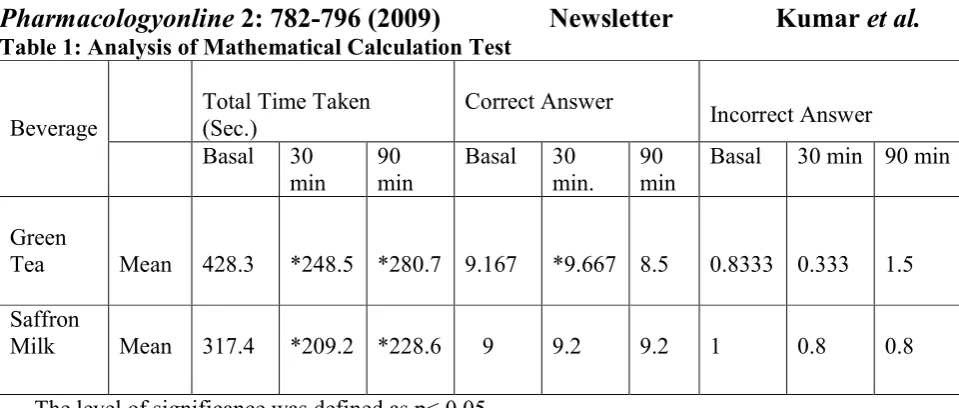
Mathematical Calculation Test: The basal time taken for solving mathematical calculation test
was 426.3 and 317.4 seconds in the groups of green tea and saffron milk respectively. This time
was reduced to 248.5 & 209.2 seconds in green tea and saffron milk respectively after 30 minutes.
The reduction in time taken to solve the mathematical calculations indicates the influence of tea
and saffron milk on performance. This was also associated with increasing alertness and to
improve physiological stamina. This effect is maintained at 90 minutes evaluation. The number of
correct summations in this test has been 9.667 and 9.2 at 30 minutes in tea and Saffron groups as
Table 1: Analysis of Mathematical Calculation Test
Total Time Taken (Sec.)
Correct Answer
Incorrect Answer Beverage
Basal 30 min
90 min
Basal 30 min.
90 min
Basal 30 min 90 min
Green
Tea Mean 428.3 *248.5 *280.7 9.167 *9.667 8.5 0.8333 0.333 1.5
Saffron
Milk Mean 317.4 *209.2 *228.6 9 9.2 9.2 1 0.8 0.8
The level of significance was defined as p< 0.05
umber Cancellation Test: The time taken to cancel the given number is decreased after green
tea consumption. However, there was no significant change in case of saffron milk consumption.
The total number of correct cancellation before and after 30 minutes of consumption of beverage
remained unchanged, however, time required to complete the test is reduced after the consumption
of tea (Table – 2).
Table 2: Analysis of umber cancellation Test
Total Time Taken (Sec.)
Total Number
Cancelled Incorrect Number Cancelled
Beverage
Basal 30 min
90
min Basal 30 min.
90
min Basal 30 min 90 min Green Tea
Mean 20.17 *15.33 *15 97.22 96.67 98.15 0 0 0
Saffron
Milk Mean
17.8 19.4 20.2 98.46 96.92 100 0 0 0
* The level of significance was defined as p< 0.05
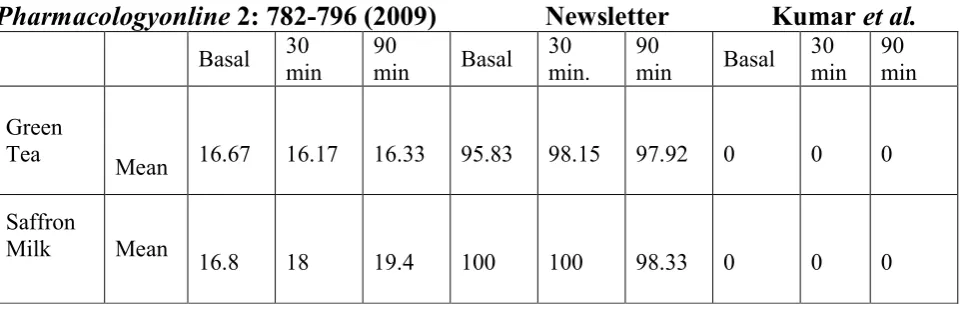
Alphabet Cancellation Test: The time taken to cancel the given alphabet in random manner is
decreased after green tea consumption; however, there was no significant change after saffron
milk consumption. The results were uniform at 30 minutes and 90 minutes (Table- 3).
Table 3: Analysis of Alphabet cancellation Test
Beverage
Total Time Taken (Sec.)
Total Alphabet
Basal 30 min
90
min Basal 30 min.
90
min Basal 30 min 90 min Green Tea
Mean 16.67 16.17 16.33 95.83 98.15 97.92 0 0 0
Saffron
Milk Mean
16.8 18 19.4 100 100 98.33 0 0 0
Upward Digit Scale Test: The analysis of upward digit test did not indicate any significant difference in memorizing synchronically the upward digits, missing numbers and incorrect numbers (Table- 4).
Table 4: Analysis of Upward Digit Scale Test
Synchrony Missing Number Incorrect Number
Beverage Basal 30 min
90
min Basal 30 min.
90
min Basal 30 min 90 min Green Tea
Mean 1.667 1 *1.833 0.8333 0.3333 0.3333 0.8333 0.6667 0
Saffron
Milk Mean
0.8 1.8 0.4 0 0.8 0.2 0.8 1 0
* The level of significance was defined as p< 0.05
Fixed Digit Test: The total score obtained in evaluation of fixed digit test showed trend towards improvisation of memory. The effects were uniform after 30 minutes and 90 minutes evaluation. The correct answers were maintained in most volunteers (Table- 5).
Table 5: Analysis of Fixed Digit Test
Total Score Correct Answer Incorrect Answer
Beverage Basal 30 min
90
min Basal 30 min.
90
min Basal 30 min 90 min Green Tea
Mean 90.63 *96.88 *97.92 7.5 *7.833 *7.833 0.5 0.1667 0
Saffron
Milk Mean
0.8 *1.8 0.4 0 0.8 0.2 0.8 1 0
Four Words Test: There was ease of memorizing four words each time at 30 minutes and 90 minutes after the consumption of beverages. It was observed that memorizing words were easier than mathematical numbers. Although, there was no distinctive difference between tea and saffron group, both had shown alertness, increasing concentration and indirectly improved the physiological and psychopharmacological performance (Table-6).
Table 6: Analysis of Four Words Test
Synchrony Missing Word Incorrect Word
Beverage Basal 30 min
90
min Basal 30 min.
90
min Basal 30 min 90 min Green Tea
Mean 100 *100 *100
0 0 0 0 0 0
Saffron
Milk Mean
100 *100 *100 0 0 0 0 0 0
* The level of significance was defined as p< 0.05
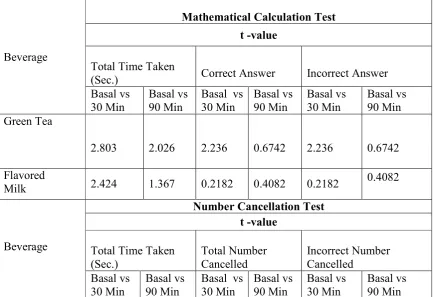
The level of significance is determined by using students paired T-test (Table - 7).
Table 7: Statistical Analysis
Mathematical Calculation Test
t -value
Total Time Taken
(Sec.) Correct Answer Incorrect Answer Beverage
Basal vs 30 Min
Basal vs 90 Min
Basal vs 30 Min Basal vs 90 Min Basal vs 30 Min Basal vs 90 Min Green Tea
2.803 2.026 2.236 0.6742 2.236 0.6742
Flavored
Milk 2.424 1.367 0.2182 0.4082 0.2182
0.4082
umber Cancellation Test t -value
Total Time Taken (Sec.) Total Number Cancelled Incorrect Number Cancelled Beverage Basal vs 30 Min Basal vs 90 Min
Discussion
The study protocol, volunteer screening format, and informed consent forms were analyzed and
approved by institutional ethics committee. It was observed in this study that compliance with both
tea and saffron milk had been excellent. There was no drop out of volunteers at any stage of the
study indicates the positive compliance. All volunteers were co-operative and there were no Green Tea
2.351 1.759 1.000 0.2545 0 0
Flavored
Milk 0.5258 1.136 1.000 1.000 0 0
Alphabet Cancellation Test
t -value
Beverage Total Time Taken (Sec.) Total Alphabet Cancelled Incorrect Alphabet Cancelled Basal vs 30 Min Basal vs 90 Min Basal vs 30 Min Basal vs 90 Min
Basal vs 30 Min
Basal vs 90 Min
Green Tea 0.4251 0.4152 0.473 0.4152 0 0
Flavored
Milk 0.5632 2.316 0 0 0 0
Upward Digit Test
t -value
Synchrony
Missing Number Incorrect Number Beverage
Basal vs 30 Min
Basal vs 90 Min
Basal vs 30 Min Basal vs 90 Min Basal vs 30 Min Basal vs 90 Min Green Tea
1.581 0.2104 1.464 1.464 1.000 1.195
Flavored
Milk 1.291 0.5898 1.372 1.000 1.000 1.177
Fixed Digit Test t -value
Total Score Correct Answer Incorrect Answer Beverage
Basal vs 30 Min
Basal vs 90 Min
Basal vs 30 Min Basal vs 90 Min Basal vs 30 Min Basal vs 90 Min Green Tea
0.9684 1.151 0 0 0.791 1.581
Flavored
summation and other two tests like cancellation of random number and random alphabet from the
chart is reduced, indicating that green tea and saffron helps to improve alertness and facilitates the
learning process. During the phase of alertness the physiological performance increases which
reflects in facilitating solving mathematical summations, ability to perform faster and better in
arithmetic number cancellation and random alphabet cancellation. The influence on performance
ability suggests improvement or facilitation of learning process. Although, analysis of results
shows only marginal level of statistical significance, this can be improved by increasing the
number of volunteers and using strict adherence to selection criterion of volunteers. The large and
broad variation performance between volunteers could be one of the factors for marginal statistical
significance as compared to clinical significance.
The experiment conducted on rats have shown that extract of green tea significantly improves the
learning and memory in terms of increased retention latency to enter difference in passive
avoidance test in the elevated maze test and more number of entries in the enclosed arm
constituents of green tea prevent obstructive sleep apnea which causes cognitive deficits (1).
Green tea polyphenols possesses anti-oxidant properties and act as free radical scavengers.
Experimental studies conducted in rats demonstrated that green tea polyphenols had better
memory and performed better in the maze test.
In another set of experimental studies the improvement of long term memory has been seen in
rats. The rats were able to find and perform faster after treatment with caffeine; increase in
memory retention was also present (2).
In human study it was shown that caffeine possesses cognition enhancing property. The result in
our study on volunteers with green tea consumption shows improvement on functional cognitive
performance. This could be the effect of transient stimulation of higher functions related to
physiological and psychological performance similar to that of caffeine (3).
The beneficial effects of Green Tea are attributed to polyphenols, particularly catechins. The
catechins have potential antioxidant properties which scavenge reactive oxygen species. This
could be beneficial in prevention of neuronal degeneration (4).
Recent studies have shown the memory enhancing properties of saffron extract. The saffron
extract or its active constituents, Crocetin and Crocin may benefit the people suffering with
neurodegenerative disorders accompanying memory impairment (5 and 6) In a study conducted in
hemorrhagic rats. Crocin had improved the cerebral oxygenation. (7).
Kaur Tranum and his colleagues studied the effects of green tea extract administration on
age-related cognition in young and old male Wistar rats. Young and old rats were orally administered
0.5% green tea extract for a period of eight weeks and were evaluated by passive avoidance,
elevated maze plus paradigm and changes in acetyl cholinesterase activity. Treatment of young
and old rats with the extract resulted in no significant difference in performance on the rota rod
treadmill test/righting reflex time. Green tea extracts significantly improved learning and memory
in older rats, with increased retention latency to enter difference in passive avoidance test. In the
elevated maze test, green tea treatment resulted in significantly more number of entries in the
enclosed arm by the young and old rats. Decline in acetyl cholinesterase activity was observed in
the cerebrum of green tea treated old rats in comparison to the green tea treated young rats. Green
tea extract administration is effective in enhancing learning and memory in aged rats, and hence,
may serve useful in reversing age-related deficits (1).
The benefits of tea in memory improvement has been reviewed and quoted by many scientists. It
has been found that both green and black tea inhibited the activity of enzymes associated with the
development of Alzheimer's disease, but coffee had no significant effect. Both teas inhibited the
activity of the enzyme acetyl cholinesterase (AChE), which breaks down the chemical messenger,
or neurotransmitter, acetylcholine; thus can be improve the memory in Alzheimer's disease which
is characterized by a drop in acetylcholine. Green tea went one step further in that it obstructed the
activity of beta-secretase, which plays a role in the production of protein deposits in the brain
which are associated with Alzheimer's disease. Scientists also found that it continued to have its
inhibitive effect for a week, whereas black tea's enzyme-inhibiting properties lasted for only one
day. It also decreases neuronal loss due to polyphenols (-)-epigallocatechin-3-gallate (MPTP),
which is a potent neurotoxin that specifically affects dopamine production and receptors. Green
tea only exhibits antioxidative properties at relatively low concentrations and at high
concentrations can actually prove to be pro-oxidative. (8 and 9) studied the effect of Crocus sativus in rats by using the object recognition and the step-through passive avoidance task. The
post- training administration of CSE (Crocus sativus extract) (30 and 60 g/kg) successfully
counteracted extinction of recognition memory in the normal rat, suggesting that CSE modulates
storage and/or retrieval of information. In a subsequent study, pre-training treatment with CSE (30
and 60 mg/kg) significantly antagonized the scopolamine (0.75 mg/kg)-induced performance
deficits in the step-through passive avoidance test. These results support findings about the
memory impairments in different behavioral tasks in the rat. investigated the effects of saffron
extract and its ingredients on learning behaviors and long-term potentiation (LTP). Oral
administration of Crocus sativus L. extract (CSE) antagonized both ethanol-induced memory
impairment and ethanol-induced suppression of LTP generation. It was concluded that Crocin was
the main active component in the CSE, with regards to both learning performance and LTP
generation, and its pharmacological action was triggered via modulation of the central NMDA
receptors. The results suggested that crocin improved learning deficits by attenuating the
inhibitory effect of ethanol on LTP generation, and highlighted the possibility that crocin is a
candidate for an ethanol-induced central nervous system disorders. The researchers proposed
saffron constituents’ involvement in learning and memory processes. They investigated the effects
of Crocin on recognition and spatial memory in the rat (10). For this aim, they had used: the object
recognition task which evaluates non-spatial working memory and a novel version of the radial
water maze which assesses spatial reference and spatial working memory. Crocin counteracted
delay-dependent recognition memory deficits in the normal rat, suggesting that these carotenoids
modulate storage and/or retrieval of information. In a subsequent study, treatment with Crocins
attenuated scopolamine induced performance deficits in the radial water maze test. The results
support and extend the enhancing effects 45 of Crocin on memory and, then, to our knowledge, for
the first time, demonstrate its implication in the mechanisms underlying recognition and spatial
memory
Acknowledgments
The authors are thankful to head of the department of Pharmacology for permitting to conduct this
study in the academic set up. We also thank our dean, SPTM for getting us permission to publish
this research work
References
1. Kaur Tranum, Pathak C.M., Pandhi P., Khanduja K.L. Effects of green tea extract on learning, memory, and behavior and acetyl cholinesterase activity in young and old male rats. Brain and Cognition 2008; 67:25–30.
2. Angelucci1.M.E.M., Cassario C, Rosalen P.L., and Da Cuhna, C. Effects of caffeine on learning and memory in rats tested on the Morris water maze, Brazilian Journal of medical and biological research.2002; (35): 1201-1208.
3. Gilles and Luthringer J. Pharmacological models in healthy volunteers: their use in the clinical development of psychotropic drugs .Psychopharmacology. 2007; 21: 272-282
5. Hosseinzadeh H. Safranal, a constituent of Crocus sativus (saffron),
attenuated cerebral ischemia induced oxidative damage in rat hippocampus. J Pharm Pharm Sci. 2005; 8 (3):394-9.
6. Giaccio M.. Crocetin from saffron: An active component of an ancient spice. Crit. Rev. Food Sci. Nutr. 2004; 44 (3): 155-72.5.
7. Carmen Cabrera, Reyes Artacho, Rafael Giménez. Beneficial Effects of Green Tea-A Review. Journal of the American College of Nutrition. 2006; 25(2): 79-99.
8. Tampa F. L. Green Tea Ingredient Prevents Alzheimer's-like Brain Damage In Mice, Science Daily 2005.
9. Sherry Baker. Green Tea Compounds Prevent memory Loss from Lack of Oxygen. Natural News.com. 2008.
10. Nikolaos Pitsikas Nikolaos Sakellaridis. Crocus sativus L. extracts antagonize memory
impairments in different behavioral tasks in the rat. Behavioural Brain Research, 2006; 173(1):112-115.