IJIRSE/Vol 3. Iss. 7/ Page 295
Texture Feature Based Local Binary Pattern for Smile
Recognition
P.Narendra Kumar1, Y.Devaraju2 1
PG Student, 2 Lecturer,
Dept. of ECE, Dr. SGIET College of Engg., Markapur, Andhra Pradesh, India. E-Mail: [email protected]
Abstract- Automatic facial expression recognition has become very popular now days due to its applications in friendly human machine interface. In this paper we propose a feature named Local Binary Pattern (LBP). For facial Feature recognition LBP is the most prominent texture classification feature. By using LBP method we are going to recognize the Smile in the faces. Smile expression represents the happy expression in the face. Hence, by using LBP method we can recognize the smile in the faces of the persons. There are several expressions present in the faces like happy, sad, dull, surprise etc.., in all these we recognize the smile face nothing but the happy face. Local Binary Pattern (LBP) uses two binary values i.e 1 and 0, 1 represents the fore-ground and 0 represents the Back-ground . It discriminates bright object against dark back-ground vice-versa. It is very simple to implement and it is robust to small fluctuations in the pixel values. It is very efficient in recognizing the facial features. But this LBP is not resistant to noise. Hence , this paper extends Local Binary Pattern (LBP) to Local Ternary Pattern (LTP) which is robust to noise. It uses three values 0,1,-1 in which 0 represents foreground, 1 represents Back-ground and -1 represents Noise in the image and gives excellent results when compared with the LBP. Experiments have been done on standard databases .
Keywords: Fisher-faces, LDA, DRLTP, FLTP, Emotions and Decision making
I. INTRODUCTION
Face recognition plays an important role in our daily lifes in decision making system which has been widely used to identify criminals at various places providing security. Face recognition is an interesting and challenging task and is used in peoples everyday life ranging from identifying criminals providing security and surveillance systems to smart phones, smart homes and intelligent digital photography, biometrics etc.., Facial expression recognition is playing prominent role in pattern recognition, computer vision, artificial intelligence and other fields. Most important expression in the face is “SMILE” Several applications are running in now a days.one of the application is detecting the smiles when taking photos. Here, we can extract the features of a human faces by two methods. One of the method is Geometric feature based method and other is Appearance based method. In Geometric feature method it utilizes the shape of the face-components like mouth, Eyepair,nose..,etc where as in appearance based method image filters are applied to whole face or certain area to extract only particular features like eyebrows, Left Eye , Right Eye ..,etc . In Smile Recognition we go for the mouth feature by using LBP and LTP methods.
In this Paper, we are proposing two methods LBP and LTP. These methods are mainly used to extract the mouth feature in the human faces inorder to recognize the Smile. Different Types of Smiles like Big Smile, Cute Smile, Small smile. Human faces exhibit different kinds of smile. Smile face is similar to the happy face. Hence, by using Proposed methods LBP and LTP we are distinguishing between Smile and NON-Smile faces. Non-Smile represents the different facial expressions of human faces like sad, disgust, surprise, Anger,Fear except happy expression. From happy faces we are extracting the mouth features which represents Smile expression. From other expressions we can represent the NON-Smile Faces.
II. LBP OPERATOR
IJIRSE/Vol 3. Iss. 7/ Page 296 neighbour value , if x greater than gc considered S(x) as 1 else 0.
∑ (gc-gp) 2p
Pattern=01000111=1+2+4+64=7
Fig. 1 computing LBP value
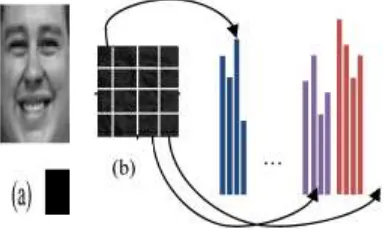
Here, a Face image taken and LBP operator is applied the result of the pixel values are tableted in the matrix. Each pixel is represented by 3X3 matrix. Based on the threshold values neighbor hood values are taken , Later the Binary values are converted in to decimal number. Face image consists of different colors. LBP is very simple to implement and also it is roubust to small variations in the pixel values. But , this LBP is Sensitive to noise
Fig. 2 Extraction of LBP features
III. LOCAL TERNARY PATTERN
IJIRSE/Vol 3. Iss. 7/ Page 297
Fig. 3 computing LTP values
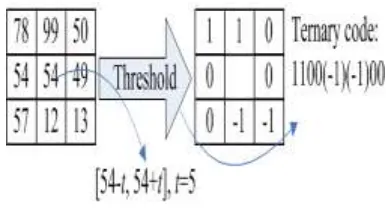
According to the LTP definition , we are taking a Smile Image for that LTP operator is applied , Center pixel taken as threshold value. Based on that neighbourhood values are taken. Here, -1 represents noise, 1 represents foreground and 0 represents background.
Fig. 1 computing LTP value
Ternary code: 1(-1)01(-1)(-1)11
Here, also binary values are convereted into decimal value and placed in that pixel in an image.LTP is very efficient in face-recognition. It is also very simple to implement and robust to small fluctuations in the pixel values. When compared with LBP, LTP method gives better results and noise is also very less in LTP when compared with LBP.
IV. EXPERIMENTALRESULTS AND ANALYSIS:
In experiment of this paper we have taken five databases images which consists both smile images and NON SMILE images. For those SMILE and NON-SMILE images we are going to apply the proposed operaters that is LBP and LTP. Results have tablated and graphs has been drawn on the values. From the Graph it has shown that LTP operator distinguishes between SMILE and NON-SMILE images clearly when compared with the LBP operator. Hence, the LTP operator has given better performance than LBP on the standard databases. By using our proposed methods , recognition of smile becomes very simple to implement. The graphs of LBP and LTP distinguished the Smile and Non Smile images very clearly.
20
30 8
12 11 6
4
11 31
IJIRSE/Vol 3. Iss. 7/ Page 298
SMILE
DataBases
Mouth
LBP
LTP
0.8495 0.5174
0.8267 0.5045
0.5701 0.4591
0.5629 0.4799
0.6483 0.4555
0.6289 0.4539
0.8173 0.5963
0.7937
0.6011
0.6148 0.4059
IJIRSE/Vol 3. Iss. 7/ Page 299 NON-SMILE DATABASES
Comparision of SMILE and NON SMILE IMAGES USING LBP
Table:1
Graph-1
Comparision of SMILE AND NONSMILE IMAGES USING LTP 0
5000 10000 15000
1 2 3 4 5
NONSMIL E
SMILE
LBP
LTP
5031
5723
5157
4999
4531
4239
4751
4077
IJIRSE/Vol 3. Iss. 7/ Page 300
5109
5723
4695
4999
4547
4239
5030
4077
4051
5566
Table:2
Graph-2
V. CONCLUSIONS
In this paper Texture Feature Based Local Binary Pattern for Smile Recognition is developed. As a system it recognizes the smile faces in the group of several face images in a photo. Because the proposed method distinguishes between the Smile Faces and Non-Smile faces easily. In the experiment analysis we are giving the faces of five databases which consists both Smile and Non-Smile faces. Later, proposed methods are applied to the faces which gives the mouth feature values in the faces. Values has been tabulated for both LBP and LTP methods. Graphs has drawn for both the methods. LTP method shown the better results than the LBP. But this paper can’t find the intenssional Smile expressions in the face. In future we can extend our paper to intenssional Smile expressions in the human faces.
REFERENCES:
[1] timo ahonen, abdenour hadid, matti pietikainen, face description with local binary patterns: application to face recognition, ieee transactions on pattern analysis and machine intellligence,VOL.28, No.12, DECEMBER 2006
[2]XIAOYANG TAN AND BILL TRIGGS,ENHANCEDLOCALTEXTUREFEATURESETSFORFACERECOGNITIONUNDERDIFFERENT
LIGHTNINGCONDITIONS,IEEESTUDENTJOURNAL2007
[3] Jo Chang-yeon, FACE DETECTION USING LBP FEATURES, CS 229 STUDENT JOURNAL DECEMBER 12, 2008
[4] Caifeng Shan, Shaogang Gong , Peter W.McOwan, FACIAL EXPRESSION RECOGNITION BASED ON LOCAL BINARY PATTERNS: A COMPREHENSIVE STUDY, IMAGE AND VISION COMPUTING 27(2009) 803-816
[5]Faisal Ahmed, Emam Hossain, A.S.M Hossain Bari and ASM Shihavuddin, COMPOUND LOCAL BINARY PATTERN(CLBP) FOR ROBUST FACIAL EXPRESSION RECOGNITION, CINTI 2011.12TH IEEE INTERNATIONAL SYMPOSIUM ON COMPUTATIONAL INTELLIGENCE AND INFORMATICS 21-22 NOVEMBER,2011, BUDAPEST,HUNGARY.
[6]Shervan Fekri Ershad ,TEXTURE CLASSIFICATION APPROACH BASED ON COMBINATION OF EDGE & CO-OCCURRENCE AND LOCAL BINARY PATTERN, Int’l Conf.IP,Comp.Vision, and Pattern Recognition|IPCV’11|2011
[7]Yang Zhao, Wie Jia ,Rong-Xiang Hu, Hai Min, COMPLETED ROBUST LOCAL BINARY PATTERN FOR TEXTURE CLASSIFICATION, IEEE Neuro Computing 106(2012) 68-76.
[8]Emir Kremic, Abdulhamit Subasi, and Kemal Hajdarevic, FACE RECOGNITION IMPLEMENTATION FOR CLIENT SERVER MOBILE APPLICATION USING PCA,it 2012 34TH Int.Conf.on Information Technology Interfaces,June 25-28,2012,Cavtat,Croatia.
0 2000 4000 6000 8000 10000 12000
1 2 3 4 5
NON-SMILE
IJIRSE/Vol 3. Iss. 7/ Page 301
[9]Zhe Wei , Yuan Dong ,Feng Zhao,Hongliang Bai, FACE DETECTION BASED ON MULTI-SCALE ENHANCED LOCAL TEXTURE FEATURE SETS, IEEE Students Journal 2012
Authors Profile:
P.Narendra Kumar received B.Tech Degree in Electronics & Communication Engineering from AVS College of Engineering and Technology, Nellore in 2006. Currently he is pursuing M.Tech at Dr.SGIET Engg College, Markapur. His research interests include Smile Recognition Based on Face Texture and Mouth Shape Features.