EVALUATING CONSUMER TRUST USING TOPSIS AND VIKOR METHODS IN
Shanmukha Satya Narayana
Department of Information Technology, Sree Vidyanikethan Engineering College, Tirupati, AP, India
A R T I C L E I N F O
INTRODUCTION
There are some techniques done on many Multi Criteria Decision Making methods like TOPSIS, ELECTRE, VIKOR and AHP etc. for user to make the trusted requirements, although these have many works using this methods, it is very confuse and tough to understand that all are timely tested and reliable in several situations. In most of those methods are implemented to include a synthetic data with the dataset of past values. In this paper we concentrate on the instance based outcomes of the cloud service providers. To im
choose the most likely methods – TOPSIS and VIKOR for the service i.e., Infrastructure as a Service (IaaS) clouds is selected. There are two steps involved in these initially we divide inputs in two directions one by altering and taking the functional requirements and other the weights are assigned. All these are implemented by using the Cloud Analyst simulation tool.
Existing System
In the existing system it has been proved the reliability and tested with several changes. This model may work
continued in the research. In other conditions, an existing system introduces with the set of drawbacks and problems. Hence here we have a some thesis of improving and make the run system better.
International Journal of Current Advanced Research
ISSN: O: 2319-6475, ISSN: P: 2319-6505,
Available Online at www.journalijcar.org
Volume 7; Issue 6(K); June 2018; Page No.
DOI: http://dx.doi.org/10.24327/ijcar.2018
Copyright©2018 Shanmukha Satya Narayana M and Venkateswara Reddy L
Commons Attribution License, which permits unrestricted use, distribution, and reproduction in any medium, provided the origi cited.
*Corresponding author: Shanmukha Satya Naraya Department of Information Technology, Sree
Vidyanikethan Engineering College, Tirupati, AP, India 517102
Article History:
Received 12th March, 2018 Received in revised form 24th April, 2018 Accepted 5th May, 2018 Published online 28th June, 2018
Key words:
Cloud computing, Trustworthiness, Trust evaluation system, SLA, Quality of Service (QoS) parameters.
EVALUATING CONSUMER TRUST USING TOPSIS AND VIKOR METHODS IN
CLOUD ANALYST TOOL
Shanmukha Satya Narayana M* and Venkateswara Reddy
of Information Technology, Sree Vidyanikethan Engineering College, Tirupati, AP, India
A B S T R A C T
Cloud Computing is most interesting research area and find new enhancements
of consumer on the cloud data. At show, there is no trust assessment framework that enables CCs to assess the dependability of CSPs based on their adherence to the SLA i.e., Cloud computing has been joined in relatively every overlap of client
all the more difficult turns into the universe of an asset buyer, so does the plenty of various cloud merchants. Each merchant attempts to auction their administrations with various attractions. Some of them are free, some as pay-as-you
contract structures. With such a significant number of decisions accessible to an irregular client, settling on the correct decision about the sort of seller is a pivotal choice. We exhibit in this paper novel techniques for cloud benefit determination. The strategy gets from the conventional choice strategies with accentuation on client criteria weights. In born correlations have been directed among the different techniques to help in dissecting and finishing specialist design for choice of the best specialist organization among the battling cloud merchants.
are some techniques done on many Multi Criteria Decision Making methods like TOPSIS, ELECTRE, VIKOR and AHP etc. for user to make the trusted requirements, although these have many works using this methods, it is very ll are timely tested and reliable in several situations. In most of those methods are implemented to include a synthetic data with the dataset of past values. In this paper we concentrate on the instance based outcomes of the cloud service providers. To implement, we TOPSIS and VIKOR for the service i.e., Infrastructure as a Service (IaaS) clouds is selected. There are two steps involved in these initially we divide inputs in two directions one by altering and taking the ctional requirements and other the weights are assigned. All these are implemented by using the Cloud Analyst simulation
In the existing system it has been proved the reliability and tested with several changes. This model may work or is being continued in the research. In other conditions, an existing system introduces with the set of drawbacks and problems. Hence here we have a some thesis of improving and make the
For the structure of the project, the existing systems have the three modules. As the whole model is based on cloud computing, finally we say that it has two main ways
Service Providers (CSPs) and Cloud Users (CUs). Visually Cloud Service Provider manages cloud services like hosting, service setup, storage, application setup etc. the other way which the cloud user is who take those servi
free of cost. Present the mediator between these two makes a broker in the middle i.e., third party services such as Amazon, Google, IBM etc. The merchant is basically an outsider, which manages collection - uniting all the required adm
the client under one standard, de
excess information accessible in the cloud information sets and security - by giving a confided in condition to clients to transfer their applications.
The dealers themselves are subjected to confide in assessment as they are outsider and have their own particular pick up as essential goal. Some Service Level Assertion arrangements are likewise done by agents by drawing up an agreement with both the gatherings. The current fra
representatives for every such action is additionally stretched out for the standard administration choice issue. The cloud benefit choice issue is a multi criteria issue with numerous decisions. Subsequently it is done in numerous lay
the representative approaches amassing the measurements from the cloud specialist co-ops, the informational index winds up immense in nature. From that point the specialists applies any of the different criteria choice displaying strategies like TOPSIS, VIKOR, AHP and so forth to through its product and
International Journal of Current Advanced Research
6505, Impact Factor: 6.614
www.journalijcar.org
; Page No. 13841-13847
//dx.doi.org/10.24327/ijcar.2018.13847.2486
Shanmukha Satya Narayana M and Venkateswara Reddy L. This is an open access article distributed under the Creative Commons Attribution License, which permits unrestricted use, distribution, and reproduction in any medium, provided the origi
Shanmukha Satya Narayana M Department of Information Technology, Sree
Vidyanikethan Engineering College, Tirupati, AP,
India-EVALUATING CONSUMER TRUST USING TOPSIS AND VIKOR METHODS IN
Venkateswara Reddy L
of Information Technology, Sree Vidyanikethan Engineering College, Tirupati, AP, India-517102
Cloud Computing is most interesting research area and find new enhancements in the trust of consumer on the cloud data. At show, there is no trust assessment framework that enables CCs to assess the dependability of CSPs based on their adherence to the SLA i.e., Cloud computing has been joined in relatively every overlap of client's present reality. As all the more difficult turns into the universe of an asset buyer, so does the plenty of various cloud merchants. Each merchant attempts to auction their administrations with various you-go administrations and some at contract structures. With such a significant number of decisions accessible to an irregular client, settling on the correct decision about the sort of seller is a pivotal choice. We exhibit for cloud benefit determination. The strategy gets from the conventional choice strategies with accentuation on client criteria weights. In born correlations have been directed among the different techniques to help in dissecting and esign for choice of the best specialist organization among the battling
For the structure of the project, the existing systems have the three modules. As the whole model is based on cloud that it has two main ways – Cloud Service Providers (CSPs) and Cloud Users (CUs). Visually Cloud Service Provider manages cloud services like hosting, service setup, storage, application setup etc. the other way which the cloud user is who take those services by paying or at free of cost. Present the mediator between these two makes a broker in the middle i.e., third party services such as Amazon, Google, IBM etc. The merchant is basically an outsider, which uniting all the required administrations of the client under one standard, de-duplication - by exculsion of excess information accessible in the cloud information sets and by giving a confided in condition to clients to
are subjected to confide in assessment as they are outsider and have their own particular pick up as essential goal. Some Service Level Assertion arrangements are likewise done by agents by drawing up an agreement with both the gatherings. The current framework that utilizes representatives for every such action is additionally stretched out for the standard administration choice issue. The cloud benefit choice issue is a multi criteria issue with numerous decisions. Subsequently it is done in numerous layers. While the representative approaches amassing the measurements ops, the informational index winds up immense in nature. From that point the specialists applies any of the different criteria choice displaying strategies like TOPSIS, VIKOR, AHP and so forth to through its product and
Research Article
sift through the best cloud administrations. This framework considers information measurements gathered over a period of time as entirety. From that point the choice displaying is connected to the whole informational index and result is created. This framework requires upkeep of tremendous database which holds the criteria measurements. The averaging of the weighted criteria technique actualized is essentially exceptionally broad in nature. It has an credit of advantages and disadvantages.
MCDM Model
When with regards to the cloud benefit choice issue, we manage different merchants with numerous administrations and fluctuated client preferences. Thus they consequently fall into the MCDM class. Likewise with any MCDM problem, we can have various methodologies like MAUT strategies, AHP, French Outranking techniques and Russian ordinal methods. Every method has its solid and feeble territories. While a few strategies function admirably with little informational collection, some are exceptionally compelling with large data sets like that of a cloud specialist organization. If we somehow happened to take a non specific case of cloud benefits alongside the client needed criteria, at that point with the incorporation of client inclination the issue of cloud benefit choice turns out to be exceptionally difficult.
Additionally another essential factor is the thought of these viewpoints both continuously and furthermore past performance. At the point when a correlation is made between mists, it is very liked to have a trust consider constructed the choice. This factor can be gotten by watching the execution of the said criteria over some stretch of time and not in an instant. For doing this, we need to small scale compute the best cloud benefits in parts i.e., one example of a period. This strategy keeps the determination more precise in contrast with the choice from the normal informational index esteems.
To summarize, regardless of numerous MCDM techniques connected to cloud benefit choice, the consistently changing nature of mists and their nature of administration criteria with time has not been fused adequately. Subsequently the current methodologies are definitely not totally precise in deciding the best specialist organization. This paper thinks about the diverse parts of time in past and exhibit. While MCDM techniques are the most appropriate to deal with multi criteria problems, they themselves are wasteful in giving ongoing responses to client prerequisite. Tests done to approve our technique and result are a wise, creative and pragmatic method for getting the cloud determination from client perspective.
Proposed Model
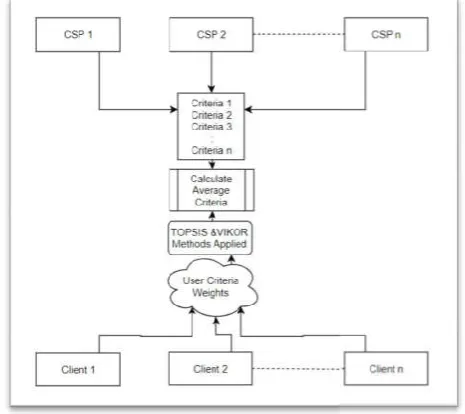
The proposed model shows straightforward as far as the segments included. To begin with we have the figuring condition with various cloud Datacenters. These can be considered as either cloud specialist organizations or cases of CSPs. These are recreated as an IaaS with center registering characteristics. They are in charge of distributing their administrations and individual standards. This administration related data is put away in a database for additionally utilize. Next we have the client aggregate who brings likely to work out by determining which criteria of the administration are of significance to them. This can be acknowledged with either relegating weights with difference technique or by fluffy weights by asking the client his/her level of significance of
every paradigm in connection to other. In the middle of these 2 classes we have the principle chief - the agent who is in charge of utilizing the basic leadership calculation to get us the best administration as the outcome. Conventional strategies include basic idea of taking a flat out normal of all criteria esteems and applying MCDM to it, anyway extremely acknowledged, this strategy isn't free of blemishes when managing a colossal informational collection of criteria esteems over an impressively significant lot. Any Cloud supplier can change with its administrations over some undefined time frame. We may have a confided in cloud server to perform inadequately in the ongoing past or the other way around. With a specific end goal to get the most unprejudiced measure of the considerable number of criteria, it is basic to give more weight age to the ongoing past. We can burrow further and ascertain the best supplier on quarter hourly or hourly premise, anyway with the enormous measure of information delivered, and referring to no real changes like the share trading system, consistent schedule is sufficiently adequate. Once the subtle elements of the CSPs are gotten, the clients are requested to say something the criteria according to their need. From that point any of the MCDM calculations specified underneath are connected to get the best administration for day by day set of qualities. For this examination we have picked 2 MCDM calculations-TOPSIS and VIKOR. The two have demonstrated their proficiency and worth in the territory of multi criteria basic leadership.
Advantages of Proposed System
The drawback of typical weighted normal technique for being delicate to outrageous qualities, is overwhelmed by computing case based midpoints as opposed to normal of the entire framework. Particularly when prompting flow of cloud, we go over outrageous qualities which when found the middle value of in general can give a conflicting worth.
Not at all like typical normal technique this proposed strategy is most appropriate for time arrangement sort of information. The idea of time arrangement information comes into picture where there is assorted variety and unpredictability is included. This kind of information which is natural to the cloud stage, is most appropriate to be computed occasion based instead of as a package.
The proposed strategy works not withstanding when all qualities are not similarly essential. Particularly with regards to mists, we have measurements of criteria running over a wide region. Thus not all are similarly imperative. The criteria have their significance set apart by the client given weight. Contingent upon client inclination, the weights are relegated to the measurements. Subsequently the proposed technique is most suited for unequal informational collections.
Proposed technique works quicker in contrast with the current strategy as the normal is computed on a littler example of information and collected.
Architecture
distributing their administrations and individual standards. This administration related data is put away in a database for additionally utilize. Next we have the client bunch that brings likely to work out by indicating which a criterion of the administration is of significance to them. This can be figured it out with either doling out weights with change strategy or by fluffy weights by asking the client his/her level of significance of every basis in connection to other. In the middle of these 2 classes we have the primary leader – the agent who is in charge of utilizing the basic leadership calculation to get us the best administration as the outcome. Customary strategies include straightforward idea of taking an outri
criteria esteems and applying MCDM to it, anyway extremely acknowledged, this technique isn't free of blemishes when managing a tremendous dataset of criteria esteems over a extensively significant lot. Any Cloud supplier can change with its administrations over some stretch of time. We may have a confided in cloud server to perform in effectively in the ongoing past or the other way around. With a specific end goal to get the most impartial measure of the considerable number of criteria, it is basic to give more weightage to the ongoing past.
Figure 1 Architecture of the proposed model.
Stages of proposed system model
Stage 1: Setting the Cloud
This stage involves setting up an assessment framework which notwithstanding genuine, at least imitates the first cloud condition. For the assessment of the proposed framework, a reenactment domain has been formulated. This has been figured it out utilizing instrument called Cloudsim. This device utilizes great java based question structure for cloud setup. Significant part of this apparatus is the accessibility of little classes which reconnects datacenters, hosts, virtual machines etc. To begin with there is a cloud data benefit. It is a registry which has the assets recorded in cloud. After registry of all the unmistakable articles, person datacenters are made. Datacenters are synonymous to mists themselves. Has under each datacenter has a few hosts, which has some equipment qualities. Next there will be virtual machines which perform cloud related errands. An intermediary is in charge of assigning undertakings to datacenter. This is finished utilizing the facilitating strategy which takes after any of the calculations accessible. The employments themselves are distributing their administrations and individual standards. This administration related data is put away in a database for additionally utilize. Next we have the client bunch that brings which a criterion of the administration is of significance to them. This can be figured it out with either doling out weights with change strategy or by fluffy weights by asking the client his/her level of significance r. In the middle of these 2 the agent who is in charge of utilizing the basic leadership calculation to get us the best administration as the outcome. Customary strategies include straightforward idea of taking an outright normal of all criteria esteems and applying MCDM to it, anyway extremely acknowledged, this technique isn't free of blemishes when managing a tremendous dataset of criteria esteems over a extensively significant lot. Any Cloud supplier can change its administrations over some stretch of time. We may have a confided in cloud server to perform in effectively in the ongoing past or the other way around. With a specific end goal to get the most impartial measure of the considerable number it is basic to give more weightage to the ongoing
Architecture of the proposed model.
This stage involves setting up an assessment framework which notwithstanding genuine, at least imitates the first cloud condition. For the assessment of the proposed framework, a reenactment domain has been formulated. This has been g instrument called Cloudsim. This device utilizes great java based question structure for cloud setup. Significant part of this apparatus is the accessibility of little classes which reconnects datacenters, hosts, virtual machines is a cloud data benefit. It is a registry which has the assets recorded in cloud. After registry of all the unmistakable articles, person datacenters are made. Datacenters are synonymous to mists themselves. Has under h has some equipment qualities. Next there will be virtual machines which perform cloud related errands. An intermediary is in charge of assigning undertakings to datacenter. This is finished utilizing the facilitating strategy which takes after any of the few calculations accessible. The employments themselves are
called cloudlets, which are appointed to virtual machines/datacenter by intermediary.
Stage 2: Selection of Average Model
This stage comprises of the choice of the primary strategy for approach. As said before, there as of now exists a framework with normal weighted based choices. Remembering their confinements, where the pertinence of time isn't mulled over, another technique has been concocted. In this strategy, the time is of quintessence. The more distant let's get this show on the road go into the past, the weightage factor lessens. This marvel of wveight rot can be found in all frameworks which construct their choices in light of aggregate time based measurements. This rot can be ascertaine
logarithmically according to necessity. In the new strategy, the measurements are subjected to estimation in light of the occurrence chose. Example can be any single perspective, weeks, days, hours, minutes and so on. To portray the way framework works, a client is offered access to the alternative to choose any of the model required
weighted or example weighted.
Stage 3: MCDM Algorithm selection stage
After the model is chosen, subsequent stage is to choose th choice algorithm. With the end goal of this assessment Topsis and Vikor have been chosen. They have both demonstrated their value in getting the best choice out of the colossal datasets of information. Two choices have been given for examination of results and information with the goal that both the calculations can be connected freely and assessment is done decently. Out of the 2 which should be connected is again sole choice of the client. To these calculations we feed the cloud metric information with client inclinations, weight rot and so forth. These perform standardization of the measurements and ascertain the positioning of the cloud specialist co-ops as result.
Figure 2 Flowchart of Proposed model
Stage 4: Selection of Cloud
The result derived from the before steps becomes the base for the user decision. The clouds are chosen and given priority in the result. This is the last step of the total implementing procedure. The output may vary based on the method used or based on the MCDM algorithms
user vary every present and future, resulting in the changes of outcome results.
called cloudlets, which are appointed to virtual machines/datacenter by intermediary.
Stage 2: Selection of Average Model
This stage comprises of the choice of the primary strategy for . As said before, there as of now exists a framework with normal weighted based choices. Remembering their confinements, where the pertinence of time isn't mulled over, another technique has been concocted. In this strategy, the e more distant let's get this show on the road go into the past, the weightage factor lessens. This marvel of wveight rot can be found in all frameworks which construct their choices in light of aggregate time based measurements. This rot can be ascertained stochastically or logarithmically according to necessity. In the new strategy, the measurements are subjected to estimation in light of the occurrence chose. Example can be any single perspective, weeks, days, hours, minutes and so on. To portray the way the framework works, a client is offered access to the alternative to choose any of the model required - either the normal weighted or example weighted.
Stage 3: MCDM Algorithm selection stage
After the model is chosen, subsequent stage is to choose the choice algorithm. With the end goal of this assessment - Topsis and Vikor have been chosen. They have both demonstrated their value in getting the best choice out of the colossal datasets of information. Two choices have been given ults and information with the goal that both the calculations can be connected freely and assessment is done decently. Out of the 2 which should be connected is again sole choice of the client. To these calculations we feed the h client inclinations, weight rot and so forth. These perform standardization of the measurements and ascertain the positioning of the cloud
Flowchart of Proposed model
Algorithms
TOPSIS - Technique for Order of Preference by Similarity to Ideal Solution This technique as delineated in calculation Fig.3. works by computing the geometric separation from the perfect arrangement. It takes into account the heaviness of every paradigm, normalizing it and afterward deciding the separation to perfect arrangement. Straight Normalization is performed to the metric information. The Technique for Order Preference by Similarity to Ideal Solution (Hwang and Yoon, 1981) recognizes the best option among the one having the most brief separation from perfect arrangement. This strategy computes the remove from the perfect option and the separation from negative choice consolidating the most exceedingly awful exhibitions of choices concerning the single rule. This strategy does not have numerous checks for worthiness when contrasted with different strategies. The real favorable position of this technique is the acceptability of different sorts of criteria and different kinds of metric in shifted ranges. TOPSIS beats different techniques by being basic and direct. It utilizes euclidean separation strategy to ascertain the separation, subsequently separating amongst individual and aggregate fulfillment.
Algorithm 1: TOPSIS algorithm
1. procedure TOPSIS
2. Identify the alternatives € N 3. for xij € R (m,n) of m*n do,
4. obtain xij where i=1,2,..,m, j= 1, 2,.n
5. end for
6. for xij € R(m,n), i =1 to i = m and j =1 to j= n do
7. Calculate NM*ij = NMij/√∑ M2ij
8. end for
9. calculate variance of weights Vj = (1/n) ∑ (NM*ij-
(NM*ij)mean )2
10. for i=1 to i=m do
11. obtain weights W j = V j/ ∑ j and ∑ j =1
12. end for
13. for i=1 to i = m and j=1 to j = n do
14. Calculate Weighted normalized matrix WV ij = Wj *
NMi
15. end for
16. Evaluate best and worst ideal solutions as 17. A+ = {a+1,…a
+
m}i.e., (max WVij)|(min WVij)
18. A- = {a-1,…a-m}i.e., (min WVij)|(max WVij)
19. Consider separation of each alternative from A+ and A -as below
20. R+i = √∑ ( aij – a+j)2
21. R-i = √∑ ( aij – a-j)2
22. Obtain similarity Index SI*i =R-i /(R+i+R-i)
23. end procedure
VIKOR-Vise Kriterijumska Optimizacija Kompromisno Resenje
The technique Algorithm Fig.4. is that it chooses the bargained arrangement among alternate options. Here the positioning is done utilizing well ordered checking where first best choice is contrasted with second best alternative. It is likewise contrasted with the by and large best option. Thus it rejects the arrangement if these checks are not passed. Anyway it might give the arrangement of bargain on the off chance that required. This technique works brilliantly with clashing criteria. Particularly where criteria has been for some time
drawn and choosing the best among such huge numbers of various variable criteria makes this the most valuable strategy. Anyway since it does checking well ordered, it turns out to be exceptionally likely that the final product might be without arrangement. This strategy is once in a while stretched out to be utilized with other such techniques like Analytic Hierarchy Process (AHP) and with fluffy information esteems. The calculation has demonstrated effective for extensive datasets where changed data types and criteria extend are utilized.
Algorithm 2: VIKOR algorithm
1. procedure VIKOR
2. Identify the alternatives € N 3. for xij € R (m,n) of m*n do,
4. obtain xij where i=1,2,..,m, j= 1, 2,.n
5. end for
6. for xij € R (m,n), i =1 to i = m and j =1 to j= n do
7. Calculate NM*ij = NMij/√∑ NM 2
ij
8. end for
9. calculate variance of weights Vj = (1/n) ∑ (NM*ij
-(NM*ij)mean )2
10. for i=1 to i=m do
11. obtain weights Wj = Vj / ∑ j and ∑ j =1
12. end for
13. for i=1 to i = m and j=1 to j = n do
14. Calculate Weighted normalized matrix WVij = Wj *
NMi
15. end for
16. Consider Maximum Criterion Weight and Minimum Criteria Weight as below
17. F+ij = max (NMij)
18. F-ij = min (NMij)
19. Evaluate Utility Measure
20. UMi = ∑ j (F+j - Fij)/ (F+j – F-j)
21. Evaluate Regret Measure
22. RMi = max [ Wj (F+j - Fij) / (F+j – F-j) ]
23. Calculate the Vikor Index
24. VI i = V((UMi – UM-) / (UM+ – UM-)) + ((RMi– RM-)
(1-V) / (RM+ – RM-))
25. Select best ranking alternative in increasing order of VI*i .
26. end procedure
RESULTS
Additionally when it came to memory vikor was superior to topsis. As the information is gathered over a time of 30 days, the dataset is Adequate to set up the way that however both the calculations are great decisions for cloud benefit choice, vikor outflanks topsis. Next would be advancement of the Instance based model utilizing genuine cloud information esteem sets and cases of days. This is applying midpoints on singular days as opposed to whole set, giving an infinitesimal and precise outcome.
In this project we describing concept to select best cloud services according to user requirements using TOPSIS and VIKOR algorithms. TOPSIS will use Eu
formula to find best matching between user requirement and available cloud services.
For example: 3 cloud servers are available with following services
Cloud RAM Bandwidth Storage ==================================
Cloud1 1000 29900 38000
Cloud2 1600 15000 30000
Cloud3 1200 19000 34000
User requirement is RAM = 1700 Bandwidth = 17500 Storage = 31000 If we apply Euclidean Distance between three clo and given user requirements then Cloud2 is more similar and Cloud2 will be the best selection for given user preferences. Similarly VIKOR algorithm also check best matches with user given input preferences and available cloud services from top to bottom. If any service matches and passed the user requirement then that service will be selected otherwise that service will be rejected. After selecting all services VIKOR will find similarity between user preferences and cloud services and then sort and display result to user in descending order. To run this project I created 10 clouds with different services and this 10 clouds will be consider as dataset. When user input his requirement then application will check similarity between user input and cloud dataset and then suggest best services to user as output. I saved ‘dataset.sim’ file inside code folder Cloud RAM Bandwidth Storage Cloud1 1393 16000 480000
Cloud2 1476 18000 350000
Cloud3 1924 24000 430000
Cloud4 1393 16000 480000
Cloud5 1756 20000 310000
Cloud6 1393 18000 240000
Cloud7 1264 23000 300000
Cloud8 1393 17000 380000
Cloud9 1680 15000 310000
Cloud10 1821 26000 320000
Cloud11 1633 27000 190000 Cloud12 1852 33000 290000 Clouod13 1759 24000 330000 Cloud14 1547 19000 210000 Step 1: Double click on ‘run.bat’ file to get the initial Cloudsim Analyst tool. Step 2: Now click on ‘Configure Simulation’ button to get the configuration settings. Additionally when it came to memory vikor was superior to topsis. As the information is gathered over a time of 30 days, to set up the way that however both the calculations are great decisions for cloud benefit choice, vikor outflanks topsis. Next would be advancement of the Instance based model utilizing genuine cloud information esteem sets lying midpoints on singular days as opposed to whole set, giving an infinitesimal and precise In this project we describing concept to select best cloud services according to user requirements using TOPSIS and VIKOR algorithms. TOPSIS will use Euclidean Distance formula to find best matching between user requirement and For example: 3 cloud servers are available with following Cloud RAM Bandwidth Storage ================================== 38000 Cloud2 1600 15000 30000 34000
RAM = 1700 Bandwidth = 17500 Storage = 31000
If we apply Euclidean Distance between three cloud services and given user requirements then Cloud2 is more similar and Cloud2 will be the best selection for given user preferences. Similarly VIKOR algorithm also check best matches with user given input preferences and available cloud services from top to bottom. If any service matches and passed the user requirement then that service will be selected otherwise that service will be rejected. After selecting all services VIKOR will find similarity between user preferences and cloud and display result to user in descending
To run this project I created 10 clouds with different services and this 10 clouds will be consider as dataset. When user input his requirement then application will check similarity between cloud dataset and then suggest best services to
Double click on ‘run.bat’ file to get the initial
Now click on ‘Configure Simulation’ button to get the
Step 3: Now click on ‘Load Configuration’ button to upload dataset i.e., dataset.sim file saved in the system.
In below table under selected row we can see 14 data centers from DC1 to DC14. If you want to see memory RAM, Bandwidth and Storage for each data cente
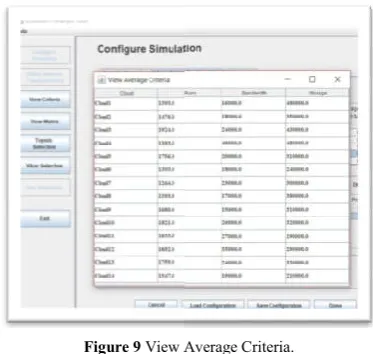
Step 8: Now click on ‘View Criteria’ button to view all cloud services details. See below screen.
Figure 9 View Average Criteria.
Step 9: Now click on ‘View Matrix’ button to convert to cloud values to matrix.
Matrix calculated as
Ram = Ram/sum_of_all_cloud_ram
Bandwidth=Bandwidth/sum_of_all_cloud_bandwidth.
Figure 10 View Matrix Creteria
Step 10: After that we can click on ‘Topsis Selection’ button to take user input and find best services according to user input.
Now click on ‘Load Configuration’ button to upload dataset i.e., dataset.sim file saved in the system.
In below table under selected row we can see 14 data centers from DC1 to DC14. If you want to see memory RAM, Bandwidth and Storage for each data center then,
Now click on ‘View Criteria’ button to view all cloud services details. See below screen.
View Average Criteria.
Now click on ‘View Matrix’ button to convert to cloud
um_of_all_cloud_ram
Bandwidth=Bandwidth/sum_of_all_cloud_bandwidth.
View Matrix Creteria
Figure 11 User Input and preference using Topsis algorithm
Step 11 Similarly click on ‘Vikor Selection’ button and enter input
Figure 12 User Input and preference using Vikor algorithm
Step 13: In above screen according to vikor algorithm cloud7 is best service.
Step 14: Now click on ‘Run Simulation’ button.
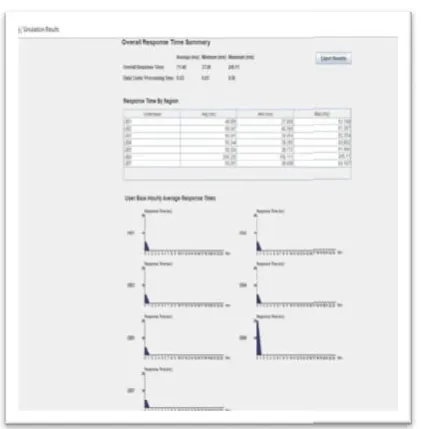
Step 15: In below screen we will get cloud processing time and graphs
Figure 14 Result showing the graphs of response times.
eference using Topsis algorithm
Similarly click on ‘Vikor Selection’ button and enter
reference using Vikor algorithm
In above screen according to vikor algorithm cloud7
Now click on ‘Run Simulation’ button.
In below screen we will get cloud processing time
Result showing the graphs of response times.
CONCLUSION AND FUTURE WORK
In conclusion, we attest that the strategy proposed by us is effective and handy as far as continuous and changing cloud situations. This strategy keeps into account the occasion based computation of measurements and thus gives
outcome than the presumptions in view of whole normal of measurements in entirety. As we have demonstrated the outcomes for a little gathering of information, this technique can be tried against a genuinely huge dataset without issues.
Upgrade of this strategy could be to incorporate fuzzy weights and future forecasts of criteria change. Additionally some essential parameters like the cost, merchant secure, information disturbance and so on have not been considered, which can be incorporated into this model.
References
1. Serafim Opricovic, Gwo
solution by MCDM methods: A comparative analysis of VIKOR and TOPSIS, European Journal of Operational Research, Elsevier, Volume 156, Issue 2,Pages 445455, July 2004.
2. Deepti Rai, Pavan Kumar V,
Criteria Decision Model for Cloud Service Selection using TOPSIS and VIKOR, Sixth International Conference on Computational Intelligence and Information Technology
3. S. Chakraborty, K. Roy, An SLA
estimating trustworthiness of a cloud, in: Proceedings of IEEE 11th International Conference on Trust, Security and Privacy in Computing and Communications, 2012, pp. 937–942.
4. X. Wu, R. Zhang, B. Zeng, S. Zhou, A trust evaluation model for cloud computing,
(2013) 1170–1177.
5. J.Abawajy Pervasive Systems, Agorithms, and Networks, “Determining service trustworthiness in intercloud computing environments”, Proceedings of IEEE 10th International Symposium, pp. 784 2009.
6. S. Ding, S. Yang, Y. Zhang, C. Liang, C. Xia, Combining QoS prediction and customer satisfaction estimation to solve cloud service trustworthiness evaluation problems, K
216-225.
7. W. Fan, H. Perros, A novel trust management framework for multi-cloud environments based on trust service providers, Knowl.
406.
8. Sarbjeet Singh, Jagpreet Sidhu, Compliance based mult dimensional trust evaluation
trustworthiness of cloud service providers, Generated Computer Systems 67(2017) 109
9. M. Deutch, cooperation and trust: some theoretical notes, in: Nebraska symposium on motivation, Nebraska university Press, 1962.
10. A.Chakrabarti, Grid Computing Security, Springer, Berlin, Heidelberg, 2007
11. T.W. Grandison, Trust management for Internet applications (Doctoral Dissertation), Imperial College of Science, Technology and Medicine, University of London, 2003.
CONCLUSION AND FUTURE WORK
In conclusion, we attest that the strategy proposed by us is effective and handy as far as continuous and changing cloud situations. This strategy keeps into account the occasion based computation of measurements and thus gives a more engaged outcome than the presumptions in view of whole normal of measurements in entirety. As we have demonstrated the outcomes for a little gathering of information, this technique can be tried against a genuinely huge dataset without issues.
rade of this strategy could be to incorporate fuzzy weights and future forecasts of criteria change. Additionally some essential parameters like the cost, merchant secure, information disturbance and so on have not been considered,
d into this model.
Serafim Opricovic, Gwo-Hshiung Tzeng, Compromise solution by MCDM methods: A comparative analysis of European Journal of Operational Elsevier, Volume 156, Issue 2,Pages 445455,
Rai, Pavan Kumar V, cInstance based Multi Criteria Decision Model for Cloud Service Selection using TOPSIS and VIKOR, Sixth International Conference on Computational Intelligence and Information Technology-CIIT 2016.
S. Chakraborty, K. Roy, An SLA-based framework for estimating trustworthiness of a cloud, in: Proceedings of IEEE 11th International Conference on Trust, Security and Privacy in Computing and Communications, 2012,
X. Wu, R. Zhang, B. Zeng, S. Zhou, A trust evaluation oud computing, Procedia Comput. Sci. 17
J.Abawajy Pervasive Systems, Agorithms, and Networks, “Determining service trustworthiness in intercloud computing environments”, Proceedings of nternational Symposium, pp. 784-788,
S. Ding, S. Yang, Y. Zhang, C. Liang, C. Xia, Combining QoS prediction and customer satisfaction estimation to solve cloud service trustworthiness evaluation problems, Knowl.-Based Syst. 56 (2014)
W. Fan, H. Perros, A novel trust management cloud environments based on trust Knowl.-Based Syst. 70 (2014) 392–
Sarbjeet Singh, Jagpreet Sidhu, Compliance based multi dimensional trust evaluation system for determining trustworthiness of cloud service providers, Future Generated Computer Systems 67(2017) 109-132. M. Deutch, cooperation and trust: some theoretical
Nebraska symposium on motivation, Nebraska university Press, 1962.
A.Chakrabarti, Grid Computing Security, Springer, Berlin, Heidelberg, 2007.
12. X. Wu, R. Zhang, B. Zeng, S. Zhou, A trust evaluation model for cloud computing, Procedia Comput. Sci. 17 (2013) 1170–1177.
13. W. Fan, S. Yang, J. Pei, A novel two-stage model for cloud service trustworthiness evaluation, Expert Syst. 31 (2) (2014) 136–153.
14. W.J. Fan, S.L. Yang, H. Perros, J. Pei, A multi-dimensional trust-aware cloud service selection mechanism based on evidential reasoning approach, Int. J. Autom. Comput. 12 (2) (2015) 208–219.
15. F. Azzedin, M. Maheswaran, A. Mitra, Trust brokering and its use for resource matchmaking in public-resource grids, J. Grid Comput. 4 (3) (2006) 247–263.
16. Sarbjeet Singh, Jagpreet Sidhu, Compliance based multi dimensional trust evaluation system for determining trustworthiness of cloud service providers, Future Generated Computer Systems 67(2017) 109-132. 17. C. Wang, Y. Wang, C. Liu, X. Wang, An audit-based
trustworthiness verification scheme for monitoring the integrity of cloud servers, J. Comput. Inf. Syst. 10(23) (2014) 9923–9937.
18. W.J. Fan, S.L. Yang, H. Perros, J. Pei, A multi-dimensional trust-aware cloud service selection mechanism based on evidential reasoning approach, Int. J. Autom. Comput. 12 (2) (2015) 208–219.
19. M. Deutsch, Cooperation and trust: Some theoretical notes, in: Nebraska Symposium on Motivation, Nebraska University Press, 1962.
20. A. Chakrabarti, Grid Computing Security, Springer, Berlin, Heidelberg, 2007.
21. T. Grandison, M. Sloman, A survey of trust in Internet applications, IEEE Commun. Surv. Tutor. 3 (4) (2000) 2–16.
22. T.W. Grandison, Trust management for Internet applications (Doctoral Dissertation), Imperial College of Science, Technology and Medicine, University of London, 2003.
23. J. Abawajy, Determining service trustworthiness in intercloud computing environments, in: Proceedings of IEEE 10th International Symposium on Pervasive Systems, Algorithms, and Networks, 2009, pp. 784-788. 24. W. Fan, H. Perros, A novel trust management framework for multi-cloud environments based on trust service providers, Knowl.-Based Syst. 70 (2014) 392– 406.
How to cite this article:
Shanmukha Satya Narayana M and Venkateswara Reddy L (2018) 'Evaluating Consumer Trust Using Topsis and Vikor Methods in Cloud Analyst Tool', International Journal of Current Advanced Research, 07(6), pp. 13841-13847. DOI: http://dx.doi.org/10.24327/ijcar.2018.13847.2486