IJSRSET162641 | Received: 15 Nov-2016 | Accepted: 22 Nov-2016 | November-December-2016 [(2)6: 118-122]
© 2016 IJSRSET | Volume 2 | Issue 6 | Print ISSN: 2395-1990 | Online ISSN : 2394-4099 Themed Section: Engineering and Technology
118
Pick and Place Robot using Accelerometer Sensor
1
Nikitha S. Paulin,
2S. Saranya,
3G. Sathya
1,2,3 Assistant Professor
Department of Electronics and Communication Engineering, SNS College of Engineering, Coimbatore, Tamil Nadu, India
ABSTRACT
This paper proposes to design a pick and place robot using accelerometer sensor. The main concept that in robotics is to reduce human effort in performing any kind of task. Nowadays in industry robotization is installed instead of automation. The accelerometer sensor that was faulty inbuilt in every smartphone nowadays, which is used to detect the orientation `of the mobile phone when the phone is tilted in the corresponding direction. Wi-Fi is a medium to send the comment from the mobile to the robot. Depending upon the movement of the mobile phone in the direction of right or left and up or down the arm of pick and place robot will move. By controlling of arm object can pick and place in the corresponding place. The camera which is interfaced with the processor will capture the video and transmit those video to smart phone, Using this user can send a further command to the robot.
Keywords : Accelerometer sensor, Mobile phone, Pick and place robot, Raspberrypi and Wi-Fi dongle.
I.
INTRODUCTION
The pick and place robot are mainly used in industry for manufacturing parts and assemble those parts. Nowadays robotics is introduced in pick and place robot which were in the industry .In industry the robot which works on the automation technic will perform the task which is programmed to it, thus it not do apart from the program. But in robotics, the robot have able to take decision according to the environment. The robot that will perform all task even, which is a risk to the human to do. Accurate, speed, reduce in the human effort are the important advantages in robotics.
[1] Carmen Maria, Andres, and Jose T. Scarpati Lopez designed to pick and place operations are proposed by trajectories of the hyperbolic type where final and initial positions are known in Cartesian and Joint spaces. This process is done with the help of a normalized hyperbolic trajectory, which may be a symmetric curve for the simpler case. [2]Yong Zhang, Brandon K. Chen, Xinyu Liu, and Yu Sundesineda robotic system that is capable of picking an object and placing objects with high reliable, fast, and accurate.
II.
METHODS AND MATERIAL
1. Components of Robot
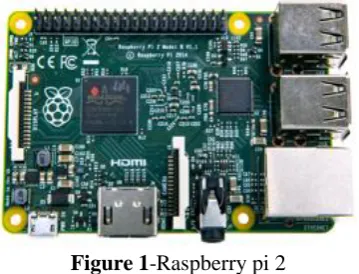
A. Raspberry PI 2
Raspberry pi generally called as simple chip CPU. Because it is different from another processor it is just like a mini CPU, the monitor, keyboard, mouse all this device are
Figure 1-Raspberry pi 2 B. Servo Motor
The Servo Motors has three wires. In this, two wires are to provide ground and positive supply to the servo DC motor. In third wire control signal is passed which is used to control the motor. These wires are identified by color codes. The black wire denotes the ground connection, red denotes the positive terminal connection, the orange wire that denotes the control signal. From GPIO pin 20ms pulse is transmitted to control wire. A 1.5 ms on pulse during the 20 ms means go to the center position. Servo motor that rotates only 180 deg., position are 0 deg., 90 deg., 180 deg. The duty cycle for those positions is 2.5 for 0 deg., 7.5 for 90 deg.,12.5 for 180 deg. In general servo motor has high torque and low RPM. Higher the torque, higher is the lifting capacity.
Figure 2 Servo Motor
Figure 3-Control signal in servo motor
Specification:
Model: Tower pro S690 Working Voltage: 4.8v dc Speed: 60 deg. in 0.1s Torque: 1.6 kg cm Weight: 9g
Pulse width Range: 0.5 ms – 2.5 ms
C. Gear Motor
A gear assembly is attached to the geared dc motor. The torque is increased by using gear assembly. When compared to dc motor the gear motor has high torque and low speed. The gear mechanism is used to increase the torque and to reduce the speed. The rotations of the shaft/minute are termed as RPM. Rpm is used to define the speed of the motor. The speed of the gear motor can be control to any level by using the correct combination of gears. The increasing of torque and reduction of speed of a vehicle is called as gear reduction. which helps in mounting. The motor is mounted to other parts of the assembly by using a nut, which is placed near the shaft. A wheel is attached to the motor by means of unthreaded hole on the shaft.
Figure 4 -Gear Motor
D. Drive Circuit
Figure 5. Pin diagram of L293D
Tabulation for L293D Operation
Figure 6. Motor Connection using H-bridge E. CAMERA
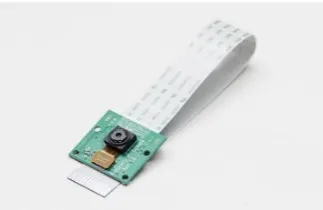
This camera is used to capture the video in front of the robot and these videos are sent through Wi-Fi, will be displayed on the mobile phone.
Figure 7. Camera for RASP PI
D. WIFI Dongle
Wi-Fi dongle 802.11n is a device used to transmit and receive the signal. Here the dongle is connected to the processor through USB port present in the processor. This dongle receives the command from the mobile phone and send those command to the processor. At the same time, it will send video from processor which is captured using the camera, to the same mobile.
Figure 8. Wi-Fi Dongle
F. Power Supply
Power Supply is a necessary to drive motors and processor. To drive a gear motor 12v power supply needed. Gear motor needs of 5v power supply. For raspberry pi 5V and 2A are necessary.
2. Working of Pick and Place Robot
A. Android Application
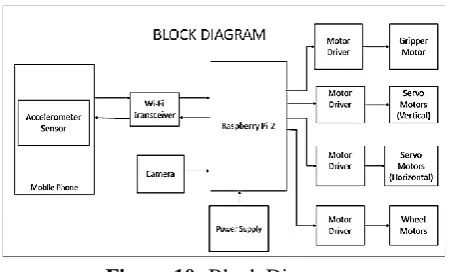
It is a platform for to control the robot using a smartphone. The information from the accelerometer sensor is sent to the robot through Wi-Fi. The movement of the robot will be based on the orientation or tilt of the smartphone.
B. Accelerometer Sensor:
Accelerometer Sensor is a MEMS device generally present in a smartphone. It is used to detect orientation/tilt of mobile phone with respect to vertical and horizontal direction. This is used to control the robot action through Wi-Fi device in order to move the robot wheel and arm in the corresponding direction.
C. Processor
The Wi-Fi dongle which is connected to RASPI 2, will receive the commands from the smart phone. These commands are sent to the processor .Then the processor will instruct the motors for rotation of wheel and movement of arm. GPIO pin is an intermediate between the motors and processor. Using GPIO pins commands from the processor drive the corresponding motor.
Figure 10 -Block Diagram
D. Pick and Place
In order to pick and place an object from one place to the other, the robot is first brought near the object, which is to be replaced because the android application is capable of performing only one task at a time either the movement of the wheel or the arm movement.
E. Movement of Robotic Wheel
Two gear motors are used to control the action of two back wheels, for the side movements a ball wheel is placed in front in order make ease the movement of the robot. For the sideways movement of robot one between the two back wheels, one will rotate in a forward direction and the other wheel will move in reverse direction. The ball wheel is used for changing the direction of the robot (i.e., right and left) and it also reduces the cost as well as to reduce the complexity of operating the robot. Wheel movements are mainly based on the tilting of the smartphone. Before pick and placing an object from one place to the other, the robot is brought near the object, which is to be replaced.
F. Picking Operation
The picking operation of the robot will be dependent on the movement of the arm in horizontal and vertical direction, and the arm should be flexible to pick and
place an object from one place to the other. This arm is controlled by an android application by tilting the mobile phone. If the mobile phone is tilted in left or right the movement of the arm will be in a vertical direction, likewise if the mobile is tilted up or down the arm will move in a horizontal direction. When the robot is placed near the corresponding object, a gripper motor does the picking operation. The gripper attached at the end of the arm is controlled by the android application.
G. Placing Operation
After picking an object it has to be placed in the corresponding place, and after picking an object the operation of the arm will be ended and the mode will be switched to the wheel. By using the android application the wheel is used to move the robot to the corresponding place where the object is to be placed. Once again the mode is switched from wheel to arm, the arm is moved to the desired direction and the object is placed in the new location.
H. Camera
RASPI 2 camera that is connected to the processor will capture the video and sent those videos to the smartphone through Wi-Fi dongle. Using this user can send a further command to the robot.
III.
RESULTS AND DISCUSSION
Experimental Result
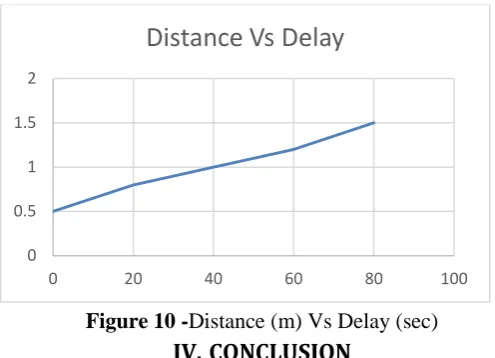
Figure 10 -Distance (m) Vs Delay (sec)
IV.
CONCLUSION
This paper proposes a pick and place robot that was controlled by human using smartphone over a distance. These kinds of robots are used in industry to save the human effort. The power required for this robot is low. The components required for this project is simple enough and the programming required is basic. This robot should be further developed, so that it can be assigned to do tasks, which would be difficult for humans to do.
V.
REFERENCES
[1] Yong Zhang, Brandon K. Chen,Xinyu Liu, and
Yu Sun, "Autonomous Robotic Pick-and-Place of Microobjects,"in IEEE TRANSACTIONS ON ROBOTICS, VOL. 26, NO. 1, FEBRUARY 2010, pp.200-207.
[2] Koen J. Meessen, Johannes J.H.paulides, Elena A.
Lomonova, "Modeling and Experimental
Verification of a Tubular Actuator for 20-g Acceleration in a Pick-and-Place Application,"
IEEE TRANSACTIONS ON INDUSTRY
APPLICATIONS, VOL. 46, NO. 5,
SEPTEMBER/OCTOBER 2010, pp.1891-1899.
[3] T. T. Overboom, J. W. Jansen, E. A. Lomonova
and F. J. F. Tacken, " Design and Optimization of a Rotary Actuator for a Two-Degree-of-Freedom zφ-Module," IEEE TRANSACTIONS ON INDUSTRY APPLICATIONS, VOL. 46, NO. 6, NOVEMBER/DECEMBER 2010, pp.2401-2409.
[4] JingFu Jin, Shang Li Yuen, Young Hoon Lee,
ChangHyun Jun, YoungjiBrigid Kim,
SungonLee,Bum-Jae You, and NakjuLettDoh, "Minimal Grasper: A Practical Robotic Grasper With Robust Performance for Pick-and-Place
Tasks," IEEE TRANSACTIONS ON
INDUSTRIAL ELECTRONICS, VOL. 60, NO. 9, SEPTEMBER 2013, pp.3796-3805.
[5] Francis Bourbonnais, Pascal Bigras, and Ilian A.
Bonev, Minimum-Time Trajectory Planning and Control of a Pick-and-Place Five-Bar Parallel
Robot IEEE TRANSACTIONS ON
MECHATRONICS, VOL. 20, NO. 2, APRIL 2015, pp.740-749.
[6] Chi-Yi Tsai, Ching-Chang Wong, Chia-Jun Yu,
Chih-Cheng Liu, and Tsung-Yen Liu, "A Hybrid Switched Reactive-Based Visual ServoControl of 5-DOF Robot Manipulators for Pick-and-Place Tasks,IEEE SYSTEMS JOURNAL, VOL. 9, NO. 1, MARCH 2015, pp.119-130.
[7] MiladGhanbari and Mohammad
JavadYazdanpanah, "Delay Compensation of Tilt Sensors Base on MEMS Accelerometer Using Data Fusion Technique,’’IEEE SENSORS JOURNAL, VOL. 15, NO. 3, MARCH 2015 , pp.1959-1966.
[8] Carmen María Müller-Karger, Andrés Leonell
Granados Mirena, and José T. ScarpatiLópez, "Hyperbolic Trajectories for Pick-and-Place
Operations to Elude Obstacles,IEEE
TRANSACTIONS ON ROBOTICS AND
AUTOMATION, VOL. 16, NO. 3, JUNE 2000, pp.294-300.
[9] Hsein-I Lin, ChiaHsienCheng ; Wei-Kai Chen,
"Learning a pick-and-place robot task from
human demonstration,"Automatic Control
Conference (CACS), 2013 CACS International,2-4 Dec. 2013, pp.312 - 317.
[10] WeilinCai, Huazhong Univ. of Sci. & Technol.,
Wuhan, China ; Tao Xiong ; Zhouping Yin, "Vision-based kinematic calibration of a 4-DOF
pick-and-place robot, Mechatronics
andAutomation (ICMA), International
Conference,5-8 Aug. 2012, pp.87 - 91. 0
0.5 1 1.5 2
0 20 40 60 80 100