Characterization of Proximate, Phytochemical and Antioxidant
Analysis of Banana (Musa sapientum) Peels/Skins
and Objective Evaluation of Ready to Eat /Cook
Product made with Banana Peels
YAMUNADEVI PURAIKALAN
Nutrition Science Department, College of Health Sciences, Dominican University, Illinois, USA.
Abstract
Banana (Musa sapientum) is usually consumed as a ripe fruit or cooked form. The peels/skins are considered as a waste product. It is important to determine any potential uses for these peels as they contribute to environmental problem due to its nitrogen and phosphorous content. The present study was aimed to evaluate and compare the nutritional compounds such as proximate principles, total phenols, flavonoids and tannin according to AOAC methods between the two varieties of banana peels from USA and India. The study also identified the anti-nutrients like saponin in the banana peel. It could also be used as a functional food. The proximate principles of USA variety peels estimated were 9.4% 6.7% and 11.5% for protein, fat and fiber The India variety peel indicate the percentage of 11.7, 3.6 and 14.4 for protein, fat and fiber respectively. These peels also had a significant amount of total phenols, flavonoids and tannin. Therefore these peels could be incorporated into value-added foods and can serve as a functional food. Extruded product and pasta were formulated using the banana peel powder at 5 % level of incorporation. Colour and texture profile analysis of the developed extruded product and pasta was determined by selected objective method. The results from the present research showed that the banana peel powder showed an improved nutritional composition. The incorporation of 5% banana peel powder in the production of extruded product and pasta were not significantly affected the color and texture profile analysis.
Current Research in Nutrition and Food Science
Journal Website:www.foodandnutritionjournal.org
Article History
Received: 07 May 2018 Accepted: 20 August 2018
Keywords
Flavonoids Tannin
Musa sapientum, Total phenols..
Introduction
Banana (Musa sapientum) is globally cultivated and usually consumes as a fruit or the raw form is used in cooking. Banana is a very popular fruit
because of its low price and presence of high nutrients. The peel or skin is usually considered as a waste product due to environmental pollution. Therefore it’s highly recommended to determine
CONTACT Yamunadevi Puraikalan [email protected] Nutrition Science Department, College of Health Sciences, Dominican University, Illinois, USA.
© 2018 The Author(s). Published by Enviro Research Publishers.
the uses of these peels in food products as they are packed with antioxidants and polyphenols. The worldwide production of bananas is estimated to be 72.5 million metric tonnes, out of which India contributes 21.8 million metric tonnes. The other countries like Uganda, China and Philippines are the next largest producer in the world1. Based on
the literature, it was found that banana peel is rich in phytochemical compounds than the pulp. In addition, banana peel also has anti-fungal, antibiotic properties which can be used for health benefits on humans2-3. The literature survey discloses that
information on GC-MS analysis of banana peel is limited.
Research trends focus on characterization and extraction of natural antioxidants and highlighting in disease prevention. As these compounds are present in many of the fruit peels, it would be worthwhile investigating the nature of these bio-active compounds that are present in banana peel. The present study was aimed to evaluate and compare the nutritional compounds such as proximate principles, total phenols, flavonoids and tannin according to AOAC4 methods between the
two varieties of banana peels from USA and India. The study also identified the anti-nutrients like saponin in the banana peel. It could also be used as a functional food.
Methodology
Nutrient Analysis of Banana Peels/Skins
Organic Bananas (Musa) at the color index of 4 (greenish more yellow than green) according to the USDA banana ripening guide5 were purchased in
one lot from COSTCO, Illinois, USA- 60305. In India, poovan banana were purchased in one lot from the local market at Thanjavur, Tamilnadu, India. Poovan is an important variety of banana which is especially grown for fruit purpose. Tamilnadu is the leading producer of poovan variety owing to its marginal soil and climatic condition. The fruit is slightly acidic, firm and has sweet aroma.
P r e p a r a t i o n o f B a n a n a Pe e l Po w d e r (US variety)
The US variety was dried in a Presto Dehydro electric food dehydrator. The peels/skins were removed from the flesh with the aid of stainless steel knife. The edges from the banana were cut and discarded.
The peels were sliced into 2 inches and these peels were laid on the dehydrator tray. There was enough space left on the tray to allow sufficient air flow for drying. Put the trays into the dehydrator and it operates at a pre set temperature of approximately 1650 Fahrenheit .The general dehydrating information
were followed and plug cord into 120 VAC electrical outlet and begin dehydrating for 4 hours. Then it was ground into powder with a mechanical blender. The powdered samples obtained were thereafter stored in clean airtight container at room temperature (30 ± 20C) until needed for use.
Preparation of Banana Peel Powder (India Variety)
Radio frequency (RF) sterilizer is a promising technology for dehydration because of the faster, uniform heating and less drying time, larger penetration depth and energy efficiency. Radio frequency sterilizer has been applied successfully for drying of agricultural/food products, thawing of frozen foods, tempering, post- baking drying, pasteurization and roasting. During RF heating, direct heat is generated within the food product due to molecular friction. This friction results in oscillation of molecules and ions caused by the applied electric field. The speed of light waves is 3 lakhs Km/sec. This offers low and no fat, chemical free safe products, since it uses electromagnetic energy of longer wavelength than microwaves. It tends to drive the moisture from inside outward equalizing moisture throughout the product and avoids overheating and over dehydration of the food product6. The resistance to heat of various
microorganisms like bacteria and pest types is the same under dielectric treatment as any other heating technique. For example molds and yeasts are killed more rapidly than bacteria. The banana peels were placed in the trays of the sterilizer and it were allowed to pass five times in the RF sterilizer.
Gas Chromatography Mass Spectrometry (GC-MS) analysis
increased to 200°C and finally with the increment of 280°C. It was estimated that total time for running was forty minutes.
MS Programme
The molecular weight and name of the compounds were identified using NIST Version 2.0 library database of National Institute Standard and Technology (NIST).
Analysis of Nutrient Parameters of Banana Peel Powder
The banana peel powder were analysized for its proximate analysis such as moisture, protein, fat, fiber, carbohydrate, energy and ash content as per their respective methods described (AOAC)4 at Indian
Institute of Food Processing Technology, Ministry of Food Processing Industries, Government of India, Thanjavur, India. All the analyses were performed in triplicates and the results were averaged.
Standardization of Extruded Product and Pasta
The standardization of extruded product and pasta were carried out at Indian Institute of Food Processing
Technology, Ministry of Food Processing Industries, Government of India, Thanjavur, Tamilnadu, India. Food extrusion is still an art though in recent years several researchers have aimed at understanding extrusion phenomenon in the light of the effect of extruder dimensions, the geometry of sewer and die, length to diameter ratio of extrudes and barrel grooves7 .
The extruded product is very popular across various sections of the people, especially among the school going children and young people. It is a popular snack food or lunch box item. The various types of food products manufactured by extrusion typically have high starch content8. Therefore,
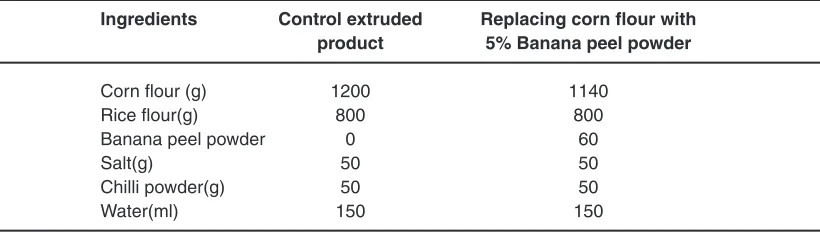
the extruded product has to be made nutritionally better by enhancing the nutrients. Extruded product was prepared by replacing corn flour with the incorporation of banana peel powder at 5 per cent proportions. The ingredients used in preparation of extruded product are given in Table I
Table 1: Ingredients Used In Extruded Product
Ingredients Control extruded Replacing corn flour with product 5% Banana peel powder
Corn flour (g) 1200 1140
Rice flour(g) 800 800
Banana peel powder 0 60
Salt(g) 50 50
Chilli powder(g) 50 50
Water(ml) 150 150
The above ingredients were separately weighed and mixed together in a blender for 30 minutes. The dry mixture was passed through a pre-conditioner. The cooking process was started by the injection of steam and the extrudate was then passed through an extruder. The final product usually puffs and changes in texture because of the force reduction and release of moisture and heat. The temperature for the extruder was adjusted to initial temperature of 52.30C and final temperature of 1100C. The extrudate
was then cut to the desired length by blades at the output of the extruder, which rotate around the die
openings at a specific speed. The product was then cooled and dried and finally packed in a zip lock bags.
Pasta Preparation
Table 2: Ingredients Used In Pasta
Ingredients Control pasta Replacing corn flour with 5% Banana peel powder
Maize flour (g) 1080 1020
Rice flour (g) 800 800
Wheat flour(g) 120 120
Banana peel powder(g)s 0 60
Salt(g) 50 50
Chilli powder(g) 50 50
Water(ml) 150 150
Colour and Texture Profile Analysis of Extruded Product and Pasta
The colour of the extruded product and pasta were determined by the color hunter colorimeter. The colour of the extruded product and pasta were evaluated by measuring the L (100 = white and 0 = black), a {red (+) and green (-)} and b {yellow (+) and blue (-)} value with a standard white tile9. The
colour and texture profile analysis was replicated for three times. Texture analysis of banana peel incorporated extruded product and pasta were done by Texture Analyzer (Make Stable Micro System, U.K, Model TA -XT2). The colour and texture profile analyses were replicated for three times. Texture analysis of extruded product and pasta was done
by two methods such as Texture Analysis (TA) and Texture Profile Analysis (TPA) test. TA test was done for measuring cutting force of extruded product and TPA test for hardness, cohesiveness, gumminess, chewiness, resilience and springiness10.
Results and Discussion
The results obtained from the present study are discussed as follows:
Analysis of Proximate Principles of Banana Peel Powder from USA and India
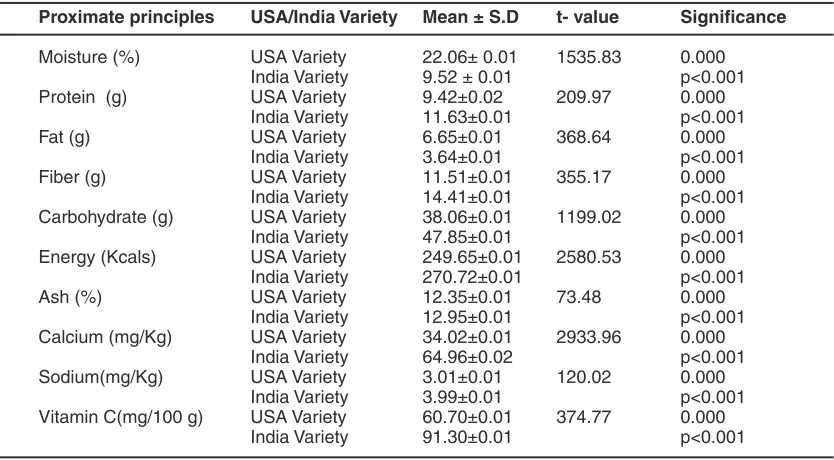
The analysis of proximate principles of banana peel powder was triplicated and the results are depicted in the following Table-III
Table 3: Analysis of proximate principles, minerals and vitamin-C of banana peel powder per 100 grams
Proximate principles USA/India Variety Mean ± S.D t- value Significance
Moisture (%) USA Variety 22.06± 0.01 1535.83 0.000
India Variety 9.52 ± 0.01 p<0.001
Protein (g) USA Variety 9.42±0.02 209.97 0.000
India Variety 11.63±0.01 p<0.001
Fat (g) USA Variety 6.65±0.01 368.64 0.000
India Variety 3.64±0.01 p<0.001
Fiber (g) USA Variety 11.51±0.01 355.17 0.000
India Variety 14.41±0.01 p<0.001
Carbohydrate (g) USA Variety 38.06±0.01 1199.02 0.000
India Variety 47.85±0.01 p<0.001
Energy (Kcals) USA Variety 249.65±0.01 2580.53 0.000
India Variety 270.72±0.01 p<0.001
Ash (%) USA Variety 12.35±0.01 73.48 0.000
India Variety 12.95±0.01 p<0.001
Calcium (mg/Kg) USA Variety 34.02±0.01 2933.96 0.000
India Variety 64.96±0.02 p<0.001
Sodium(mg/Kg) USA Variety 3.01±0.01 120.02 0.000
India Variety 3.99±0.01 p<0.001
Vitamin C(mg/100 g) USA Variety 60.70±0.01 374.77 0.000
India Variety 91.30±0.01 p<0.001
Table: III summarizes the results of proximate principles, minerals and vitamin-C of two varieties of banana peel powder. The content of carbohydrate, protein and fiber seems to be higher for India variety peel. Fat content were higher in USA variety (6.65%). This value depicts that the peel could be a good source of carbohydrate and fiber. The result of moisture content was lower for India variety of 9.52%. This low value may be due to the time of harvest. The lower value, longer the shelf life for banana without mold growth. According to Mircini et al.,11, 1997
these peels are good sources of minerals. These results indicate that peels have a concentration of 3 mg/Kg of sodium and higher amount of calcium were observed in India variety. The high calcium content also indicates that the peels could help treat Calcium- deficiency disorders and improve bone health. Vitamin-C content was high in India variety (91mg/100mg) when compared to USA variety (61 mg/100g). It was found by Kanazawa et al.,12,
2002 that the ascorbic acid content of banana peel and pulp was constant at 10mg/100g.
Table 4: Total phenol, Flavonoids, Tannin and saponin content in banana peel powder per 100 g
Parameters US/India Variety Mean ± S.D t- value Significance
Total phenol(mg/100g) USA Variety 235±1.00 93.08 0.000
India Variety 159±1.00 p<0.001
Flavonoids (mg QE/ g) USA Variety 1.23±0.15 4.42 0.011
India Variety 1.70±0.01 p<0.001
Tannin (mg/100 g) USA Variety 152±1.00 30.61 0.000
India Variety 127±1.00 p<0.001
Saponin (mg/100 g) USA Variety 7.75±0.01 232.70 0.000
India Variety 9.65±0.01 p<0.001
NS-Not Significant, Mean ± SD of triplicates determination
The total phenol, flavonoids, tannin and saponin content of two banana peel extracts is shown in Table: IV. From the results, it is inferred that USA variety extract showed higher phenol and tannin content compared to India variety, which could be due to its antioxidant potential. Wide applications of phenols include as an antioxidant, anti-carcinogenic and also aids in decreasing the complications of cardiovascular diseases. In this study from the Table: IV values, India variety peel extract exhibited higher flavonoids content. The results of anti-nutritional factors indicate the saponin concentration to be 7.75mg for USA variety and 9.65 mg for India variety. The value obtained is slightly high when compared
to the study conducted by Kumar et al.,13, 1991. He
found that 3% as the minimum safe value. Dietary saponin has a positive effect by decreasing the serum and tissue cholesterol levels in animals.
Table 5: GC-MS analysis of bioactive components in USA variety banana peel powder
Sl. Retention Name of the Molecular Molecular Peak area No time compound formula Weight Percent
1 4.51 4H-Pyran-4-one,2,3-dihydro- C6H8O4 144 0.54
3,5-dihydroxy-6-methyl
2 5.82 5-Hydroxymethylfurfural C6H6O3 126 1.31
3 8.38 Propanedioic acid, 3- thienyl C7H6O4S 186 1.10
4 9.65 Sucrose C12H22O11 342 3.31
5 15.46 n-Hexadecanoic acid C16H32O2 256 0.36
6 18.24 Octadecanoic acid C18H36O2 284 0.46
7 20.09 Oleic acid C18H34O2 282 0.19
8 26.23 Aromadendrene oxide-(2) C15H24O 220 1.03
9 32.39 α- Tocopheryl acetate C31H52O3 472 1.51
10 35.08 Stigmasterol C29H48O 412 2.49
11 36.22 4,22- Stigmastsdiene-3-one C29H46O 410 5.51
12 36.59 9,19-Cyclolanost-23-ene-3,25- C30H50O2 442 18.13
diol,(3β,23E)
13 38.08 9,19-Cyclolanost-24-en-3- ol, C32H52O2 468 31.45
acetate, (3β)
14 38.47 9,19-Cyclolanostan-3- ol, C32H54O2 470 32.61
acetate, (3β)
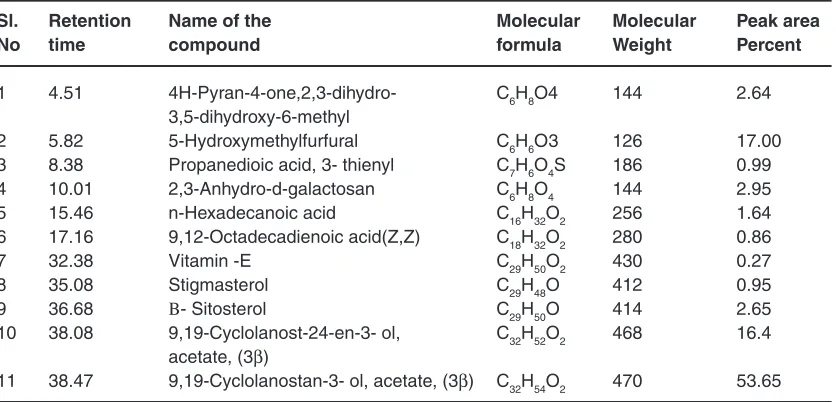
Table 6: GC-MS analysis of bioactive components in India variety banana peel powder
Sl. Retention Name of the Molecular Molecular Peak area No time compound formula Weight Percent
1 4.51 4H-Pyran-4-one,2,3-dihydro- C6H8O4 144 2.64
3,5-dihydroxy-6-methyl
2 5.82 5-Hydroxymethylfurfural C6H6O3 126 17.00
3 8.38 Propanedioic acid, 3- thienyl C7H6O4S 186 0.99
4 10.01 2,3-Anhydro-d-galactosan C6H8O4 144 2.95
5 15.46 n-Hexadecanoic acid C16H32O2 256 1.64
6 17.16 9,12-Octadecadienoic acid(Z,Z) C18H32O2 280 0.86
7 32.38 Vitamin -E C29H50O2 430 0.27
8 35.08 Stigmasterol C29H48O 412 0.95
9 36.68 Β- Sitosterol C29H50O 414 2.65
10 38.08 9,19-Cyclolanost-24-en-3- ol, C32H52O2 468 16.4
acetate, (3β)
11 38.47 9,19-Cyclolanostan-3- ol, acetate, (3β) C32H54O2 470 53.65
Standardization of Extruded Product and Pasta Colour Analysis of Extruded Product
The colour of the banana peel incorporated extruded product was determined by the color
Table 7: Colour Analysis Of Banana Peel Incorporated Extruded Product
Variables Sample Mean ±S.D t- value Significance Control Vs5% Control Vs5%
L Control 48.56±2.00 7.965 0.001p<0.001
5% 39.36±0.02
a Control 7.33±0.36 20.50 0.000p<0.001
5% 2.78±0.12
b Control 13.54±1.20 10.90 0.000p<0.001
5% 7.03 ±0.35
NS-Not Significant
Colour is one of the most important parameter in evaluating the developed extruded product and pasta. It not only reflects the suitable ingredients used for the preparation but also provides information about the formulation and quality of the product. Shahzag Hussain et al.,14, 2006 showed that increased level
of addition of flax seed flour resulted in dark brown
colour of the cookies. It can be depicted from the above table that mean value for L was found to be 48.56±2.00 for control extruded product, 5 per cent of extruded product had 39.36±0.02. The value for “a” and “b” were found be significant among the control and 5% banana peel incorporated extruded product.
Table 8: Colour Analysis Of Banana Peel Incorporated Pasta
Variables Sample Mean ±S.D t- value Significance Control Vs5% Control Vs5%
L Control 34.97±0.02 20.96 0.001p<0.001
5% 34.55±0.03
a Control 3.32±0.01 4.90 0.008p<0.001
5% 3.28±0.01
b Control 5.53±0.01 4.90 0.000p<0.001
5% 5.34 ±0.02
NS-Not Significant
It can be depicted from the above table that mean value for L was found to be 34.97±0.02 for control product, 5 per cent of pasta had 34.55±0.03. The value for “a” and “b” were found be significant among the control and 5% banana peel incorporated pasta.
Texture Profile Analysis of Extruded Product and Pasta
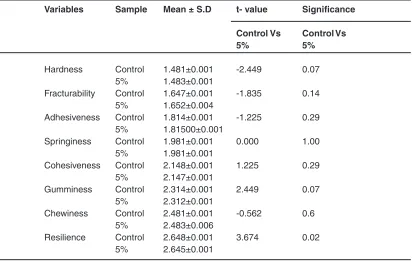
The Table IX and show the texture profile analysis of extruded product and pasta.
Extrusion technology is the widely used technique for the development of snack foods. Texture plays a vital role, with crispiness being often a desirable parameter. Instrumental analysis has been a useful tool for food industry and manufacturers and it has been related to sensory evaluation. Extruded food products are generally composed of cereals, starches and proteins. These ingredients contribute structure, mouth feel and texture15. The physical
Warner-Bratzler cutting device16. Liu et al.,17 (2000)
conducted a TPA of extruded oat-corn puffs and established a high correlation with human sensory perception of specific textural attributes. It was found that there were no significant difference in the texture profile analysis between the control and 5 % incorporated extruded product
Banana contains a high proportion of indigestible compounds like resistant starch and non starch polysaccharides. The use of banana peel flour decreased the lightness. The texture analysis like hardness, fracturability, adhesiveness, springiness and chewiness were not affected by the incorporation of 5 % banana peel powder.
Table 9: Texture profile analysis of extruded product
Variables Sample Mean ± S.D t- value Significance
Control Vs Control Vs
5% 5%
Hardness Control 1.481±0.001 -2.449 0.07
5% 1.483±0.001
Fracturability Control 1.647±0.001 -1.835 0.14
5% 1.652±0.004
Adhesiveness Control 1.814±0.001 -1.225 0.29
5% 1.81500±0.001
Springiness Control 1.981±0.001 0.000 1.00
5% 1.981±0.001
Cohesiveness Control 2.148±0.001 1.225 0.29
5% 2.147±0.001
Gumminess Control 2.314±0.001 2.449 0.07
5% 2.312±0.001
Chewiness Control 2.481±0.001 -0.562 0.6
5% 2.483±0.006
Resilience Control 2.648±0.001 3.674 0.02
5% 2.645±0.001
Table 10: Texture profile analysis of extruded product
Variables Sample Mean ± S.D t- value Significance
Control Vs Control Vs
5% 5%
Hardness Control 1.481±0.001 -74.000 0.000
5% 1.530±0.000
Fracturability Control 1.647±0.001 -63.687 0.000
5% 1.699±0.001
Adhesiveness Control 1.814±0.001 -63.687 0.29
5% 1.866±0.001
Springiness Control 1.981±0.001 0.000 0.000
5% 2.304±0.001
Cohesiveness Control 2.148±0.001 -66.136 0.000
Gumminess Control 2.314±0.001 -69.810 0.000
5% 2.371±0.001
Chewiness Control 2.481±0.001 -0.355 0.740
5% 2.496±0.075
Resilience Control 2.648±0.001 -71.035 0.000
5% 2.706±0.001
Conclusion
The results from the present research showed that the banana peel powder showed an improved nutritional composition. The proximate principles of USA variety peels estimated were 9.4% 6.7% and 11.5% for protein, fat and fiber The India variety peel indicate the percentage of 11.7, 3.6 and 14.4 for protein, fat and fiber respectively. These peels also had a significant amount of total phenols, flavonoids and tannin. The incorporation of 5% banana peel powder in the production of extruded product and pasta were not significantly affected the color and texture profile analysis. Hence banana
peel can be exploited for their nutritional and bio- active components. Therefore these peels could be incorporated into value-added foods and their efficacy can be studied by human supplementation studies.
Acknowledgements
Author is extremely thankful to Dominican University, River Forest, Illinois - 60305 for their financial support for this research study. Further Author is sincerely acknowledged to IIFPT, Thanjavur, Tamilnadu, India for GC-MS analysis.
References
1. Anhwange A., Ugye J and Nyiaatagher D. Chemical composition of Musa sapientum (banana) peels. Electronic Jour nal of Environment, Agricultural and Food Chemistry.2009;8(6):437-442.
2. Someya S., Yoshiki, Y. and Okubo, K. Determination of the Antioxidant Potentials of Two Different Varieties of Banana Peels in Two Different Solvents. Food Chemistry.2002;
79:351-354.
3. Sulaiman F., Yusoff M., Eldeen M., Seow M., Sajak A., Supriatno and Ooi L. Journal of Food Composition and Analysis.2011;24: 1–10.
4. AOAC (Association of Official Analytical Chemist),Official methods of analysis. Washington DC, 19th Edition.2012;173.
5. www.ams.usda.gov
6. Palazoglu T.K., CoskunY., KocadagliT., Gokmen V. Effect ofradio frequency postdrying of partially baked cookies on acrylamide content, texture, and color of the final product. Journal of Food Science.2012;77(5): E113-E117.
7. Kaur S., Sarkar B.C., Sharma H.K and
Singh C. Response surface optimization of conditions for the clarification of guava fruit juice using commercial enzyme, Journal of Food Engineering.2009;10:1745.
8. Harper J.M. Food extrusion, Critical Reviews in Food Science and Nutrition.1978;11:2, 155-215.
9. ISO 11037. Sensory Analysis, General guidance and test method for assessment of the color of food, Westport, CT: AVI Publ. Co.1999;121- 136.
10. ISO 11036. Sensory analysis Methodology, Texture profile analysis. In Rheology and Texture in Food Quality, Westport, CT: AVI Publ. Co.1994;142- 243.
11. Mirconi E., Ruggeri, S. and Carnovale, E. Chemical Evaluation of wild under exploited Vigina sp.seed. Food Chemistry.1997;59, 203-212.
12. Kanazawa K. and Sakakibara H. High content of dopamine, a strong antioxidant, in Cavendish banana. Journal of Agricultural and Food Chemistry.2000;48,844-848. 13. Kumar R. Anti-nutritional factors, the potential
Proceedings of FAO expert’s consultation held at the Malaysia Agricultural Research and Development Institution Kuala Lumpur. Malaysia. 1991;Pp: 14-18.
14. Shahzad Hussain., Faqir Muhammad Anjum., Masood Sadiq Butt et al., Physical and Sensoric Attributes of Flaxseed Flour Supplemented Cookies, Turk J Biol.2006;30:
87-92.
15. Jamora J. J., Rhee, K. S., Rhee, K. C. Chemical and sensory properties of expanded extrudates from pork meat-defatted soy flour
blends with onion,carrot and oat. Journal of Food Science and Nutrition.2002;6: 158–162.
16. Grenus K. M., Hsieh, F., Huff, E. H. Extrusion and extrudate properties of rice flour. Journal of Food Engineering.1993;18:229-245. 17. Liu Y.,Hsieh F., Heymann, H. and Huff, H.