http://www.gjaets.com
(C) Global Journal of Advance Engineering Technology and Sciences
40
Global Journal of Advance Engineering Technologies and Sciences
ANALYSIS OF IMAGE COMPRESSION USING HAAR AND DB-2
WAVELET WITH MEDIAN FILTER
Deepak Prajapat
1, Prof. Mahesh Goud
2P.G. Student
1, Asst. Prof.
2Sagar Institute of Research and Technology (Truba College), Indore
ABSTRACT
The technological advancements in digital communication and computer technology have paved the way for all pervading World Wide Web based internet. The development and deployment of 4G technology based mobile communication has provided a powerful multimedia communication device for users. The multimedia signals are alphanumerical text signals, audio signals including speech and music, and video signals including still and moving images. Transducer based sensor data may fall under any one or more of the above categories of signals i.e. text, audio and video. Sensor networks have emerged as an integral part of information technology. In this paper analysis of image compression using Haar and Db-2 Wavelet Transform with median filter and flat fading is used as wireless channel for transmission of image on wireless medium with QPSK modulation. Performance of these systems is measured by BER verses SNR.
Keyword: BER, Fading channel, Haar-wavelet, Image compression, QPSK, SNR, Median filter,
INTRODUCTION
Image processing for wireless transmission is a challenging task, because of the amount of image data that need to be processed in real time, the restriction of transmission bandwidth, and other limited resources of the wireless network. One of the most important and challenging goal of current and future communication is transmission of high quality images from source to destination quickly with least error where limitation of bandwidth is a prime problem. By the advent of multimedia communications, the multimedia transmission of multimedia over wireless links is considered as one of the major applications of future communication systems, and such systems require the use of high storage capacity and less error transmission. Image processing includes any form of information processing in which the input is an image. Many image processing techniques derive from the application of signal processing techniques to the domain of images two-dimensional signals such as photographs or video. Extend naturally to images as well. However, image processing brings some new concepts such as connectivity and rotational invariance - that are meaningful or useful only for two-dimensional signals. Also, certain one-dimensional concepts - such as differential operators, edge detection, and domain modulation - become substantially more complicated when extended to two dimensions.
A. Digital Image Processing
Digital images are composition of pixels (short for picture elements).Image is sampled and mapped as picture elements or a grid of dots (pixels). Each pixel represents the colour (or gray level for black and white photos) at a single point in the image, so a pixel is like a tiny dot of a particular colour. An image have large number of points, it helps to create a digital approximation of the test image by which a copy of the original image can be reproduced. The binary digits also called bits for each pixel are stored in a sequence manner by a computer and of also reduced to a mathematical representation (compressed form). These bits are then interpreted and read by the computer to reproduce an analog version for display. Pixels are like grain particles in a conventional photographic image, but it arranged in a regular pattern of rows and columns and store information some differently manner. A digital information contained image is a rectangular array of pixels also called a bitmap [1].
B. Requirement of Image Compression
http://www.gjaets.com
(C) Global Journal of Advance Engineering Technology and Sciences
41
to store images on a computer and also to transmit them over the internet, to share them with other persons [3]. The big problem is that digital images are quite memory-consuming, and so a need to compress images is also quite natural if one wants to store lots of images with a rather high resolution or wants to transmit these images via a channel with limited bandwidth. Although memory is getting cheaper and cheaper these days it is still not unlimited and also the number and even more severe the resolution of images one may want to store has increased in the last years. Furthermore, we should not forget that transferring images is still an issue, as the bandwidth of networks, may they be wireless or wired, is still quite limited, actually too limited to transfer images in a raw format [4]. So, Image compression is very important for efficient transmission and storage of images. Images contain large amounts of information that requires much storage space, large transmission bandwidths and long transmission times. Therefore it is advantageous to compress the image by storing only the essential information needed to reconstruct the image. An image can be thought of as a matrix of pixel values. Image compression standards bring about many benefits, such as: (1) easier exchange of image files between different devices and applications; (2) reuse of existing hardware and software for a wider array of products; (3) existence of benchmarks and reference data sets for new and alternative developments [5].
Image compression helps the problem of reduce the data needed to represent a digital image. The removal of redundant data is basis principle of the reduction process. According to mathematical point of view, this amounts to transforming a twodimensional pixel array into a statistically uncorrelated data set. The example below clearly shows the importance of compression. An image, 1024 pixel×1024 pixel×24 bit, without compression, would require 3 MB of storage. If these image is compressed at a 10:1compression ratio, need of storage requirement is reduced to300 KB [6].
SIMULATION MODEL
http://www.gjaets.com
(C) Global Journal of Advance Engineering Technology and Sciences
42
Fig. 1: Simulation Model
RESULT ANALYSIS OF FLAT FADING WITH QPSK MODULATION
A. Performance of Haar Transform with median filter
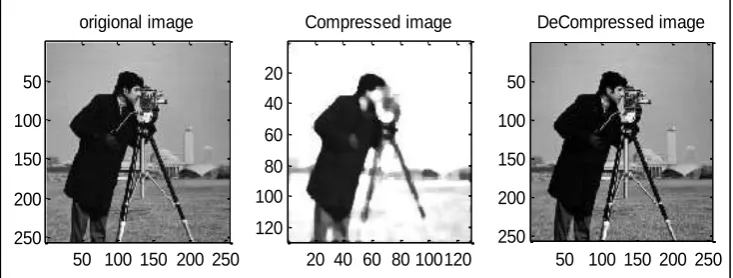
In the figure 3 and 4 show the BER and SNR (dB) comparison of the results with the proposed technique of discrete wavelet techniques, Haar wavelet and Db2 wavelet with De-noising filter, with Median filter to the existing network respectively. In the figure 2 shows the A. Original image, B. Compressed image and C. De-compressed image
Fig. 2 shows the A. Original image, B. Compressed image and C. De-compressed image
A. Performance of Haar Transform with median filter
Fig. 3: FLAT of QPSK in Haar with median filter
B. Performance of Db2 Transform with median filter origional image
50 100 150 200 250 50
100
150
200
250
Compressed image
20 40 60 80 100120 20
40
60
80
100
120
DeCompressed image
50 100 150 200 250 50
100
150
200
http://www.gjaets.com
(C) Global Journal of Advance Engineering Technology and Sciences
43
Fig. 4: FLAT of QPSK in Db 2 with median filter
CONCLUSION
We get results of different wavelet image compression techniques (Haar wavelet and Db2 wavelet) are presented and compared their effect. We also the used of de-noising Median filter. Our focus on increase CR and PSNR and decrease MSE also get simulated result of wireless channels model Flat fading channel with QPSK modulation techniques and compared their effect, focus on decrease BER. Simulation result shows in figure 3,BER v/s SNR for Flat fading of QPSK in Haar with median filter at SNR up-to 10 dB. So, Best BER & SER is 3.0117 × 10⁻²
& 6.0616 × 10⁻² respectively at SNR of 10 dB. Simulation result showsin figure 4BER v/s SNR for Flat fading of QPSK in Db2 with median filter at SNR up-to 10 dB. So, Best BER & SER is 3.6764 × 10⁻² & 6.2410 ×
10−2 respectively at SNR of 10 dB.
REFERENCES
I. Manjit Sandhu, Jaipreet Kaur and Sukhdeep Kaur “Matlab Based Image Compression Using Various
Algorithms” International Journal of Advanced Research in Computer Science and Software Engineering, Vol. 6, Issue 4, April 2016.
II. Rimas A. Zrae, Mohamed Hassan, and Mohamed El-Tarhuni “An Adaptive Modulation Scheme for Image Transmission over Wireless Channels”, 978-1-4244-9991-5/11/ 2011 IEEE.
III. Poonam Dhumal and S. S. Deshmukh “Survey on Comparative Analysis of Various Image Compression
Algorithms with Singular Value Decomposition” International Journal of Computer Applications, Vol. 133, issue 6, January 2016.
IV. Ms. Vaibhavi P. Lineswala, Ms. Jigisha N. patel, “JPEG Image Compression and Transmission Over
Wireless Channel”, 978-0-7695-3915-7/09 © 2009 IEEE DOI 10.1109/ACT.2009.163.
V. Hemalatha Sa, U. Dinesh Acharyaa and Renuka Aa “Wavelet transform based steganography technique
to hide audio signals in image” Science-Direct, Elsevier, Procedia Computer Science vol. 47, 2015. VI. Ramandeep KaurGrewal, Navneetrandhawa, “Image Compression Using Discrete Cosine Transform &
Discrete Wavelet Transform”, International Journal of Computing & Business Research ISSN (Online): 2229-6166, at GKU, Talwandi Sabo Bathinda (Punjab), Proceedings of ‘I-Society 2012.
VII. Jagadish H. Pujar, Lohit M. Kadlaskar, “A New Lossless Method of Image Compression and
Decompression Using Huffman Coding Techniques”, Journal of Theoretical and Applied Information Technology © 2005 - 2010 JATIT.
VIII. Guojin Liu, Xiaoping Zeng, FengchunTian, KadriChaibou, ZanZheng, “A novel direction-adaptive
wavelet based image compression”, Int. J. Electron. Commun. (AEÜ) 64 (2010), Page 531–539, 1434-8411/2009 Elsevier GmbH. Doi: 10.1016/j.aeue.2009.03.004.
IX. K. Khelil , A. Hussainb, R.E. Bekkac, F. Berrezzeka, “Improved multiple description wavelet based image
coding using subband uniform quantization”, Int. J. Electron. Commun. (AEÜ) 65 (2011), Page 967– 974, 1434-8411/2011, Elsevier GmbH.doi:10.1016/j.aeue.2011.03.011.
X. Sandeep Kumar, “Image Compression Based On Improved Spiht and Region Of Interest”, Dept. of Electronics & Communication Engineering Thapar University, Patiala, June 2011.
XI. Vincent Lecuire, Cristian Duran-Faundez, and Nicolas Krommenacker; “Energy-Efficient Transmission
of Wavelet- Based Images in Wireless Sensor Networks”, Hindawi Publishing Corporation EURASIP Journal on Image and Video Processing Volume 2007, Article ID 47345, 11 pages doi:10.1155/2007/47345.
XII. Ms. Sonam Malik and Mr. VikramVerma, “Comparative analysis of DCT, Haar and Daubechies Wavelet
for Image Compression”, International Journal of Applied Engineering Research, ISSN 0973-4562 Vol.7 No.11 (2012) © Research India Publications.
XIII. Bhabesh Deka and Sangita Choudhury, “A Multiscale Detection based Adaptive Median Filter for the
Removal of Salt and Pepper Noise from Highly Corrupted Images”, International Journal of Signal Processing, Image Processing and Pattern Recognition Vol. 6, No. 2, April, 2013.
http://www.gjaets.com
(C) Global Journal of Advance Engineering Technology and Sciences
44
XV. Iram Sami, Abhishek Thakur, Rajesh Kumar, “Image Denoising for Gaussian Noise Reduction in Bionics