Global Journal of Advance Engineering Technologies and Sciences
MIMO SYSTEM ANALYSIS ON DIFFERENT MODULATION SCHEME
WITH AWGN CHANNEL
Jitendra Singh Chouhan, Prof Gaurav Gupta
Mahakal Institute of Technology, Ujjain
Department of Electronics & Communication Engineering
ABSTRACT
The Wireless communication technology, affordable wireless service has become a reality. Increasing demand for high-performance 4G broadband wireless is enabled by the use of multiple antennas at both base station and subscriber ends, in the multiple antenna technologies enable high capacities suited for multimedia services, Internet and also dramatically increase range and reliability. WiMAX is based on the IEEE 802.16 specification of which IEEE-802.16-2004 and 802.16e amendment are physical layer specification. IEEE 802.16-2004 currently supports several multiple antenna option including space time codes, multiple input multiple output antenna system and diversity of antenna. MIMO-OFDM is a key technology for next-generation cellular communications (Mobile WiMAX, IMT Advanced) as well as wireless Personal Area Network, wireless Local Area Network (IEEE 802.11a, IEEE 802.11n) and broadcasting (DAB, DVB).
In this project analysis of the multiple antenna technologies like Single input signal output antenna system, multiple input multiple output antenna system under different combination of modulation technologies (BPSK, QPSK, 8-QAM and 16-8-QAM) with Additive white Gaussian noise channel used and the performance results shows under the bit error rate versus signal to noise ratio.
Keyword: -Additive White Gaussian Noise channel (AWGN), Orthogonal Frequency Division Multiplexing (OFDM), multiple-input and multiple output (MIMO) Bit Error rate (BER), Signal to Noise ratio (SNR).
Introduction
INTRODUCTION
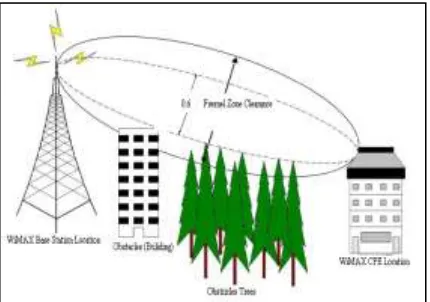
WiMAX is capable of working in different frequency ranges but according to the IEEE 802.16, the frequency band is 10 GHz to 66 GHz. A typical architecture of WiMAX includes abase station built on top of a high rise building and communicates on point to multi-pointbasis with subscriber stations which can be a business organization or a home. The basestation is connected through Customer Premise Equipment (CPE) with the customer. Thisconnection could be a Line-of-Sight (LOS) or Non-Line-of-Sight (NLOS).
A. Line of Sight (LOS)
B. Non-Line of Sight (NLOS)
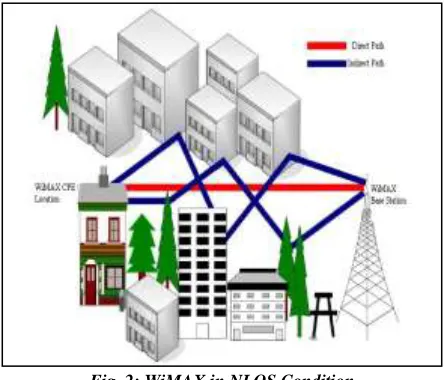
Non-line-of-sight service is a Wi-Fi sort of service. Here a small antenna on your computer connects to the WiMAX tower. In this mode, WiMAX uses a lower frequency range 2 GHz to 11 GHz (similar to Wi-Fi). In LOS connection, signal travels in a straight line which is free of obstacles, means, a directconnection between a transmitter and a receiver. In NLOS connection, signal experiences obstacles in its path and reaches to the receiverthrough several reflections, refractions, diffractions, absorptions and scattering etc. Thesesignals arrive to the receiver in different times, attenuation and strength which make it hard todetect the actual signal. WiMAX shows good performance in NLOS condition as it isbased on OFDM which can handle delays caused in NLOS, perfectly. WiMAX offers other benefits which works well in NLOS condition.
Fig. 2: WiMAX in NLOS Condition
MOTIVATION OF WIRELESS COMMUNICATION
Recent advances in wireless communication technology and portable computing devices such as wireless handhelds, Personal Digital Assistants (PDAs) and other mobile information terminals are driving a revolutionary change in our information society towards the era of mobile communications. Mobile users can utilize several electronic platforms simultaneously through which they can access all the necessary information whenever and wherever required. Some decades ago, we were purely dependent on analog system. Both the sources and transmission system were on analog format but the advancement of technology made it possible to transmit data in digital form. Along with those, the computer was getting faster to the fastest, the data payload capacity and transmission rate increased from kilobit to megabit and megabit to gigabit. From wire to wireless concept emerged and after researching and investing so much money, engineers became successful to invent wireless transmitter to transmit data. Applications like voice, Internet access, instant messaging, SMS, paging, file transferring, video conferencing, gaming and entertainment etc became a part of life.
Cellular phone systems, WLAN, wide-area wireless data systems, ad-hoc wireless networks and satellite systems etc are wireless communication. All emerged based on wireless technology to provide higher throughput, immense mobility, longer range, robust backbone to thereat. The vision extended a bit more by the engineers to provide smooth transmission of multimedia anywhere on the globe through variety of applications and devices leading a new concept of wireless communication which is cheap and flexible to implement even in odd environment..
MIMO SYSTEM MODEL
Fig 3 MIMO Model
Since each of the receive antennas detects all of the transmitted signals, there are N x N independent propagation paths, where there are transmit and receive antennas. This allows the channel to be represented as N x N matrix. Again using a 2 x 2 System as an example, the matrix below is obtained as:
𝐻 = [ℎℎ11 ℎ12
21 ℎ22]
(1)
Each of the elements in the channel matrix is define an independent propagation path. The transmitted signal can be represented as a vector, as can the received signal. Hence, the system can be represented as the following equation.
Y = HX + n (2)
Where Y is the received signal vector, H is the channel Matrix, X is the transmitted signal vector, and n is the noise. The transmitted signals in the vector Y are complex signals, as the channel matrix values and the received signals in vector X. The complex form in each of the elements in the vectors represents the power of the signal and its phase delay. The complex form of the elements of the channel matrix ‘H’ represent the attenuation and phase delay associated with that propagation path.
SIMULATION MODEL
In the Simulation model of the WiMAX, there are some steps for implementation. These are data generation, data randomization, FEC encoder, interleaver, symbol mapper, IFFT modulator at the transmitter side. AWGN channel is used for the WiMAX. At the receiver side FFT modulator, symbol de-mapper, de-interleaver, FEC decoder, Data de-randomizer, data collection. OFDM is an important part of the WiMAX.
Input Binary Sequence
Randomaization
Block Encoder
Convolutional Coding
Interleaving
IQ Mapping
Modulation
IIFT Serial to Parallel Con.
Add Cyclic Prefix
Data Output
Derandamizer
Block Decoder
ConvolutionalDecding
De-interleving
IQ De-mapping
Demodulation
Parallel to Serial con.
FFT
Remove Cyclic Prefix
T
ran
sm
itter
Sectio
n
R
ec
eiv
er
Sectio
n
Communication Channel
Section
SIMULATION RESULTS
A. Performance of 𝟐 × 𝟒MIMO system over AWGN channel
In this analysis we are used in AWGN (Additive White Gaussian Noise) and different modulation schemes used like BPSK, QPSK, 8-QAM and 16-QAM. The performance of used New scheme Alamouti with combination of MIMO (multiple input and multiple output). The simulation results are shown in figure 5 and the result analysis are shown in table 1.
Fig. 5: Performance analysis of 𝟐 × 𝟒 MIMO system using different modulation techniques with AWGN channel
Table 1: Performance result analysis of 𝟐 × 𝟒 MIMO system
Modulation Techniques
System Bit Error rate Signal to Noise Ratio (dB)
BPSK
MIMO 10−3
1.50
QPSK 2.7
8-QAM 6.7
16-QAM 14.00
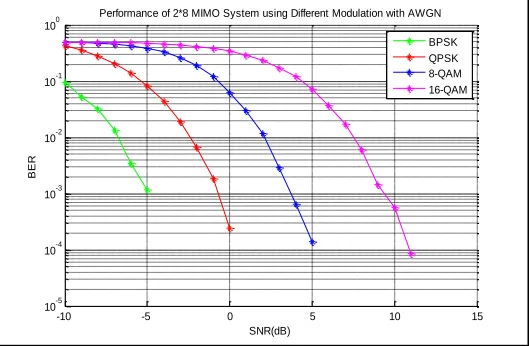
B. Performance of 𝟐 × 𝟖MIMO system over AWGN channel
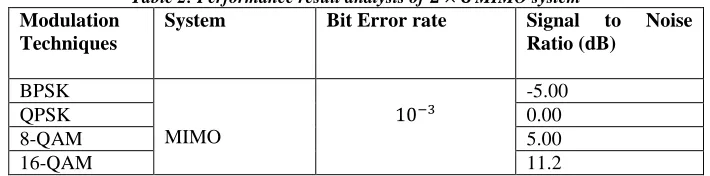
The simulation results 2 × 8MIMO system are shown in figure 6 and the result analysis are shown in table 2.
Fig. 6: Performance analysis of 𝟐 × 𝟒 MIMO system using different modulation techniques with AWGN channel
-10 -5 0 5 10 15
10-4
10-3
10-2
10-1
100
SNR(dB)
BER
Performance of 2*4 MIMO Systems using different Modulation with AWGN
BPSK QPSK 8-QAM 16-QAM
-10 -5 0 5 10 15
10-5
10-4
10-3
10-2
10-1
100
SNR(dB)
BER
Performance of 2*8 MIMO System using Different Modulation with AWGN
Table 2: Performance result analysis of 𝟐 × 𝟖 MIMO system Modulation
Techniques
System Bit Error rate Signal to Noise Ratio (dB)
BPSK
MIMO
10−3
-5.00
QPSK 0.00
8-QAM 5.00
16-QAM 11.2
CONCLUSION
A MIMO-OFDM modulation technique can achieve reliable high data rate transmission over broadband wireless channels. We developed a program in MATLAB, to study MIMO and MIMO-OFDM systems behavior under different conditions. We have used the parameters data rate1Mbps, number of transmitted bits 100000, AWGN channel, 64 subcarriers OFDM signal, four types of modulation BPSK, QPSK, 16QAM and 64QAM.
The performance is displayed in figure 5 in terms of the BER verses SNR logarithmic plot. In the table 1 in this plot we analysis the 16-QAM, SNR is increased 8.2 dB on BER at 10−3 as compared to 8-QAM and Modulation
Techniques at a constant signal power.
The performance is displayed in figure 6.8 in terms of the BER verses SNR logarithmic plot. this plot we analysis the 16-QAM, SNR is increased 6.2 dB on BER at 10−3 as compared to 8-QAM and Modulation Techniques at a
constant signal power.
REFERENCES
1. AmmarAli Sahrab “MIMO-OFDM: Maximum Diversity Using Maximum Likelihood Detector” IEEE-2014. 2. Mukesh Patidar, Rupeshdubey “Performance Analysis of WiMAX 802.16e Physical Layer Model” 2012
IEEE.
3. S.M. LalanChowdhiury, P. Venkateswaran, “Performance Analysis of WiMAX PHY”, IEEE CASCOM Post Graduate Student Paper Conference 2010, Dept of electronics & Tele-Communication Engg., Jadavpure University, Kollata, India.
4. Jian Li, Guoqing Liu, and Georgios B. Giannakis, Fellow, IEEE, “Carrier Frequency Offset Estimation for OFDM-Based WLANs”, IEEE SIGNAL PROCESSING LETTERS, VOL. 8, NO. 3 MARCH 2001.
5. IEEE 802.16-2006: "IEEE Standard for Local and Metropolitan Area Networks, Air Interface for Fixed Broadband Wireless Access Systems".
6. BiswajitSahoo, Ravi Ranjan Prasad “BER Analysis of Mobile WiMAX System using LDPC Coding and MIMO System under Rayleigh Channel” International conference on Communication and Signal Processing, April 5-5, 2015.
7. Sonal Singh, Dr. Manish Rai “BER Performance Analysis of QAM Modulation Techniques in MIMO Rayleigh Channel for WCDMA System” February-2015.
8. Gede Puja Astawa “Performance Analysis of MIMO-OFDM Using Convolution Codes with QAM Modulation” International Scholarly and Scientific Research & Innovation 7(12) 2013.
9. Koffman I., Roman, V., “Broadband wireless access solutions based on OFDM access in IEEE 802.16” Communications Magazine, IEEE, Vol.40, Issue. 4, April 2002, Pages 96-103.
10. IEEE 802.16e-2005, “IEEE Standard for Local and Metropolitan Area Networks, part 16,Air Interface for Fixed and Mobile Broadband Wireless Access Systems”, IEEE Press, 2006.
11. DaanPareit, Bart Lannoo “The History of WiMAX: A Complete Survey of the Evolution in Certification and Standardization for IEEE 802.16 and WiMAX” IEEE Communications Surveys & Tutorials, VOL. 15, NO. 5, FOURTH QUARTER 2012.
12. Koffman I., Roman, V., “Broadband wireless access solutions based on OFDM access inIEEE 802.16” Communications Magazine, IEEE, Vol.40, Issue. 4, April 2002, Pages 96-103
13. ETSI TS 102 177 Version 1.3. February 2006, "Broadband Radio Access Networks (BRAN); Hiper-MAN;Physical (PHY) Layer".
16. IEEE Computer Society, “IEEE standard for information technology - telecommunications and information exchange between systems - local and metropolitan area network-specific requirements part 11: Wireless LAN medium access control and physical layer specifications”, IEEE Std 802.11, June 2007.
17. IEEE 802.162004, “IEEE Standard for Local and Metropolitan Area Networks Part16: Air Interface for Fixed Broadband Wireless Access Systems”, 1 October, 2004.
18. PavaniSanghoi, Lavish Kansal “ Analysis of WIMAX Physical Layer using Spatial Diversity under Different Fading Channels”, International Journal of Computer Applications (0975 – 8887) Volume 45– No.20, May 2012.
19. NehaRathore “Simulation of WiMAX 802.16e MAC Layer Model: Experimental Results”, International journal of electronics & communication technology, IJECT Vol. 3,issue, Jan.-March 2012.
20. Md. Ashraful Islam, Md. ZahidHasan, “RiazUddinMondal(corresponding author), Performance Evaluation of Wimax Physical Layer under Adaptive Modulation Techniques and Communication Channel”s, (IJCSIS) International Journal of Computer Science and Information Security, Vol. 5, No.1, 2009.
21. M.A. Mohamed, M.S Abou-El-Soud, and H.M. Abdel-Atty “Performance and Efficiency of WiMAX-MAC-Layer: IEEE-802-16e” , IJCSNS International Journal of Computer Science and Network Security, VOL.10 No.12, December 2010.
22. John Proakis, MasoudSalehi, “Digital Communications”, Fifth Edition.
23. SumitSugandhi, “BER Performance of OFDM Using Different Modulation Techniques over Different Fading Channels” June-2015.