251 | P a g e
COMPARATIVE ANALYSIS OF GFRP & GFRP DOPED
WITH MWCNTS COMPOSITES SLIDING UNDER DRY
AND OIL LUBRICATED ENVIRONMENTAL
CONDITIONS
Anay Arun
1, Praveen Kumar
2, Kalyan Kumar Singh
3 1,2,3Department of Mechanical Engineering, Indian School of Mines, Dhanbad, (India)
ABSTRACT
Tribological properties of GFRP (glass fiber reinforced polymer) and GFRP doped with MWCNTs(carbon nanotubes, diameters of order nanometers) fabricated by vacuum bagging process were experimentally investigated under three different loads and two different sliding environments, (a) Dry environment and (b) Oil lubricated environment. Wear tests were conducted on a pin on disc type tribometer and steel as counter body with three different loads and two sliding velocity. Experimental results depict that coefficient of friction and wear rate is less in nano composites as compared with GFRP composites. Wear rate shows a similar behavior in both type of composites as it is comparatively less in oil lubricated sliding when compared with sliding in dry environment. In oil lubricated sliding, the coefficient of friction is reduced due to presence of softer epoxy resin body matrix in between layers of glass fibers. Initial wear of polymer mixes with absorbed lubricant on steel surface which acts as lubricant storage reservoir, due to which the protruding glass fibers pick up lubricant molecules to effectively and avoids direct contact between steel and fiber. In the dry sliding environment condition, images taken by FESEM shows that the rate of wear of composite increases due to increasing load and high friction as a result they undergo bending at the ends.
Keywords: Tribology; Nano Composites; Polymer Matrix Composite; Wear resistance; Carbon Fiber;
Carbon Nanotubes
I. INTRODUCTION
Fabrication of composites by inserting fibers in a base of polymer or epoxy resin materials has emerged as a low
cost, high strength to weight ratio and high impact strength has led to its use in day to day life. Uses of composite
materials have emerged in shipbuilding, automobile, chemical and aerospace industries etc [1–3] and all these
application requires knowledge of both mechanical and tribological properties.
Some research have been done regarding the sliding wear of GFRP composites[5-6].Even though the epoxy resin
252 | P a g e
degrades its properties as well[4].In research among the various categories of composites available glass fiberreinforced polymer (GFRP) is focused more because of its promise in terms of engineering applications[5-6]. These
are comparatively more expensive, but are used for variety of engineering applications due to its superior
mechanical properties and uses [7-9]. Density of GFRP is comparatively very less and is easily shapeable as
compared with other engineering materials. The different sequences of stacking of laminates in composites results in
increasing strength and attain heavy loads[10]. As per required mechanical property and applications selection of
epoxy resin and reinforcement are done to fabricate any composite material [11-14]. Prior researchers have been
done regarding the sliding wear of GFRP composites. Some common mechanisms of wear for GFRP composites
are: fiber–matrix deboning, Delamination and fiber breaking [15]. Some additional mechanisms noted are fiber pull
out, pealing of the resin, matrix wear associated to fiber separation, deformation of the edges of the wear track and
shear deformation of the fibers. Thus application of GFRP composites in mechanical parts requiring adequate wear
resistance in actual service conditions would require an adequate knowledge through research, of the friction and
wear characteristics of such composites when used in conjunction with other sliding material e.g. steel.
There are various research done on polymer composites for various applications including enhancing its strength at
low temperatures over glass thermoset systems[16] .To enhance the mechanical properties of GFRP it is mixed with
CNTs(carbon nano tubes with diameters in nanometers)[17-18].In this research laminates mixed with epoxy and
carbon nanotubes for the manufacture nano composites. CNTs are aligned along the existing glass fibers and epoxy
resins binds all the filaments (CNTs and fiber) together. The reinforcements of CNTs in epoxy along with woven
glass fiber, so as to provide enhance strength and toughness. Alignment and adhesion of CNTs in epoxy plays a very
important criteria for application of composites and several difficulties are reported in prior research articles[19],
these difficulties arises due to impregnation of high volume fraction of CNTs in aligned fiber advanced composites.
There are several issues like dispersion and agglomeration slight mechanical properties are improved in case of nano
composites [20-21].
Investigation done by researchers has shown that when the polymer resins are reinforced with fibers, it reduces the
wear rate of composites [22].But the tribological behavior of composites depends on other parameters like
composition, angle of orientation of the fibers, shape and size of laminates etc[23]. To extend that prior work, the
present research is aimed at determining the effects of all such parameters on tribological behavior of GFRP and
GFRP mixed with CNT composite materials. Wear analysis of GFRP materials were studied under various normal
loads, sliding velocities and sliding conditions and lubricating media such as dry and oil lubricated environmental
conditions.
II. EXPERIMENTAL DETAILS
2.1 Materials used for GFRP
GFRP specimens were prepared using plain weave glass fiber include E-glass fibers of diameter 10– 15 µm and
Epoxy Resin(epoxy resin with viscosity 300cP mixed with K-6 Hardener) supplied by Atul Limited, Gujarat, India.
The property of epoxy resin was not modified i.e no other solvent was used to reduce its viscosity. Epoxy have
253 | P a g e
shrinkage on curing. GFRP is a good engineering material with high impact strengths, easily shapeable, highstrength to weight ratio and that is also desirable in commercial applications due to lower cost. Carbon
nanotubes(diameters in nanometers) were used for fabrication of nano composites. Curing of composites was done
at room temperature.
2.2 Fabrication of GFRP and Nano Composites
The GFRP composite plates having dimensions 270mm×320mm×6mm were prepared by the vacuum bagging
process (Fig. 1). 6 mm nominal thickness was achieved by eight layers of glass fabric laminates. Different layers of
glass fabric were laid one over other by stacking sequence as [0◦/ ±45◦/ 90◦]s 3 % Carbon nanotubes (diameters in nanometers) were mixed with epoxy for the fabrication of nano composites. Due to vacuum created by vacuum
bagging technique, it promotes easy flow of excess epoxy and results in better wetting and accelerates the curing
time. Surface of specimen having 0◦ fiber orientation direction was used to contact with steel disc for friction and
wear test. Composite were cured at room temperature for 24 hrs and was prevented from damage from external
environment.
Fig.1 Vacuum bagging process for manufacture of GFRP and GFRP mixed with Carbon
Nanotubes
2.3 Tribological testing
Tribological behavior (wear analysis and coefficient of friction) were performed using pin on disc type tribological
machine. Track diameter of 100mm has been used for all the sets of experiments. The loads and sliding velocities
varied from 30 N to 90 N and 3.14 m/s(600 rpm) respectively. Weight of the specimen were taken before and after
wear test with help of balance having least count of 0.01,all sets of experiments were conducted five times in the
same manner and average weight loss was taken for calculation of specific wear rate. All the GFRP and Nano
Composite specimens were cut to smaller pieces and glued to pin before carrying out experiment There were several
other parameters such as increase in coefficient of friction, rise in temperature of disc, mark of abrasion were
254 | P a g e
Oil used for lubricating disc was SAE20 with kinematic viscosity of 20-30cSt. Prior to every experiment discsurface was cleaned by rubbing with emery paper and washed with acetone. Further oil was poured at 0.05ml/min.
In experiment 0.025 bar pressure was applied at rate of 1.5lit/min.
The specific wear rate was calculated by the given equation, K0(mm3/Nm)=∆m/ρLd (1)
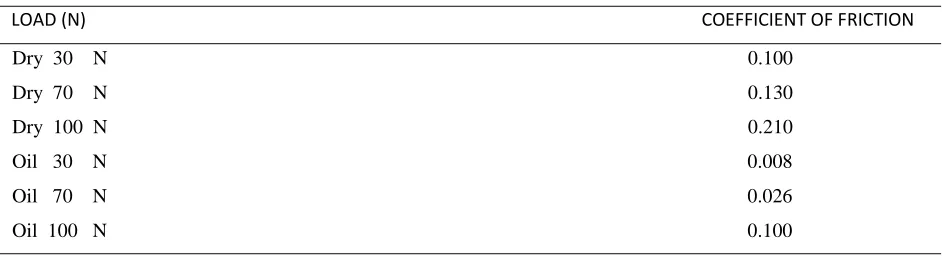
Where ∆m is the weight loss in kg, ρthe density in kg/mm3, Lthe load in N and d the sliding distance in m(Table 1 &2).Coefficient of friction for different sliding conditions are shown in Table 3&4.
Table 1
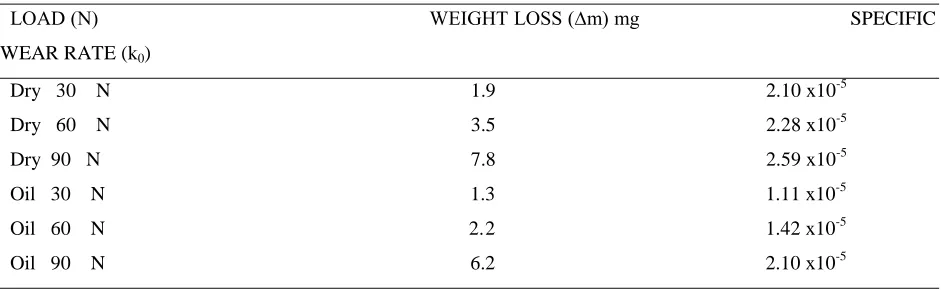
Weight loss and specific wear rate for dry, oil lubricated environmental conditions sliding at 3.14 m/s with variable
loads.
GFRP specimen ρ=1.7842x10⁻⁶
kg/mm3 , N=600 rpm , ∆T=600sec , Track dia = 100 mm, v=3.14 m/s
LOAD (N) WEIGHT LOSS (∆m) mg SPECIFIC
WEAR RATE (k0)
Dry 30 N 1.9 2.10 x10⁻⁵
Dry 60 N 3.5 2.28 x10⁻⁵
Dry 90 N 7.8 2.59 x10⁻⁵
Oil 30 N 1.3 1.11 x10⁻⁵
Oil 60 N 2.2 1.42 x10⁻⁵
Oil 90 N 6.2 2.10 x10⁻⁵
Table 2
Weight loss and specific wear rate for dry, oil lubricated environmental conditions sliding at 3.66 m/s with variable
loads.
Nano Composite(GFRP+CNT) specimen ρ=0.923 g/cm3, N=600 rpm , ∆T=600sec , Track dia = 100 mm, v=3.14
m/s
LOAD (N) WEIGHT LOSS (∆m) mg SPECIFIC
WEAR RATE (k0)
Dry 30 N 1.3 1.12 x10⁻⁵
Dry 60 N 1.9 1.54 x10⁻⁵
Dry 90 N 2.3 1.92 x10⁻⁵
Oil 30 N 1.1 1.00 x10⁻⁵
Oil 60 N 1.4 1.08 x10⁻⁵
Oil 90 N 1.9 1.43 x10⁻⁵
Table 3
Coefficient of friction for dry, oil lubricated environmental conditions sliding at 3.14 m/s with variable loads.
255 | P a g e
LOAD (N) CO EFFICIENT OF FRICTIONDry 30 N 0.200
Dry 60 N 0.220
Dry 90 N 0.310
Oil 30 N 0.060
Oil 60 N 0.068
Oil 90 N 0.120
Table 4
Coefficient of friction for dry, oil lubricated and inert gas environmental conditions sliding at 3.14 m/s with variable
loads.
Nano Composite(GFRP+CNTs) specimen ρ= 0.923 g/cm3, N=600 rpm , ∆T=900sec , Track dia = 100 mm,
v=3.14 m/s
LOAD (N) COEFFICIENT OF FRICTION
Dry 30 N 0.100
Dry 70 N 0.130
Dry 100 N 0.210
Oil 30 N 0.008
Oil 70 N 0.026
Oil 100 N 0.100
III. RESULTS AND DISCUSSION:
3.1. Coefficient of friction
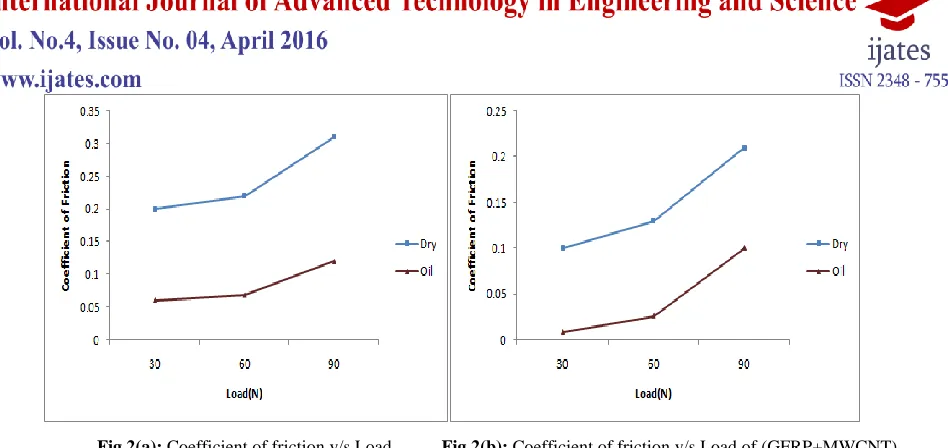
The values of coefficient of friction of GFRP and GFRP doped with MWCNTs are given in Table 3& 4. The
obtained results of coefficient of friction are plotted in Fig. 2 (a) & (b). The figure shows the deviations of
coefficient of friction (average value taken at each situation) with load and velocity of sliding for two mediums
under which the sliding had taken place for theGFRP and Nano Composites. Coefficient of friction increases with
increase in load and sliding velocity for glass fiber reinforced composites. In GFRP composites angle of fiber does
not significantly relate with coefficient of friction and medium of sliding. The values of coefficient of friction is
comparatively very less in nano composites than GFRP thus mixing up of carbon nanotubes increases the
mechanical properties of GFRP. In oil lubricated sliding the wear debris which get accumulated on the disc surfaces
comes in between the composite and rotating disc and this soft debris prevents direct contact between fiber and disc
256 | P a g e
Fig 2(a): Coefficient of friction v/s Load Fig 2(b): Coefficient of friction v/s Load of (GFRP+MWCNT)of GFRP composite composite
3.2. Wear studies
3.2.1. Weight loss and Specific wear rate
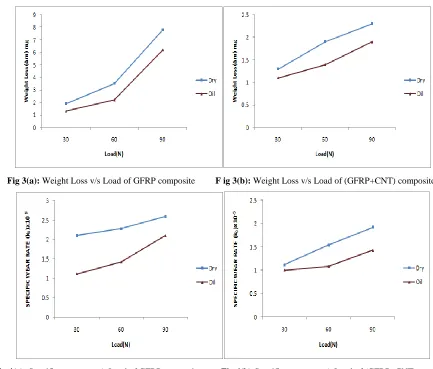
Fig 3 and 4 shows the weight loss and specific wear rate of GFRP and GFRP doped with MWCNTs composite.
Weight loss and specific wear rate generally depends on the factors like normal load, sliding environment, sliding
distance of specimens on rotating disc, and velocity of sliding. The effects of the variable normal load, sliding speed
and sliding environment on the weight loss of GFRP and Nano Composites are shown in fig 3&4. The weight loss
and specific wear rate in GFRP and Nano Composite specimens was measured at 3.14 m/s speeds and under 30N-90
N loads on the dry and oil lubricated sliding environment. The weight loss for all the composite specimens normally
increased with the increase of normal loads for GFRP and GFRP+CNTs composites at constant sliding speeds of
3.14 m/s. However under both sliding environment weight loss in case of Nano Composites is comparatively less
than GFRP specimen this is due to presence of CNTs which aligns radially around the existing glass fibers thus
provides enhanced strength and toughness. The GFRP specimens show a lower coefficient of friction and lesser
wear rate in oil lubricated medium, as compared with dry sliding environment. Due to this reason, the weight loss
also becomes comparatively less for the same sliding distance.
Results obtained through experiment also show that temperature of specimen increases with increase in normal load
and sliding velocity. From table 1& 2 it can be observed that the “loss of weight due to wear” is increased with
increase in sliding velocity and normal loads. Due to thermal softening effect of epoxy matrix in GFRP composites
because of rise in temperature, the matrix gets more softened attaining more depth i.e. softening of matrix in
proportion to the increment in temperature, it was observed that the softened layers of matrix and the glass fibers
embedded and gets separated from the surface of the specimen, as a result, the weight loss increased with an
increase in load and sliding speed. In Oil lubricated sliding environment the decrease in specific wear rate and
weight loss for both GFRP and Nano Composites is because of the formation of thin film of lubricant over the
counter face of rotating disc i.e in oil lubricated sliding, the wear rate is reduced due to presence of softer epoxy
resin body matrix in between layers of glass fibers. Initial wear of polymer mixes with absorbed lubricant on steel
257 | P a g e
molecules to effectively and avoids direct contact between steel and fiber. Generally oil as a lubricating materialminimizes the loss due to wear of GFRP and Nano Composites which is dependent on the quality of the transfer film
and its adsorption on the metallic surface.
Value obtained from experiments shows that specific wear rate mainly depends on the load, velocity, density of
matrix and sliding environment. Experimental data reveals that for both GFRP and GFRP+CNTs during oil
lubricated sliding environment there is a considerable decrease of specific wear rate when compared with dry sliding
environment. By observing the trend of specific wear rate, weight loss and nature of wear the wear mechanism of
GFRP and Nano Composites can be classified in two groups such as the matrix wear(matrix plastic deformation,
matrix cracking etc) and the fiber wear(Delamination of fiber, fiber cracking, fiber rupture, dislocation of fiber from
its orientation etc).
Fig 3(a): Weight Loss v/s Load of GFRP composite F ig 3(b): Weight Loss v/s Load of (GFRP+CNT) composite
Fig 4(a): Specific wear rate v/s Load of GFRP composite Fig 4(b):Specific wear rate v/s Load of (GFRP+CNT) composite
3.2.2. FESEM analysis of worn surface
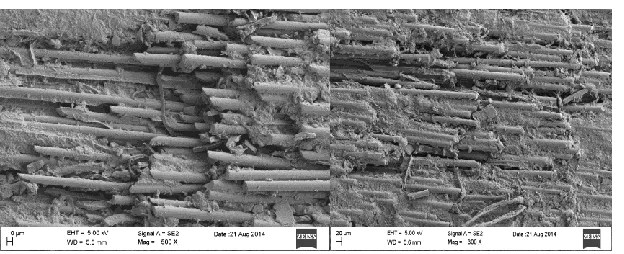
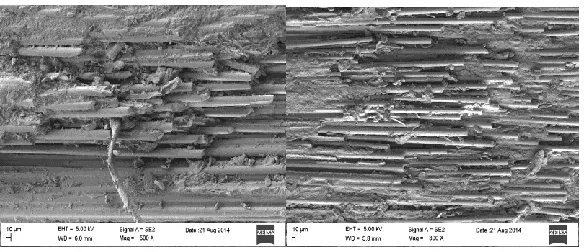
Worn surfaces of the composites after tribological testing on pin on disc machine were studied by FESEM analysis
to understand and get insights into the process of wear and Delamination of fibers. Micrographs of surfaces of
258 | P a g e
Damage of fiber and matrix increases with increase in normal load on fibers and it gives a correlation with wearrate. With the help of FESEM micrographs it is observed that stacking of fibers (which acts as wear resistance of
composites) and fiber debris(responsible for high coefficient of friction and low wear resistance)diminished with
increase in normal load. Delamination and dislocation of fibers in GFRP doped with MWCNTs composites is
comparatively very less when compared with GFRP composites.
The effect of normal load and sliding environment i.e. dry environment and oil-lubricated environment up to the
level of fiber damage in different mechanisms or up to a limit of deterioration in fiber–matrix bonding followed by
fiber micro-cracking which leads to pulverization and removal in form of debris(which may be thrown out of the
surface or may get embedded) in the matrix in random directions plays a significant role in change of wear rate and
coefficient of friction which can be clearly observed in SEM micrographs.
Fig 5(a):
Worn surface of GFRP and GFRP doped with MWCNT sliding under Dry environment at 30N
Fig 5(b):
Worn surface of GFRP and GFRP doped with MWCNT sliding under Dry environment at 60N
259 | P a g e
Fig 5(d):S
urface of GFRP and GFRP doped with MWCNT sliding under Oil lub environment at 30N
Fig 5(e):S
urface of GFRP and GFRP doped with MWCNT sliding under Oil lub environment at 60N
Fig 5(f):
Surface of GFRP and GFRP doped with MWCNT sliding under Oil lub environment at 90N
IV. CONCLUSIONS
By the help of graph obtained from experimental data and FESEM micrographs the results obtained out of
tribological testing of GFRP and GFRP doped with MWCNT composite the following conclusions can be drawn:
1. The coefficient of friction of the GFRP and GFRP doped with MWCNT tested was in the range of 0.2-0.3 sliding
against steel under dry and oil lubricated environmental conditions.
2. Tribological behavior of a GFRP and GFRP doped with MWCNT composite material depends on variable loads,
sliding velocity and sliding environment. For all values of normal loads and sliding velocities studied, the obtained
values of coefficients of friction and wear rates for GFRP composites are greater as compared to GFRP doped with
260 | P a g e
3. Value of coefficient of friction in oil lubricated sliding environment for both GFRP and GFRP+MWCNTs is lessbecause of formation of lubrication film in between two contacting surfaces. Debris which gets embedded in
between laminates and rise in temperature while working at higher load also plays an important role in lowering the
coefficient of friction.
4.Fibres of GFRP and GFRP doped with MWCNT composites sliding under dry sliding environment undergo
shearing at the ends due to increase of normal load thus higher values of wear rate is obtained when compared with
oil lubricated sliding environment. This can be clearly observed using FESEM micrographs
5. Lubricating oils with higher absorption capacity and high viscosity can play a vital role in decreasing the wear
rate as they can easily form thin films in between two mating surfaces.
6. Wear rate for all the composite specimens increased with the increase of normal loads for GFRP and GFRP doped
with MWCNT composites at constant sliding speeds of 3.14 m/s. However under both sliding environment weight
loss in case of Nano Composites is comparatively less than GFRP specimen this is due to presence of CNTs which
aligns radially around the existing glass fibers thus provides enhanced strength and toughness.
7. Mechanism of wear identified in the samples were adhesion and surface fatigue.
Acknowledgement
I am thankful to Department of Mechanical Engineering of The Indian School of Mines, Dhanbad, India for
providing me the experimental support for carrying out the laboratory work.
REFERENCES
[1] N.S.M. El-Tayeb, B.F. Yousif, P.V. Brevern, On the measurements of interface temperature and friction
coefficient of glass-fibre reinforced epoxy composite under dry sliding contact, in: Proceedings of the
international conference on recent advances in mechanical and materials engineering, 30–31 May 2005,
Kuala Lumpur, Malaysia, 2005, pp. 1006–113.
[2] N.S.M. El-Tayeb, B.F. Yousif, Wear and friction behaviour of CGRP and WGRP composites subjected to
dry sliding, in: Proceedings of WTC2005 world tribology congress III September 12–16, 2005, Washington,
DC, USA, Paper No. WTC 2005-63097.
[3] K.L. Edwards, An overview of the technology of fibre-reinforced plastics for design purposes, Materials &
Design, 19(1-2) (1998) 1–10.
[4] S. Bahadur, Y. Zheng, Mechanical and tribological behaviour of polyester reinforced with short glass fibres,
Wear 137 (2) (1990) 251–66.
[5] H. Pihtili, A. N. Tosun, Effect of load and speed on the wear behaviour of woven glass fabrics and aramid
fibre reinforced composites, Wear 252 (2002) 979–84.
[6] H. Pihtili, A. N. Tosun, Investigation of the wear behaviour of a glass fibre- reinforced composite and
261 | P a g e
[7] P. Kishore Sampathkumaran, S. Seetharamu, S. Vynatheya, A. Murali, R. K. Kumar, SEM observations ofthe effects of velocity and load on the sliding wear characteristics of glass fabric–epoxy composites with
different fillers, Wear 237(2000) 20–7.
[8] A. A. Collyer, Rubber toughened engineering materials, Chapman and Hall, London, 1994.
[9] N.S. El-Tayep, R.M. Gadelrap, Friction and wear properties of E-glass fibre reinforced epoxy composites
under different sliding contact conditions, Wear 192 (1996) 112–117.
[10] M. R. Piggot, Load-bearing fibre composite, Pergamon Press, Oxford, 1980.
[11] S.N. Kukureka, C.J. Hooke, M. Rao, P. Liao, Y.K. Chen, The effect of fibre reinforcement on the friction
and wear of polyamide 66 under dry rolling–sliding contact, J. Tribol. Int. 32 (1999) 107–16.
[12] V.K. Srivastava, J.P. Pathak, Friction and wear properties of bushing bearing of graphite filled short glass
fibre composite in dry sliding, Wear 197 (1996) 145–50.
[13]
Friction, Lubrication, and Wear Technology ASM Handbook, Volume 18, ASM International, Materials
Park, Ohio, USA, (1992).
[14] R. Ramesh, P. Kishore Sampathkumaran, R.M.V.G.K. Rao, Dry sliding wear studies in glass fibre
reinforced epoxy composites, Wear 89 (1983) 131.
[15] K. H. Zum Gahr, Microstructure and Wear of Materials, Tribology, series no10, Elsevier, Amsterdam, 1987.
[16] Ajayan PM,TourJM,Nanotube composites.Nature 2007;447:1066-8
[17] Thostenson ET,Li WZ,Wang DZ,Ren ZF,Chou TW,cabon nanotube/carbon fibre hybrid multiscale
composites.J Appl Phys 2002;91(9):6034-7
[18] Vaia RA,Wagner HD.FrameworkNanocompos Mater Today 2004;32:32-7
[19] Schulte k<Windle AH,Editorial.Compos Sci Technol2007;67:777
[20] EnriqueJ.,Garcia,Brain l.Wardle,A.John hart,Namiko Yamamoto:fabrication and multifunctional properties
of hybrid laminate with aligned carbon nanotubes grown situ:composite science technology 68(2008)
2034-2041
[21] Gu YH.Fracture behavior of continuous alumina fiber reinforced epoxy. j
composMater1994;28(13):1227-36
[22] Thostenson ET,Li C,chou TW,nanocomposites in context.Compos Sci Technol 2005;65:491-516
[23]
Friction, Lubrication, and Wear TechnologyASM Handbook, Volume 18, ASM International, Materials Park, Ohio, USA, (1992).
[24] K. H. Zum Gahr, Microstructure and Wear of Materials, Tribology, series no10, Elsevier, Amsterdam, 1987