2018.10.08.021
Optimized Rectangular Electrode of Electrostatic Sensor
Mozhde Heydarianasl
1and Mohd Fuaad Rahmat
1,*1Department of Control and Mechatronics Engineering, Universiti Teknologi Malaysia,
81310 UTM Johor Bahru, Johor, Malaysia
Received 6 June 2018; accepted 25 November 2018, available online 31 December 2018
1. Introduction
Flow measurement community has significant attention to electrostatic sensor due to its advantages. These sensors not only are normally strong but also do not need an external source. Those are the most effective sensors in a pneumatic conveyor to generate an electrostatic charge on the particles because of movement of particles and their interaction with each other, the pipeline and conveying air. In this situation, the amount of charge depends on the physical and chemical properties of the particles and surrounding environment in the pipeline [1,2]. It can be employed directly for controlling the velocity particles to improve product quality and to reveal the performance with better efficiency. Optimization of electrostatic sensor electrodes is required to obtain maximum spatial sensitivity and minimum statistical error. The main reason to optimize electrostatic sensor is that reducing discrepancy between the measured correlation velocity and true mean particle velocity to obtain uniform spatial sensitivity. For these relatively, optimization methods have been studied in terms of fundamental characteristics of electrostatic sensor in several configurations [3,4].
Mathematical model of electrostatic sensor have been reported from circular- ring electrode, quarter- ring electrode, pin electrode, and rectangular electrode by several researchers [5-7]. Detailed mathematical model to describe the characteristics of rectangular electrodes is available in literature [8]. Apart from those two different methods to install electrostatic sensor to a pipeline is also available which are non- intrusive arrangement and intrusive arrangement [9]. Experimental studies have been reported on measurement of velocity, concentration and mass flow rate for both non-intrusive and intrusive
models of electrostatic sensors by several researchers [10-12].
Numerical investigations in this paper are performed for intrusive models of electrostatic electrode using mathematical model as reported in Heydarianasl and Rahmat [13]. Length and thickness of electrode has significant role on the spatial sensitivity and statistical error; hence, both parameters has been considered in a new optimization method (MOPSO) to obtain the optimal value. The focus of present optimization study is to further validate the electrostatic sensor designs using the available experimental data. Numerical investigation has been done for the critical conditions of various lengths and thicknesses of electrode.
2. Numerical Model
In the present study, a mathematical model of intrusive rectangular electrode has been developed. The equations of spatial sensitivity and statistical error based on length and thickness of electrode has been computed and then plotted using commercial MATHCAD software. Fig. 1 shows the proposed model of rectangular electrode. Some assumptions are considered to calculate required equations. First, a single charged particle, q, has been regarded as a point charge in the upstream of the pipeline.
As mentioned earlier, a net electrostatic charged, Q, on the particle has been generated when a charged particle move down in the pipeline and can be stated by equation(1). Second, pipe wall is earthed. Third, the diameter of pipeline and width of electrode has been fixed in 10 cm and 0.5 cm, respectively. According to coulomb’s law, the magnitude from the electric field E
created by a point charge q at a certain distance r is given by equation (2):
Abstract: This paper focuses on optimization of rectangular electrodes of electrostatic sensors. Fundamental characteristics of these electrodes are significant in order to use them in many industries that deal with particles and powders. In this study, Multi- Objective Particle Swarm Optimization (MOPSO) technique has been employed to obtain optimal value of electrode designs including length and thickness. Commercial MATLAB software is used in the optimization. Special sensitivity and statistical error have been utilized as conflict objective functions to recognize optimal sizes of electrodes. The optimization results are compared with the experimental data available in current study. From the observed results, the optimum sizes of length and thickness of rectangular electrode was equal to 0.6 cm and 0.5 cm, respectively.
Ф M S P +q r y h E E┴ Rectangular-shaped electrode u X Y dy dx E┴ dz Z β
Fig.1 Modeling of rectangular electrode.
V V
dS
Q
(1)
2 0
4
r
q
E
(2)
To simplify the equations, normalized electric field of rectangular electrode is calculated:
E
sin
φ
cos
E
(3)
After that, according to modeling of rectangular electrode;
PS
MS
sin
(4)
MS
PM
cos
(5)
V
E
dQ
0
(6)
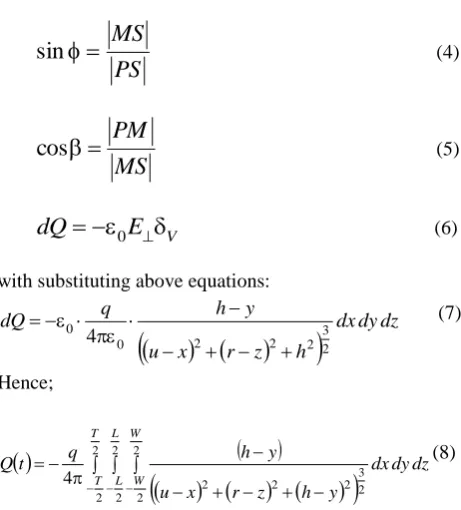
with substituting above equations:
u x r z h
dxdydz y h q dQ 2 3 2 2 2 0 0 4
(7)
Hence;
2 2 2 2 2 2 2 3 2 2 2 4 T T L L W W dz dy dx y h z r x u y h q t Q (8)where L, T, and W is the length, thickness and width of the electrode, respectively. To simplify the model, the
width of electrode is fixed in 0.5 cm. Finally, the dimensionless equation of spatial sensitivity for rectangular electrode can be stated as:
2 2 2 2 2 1 2 2 2 2 1 2 2 2 2 2 25 . 0 25 . 0 25 . 0 25 . 0 4 1 T T L L dz dy y z r u u y z r u u y z r y S (9)Furthermore,normalizedstatistical error is considered as:
2 1 2 3
49
.
5
L
T
(10)
Table 1. The numerical amount of spatial sensitivity for rectangular electrode.
No. Electrode
type
Length of electrode
(cm)
Thickness of electrode
(cm)
Spatial Sensitivity
(%)
Length of electrode
(cm)
Thickness of electrode
(cm)
Spatial Sensitivity
(%)
1 Rectangular 1.00 0.15 3.200 0.60 0.50 0.280
2 Rectangular 1.00 0.30 7.200 0.70 0.50 0.550
3 Rectangular 1.00 0.50 7.400 0.80 0.50 0.650
4 Rectangular 1.00 0.70 7.600 0.90 0.50 1.050
5 Rectangular 1.00 1.00 7.800 1.00 0.50 1.410
S (T = 0.15 cm)
S (T = 0.30 cm)
S (T = 0.50 cm)
S (T = 0.70 cm)
S (T= 1.00 cm)
Fig. 2 Numerically obtained spatial sensitivity of rectangular electrode in constant length (L=1.0 cm) and different thickness (T).
S ( L = 0.60 cm)
S ( L = 0.70 cm)
S ( L = 0.80 cm)
S ( L = 0.90 cm)
S (L = 1.0 cm)
Fig. 3 Numerically obtained spatial sensitivity of rectangular electrode in constant thickness (T=0.5 cm) and different length (L).
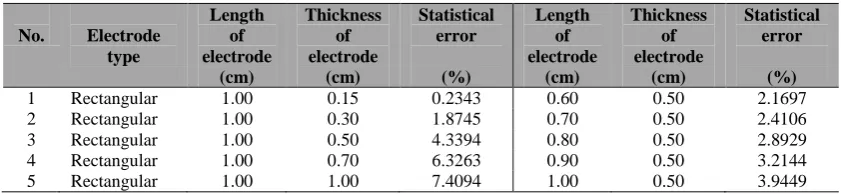
Table 2. The numerical amount of statistical error for rectangular electrode.
No. Electrode
type
Length of electrode
(cm)
Thickness of electrode
(cm)
Statistical error
(%)
Length of electrode
(cm)
Thickness of electrode
(cm)
Statistical error
(%)
1 Rectangular 1.00 0.15 0.2343 0.60 0.50 2.1697
2 Rectangular 1.00 0.30 1.8745 0.70 0.50 2.4106
3 Rectangular 1.00 0.50 4.3394 0.80 0.50 2.8929
4 Rectangular 1.00 0.70 6.3263 0.90 0.50 3.2144
5 Rectangular 1.00 1.00 7.4094 1.00 0.50 3.9449
3.
Optimization Method
Several researchers have been applied different methods including FEM [14,15], GA [3], ANSYS [3], and PSO [4] to optimize electrostatic sensor electrodes. MOPSO has been examined as a new approach in this study due to its advantages including simplicity, high accuracy, and good performance. Spatial sensitivity and statistical error are two conflict objective functions in MOPSO. Main purposes of optimization of electrostatic sensors are maximum spatial sensitivity and minimum statistical error. On the one hand, longer length and thicker thickness are required to attain maximum spatial
Fig.4 Optimization of rectangular electrode using MOPSO.
4.
Results and Discussion
To validate the use of MOPSO technique, a laboratory setting was created to compare the optimization results with the experimental observations. Experimental data obtained through the use of DEWETRON data acquisition equipment from the test rig. Two electrostatic sensors have been arranged in pipeline wall in 15 cm separation. Figs. 5-7 show the upstream and downstream signal in addition to correlation diagram of electrostatic sensor. As mentioned earlier, different length (for e.g. 0.4 cm, 0.6 cm, and 1.0 cm) and thickness (for e.g. 0.3 cm, 0.5 cm, and 0.6 cm) were applied in laboratory to find the optimum amount.
Then, the correlation velocity was measured and compared with mean particle velocity. If the discrepancy between correlation and mean particle velocity is decreased, more uniform spatial sensitivity has achieved. Moreover, spatial sensitivity could be calculated using correlation diagram and dimensionless equation, which is stated as:
%
100
)
,
,
(
)
,
,
(
q
z
y
x
Q
z
y
x
S
(11)The mean particle velocity and correlation velocity was respectively equal to 4.427 m/s and 3.382 m/s in present research; hence, the discrepancy between correlation and mean particle velocity for rectangular electrode was equal to 1.045 m/s and the percentage of statistical error was 23%. According to experiments, the best value of length of electrode was 0.600 cm in comparison to optimal value measured by MOPSO method that was 0.63 cm; additionally, the best value of thickness of electrode was 0.500 cm in comparison to optimal value measured by MOPSO method that was 0.54 cm. Therefore, the optimization and experimental results are close to each other. These values lead to low electrical erosion, high spatial sensitivity, and low statistical error.
The predictions by the present numerical model (Figs. 2 and 3) are quite close to the experimental results than the detailed predictions by previous researches. This is probably due to the capabilities of the numerical models used in the present study as compared to that in the reported works.
(a)
(b)
(c)
(a)
(b)
(c)
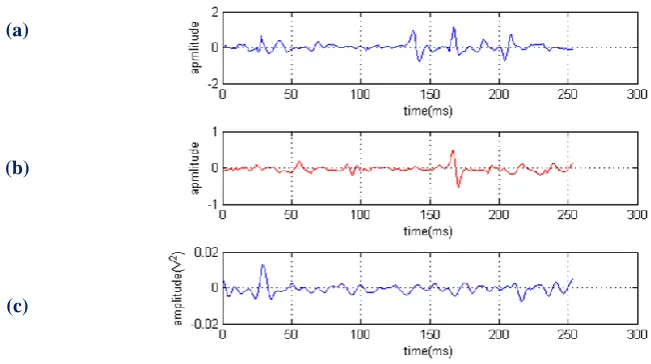
Fig. 6 (a) Upstream signal of electrostatic sensor, (b) downstream signal of electrostatic sensor, (c) correlation diagram of rectangular electrode for electrostatic sensor in length= 0.6 cm, thickness= 0.5 cm, and frequency= 1000 Hz
(a)
(b)
(c)
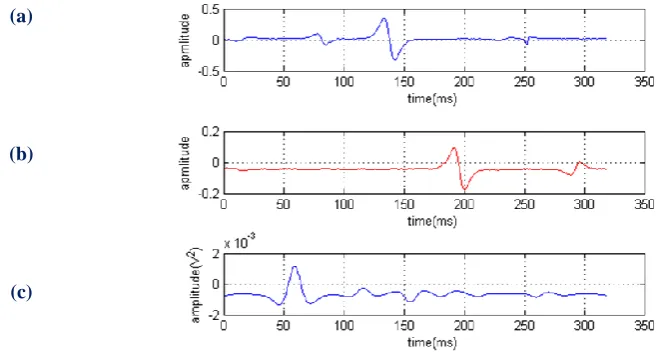
Fig. 7 (a) Upstream signal of electrostatic sensor, (b) downstream signal of electrostatic sensor, (c) correlation diagram of rectangular electrode for electrostatic sensor in length= 1.0 cm, thickness= 0.6 cm, and frequency= 1000 Hz.
5.
Summary
Optimization results of rectangular electrode of electrostatic sensors have been reported in detail. Additionally, using experimental measurements reported in this research work, validation of Multi- Objective Particle Swarm Optimization technique has been carried out. Mathematical equations of spatial sensitivity and statistical error relevant to model of rectangular electrode has been calculated and then plotted. Numerical
References
[1] Ma, J., Yan, Y. Design and evaluation of electrostatic sensors for the measurement of velocity of pneumatically conveyed solids. Flow Measurement and Instrumentation, (2000), 11, 195-204.
[2] Matsusaka, S., Masuda, H. Simultaneous measurement of mass flow rate and charge-to-mass ratio of particles in gas–solids pipe flow. Chemical engineering science, (2006), 61, 2254-2261.
[3] Qian, X., Cheng, X., Zhang, L., Cao, M. The sensitivity analysis and optimization design of the electrostatic inductive measuring device for weak charge measurement of coal mine dust. In Computer science for environmental engineering and ecoinformatics, Springer: (2011), pp 83-90.
[4] Heydarianasl, M., and Rahmat, M.F.a. Optimization of electrostatic sensor electrodes using particle swarm optimization technique. The International Journal of Advanced Manufacturing Technology,
(2017), 89, 905-919.
[5] Shao, J., Yan, Y., Krabicka, J. In Comparative studies of electrostatic sensors with circular and rod electrodes for the velocity measurement of pulverized coal and biomass fuels, Instrumentation and Measurement Technology Conference, 2009. I2MTC'09. IEEE, (2009), IEEE: pp 724-727. [6] Tajdari, T., bin Rahmat, M.F.a., Thuku, I.T. In
Sensitivity characteristics of electrostatic sensor using finite element modeling, Control System, Computing and Engineering (ICCSCE), 2012 IEEE International Conference on, (2012), IEEE: pp 194-197.
[7] Wang, L., and Yan, Y. Mathematical modelling and experimental validation of electrostatic sensors for rotational speed measurement. Measurement Science and Technology, (2014), 25, 115101. [8] Peng, L., Zhang, Y., Yan, Y. Characterization of
electrostatic sensors for flow measurement of
particulate solids in square-shaped pneumatic conveying pipelines. Sensors and Actuators A: Physical, (2008), 141, 59-67.
[9] MUSTAFA, F.M. Electrostatic nonintrusive method for measuring the flow rate of insulating fluids.
Journal of Basrah Researches (Sciences), (2011),
37, 15-24.
[10] Krabicka, J., Yan, Y. In Optimised design of intrusive electrostatic sensors for the velocity measurement of pneumatically conveyed particles, Instrumentation and Measurement Technology Conference, 2009. I2MTC'09. IEEE, (2009), IEEE: pp 341-345.
[11] Krabicka, J., and Yan, Y. In Finite element modelling of intrusive electrostatic sensors for the measurement of pulverised fuel flows, Instrumentation and Measurement Technology Conference Proceedings, 2007. IMTC 2007. IEEE, (2007), IEEE: pp 1-4.
[12] Nieuwland, J., Meijer, R., Kuipers, J., Van Swaaij, W. Measurements of solids concentration and axial solids velocity in gas-solid two-phase flows. Powder Technology, (1996), 87, 127-139.
[13] Heydarianasl, M., and Rahmat, M.F.a. In Modelling and simulation of different electrode size for electrostatic sensors, Control Conference (ASCC), 2015 10th Asian, (2015), IEEE: pp 1-7.
[14] Krabicka, J., and Yan, Y. Finite-element modeling of electrostatic sensors for the flow measurement of particles in pneumatic pipelines. Instrumentation and Measurement, IEEE Transactions on, (2009),
58, 2730-2736.
[15] Xu, C., Li, J., Gao, H., Wang, S. Investigations into sensing characteristics of electrostatic sensor arrays through computational modelling and practical experimentation. Journal of electrostatics, (2012),