Devolution policy and its implication on watershed restoration in eastern Uganda
S. AKELLO 1, N. TURYAHABWE 1, H. SSEGUYA2 and J.G. AGEA 1
1Department of Extension and Innovation Studies, School of Agricultural Sciences, Makerere University, P.O Box 7062, Kampala, Uganda
2 International Institute for Tropical Agriculture (IITA) East Africa Hub, Plot 25, Mikocheni Light Industrial Area
Mwenge Coca-Cola Road, Mikocheni B, P.O. Box 34441, Dar es Salaam, Tanzania Corresponding author: [email protected]
ABSTRACT
Whereas decentralisation has received support as an institutional panacea to natural resource management, devolution is seen as an effective solution to local collective action in watershed restoration. Despite conducive institutional and policy environment in Uganda, restoration of Awoja watershed has not been successful. This paper analysed the institutional framework that supports restoration of Awoja watershed. The study was carried out in Ngora district, employing mixed methods. Content analysis results indicated weak inter-sectoral linkages between departments, absence of ordinances and by-laws on watershed restoration as partly reasons for failed restoration. Chi square analysis showed a significant relationship between restoration of vegetation cover and management decision making (P=0.000), community-government relations (P=0.000) and benefit sharing (P=0.002) in Awoja watershed. Therefore restoration efforts will not gain their full potential unless the linkages between sectors, departments, government and the community are strengthened. This framework review gives insight on how devolution can better the governance of Awoja watershed and other similar ecosystems for appropriate restoration.
Key words: Awoja, common pool resource, institutional analysis, Teso sub region, Uganda RÉSUMÉ
Alors que la décentralisation a été défendue comme panacée institutionnelle à la gestion des ressources naturelles, la dévolution est considérée comme une solution efficace à l’action collective locale dans la restauration des bassins hydrographiques. Malgré l’environnement institutionnel et la politique propice à l’Ouganda, la restauration du bassin versant d’Awoja n’a pas été un succès. Cet article a analysé le cadre institutionnel qui soutient la restauration du bassin versant d’Awoja. L’étude a été réalisée dans le district de Ngora, et est basée sur des méthodes mixtes. Les résultats de l’analyse qualitative ont montré des liens intersectoriels faibles entre les départements, l’absence d’ordonnances et les règles administratives sur la restauration des bassins hydrographiques, comme preuve partielle de l’échec de la restauration. L’analyse du Chi-carré a montré une relation significative entre la restauration de la couverture végétale et la prise des décisions de gestion (P = 0,000), les relations entre communautés et gouvernements (P = 0,000) et le partage des bénéfices (P = 0,002) dans le bassin hydrographique d’Awoja. Par conséquent, les efforts de restauration ne permettront pas d’atteindre les résultats escomptes, à moins que les liens entre les secteurs, les départements, le gouvernement et la communauté ne soient renforcés. Ce cadre de travail donne une idée de la manière dont la dévolution peut améliorer la gouvernance et la gestion du bassin versant d’Awoja et d’autres écosystèmes similaires pour une restauration appropriée.
Mots clés: Awoja, ressource commune, analyse institutionnelle, sous-région de Teso, Ouganda INTRODUCTION
Decentralisation has been advocated for as an institutional panacea to natural resource management (Araral, 2011). According to UNDP (2012), devolution of decision making
rights from central to local governments has received commendable support as an approach to restore natural resources. Decentralised reforms have been under taken by over 60 developing countries in various forms (World Resources
Institute, 2003; Saravanan, 2009) Whereas there are success stories of devolution as a form of decentralisation in Botswana and Zimbabwe, in Mali, Indonesia and South Africa failures were registered because government maintained dominant role in managing watersheds (Kasibo, 2002; Ntsebesa, 2003; Kasibo, 2004; Mearns, 2004). According to Kumar (2011), in India there was a substantial devolution of authority to local community through community based watershed management approach. In Zambia and Bolivia, devolution led to the realisation of gainful benefits for the community and improved government and community relationships in natural resource use. This encouraged the participation of watershed adjacent community for sustained collective action in watershed restoration. Watershed restoration is an endeavour to return the ecosystem to as close an approximation as possible to its status prior to deterioration (Palmer, 2009).
In Uganda, restoration of watersheds is carried out through local devolution and public participation. The legal framework that created this opportunity for stakeholders to negotiate mutually agreed outcomes were the 1995 constitution and the local government act of 1997 (Saito, 2003). This action was expected to increase resource use efficiency, community social welfare, promote equity, greater participation and responsiveness of government to local people. Devolution is a form of decentralisation involving transfer of governance responsibility and services from the central government to district local governments (GoU, 1997; Turyahabwe, 2006; Araral, 2013). The success of devolution operates on relationships between the actors, power and accountability in natural resource management. Devolution also referred to as political or democratic representation is the strongest form of decentralisation because accountability is to the constituents (local community) and not the central government (Ribot, 2002). According to Agrawal et al. (1999), the implementation of restoration activities within the devolution policy should be carried out with utmost transparency and accountability. The institutional factors often used in carrying out assessment are; planning, management decision making, legislation (crafting and enforcing
ordinances and bye laws), improved social welfare (benefit sharing), and accountability coupled with improved community and government or formal institutional relationship (Agrawal and Ribot, 1999).
In the last two decades, opportunities have been unveiled through both government and development partners in order to protect and restore the degraded watersheds (MWE, 2012; World Bank, 2013). In Eastern Uganda, two interventions were implemented between 2007 and 2013. These included the Farm Income Enhancement and Forest Conservation (FIEFOC) and the Community Based Wetland Extension and Biodiversity (COBWEB) projects. The FIEFOC project provided assistance to watershed communities to plan for, restore and manage the watersheds through groups. The FIEFOC provided trainings and supplied assorted species of tree seedlings to watershed communities. This involved supporting different forms of tree growing like woodlot establishment, enrichment planting and soil and water conservation technologies. The COBWEB project targeted restoration of biodiversity especially for crested cranes (Balearica regulorum) and shoebills (Balaeniceps rex) in Lake Bisina, Awoja watershed area. This was done through training the watershed community on tree nursery establishment, tree planting, establishment of alternative sources of income for the community through starting an eco-tourism site, and supporting Savings and Credit Cooperatives (SACCOs). The interventions were aimed at restraining the community from over exploitation of Awoja watershed.
1997; National Water Policy of 1999; National Wetland Policy of 1995; the National Forestry Policy 2003; and the Land Use Policy of 2006. The adequate provisions and implementation of the relevant policies, laws and regulations on watershed restoration are very important for its success.
Awoja watershed in Kyoga Water Management Zone (WMZ) of Eastern Uganda with an area of 10.281 km2 is a degradation hot spot (MWE, 2013;
UBOS, 2015). This watershed faces rising levels of degradation estimated at 20% annually, despite over Uganda shillings 7 trillion (approximately US$2,000,000) invested in its restoration from 2007-2013 by the Uganda Government and NGOs (World Bank, 2013; Mbogga et al., 2014). Although studies in Awoja watershed have focused on reforms of the institutional framework (World Bank, 2013) with glaring gaps between the existence of policies, laws and the reality of implementation, no in-depth study has been under taken on how devolution policy has influenced watershed restoration. Yet this contributes to the success of watershed restoration which this study addresses. Understanding the adequacy of devolution policy used in Awoja watershed restoration will reduce the persistent impacting of degradation on over 1,600,000 individuals who derive their livelihood from it (UNDP, 2013). Analytical framework. As part of efforts to restore degraded watersheds, several interventions have been effected in line with policies, laws and regulation through existing institutions. These institutions include the department of wetland management, forest sector support department and department of water resources (UNDP, 2013). For effective restoration to be achieved, devolution policy used in the governance of watersheds in Uganda ought to be well understood and its implication known. This is because the support received from institutions refurbishes watersheds to provide food, fresh water and raw materials for both domestic and industrial use (Kakuru et al., 2013; Turyahabwe, 2013). According to Ostrom (1990), watershed communities can co-operate to share resources from a rational choice perspective with the support of appropriate policies, laws and regulations. This is possible when they
formulate by-laws that allow for greater use of these resources during surplus and restricted use during scarcity (Ostrom et al., 1994). By-laws are rules made by lower local government councils at village (LC1) and sub-county level (LC3) and provide the local policy guidelines to be followed in sectoral developments, such as natural resource management. The by-laws for watershed restoration are seen as viable alternatives for enforcing government policies and rectifying their inefficiencies (Sanginga et al., 2004; Abenakyo, 2012). The ability to understand the implication of devolution policy on restoration of Awoja is vested in assessing the key variables of planning, decision making, social welfare (benefit sharing), laws crafted, accountability and improved relationships between the community and the formal institutions that define the functionality of the framework. It is therefore important that rules governing watershed restoration using devolution is followed with utmost focus on whether accountability was given to the local actors (Ostrom, 1990; Ostrom et al., 1994; Agrawal, 1999). According to Schlager et al. (1993), the contribution of informal solutions to resource commons cannot be over emphasized in the restoration of watersheds.
METHODOLOGY
Study area and sample selection. The study was conducted in part of Awoja watershed area in North Eastern Uganda. The watershed was selected out of the four Watershed Management Zones, based on its high rate of degradation estimated at 20% compared to the national average rate of 11% (UBOS, 2015). Ngora district was specifically chosen based on its occupancy of a greater part of Awoja out of the 14 districts the watershed traverses. The district also piloted the two watershed restoration intervention projects, namely, the Farm Income Enhancement and Forest Conservation (FIEFOC) and the Community Based Wetland and Biodiversity (COBWEB). Ngora district borders Kumi district in the East, Serere to the West, Soroti in the North West, Katakwi district in the North and Pallisa district in the South. It lies approximately between latitude 1010’ and 1035’ North and longitude 33030’ and 34020’ East.
the FIEFOC project and Kapir was the implementing sub county for COBWEB project interventions. The two sub counties also had the highest average household sizes of 5.3 and 5.2, respectively well above the country’s average of 4.7 (UBOS, 2015). The parish of Moru-Kakise in Mukura was selected purposively because it was the implementing parish for FIEFOC and Omittoin Kapir was the implementing parish for COBWEB Project. The villages of Kakor and Omitto in Omitto parish, and Ariet and Puna in Moru-Kakise parish were chosen randomly out of the eight implementing villages.
This study used an ex post facto cross-sectional (after the fact) research design with both qualitative and quantitative data collection methods. This design is very common and useful when using human subjects in real-world situations and the investigator comes in “after the fact” or after an intervention has taken place (Yin, 2006). Cross sectional because data were collected only once and at time of the study.
Data collection. This involved extensive review of documents which included journal articles on watershed restoration, project documents, plans and technical reports on restoration. This was meant to create understanding of the status of the watersheds, knowledge of institutions mandated to oversee watershed management, how they operate and identify the existing gaps for further research. The documents reviewed were guided by a checklist consisting of the relevant secondary documents for review.
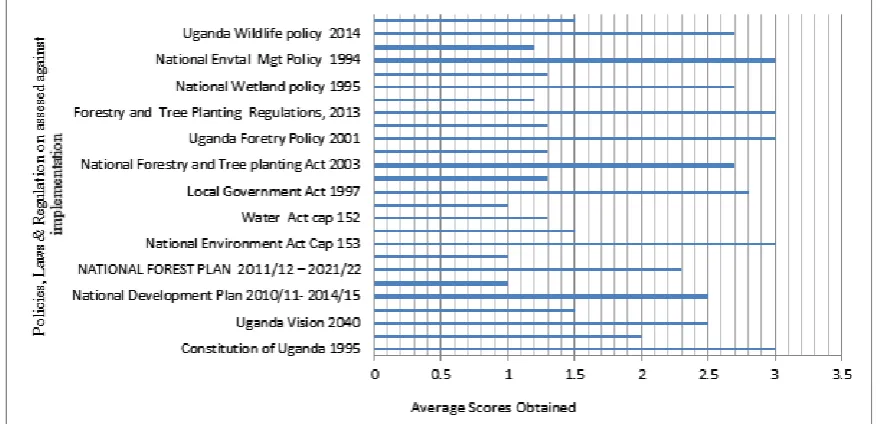
Key informant interviews were held with Ngora District Local Government staff of the Environment and Natural Resource sector and staffs of the two projects that participated in the implementation. The COBWEB consortium NGO staff and the FIEFOC staff who participated in the project were also interviewed. The interviews generated information on the assessed provisions of relevant policies, laws and regulations on watershed restoration and the processes involved. The relevant provisions of the policies, laws and regulations were assessed using a three point likert scale of 1 to 3. Where 1 = inadequate, 2= moderately adequate and 3=Adequate. The generated aggregated scores were
realised after computing the averages of various responses from the key informants. The accepted threshold score for this study was above 2.
In-depth interviews were held with the staff from the Directorate of Water Resources Development, NEMA, Havillah Consults, Moru-Kakise Watershed Management Groupand Kakor Beach Management Unit leaders. The interviews generated information on roles and responsibilities of various stakeholders, planning and decision making, the process of crafting the laws, enforcement of the bye laws and ordinances; inter-sectoral linkages, joint implementation and their implication on restoration of Awoja watershed.The interviews were carried out with the aid of an interview guide. To ensure validity of the findings, appropriate quotations for the issues under discussion were digitally recorded and transcribed in verbatim. We also cross checked with members of the research team, secondary literature and Ngora District Local Government staff (Patton, 2002).
A household survey was undertaken in the two restoration sites of FIEFOC (Mukura) and COBWEB (Kapir). The households interviewed were selected using simple random sampling from lists provided by the chairpersons (Community leaders) of the groups. A total of 237 households were interviewed. This number was obtained using Krejcie and Morgan’s (1970) table, commonly used for determining sample sizes when the number of the study population is known. On average, each group had 40 and 50 households for FIEFOC and COBWEB Projects sites, respectively. In total, 112 households in Mukura and 125 in Kapir from the four villages chosen were interviewed. Each household was represented by a respondent who was either the head of the household or any member of the household who was knowledgeable on the group activities.
Information was also generated on how the laws were formulated, enforced and how this improved restoration. The unit of analysis in the survey was the household. Validity was ensured by calculating the content validity index which was found to be 0.8 after the assesement of the questionare by experts in the field of watersheds policy and mamagement. Reliability was attained through pre-testing the instruments in Gweri subcounty of Soroti district as recommended by Amin (2004) and Yin (2006). Ethical considerations were ensured by seeking consent from the respondents to voluntarily particpate in the study as well as keeping the their identity confidential.
Data analysis. Content analysis was used to analyse qualitative data. Manual coding was employed to understand key common issues highlighted by respondents on watershed restoration process, actors participation, inter and intra sectoral relations, crafting and enforcement of laws and accountability within the devolution framework. Five major themes emerged out of the questions asked on the study objective and these were: (1) planning and decision making (2) inter sectoral linkages, (3) crafting byelaws and ordinances, (4) enforcement of by-laws, and (5) Joint implementation and monitoring with other formal institutions. Quantitative data were analysed using a non-parametric chi square technique in order to analyse how institutional framework factors influenced restoration of Awoja watershed. This was assessed against six institutional variables of planning, management decision making, enforcement of laws, benefit sharing, accountability coupled with community- formal institutional relationships.
RESULTS
(a) In-depth interviews. From the in-depth interviews five themes emerged on planning and decision making, inter sectoral linkages, crafting by-laws, ordinances and their enforcement coupled with joint implementation alongside other formal institutions.
Planning and decision making. Watershed resource use planning and decision making were effected from the village to the district level during the restoration of Awoja watershed. Whereas
Awoja watershed had an instituted inter district committee representing the 14 districts Awoja traverses to monitor and make decisions on all restoration projects, this was not realised due to lack of facilitation to convene meeting. This is evidenced by one of the respondents who stated that:
“…there is a framework management plan for Awoja Wetland System that is overseen by the inter district management committee comprising of the District Forest Officer, Chief Administrative Officer, District Environment Officer, District Agricultural Officer and Directorate of Water Development in the districts of Soroti, Kumi, Ngora, Bukedea, Sironko, Bulambuli, Kapchorwa, Kween, Bukwo, Nakapiripirit, Amuria, Katakwi and Napak. Whereas drafts of the district watershed action plans exist and all the LC 5 Chair persons are signatories, this unfortunately has not been implemented’’ (KI, Ngora, April 2015). This led to inadequate oversight for the implementation of restoration activities in Awoja watershed. Although there was common interest to improve on the state of degraded watershed, absence of ongoing projects in line with restoration that could have catered for the allowances and per diem curtailed the restoration of Awoja. Therefore the decisions made during restoration were mainly by the local government authority and little by the local community who were the reason for devolving watershed management. The ENR sector took lead in planning and decision making roles, an opportunity that should have engaged other departments and sectors.
development of a weak inter-sectoral linkage in Ngora district. This is exemplified in the narrative quotes from the key informants that state:
“….the establishment of the Water Management Zones (WMZ) in the four regions of the country was meant to strengthen the linkage between the different departments. Unfortunately in Ngora, Kyoga WMZ team only deal with the department of water at the district and not the ENR sector much as ENR sector understands better the ecological relationship that underpins the availability of water and are mandated to oversee its use…” (KI, Ngora, June 2015)
“The water department falls under the Directorate of Water Resources Development and not the Directorate of Environmental Affairs in the Ministry of Water and Environment. Meaning since the ENR is not well facilitated they can create synergies with Kyoga Management Zone a unit that supervises water department at the district so as to work together on restoration efforts of Awoja…” (KI, Kampala, June 2015)
Awoja watershed being the sole source of water, raw materials for use in the entire region was reason enough for water department and ENR sectors to work together for its sustained existence. Additionally, whereas it is important to strengthen inter sectoral linkages at the district level, there is need to formulate and enforce ordinances and by-laws for effective restoration at the watershed level.
Crafting of by-laws, ordinances and enforcement. The FIEFOC and COBWEB projects began the process of doing this but the projects ended before the specific laws were promulgated for enforcement on culprits that failed to abide. The devolution policy provides for, crafting by-laws and ordinances right from the village to the district level (GoU, 1997). This was participatory but the promulgation of the laws for enforcement was not finalised and therefore culprits could not be prosecuted. This leaves the local community with an uphill task of operationalising the devolved powers given to them by both the constitution and the local
government act in order to authoritatively voice their concerns through their elected leaders.The process of crafting, approval and enforcement of the ordinances and by-laws are made known public for appropriate implementation. This is supported by a narrative text;
“Issues of concern at a sub county are identified and community meetings are held to affirm the situation. A motion is passed in council on the same. The sub county chief together with a few relevant stakeholders draft bye- laws on that issue. The councilors then go to the community for more consultations so as to pass the bye-law at sub-county by council. The sub county chief submits it for ratification at the district. The Attorney General finally confirms its conformity with the laws in the country. This is sent back to the district and then to the sub county. However, Ngora district does not have any bye-law or ordinance more so on watersheds. This makes it hard and illegal for the community leaders to enforce the law on culprits who are involved in degradation activities’’ (KI, Mukura, May 2015)
This therefore makes it hard to implement the ordinance and bye-laws having not been promulgated because they are often not legally approved documents. In the event that they are not enacted at all, there will be nothing to enforce hence affecting restoration efforts.
Enforcement of the bye-laws. Enforcement of ordinance and by-laws were not realised because the law formulation process was incomplete which unfortunately negatively affected the implementation of the FIEFOC and COBWEB projects (MWE, 2012). The failure to interpret and enforce laws by the technical staff that execute restoration efforts in Ngora district was a big setback in restoration efforts of Awoja. This statement is supported by a narrative text; “… the Director Natural Resources being a physical planner by profession doesn’t know which law to apply when a culprit is apprehended. The police only use the penal code” (KI, Ngora May, 2015)
framework can only be interpreted to the police by an authority in watershed related disciplines. This means that, once a culprit is apprehended, the enforcement is done in accordance with the Local Government Act, the National Forestry and Tree Planting Act, Water Act, Wildlife Act, the Fisheries Act and associated regulations depending on which component of the watershed was affected. This calls for a concerted effort by various institutions to enforce these laws and jointly implement them.
Joint implementation and monitoring with other formal institutions. The role of Teso cultural institution (Emori Mori) in influencing the acceptance of projects to support restoration is important for watershed management. Nevertheless the customary tenure of free grazing promoted degradation of wetlands. The culture of the community which is predominantly “Iteso” had a bearing on the failed restoration of Awoja watershed. In particular, the cattle keepers devote little time and attention to tree growing as an activity. Furthermore, the communal land tenure in Teso made it hard to control grazing in Awoja since the community believes Awoja watershed existed from creation, so they should be let free to graze whenever and where ever they feel like hence the rising levels of degradation. This is supported by a participants quote: “.... Emorimor is there as a figure head with no watershed restoration plans for his subjects. We hear of him yet no program for his people has been heard of, not even a familiarisation tour. I have never seen him nor even any document on tree planting per se for the over 20 years I have worked in Ngora’’ (KI, Ngora, May 2015).
In the above endeavors, the participation of the Iteso cultural institution is therefore important for the success of restoration. The fact that the cultural institution understands the trends in the watershed status and benefits the local community obtain, the negative trend Awoja is experiencing which should be reversed will promote community enagagement . This woud enhance restoration of Awoja watershed for sustained livelihoods in the area.
(b) Key informant interviews. The Key informant
interview results indicated that 92.3% of the provisions in the laws, policies and regulations on watershed restoration were moderately adequate or adequate i.e., above the threshold of 2. The threshold was set basing on the assessment of how well the provisions were implemented in relation to watershed restoration. This implies that the laws, policies and regulations on watershed restoration were well provided for in the literature reviewed. However, 7.7% of the respondents interviewed indicated inadequacy in the provision of the law on restoration. The Water Act, Cap 152 in particular was cited to be having certain gaps that does not support restoration in Awoja. In contrast, the results on implementation of these laws, policies and regulations were rated at a paltry (7.69%) as moderately adequate. This means that inadequacy in implementation of the laws, policies and regulations in restoration of Awoja watershed accounted for 92.31% (Figure 5.1).
management decision on how to improve grazing coupled with improved community- government relations in Awoja improves the number of cattle kept.
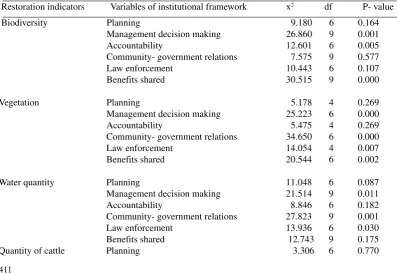
There was a significant relationship between Planning (P=0.000) and availability of products like poles. This suggests that proper planning through controlled harvests of watershed products like poles improve its availability in Awoja watershed. Results also indicate that there was a significant relationship between restoration through tree planting and planning (P=0.000), management decision making (P=0.002), community-government relations (P=0.001) and benefit sharing (P=0.001). This shows that planning, management decision making, community-government relations and benefit sharing significantly influenced the areas planted with trees as a method of restoring degraded Awoja. Furthermore, there was a significant relationship between restoration of fish richness and community-government relations (P=0.023). This indicates that when community-government relations improve, the rate of fishing is regulated through monitoring by both parties hence less exploitation and improved fish stocking and diversity. The results also showed a significant association between illegal harvesting of watershed products and
community-government relations (P=0.026) and law enforcement (P=0.028). This indicates that when byelaws are enforced and relationship between the community- government improved, the rate of illegal harvests of watershed products reduces.
There was a significant relationship between restoration of encroached area of wetland and planning (P=0.001), management decision making (P=0.002) and law enforcement (P=0.009). This suggest that in order to control the rate at which wetland lands are encroached, good planning, good management decision making and law enforcement are very important. This could be through penalties and possibly alternate areas for settlement and use. Lastly, there was a significant relationship between charcoal burning and community-government relations (P=0.006). This shows that if there is an improved community-government relation then the two parties are able to suggest ways of controlling charcoal burning in Awoja watershed and in other areas. However, there was no significant relationship between controlling floods and the institutional indicators (Table 5.1).
DISCUSSION
Whereas the results provide evidence of enabling laws and policies in place that support watershed
Table 5.1. Assessing indictors’ of devolution against restoration of Awoja in Ngora district
Restoration indicators Variables of institutional framework x2 df P- value
Biodiversity Planning 9.180 6 0.164
Management decision making 26.860 9 0.001
Accountability 12.601 6 0.005
Community- government relations 7.575 9 0.577
Law enforcement 10.443 6 0.107
Benefits shared 30.515 9 0.000
Vegetation Planning 5.178 4 0.269
Management decision making 25.223 6 0.000
Accountability 5.475 4 0.269
Community- government relations 34.650 6 0.000
Law enforcement 14.054 4 0.007
Benefits shared 20.544 6 0.002
Water quantity Planning 11.048 6 0.087
Management decision making 21.514 9 0.011
Accountability 8.846 6 0.182
Community- government relations 27.823 9 0.001
Law enforcement 13.936 6 0.030
Benefits shared 12.743 9 0.175
Quantity of cattle Planning 3.306 6 0.770
restoration, the Ngora District Councils did not exploit this opportunity. A case in point is where the district environment committees are mandated to coordinate, monitor and advise the council on all aspects of watershed restoration which the team did not utilise. Such an opportunity was not used to advise the council on the need to set aside funds to protect the restored watershed areas in Ngora. According to Mbogga et al. (2014), the attempt made in restoration of Awoja was unsuccessfuldue to inadequate enforcement of laws. In Ngora this was escalated by the non-existence of ordinances or bye-laws that should have addressed the issue of lack of implementation/ enforcement of the laws in order to restore Awoja watershed.
The NFTPA (2003) promotes devolution of functions, powers and services to ensure that environmental benefits, costs and values are reflected in strategies and activities of watershed restoration. Although section 38 and 39 of the Local Government Act (1997) empowers the district councils and lower councils to pass local bills into ordinances and bye-laws so as to punish offenders, none of these existed in Ngora, on restoration of Awoja. Bye-laws are part of the conditions for self-management of watersheds, and although initiated by the two projects in the study area, none of the
projects concluded the process of making the bye-laws because it was lengthy and the project life spans were short. The absence of an ordinance and bye-laws in Ngora was partly the reason for the rising level of degradation. Yet the bye-laws could have been used as leverage in influencing cultural institution participation in protection and restoration activities.
The findings of this study do not agree with that of Geodegebure (2013) on the perspective that community involvement in the formulation process automatically commits them towards restoration and sustained management. The findings tend to suggest that lack of bye-laws and ordinance were the main reasons for failed restoration of Awoja. This may have been so because the community involvement in the law crafting process was not conclusive. Therefore successful restoration efforts demand a conclusive process in order to restrain the people from destroying the watersheds. Once the laws are crafted it inevitably provides the framework upon which they are to be enforced.
Management decision making 18.011 9 0.035
Accountability 10.795 6 0.095
Community- government relations 22.849 9 0.007
Law enforcement 8.175 6 0.226
Benefits shared 16.375 9 0.059
Products like poles Planning 25.291 6 0.000
Management decision making 7.640 9 0.571
Accountability 7.779 6 0.255
Community- government relations 22.464 9 0.008
Law enforcement 14.077 6 0.029
Benefits shared 12.054 9 0.210
Area of trees planted Planning 26.291 6 0.000
Management decision making 26.401 9 0.002
Accountability 5.398 6 0.494
Community- government relations 29.049 9 0.001
Law enforcement 13.987 6 0.030
Benefits shared 29.425 9 0.001
Fish abundance Planning 4.406 6 0.622
Management decision making 2.333 9 0.985
Accountability 3.866 6 0.695
Community- government relations 19.239 9 0.023
Law enforcement 4.450 6 0.616
Benefits shared 13.603 9 0.137
Incidents of floods Planning 4.935 6 0.552
Management decision making 9.228 9 0.416
Accountability 3.942 6 0.685
Community- government relations 16.138 9 0.064
Law enforcement 16.079 6 0.113
Benefits shared 10.504 9 0.311
Illegal harvests Planning 11.357 6 0.078
Management decision making 15.257 9 0.084
Accountability 5.395 6 0.494
Community- government relations 18.891 9 0.026
Law enforcement 14.156 6 0.028
Benefits shared 12.201 9 0.202
Wetland encroached Planning 22.536 6 0.001
Management decision making 25.551 9 0.002
Accountability 12.889 6 0.045
Community- government relations 18.756 9 0.027
Law enforcement 17.187 6 0.009
Benefits shared 14.636 9 0.101
Charcoal burning Planning 10.030 6 0.123
Management decision making 4.379 9 0.885
Accountability 6.089 6 0.413
Community- government relations 23.123 9 0.006
Law enforcement 7.452 6 0.281
a common plan of action when implementing restoration. The legal framework fosters restoration efforts and reduces degradation. Despite the appropriate legal framework, enforcement of the laws was rated low and therefore is an area that needs attention. It is not until the various sectors integrate their operations for mutual benefit, craft and enforce the laws, then will inter departmental linkage make sense in restoration of Awoja.
Section 1.2.11 of the Forest Policy on the role of Local Government emphasises devolution of powers from central government to the districts and other lower councils. The Land Act (1998) places the responsibility for regulating land tenure on local autonomous land boards, a level of decision-making that is independent of the executive district authorities. These Acts aim to ensure good governance and democratic participation in decision-making, including decisions concerning the management of watersheds which the community can make better from an informed point of view. Unfortunately, the council in the study area being the highest political authority failed in its mandate to exploit opportunities from project funding on community decision making for restoration. This finding is in line with an argument on property rights structure and the governing rules influencing resource use of common (Baviskar, 2015). There is a misconception held by the local communities that a watershed is an open access property that should have no regulation in their exploitation. The responsibility for their protection or proper management is inadequate due to the failure of the responsible body at the district to make the community aware of their role as citizens to restore any part of the watershed that has been degraded. The implementation of activities by the various stakeholders was curtailed partly by inadequate facilitation. This also explains the low implementation rate of 7.69% and a high rate of degradation (20%) in Awoja as compared to the national average of 11%.
Household survey discussion. Whereas restoration indicators of biodiversity, vegetation, water quantity, quantity of cattle, fish abundance, illegal harvesting, area planted with trees, wetland encroachment, and charcoal burning were
significantly influenced by mainly management decision making, community- government relations and benefit sharing were not influenced by any of the institutional factors. Further, flooding was not influenced by any of the institutional factors. This may have been because the institutional factors had no control on climatic conditions of Awoja watershed but could be influenced by whatershed restoration activities as indicated in our study. This observation supports reports in Zambia and Bolivia, on how benefit sharing and improved community – government relations influenced estoration of watersheds. This encourages the participation of watershed adjacent community for sustained collective action in restoration. The results are also similar to that in a study conducted by Araral (2011) on how decentralisation promotes collective action problems through credible law enforcement. Therefore, the enforcement of laws on culprits who illegally harvest products and encroach on the wetlands should be enforced through law enforcement agencies for restoration to be realised in Awoja watershed. However, the result of this study disagrees with that of Kumar (2011) on inactiveness of watershed institutions after the project periods are over with stakeholders unaware of how their responsibilities change in the post-project period. In Mukura (FIEFOC) restoration site, the existence of homogeneous social groups with similar goals led to the emergency of Mukura Integrated Development Initiative (MIDI), a community based initiative to enhance community active participattion to improve livelihoods in the study area.
sector to effectively restore Awoja watershed. Ngora district local government should complete the formulation process of ordinance and bye-laws on restoration that both projects initiated as well as constituting a fully functional district and lower council environment committees to enhance restoration. Further studies on restoration of Awoja should look at the policy formulation processes in partnership building and the role of common interest and influences of various stakeholders. In the above endeavors, the participation of the Iteso cultural institution is important for the success of restoration.
ACKNOWLEDGEMENT
The authors thank the Regional Universities Forum for Capacity Building in Agriculture (RUFORUM) for financing the study, and the research assistants Irene Mary Apiny, Margaret Awekonimungu and Acuu Simon Peter for the data collection.
STATEMENT OF NO CONFLICT OF INTEREST
The authors declare no conflicts of interest with respect to the research, authorship, and/or publication of this article.
REFERENCES
Agrawal, A. and Gibson, C. C. 1999. Enchantment and disenchantment: the role of community in natural resource conservation. World Development Centre 27 (4): 629–649.
Agrawal, A. and Jesse, C. R. 1999. Accountability in decentralization: A framework with south Asian and west African cases. The Journal of Developing Areas 33 (4): 473-502.
Agrawal, A. and Gupta, K. 2005. Decentralization and participation: the governance of common
pool resources in Nepal’s terai. World Development 33 (7): 1101-1114.
Ananda, J. 2013. Watershed development, decentralisation and institutional competition.
School of Economics, Latrobe University, Australia.
Araral, E.K. 2011. The impact of decentralization on large scale irrigation: Evidence from Philipines. Water Alternatives 4 (2): 110-123.
Baviskar, A. 2015. Between micro-politics and administrative imperatives: Decentralization and the watershed mission in Madhya Pradesh,
India. European Journal of Development Research 16 (1): 26-40.
Goedegebuure, R., Ssejjemba, K. and André, D.W. 2013. Key determinants of effective partnerships: The case of partnerships between lead firms and farmers in pineapple value chain in Uganda and Kenya.Working Paper No. 2013/27. MSM. Government of Uganda (GoU). 1997. The Local
Government Act. Entebbe: Government Printers.
Kakuru, W., Turyahabwe, N. and Mugisha, J. 2013. Total economic value of wetlands products and services in Uganda. The Scientific World Journal Kitutu, K. M. G. and Diisi, J. 2012. State of the Environment Report for Uganda 2012. Kampala:
National Environment Management Authority Krejcie, R.V. and Morgan, D. W. 1970. Determining
Sample Size for Research Activities. Educational and Psychological Measurement. Duluth: University of Minnesota
Mbogga, M., Malesu, M. and De, L. J. 2014. Trees and watershed management in Karamoja, Uganda. Evidence on Demand, UK; iv + 25 pp, Kampala.
Ministry of Water and Environment. 2013. The National Forest Plan 2011/12 –2021/22. Directorate of Environment Affairs, Kampala, Uganda
Mutekanga, F. P., Kesslee, A., Leber, K. and Visser, S. 2013. The use of stakeholder analysis in integrated watershed management: experiences from the Ngenge Watershed, Uganda. Mountain Research, Kampala
Means, K., C., Josayma, E., Neilsen, E. and Viriyasakultorn, V. 2002. Community-based forest resource conflict management. A Training
Package. Volumes 1-2. Rome, Italy: Food and Agriculture Organization of the United Nations, (FAO), Rome.
Ostrom, E. 1986. An agenda for the study of institutions. Public Choice 48 (1): 3–25. Ostrom, E. 1990. Governing the commons: The evolution of institutions for collective action. Cambridge University Press, New York. Ostrom, E.R. G. and Walker, J. 1994. Rules, games and common-pool resources. The University of Michigan Press, Ann Arbor.
applications in need of Science. The H.T. Odum Synthesis essay. Estuaries and Coasts 32:1–17 DOI .10.1007/s12237
Patton, M.Q. 2002. Qualitative evaluation and research methods. Newbury Park, CA: Sage Publications
Sanginga, P.C., Kamugisha, R., Andrienne, M., Kakuru, A. and Ann, S. 2004. Facilitating participatory processes for policy change in natural resource management: Lessons from the Highlands of Southwestern Uganda. Journal of Agricultural Sciences 9 (1): 950-962. Saravanan.,V. S. 2009. Decentralisation and water resources management in the Indian Himalayas: The contribution of new institutional theories conservation and society. Conservation and Society 7 (3): 176-191. Schlager, E. and Ostrom, E. 1993. Property-rights regimes and coastal fisheries: An empirical analysis. pp. 13– 41. In: Anderson, T. L. and Simmons, R. T. (Eds.), The political economy of customs and culture: Informal solutions to the commons problem. Rowman and Little Field Publishers, Lanham.
Turyahabwe, N. 2006. Local capacity to manage
forestry resources under a decentralised system of governance:The case of Uganda. PhD
Dissertation, Stellenbosch University, South Africa.
Turyahabwe, N., Tumusiime, D. M., Kakuru, W., Tweheyo, M. and Bashasha, B. 2013. Wetland use/ cover changes and local perceptions in Uganda. Sustain. Agric. Res. 2 (4): 95-105. Uganda Bureau of Statistics (UBOS). 2015. Statistical abstract:Uganda Bureau of Statistics. Kampala
World Bank. 2013. Development of the Awoja Catchment Management Plan in the Kyoga Water Management. Zone Contract: 7164726. Final Stakeholder Engagement Report. World Bank. Kampala.
World Resources Institute. 2003. Decentralization: A local voice. pp. 89-106. In: World Resources 2002-2004. Washington DC: World Resources Institute.
Yin, R. 2006. Case study research: Design and methods. Applied Social Research Methods