MAGNETIC RESONANCE
Implementing diffusion-weighted MRI for body imaging
in prospective multicentre trials: current considerations
and future perspectives
N. M. deSouza
1&J. M. Winfield
1&J. C. Waterton
2&A. Weller
1&M.-V. Papoutsaki
1&S. J. Doran
1&D. J. Collins
1&L. Fournier
3&D. Sullivan
4&T. Chenevert
5&A. Jackson
2&M. Boss
6&S. Trattnig
7&Y. Liu
8Received: 30 November 2016 /Revised: 24 May 2017 / Accepted: 28 June 2017 #The Author(s) 2017. This article is an open access publication
Abstract
For body imaging, diffusion-weighted MRI may be used for
tumour detection, staging, prognostic information, assessing
response and follow-up. Disease detection and staging involve
qualitative, subjective assessment of images, whereas for
prognosis, progression or response, quantitative evaluation
of the apparent diffusion coefficient (ADC) is required.
Validation and qualification of ADC in multicentre trials
Contribution of NIST - not subject to copyright in the US
* N. M. deSouza
J. M. Winfield
J. C. Waterton
A. Weller
M.-V. Papoutsaki [email protected]
S. J. Doran
D. J. Collins
L. Fournier
D. Sullivan
T. Chenevert
A. Jackson
M. Boss
S. Trattnig
Y. Liu
1 CRUK Cancer Imaging Centre, Institute of Cancer Research and
Royal Marsden NHS Foundation Trust, Downs Road, Surrey SM2 5PT, UK
2 Manchester Academic Health Sciences Institute, University of
Manchester, Manchester, UK
3 Assistance Publique-Hôpitaux de Paris, Hôpital Européen Georges
Pompidou, Radiology Department, Université Paris Descartes Sorbonne Paris Cité, Paris, France
4 Duke Comprehensive Cancer Institute, Durham, NC, USA 5 Department of Radiology, University of Michigan Health System,
Ann Arbor, MI, USA
6 Applied Physics Division, National Institute of Standards and
Technology (NIST), Boulder, CO, USA
7 Department of Biomedical Imaging and Image guided Therapy,
Medical University of Vienna, 1090 Vienna, Austria
8 European Organisation for Research and Treatment of Cancer,
involves examination of i) technical performance to
deter-mine biomarker bias and reproducibility and ii) biological
performance to interrogate a specific aspect of biology or
to forecast outcome. Unfortunately, the variety of acquisition
and analysis methodologies employed at different centres
make ADC values non-comparable between them. This
inval-idates implementation in multicentre trials and limits utility of
ADC as a biomarker. This article reviews the factors
contrib-uting to ADC variability in terms of data acquisition and
anal-ysis. Hardware and software considerations are discussed
when implementing standardised protocols across
multi-vendor platforms together with methods for quality assurance
and quality control. Processes of data collection, archiving,
curation, analysis, central reading and handling incidental
findings are considered in the conduct of multicentre trials.
Data protection and good clinical practice are essential
prereq-uisites. Developing international consensus of procedures is
critical to successful validation if ADC is to become a useful
biomarker in oncology.
Key Points
•
Standardised acquisition/analysis allows quantification of
imaging biomarkers in multicentre trials.
•
Establishing
B
precision
^
of the measurement in the
multicentre context is essential.
•
A repository with traceable data of known provenance
pro-motes further research.
Keywords
Diffusion-weighted MRI . Multicentre trials .
Quality assurance . Quantitation . Standardization
Essentials
1. When utilizing the Apparent Diffusion Coefficient (ADC)
as an imaging biomarker in multicentre trials, processes
that standardise data acquisition and analysis within a
framework of Quality Assurance and Quality Control
are mandatory.
2.
Test-object and healthy volunteer studies should be used
to develop an imaging protocol for multi-vendor, multi
field-strength use and establish the precision of the ADC
measurement within a multicentre trial context.
3.
A streamlined workflow for data curation, archiving and
analysis in a central repository ensures traceable data within
the trial as well as its preservation for further research.
Patient Impact
1. A standardised ADC measurement would enable
incor-poration of an imaging biomarker of response as an
early end-point in multicentre trials of cancer therapies.
2.
A standardised ADC measurement in longitudinal
stud-ies could be utilized as a prognostic biomarker in
on-cology and for stratifying patients for therapeutic
interventions.
Introduction
Diffusion-weighted magnetic resonance imaging (DW-MRI)
provides unique soft tissue contrast and is now used in tumour
detection, staging and for monitoring response to treatment in
a variety of tumour types [
1
–
8
]. It may be utilized qualitatively
(binary, normal vs. abnormal), semi-quantitatively (scoring
system, e.g., grade I-V) or quantitatively (continuum, derived
numerical values). Qualitative assessments are quick and easy
for the expert radiologist but are variable in interpretation.
Objective semi-quantitative (scoring systems) or quantitative
(numerical) assessments are more robust; the latter deliver
information beyond visual perception.
The apparent diffusion coefficient (ADC) derived from
DW-MRI describes the diffusion of a water molecule proton
(typically over 10-40
μ
m during 10-100 msec) and reflects
tissue microstructure and its remodelling. This is interesting
for drug developers as it sits in the
B
pharmacologic audit trail
^
[
9
] downstream of a target and its pathway (thereby uniting
many therapy classes), but upstream of macroscopic disease
modification (thus making it suitable for early readouts). Such
quantitative measurements potentially offer earlier indicators
of response than conventional size criteria, with ethical and
economic benefits for sponsors and pharmaceutical
compa-nies as well as for patients and society in general. The
imple-mentation of DW-MRI, however, is variable across scanner
platforms [
10
], tissue-type being studied and methods of
in-terpretation and analysis. Consensus on image acquisition and
analysis methods must be reached before embarking on a
clin-ical trial and measures put in place to standardise the process
across centres. Furthermore, the utility of quantitative ADC
metrics as response biomarkers depends on the variability of
the measurement, which must be established and minimized.
This article reviews current knowledge of factors that require
consideration (equipment, technical development, quality
control, infrastructure, expertise and governance issues) when
acquiring and analysing DW-MRI data prior to adopting ADC
as a biomarker in multicentre trials.
Data Acquisition
Hardware and software considerations
improvements have resulted from higher field strength (3T),
improved magnetic field gradient performance (increased
max-imum gradient amplitudes and ramp rates), improved digital
radiofrequency (RF) chains and receiver technology with
mul-tiple receiver arrays. Advanced digital compensation schemes
further mitigate gradient-induced eddy currents reducing image
distortion and blur. Although DW-MRI at 3T initially struggled
to match the quality of large field-of-view (FOV) 1.5T
DW-MRI images because of inhomogeneity of the static magnetic
field (B0), recent advances in automated correction (shimming)
and improvements in static field homogeneity have made
mod-ern 3T platforms viable options for body imaging. In normal
volunteers, ADC values of upper abdominal organs are
comparable across field strengths; however, the coefficient
of variation, (CoV) of the liver was 1.5 - 2.0 times greater
at 3.0T compared to 1.5-T [
11
], emphasising that
suitabil-ity for inclusion in a multicentre trial requires assessment
of individual scanner performance.
Optimising a DW-MRI protocol
Protocol optimisation is often scanner-specific as available
measurement and artefact [
12
] reduction techniques vary
be-tween manufacturers, models and software versions.
Geometric distortion associated with the static magnetic field
can be reduced by using methods to correct field
inhomoge-neity (advanced shimming) and by increasing the readout
bandwidth [
13
–
15
]. Distortions arising from eddy-currents
can be diminished by reducing the diffusion-weighting
(maximum b-value) and other sequence parameters
(echo-train length, matrix) or by employing gradient schemes such
as the twice-refocused spin echo [
16
] that compensate for
eddy-currents, as well as by using post-acquisition image
reg-istration routines [
17
]. Ghosting artefacts (displaced
re-duplications of the image) can be reduced by adjusting the
receiver bandwidth and echo time.
Depending on the disease, an optimal selection of b-values
[
18
] is needed with considerably more b-values required if the
signal decay with increasing b-value is to be fitted to
non-mono-exponential functions [
19
]. To avoid confounds from
perfusion, b-values of <100 s/mm
2should be avoided:
maxi-mum b-values of 800 to 1000 s/mm
2are usual in body
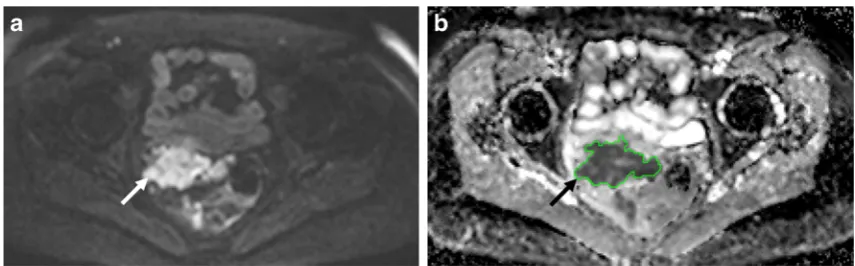
appli-cations (Fig.
1
) [
20
] but their range may need optimisation for
specific tumour types. Noise characteristics influence the
maximum b-value used in practice. The number of signal
averages may be increased at higher b-values to increase
SNR [
21
]. Most DW-MR images are acquired in
free-breathing, averaging the signal over physiological motion.
Respiratory triggering, using bellows or a navigator, has
not shown advantages over multiple averaged
free-breathing in estimation of ADCs in abdominal organs
[
22
,
23
]. Cardiac triggering has been explored in the upper
abdomen [
24
]. Anti-peristaltic agents reduce image blur
arising from peristaltic motion in abdominal and pelvic
DW-MRI and multishot techniques may offer some
advan-tages over single-shot techniques in reducing distortion
from air within bowel [
25
].
Parallel imaging reduces geometric distortion, but reduces
SNR. The extent of the imaging volume along the scanner
bore (z-axis) should be limited to around 25 cm (depending
on scanner capability) to mitigate bias in ADC estimates due
to spatial non-linearities in diffusion-encoding gradients [
26
].
For larger volumes, multiple imaging stations can be acquired
at the isocentre of the magnet sequentially [
27
]. Acquisition of
multiple stations requires software tools to normalize
station-to-station signal variation and the ability to compose the
im-ages into a single series for a given diffusion-weighting
(b-value). At 1.5T, spectral fat-suppression techniques are often
used for abdominal, pelvic or small FOV applications, while
inversion recovery is used for whole-body DW-MRI and in
regions of poor static magnetic field homogeneity. Fat
sup-pression at 3T is more challenging, and the preferred method
may vary between scanners; combinations of suppression
techniques may be required [
28
]. Some consortia such as
the Quantitative Biomarkers Imaging Alliance (QIBA)
and the European initiative Quantitative Imaging in
Cancer-Connecting Cellular Processes to Therapy
(QuIC-ConCePT) have been working on standardisation and
op-timisation of DW-MRI acquisition protocols, and
techni-cally validated protocols, e.g., in liver and lung are
avail-able to the public [
29
,
30
].
In multi-centre trials, compromises may be required in
ac-quisition parameters in order to achieve an acceptable degree
of standardization whilst maintaining good image quality on
all scanners [
12
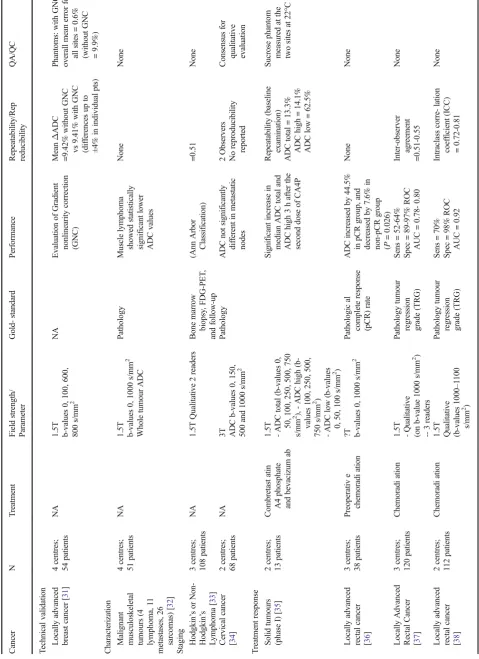
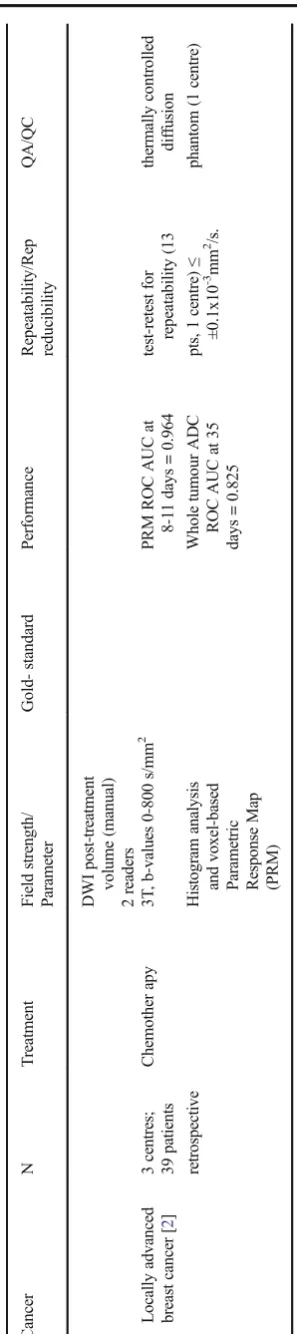
]. A current list of multicentre trials reporting
DW-MRI as a readout in body imaging applications is listed in
Table
1
.
Setting up Quality Assurance: Test Objects
According to metrology standards of quantitative imaging
biomarkers (QIB) [
39
], measurement performance should be
evaluated by assessing repeatability, reproducibility, linearity
and metrics of bias. Test-object measurements yield practical
estimates of the bias and the repeatability of each clinical MRI
system and can be used to compare technical accuracy across
the systems [
40
]. Precise measurement of ADC is important
since the dynamic range of the biomarker is quite small, from
approximately 0.5×10
-3mm
2/s in densely packed cells to
3×10
-3mm
2/s in fluid-filled cysts.
[
12
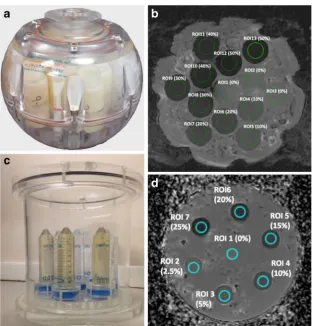
] for optimising a diffusion-weighted protocol in a
multi-centre setting. Solutions of polyvinylpyrrolidone (PVP) in
water embedded in an ice-water filled sphere [
43
] or
cylindri-cal vessel [
44
], remain limited in their range of ADCs (Fig.
2
).
More specific test-objects have assessed ADC uniformity
[
12
], ghosting and distortions [
45
,
46
].
Test-objects at room temperature are more convenient to
prepare than those with ice-water and have been used in
single-centre studies [
47
,
48
] but require correction from a
temperature-controlled experiment [
47
] to account for
temper-ature dependence of ADC. The performance of routine
test-object evaluations in multi-centre trials involving DW-MRI,
their frequency and pass-fail criteria, depends on the trial
de-sign and the nature of the imaging endpoint. Test-objects with
the required range of ADCs need to be supplied and utilized at
participating centres.
Role of Healthy volunteer studies
Test-objects lack the necessary variation in tissue structure,
geometry and motion experienced when imaging humans.
Therefore, several trials have built in normal volunteer
assess-ments during set-up.
Optimisation [
49
] and refinement of the DW-MRI
mea-surement, e.g., multiband techniques [
50
], Zonal Oblique
Multislice [
51
] and diffusion tensor imaging (DTI) can be
assessed [
52
]. Protocols can also be tailored to underlying
tissue structure e.g., lower b-values in pancreas [
53
] and
tolerable versions for clinical use can be developed. Data
analysis methods can also be optimised by seeking the best
model fits of data from normal tissue [
54
] which can then
be used as a comparator with pathological tissue to
inves-tigate structural differences [
55
].
Healthy volunteer studies are also useful for establishing
physiological variation and reference values for disease e.g.,
in liver [
56
], bladder [
57
], bone marrow [
58
] and breast [
59
,
60
].
Finally, normal volunteer studies are invaluable for
study-ing technique repeatability: coefficient of variation of mean or
median ADC estimates in breast 8%,[
61
] in liver 5.1% [
62
]
and in skeleton 3.8% [
63
] have been reported. Inter-scanner
reproducibility of volunteer data in neurological [
64
] and
ab-dominal [
11
] applications provides re-assurance that, with
standardisation DW-MRI is suitable for use in multi-centre
clinical trials.
Data Storage and Analysis
Data archiving, Transfer and Curation
A contemporary data archiving framework (termed a
Research PACS
[
65
]) needs to consider three important areas:
&
A data storage platform that is resilient, secure and
scal-able and attached to multiple redundant servers. The
ob-ject store
is a currently popular example [
66
].
&
A database and associated application program interfaces
(APIs) for uploading, querying and downloading data. At
present, so-called relational (SQL) databases dominate but
the era of Big Data is seeing increasing use made of
noSQL concepts.
&
User-facing components
that allow a user to access and
interact with the data, e.g., a web browser interface and a
toolkit of research applications.
The extensible Neuroimaging Archive Toolkit (XNAT), an
open-source platform (Neuroinformatics Research Group,
Washington University, St. Louis,MO,USA) has recently
gained significant traction among academic groups as the
foundation for such a Research PACS. However, several
dedicated clinical trial management systems are also
avail-able commercially. Whichever product is used, standard
operating procedures (SOPs) must be developed and used
for staff training with both trial protocols and legislation
vis-à-vis data handling.
Fig. 1 Diffusion-weighted-MRI in relapsed peritoneal cancer: Axial b-value=900 mm2/s (A) and image through the mid pelvis showing an
irregular mass (arrow), with restricted diffusion contoured using a
Ta bl e 1 Publis hed m ul tic ent re D W -M RI clini cal st udie s Cancer N T reatment Field strength/ Pa ra me ter Go ld -sta nd ar d P er fo rm an ce R ep ea ta bi lit y/R ep re duci bili ty QA /QC Te ch ni ca lv al id at io n Locally advanced br ea st can cer [ 31 ] 4c en tr es ; 54 patients NA 1.5T b-valu es 0, 100, 600, 800 s/mm 2 NA Eva lua tion of G rad ient nonlinearity correction (G NC) Me an Δ ADC =9.42% without GNC vs 9.41% with GNC (di ffe re nce s up to ±4% in individual pts) Ph an to m s: w ith G N C overall mean error for al ls ite s = 0.6% (without GNC =9 .9 % ) Ch ar ac te ri za tio n
Malignant musculoskeletal tumours
(4 ly mphoma, 11 metastases, 26 sa rc oma s) [ 32 ] 4c en tr es ; 51 patients NA 1.5T b-valu es 0, 1000 s/mm 2 Whole tumour ADC Pa th ol og y M us cl e ly m ph om a show ed sta tist ica lly significant lower AD C value s None None St agin g Hodgkin ’ so rN on -Hodgkin ’ s Ly m ph om a [ 33 ] 3c en tr es ; 108 patients NA 1.5T Qualitative 2 readers B on e m arrow biopsy ,F DG-PET , and follow-up (A nn Arb or Cla ssific ati on) =0.51 No ne Cer vic al ca nce r [ 34 ] 2c en tr es ; 68 patients NA 3T ADC b-values 0, 150, 500 and 1000 s/mm 2 Pa th ol og y ADC not significantly dif fer ent in m eta sta tic nodes 2O bs er ve rs No reproducibility reported Co nsensus for
qualitative eval
Figure
3
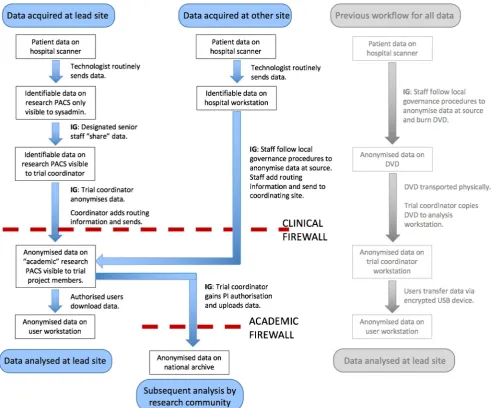
presents a schematic of the workflow adopted
within multicentre imaging trials. Clear organisation of
multi-ple data types in a central hub brings significant time-savings
when retrospective analysis is required [
68
] and all-electronic
data transfer is now rapidly superseding the former practice of
posting digital video discs (DVDs) containing trial images.
Information governance is implemented via the use of
desig-nated staff who exercise a
B
gatekeeping
^
role. Data
anonymisation by removal and/or replacement of metadata
fields in the DICOM files requires a technical understanding
of the processing to be done as well as knowledge of trial
design and legal expertise. Data protection is achieved by
designing robust systems, often including an element of
geo-spreading, whilst prevention of unauthorised access is
achieved by restriction on an IP address (implemented via
appropriate firewall rules), user authentication and role
defi-nitions within database software. If a patient withdraws
con-sent, it is possible to remove completely the data from the
cohort used for ongoing analysis, but it is likely to prove
impossible to remove these data from any summary
statis-tics that have already been published, or any data record
deposited as part of the publication process. Government
bodies have guidelines pertaining to procedures required to
ensure data integrity and compliance with information
governance legislation [
69
].
Software for image processing
As the variability of the measurement at low
diffusion-weightings is high [
70
] and the signal decay is exponential,
a low b-value of 100-150 s/mm
2is preferred when fitting a
monoexponential function to derive ADC to reduce the
influ-ence of perfusion or flow effects on the measurement
(Fig.
1B
). Computed DW-MRI, (e.g., b=2000 s/mm
2),
im-proves DW-MRI contrast without any measurement penalty
[
71
] but does not contribute to quantitation.
In DW-MRI, the use of non-mono-exponential models
(stretched exponential, kurtosis, statistical and bi-exponential)
[
72
–
76
] probe aspects of tissue microstructure [
77
] and
differ-ences between tumour sub-types or inter-tumour heterogeneity
[
78
–
83
]. They may also provide an earlier indication of
re-sponse to treatment than ADC estimates [
84
,
85
]. Selection
of the most appropriate model remains an area of active
re-search: use of a model with many additional parameters risks
over-fitting the data and may be sensitive to noise
characteris-tics of the system rather than structural properties of the tumour
or normal tissue. Vendor-supplied software to support
calcula-tion of these alternative diffusion attenuacalcula-tion models would
help address some of these issues [
77
–
86
].
Finally, retention of tumour segmentations allows quality
control (QC) review of data reduction procedures, as well as
facilitating retrospective trial of alternative diffusion metrics
drawn from the same 3-D segmentation objects stored at the
pixel level [
87
]. As interobserver concordance is dependent on
extent of sampling [
88
], the method of segmentation should
be clearly recorded, for example, whether whole tumour or
selected slices are segmented, and whether necrotic or cystic
areas are excluded. A manual, semi-automated or automated
method could also introduce variability in the measurement
[
89
] and should be standardised.
Maintaining quality standards across centres
through the life of a trial
QC and Data cleaning
Following set-up and Quality Assurance (QA), tests should
be carried out at the beginning of the study to assess the
baseline performance of each scanner, followed by regular
QC tests over the course of the study (particularly after
servicing and software upgrades) to detect changes in
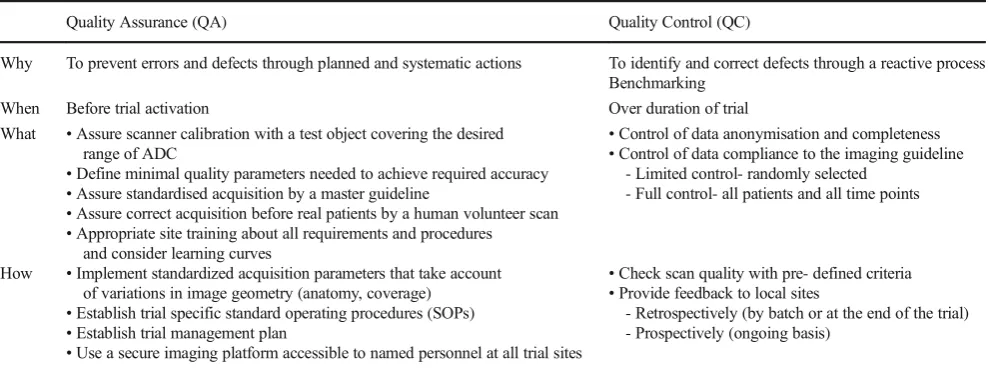
per-formance (Table
2
). The frequency of tests and defined
action limits, which specify the range of acceptable values
may be study-dependent.
Within a multicentre trial, QA and QC procedures for
im-aging depend on the role of imim-aging in the trial [
90
].
Qualitative interpretation does not require the same level of
QA/QC as for deriving quantitative data. The ROI size and
number of pixels within it are crucial for quantitative
assess-ments, particularly as many studies now address ADC
distri-bution rather than mean or median values. Operational support
for imaging QA and QC should be in place at trial setup and
through the life of the trial (Table
2
). A standardised and
optimised acquisition protocol, which acknowledges vendor
differences and incorporates acceptable and non-acceptable
deviations should be defined and supplied to sites upfront.
Acquisition of test data (test-objects, volunteers) reduces the
likelihood of poor quality or non-evaluable imaging data
be-ing acquired from the first patient in the study; occasionally
the first 1 or 2 patients may be considered as
B
run-in
^
to assess
site compliance and data quality. From an ethical perspective,
the intention must be for all included patients to contribute
analysable data. However, if sites find it difficult to comply
with the protocol, or if the first few patients' data are of poor
quality, it may be necessary to discard those data following a
protocol amendment to improve the methodology.
Prospective QC with timely and informative feedback to the
site enables supplementary correction to be taken and avoids
non-assessable poor quality data at the end of the trial. Site
upload of anonymised data via a web-based system requires
training so that data are securely handled and correctly coded
for inclusion in the trial imaging database.
Assessing measurement variability
Measurement uncertainty arises from differences in
acquisi-tion (hardware and software differences between scanners as
well as within scanners variations due to use of different
pro-tocols) plus post-processing parameters, longitudinal changes
or
‘
drift
’
in MRI signal when using the same scanner over the
study period as well as from natural physiological variation
within and between study participants. The Radiological
Society of North America (RSNA) Quantitative Imaging
Biomarkers Alliance (QIBA) recommends that evaluation of
biomarker reliability includes analysis of precision and bias
estimation, plus measurement linearity, by comparison with
an accepted reference or standard measurement [
91
]. For
DW-MRI,
in vivo
physiological references are not available
for bias/linearity measurements and these are extrapolated
from phantom studies [
20
,
39
,
91
,
92
].
Assessment of technical performance of an imaging
bio-marker includes measurement variability arising through
dif-ferences between scanners (same patient, different scanners)
[
11
], imaging protocols [
93
] and post-processing methods
(such as different analysis software, lesion segmentation
methodologies [
94
] and imaging readers [
91
,
92
,
95
]).
In trial design, the context in which the biomarker is being
utilized dictates the measurement variations that must be
accounted for. If measuring therapy-induced change, where
it is usually possible to image each patient on the same scanner
and for all analysis to be carried out by the same investigator,
precision estimation is limited to repeatability [
39
]. For studies
aimed at prognostication or lesion characterisation, ADC
Fig. 3 Data flow during a typical clinical trial curation process: Steps markedBIG^involve an information governance aspect, which will be determined by the ethics protocols attached to the trial. Local evaluation (not included as part of this trial workflow schematic) is a critical part of
values will be compared between individuals or across
insti-tutions and as it is necessary to know whether a measured
difference represents a true difference, measurement
uncer-tainty including statistical appraisal due to reproducibility
must be evaluated.
Coefficients of variation at different anatomic locations are
in the range 3-10% [
20
,
96
]. Inter-vendor two-site
reproduc-ibility coefficients of variation range from 14-27% [
20
]. In
multicentre trials, a measured difference should be outside
the 95% limits of agreement of the measurement uncertainty
expected in a multicentre trial setting for it to be attributed to a
true treatment-related difference. Alterations in lesion
geome-try also may affect segmentation thresholds and need
consid-eration when making longitudinal measurements [
97
].
Good Clinical Practice (GCP)
Clinical trials of investigational drugs and devices must
com-ply with International Conference on Harmonisation GCP if
they are intended to support regulatory approval [
98
]. For
multicentre imaging studies, challenges exist in ensuring that
different makes and models of MR scanner yield comparable
data [
90
] and maintaining compliance with unfamiliar
proto-cols at trial centres. The Food and Drug Administration has
specific guidelines to help ensure that imaging biomarkers are
measured in accordance with the trial
’
s protocol [
99
], and that
quality is maintained over time and between sites: it
recom-mends that sponsors employ an
B
Imaging Charter
^
, ancillary
to the trial protocol, which defines the imaging process in
exhaustive detail. Sponsors often engage specialist Imaging
Clinical Research Organisations to perform site qualification
and training, phantom-based QA/QC, pilot studies, data
man-agement and analysis. Double baseline studies are valuable in
verifying repeatability [
100
], although the additional burden
may deter patients, sponsors and ethical committees.
Reporting considerations for clinical governance
Performing imaging in clinical trials risks discovery of
inci-dental findings (IFs) that may require action and, therefore,
require review by a trained diagnostician [
101
]. Ethical and
legal issues surrounding IFs are a key element of the duty of
care owed by researchers to study participants (Table
3
).
Generic recommendations are offered by the National
Institute of Health in the USA and Royal Colleges in the UK
(Table
3
). No specific recommendations have yet been
pro-posed for studies utilising DW-MRI.
A report of whole body DW-MRI in healthy volunteers has
shown IFs in 29% of subjects. Of these 30.6% were
consid-ered of
‘
moderate significance
’
and 10.2%
‘
high significance
’
,
requiring specialist review but only a minority of scans
re-quired further action [
102
]. In myeloma, IFs were seen in
38% (67/175) of examinations, 20% of findings were
equiv-ocal and after specialist radiologist and clinical review, only
3% of cases prompted further investigation. It is mandatory to
introduce an image review process, triage and referral
path-ways embedded into trial design and reflected in consenting
procedures. For multicentre trials, this system should account
for the logistical hurdles that arise due to data storage and
delays in data viewing. For cases where data are interpreted
centrally, procedures should define a reporting mechanism, so
that IFs discovered centrally prompt action locally.
Proposals for future workflow
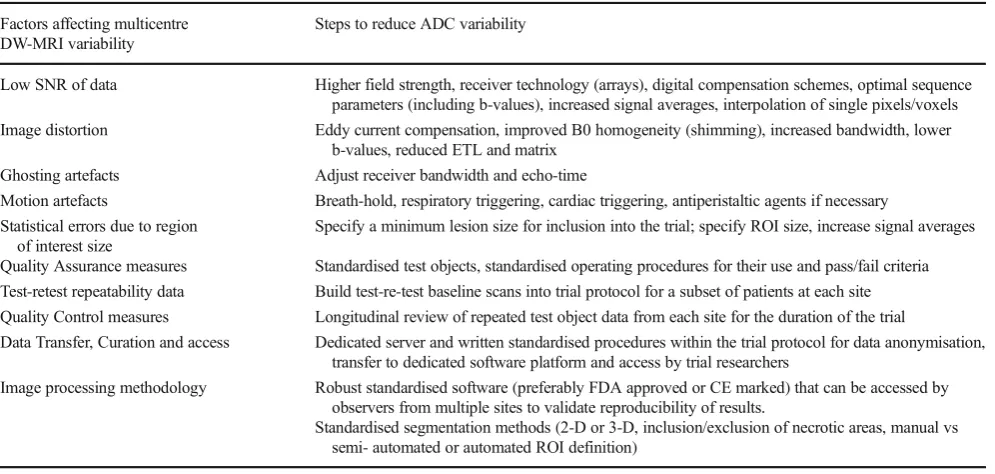
A summary of factors that need to be addressed to ensure that
ADC is accurate and reproducible across multiple centres
to-gether with recommended actions is given in Table
4
.
Consideration of these enable guidelines and drug approvals
to be written and implemented consistently so that
Table 2 Quality assurance and quality control considerations for imaging in multicentre clinical trials
Quality Assurance (QA) Quality Control (QC)
Why To prevent errors and defects through planned and systematic actions To identify and correct defects through a reactive process Benchmarking
When Before trial activation Over duration of trial
What •Assure scanner calibration with a test object covering the desired range of ADC
•Define minimal quality parameters needed to achieve required accuracy •Assure standardised acquisition by a master guideline
•Assure correct acquisition before real patients by a human volunteer scan •Appropriate site training about all requirements and procedures
and consider learning curves
•Control of data anonymisation and completeness •Control of data compliance to the imaging guideline
- Limited control- randomly selected - Full control- all patients and all time points
How •Implement standardized acquisition parameters that take account of variations in image geometry (anatomy, coverage)
•Establish trial specific standard operating procedures (SOPs) •Establish trial management plan
•Use a secure imaging platform accessible to named personnel at all trial sites
•Check scan quality with pre- defined criteria •Provide feedback to local sites
repeatability is smaller than the clinically-significant changes
sought in a clinical trial or trial-of-therapy [
103
]. MR
instru-ments must be designed and maintained so that selected
diffusion-weightings are imposed faithfully, sufficient
gradi-ent strengths must be provided to allow adequate
diffusion-weighting where
T
2is short, pulse sequences, k-space
trajec-tories and analysis modules must be integrated, the number of
measurements (signal averages) optimised, nomenclature
standardised and technical details retained in public DICOM
image fields.
Once the reliability of the ADC has been established,
tu-mour heterogeneity of the biomarker may provide further
op-portunity for tumour mapping (spatial display of quantitative
parameters) to guide surgery or radiotherapy. Locations above
(or below) a cut-off may be selected for targeting. There is
some regulatory precedent for such a workflow with the US
Table 3 Recommendations for dealing with Incidental Findings
Questions arising from research scan NIH recommendation (reproduced from Wolf [88])
Do researchers have an obligation to examine their data for IFs? ‘It is unrealistic to place on researchers an affirmative duty to search for IFs’
What should be done if an IF is detected - should it prompt specialist referral for definitive diagnosis?
‘Obligation to establish a pathway for handling IFs and communicate that to the Independent ethics committee/review board and research participants’
What should the research participant be told? ‘In many, but not all circumstances, researchers have an obligation to offer to report IFs to participants’
What should research protocols and consent forms include relating to IFs, should the right to refuse knowledge of IF be addressed?
‘Researchers have an obligation to address the possibility of discovering IFs in their protocol and communications with the IRB, also in consent forms and communications with research participants’ Key NIH recommendations for addressing IFs:
•Plan for the discovery of IFs in study protocol and IRB communication •Plan to verify and evaluate a suspected IF with expert review if necessary •Researchers and IRBs should create and monitor pathways for IFs •Address IFs in the consent process
•Plan to determine whether to report IFs, based on likely health importance: a. Strong net benefit to health from reporting IF
b. Possible net benefit c. Unlikely net benefit
•Address the potential for IFs in future analyses of archived data
Table 4 Summary of factors contributing to ADC variability in multicentre trials and measures required to reduce them
Factors affecting multicentre DW-MRI variability
Steps to reduce ADC variability
Low SNR of data Higher field strength, receiver technology (arrays), digital compensation schemes, optimal sequence parameters (including b-values), increased signal averages, interpolation of single pixels/voxels Image distortion Eddy current compensation, improved B0 homogeneity (shimming), increased bandwidth, lower
b-values, reduced ETL and matrix Ghosting artefacts Adjust receiver bandwidth and echo-time
Motion artefacts Breath-hold, respiratory triggering, cardiac triggering, antiperistaltic agents if necessary Statistical errors due to region
of interest size
Specify a minimum lesion size for inclusion into the trial; specify ROI size, increase signal averages
Quality Assurance measures Standardised test objects, standardised operating procedures for their use and pass/fail criteria Test-retest repeatability data Build test-re-test baseline scans into trial protocol for a subset of patients at each site Quality Control measures Longitudinal review of repeated test object data from each site for the duration of the trial
Data Transfer, Curation and access Dedicated server and written standardised procedures within the trial protocol for data anonymisation, transfer to dedicated software platform and access by trial researchers
Image processing methodology Robust standardised software (preferably FDA approved or CE marked) that can be accessed by observers from multiple sites to validate reproducibility of results.
approval of [
99mTc]-tilmanocept uptake above cut-off as a
biomarker for surgical removal of lymph nodes in patients
with breast cancer or melanoma [
104
]. Again, as a prognostic
or predictive biomarker, it may be the proportion of the
tu-mour above (or below) an ADC cut-off which is of interest,
just as with hypoxia biomarkers [
105
], rather than the average
across a tumour. For acute response biomarkers and
trial-of-therapy biomarkers, a more ambitious workflow is functional
diffusion mapping [
97
,
106
], which attempts to correlate
changes voxel-wise between baseline and follow-up. This
ap-proach requires that specific voxels at baseline correspond to
specific voxels at follow-up, an assumption which may be
difficult to validate.
It is unlikely that ADC will find a decision-making role in
healthcare until vendors incorporate adequate ADC reliability
into scanner maintenance (just as RECIST relies on
dimen-sional accuracy verified by scanner maintenance). However,
vendors are unlikely to consider that it is a good use of their
resources to provide and maintain accurate ADC
measure-ments until there is a demand from their customers, the
radi-ologists; these radiologists are unlikely to demand accurate
ADC measurements until there is an evidence base from
multicentre trials to show the impact of ADC measurements
on health outcomes, and such an evidence base is difficult to
collect unless scanners routinely generate accurate ADC
mea-surements. Expert groups and consortia such as
QuIC-ConCePT, EIBALL (European Biomarkers Alliance),
NCI-QIN (Quantitative Imaging Network) and QIBA are
essential in supporting standardisation to break us out of
this vicious circle and enable ADC quantitation to enter
clinical workflows.
In conclusion, the use of ADC as an imaging biomarker in
multicentre trials demands processes that standardise data
ac-quisition and analysis within a framework of Quality
Assurance and Quality Control. Test-object and healthy
vol-unteer studies should be used to develop an imaging protocol
for multi-vendor, multi field-strength use and establish the
accuracy of the ADC measurement. Finally, data storage in a
central trial repository ensures traceability as well as data
pres-ervation for further research.
Compliance with ethical standards
Guarantor The scientific guarantor of this publication is Professor Nandita Desouza.
Conflict of interest The authors of this manuscript declare no relation-ships with any companies, whose products or services may be related to the subject matter of the article.
Funding This study has received funding by EU Innovative Medicines Initiative and Cruk.
Statistics and biometry No complex statistical methods were neces-sary for this paper.
Ethical approval Institutional Review Board approval was not re-quired because this is a special report.
Informed consent Written informed consent was not required for this study because this study is a special report.
Methodology This is an opinion piece with recommendations for im-aging in multicentre trials, submitted as a special report.
Open AccessThis article is distributed under the terms of the Creative Comm ons Att ributi on 4 .0 Inte rnati onal Li cense (htt p: // creativecommons.org/licenses/by/4.0/), which permits unrestricted use, distribution, and reproduction in any medium, provided you give appro-priate credit to the original author(s) and the source, provide a link to the Creative Commons license, and indicate if changes were made.
References
1. Weiss E, Ford JC, Olsen KM et al (2016) Apparent diffusion coefficient (ADC) change on repeated diffusion-weighted magnetic resonance imaging during radiochemotherapy for non- small cell lung cancer: A pilot study. Lung Cancer 96: 113–119
2. Galban CJ, Ma B, Malyarenko D et al (2015) Multi-site clinical evaluation of DW-MRI as a treatment response metric for breast cancer patients undergoing neoadjuvant chemotherapy. PLoS One 10, e0122151
3. Yap TA, Yan L, Patnaik A et al (2014) Interrogating two schedules of the AKT inhibitor MK-2206 in patients with advanced solid tumors incorporating novel pharmacodynamic and functional im-aging biomarkers. Clin Cancer Res 20:5672–5685
4. Messiou C, Collins DJ, Morgan VA, Bianchini D, de Bono JS, deSouza NM (2014) Use of apparent diffusion coefficient as a response biomarker in bone: effect of developing sclerosis on quantified values. Skeletal Radiol 43:205–208
5. Rud E, Klotz D, Rennesund K et al (2014) Detection of the index tumour and tumour volume in prostate cancer using T2-weighted and diffusion-weighted magnetic resonance imaging (MRI) alone. BJU Int 114:E32–E42
6. Kyriazi S, Collins DJ, Messiou C et al (2011) Metastatic ovarian and primary peritoneal cancer: assessing chemotherapy response with diffusion-weighted MR imaging–value of histogram analysis of apparent diffusion coefficients. Radiology 261:182–192 7. Xie P, Liu K, Peng W, Zhou Z (2015) The Correlation Between
Diffusion-Weighted Imaging at 3.0-T Magnetic Resonance Imaging and Histopathology for Pancreatic Ductal Adenocarcinoma. J Comput Assist Tomogr 39:697–701 8. Hoang JK, Choudhury KR, Chang J, Craciunescu OI, Yoo DS,
Brizel DM (2014) Diffusion-weighted imaging for head and neck squamous cell carcinoma: quantifying repeatability to understand early treatment-induced change. AJR Am J Roentgenol 203: 1104–1108
9. Workman P, Aboagye EO, Chung YL et al (2006) Minimally invasive pharmacokinetic and pharmacodynamic technologies in hypothesis-testing clinical trials of innovative therapies. J Natl Cancer Inst 98:580–598
11. Donati OF, Chong D, Nanz D et al (2014) Diffusion-weighted MR imaging of upper abdominal organs: field strength and intervendor variability of apparent diffusion coefficients. Radiology 270:454– 463
12. Winfield JM, Collins DJ, Priest AN et al (2016) A framework for optimization of diffusion- weighted MRI protocols for large field-of-view abdominal-pelvic imaging in multicenter studies. Med Phys 43:95–110
13. Kyriazi S, Blackledge M, Collins DJ, deSouza NM (2010) Optimising diffusion- weighted imaging in the abdomen and pel-vis: comparison of image quality between monopolar and bipolar single-shot spin-echo echo-planar sequences. Eur Radiol 20: 2422–2431
14. Donato F Jr, Costa DN, Yuan Q, Rofsky NM, Lenkinski RE, Pedrosa I (2014) Geometric distortion in diffusion-weighted MR imaging of the prostate-contributing factors and strategies for im-provement. Acad Radiol 21:817–823
15. Alexander AL, Lee JE, Wu YC, Field AS (2006) Comparison of diffusion tensor imaging measurements at 3.0 T versus 1.5 T with and without parallel imaging. Neuroimaging Clin N Am 16:299– 309,xi
16. Reese TG, Heid O, Weisskoff RM, Wedeen VJ (2003) Reduction of eddy-current- induced distortion in diffusion MRI using a twice-refocused spin echo. Magn Reson Med 49:177–182 17. Rohde GK, Barnett AS, Basser PJ, Marenco S, Pierpaoli C (2004)
Comprehensive approach for correction of motion and distortion in diffusion-weighted MRI. Magn Reson Med 51:103–114 18. Saritas EU, Lee JH, Nishimura DG (2011) SNR dependence of
optimal parameters for apparent diffusion coefficient measure-ments. IEEE Trans Med Imaging 30:424–437
19. Koh DM, Collins DJ, Orton MR (2011) Intravoxel incoherent motion in body diffusion- weighted MRI: reality and challenges. AJR Am J Roentgenol 196:1351–1361
20. Taouli B, Beer AJ, Chenevert T, et al. (2016) Diffusion-weighted imaging outside the brain: Consensus statement from an ISMRM-sponsored workshop. J Magn Reson Imaging
21. Xing D, Papadakis NG, Huang CL, Lee VM, Carpenter TA, Hall LD (1997) Optimised diffusion-weighting for measurement of apparent diffusion coefficient (ADC) in human brain. Magn Reson Imaging 15:771–784
22. Kwee TC, Takahara T, Koh DM, Nievelstein RA, Luijten PR (2008) Comparison and reproducibility of ADC measurements in breathhold, respiratory triggered, and free-breathing diffusion-weighted MR imaging of the liver. J Magn Reson Imaging 28: 1141–1148
23. Jerome NP, Orton MR, d'Arcy JA, Collins DJ, Koh DM, Leach MO (2014) Comparison of free-breathing with navigator-controlled acquisition regimes in abdominal diffusion- weighted magnetic resonance images: Effect on ADC and IVIM statistics. J Magn Reson Imaging 39:235–240
24. Metens T, Absil J, Denolin V, Bali MA, Matos C (2016) Liver apparent diffusion coefficient repeatability with individually predetermined optimal cardiac timing and artifact elimination by signal filtering. J Magn Reson Imaging 43:1100–1110
25. Fedorov A, Tuncali K, Panych LP et al (2016) Segmented diffusion-weighted imaging of the prostate: Application to transperineal in-bore 3T MR image-guided targeted biopsy. Magn Reson Imaging 34:1146–1154
26. Malyarenko DI, Newitt D, Wilmes LJ et al (2015) Demonstration of nonlinearity bias in the measurement of the apparent diffusion coefficient in multicenter trials. Magn Reson Med 75:1312–1323 27. Koh DM, Blackledge M, Burns S et al (2012) Combination of chemical suppression techniques for dual suppression of fat and silicone at diffusion-weighted MR imaging in women with breast implants. Eur Radiol 22:2648–2653
28. Winfield JM, Douglas NH, deSouza NM, Collins DJ (2014) Phantom for assessment of fat suppression in large field-of-view diffusion-weighted magnetic resonance imaging. Phys Med Biol 59:2235–2248
29. Innovative medicines initiative. QuIC-ConCePT liver DW acqui-sition protocol. Available via
http://www.quic-concept.eu/wp-content/uploads/2015/05/DW-protocol-lin-live.pdf. Accessed 27
Feb 2017
30. Innovative medicines initiative. QuIC-ConCePT lung DW acqui-sition protocol. Available via
http://www.quic-concept.eu/wp-content/uploads/2016/04/DW-protocol-in-lung.pdf. Accessed 27
Feb 2017
31. Newitt DC, Tan ET, Wilmes LJ et al (2015) Gradient nonlinearity correction to improve apparent diffusion coefficient accuracy and standardization in the american college of radiology imaging net-work 6698 breast cancer trial. J Magn Reson Imaging 42:908–919 32. Surov A, Nagata S, Razek AA, Tirumani SH, Wienke A, Kahn T (2015) Comparison of ADC values in different malignancies of the skeletal musculature: a multicentric analysis. Skeletal Radiol 44:995–1000
33. Kwee TC, Vermoolen MA, Akkerman EA et al (2014) Whole-body MRI, including diffusion-weighted imaging, for staging lymphoma: comparison with CT in a prospective multicenter study. J Magn Reson Imaging 40:26–36
34. Klerkx WM, Veldhuis WB, Spijkerboer AM et al (2012) The value of 3.0Tesla diffusion- weighted MRI for pelvic nodal stag-ing in patients with early stage cervical cancer. Eur J Cancer 48: 3414–3421
35. Koh DM, Blackledge M, Collins DJ et al (2009) Reproducibility and changes in the apparent diffusion coefficients of solid tumours treated with combretastatin A4 phosphate and bevacizumab in a two-centre phase I clinical trial. Eur Radiol 19:2728–2738 36. Lee EM, Hong YS, Kim KP et al (2013) Phase II study of
preop-erative chemoradiation with S-1 plus oxaliplatin in patients with locally advanced rectal cancer. Cancer Sci 104:111–115 37. Lambregts DM, Vandecaveye V, Barbaro B et al (2011)
Diffusion-weighted MRI for selection of complete responders after chemo-radiation for locally advanced rectal cancer: a multicenter study. Ann Surg Oncol 18:2224–2231
38. Lambregts DM, Rao SX, Sassen S et al (2015) MRI and Diffusion-weighted MRI Volumetry for Identification of C o m p l e t e Tu m o r R e s p o n d e r s A f t e r P r e o p e r a t i v e Chemoradiotherapy in Patients With Rectal Cancer: A Bi-institutional Validation Study. Ann Surg 262:1034–1039 39. Sullivan DC, Obuchowski NA, Kessler LG et al (2015) Metrology
Standards for Quantitative Imaging Biomarkers. Radiology 277: 813–825
40. Padhani AR, Liu G, Koh DM et al (2009) Diffusion-weighted magnetic resonance imaging as a cancer biomarker: consensus and recommendations. Neoplasia 11:102–125
41. Malyarenko D, Galban CJ, Londy FJ et al (2013) Multi-system repeatability and reproducibility of apparent diffusion coefficient measurement using an ice-water phantom. J Magn Reson Imaging 37:1238–1246
42. Douglas NH, Winfield JM, deSouza NM, Collins DJ, Orton MR (2013) Development of a phantom for quality assurance in multi-center clinical trials with diffusion-weighted MRI. Proc Int Soc Magnet Reson Med 3114
43. Boss MA, Chenevert TL, Waterton JC, Morris DM, Ragheb H, Jackson A (2014) Temperature-controlled Isotropic Diffusion Phantom with Wide Range of Apparent Diffusion Coefficients for Multicenter Assessment of Scanner Repeatability and Reproducibility. Proc 22nd Int Soc Magnet Reson Med 4505 44. Jerome NP, Papoutsaki MV, Orton MR et al (2016) Development
quality assurance of diffusion, dynamic, and relaxometry mea-surements. Med Phys 43:2998–3007
45. Jezzard P, Barnett AS, Pierpaoli C (1998) Characterization of and correction for eddy current artifacts in echo planar diffusion im-aging. Magn Reson Med 39:801–812
46. Holz M, Heil SR, Sacco A (2000) Temperature-dependent self-diffusion coefficients of water and six selected molecular liquids for calibration in accurate 1H NMR PFG measurements. Phys Chem Chem Phys 2:4740–4742
47. Delakis I, Moore EM, Leach MO, De Wilde JP (2004) Developing a quality control protocol for diffusion imaging on a clinical MRI system. Phys Med Biol 49:1409–1422
48. Miquel ME, Scott AD, Macdougall ND, Boubertakh R, Bharwani N, Rockall AG (2012) In vitro and in vivo repeatability of abdom-inal diffusion-weighted MRI. Br J Radiol 85:1507–1512 49. Korteweg MA, Veldhuis WB, Visser F et al (2011) Feasibility of 7
Tesla breast magnetic resonance imaging determination of intrin-sic sensitivity and high-resolution magnetic resonance imaging, diffusion-weighted imaging, and (1)H-magnetic resonance spec-troscopy of breast cancer patients receiving neoadjuvant therapy. Invest Radiol 46:370–376
50. Taviani V, Alley MT, Banerjee S, et al. (2016) High-resolution diffusion-weighted imaging of the breast with multiband 2D ra-diofrequency pulses and a generalized parallel imaging recon-struction. Magn Reson Med
51. Downey K, Jafar M, Attygalle AD et al (2013) Influencing surgi-cal management in patients with carcinoma of the cervix using a T2- and ZOOM-diffusion-weighted endovaginal MRI technique. Br J Cancer 109:615–622
52. Zhu T, Liu X, Gaugh MD et al (2009) Evaluation of measurement uncertainties in human diffusion tensor imaging (DTI)-derived parameters and optimization of clinical DTI protocols with a wild bootstrap analysis. J Magn Reson Imaging 29:422–435 53. Nissan N, Golan T, Furman-Haran E et al (2014) Diffusion tensor
magnetic resonance imaging of the pancreas. PLoS One 9, e115783
54. Jambor I, Merisaari H, Taimen P et al (2015) Evaluation of differ-ent mathematical models for diffusion-weighted imaging of nor-mal prostate and prostate cancer using high b-values: a repeatabil-ity study. Magn Reson Med 73:1988–1998
55. Winfield J, Orton M, Collins D, et al. (2016) Separation of type and grade in cervical tumours using non-mono-exponential models of diffusion-weighted MRI. Eur Radiol
56. Tokgoz O, Unal I, Turgut GG, Yildiz S (2014) The value of liver and spleen ADC measurements in the diagnosis and follow up of hepatic fibrosis in chronic liver disease. Acta Clin Belg 69:426– 432
57. Daggulli M, Onur MR, Firdolas F, Onur R, Kocakoc E, Orhan I (2011) Role of diffusion MRI and apparent diffusion coefficient measurement in the diagnosis, staging and pathological classifica-tion of bladder tumors. Urol Int 87:346–352
58. Lavdas I, Rockall AG, Castelli F et al (2015) Apparent Diffusion Coefficient of Normal Abdominal Organs and Bone Marrow From Whole-Body DWI at 1.5 T: The Effect of Sex and Age. AJR Am J Roentgenol 205:242–250
59. O'Flynn EA, Morgan VA, Giles SL, deSouza NM (2012) Diffusion weighted imaging of the normal breast: reproducibility of apparent diffusion coefficient measurements and variation with menstrual cycle and menopausal status. Eur Radiol 22:1512–1518 60. Nissan N, Furman-Haran E, Shapiro-Feinberg M, Grobgeld D, Degani H (2014) Diffusion-tensor MR imaging of the breast: hor-monal regulation. Radiology 271:672–680
61. Giannotti E, Waugh S, Priba L, Davis Z, Crowe E, Vinnicombe S (2015) Assessment and quantification of sources of variability in breast apparent diffusion coefficient (ADC) measurements at dif-fusion weighted imaging. Eur J Radiol 84:1729–1736
62. Winfield JM, Papoutsaki MV, Ragheb H et al (2015) Development of a diffusion-weighted MRI protocol for multicentre abdominal imaging and evaluation of the effects of fasting on measurement of apparent diffusion coefficients (ADCs) in healthy liver. Br J Radiol 88:20140717
63. Giles SL, deSouza NM, Collins DJ et al (2015) Assessing myelo-ma bone disease with whole-body diffusion-weighted imyelo-maging: comparison with x-ray skeletal survey by region and relationship with laboratory estimates of disease burden. Clin Radiol 70:614– 621
64. Grech-Sollars M, Hales PW, Miyazaki K et al (2015) Multi-centre reproducibility of diffusion MRI parameters for clinical sequences in the brain. NMR Biomed 28:468–485
65. Doran SJ, d’Arcy J, Collins DJ et al (2012) Informatics in radiol-ogy: development of a research PACS for analysis of functional imaging data in clinical research and clinical trials. Radiographics 32:2135–2150
66. Mesnier M, Ganger GR, Riedel E (2003) Object-based storage. Commun Mag, IEEE 41:84–90
67. Marcus DS, Olsen TR, Ramaratnam M, Buckner RL (2007) The Extensible Neuroimaging Archive Toolkit: an informatics plat-form for managing, exploring, and sharing neuroimaging data. Neuroinformatics 5:11–34
68. Welsh L, Panek R, McQuaid D et al (2015) Prospective, longitu-dinal, multi-modal functional imaging for radical chemo-IMRT treatment of locally advanced head and neck cancer: the INSIGHT study. Radiat Oncol 10:112–122
69. National Institutes of Health. National Institutes of Health data safety monitoring. Available viahttps://grants.nih.gov/grants/
guide/notice-files/not98-084.html. Accessed 27 Feb 2017
70. Jerome NP, Orton MR, d'Arcy JA et al (2015) Use of the temporal median and trimmed mean mitigates effects of respiratory motion in multiple-acquisition abdominal diffusion imaging. Phys Med Biol 60:N9–N20
71. Blackledge MD, Leach MO, Collins DJ, Koh DM (2011) Computed diffusion-weighted MR imaging may improve tumor detection. Radiology 261:573–581
72. Le Bihan D, Breton E, Lallemand D, Aubin ML, Vignaud J, Laval-Jeantet M (1988) Separation of diffusion and perfusion in intravoxel incoherent motion MR imaging. Radiology 168:497– 505
73. Bennett KM, Schmainda KM, Bennett RT, Rowe DB, Lu H, Hyde JS (2003) Characterization of continuously distributed cortical water diffusion rates with a stretched- exponential model. Magn Reson Med 50:727–734
74. Yablonskiy DA, Bretthorst GL, Ackerman JJ (2003) Statistical model for diffusion attenuated MR signal. Magn Reson Med 50: 664–669
75. Jensen JH, Helpern JA, Ramani A, Lu H, Kaczynski K (2005) Diffusional kurtosis imaging: the quantification of non-gaussian water diffusion by means of magnetic resonance imaging. Magn Reson Med 53:1432–1440
76. Kiselev VG, Il'yasov KA (2007) Is the "biexponential diffusion" biexponential? Magn Reson Med 57:464–469
77. Rosenkrantz AB, Padhani AR, Chenevert TL et al (2015) Body diffusion kurtosis imaging: Basic principles, applications, and considerations for clinical practice. J Magn Reson Imaging 42: 1190–1202
80. Rosenkrantz AB, Sigmund EE, Johnson G et al (2012) Prostate cancer: feasibility and preliminary experience of a diffusional kur-tosis model for detection and assessment of aggressiveness of peripheral zone cancer. Radiology 264:126–135
81. Mazaheri Y, Afaq A, Rowe DB, Lu Y, Shukla-Dave A, Grover J (2012) Diffusion- weighted magnetic resonance imaging of the prostate: improved robustness with stretched exponential model-ing. J Comput Assist Tomogr 36:695–703
82. Bourne RM, Panagiotaki E, Bongers A, Sved P, Watson G, Alexander DC (2014) Information theoretic ranking of four models of diffusion attenuation in fresh and fixed prostate tissue ex vivo. Magn Reson Med 72:1418–1426
83. Winfield JM, deSouza NM, Priest AN et al (2015) Modelling DW-MRI data from primary and metastatic ovarian tumours. Eur Radiol 25:2033–2040
84. Hauser T, Essig M, Jensen A et al (2013) Characterization and therapy monitoring of head and neck carcinomas using diffusion-imaging-based intravoxel incoherent motion parameters-preliminary results. Neuroradiology 55:527–536
85. Orton MR, Messiou C, Collins D et al (2016) Diffusion-weighted MR imaging of metastatic abdominal and pelvic tumours is sen-sitive to early changes induced by a VEGF inhibitor using alter-native diffusion attenuation models. Eur Radiol 26:1412–1419 86. Lima M, Le Bihan D (2016) Clinical Intravoxel Incoherent
Motion and Diffusion MR Imaging: Past, Present, and Future. Radiology 278:13–32
87. Fischer F, Selver MA, Gezer S, Dicle O, Hillen W (2015) Systematic Parameterization, Storage, and Representation of Volumetric DICOM Data. J Med Biol Eng 35:709–723 88. Singer AD, Pattany PM, Fayad LM, Tresley J, Subhawong TK
(2016) Volumetric segmentation of ADC maps and utility of stan-dard deviation as measure of tumor heterogeneity in soft tissue tumors. Clin Imaging 40:386–391
89. Yu Y, Lee DH, Peng SL et al (2016) Assessment of Glioma Response to Radiotherapy Using Multiple MRI Biomarkers with Manual and Semiautomated Segmentation Algorithms. J Neuroimaging 26:626–634
90. Liu Y, deSouza NM, Shankar LK et al (2015) A risk management approach for imaging biomarker-driven clinical trials in oncology. Lancet Oncol 16:e622–e628
91. Raunig DL, McShane LM, Pennello G et al (2015) Quantitative imaging biomarkers: a review of statistical methods for technical performance assessment. Stat Methods Med Res 24:27–67 92. Kessler LG, Barnhart HX, Buckler AJ et al (2015) The emerging
science of quantitative imaging biomarkers terminology and def-initions for scientific studies and regulatory submissions. Stat Methods Med Res 24:9–26
93. Sasaki M, Yamada K, Watanabe Y et al (2008) Variability in ab-solute apparent diffusion coefficient values across different
platforms may be substantial: a multivendor, multi- institutional comparison study. Radiology 249:624–630
94. Nishino M, Hatabu H, Johnson BE, McLoud TC (2014) State of the art: Response assessment in lung cancer in the era of genomic medicine. Radiology 271:6–27
95. Bernardin L, Douglas NH, Collins DJ et al (2014) Diffusion-weighted magnetic resonance imaging for assessment of lung le-sions: repeatability of the apparent diffusion coefficient measure-ment. Eur Radiol 24:502–511
96. Weller A, O'Brien ME, Ahmed M et al (2016) Mechanism and non-mechanism based imaging biomarkers for assessing biologi-cal response to treatment in non-small cell lung cancer. Eur J Cancer 59:65–78
97. Reischauer C, Froehlich JM, Koh DM et al (2010) Bone metasta-ses from prostate cancer: asmetasta-sessing treatment response by using diffusion-weighted imaging and functional diffusion maps–initial observations. Radiology 257:523–531
98. European Medicines Agency Science Medicines Health. Guideline for good clinical practice E6(R2). Available viahttp:// www.ema.europa.eu/docs/en_GB/document_library/Scientific_
guideline/2009/09/WC500002874.pdf. Accessed 27 Feb 2017
99. Draft Guidance for Industry. FDA Clinical Trial Imaging Endpoint Process Standards. Available viahttp://www.fda.gov/downloads/ drugs/guidancecomplianceregulatoryinformation/guidances/
ucm268555.pdf. Accessed 27 Feb 2017
100. O'Connor JP, Aboagye EO, Adams JE et al (2017) Imaging bio-marker roadmap for cancer studies. Nat Rev Clin Oncol 14:169– 186
101. Wolf SM, Lawrenz FP, Nelson CA et al (2008) Managing inci-dental findings in human subjects research: analysis and recom-mendations. J Law Med Ethics 36:219–248,211
102. Wale A, Pawlyn C, Kaiser M, Messiou C (2016) Frequency, dis-tribution and clinical management of incidental findings and extramedullary plasmacytomas in whole body diffusion weighted magnetic resonance imaging in patients with multiple myeloma. Haematologica 101:e142–e144
103. O’Connor J, et al. (2016) Imaging Biomarker Roadmap for Cancer Studies. Nat Rev Clin Oncol
104. FDA news release 2013. FDA approves Lymphoseek to help locate lymph nodes in patients with certain cancers. Available viahttp:// www.fda.gov/NewsEvents/Newsroom/PressAnnouncements/
ucm343525.htm. Accessed 27 Feb 2017
105. van Elmpt W, Zegers CM, Reymen B et al (2016) Multiparametric imaging of patient and tumour heterogeneity in non-small-cell lung cancer: quantification of tumour hypoxia, metabolism and perfusion. Eur J Nucl Med Mol Imaging 43:240–248