84 | P a g e
A SURVEY ON DIFFERENT METHODS TO SOLVE
TRAVELLING SALESMAN PROBLEM
Harshala Ingole
1, V.B.Kute
21,2
Computer Engineering & RTM Nagpur University, (India)
ABSTRACT
Travelling salesman problem acts as an eminent combinatorial optimization problem .It belongs to the class of
NP-Hard complexity problem and becomes an notable method of validating the correctness and feasibility of
new algorithms.TSP finds its application in many areas like VLSI chip design, vehicle routing problem, gene
sequencing, etc. Many algorithms have developed to solve the TSP. This paper presents the survey about the
different approaches to solve TSP with an optimized cost value. With the survey, We find Branch and bound
approach facilitates for solving TSP with the parallel computing mechanism and will give the results within a
reasonable amount of time for large scale problem.
Keywords
:
Branch and bound, Travelling Salesman Problem, Parallel Computing
I.
INTRODUCTION
Travelling Salesman Problem (TSP), in which salesman wants to find a shortest possible tour by visiting every
city exactly once and returns back to the city from where he started. [1].Travelling salesman problem (TSP)
finds its application in the areas like logistics, transportation, and semiconductor industries. few prospective
applications of TSP includes finding an optimized scan chains route in integrated chip design and testing,
transportation routing problem[2].TSP first expressed as a mathematical problem in 1930 and most
aggravatingly studied problem in combinatorial optimization [3].It belongs to the class of NP-hard problem,
which can’t be solved by deterministic algorithm in polynomial time but can be verified in exponential
time[4].Travelling salesman problem has different solution but requires to find the best optimal solution from
available solution space search tree.
Two methods for solving TSP: exact algorithm and approximate algorithm. Exact algorithms fully search the
complete solution space tree and obtain the global optimal solution i.e. it solves the problem towards optimality.
E.g. branch-and-bound method, linear programming method, and dynamic programming method. Algorithm
based on this approach has the exponential running time. Approximate algorithm provides solution as close as
possible to the optimum value in a reasonable amount of time but it does not assure the optimal solution. E.g.
greedy algorithm, genetic algorithms, simulated annealing algorithm, neural network algorithm and ant colony
algorithm [5].
With the comparison of these two methods, exact algorithms have difficulty to transform for large scale problem
85 | P a g e
small amount of calculation required .It opportune for medium scale problem but with the increased number ofnodes it does not give the optimal solution in polynomial time.
To solve TSP in an acceptable time, it has the ways as to optimize the existing algorithm or to propose new
algorithm and to improve hardware computing performance. But these are improbable to get qualitative
innovation in a short time so it requires to find the other ways to solve TSP .The emergence of parallel
computing mechanism brings hope to solve TSP in an acceptable amount of time.
This paper is organized as follows: In section II, We present overview of TSP. Section III, Literature survey of
different methods to solve TSP. Section IV proposed work and last section presents the summary.
II.
OVERVIEW
OF
TSP
Operations research and theoretical computer science addresses the TSP as a combinatorial optimization
problem, used to find optimum route to travel through the given number of cities. It classified as Symmetric
TSP (STSP), asymmetric TSP (ATSP). In STSP, the distance between cities same in both the direction this
means it results in undirected graph. As in ATSP, the directed graph where distance between two cities differ in
both the direction.
The notation of the TSP is as follows:
Complete graph G=(V,E) that has positive integer cost c(u,v) Where cities are represented as vertices and the
distance (u,v) ϵ E , a set of undirected edges, V={u}(1≤u≤n) , a vertex set and to find a Hamiltonian cycle (a
tour) of G with minimum cost [6].
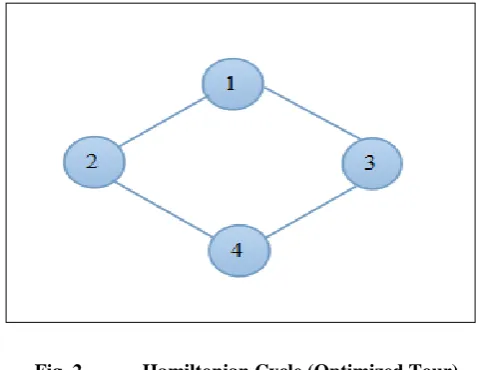
Fig. 1 shows the complete graph of four nodes. Assume edges assigns with different x values. Fig 2 shows
the graph as a Hamiltonian cycle, that cycle indicates the optimized cost(tour) which obtained by calculating the
minimum cost required to visit all the vertex.
86 | P a g e
Fig. 2. Hamiltonian Cycle (Optimized Tour)III.
LITERATURE
SURVEY
[7] The proposed work in this project uses branch and bound approach where code matrix to calculate the low
bound value. In this method, each branch needs a matrix and the child nodes will use code matrix of its parents.
These methods can improve the traditional algorithm and improve the speed of cutting branch. But these types
of algorithms are more complexity and get affected by the performance of the hardware. If the hardware
configuration is not high, algorithm speed up effect is not evident or the results cannot be obtained. On single
core, it can improve the performance but as the number of nodes increases, the improved results are not obvious.
The proposed work [8] introduces genetic algorithm which is created with the help of a neighborhood creation
scheme for flowshop scheduling.
[9] In this paper an improved genetic algorithm is proposed where the new crossover operation, population
reformulation operation, multi-mutation operation, partial local optimal mutation operation, and rearrangement
operations are used to solve the Travelling Salesman Problem.
The work proposed in [10] and [11] paper solves the problem using parallel genetic algorithm. In [10] TSP is
solved using genetic algorithm and it is parallelized using Hadoop Map/Reduce framework. Here three
crossover methods are used such as Order Crossover, Two Point Crossover and Partially Matched
Crossover.[11] The parallel genetic algorithm process the fitness evaluation phase in parallel so that time
consumption is reduced and hence execution speed is increased. The Map/Reduce framework is also used to
run the genetic algorithm in parallel so that it can handle the large scale data.
[3]In this paper the combination of genetic algorithm with dynamic programming uses for solving travelling
salesman problem. In CGADP, the solutions obtained by genetic algorithm will be selected for applying a local
search based on DP. The convergence rate of the solution found by CGADP is faster than that of GA. But with
larger size problem, the running time is also increasing.
[12] This paper proposed to solve the problem of excessive memory usage, calculates the bound by simple
estimation method. This method reduces the complexity of boundary calculation algorithm and it also saves
memory space. But this algorithm just solves the time and space-consuming problem and it does not consider
87 | P a g e
With the survey of methods [13] in this, TSP solves using dynamic programming method found its correct andgives optimal solution with complexity Ο(n22n) ,but optimal solution obtained is not exact optimal solution, the
use of heuristic as intermediate step to get the optimal solution using dynamic programming approach.
[14]Using approximation algorithm to solve large scale TSP generally includes the eliminating cross path
improves the quality of solution. In this proposed work, develop a method to detect and dismantle cross paths,
and thus propose a novel greedy algorithm-based approach to the TSP. The experimental result compared with
other optimization algorithm shows the approximate solution to high quality and less computational cost.
A simulated annealing algorithm provably works better than the metropolis algorithm for any fixed temperature
[15].Although the use of parallel computing approach can improve the efficiency of algorithm on dealing with
large-scale TSP problem, these papers both refers to local optimal solution algorithm, e.g. genetic algorithms,
simulated annealing algorithms. Even they can calculate the results quickly; the results are not globally optimal
solution.
[1]In this proposed work TSP solved using Parallel branch and bound algorithm at multi-core platform Beehive.
It finds the bound by limit method according to greedy algorithm and minimum of distance matrix. And on each
core the algorithm eliminates the sub loop to avoid repetitive calculations, and reduce the time required to get
the optimize solution. But due to limitation of timer in beehive multi-core platform, result cant shows the
accurate search time for more than 15 cities. Due the small memory space of Beehive it solves for small scale
problem.
IV.
PROPOSED
WORK
In the proposed work we will try to use parallel computing approach to realize branch and bound algorithm to
solve the travelling salesman problem. Our main aim is to solve large scale Travelling Salesman Problem in
polynomial time with optimized cost. Parallel computing mechanism will provide the result in polynomial time
as TSP is NP-Hard problem. Branch and bound algorithm is suitable for distributed and parallel computing as it
can be divided into independent sub-problems and can run that sub-problem parallel to get global optimal
solution as it is an exact algorithm.
V.
CONCLUSIONS
In this paper an overview of travelling salesman problem is discussed .The paper presents a glance of different
approaches to solve TSP. With the survey of different methods for solving TSP problem, parallel branch and
bound method of exact algorithm is found better workable to get accurate and efficient results.
REFERENCES
[1] KAI MA,JIONG ZHANG “AN EFFICIENT MULTI CORE BASED PARALLEL COMPUTING APPROACH FOR TSP
88 | P a g e
[2] Anshul Singh, Devesh narayan “A Survey Paper on Solving Travelling Salesman problem Using Beecolony optimization” International Journal of Emerging Technology and Advanced Engineering
Website www.ijetae.com (ISSN 2250-2459, Volume 2, Issue 5, and May 2012).
[3] PHAM Dinh Thanh, HUYNH Thi Thanh Binh, BUI Thu Lam “A Survey on Hybridizing Genetic
Algorithmn with Dynamic Programming forSolving the Traveling Salesman Problem” International
Conference of Soft Computing and Pattern Recognition (SoCPaR), 2013.
[4] Johnson DS, McGeoch LA, “The traveling salesman problem: a case study in local optimization[R”].
In:Aarts EH, LenstraJK, eds. LocalSearch in Combinatorial Optimization. NewYork: John Wiley an
Sons, 1996.
[5] D. AppleGate, R. Bixby, V. Chvatal and W. Cook, “On the Solution of the Traveling Salesman
Problems”, Documenta Mathematica –Extra Volume CM, chapter 3, 1998, pp. 645-656.
[6] Thomas H.Cormen,Charles E. Leiserson,Ronald L. Rivest,Clifford Stein “Introduction To Algorithms”
(3rd Edition).
[7] Paulo Henrique Siqueira, Maria Teresinha Arns Steiner, Sergio Scheer, “A new approach to solve the
traveling salesman problem” in Neurocomputing, vol, 70, 2007, pp. 1013-1021.
[8] S. G. Ponnambalam, H. Jagannathan, M. Kataria, A. Gadicherla, “ATSP-GA multi-objective algorithm
for flow-shop scheduling”, in Int J AdvManuf Technol, vol.23, 2004, pp. 909915.
[9] Omar M. Sallabi and Younis EI-Haddad, “An Improved Genetic Algorithm to Solve the Traveling
Salesman Problem”, World Academy of Science, Engineering and Technology Volume 3, 2009.
[10] Md. Lutful Islam, Danish Pandhare, Arshad Makhthedar and Nadeem Shaikh, “A Heuristic Approach
for Optimizing Travel Planning Using Genetics Algorithm”, International Journal of Research in
Engineering and Technology eISSN: 2319-1163, pISSN: 2321-7308, Volume: 03, Issue: 01, Jan- 2014.
[11] Harun Rasit Er and Prof. Dr. Nadia Erdogan “Parallel Genetic Algorithm to Solve Travelling Salesman
Problem on MapReduce Framework using Hadoop Cluster”, The International Journal of Soft
Computing and Software Engineering [JSCSE], Vol. 3, No. 3, March 2013.
[12] Richard Wiener, “Branch and Bound Implementations for the Traveling Salesperson Problem-Part 1:
A solution with nodes containing partial tours with constraints”, in JOURNAL OF OBJECT
TECHNOLOGY,Vol. 2, No. 2, February-March 2003, pp. 65-86.
[13] Chetan Chauhan, Ravindra Gupta, Kshitij Pathak “ Survey of Methods of Solving TSP along with its
Implementation using Dynamic Programming Approach” International Journal of Computer
Applications (0975 – 8887) Volume 52– No.4, August 2012.
[14] Yongsheng Pan, Yong Xia* “Solving TSP by Dismantling Cross Paths” 2014 IEEE International
Conference on Orange Technologies (ICOT).
[15] Klaus Meer, “Simulated Annealing versus Metropolis for a TSP instance”, in Information Processing