Throughput Analysis
in Closed Queueing Networks
with Finite Buffers
by R.O. Onvural
and H.G. Perros
Center for Communications and Signal Processing Department of Electrical Computer Engineering
North Carolina State University
March 1987
The behavior of throughput in closed queueing networks with finite buffers is
studied as the number of customers changes from one to the capacity of the network. Based on the results obtained, an approximation algorithm is
developed to calculate the throughput of large closed queueing networks under
two different types of blocking mechanisms. Validation tests show that the
algorithm is fairly accurate.
1.INTRODUCTION
In recent years, there has been a growing interest in the development of computational methods for the analysis of queueing networks with finite
buffers. This is primarily due to a growing need to model actual systems which have finite capacity resources. An important, feature of systems with finite
buffers is that a server may become blocked when the capacity limitation of the destination queue is reached. Various blocking mechanisms have been
con-sidered in the literature so far. These blocking mechanisms arose out of various
studies of real life systems. A discussion on these different blocking mechanisms
can be found in Onvural and Perros
[7].
In this paper, we will study such closed queueing networks under two
types of blocking mechanisms, namely type 1 and type 2. In Type 1 blocking mechanism, a customer declares its destination after it completes its service. If upon service completion, a customer at node i attempts to enter node j and
finds it full, then the customer will be forced to wait in front of server i until a space becomes available at node j. Server i remains blocked for this period of
time, and it can not serve any other customer waiting in its queue. If more than one server is blocked by the same node, then these servers will get unblocked
in a first-blocked-first-unblocked fashion.
Due to the blocking mechanism described above, and due to the fact that
occur. For instance, assume that node i is blocked by node j. ~o\\· it is possible that a customer in node j may, upon completion of its service, choose to go to
node i. If node i is at that time full, then deadlock willoccur. In this paper, it is assumed that deadlocks are detected immediately and resolved by instantane-ously exchanging blocking units. This may violate the
first-blocked-first-unblocked rule described above. For instance, let us assume that nodes i and k
are blocked by node j in that order. That is, if a departure occurs from node j
the blocked customer from node i will enter node j first. ~O\V, let us assume that the departing unit from node j chooses node k as its destination, and, that node k is full
at
that moment. This causes a deadlock to occur, which is resolved by simultaneously exchanging the blocking units from nodes j and k. In view of this, the blocked customer from node k enters node j first while nodei still remains blocked. Thus, the first- blocked-first-unblocked priority rule has been violated.
In Type 2 blocking mechanism, a customer in queue i declares its
4
deadlocks can not bessolved in this type of blocking mechanism unless some customers are rernovefrom the system.
A closed queueignetwork with finite buffers under Type 1 blocking is
shown to have produeform solution when the network has exactly two nodes (see, Akyildiz
[1],
Diti~3J, Perras [9]). Onvural and Perras [8] showed that a closed queueing net_ under type 1 blocking, has a product form solution when the number of CIIomers,K, is equal to the capacity of the smallest buffer plus one. Gordon aIlI'iewell[4]
considered Type 2 blocking mechanism and introduced the concepti holes in closed tandem networks. They proved thatifthe number of holes mile network is less than or equal to the minimum buffer capacity, then the IlSork has a product form solution. Persone and Grillo [10] compared the aVBge visiting time and utilization of a node in
symmetri-cal closed queueing D.-sorks under three different blocking mechanisms.
Approximation jprithms for analyzing closed queueing networks with
finite buffers have beeproposed by Suri and Diehl
[11],
and Akyildiz[1,2J.
Inparticular, Suri and IlDl studied closed tandem queueing networks with finite
capacities in which tiftrst queue has an infinite capacity. Their algorithm is
restricted to only tanirn configuration and validation tests were restricted to
networks with srnall~pulations. The algorithm works for both blocking
mechanisms defined j this paper. Akyildiz
[1]
finds an equivalentthe throughput of both systems is approximately the same . In Akyildiz [2], another approximation for blocking queueing networks is introduced using mean value analysis. The approximation is based on the modification of mean residence times due to the blocking events that occur in the network. He con-sidered only Type 1blocking mechanism.
Throughput is defined next. The behavior of the throughput as the number of customers varies is discussed in Sections 2.1,2.2 and 2.3. Based on
these results, approximation algorithms are developed and validated in Section
3.
2.THROUGHPUT OF CLOSED QUEUEING NETWORKS
In this paper, we will consider closed queueing networks consisting of N
nodes and K customers. Each node consists of a single queue served by a server with an exponentially distributed service time with rate J..L1 ,i=1.... ,N. B1 is the capacity of node i including the service space in front of the server. A customer
upon completion of its service at node i attempts to enter destination node j
with probability P1j' i==I, ..,:"; j
=
1,..,N.6
property, several well known algorithms have been developed in the literature
to calculate the throughput of a network (i.e., N[VA, Convolution Algorithm, etc).
Let ~i(K) and r3(K) bethe throughput of a node andthroughput of CQN-I
with K customers in it. Then, by definition
~i(K)={l-PIK(O)}J.L1
wherep{(O)
is the probability that node i is empty and ~i is the service rate at node i, Furth-ermore r3i(K)=~(K)etwhere ei is the mean number of visits acustomer makesto node i and is given by:
.v
ei=
2:
Pjiej Ji=
1,... ,N;
j=1with e .=1 for some J.
J
(1)
One efficient algorithm to calculate the throughput of a CQN-I is given in
Akyildiz
[1]
~(K)= K
K m-1 N
L L
~(K- ) )2:
I jm
(2)
m=li=l 1=1
where x.=e./~. is the relative utilization of node i. When restrictions are
t t l
imposed on buffer capacities, product form solutions are, in general, not
avail-able.
For closed queueing networks with finite buffers
(CQN-B).
let AI(K) andA(K)
be the throughput of node i and the throughput of the networkrespec-tively. Then we have:
Ai(K)={l-P{(O)-p{(bn ....
j whereP~(O)
andP{(b)
arewill contain at least one customer.
K
customers in the network ...\150, At(K)=,\,(K)e
"
i=l, ...,~ wheree,
15 givenby
(1).
Clearly, AI(K) depends on the pararneters of the network. In figures 2 and
3
3, we give two examples of A3(K ) as K changes from 1to ~(=
2:
81) for the1=1
network shown in figure 1.
Figure 1: A three-node cyclic network
We note that in figures 2 and 3, A.3(K ) increases as K increases until
it
-
.-reaches a maximum value, A , for some
K , K
E{L:AJ{L)
~ A3(i),i= 1....M} where the set can be a singleton or can have more than one element. For-K>
K ,
"-3(K)
is non-increasing on K. The behavior of these graphs can beexplained as follows:
P:
(G) decreases, as K increases, until it reaches 0 atK=M-B3+ 1. This value of K is such that the number of holes (i.e. free spaces)
in the queueing network, M-K, is equal to B3-1. That is, in all states queue 3
K
For ~-B3+1~
K
~~I, P3 (0)=0.P:
(b)=0
for 1<K~
8 1 and non-decreasing beyond 8a o
..
,..
.
o
(xUc~
~1..2.'"
f!"~J.U
;:
0 + - - - -...- - - - - ~ ,
J ' •
"u.b.~ 01 ou.tQ••~.
i
•
Fig. 2:Throughput vs # of
customers-r
-..
r
o
...u
-~o
....
..
o C't'ClIC
~()iUl.
~'~.:.141
f- I~·.~• •I
~ ' r
-2
P'fu.,bcr- 0;' cu. casc"a
is non-increasing in the interval [1.81] and non-decreasing in [~1-B3+1,Ml. It is
not clear what happens in the interval
[B
1+
1,~1-B3]. Empirically, we have.
-ues to be non-increasing in
[B1+l,K ]
and non-decreasing in[K
+19~f-B3].2.1. CQN-B under Type 1 blocking
Theorems 1 through 3 and corresponding corollaries presented below can be found in Onvural and Perros [8] hence they are not proved here. These results present the equivalencies between CQN-Bs with respect to the buffer capacities and the number of customers in the network. They also help us to understand the behavior of throughput as a function of the number of custo-mers in the network.
i=1
•
THEOREM 1:
Let 'A.=max{A(K)},
n= Kmin
{B,}
and M= ~8
1• Theni=1,u,N
,
~(n+l)~A ~~(~1-
max
{HI}+1)
1=1,..,N•
• •
COROLLARY
l:Let Kbe
such that It. =A(K ). Then, •max { min
{B
j such that PI}*O}}~K <M- max{B
i}+1
1=1,.. ,N j
=
1,...,N 1=1,u,NN
THEOREM 2:Let M= ~ 8 "
B
t=1
max
{B
1}9
... '
,
,
and
S={L:~f-B
+l$L$B +l}. [f 28~~1
(i.e. Sis not empty) then thenet-work with K customers in it has the same steady state queue length distribu-tion for all K E S.
COROLLARY
2:[f there exists a j such that2B.
~M
then increasing theJ
buffer capacity of node j will not change the value of the maximum throughput.
THEOREM
3:Let J-Ll ,Pi} be the parameters of two closed queueing networkswith buffer capacities Bl and Cl, i=I, ...N: j=I, ..,N. [f min
i=l, ..,N
Bc~l+l
and
min CI 2 ' : I + I , 1>0, that is O<I$min{ min Bi-I, min
Ci-l},
then the twoi=l, ..,N i=l, ...,N i=l, ...,N
N
networks with
2:
B,
-I and2:
C,
-I customers respectively have the same ratematrix.
1=1 i==l
COROLLARY 3:Let ~ be the total capacity of the network. Then, A(M) is
independent ofbuffer capacities
B
i, i==l, ..,:'J'.1"1
Now, we will present another result for cyclic networks with K=
2:
B~.i=l
customers. Consider the cyclic network shown in Figure 1 and let 8;=1,
· 1 2 3 d K 3 Furthermore let
X
be the service time at node i and at1= , , ,an = . ' I
time 0 all servers are busy working. Without loss of generality, assume
deadlocks are detected immediately and resolved by exchanging blocking units. Hence at time
4¥
3' the customer at node 1 will go to node 2, the customer atnode 2 will go to node 3 and the customer at node 3 will go to node 1. At this point in time, all servers will start service and they will be busy working. The points at which all servers begin a new service, i.e. they all become busy
work-ing, are renewal points. In this example, the mean time between renewals is
THEOREM
4: In cyclic networks, if the number of customers in the networkN
,K, IS equal to M
(=
2:
B1) then the throughput of the network is equal to
i=l
Proof: Let N(t) be the number of times all servers are busy working at or prior to time t. Then ~(t) is a renewal process, and the mean time between renewals is equal to E[max(X
1,..f2, . • . ,~¥."')] where XI is distributed exponentially with
rate ~l' i=l, ...,N. Consider any node i. Then a departure from this node will
occur at renewal points. Hence, the mean time it takes a customer to depart
from that node is equal to the mean time between renewals. Thus, the
throughput of node i is equal to
1/E[max(X
1,X2, · · · '.i¥.v)]. Furthermore,since X s are distributed exponentially, we have I
N
P( max
(X1)<t)=
Il
P(Xc<t),
1=1 LV
or P( max
(XJ<t)=
n
(l-e - ...t) 1=1,....N:x:
~V
Hence. E[max(X
l l . . . ,XN)]= J (1 -
O(1-e - ... t))
dto 1=1
2.2. CQN-B under Type 2 blocking
II
Gordon and :'-Iewell
[4]
introduced the concept of holes in cyclic networks under Type 2 blocking. Consider a cyclic network with ='i nodes. Let B.,I I I .,..., bethe buffer capacity and the service rate of node i respectively, i= 1,...,N, where the service times are distributed exponentially. Deadlocks do not occur in this blocking mechanism hence the number of customers in the network should be
N
less than the capacity of the network, i.e. K
<
2:
Bi. Since the buffer capacity i=1of node j is
B ,
let us imagine that this node consists ofB.
cells. If there are i} l }
customers at node j, then
i
of these cells are occupied and B - i. are empty.1 1 1
vVe may say that these empty cells are occupied by holes. The number of holes
N
in the system is equal to
2:
Bi-K .
As the customers move sequentially through1=1
the network, the holes execute a counter-sequential motion since each move-ment of a customer from the jth to the
(j
+
1)st node corresponds to the move-ment of a hole in the opposite direction. Hence, they showed that two systemsi=1
LEMMA l:Let B ,J..L be the parameters of a cyclic network under Type 2 I •
blocking. Then the network with K customers has the same throughput as the
iV
network with
2:
B,
-K customers. Hence, the maximum throughput is achieved i=1Theorem .), presen ted below, is true for cyclic networks and is a
gene~ali-zation of Theorem 2 to Type 2 blocking mechanism. Furthermore, it can be generalized to arbitrary configurations provided that the maximum number of customers in the network is such that deadlocks can not occur.
N
•
THEOREM
5:Let~f=L
Bi, B=
max {Bj }i=1,..,N
•
• •
•
and S={L:M-B $L<B
+1}.
If 28 '2:M [i.e. S is not empty) then the cyclic network with K customers in it has the same steady state queue length distri-bution for all K € S.Proof:This theorem was proved by Onvural and Perros [8] for Type 1 block-ing. The same proof can also be used for Type 2 blocking for M-B •<K< LAl/2
J,
and for L\1121
-s K~
M the proof follows from Lemma 1.In Type 2 blocking mechanism, a server gets blocked if the destination queue of its customer, who is about to start service, is full. A variation of this
13
,
Type 2 blocking mechanism: ..-\.server will be blocked ifat least one of its desti-nation queues is full.
THEOREM 6: In
CQN-B
under Type 2· blocking, if the network has a rever-sible routing matrix, then it has a product form joint queue length distribution.Proof: If the network has a reversible routing matrix and infinite buffer
capaci-•
ties then it has a product form solution with state space S. Under Type 2 blocking, the state space of the network, A, is a subset of S. Let q(j,k) be the
rate of going from state j to state k in the network with infinite buffer capaci-ties. Let
{
o
if J"E
A
andk
ES -
Aq' (j,k)= .q(j,k) if jEA and kE.4
then the process with state space A and rates q'
(j
,k) is a truncated process and hence it has a product form solution(Kelly[7]).
But, it can be verified that~
the truncated process is the queueing network under Type 2 blocking. There-fore, CQN-B under Type 2· blocking has a product form solution.
2.3.Equivalency of Type 2 and Type 1 Blocking Mechanisms
block-ing, i==l, ...,~: where :\>2. In the following theorem, we prove that there exists an equivalency between Type 1and Type 2 blocking mechanisms.
THEOREM 7:Let ~1 and ~2 be defined as above. Furthermore, let C ==8 +1,I , i=l, ...,N. Then, the two networks are equivalent for all K such that
l zsKesmin] min (CI+C'~l)'min(CjV+C1)}-l.
1=1,... ,.V-1
Proof: Let (bi: . · · , b.v ) be the state of N1 where bi is the number of
custo-,
rners at node i. Furthermore, let (bI, . . . ,bi,b
i+ 1, . • • ,bN) denote that node i
is blocked by node i+1. Likewise, let (ci l . . . ,cN) be the state of ~2 where ei is the number of customers at node i. Note that node i in ~2 is blocked by node
i+l if ci+1
= C
i+1and ci>O.We observe that, for l:5K$min{ min (Ci+Ci+
I),
rnin(C~V+CI)}-l, thei=l, ...,lV-l
two networks have the same number of states. Let us now apply the following transformations to the states of Nl:
(bI, • •• , bN)===>(b1, ••• ,bN ), if no node is blocked and
•
(bI , · · · ,bt,ba ...1 , · · · ,biv)===>(b1, · · · ,bi-l,b''''l+l, ...,b.\;) if node 15
blocked, i=l, ...,~.
15
the same rate matrix as N2.
3.APPROXIMATION ALGORITHMS
In this section, we will present approximation algorithms for analyzing cyclic queueing networks and the central server model under Type 1and Type 2 blocking.
\Ve, first, summarize the results of the last section as applied to the throughput of closed queueing networks with finite buffers. For l:5K:5L, for some L, the network has a product form solution and the throughput is increas-ing in this interval as the number of customers increases. For I:5K:5M, for some I, I> L, throughput is decreasing as K increases. Let,
SK·=(K·IA(K·)~A(K),
l<K:SM)
Then, SK· is the set of number of customers for which the throughput is max-imum. Furthermore, let us assume that the set SK· is a singleton, i.e. there is
•
exactly one point,
K ,
at which the throughput is maximum. One can easily find examples where this assumption does not hold (one immediate example may be a network with a node i where2B
i~M, i.e. Theorems 2 and ,5). But, this assumption is made only for presentation purposes and it is not used in the approximation algorithms.pararne-..
ters of a curve that passes through the points ~(1),
...,
~(L),X(K ),
and ~(M). this curve can then be used to estimate the throughput at the unknown points,.
,
L+1,...
,K
-1, andK
+
1,"..,~1-1. Based on our empirical observations, we will..
,
assume that ~(K)is non-decreasing in
[1,K
1and non-increasing in[K
,~I].The main steps of the approximation procedures can be generalized as fol-lows:
i)
ii)
If there exists a node i with 2
B
~ ~I then letB
= L~\t[/2J
z t
•
•
Find K ,and calculate ~(K
)
iii) Calculate
A(l), ...
,~(L), andA{Nf)
iv) Estimate the parameters of the curve that passes through
1) A(l), ...
,A(L),
,
and
X( K )
with a non-negative slope;2)A(
K ) and;\(M)
with a positive slope.v) Calculate the unknown throughput values from the equations of these curves.
17
~ext, we will discuss, how these individual steps can be implemented for each type of blocking.
3.I.Cyclic networks under type 2 blocking
Consider a cyclic network, shown in Figure 1, under type 2 blocking. From Lemma 1, the throughput curve is symmetric, i.e.A(i)=A(M-i);
i=l, ... ,M-l, and maximum occurs at l1\-1/2J. Hence, we only need to calculate
A(1), ... ,A(LAt/2
1.
But, A(1), ... ,A(minB1) can be calculated efficiently, i.e. using Eq.(2), since the network has a product form solution.A(
lM
/2J)
can be calcu-lated from the joint queue length distributions obtained by numerically solvingthe network with
lM/2
J
customers. We first experimented with some interpo-lation algorithms, such as cubic splines and least squares method to estimatethe throughput at unknown points using the throughput at known points. But
these algorithms did not provide good approximations. This is due to the fact
that we have few known points to use and the length of the interval between
K' and minB is usually large. Hence, the two end points do not provide much
&
information for the points in between. The following equation was found to
yield good approximations, as it takes into account the rate at which the
throughput changes as the number of customers changes.
A
(i)
= A(i+
1) - yxK· -iwhere .'"': and y can be determined as follows. For i=min Bi ,we have:
K·-manB,
~(minBt)=A(minBl
+
1)-yxK - mlnB, - 1 K· - mInE,
=A(minB,+2)-yx -yx
K-minBi
-=A -y
1=1
•
A -A(minBi)
Hence, y= . Substitutingy into Eq.(3), we have:
K-mlnBi
K - I
X
i=1
K- --i
~(i)=A(i+1
)-x
K-minB,
K - I X
i = 1
K -tmnB,
Now, let i=minB -1.I Then;
•
K' -(minB,-l) 'A
--'A(minB,)
~(minBI-l)==X.(minB,)-xK - I
X
i=l
K- ...1-manB
x
'(i-x).
=
A(
minB,) - • (;\ -A(
m£nBa) )K - minE, +1
x-x
,
Since, the values of A(minBi) , ~(minB,-l), and A are known, solving x
can be treated as a fixed point problem. The unknown throughput points can
# ..
19
calculate I, we assume that minB
l ~2. If, minBl =1 then, we have to solve the network with minBl
+1
customers numerically to calculate A.(minBl
+1).
The complete algorithm is given in Appendix A. 'vVe applied our algorithm toseveral cyclic networks with different buffer capacities and service rates. The
number of nodes in the network was varied from 3 to 8. The results show that the algorithm is quite accurate. Of the 50 examples we run, the relative error
percentage (i.e. lOO*(exact throughput - app. throughput)/exact throughput)
was less than
4%.
.A representative set of examples is given in Tables 1 to 10. The exact throughput \\9as obtained numerically.3.2.Cyclic networks under Type 1 blocking
IV
Let
B,
,Jl.j be the parameters of a cyclic network and let M=L
Bi · Then,i =1
to estimate the number of customers at which the throughput is maximum, we
will use the equivalency of type 1and type 2 blocking, presented in Theorem 7.
In Theorem 7, we showed that a cyclic network under Type 1 blocking with
buffer capacities B "
i=1,.. .,N is equivalent to the same cyclic network under Type 2 blocking with buffer capacities Bi
+l ,
i=I, ... ,N, for some range of number of customers in the network. But, in Type 2 blocking, the maximumN
2:
e,
+
1•
throughput IS achieved at
K
=
1=1
2
•
[
~\{
+
~V
] -will assume that K=
2 -1 and solve the network numerically with K,
customers in order to calculate
A(K ).
Furthermore, ~(M) can be calculated using Theorem 4, and A.(1), ...,A(minB1+1) can be calculated from Eq.(2) since
the network has a product form solution with K customers for 1
-s
K-sminB+
1. IThe main steps of the algorithm are given in Appendix B.
The algorithm was applied to a variety of cyclic networks. The number of nodes was varied from 3 to 7. ~-\. representative set of examples is given in Tables 11 to 18. The exact throughput in each of the examples was obtained numerically. y\"e note that the approximation results have low relative error.
a.3.The Central Server Model
Now consider the central server model shown below.
21
The parameters of the network are BI , !J.I' and Pit' i=l, ...,N with p
l1= O.
Case l:Let B1=r, and B.
<>,
i==2, ...,~, and consider the network under .VType 1 blocking. Furthermore, let R=
L
B
I • Since,B
1=:x:, we have that.=2
281
>
R. Using Theorem 2, we conclude that the throughput of the network is constant for K~R+l. Noting that the maximum throughput is achieved atI
K =R+1, we applied the algorithm given in Appendix B to calculate
x'(minBi+2), ... , A(R). A set of representative examples is given in Tables 19 to 25. The results on the exact throughput were obtained numerically. We note that the approximation results have a very low relative error.
Case 2:Let B1=x and B,
<>.
i=2, ... ,N, and consider the network under TypeN
2 blocking. Furthermore, let R=
2:
Bi. From Theorem 5, ,veconclude that thei=2
throughput of the network is constant for K>R. Hence, the maximum
,
throughput is achieved at
K
=R. With this modification, we applied the algo-rithm presented in Appendix A to these networks with different service rates, routing probabilities and B15. The examples given in Tables 26 to 32show thatthe algorithm isfairly accurate. The exact throughput given in these tables was
obtained numerically.
Case 3:Let B
Case 4:Let
B
1<:c,
B,
=x, i==2, ,l\; and consider the network under Type 123
Appendix A:AIgorithm for Type 2 blocking
Sl: Calculate
A(i),
i=l, ... , min(Hi)
i=1....,NS2: Solve the network numerically with
K-
=
l
~
I
customers and calculate,
~A
=
A(K )
~
S3: Let DIFl:=A
-A{min(B.))
•
•
DIF2:=K -minB
1
Calculate x from the following equation:
.
DIF
1*xDIF2-d *(1-x) .A(mlnB ))- =>..(mJnB.-l)
, DIF2+1 t
x-x
DIF
1 *(l-x)S4: Let DIF= ,
DIF2~1
x-x
,
and .-\.=X
for i=(K--l) downto (minB,+l) do
begin .
K -i*
A(i)=i\.-X
DIFA=A(i)
A(i)=A(i)+c, *DIF
end;where
-K
- ic . 1-1
l~
i=l, ...
,LzJ
,
K - min(B,)
a n d Z =
-2
Appendix B:Approximation Algorithm for Type 1 Blocking
81: Calculate A(~l) using Theorem 4. Let A(~'1-1)=~(M)+(r3(3)-~(2))*O.97.5
- [M+N]
,
52: Let K
=
2 -1 and solve the network numerically with K custo-mers to-
-)calculate A
=
x,(
K•
83: Let DIF1:=A•
-A(min(B +1))
IDIF2:=K -minB.-l
&
Calculate x from the following equation:
DIF
1*xD1F'!.-1 *(1-x)A(
minB+
1)) -
='A(
minB )1 2 DIF2+ 1 I
X -x
DIFl·(l-x)
84: Let DIF=
,
2 DIF2-1
X - I
-Let A='A
-for
i=(K
-1) downto (minB. +2)do
begin .
A(i)=A-xK - i*DIF A=A(i)
-55: LetDIF=(A -;\(.\f-l))*(l-x) , and ....\==A
'\;[-
·
x -x' K-1
•
for i=K to ~1-2 do
begin #I
A(i):=A-xK - i*DIF A=A(i)
A(i)=A(i)+
di*DIF
end;25
where
•
K - i i=1, ...,
LzJ
if i=
r
z
1
andr
z
1
*
lz
j
i=
lzl
e
i, ...,l\{-l•
K
-min(Bi)-l
and Z=2
K-
- i;=1, ...,
LzJ
and d = d if i
=
r
z
1
andr
z
1;::
lz
j
1 1-1
•
/vf-Kand Z=
[1]
I.F .•Akyildiz, "Analysis of Closed Queueing :'-ietworks with Blocking",CS
Dept,85-022 (1985),Lousiana State Un iversity[2]
IoF.
Akyildiz, "Mean Value Analysis for Blocking Queueing Networks", Manuscript[3] G.W. Diehl, "A Buffer Equivalency Decomposition Approach to Finite Buffer Queueing Networks", Ph.D. Thesis, Eng. Sci., Harvard University, (1984)
[4] vV.J.
Gordon and G.F .Newell, "Cyclic Queueing Systems with Restricted Queue Lengths", Opere Res.,I.5(1967), 266-278[5] \V.J. Gordon and G.F. Newell, "Closed Queueing Systems with Exponential Servers".Oper. Res.,15( 1967),254-265
[6] F.Pc Kelly, "Reversibility and Stochastic Networks", John Wiley and Sons,
(1979)
[7] R.O. Onvural and H.G. Perros, "On Equivalencies of Blocking Mechanisms in Queueing Networks with Blocking", To appear in OR Letters
[8] R.O. Onvural and H.G. Perros, "Some Exact Results in Closed Queueing Networks with Finite Buffers", CCSP, NC State Univ, (1986)0
[9]
H.G. Perras," A Survey of Queueing Networks with Blocking (Part I)", Dept. of CS,86-04 (1986),NC. State University[10] V. De Nitta Persone and D. Grillo, "Managing Blocking in Finite Capacity Symmetrical Ring Networks", Third Int. Conf. on Data Comm. Sys, and Their Perf., (1987)
[11]
R. Suri and C.W. Diehl, nA New 'Building Block' for PerformanceI
# cust exact approxrmare ! relat. veI ~brQ!Jl7hpl1t ~bro!lJ'Dllt or~Qr ~
!
.5 l.76.) l.7til o·t 6 1.~31 1.~'.!7 O.~S
7 1.~6:1 1.~61 0.1
~ 1376 l.~;\ o os
Table 1:B=(5.4.5.~)...=\3.~..)..!)
.. cust approximate relative; .. o-: .
J 0.:.5; 0.92
~ 0.846 1.-4
.) 0.902 1.7
6 0.937 1..)
-
j 0.9.1; 1')3 0.969 O.~
9 0.97~ 0..4
Table 2: B=(2,4.3,5), ~=(2.1.3,4)
Table~:B=(·..~.J..1.6.2),~=(L3.2.4.3.4)
# cust
3 0.71 0.:02 L15
~ 0.:98 0.787 1.33
.) o.su 0.831 1.12
X;- .'-4~ 0.:-.) l.08 0.7-t relauve : C?:,I approximate 3 ~ 5
# cust exact
I t
Table3: B=(2,4,3,3,4), JJ.=(2.2.2.2,2)
Table3:B=(2.2.~.2.2.2.2), ~=(1.3.2.4.J.4.3)
Table9: B={2,2,.2,2,2,2,2), J.L=(2.1,4,5,2,3,3) # cust I ,.
3
4
5 6
Table-4: B=(2.4.3.3A), J..L={5.3 ..4.6.2)
# cust
I
t
3 4 ·5 6
exact approximate relative
cr
Table10:B=(2.~.2.2,2.2.2,2), ~=(5,3,4.6.2.3,3.2)
# cust ~ approximate relative
0"'-4 l.37g 1.391 0.9
.s 1.417 1.506 1.94
6 l.~l 1.5; 1.8
7 1.583 1.593 0.65
9 l.~ 1.597 0.5
10 1.587 1.584 0.2
11 1.~9 1.559 0.4
12 1.487 1.495 0.57
0.9 1.5 1.4 o.s 0.44 0.28 0.16 relative
perorCC I
1.25 1.422 1.535 1.61 1.656 1.694 1.694 approximate tbrOI1c7bplJt 1.261 1...43 1.556 1.62-l 1.662 1.68.) 1.696 exact rbCOJlC7,pnt
s
6Table 5: B=(4.4,3.3.6.2), ~=(5,3.4.6.2,~)
Table 11:8=(6,2,2,-4) , J.L=(3,2,4,2)
Table 6: B=(2,3,4,2,.)), J.L=(3,2,4,1,5,1)
# cust II
t exact 19proximate 0.625 0.71 0.766 0.798 0.813 relati~ i 1.07 1.8 2.3 1.96 0.88 # cust 4 5 6 7 9 to 11 12 0.s89 0.935 0.961 0.973 0.978 0.97''' 0.96-4 0.936 ~ approximate relative cr 0.3 0.5 0.5 0.2 0.1 0.2 0.2 004 ')
0.~9') 0.';88 0.:9
0.:12 0.:1:3 0.14
! )
5 0.91: 0.914 0..1
6 O.7)e5 0.:61 O. ,
-
0.9'26 O.9·~) 0"2'7 O.:q O.:-q.) 0.6:1
.
S 0.93 0.93 0
3 0.~11 0.811 0
10 0.931 0.931 0
9 0.323 0.8~1 0.21
11 0.9'29 0.9:?~ 0.1
10 0.827 0.8"26 0.12
l~ 0.Q:?3 O.g:!t 0.1
12 0.826 0.8~·) o.i:
13 0.909 0.912 O.~
13 0.816 0.81~ 0.2·') Ii Q.~T Q.39:! '24
14 0.79.) 0.80·') 1.3
15 0.762 0.:69 1.1
Table 13:8=(·4.3.2.4.2), JJ.=(3.2.4.2.1)
Table 18:8={3,2.3,3,2,2.2), JL=(3.1,2.1.2,J,4)
#cust exact approximate relative
t
C"?-4 1.738 0
5 1.818 0.25
6 1.866 0.:
7 1.884 0.5
8 1.889 0.3
9 1.891 0.1
Table 14: 8={2.2.2.2,2.2), J.L=(1.1.1.3.2.3)
Table19:8=(%,2,3,5),~=(8.2.3,2),p11=(0.0.25.0.25.0.5)
# cust exact approximate relati~
I
-4 0.704 0.8
5 0.767 1.65
6 0.803 1.2
7 0.816 0.2
9 0.815 1.3
10 0.8 3.4
..., .)
Table 15:B=(2.:2.2.2.~.::!),J.L=(2.1.o4,3.1,4)
exact 4 1.827 5 1.882 6 1.914 1 1.923 8 1.926 9 1.927 ... approximate relative
C"?-#cust exact approximate relative
I
...~ ~ ,
4 1.945 1.94 0.3
5 1.919 1.972 0.3
6 1.989 1.985 0.2
~, 1.992 1.99 0.1
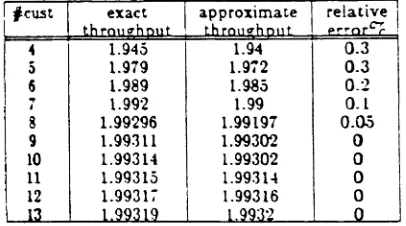
8 1.99296 1.99197 O.Q.5 9 1.99:111 1.99302 0 10 1.99314 1.99302 0
11 1.99315 1.9931-4 0
12 1.9931;- 1.99316
..
0)
Table 2O:B=(x ,2,3,5),~={18.2.3.2),p11=(0.0.25,0.25.0.5)
Table 16:8={2,2.2.2.2.2.2), jJ.=(3,2.4,5,1.2,3)
I
1#cust exact approximate relative !
tbrO!Ia'I,OJlf tbrollC1hput errnror
4 0.:96 0.787 1.1
5 0.86 0.84;- 1.5
6 0.B93 O.~85 0.9
-
.
0.913 0.907 0.668 0.92 0.91; 0.5
9 0.925 0.922 0.3
11 0.918 0.921 0.3
12 0.902 0.913 1.2
u.,~.- ~
#rust exact approximate relative cr
4 1.179 0.7
5 1.214 0.8
I 1.229 0.6
1 1.236 0.3
8 1.239 0.1
9 1.24 O.OS
I")
T6b1e 21:B=('X,3,4,6), JL= (... .6,3,8),p11= (0,0.25.0.25, 0.,) )
# cust exact approximate
4 1.033 1.043
5 1.157 1.183
6 1.252 1.297
-; 1.327 1.39
8 1.389 1.426
9 1.434 1.449
10 1.46 1.462
12 1.4~i 1.461
13 1.427 1.444
14 1.381 1.415 15 1.309 1.317
-Table 17: B=(3,2,3.3.2.2.2), ~=(4,2.2,3,5.2,3) Tab~ ~:B=(:c.2.3.j).~=(~.3.3.4),p
I
.cust exact approximate relauve
1
·b,.oua h? ll t ' brOJ1ahp"r ~"'-or'".
'" 1.7IJM i.rss 0.6
) 1.8.5; 1.~4t) 0.7
6 1.88 1.~7 0 ..1
; 1.388 1.~83 0.3
s 1.~9 1.~88 0.1
9 1.390; 1.~9 0.0,)
to 1.3908 1 ~906 0
#C\J~t aoproxirnate
Table 23:B=(x.2,3.5),~=(4.3.~.5),p11=(0.0.3.0.2.0.5) Table 28:B=(:D,2,3,5),~=(8,2,3.2),p"=(0,1/.,1/4,1/2)
relative
oz
approximate exact
#cust
#CU!t exact approximate relative
or
4 1.212 0.4
5 1.239 0.4
6 1.2 '9 0.3
..
I 1.2.c)3 0.18 1.254 0.04
Table 24:8=(x ,2,3,-t),~=(4,3,3,4),p11=(0,0.45,0.2,O.35)
Table29:B={~,3,5,4),~={3,1,1,l),Pll=(0,1/3,1/3,1/3)
#cust exact approximate relative ~
0.62 0.616 0.6
0.651 0.644 1.1
0.669 0.661 1.2
0.679 0.672 0.98 0.683 0.678 0.66
0.684 0.682 0.4
0.68467 0.6835 0.2
#cust exact approximate relative
oz;
3 1.088 1.11
4 1.163 1..1
.5 1.191 L
6 1.1994 0.52
7 1.202 0.25
8 1.2025 0.1
Table25:B=(~,3,5,4),~={3,1,1,l),pII=(0,1/3,1/3,1/3)
Table30:B=(~,2,3,5),J.L=(4,3.3.-1),p11=(0,1/3,1/3.1/3)
#cust exact approximate
1.944 1.938 1.976 1.969 1.985 1.981 1.988 1.986 1.9883 1.9874 1.9884 1.9881 1.988-44 1.98832 1.98844 1.98841
#cust exact approxirnate relative
C1.
3 1.116 1.103 1.2
4 1.174 1.161 1.1
5 l.193 1.185 0.66
6 1.19i9 1.194 0.32
1.1989 1.1974 0.12
Table 31:B=(~,2,3,..),JJ.=(4,3,3,4),p11=(O,O.~5,O.2,O.35)
Table 26:B=(a;),3,4,6),~={4,6,3,8),pII=(0,1/4,1/4,1/2)
Table 32:B=(a3,J,4,J},J.L=(J,2,1,2),p11=(0,1/3,1/3,1/3)
exact approximate 1.638 1.75 1.803 1.827 1.8371 1.8412 #cust 4 oS 6 i
exact. approximate relative
or.