© EuroJournals Publishing, Inc. 2009 http://www.eurojournals.com/ejsr.htm
Development of Energy Aware TDMA-Based MAC Protocol for
Wireless Sensor Network System
Rozeha A. Rashid
Faculty of Electrical Engineering, Universiti Teknologi Malaysia Skudai, Malaysia
E-mail: [email protected]
Wan Mohd Ariff Ehsan W. Embong
Faculty of Electrical Engineering, Universiti Teknologi Malaysia Skudai, Malaysia
E-mail: [email protected]
Azami Zaharim
Faculty of Engineering, Universiti Kebangsaan Malaysia Bangi Malaysia
E-mail: [email protected]
Norsheila Fisal
Faculty of Electrical Engineering, Universiti Teknologi Malaysia Skudai, Malaysia
E-mail: [email protected]
Abstract
The development of wireless sensor networks (WSN) can be motivated by several types of applications such as habitat monitoring, smart healthcare system, building automa-tion, and etc. These applications however, demand an energy-efficient WSN that can pro-long the network lifetime and can provide high throughput, low latency and delay, and high packet received rate data communication. The ability of wireless network structure to mi-nimize network lifetime is among the hot topic due to limitation resources such as energy, processing and memory, in sensor network architecture itself. This paper proposes a novel approach that tries to reduce idle energy consumption by implementing active-sleep algo-rithm named energy aware A-MAC protocol. The result from the computational model shows that the algorithm can prolong network lifetime due to efficiency in energy con-sumption from time slot management.
1. Introduction
Network System 572
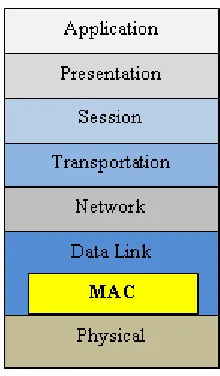
layer controls the physical (radio), it has a large impact on the overall energy consumption, and hence, the lifetime of a node.
Figure 1: OSI basic reference model
Traditional MAC protocols such as ALOHA [1], CSMA [2], and MACA [3], are designed based on contention-based approach. The classic ALOHA protocol was developed for packet radio communication in the1970s. It uses simple transmission mechanism where node transmits a packet that is generated. The transmission is declared to be a success if the sender receives an acknowledge-ment packet. Else, the transmission failed and the sender retries the transmitting after a random period. Using this mechanism, the probability of a packet collides with other packet is very high, hence in-creases the energy expenditure due to packet retransmission.
Therefore, in 1975, Kleinrock and Tobagi developed Carrier Sense Multiple Access (CSMA) protocol with the objective of minimizing the collision. They enhanced the ALOHA protocol by im-plementing a small time for channel listening in order to detect the channel activity. If it does not sense any packet transmission process, it assumes the channel is clear and starts transmitting the intended packet.
However, the protocol cannot solve the hidden terminal problem which normally occurs in ad-hoc networks. The radio range is not large enough to allow communication between arbitrary nodes where two or more nodes may share a common neighbor while being out of each other’s reach. Fig. 2 below illustrates this problem. Note that, since node A is hidden from node C and vice versa, any packet that is sent at the same time by both nodes to node B will be disrupted by each other.
The MACA protocol introduces a three way handshake mechanism to make hidden nodes aware of upcoming transmission, so collision at neighboring nodes can be avoided. Consider again the situation in Fig. 2 above, where both node A and node C intend to transmit a packet to node B. Both nodes first need to send a Request-to-Send (RTS) control packet to node B in order to request permis-sion from node B. Before sending the RTS packet, both nodes need to random delay the transmispermis-sion in order to avoid synchronized transmission. Node B responds with a Clear-to-Send (CTS) packet, which informs all neighboring nodes of the upcoming transfer. The permitted RTS packet sender then starts to transmit the intended data packet to node B. When data is received correctly, an acknowl-edgement is send back to the sender.
2. Related Works
Note that, all the mentioned protocols above require all nodes to continuously listen to the channel due to unpredictable packet transmission by its neighboring nodes, hence introducing a problem called idle-listening. This situation causes a node to expend a lot of wasteful energy and thus, making the im-plementation of these protocols in WSN inefficient.
Sensor-MAC (SMAC) protocol [4] attempted to solve the problems by introducing an active-sleep cycles in the presence of random access channel. Nodes execute a variant of MACA contention-based MAC protocol during active period to minimize the hidden terminal problem, while turning its radio off during sleep period to reduce idle listening problem. Furthermore, SMAC implements neighbors’ information variables called Network Allocation Vector (NAV) [5] for its collision avoidance technique. Node checks the NAV value before sending the RTS message. Nevertheless implementing contention based mechanism is still vulnerable to collision due to random mechanism in its data packet transmission.
Energy inefficiency caused by the idle-listening problem and high collision probability can be avoided in Time Division Multiple Access (TDMA) based protocols. In TDMA-based protocol such as HiperLan-II [6], time is divided into several frames, and frame is divided into numbers of time slots. Since all transmissions within the frame are pre-scheduled, it is possible for a node to sleep when it is not expected to transmit or receive packets, thus the TDMA-based MAC protocol can clearly avoid the over-emitting problem. Since only the owner of the time slot is allowed to transmit a packet, collision problem can be avoided significantly. However, the dependency on a centralized base station implemented in HiperLan-II is not desirable for ad hoc deployed sensor networks, thus the design goal should be to develop a TDMA-based protocol with distributed time slot scheduling algorithm.
Network System 574
3. The Proposed Design
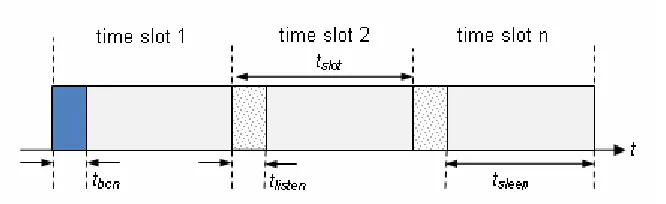
Advanced Medium Access Control (A-MAC) is a TDMA-based MAC protocol developed for low rate and reliable data transportation with the view of prolonging the network lifetime, adapted from LMAC protocol. Compared to conventional TDMA-based protocols, which depend on central node manager to allocate the time slot for nodes within the cluster, our protocol uses distributed technique where node selects its own time slot by collecting its neighborhood information. The protocol uses the supplied en-ergy efficiently by applying a scheduled power down mode when there is no data transmission activity. The protocol is structured into several frames, where each frame consists of several time slots. As shown in Fig. 3 below, each node transmits a beacon message at the beginning of its time slot, which is used for two purposes; as synchronization signal and neighbor information exchanges. By us-ing this message, the controlled node informs which of its neighborus-ing nodes will be participatus-ing in the next data session. The intended nodes need to stay in listening mode in order to be able to receive the intended packet, while other nodes turn to power down mode until the end of current time slot.
Figure 3: Structure of A-MAC frame
Figure 4: State diagram of A-MAC operation
Before entering the wait state, node randomly chooses a number of waiting frame. This is done in order to decrease the probability of nodes enter the discover state at the same time, which then increase the probability of several nodes selecting the same time slot. If a node lost its synchronization beacon for aMaxBeaconLost while in the wait state, node returns back to initial state to find a synchronization beacon again.
Node enters the discover state when the waiting counter expired and start collecting its neigh-borhood information by listening for its neighboring node’s beacon messages for a period of aListen-Frame frames. By using bitmap vector in the beacon message, node randomly selects an unoccupied time slot from the result of combining all bitmap vectors from its neighboring nodes using Equation 1
(
N)
NOR x x x x x x
z 1, 2,K, = 1∨ 2∨K∨ (1)
where is the ith time slot and is an OR operation. The resultant bitmap pattern from this operation will be in terms of 1’s and 0’s where 1’s indicate occupied time slot, while 0’s indicate the vacant ones. Hence, a node randomly chooses its time slot identification from the list of vacant ones (indicated by 0’s).
Figure 5: Time slot assignment with reuse
Network System 576
above, the vacant time slots is 0, 5, and 7. Therefore, node x will randomly select its time slot from the list of vacant time slots.
Node enters active state when it successfully selects a time slot. In this state, node continuously transmits a beacon message at the beginning of its time slot as shown in Fig. 3 above. It also needs to listen to the channel at the beginning of other time slot in order to be able to listen for a beacon mes-sage from its neighboring nodes. Node enters sleep mode in two scenarios. First, after transmitting a beacon message and no more data packet scheduled to be transmitted. Second, if received beacon mes-sage from it neighboring node indicates no incoming data packet.
Compared to LMAC, our designed protocol allows node to transmit to multiple destinations. Furthermore, A-MAC implements an additional flag field in the data packet header called MORE_PACKET flag that is used to indicate if the sender has more packets to be transmitted to the in-tended receiver. By using the MORE_PACKET flag, the intended receivers can immediately enter the sleep mode after receiving all packets destined to it.
4. Analysis of Energy Efficiency
We analyze the efficiency of energy consumption in A-MAC protocol for a network without data transmission. We formulate the energy expenditure of A-MAC protocol in a frame as shown in Fig. 3 above, which consists of number of time slot, as
(
ts)
rx listen tx bcn pd sleep MACA N P t P t P t
E − = −1 + + (2)
where parameters , , and are the powers used in receive mode, transmit mode, and power down mode respectively, and can be calculated as
I V
P= × (3)
where is the current consumed for the given mode and is the operating voltage for the radio transceiver. The value of for each mode and are shown in Table 1 below.
Table 1: Electical specification for radio transceiver CC2420 from Chipcon [9]
Parameter Value
Current consumption, receive mode, 18.8 mA
transmit mode (at 0dBm), 17.4 mA
power down mode, 20 µA
Operating voltage, 3.0 V
The variable , , and represent time for beacon listening period, beacon transmitting period and node sleeping period respectively, as illustrated in Fig. 3 above. Therefore, the total energy consumption for number of nodes in a network can be formulated as
MAC A total n E
E = × − (4)
We analyze the correlation between the number of time slot and the network lifetime. Fig. 6 plots the number of days that a network can stay alive for a given number of time slots from Equation 2, where we assume is equals to . The size of beacon message is 19 bytes and the transmission bandwidth of the CC2420 radio transceiver is 250kbps. The network lifetime is defined as
ts slot MAC A
i
lifetime t N
E E
t = ×
−
(5) where is the given initial energy and is the time slot length. From Fig. 3, the time slot length is
calculated as
bcn sleep
slot t t
To see the correlation between energy consumed per frame with the length of time slot, we put the Equation 6 into the Equation 2.
(
ts)
rx listen tx listen pd(
slot bcn)
MAC
A N P t P t P t t
E − = −1 + + − (7)
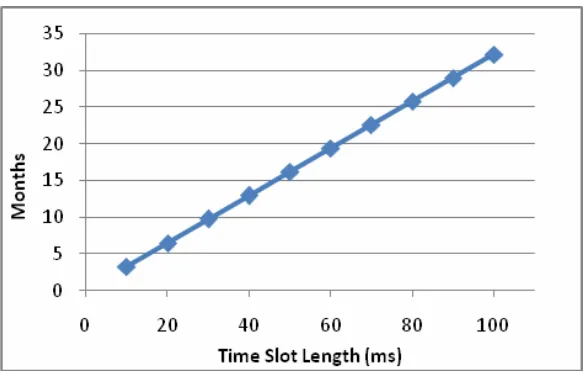
Intial energy Ei in Equation 5 is taken to be 4000 mAh, which is equal to energy from two AA alkaline batteries [10]. As illustrated in Fig. 6 below, the increment of network lifetime is shortened when the number of time slot is bigger than 10. Simultaneously, the network lifetime curve displays a marked slow increment starting from 32 months and above. This is because the energy consumed for sleeping mode is very large compared to the energy consumed for transmitting or receiving. Figure 7 shows the relationship between the network lifetime and the time slot length. The graph shows that the increment of the network lifetime is linear to the increment of time slot length. This is due to longer period of Ppd where most energy dissipates at a very low rate and thus resulted in minimal power con-sumption.
Figure 6: Plot of network lifetime vs number of time slot
Figure 7: Plot of network lifetime vs time slot length
5. Conclusion
Network System 578
is no packet scheduled to be transmitted or received. Simulation study also has been done to prove the A-MAC algorithm can prolong the network lifetime compared to the classical CSMA approach.
References
[1] N Abramsom 1970 The Aloha System – Another Alternative for Computer Communication. AFIPS pp 265 – 298
[2] Kleinrock, L and F Tobagi (1974) Carrier Sense Multiple Access for Packet Switched Radio Channels. Int Conf on Communications pp 21B-1 to 21B-7
[3] P Karn (1990) MACA: A new Channel Access Method for Packet Radio. 9th ARRL Computing Networking Conference pp 134 – 140
[4] W Ye, J Heidemann, and D Estrin (2004) Medium Access Control with Coordinated Adaptive Sleeping for Wireless Sensor Networks. IEEE/ACM Trans Net Vol 12 No 3 pp 439 – 506
[5] IEEE Computer Society (1997) Wireless LAN Medium Access Control (MAC) and Physical Layer (PHY) Specification IEEE Std 802.11.
[6] ETSI (1998) HIPERLAN Type 2 Technical Specification; Physical (PHY) Layer. DTS/BRAN-0023003
[7] L V Hoesel, P Havinga (2005) Collision-free Time Slot Reuse in Multi-hop Wireless Sensor Net-works. Proc Int Conf on Intelligent Sensor, Sensor Networks and Information Processing pp 101 – 107
[8] L V Hoesel, T Nieberg, J Wu, and P J M Havinga (2004) Prolonging the Lifetime of Wireless Sensor Networks by Cross Layer Interaction. IEEE Wireless Communication pp 78 – 86