Impact of the Process Approach Method in Teaching Writing at Secondary School Level: A Case study of Odisha
Sasmita Bharati Research Scholar
SOA University
Dr. Stithaprajan , ITER, Asst . Professor
Abstract
The study investigates the effects of implementing a process approach in teaching L2 writing at the secondary level. In order to examine the effectiveness of the teaching instructions, the present study has been undertaken into two parts .The first part of the study seeks to identify the problems in writing in the classrooms of regional medium schools of Odisha and second part deals with process approach strategies for teaching English and , there will be a study of six different writing samples. The present study includes forty students as participants from six different schools. As instrument a questionnaire and a summary writing examination were implied for the study .The study propose process approach interventions and techniques to support learner academic writing practices at the secondary level. So the data analysis of ESL teachers and students revealed a strong support for using a process approach method to improve learner’s ESL writing skills. Learner’s writing samples score is determined by three writing rubrics differed at the end of the study. The study throws enough light in understanding the importance and effectiveness of process approach in ESL classroom of Odisha.
Key Words-: Second language, writing Problems, process approach , and Learners, secondary Level.
1.0 Introduction
This study attempts to bring the issues related to English language learning and teaching situation of regional medium schools of Odisha .The present study makes an experiment with secondary level ESL learners and aims to improve their writing skills through process approach. English is undoubtedly the largely dominant language in the present world. All advanced knowledge in science, technology, medicine and other disciplines are available in English .English literature contains best treasure of the world thought. In the eve of India’s independence, English has become an essential part of the postcolonial culture of India, and has been acknowledged by nationalist politicians as a means to acquire reputable use today. English is universally used as a medium to connect the people of multitude of India’s languages and cultures (Annamalai, 2005). Though there is a huge demand for English education in our society but the quality of teaching in vernacular medium schools is not coping with the expected level.
1.1 Problem Statement
proficient enough to teach the language properly or learners who do not want to take their learning seriously; or the education system which is supposed to be unsuccessful. The present study examines the problems encountered by the ESL learners in writing.
English is taken as a primary subject in 8 states of India. English is introduced from Class III as second language in regional medium schools. English has now become a matter of state policy. There is a little scope and less exposure for rural learners and their learning chiefly depends on the surrounding. Classrooms are not well equipped with modern teaching equipments. Due to shortage of funds the teachers often lag behind in adopting new materials. As there is large number of students in the classroom, the teachers fail to give attention individually and do group work effectively. The teacher follows the lecture method of teaching. The students play a passive roll and prefer note learning. The teacher does not get enough time to ask questions to all the students. Only the bright students answer, the less proficient students always remain far behind.
1.2 Objective of the Study
The purpose of this study is to investigate the problems in teaching and the nature of writing instructional practices that leaner’s receive at the secondary level. As, the Secondary education is an important sub-sector of the entire education system so the present study aims to focus on the secondary level. As a result, this level of education organized in such a way that it prepares young men and women for the pursuit of higher education as well as prepares them to adjust to their practical lives meaningfully and productively. So the objective of studies are:
1. To find out the problems in writing skills of regional learner’s of Odisha at the secondary level. 2. To identify and obtain information from learners regarding their writing processes, methods and
materials in academic and non-academic setting.
3. To know whether teachers and learners are aware of these problems.
4. Provide suggestions for effective and appropriate strategies for ESL writing to improve the student’s writing at the secondary level.
1.4 Research Hypothesis
2.0 Literature Review
2.1 Factors involved in Second Language writing
Writing is a productive skill. Learning writing is a result of formal instruction and procedure employed in the classroom. Writing ability is one of the most important components for an English as second language learners to achieve success in academic setting but the complexities associate with teaching writing is the major factor in learning writing. (Hinkel ,2004) argues that there is often too much emphasis on teaching the process of writing in ESL courses instead of teaching the practical skills that students need. The writer presents findings which show that ESL students‟ academic papers are often perceived as vague and confusing (p. 4). She argues that this is a result of the process-writing curriculum, which emphasizes content and structure while only sparsely and inconsistently addressing grammar and lexis.
2.1.1 Psychological Problems
According to (Murray, 1982, p. 142), emotion is a way of guiding the learning process: "The deeper we get into the writing process the more we may discover how affective concerns govern the cognitive, for writing is an intellectual activity carried on in an emotional environment, a precisely engineered sailboat trying to hold course in a vast and stormy Atlantic”
(Penfield and Roberts, 1959) posited a language was best learned by the direct method, where language learning was not the conscious primary goal, but a spontaneous activity, characterized by a psychological urge to learn about life, get what one wanted, and satisfies one’s curiosity, as for young children growing up in their home environment.
.
2.1.2 Linguistics Problems
(Ellis, 2000) recognizes the fact that a learner constructs a linguistic system that draws, in part, on his/her L1 but is also different from it and also from the target language. A learner’s inter language is, therefore, a unique linguistic system (p. 33). Ellis also point out that that learners have perceptions regarding the linguistic features of their own language. They treat some features as potentially transferable and others as potentially non-transferable and they are more prepared to risk transferring the features than they are those they perceive to be unique to their own language (p. 53).
.2.1.3 cognitive Problems
2.1.4 Environmental Factor
Mitra (2008) also did an investigation on rural education. The aim of their research was to examine the effects of remoteness on the quality of education in schools. A number of students and teachers from 16 rural schools in Northern India were surveyed. Student’s performance on several subjects including science, English, Hindi and math were also checked. The results showed that students in these schools did not perform well in all these subjects. This poor performance, according to the researchers, was partly caused by the schools’ poor quality (i.e. poor infrastructure and facilities). One of the most interesting findings of the study was that most teachers working in these schools hoped that they could migrate to urban schools which. Could offer them “better job satisfaction, salary structure, standard of living, facilities and educational opportunities” (p. 177).
The above discussed literature offers important direction and reference to this study. Although a number of studies discuss the status of writing school failure, no study has looked to investigate the problem in English language writing made by the podia learners at secondary level. Focusing on writing as an independent skill will help researcher to identify exact area of difficulties encountered by the learner which need to be attention. So this study will provide language teachers with specific language teaching procedures and guidelines which they can use in their classroom to enhance their students’ achievement in English writing.
3.0 Research Methodology
The gap in the literature survey gives us vision to design of the present chapter. This chapter presents a picture of the research methodology to be used throughout this study. The research methodology includes the research design, procedure, participants, instruments, and data collection procedure. The study incorporated a two tier research. The first part of the study seeks to investigate the problems in second language writing in language in the regional schools of odisha and second part suggests strategies for developing ESL writing skills.
1.3 Design
The effects of the interventions were examined using a combination of the quantitative and qualitative research methods. Data were collected using questionnaires, pre- and post-intervention summary writing.The process genre approach had a higher rate of effect than the other approaches. So this study followed a examination for the research to examine three common writing problems among the ESL students at the secondary schools of odisha and teachers’ experienced towards students’ writing problems. The collect data randomly from 40 ESL students from six different schools through a questionnaire and a sample summary written by the students. The SPSS was used to calculate and compute the results of the summary.
3.2 Selection of samples
The subject of this study was drawn from BSE (Board of Secondary Education) students of Odisha. The samples for the present study are only secondary level students of regional medium High school of Odisha. The target population at each school was IX grade students and their teachers. The researcher selected the secondary level learner’s age range between 13 to 16 years.
3.3 Validity of the Checklist
The checklist was submitted to specialized jury members in the field of ELT for their suggestion. The jury members stated that the skills included in the checklist were generally adequate and appropriate to its purpose. The checklist was adapted accordingly recommended by the jury members. The content error includes the lack of main ideas, logical development of ideas, and supporting ideas with proper examples. The Organization deals with measurement specifies the proper sequencing of ideas and use of cohesive devices and the Language in Use dimension focuses on the range of vocabulary and the use of proper register.
4.0 Research Procedure
The student and teacher participants for this study were selected from regional secondary schools of Odiha. During the study student participants were randomly selected from the available classes. Then, the summary were examined by the researchers to check for possible intended errors in the writing .This part addresses the research questions and result was found through the sample summary writing and questionnaire .
4.1Analysis of Students’ Writing Samples
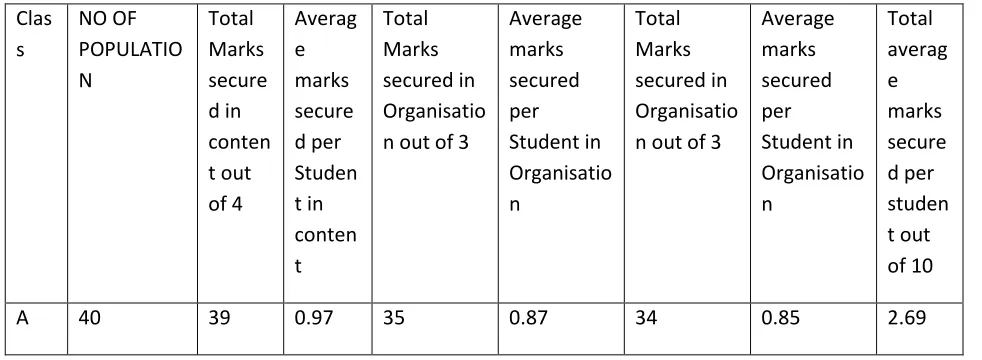
Students’ summary were analyzed and marked by the researchers to find out the number of errors they have made based on the three related aspects (i.e. content, organization, and language in use). Table 1 : depicts the total number of students’ errors on content, organisation, and language use in their summary examinations. Inferential statistics was employed to determine the results entered for each student for the summary.
Table 1: The total number of students’ errors on content, organisation, and language use
Clas s NO OF POPULATIO N Total Marks secure d in conten t out of 4 Averag e marks secure d per Studen t in conten t Total Marks secured in Organisatio n out of 3
Average marks secured per Student in Organisatio n Total Marks secured in Organisatio n out of 3
Average marks secured per Student in Organisatio n Total averag e marks secure d per studen t out of 10
A 40 39 0.97 35 0.87 34 0.85 2.69
found that due to least of teacher’s feedback, Students at many stages are not clear about the use of language. It was found, that the highest error which is done by students in summary writing is language use, second on gathering ideas. As such, the students seemed to have difficulty in maintaining the unity in writing. Learners are unable to supply enough explanation to topic, or failing to supply the right information or related information needed to elaborate on the topic. The writer lacks basic linguistic resources and control, which makes writing difficult. Inter-language is at the stage that his writing is partly based on translations and grammar i.e. - (“I am would like know, how you are?”; “She couldn’t go for a third world journey away”) was found as one of the major factor in their writing .
4.2Findings of the questionnaires
The analysis of the questionnaires of the students’ show that the students have shortage of time to practise writing in the classroom, with the teacher available for clarifying their doubts or supply necessary information about summary writing. The students appeared to have many problems when writing in English, like not knowing how to organize their ideas, because it is a new experience for them. For students to succeed in a L2 language generally, and writing skills specifically, they need to surround themselves in a language learning environment. In the case of these school learners have little opportunities to use English in their surroundings . As a result, they unable to get proper guidance to improve their writing skill. So the above discussion indicates the various causes of difficulties by these students in learning and writing English as a second language.
All most all learners mentioned that they wanted to develop their writing skill in English. They suggest that written feedback on students‟ writings do lead to revisions on the final drafts and pointed out the students‟ errors in a more straightforward manner. (i.e: “You are still weak in your grammar”, “wrong use of preposition”, and “there is no such word” etc). So, it is easier for students to revise as the teachers specified what errors the students made. Some student’s said that by doing group or pair activity writing can improved . The students also proposed that teachers should increase the number of writing tasks in the English classes. They believe that by doing so, they would strengthen their abilities in academic writing.
The researcher realised that the writing in English is often neglected in these classes, partly because the current textbooks do not have any writing activities and also because teachers find writing quite a discouraging prospect in their classes. In this school the exposure to English is typically limited within three periods each week, students get chance for little practice in writing in English. When they starts write, they find themselves confused with word choice, grammatical use, organization and generation of ideas. They are trained to translate ideas from mother tongue into English, express ideas in long sentences, and are not aware of different kinds of writing, thus making them unable to write.
4.3 Improvement in six writing classes through process approach
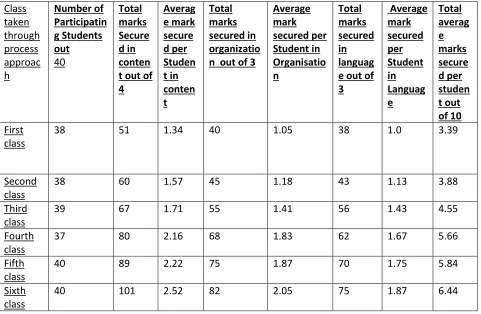
The tables a below illustrate the average result of process approach teaching in the schools through intervention teaching.
Table 2: Improvement in writing classes through process approach
The table indicates that the process approach improved the learner’s content, organization and language errors. The table above shows the differences in class 1 and class 6 intervention results of by using the process approach methods of teaching.
Class taken through process approac h Number of Participatin g Students out 40 Total marks Secure d in conten t out of 4 Averag e mark secure d per Studen t in conten t Total marks secured in organizatio n out of 3
Average mark secured per Student in Organisatio n Total marks secured in languag e out of 3 Average mark secured per Student in Languag e Total averag e marks secure d per studen t out of 10 First class
38 51 1.34 40 1.05 38 1.0 3.39
Second class
38 60 1.57 45 1.18 43 1.13 3.88
Third class
39 67 1.71 55 1.41 56 1.43 4.55
Fourth class
37 80 2.16 68 1.83 62 1.67 5.66
Fifth class
40 89 2.22 75 1.87 70 1.75 5.84
Sixth class
40 101 2.52 82 2.05 75 1.87 6.44
5.0 Comparison of overall score of pre-intervention and post-intervention
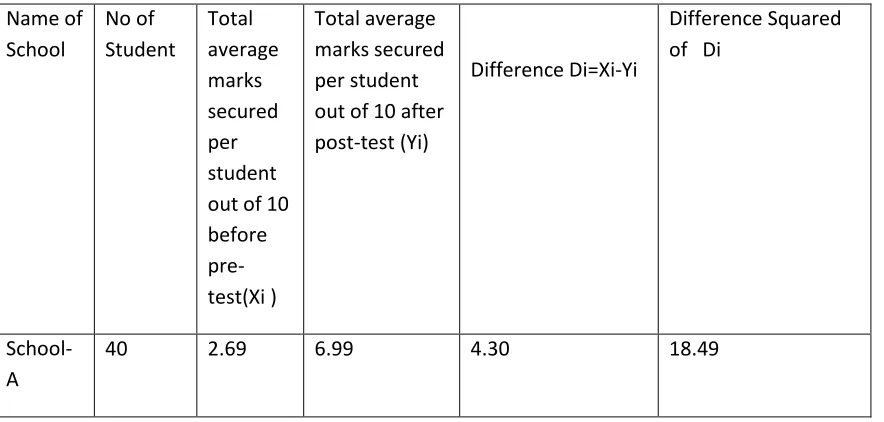
The following table illustrates the effect of the interventions on results . From the Comparison of overall score of pre-intervention and post-intervention, it is obvious that students in all classrooms improved over the total average score as well as in the content, organization and language , which can be seen in the increase in the marks given in all the above areas.
Table 3: The score of pre-intervention and post-intervention Schools Name of
School
No of Student
Total average marks secured per student out of 10 before pre-test(Xi )
Total average marks secured per student out of 10 after post-test (Yi)
Difference Di=Xi-Yi
Difference Squared of Di
School-A
40 2.69 6.99 4.30 18.49
The two-tailed test illustrated above shows that there is sufficient evidence at the significance level to conclude that the interventions were very effective in improving the writing skills of the students. This conclusion was reached since the value reach significance level .Therefore, the hypothesis was accepted which stated that the performance before the intervention is improved to the performance after the intervention through process approach method of teaching. The main conclusion is that the process approach writing interventions had a positive impact on the academic writing abilities of the majority of students. The study throws enough light in understanding the importance and effectiveness of process approach teaching in ESL classroom Odisha.
6.0 Conclusion
This study discuss implications of these findings for further ESL research and implications for secondary ESL teachers. Lastly, I conclude with my final thoughts about the effectiveness of using the writing process approach and what role an ESL teacher can play to support this approach in the writing of English as a second language in odisha. Data in this study were analyzed to identify differences, over time, in the writing ability English Learners who were taught to write through process approach writing and intervention took place during six consecutive class . The post data shown changes and differences which show positive effect of process approach writing on students’ writing ability.
that gave conclusive answers to the research questions and hypotheses. I can say without doubt that thorough proper guidance and effective approach in the classroom led to improved academic writing skills the students.
References
Annamalai, E. Nation-building in a globalised world: Language choice and education in India. In A. M. Y. Lin & P. W. Martin .Eds. Decolonisation, globalization: Language in education policy and practice (pp. 20-37). Clevedon, U.K., Tonawanda, U.S.A.: Multilingual Matters Ltd, 2005. Print.
Annamalai, E. Nation-building in a globalised world: Language choice and education in, 2005.print. Creswell, J. W. Qualitative inquiry and research design: Choosing among five traditions. Thousand Oaks, CA: Sage. 1998. Print.
Ellis, R.Second language acquisition. Shanghai: Shanghai For-eign Language Research Press. 2000. Print. Hinkel, E. Teaching Academic ESL Writing: Practical Techniques in Vocabulary and Grammar. Lawrence Erlbaum Associates. 2004.print.
Leki, L. ESL composing: Strategies and perceptions. In B. Leeds Eds.Writing in a Second Language: Insights from First and Second Language Teaching and Research. Longman: Addison-Wesley,1992.print.
Kellogg, R. T. Effectiveness of prewriting strategies as a function of taskdemands. American Journal of Psychology, 103, 1990.print.pp- 327–324.
Mitra, S., Dangwal, R., & Thadani, L. “Effects of remoteness on the quality of education: A case study from North Indian schools”. Australasian Journal of Educational Technology .24.2 (2008):168-180.print.
Mora, Eugenia .Writing Instruction for English Learners: A Focus on Genre. Volume 13, Number 4 Thousand Oaks, California: Corwin Press. 2009. print.
Murray, D. Teaching the Other Self: The Writer's First Reader. College Composition and Communication, 33.1982. print.pp-142-145.
Penfield, W., & Roberts, L. Speech and brain-mechanisms. New York, NY: Atheneum,1959.print.
Schmitt & McCarthy .Eds. Vocabulary, Description, Acquisit ion and Pedagogy. Cambridge: Cambridge University Press,1997.print. pp-199-227.
Appendix
Questionnaire for the student’s
1. What is your opinion on the importance of English?
4. At what age did you start learning English?
5. What are your personal reasons for learning English?
6. What do you feel is the biggest problem you face in your writing? 7. What do you dislike most about writing?
8. How many hours of English classes do you have per week at school? Do you think it is sufficient? 9. Would you think your English classroom is sufficient for learning writing in English?
10. How much practice do you get in the English classroom to practice writing in English at school? 11. How would you describe the facilities and opportunities available for English writing at your school? 12. What kind of facilities do you get outside school to learn English?
13. Does your teacher give instruction before giving a writing task to you?