Cloud Business Process Management & Data
Security
Honey Tilwani
Asst. Professor, MJRP University, Jaipur
Abstract -- Cloud computing comes into focus when it is all
about I.T., as it is a way to increase capacity or capability of any organization without investing in training, infrastructure etc. “The cloud” is based on the criteria that it relies on sharing computing resources rather than various techniques to optimize business processes. In combination of both, the cloud has transformed the business case for generic applications. CBPM represent an opportunity for small & medium size organizations to de-risk their process improvement activities and data maintenance can be done by controlling I.T. budgeting & enabling geographical mobility. It focuses on business management to concentrate on process modelling over I.T. infrastructure.
This paper’s goal is to talk about the aforementioned subjects i.e. “The cloud” & “Business Process Management (BPM)”. It also describes the hypothesis of the deployment of business logic of an application server and data in bulk resides in the cloud storage & security of data of any system that occupies in the cloud storage. It seeks to systematically categorize cloud computing based on infrastructure, software and platform services provided by it. It likewise aspires to explore knowledge of BPM in the cloud which explains how these may be bridged.
Keyword: Cloud Computing, BPM, Data Security.
I. INTRODUCTION TO CLOUD COMPUTING With the development of Computer Science, the cloud computing has become a recent technology that has replaced the Web 2.0 & Service-Oriented Architecture (SOA) and provided highly computing environment. For consumers, this can significantly reduce I.T. costs and includes a third party, such as Google, Amazon etc. which provides hosted environment in the cloud to maintain & upgrade software and hardware. In cloud computing system, there is a significant workload shift, the network of computing that works up the cloud handles all the operations. As a benefit, hardware and software demands on the user’s side decrease. Hence, cloud computing aims to store data to an off-site storage system maintained by a third-party i.e. saving data to a remote database
By using cloud computing, users only have to pay for the computing material when they use it. It is linked up to the use of computing resources (both software and hardware) that are coded as a avail over a network. Examples that focuses usage of cloud computing are:
1- Salesforce.com- It was founded in 1999, was first successful instance of providing Software as a Service (SaaS) in the business arena.
2- Amazon.com- It is one of the first marketers to offer storage space & computing resources following cloud computing model.
3- Google & Microsoft- They supply the development platform that can be accessed with “pay-per-use” billing model.
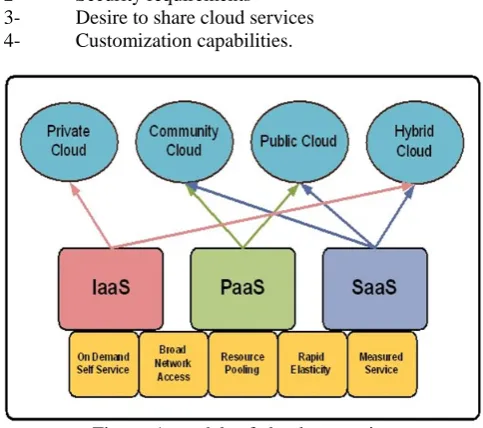
II. CLOUD COMPUTING DEPLOYMENT MODELS Deployment of cloud services depends on the organizational structure and provisioning location. The deployment model represents a specific type of cloud environment primarily distinguished by ownership, size and access. A deployment model represents a specific type of cloud which is deployed by an agency in several ways depending on many factors:
1- Where the cloud services are hosted. 2- Security requirements
3- Desire to share cloud services 4- Customization capabilities.
Figure 1: models of cloud computing
computing resources over the internet form a CSP who shares its resources with other organizations. This case of deployment can be most cost effective deployment model for agencies as it affords them the flexibility to secure only the computing resources they demand and delivers all services.
A public cloud is a good choice:
(i) While testing and developing an application code (ii) While doing collaboration projects
(iii) While incrementing capacity, i.e. ability to add computing resources.
B- Private cloud: It is consecrated to a special
organization which allow commercial enterprises to host applications in the cloud while addressing concerns regarding data protection and mastery. Such systems emulate public cloud services offering within an organization’s boundary to make services accessible for one designed organization. They are commonly not utilized as large scale as public cloud which results in economies of scale. This infrastructure is operated solely for a single organization or agency. The agency specifies architects and controls a pool of computing resources that CSP is delivered as a standardized set of services. When private cloud exists as a controlled environment, the problems described in the risks and challenges section so not tend to apply. With a private cloud, the same organization is technically both cloud consumers and cloud providers. This is a highly virtualized joined together by mass quantities of I.T. infrastructure into resource pools and privately owned and managed. There are two fluctuations of private clouds:
1- On-Premise Private Cloud: This type of cloud is
hosted within an organization's own facility. A businesses, IT department would incur the capital and operational costs for the physical resources with this model. On-Premise, Private Clouds are best utilized for applications that require complete control and configurability of the infrastructure and security.
2- Externally Hosted Private Cloud: Externally hosted private clouds are also exclusively used by one organization, but are hosted by a third party specializing in cloud infrastructure. The service provider facilitates an exclusive cloud environment with total guarantee of secrecy. This format is recommended for systems that prefer not to employ a public cloud infrastructure due to the dangers associated with the sharing of physical resources.
C- Community cloud: In Community Cloud, the
organizations share a cloud base. That cloud is procured jointly by various agencies or plans that share specific needs such as security compliances or jurisdictional considerations. It is similar to public cloud except that its access is limited to a specific community of cloud consumers. Members of such cloud consumers typically share the response for defining and evolving the community cloud, such clouds are a hybrid form of private
cloud built and operated specifically for a targeted group. The objective is to have participating organizations realize the benefits of a public cloud with an added layer of privacy, security ad policy compliance usually associated with a private cloud. It is best used in:
(i) Government organizations within a state that need to share resources.
(ii) Telco community cloud for Telco DR to meet specific FCC regulations.
D- Hybrid cloud: Such clouds are a composition of
two or more clouds (private, community or public) that are bonded together which puts up the advantages of multiple deployment models. A hybrid cloud architecture requires both on-premises resources and off-site server based cloud infrastructure. A hybrid environment is best when:
(i) A company wants to use a SaaS application, but is concerned about security.
(ii) When a company offers services that tailored for different vertical markets.
(iii) When you can provide public cloud to your customers while using a private cloud for internal I.T.
III. BUSINESS PROCESS MANAGEMENT (BPM) Business Process Management (BPM) focuses on organization, integration, optimization, implementation, monitoring & management of processed. With software architecture design which is basically known as SOA (Software Oriented Architecture), all different business processed can be accessed dynamically via a protocol. This is known as service-orientation and it is adjusted as per the requirements of business. It aims at improving corporate performance by managing all the company’s business processes. BPM includes:
1- Tools developed for users to personally define model with basic components.
2- Business performance management tool to manage all functions as different processes & to monitor I.T. system & operations of business process.
With intensified globalization, management of business & its processes have become a major challenge. In a bid to deal with these challenges, Information Technology (I.T.) was harnessed to manage business processes. It is eventually evolved into what is known as BPM today. It acts as a “supporting business process” which uses methods, techniques & software to design, enact, control & analyze operational processes involving humans, organizations, applications, documents & other sources of information.
IV. THE BPM LIFE CYCLE
Figure 2: BPM life cycle
A- Design: This process aims to prepare designs that are theoretically efficient and correct. It encompassed both existing processes and processes that are to be designed. It focuses on process flow, actors within it alerts and task handover mechanisms. This phase requires documents, templates to gather, process data, process modelling software tools that support BPMN, SIPOC or value stream mapping.
B- Modelling: It captures the business processes at a high level. It gathers the details to understand conceptually how the process works. It concentrates on ensuring the high level details accurate without being distracted by the details of how it’s going to be implemented. It involves “what-if analysis” process in the processes. It takes a theoretical view of design and introduces combinations of variables. It simulates the changes to the process. It also compares the various simulations or process options to determine optional improvements.
C- Execution: This phase selects and implements
improvements. During this phase, theoretically correct and efficient process, after analysis, is implemented practically. After comparing the various simulations which determine optimal improvement, it is then implemented. An application is developed or purchased is executed and all the steps in the process are executed accurately and completely.
D- Monitoring: It is the phase where measurement of key performance indicator and process performance is conducted. It allows user to understand where the bottlenecks or inefficiencies in the process are. It encompasses the tracking of individual processes so that the information on their state can be easily seen and statistical reports on their performance can be easily provided. For example, tracking of customer’s product(s) can be tracked or viewed easily (for example order confirmed, order arrived, awaiting, delivered, invoice paid) so that problems in its operation can be identified or corrected.
Degree of monitoring depends upon what information the business wants to evaluate and analyze and how business wants it to be monitored. Business Activity Monitoring (BAM) extends and expands the monitoring tools which are generally provided by Business Process Management.
E- Optimization: It improves business processes and performance by reducing bottlenecks inefficiencies which might be identified during monitoring phase. It simulates these changers using “what-if” simulation. It also determines which changes will deliver the maximum benefits. Thus, examining such inconsistencies will result in improvement of business process.
V. BPM IN THE CLOUD
The Cloud Business Process Management is the usage of Business Process Management tools that are delivered as Software service, which is basically termed as SaaS (Software as as Service), over a network. According to Gartner, by 2016, nearly 20% of all the business processes of many companies will be supported by Cloud Business Process Management platforms.
BPM software in the cloud enables improvement in the strategic business process, reduces technology cost and better alignment of I.T. with business goals. For example, the Appian BPM Suite is a social BPM which offers on-premises or cloud offering. It is highly secure, scalable & reliable approach which has 100% web-based interface and makes it an ideal environment to deploy a service in the cloud.
Cloud Based BPM gives the cloud users an opportunity to use cloud software in a pay-per-use manner. System scale-up and down according to cloud user needs i.e. users do not have to bother about over-provisioning or under-provisioning. Business Process Management (BPM) on the cloud exploits explicit management of service-as-resource. Within an organization, cloud means different things to different people. For the CFO, it’s a mean of reducing upfront cost & for the CEO, it presents all of outsourcing opportunity to complete among all competitors through the creation of a more agile and responsive organization.
VI. CLOUD BUSINESS PROCESS MANAGEMENT
SERVICE MODELS
The requirement & challenges that have to be faced when moving an application to each of the service models are:
A- IaaS (Infrastructure as a Service)
When an application is moved to IAAS service model, the cloud user is responsible for the operating system, the middleware and the applications running in the virtual machine, in addition, the cloud user has to take care of certain security measures to secure the system from intruders as they are given access to the virtualized components in order to build their own I.T. platforms. Physically, a pool of hardware resources is pulled from a multitude of servers and network usually distributed across different datacenters.
B- SaaS (Software as a Service)
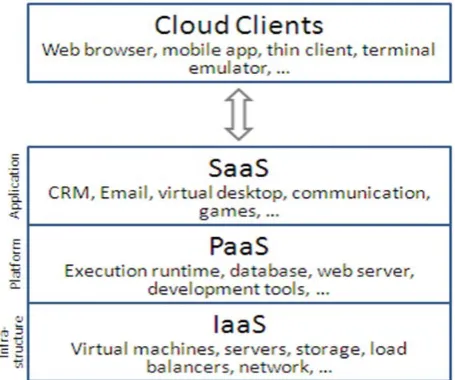
By moving the application to the SaaS service model, the cloud provider is only responsible for the application itself i.e. that specific application is no longer an asset of the cloud user’s enterprise, this application can be offered to multiple cloud users using single tenant or multi-tenant architecture. It allows to provide software application as a service to the end user, it implies to a software that is deployed on a hosted service and is accessible on the internet and software are maintained by the vendor rather than where they are running. It offers a shared data model and therefore, multiple users can share a single instance of infrastructure. Using SAAS has proved to be beneficial in terms of scalability, efficiency, performance. The client can have a single license for multiple computers running at different locations which reduces license cost. The applications suitable for SAS model reside on this service layer. Gmail, salesforce.com. Today, SAAS (Software as a Service) & the cloud are almost interchangeable. The following diagram shows responsibilities for the cloud users & cloud providers.
C- PaaS (Platform as a Service)
It offers development & deployment tool that are required to develop applications. It offers a runtime environment for applications. By deploying applications on the PaasS service model, responsibilities of cloud user & providers completely changes. Users need to upload their processed in order to run them on the cloud. The responsibility of data storage & data management is no longer in hands of cloud user, which may lead to several security measures.
VII. CASE STUDY:UBISOFT
It is the creator of the world’s most popular games in the 21st century such as Assassin’s Creed, Far Cry, Just Dance etc. It was founded by Yues Guilemot in March, 1986 in France. Ubisoft Entertainment is a well-known multinational video game developer & publisher for several acclaimed video game franchises. It has selected Amazon Web Services (AWS) which provide them compatible & innovative set of tools & services available in the AWS cloud. This helped developers in building, deploying, scaling, analyzing & monetize successful games. AWS made it possible for Ubisoft to launch 10 games in 18 months, which was next to impossible without AWS.
AWS tools matched Ubisoft’s infrastructure to match growth in significantly cheaper rates as compared to other services. The most eye-catching or appealing thing is the simplicity of the service which AWS provides. Two of them are elaborated below:
A- Amazon S3 (Simple Storage Service): Ubisoft
considered Amazon S3 because it is cost-effective storage, back-up and archiving, tools for disaster recovery and big data analytics. It also provides data storage infrastructure which is fully redundant for storing and retrieving enormous amount of data, everywhere at any time on the web. It has a free tier which is designed to get hands on experience for 1 year at no charge but it requires user to sign up and it can provide user any 21 products & service for free within certain limits of usage. It provides developers and IT teams with highly scalable and non-redundant data which can be accessed easily and quickly with simple web services. It follows the concept of “pay per use” i.e. you pay only for the storage you actually use. It eliminates fee charging and setup cost.
AWS can be used alone or better with other AWS services like Amazon Block Store (EBS), Amazon Glacier etc. These products may include database, analytics, storage & CDN, compute, mobile etc. It also provides 5GB storage, 20,000 get requests and 2000 put requests.
Data Security in Amazon S3
It supports data transfer over Secure Socket Layer (SSL) and it automatically encrypts using HTTPS data once it is uploaded.
1- Encryption: As an alternate solution, it can also use a client encryption library such as Amazon S3 encryption client to encrypt client data before uploading to Amazon S3. If a client chooses to have Amazon S3 encrypt data with SSE (Server-side encryption) at rest, it will automatically encrypt the data to write and decrypt it on retrieval. It uses AES (Advanced Encryption Standard).
2- Audit logs: Amazon S3 additionally backings logging of requests made against your Amazon S3 resources. You can design your Amazon S3 basin to make access log records for the solicitations made against it. These server access logs catch all solicitations made against a bucket or the objects in it and can be utilized for auditing purposes.
3- Versioning: Amazon S3 gives further protection with versioning capability. You can utilize framing to safeguard, recover, and restore each adaptation of each object put away in your Amazon S3 bucket. This permits you to effortlessly recoup from both unintended client activities and application disappointments. Naturally, the demands will recover the most as of late composed form. More established renditions of an object can be recovered by determining an adaptation in the appeal. Capacity rates seek each rendition put away.
permanently delete an object version. A client can configure MFA delete on a bucket to ensure that data cannot be deleted accidentally. Attention should be paid to an aspect that that the bucket owner the AWS account which is a root account and all authorized only bucket can enable MFA delete.
B- Amazon Elastic Block Store (Amazon EBS)
It provides block level volumes which can be used with Amazon E2C instances in the AWS cloud. Each Amazon EBS volume is replicated within its availability area to protect its users from component failure, providing high availability and strength. It also offers low latency performance whenever required to your workloads. It is highly scalable, durable and secure. It provides three types of volumes:
1- General Purpose (SSD) 2- Provisioned IOPS (SSD) 3- Magnetic
4-All the three volumes differ from each other with respect to cost and features depending upon application need. They are purely designed for maximum availability Amazon EBS is recommended when data changes quickly and where there is requirement of high persistence. These volumes are used for storage of file systems, databases or for any application that requires granular updates. It is also helpful for such databases that encounter many read and writes across data sets. Amazon EBS provides the ability to save snapshots of volumes timely to Amazon S3. Snapshots are saved incrementally and users are only charged for the changed blocks. For instance, if you deliver a device with 200 GB of data, but only 3 GB changed after last snapshot, a subsequent snapshot consumes only 3 additional GB and only charged for it. Both earlier and later snapshots will appear completely.
VIII. CONCLUSION
In this report, we described the combination of BPM and cloud computing. We discussed both cloud computing and BPM and gave an overview of both the aspects and also discusses their combination. BPM has been brought out by identifying the four forms of the BPM lifecycle. We explained the construction of a BPMS and identified concepts within BPM that are relevant to this work. We also discussed cloud computing by giving an overview of the three service models, and the specific benefits and drawbacks of each of these service models. Four cloud types were identified, and wares of three cloud providers, namely Amazon, Google and Microsoft, have been introduced. It has been shown that the BPM Suite provides tremendous value to businesses across many industries. The distribution of data and activities within a process was also discussed by looking into a case study of a gaming company Ubisoft and how it uses cloud services provided by Amazon. This paper also reviews about data security by using cloud data security services provided by Amazon. With this we can conclude that BPM on cloud provides business users simplified BPM with cloud-based process and scheme tools. Cloud computing provides many advantages for BPM adoption and would assist in taking out some of the challenges that are obstacles in the success of BPM.
REFERENCE
[1] Amazon. Amazon Elastic Compute Cloud (Amazon EC2).
http://aws.amazon.com/ec2/, Dec. 2011.
[2] Amazon. Amazon Simple Queue Service (Amazon SQS).
http://aws.amazon.com/sqs/
[3] Amazon. Amazon Simple Storage Service (Amazon S3).
http://aws.amazon.com/s3/
[4] Amazon. Amazon SimpleDB. http://aws.amazon.com/simpledb/ [5] Business Process Management in the cloud: Business Process as a
Service (BPaaS) by Evert Duipmans
[6] Appian. BPM in the Cloud Its Time, Its Safe... Its Smart [7] Appian. Cloud, Mobile and Social BPM
[8] Cloud Computing – www.salesforce.com