Design of PLC-SCADA Based Automated
Boiler Control for Thermal Power Plant
Mohtashim.A.Khan1, A.V.Nikalje2
PG Student, Dept. of E&TC, D.I.E.M.S, Aurangabad, Maharashtra, India1
Professor, Dept. of E&TC, D.I.E.M.S, Aurangabad, Maharashtra, India2
ABSTRACT: Programmable Logic Controller & Supervisory Control and Data Acquisition system. This paper outlines the design and development of boiler automation system using PLC, SCADA and sensors. PLC and SCADA interfaced via communication cables. The initial phase of the paper focuses on passing the inputs to the boiler at a required temperature, so as to constantly maintain a particular temperature in the boiler. SCADA is used to monitor the boiler temperature, pressure and water level using different sensors and the corresponding output is given to the PLC which controls the boiler temperature, pressure and water level. If the temperature and pressure inside the boiler exceeds the predefined value then the entire system is shut down. In case of emergency different automated check valves are used to release pressure, steam and inform the concerned authority through alarm. Boiler automation ladder diagram is designed using RS Logics 500 and SCADA design is done by RS View 32 works.
KEYWORDS: Communication cables, Programmable Logic Controller (PLC), Power Plant, Supervisory Control and
Data Acquisition system (SCADA).
I.INTRODUCTION
Over the years the demand for high quality, greater efficiency and automated machines has increased in the industrial sector of power plants. Power plants require continuous monitoring and inspection at frequent intervals. There it is having number of boiling section. This boiling section produces the high temperature water of the steam level temperature. This steam level temperature is used for power generation and the steam waters are applied to the turbine section. After the power is generated, steam waters are supplied to various plants for reuses. If the supply of the high temperature is reduced to low temperature, it will be used for all other plants which needs the low temperature. There are possibilities of errors at measuring and various stages involved with human workers. In order to automate a power plant and minimize human intervention, there is a need to develop a PLC &SCADA system that helps to reduce the errors caused by humans.
SCADA is a centralized system used to supervise a complete plant and basically consists of data accessing features and controlling processes remotely. It is used to monitor the boiler temperature, pressure and water level using different sensors and the corresponding output is given to the PLC which controls the boiler temperature, pressure and water level. If the temperature and pressure inside the boiler exceeds the predefined value then the entire system is shut down. In case of emergency different automated check valves are used to release pressure, steam and inform the concerned authority. PLC is also used for the internal storage of instruction for the implementing function such as logic, sequencing, timing, counting and arithmetic to control through digital or analog input/ output modules various types of machines processes.
II.LITERATURE SURVEY
power plant and power station are complex systems characterized by nonlinearity, uncertainty and load disturbances. The conventional controllers do not work accurately in a system having nonlinearity in it. So, an intelligent control using PLC& SCADA is developed to meet the nonlinearity of the system for accurate control of the boiler steam temperature and pressure level. Embedded system based boiler automation system consist of GSM (Global System for Mobile Communication), PIC (Peripheral Interface Controller) and different sensors which is capable of monitoring the entire boiler temperature and pressure. The obtained temperature and pressure measured data are transferred through the PIC microcontroller. The microcontroller read the available data and processed.
If the temperature and pressure exceeded the maximum value then the user will be able to get information about the current temperature in any boiler by simply sending a boiler identification number [1], [3]. Microcontroller is programmed with the fuzzy knowledge base rule to control the boiler temperature. The temperature sensor is interfaced with the microcontroller to monitor the steam temperature and a level indicator circuit is used to indicate the water level inside the boiler chamber which is interfaced with the microcontroller and the corresponding outputs are given as the two inputs for the Fuzzy Inference System. After fuzzification of the inputs and applying suitable rules and defuzzifying the output the microcontroller generates appropriate control signals [2]. Fuzzy PID controller is used for temperature superheated steam of boiler based on the fuzzy control methodology. The control process is simulated through the Simulink MATLAB software. It shows that the system can demonstrate good control ability and dynamic effects even in large delay and stochastic disturbance circumstances [4]. From the literature works that are discussed; it is evident that have several disadvantages. In the proposed system the previous papers disadvantages are overcome by using PLC & SCADA for boiler automation to monitor and control the boiler temperature, pressure and water level in thermal power plant.
III.OVERVIEW OF PROPOSED WORK METHODOLOGY
Boiler is one of the most important parts in any power plant. Which require continuous monitoring and inspection at frequent interval. In Power plants it has number of boiling section. This boiling section produces the high temperature water of the steam. Boiler steam temperature in thermal power plant is very complex and hard to control, due to poorly understand the working principles; Boilers have many serious injuries and destruction of property. It is critical for the safe operation of the boiler and the steam turbine. Too low a level may overheat boiler tubes and damage them. Too high a level may interfere with separating moisture from steam and transfers moisture into the turbine, which reduces the boiler efficiency. Various controlling mechanism are used to control the boiler system so that it works properly, many control strategies have been applied to it. In order to automate a power plant and minimize human intervention, there is a need to develop a Boiler Automation system. It is achieved by using Programmable Logic Controller & Supervisory Control and Data Acquisition system that helps to reduce the errors caused by humans and avoids the catastrophic failure.
A. BOILER AUTOMATION USING PLC AND SCADA
In order to automate a power plant and minimize human intervention, there is a need to develop a PLC &SCADA system that helps to reduce the errors caused by humans. PLC and SCADA interfaced through communication cables. SCADA is used to monitor the boiler temperature, pressure and water level using different sensors and the corresponding output is given to the PLC which controls the boiler temperature, pressure and water level.
Fig. 1. Block Diagram of Boiler Automation
B. BOILER OPERATION
Water plays a major part in the generation of steam. Initially Pushbutton is switched ON then the PLC, SCADA, different sensors are switched ON. Feed water pump is switched ON by using feed water pump switch. Coal from the coal chamber passed to the water tube boiler. And the water from the water tank is allowed to pass through two parallel pipes to boiler and its temperature is measured. In one pump the flow rate is maintained at 130% and in another it is 75%. Thus the failure of any one pipe does not affect the boiler operation. Heater is switched ON by using PLC. Forced draft fan is used to force the air into the boiler to improve the combustion efficiency and its corresponding temperature and pressure are measured by sensors. The water is passed through economizer, thus the heat in the outgoing gases is recovered, by transferring its heat to the water. Then the heated water is made to flow through steam and water drum. In this, water should be maintained at least at 50%. For sensing water level Float switches are used. When the level is lesser than or greater than 50%, Float switches senses the level change and sends the appropriate control signal to the PLC. Thus, in spite of any changes in disturbance variable, the water level can be maintained at 50% by proper tuning of PID controller. Water in the water drum is maintained at more than 75%.
When the water is less than 2000 liters then motor will be switched ON. If the temperature and pressure inside boiler exceeds then entire system will be in OFF state. The corresponding automated check valves are opened to avoid catastrophic failure.
C. CONTROL PARAMETERS
Temperature Control
Pressure Control
Force draft pressure, Induced draft pressure, Steam drum pressure, Turbine inlet steam pressure, and flue gas pressure.
Level Control
Steam Drum level, Water level
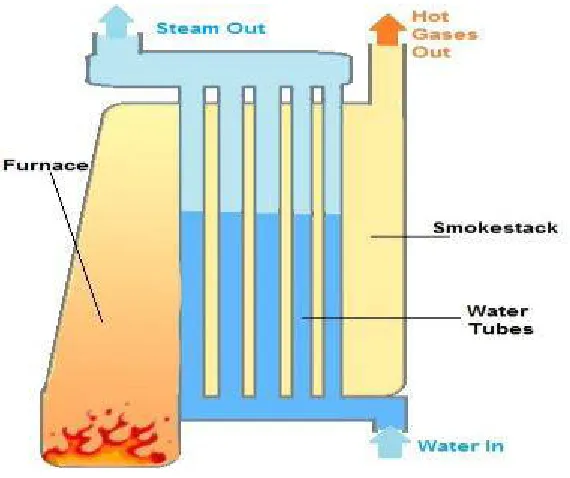
Fig. 2. Water Tube Boiler
D. BOILER
Boiler is essentially a closed vessel into which water is heated until the water is converted into steam at required pressure. There are mainly two types of boiler – water tube boiler and fire tube boiler. At first Fuel (generally coal) is burnt in a furnace and hot gasses are produced which is shown in Fig.2. These hot gasses come in contact with water vessel where the heat of these hot gases transfer to the water and consequently steam is produced in the boiler. Then this steam is piped to the turbine of thermal power plant. There are many different types of boiler used for different purposes like running a production unit, sterilizing equipment, sanitizing some area, to warm up the surroundings etc.
Fig. 3. Resistance Temperature Detector
E. TEMPERATURE SENSOR
convert it to a voltage and use the voltage to drive a differential input amplifier. The differential input amplifier will reject the common mode noise on the leads of the RTD and provide the greatest voltage sensitivity.
The RTD signal is usually measured one of two ways: either by connecting the RTD element in one leg of a Wheatstone bridge excited by a constant reference voltage or by connecting it in series with a precision current reference and measuring the corresponding IR voltage drop.
F. PRESSURE SENSOR
RT pressure switch is used to sense the pressure inside the boiler. RT Series pressure switches utilize a seamless bellows as sensing element. The bellows can be either phosphor bronze or stainless steel to suit various kinds of process medium. The mechanism is enclosed in a weather proof (IP66) enclosure which can be of either DMC (Die Cast Aluminum).Pressure ranges between -1 to 30 bar [8].
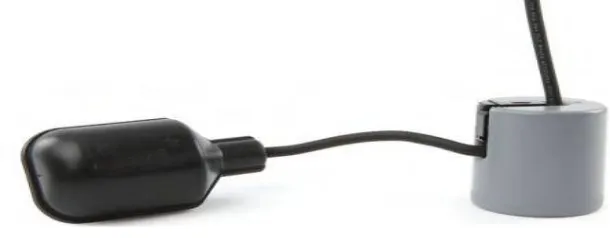
Fig. 4. Float Switches
G. FLOAT SWITCHES
A float switch is a device used to detect the level of liquid within a tank which is illustrated in Fig.4. The switch may be used in a pump, an indicator, an alarm, or other devices. Float switches range from small to large and may be as simple as a mercury switch inside a hinged float or as complex as a series of optical or conductance sensors producing discrete outputs as the liquid reaches many different levels within the tank [7].
IV. PLC AND SCADA
A. PROGRAMMABLE LOGIC CONTROLLER
Fig. 5. Architecture of PLC
B. SUPERVISORY CONTROL AND DATA ACQUISITION SYSTEM
SCADA (Supervisory Control and Data Acquisition) is a centralized system used to supervise a complete plant and basically consists of data accessing features and controlling processes remotely. It is a system operating with coded signals over communication channels so as to provide control of remote equipment (using typically one communication channel per remote station). The control system combined with a data acquisition system by adding the use of coded signals over communication channels to obtain information about the status of the remote equipment for display or for recording functions [5].
VI.CONCLUSION
REFERENCES
[1] T.Karuppiah, Sivasankaran V, Azha , Periasamy, Muruganand S―Embedded System Based Industrial Power Plant Boiler Automation Using GSM Technology‖ IJARCCE Vol. 2, Issue 8, August 2013.
[2] Anabik Shome, Dr. S.Denis Ashok ―Fuzzy Logic Approach for Boiler Temperature & Water Level Control‖ International Journal of Scientific & Engineering Research, Volume 3, Issue 6, June-2012.
[3] K. Ghousiya Begum Mercy D, Kiren Vedi H, Ramathilagam V ―An Intelligent Model Based Level Control of Boiler Drum‖ IJETAE Volume 3, Issue 1, January 2013.
[4] Chuntanman, Jia Li,Lanying Wang,Yantao Chi ―The fuzzy PID control system for superheated steam temperature of boiler‖ Strategic Technology (IFOST) , IEEE International Conference ,Volume 2, pp. 967-970, June-2011.
[5] Ezell, Barry, ―Supervisory Control and Data Acquisition Systems for Water Supply and Its Vulnerability to Cyber Risks‖ available on the internet at: http://watt.seas.virginia.edu/~bce4k/home.html.
[6] Programmable Logic Controllers (PLCs) details are available at: http://world.keyence.com/products/programmable_ logic_controllers/plc.html.
[7] Float switches operating principles are available at: http://www.pulsar-pm.com/product-types/level-volu me/signal-master.aspx. [8] RT pressure switches working principle available at: http://www.gemssensors.com/en/Products/ Pressure/Pressure-Switches.
[9] Vasantha D. kumara and M. Malleswaran, “A Real Time Application For Remote monitoring & Controlling System Based on Embedded Web”. International Journal of Electronic Engineering Research ISSN 0975-6450, Volume 2 Number 4, 2010
[10] K. Gowri Shankar, “Control of Boiler Operation using PLC-SCADA”. Proceedings of the International MultiConfernce Engineers and Computer Scientists, 2008.
[11] V. Bhaskar, T. Gowri Manohar, “GSM Based Motor Monitoring and Speed Control”. International journal of mechanical and Industrial Engineering (IJMIE), ISSN No. 2231-6477, Volume-1, Issue-2, 2011.