Distortion Estimation of a Loudspeaker Using
Knock Off Filter
Shivarajkumar Hosur1, Prof. Raghunath.B.H2
PG Student [DCE], Dept. of ECE, Acharya Institute of Technology, Bangalore, Karnataka, India1 Associate Professor Grade 1, Dept. of ECE, Acharya Institute of Technology, Bangalore, Karnataka, India2
ABSTRACT: The Distortion Level (DL), a vital criterion accustomed appraises loudspeaker performance, normally will be measured using spectral analysis technique. However, spectral analysis produces nice procedure quality. What is more, long measuring times area unit necessary to measure DL accurately during a noisy atmosphere. Therefore, we have a tendency to project the DL measuring technique for a speaker system using an knock off filter. This measuring technique will measure DL as accurately as spectral analysis using quick Fourier transform. The procedure quality is far good that of spectral analysis. Yet, this measuring technique needs a long measuring time to assess the convergence of filter coefficients. This paper presents an outline of the DL measuring technique of a speaker system using knock off filters. The projected measuring technique will measure DL accurately than spectral analysis during a crying atmosphere and evaluate the performance of the project measuring technique victimization laptop simulations. Results based on simulations, show that the proposed measuring technique is more effective than spectral analysis in an acoustic atmosphere with background signal.
KEYWORDS: loudspeaker, original signal, knock off filter, distortion level measurement.
I.INTRODUCTION
The Distortion level (DL) is a very important criterion accustomed valuate loudspeaker system performance as a result of harmonic distortion is created in the main by nonlinearity of a loudspeaker system. DL is outlined as the power magnitude relation of the n-th order harmonic component to the fundamental element. Harmonic distortion, which has all harmonic parts, is named Total Harmonic Distortion (THD). In fact, THD is usually accustomed valuate the loudspeaker system performance. Normal ways of metric capacity unit measuring were exit [1]-[4]. The DL of a loudspeaker system is usually measured exploitation spectral analysis that is typically calculated exploitation the Fourier transforms. This measuring technique is employed to measure the DL not only of a loudspeaker system, however also of audio instrumentation of varied types.
Recently, many measurement techniques for nonlinear distortion have been proposed [5]-[7], as have various measurement techniques for harmonic distortion [8]. [9]Most proposed measurement techniques use spectral analysis to obtain the power of distortion components, which require various procedures. Consequently, these measurement techniques require high computational complexity. To realize measurements with less computational complexity, we are going to proposing a technique using an knock off filter
.
II .PAPER OVERVIEW
This paper is organized into eight parts. Part 1gives a general idea of Distortion level Measurement. Part 3 is about literature survey. Part 4 gives the methodology used to solve the problem. Part 5 gives derived results and followed by conclusion and future works.
III.RELATED WORK
DL Measurement Of A Loudspeaker
Distortion of a loudspeaker results from nonlinearity between an input voltage signal and an output audio signal. We assume that a test signal is a sinusoidal signal vi(t) .
……….1
Fig .1. Outline of Distortion measurement system
.
Therein, f denotes the frequency vi(t) of . When the distortion of a loudspeaker is generated by vi(t) , an output audio signal vo(t) can be represented as the Fourier series using the following equation.
...2
IV.PROPOSED WORK
A.THE KNOCKOFF FILTER
This paper presents the knockoff channel, another variable determination system controlling the FDR in the factual direct model at whatever point there are in any event the same number of perceptions as variables. This strategy accomplishes definite FDR control in limited specimen settings regardless of the configuration or covariates, the quantity of variables in the model, and the amplitudes of the obscure relapse coefficients, and does not require any information of the commotion level.
B. ALGORITHMS: STFT:
The brief short time Fourier transform change (STFT), or on the other hand transient Fourier change, is a Fourier-related change used to decide the sinusoidal recurrence and stage substance of nearby segments of a sign as it changes after some time. By and by, the strategy for registering STFTs is to partition a more extended time signal into shorter fragments of equivalent length and after that figure the Fourier change independently on each shorter portion. This uncovers the Fourier range on each shorter portion. One then normally plots the changing spectra as an element of time
.
FFT:A fast Fourier transform (FFT) algorithm computes the discrete Fourier transform (DFT) of a sequence, or its inverse. Fourier analysis converts a signal from its original domain (often time or space) to a representation in the frequency domain and vice versa.
C. BLOCK DIAGRAM:
Consists of: loudspeaker, input signal, knock off filter, microphone, converters.
Fig .2. Block Diagram of Proposed system
If the amplitude of is equal to and is the opposite phase of , then the square mean of converges to the minimum, and the signal power of becomes equal to the signal power of . Consequently, this measurement system can estimate the signal power of the n -th order harmonic component exactly
.
V. RESULT AND ANALYSIS
Graphs show the original signal and Spectrum results, these simulation results are taking has comparing between the spectral analysis ,adaptive filter and knock off filter.
Fig.4.Original signal
Fig 4 shows the original signal that include some noise that produced by the nonlinearity characteristics of loudspeaker.
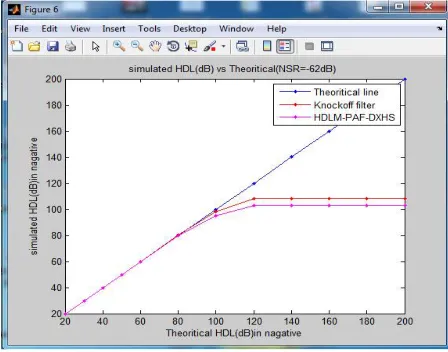
Fig.5. Relation of the simulated HDL over the theoretical value of HDL, for NRS=-62dB.
Fig.6. Relation of the simulated HDL over the theoretical value of HDL ,for NRS=-56dB
Fig.6 shows that ,measurement accuracy is more as compared to adaptive filter methods. Here adaptive filter measure up to near 100dB,and knock off filter measures up to 105dB.as more as than the adaptive filter methods.
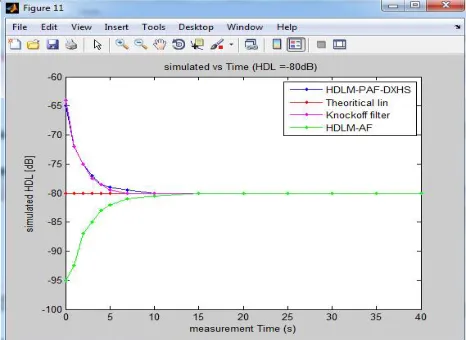
Fig.7.Simulated HDL Vs Measurement time, for HDL=-80dB
Fig.7 shows that ,for measuring the -80dB, adaptive filter requires a near 20sec,meanwhile plural adaptive filter also requires near to 20 seconds, but our proposing method using knock off filter requires less time as compared to both methods.
Fig 6 and 7 these all results shows, fig 7 gives the how accuracy in measurement time in the distortion within the minimum time, a knock off filter compared with an adaptive filter.
VI .CONCLUSION
In this paper , knockoffs is very general and flexible, and can work with a broad class of test statistics and Distortion will be remove accurately.
low-background- noise environment. However, when a loudspeaker is installed in a wall or a car, or fixed in a life environment, background noise is sure to exist in an acoustic environment.
REFERENCES
[1]“IEC 60268-5, Sound system equipment–Pt. 5: Loudspeakers,” May 2003.
[2] S. Temme, “Why and how to measure distortion in electro acoustic transducers,” in Proc. 11th AES Int. Conf. Test Meas., 1992, pp. 223–247, 11-028.
[3] R. C. Cabot, “Fundamentals of modern audio measurement,” J. Audio Eng. Soc., vol. 47, no. 9, pp. 738–762, 1999.
[4] W. Klippel, “Measurement and application of equivalent input distortion,” J. Audio Eng. Soc., vol. 52, no. 9, pp. 931–947, 2004.
[5] A. Farina, “Simultaneous measurement of impulse response and distortion with a swept-sine technique,” in Proc. Audio Eng. Soc. Conv., 2000, vol. 108, no. D4.
[6] I. Djurek, B. Somek, and M. Maletic, “Method for distortion measurements using Pseudo-random signal,” in Forum Acusticum Sevilla, 2002, ELE-02-008.
[7] K. Imaoka and J. Ohga, “Digital measurement of dynamic distortion of loudspeakers,” in Proc. 19th Int. Congr. Acoust., 2007.
[8] D. Bailey, “Harmonic distortion measurement using spectral warping,” in Proc. 3rd IEEE Int.Workshop Electron. Design, Test,Applicat., 2006. [9 ]S. Masunaga, D. Ikefuji, M. Morise, M. Nakayama, and T. Nishimura, “Harmonic distortion measurement for a parametric loudspeaker with logarithmic time stretched pulse,” in Proc. Acoust.’12, Hong Kong, China, 2012.
[10] J. Holub and J. Vedral, “Measurement of effective resolution of ADC in micro convertor ADUC834,” in Proc. 7th IEEE Int. Workshop DDECS, 2004.
[11]T. Fujioka, Y. Nagata, and M. Abe, “The harmonic distortion level measurement system by using the adaptive filter and the performance evaluation by the real-time experiment,” IEICE Trans. Fundamentals(J), vol. J92-A, no. 2, pp. 71–83, 2009.
[12]S. Masunaga, D. Ikefuji, M. Morise, M. Nakayama, and T. Nishimura, “Harmonic distortion measurement for a parametric loudspeaker with logarithmic time stretched pulse,” in Proc. Acoust.’12, Hong Kong, China, 2012.