Available online:
https://edupediapublications.org/journals/index.php/IJR/
P a g e | 1866
Phani Raja.I
Assistant Professor, Department of Computer Science Engineering,
Guru Nanak Institute of Technology, Ibrahimpatnam, Ranga Reddy, Telangana, India
ABSTRACT:The presence of duplicate records is a fundamental information first-rate situation in colossal databases. To detect duplicates, entity decision also known as duplication detection or document linkage is used as a part of the info cleansing system to determine files that potentially refer to the equal actual world entity. O become aware of the duplicity with much less time of execution and likewise without disturbing the dataset excellent, methods like progressive blockading and progressive local are used. Innovative sorted nearby procedure also referred to as as PSNM is used on this mannequin for finding or detecting the reproduction in a parallel method. Progressive blocking off algorithm works on massive datasets where finding duplication requires immense time. These algorithms are used to increase reproduction detection approach. The effectivity may also be doubled over the traditional duplicate detection approach making use of this algorithm.
KEYWORDS-Data Duplicity Detection, Progressive deduplication, PSNM, Data Mining
I. INTRODUCTION
In these days databases play an fundamental function in IT foundedeconomy. Many industries and methods depend upon theefficiency of databases to carry out all operations.Hence, the fine of the files which might be stored within thedatabases, can have significant cost signals to a processthat depends on data to behavior trade.With this ever increasing bulk of data, the data high-qualityproblems arise. Duplicate documents detection can also be dividedinto three steps or phases. Candidate description ordefinition, to come to a decision which objects are to be
comparedwith every other. And secondly
reproduction definition, thestandards situated on
which two duplicate candidates are infact
duplicates.Thirdly genuine duplicate detection, which is specifyinghow one can realize replica candidates and methods to determine actualduplicates from candidate duplicates. First two steps canbe finished offline at the same time with process setup. Third steptakes location when the exact detection is carried out and thealgorithm is run. Multiple, or one of a kind representations ofthe equal actual-world objects in data, duplicates, are one amongthe most arousing data excellent problems.The effects of such
duplicates are adverse; for instance,financial
institution clients may obtain replica identities, inventorylevels are regulated incorrectly, identical catalogs are mailedcountless times to the same sectors and in addition theintroduction of equal
product portfolio.Progressive replica detection
utilising adaptive windowalgorithm helps to decrease the ordinary time and finds morequantity of duplicate pairs more efficiently and turbo thanthe prevailing
methods. And we know detecting
duplicatesmechanically is a elaborate system:to begin
with, duplicate representations are usually
notproprium but may just reasonably fluctuate of their values. Secondly,in essential all pairs of documents must be when compared,which is infeasible for gigantic volumes of data. Nevertheless, thecolossal measurement of in these days’s datasets render replica detectiontechniques more high-priced.
II. RELATED WORKS
Much research on duplicate detection [2], [3], alsoknown as entity resolution and by many other names,focuses on pair selection algorithms that try tomaximize recall on the one hand and efficiency
A Novel Approach For Progressive Of Duplicate
Available online:
https://edupediapublications.org/journals/index.php/IJR/
P a g e | 1867
onthe other hand. The most prominentalgorithms in
this area are Blocking [4] and thearranged
neighborhood method (SNM) [5].
Adaptivetechniques. Previous publications on
duplicatedetection often focus on reducing the overall runtime.Thereby, some of the proposed algorithms arealready capable of estimating the quality
ofcomparison candidates [6],[7], [8]. The
algorithmsuse this information to choose the comparisoncandidates more carefully. For the same reason, otherapproaches utilize adaptive windowing techniques,which dynamically adjust the window size dependingon the amount of recently found duplicates [9], [10].These adaptive techniques dynamically improve theefficiency of duplicate detection, but in contrast toour progressive techniques, they need to run forcertain periods of time and cannot maximize the nodesefficiency for any given time slot. Progressivetechniques. In the last few years, the economic needfor progressive algorithms also initiated someconcrete studies in this domain. For instance, pay-asyou-go algorithms for information integration onlarge scale datasets have been presented [11].
Otherworks introduced progressive data
cleansingalgorithms for the analysis of sensor data streams[12]. However, these approaches cannot be applied toduplicate detection. Xiao et al. proposed a top-ksimilarity join that uses a special index structure toestimate promising comparison candidates [13]. Thisapproach progressively resolves duplicates and alsoeases the parameterization problem. Although theresult of this approach is similar to our approaches (alist of duplicates almost ordered by similarity), thefocus differs: Xiao et al. find the top-k most similarduplicates regardless of how long this takes byweakening the similarity threshold; we find as manyduplicates as possible in a given time. That theseduplicates are also the most similar ones is a sideeffect of our approaches. Pay-As-You-Go EntityResolution by Whang et al. introduced three kinds ofprogressive duplicate detection techniques, called“hints” [1]. A hint defines a probably good executionorder for the comparisons in order to matchpromising record pairs earlier than less
promisingrecord pairs. However, all presented hints producestatic orders for the comparisons and miss
theopportunity to dynamically adjust the
comparisonorder at runtime based on intermediate results. Someof our techniques directly address this
issue.Furthermore, the presented duplicate
detectionapproaches calculate a hint only for a specificpartition, which is a (possibly large) subset of recordsthat fits into main memory. By completing onepartition of a large dataset after another, the overallduplicate detection process is no longer progressive.
This issue is only partly addressed in [1], whichproposes to calculate the hints using all partitions.The algorithms presented in our paper use a globalranking for the comparisons and consider the limitedamount of available main memory. The third issue ofthe algorithms introduced by Whang et al. relates tothe proposed pre-partitioning strategy: By using minihash signatures [14] for the partitioning, thepartitions do not overlap. However, such an overlapimproves the pair-selection [15], and thus ouralgorithms consider overlapping blocks as well. Incontrast to [1], we also progressively solve the multipass method and transitive closure calculation, whichare essential for a completely progressive workflow.
Finally, we provide a more extensive evaluation onconsiderably larger datasets and employ a novelquality measure to quantify the performance of ourprogressive algorithms. Additive techniques. Bycombining the arranged neighborhood method withblocking techniques, pair-selection algorithms can bebuilt that choose the comparison candidates muchmore precisely. The Arranged Blocks algorithm [15],for instance, applies blocking techniques on a set
ofinput records and then slides a small
windowbetween the different blocks to select additionalcomparison candidates. Our progressive
PBalgorithm also utilizes sorting and
Available online:
https://edupediapublications.org/journals/index.php/IJR/
P a g e | 1868
likelihoodof matching. The recall of blocking and
windowingtechniques can further be improved by using multipass variants [5]. These techniques use differentblocking or sorting keys in multiple,
successiveexecutions of the pair-selection
algorithm.Accordingly, we present progressive multi-passapproaches that interleave the passes of differentkeys.
Map Reduce steps:-
1. Demonstrating how to apply map reduce for a commonentity having blocking and matching policies.
2. Identifying the main challenges and proposing two
JobSN and RepSN approaches for
SortedNeighborhood Blocking.
3. Evaluating the two approaches and displaying itsefficiencies. The size of the window and data skew bothinfluences the evaluation.
III. THE PROPOSED APPROACHES
The process of duplicate detection is the method ofidentifying multiple representations of same real worldentities. Today, duplicate detection methods need toprocess very larger datasets in very shorter time:maintaining the quality of a dataset becomes increasinglydifficult. One existing system for finding duplicatesinclude progressive duplicate detection method.
The progressive sorted neighborhood method
(PSNM)depends on the traditional sorted
neighborhood method[3]. PSNM firstly sorts the given data using a predefinedsorting key and then only compares records that are withina window. The perception is that data records that areclose in the sorted order are more likely to be duplicatesthan records that are far apart, because they are alreadyalike with respect to their sorting key.
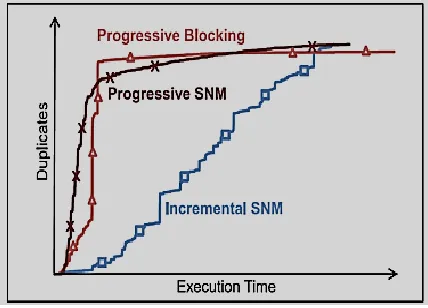
Fig 1: Duplicates pairs found by snm and the two progressive algorithms.
More specifically, the distance of two records in theirrank-distance gives PSNM an approximate of theirmatching likelihood. The PSNM algorithm uses thisperception to iteratively vary the window size, startingwith a low window of size two that quickly finds the mostpromising records. This type of approach has already beenproposed as the sorted list of record pairs (SLRPs) hint [9].The PSNM
algorithm differs by dynamically changing
theexecution order of the comparisons based on look-aheadresults. Progressive blocking (PB) algorithm [1] is anothermethod for duplicate detection. It is a blocking algorithminstead of windowing method. Progressive blocking (PB)is an approach that initiates upon an equidistant blockingtechnique and the successive enlargement of blocks.
The proposed solution uses two types of novel algorithmsfor modern duplicate detection, that are as follows:
PSNM – it's often called Progressive sorted neighborhoodprocess and it is performed over smooth and small datasets.
PB – it's referred to as modern blocking off and it's performedover soiled and giant datasets.
Both these algorithms grumble up the efficiencies
over enormousdatasets. Progressive duplicate
Available online:
https://edupediapublications.org/journals/index.php/IJR/
P a g e | 1869
conventional reproduction persuades twostipulations
which are as follows [1]:
Increased early quality: The target time
when the outcomeare critical is denoted as t. Then the reproduction pairsare detected at t
when in comparison with the
associatedtraditional algorithm. The worth of t is less whencompared to the conventional algorithm’s runtime.
Same eventualquality: When each the
innovativedetection algorithm and
conventional algorithm finishesits execution on the identical time, without terminating tearlier.
Then the produced outcome are the identical.As proven in Fig.2 i.e. System structure, originallya database is picked for deduplication and for functionalprocessing of data, the data is break up into numerous partitionsand blocks. Clustering and classification is used after sortingthe data to make it more ordered for effectivity. Subsequent stepthe pair smart matching is completed to search out duplicates in blocksand by way of new transformed dataset is generated. Ultimately the changed data is up-to-date in database finallyfiltrations.When the time slot of constant is given then the progressivedetection algorithms works on maximizing the efficiencies.
Fig.2: System Architecture
As a consequence PSNM and PB algorithms are
dynamically adjustedusing their top-quality
parameters like window sizes, sortingkeys, block sizes, and so on. The next contributions are madethat are as follows:
PSNM and PB are two algorithms which
might be proposed forrevolutionary
reproduction detection. It exposes a
fewstrengths.
This procedure is compatible for a more
than one go system andan algorithm for incremental transitive closure isadapted.
To rank the performance, the progressive
replicadetection is measured utilizing a great measures.
Many real world databases are evaluated
through testing thealgorithms previously identified.
IV. CONCLUSION
Several duplicate detection methods are considered in thispaper. The existing techniques which have algorithms todetect duplicity in records improve the competence infinding out the duplicates when the time of execution is less.The process gain within the available time is maximized byreporting most of the results.
REFERENCES
[1] S. E. Whang, D. Marmaros, and H. Garcia-Molina, “Pay-asyou-go entity resolution,” IEEE Trans. Knowl. Data Eng.,vol. 25, no. 5, pp. 1111–1124, May 2012.
[2] A. K. Elmagarmid, P. G. Ipeirotis, and V. S. Verykios,“Duplicate record detection: A survey,” IEEE Trans. Knowl.Data Eng., vol. 19, no. 1, pp. 1–16, Jan. 2007.
[3] F. Naumann and M. Herschel, An Introduction to DuplicateDetection. San Rafael, CA, USA: Morgan & Claypool, 2010.
Available online:
https://edupediapublications.org/journals/index.php/IJR/
P a g e | 1870
[5] M. A. Hern_andez and S. J. Stolfo, “Real-world data is
dirty:Data cleansing and the merge/purge problem,” Data MiningKnowl. Discovery, vol. 2, no. 1, pp. 9–37, 1998.
[6] X. Dong, A. Halevy, and J. Madhavan,
“Referencereconciliation in complex information spaces,” in Proc. Int.Conf. Manage. Data, 2005, pp. 85–96.
[7] O. Hassanzadeh, F. Chiang, H. C. Lee, and R. J.Miller,“Framework for evaluating clustering algorithms
induplicate detection,” Proc. Very Large
DatabasesEndowment, vol. 2, pp. 1282–1293, 2009.
[8] O. Hassanzadeh and R. J. Miller, “Creating probabilisticdatabases from duplicated data,” VLDB J., vol. 18, no. 5, pp.1141–1166, 2009.
[9] U. Draisbach, F. Naumann, S. Szott, and O. Wonneberg,“Adaptive windows for duplicate detection,” in Proc. IEEE28th Int. Conf. Data Eng., 2012, pp. 1073– 1083.
[10] S. Yan, D. Lee, M.-Y. Kan, and L. C. Giles, “Adaptivearranged neighborhood methods for efficient record linkage,”in Proc. 7th ACM/IEEE Joint Int. Conf. Digit. Libraries,2007, pp. 185–194.
[11] J. Madhavan, S. R. Jeffery, S. Cohen, X. Dong, D. Ko, C. Yu,and A. Halevy, “Web-scale data integration: You can onlyafford to pay as you go,” in Proc. Conf. Innovative Data Syst.Res., 2007.
[12] S. R. Jeffery, M. J. Franklin, and A. Y. Halevy, “Pay-as-yougo user feedback for dataspace systems,” in Proc. Int. Conf.Manage. Data, 2008, pp. 847–860.
[13] C. Xiao, W. Wang, X. Lin, and H. Shang, “Top-k setsimilarity joins,” in Proc. IEEE Int. Conf. Data Eng., 2009,pp. 916–927.
[14] P. Indyk, “A small approximately min-wise independentfamily of hash functions,” in Proc. 10th Annu. ACM-SIAMSymp. Discrete Algorithms, 1999, pp. 454–456.
[15] U. Draisbach and F. Naumann, “A generalization of
blockingand windowing algorithms for duplicate