
Efficient Group Signatures in the Standard Model
Laila El Aimani and Olivier Sanders?
Technicolor, Security & Content Protection Labs 1 avenue de Belle Fontaine, 35576 Cesson-S´evign´e Cedex, France
Abstract. In a group signature scheme, group members are able to sign on behalf of the group. Since the introduction of this cryptographic authentication mechanism, several schemes have been proposed but only few of them enjoy a security in the standard model. Moreover, those provided in the standard model suffer the recourse to non standard-assumptions, or the expensive cost and bandwidth of the resulting signature.
We provide three practical group signature schemes that are provably secure in the standard model under standard assumptions. The three schemes permit dynamic enrollment of new members while keeping a constant size for both keys and group signatures, and they improve the state-of-the art by several orders of magnitude.
Key words:Group signature, bilinear groups, standard model, non-interactive zero-knowledge.
1
Introduction
Group signatures, introduced in 1991 by Chaum and Van Heyst [16] allow members of a group to anony-mously sign messages on behalf of the whole group. However, to prevent abuses, the group is controlled by a group manager that has the ability toopen the group signature, i.e.to identify the signer of a message. Group signatures have proved to be extremely useful in various applications, for example keycard access to restricted areas, where it is necessary to secure areas to only employees of the group without tracking individual employee’s movements.
Related works. Since their introduction, a great number of security properties that group signatures should meet have been introduced until Bellare, Micciancio and Warinschi [5] provided appropriate definitions and formalized the intuitive informal requirements of previous works. In fact, they proposed two properties for static groups, namelyfull anonymity and full traceability, that captured all previous requirements. Full anonymity requires that group signatures reveal no information about the signer, even in the presence of a powerful adversary who has access to an opening oracle and to all users secret keys. Full traceablity requires that the group manager is always able to identify the signer of a valid group signature or a member of the coalition that issued it. Bellare, Shi and Zhang [6] extended these notions to dynamic groups and added the notion ofnon-frameability, which requires that even a dishonest group manager and a coalition of group members cannot falsely accuse an honest user of having issued some group signature.
Boneh and Shacham [10] proposed a weaker notion of anonymity, called selfless anonymity, where signers can trace their own signatures. Further schemes ([11], [12]) introduced another weak version of anonymity, namely the CPA-anonymity where the adversary does not have access to an opening oracle. As mentioned in [7], this is a much more serious limitation because the opening functionality becomes virtually useless.
Most practical group signatures schemes ([7], [17]) that have been proposed are proven secure in the random oracle model (ROM). Indeed, despite its inherent flaws ([14], [4]), the ROM compares much better than the standard model with respect to efficiency. Atenieseet al.[3] gave an efficient group signature scheme in the standard model but proved its security under non-standard assumptions. Moreover, the security proof of anonymity (lemma A.2 of their paper) does not mention any access to opening oracles by the adversary and thus differs from the standard CCA-anonymity experiment. Actually, this CCA-anonymity seems hard to reach since their group signatures are partially re-randomizable, so any adversary against the selfless
?
anonymity is able to randomize the first part of the challenge group signature and make an opening re-quest on the result. In 2007, Groth [19] gave the first efficient realization, achieving full anonymity in the standard model, where the size of group signatures is about 50 elements.
Our contributions.We propose three groups signatures schemes, proven secure in the standard model under standard assumptions, that improve the size of group signatures and the number of pairings required for the signature verification.
In our constructions, each user joining the group receives a certificate on a key while the group manager receives some information allowing him to open the group signatures produced by this user. To produce a group signature on a message, the user will use his key to sign, with a digital signature scheme, the message, a randomized part of the certificate and the verification key of a strong one-time signature. Then he will produce a non-interactive zero-knowledge proof (NIZK) to prove that the key used to sign the message is certified. Finally, to prevent anyone else to randomize his group signature, the user will sign some of its elements with the strong one-time signature scheme.
Our first group signature scheme, whose group signatures comprise only 22 group elements, achieves selfless anonymity without the need for encryption. Indeed, the use of the Camenish-Lysyanskaya signature scheme [13] makes it possible to disclose the digital signature on the message in the group signature, and thus to decrease the cost and size of the non-interactive proof of knowledge. The scheme resorts however to a trusted party to set up the system parameters. Moreover the cost of the opening algorithm is linear in the number of members.
Our second group signature scheme overcomes the drawbacks of the first scheme but at the expense of a slight increase in the size of the group signature (28 group elements). In fact, users certify now their verification keys (instead of their siging keys), allowing the group manager to set up the system parameters and to extract the identity of the group signature issuer using his extraction key. Since the verification keys are group elements, we now require that our certificate scheme is structure-preserving [1], which explains the extra-cost of the scheme.
Finally we propose a generic group signature scheme that generalizes Groth’s scheme, and which achieves full anonymity. The construction makes use of an encryption scheme in order to be able to use any EUF-CMA digital signature scheme, which increases the size/cost of the group signature. An instantiation of this construction results in a group signature with 30 group elements.
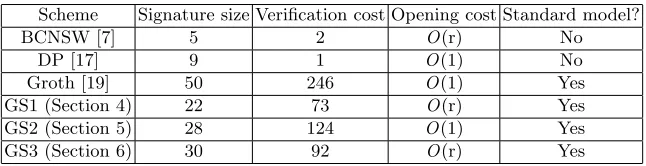
We summarize in Figure the signature sizes (number of group elements), the verification costs (number of pairings) and the opening cost (as a function of the number of participants, denotedr) of our contributions (GS1, GS2, GS3) and compare them with the state of the art.
Scheme Signature size Verification cost Opening cost Standard model?
BCNSW [7] 5 2 O(r) No
DP [17] 9 1 O(1) No
Groth [19] 50 246 O(1) Yes
GS1 (Section 4) 22 73 O(r) Yes
GS2 (Section 5) 28 124 O(1) Yes
GS3 (Section 6) 30 92 O(r) Yes
Fig. 1.Comparison between group signatures performances
2
Preliminaries
In this section we recall some necessary bricks that will be used throughout the document, namely bilinear maps, Camenisch-Lysyanskaya’s signatures, and signatures on committed values. Note that we defer in Appendix A the recall of further primitives such as (one-time, structure-preserving) signatures, tag-based encryption, and non-interactive proofs of knowledge.
2.1 Bilinear groups
Our constructions use cyclic groups of prime order that have a non-degenerate efficiently computable bilinear mape. We use the following notations:
– G1,G2,GT are cyclic groups of prime orderq.
– We write the group operations multiplicatively in each group. – A bilinear map e:G1×G2→GT has the following properties:
1. For allx∈G1, y∈G2 anda, b∈Zq we have e(xa, yb) =e(x, y)ab. 2. Forx6= 1G1 or y6= 1G2,e(x, y)6= 1GT.
3. eis efficiently computable.
The Symmetric External Diffie-Hellman (SXDH) assumption: We saySXDHholds in the bilinear groupsG1 andG2ifDDH is hard in both groups, where DDH (Decisional Diffie-Hellman) is the following problem:
Given (g, ga, gb, gc) it is hard to decide whetherc=ab modq or random.
2.2 Camenisch-Lysyanskaya Signatures
Our group signature schemes make use of the pairing-based Camenish-Lysyankaya signature schemes [13] (scheme A and scheme C in their paper), which are provably secure under the LSRW assumption [21]. The two schemes operate in three cyclic groupsG1,G2 and GT of prime order q, equipped with a pairing
e:G1×G2→GT, and two generatorsg∈G1 andeg∈G2.
Lysyanskaya-Sahai-Rivest-Wolf (LSRW) assumption: Let eg ∈ G2, ex = eg
α,
e
y = egβ and O
e
x,ey(.) be an oracle that, on input a value u ∈ Zq, outputs A = (a, aβ, aα+uαβ)∈
G31 for a randomly chosena∈G1. Then for all probabilistic polynomial time adversaries
A, the quantityis negligible:
=Pr[α, β←Zq;ex←eg
α,
e
y←egβ; (u, a, b, c)← AO e
x,ye(
e x,ye) :
u /∈Q∧a∈G1∧b=aβ∧cα+uαβ]
whereQis the set of queries asked byAto his oracleO e
x,ye(.).
[Key generation]Chooseα, β←R−Zdthen computeX←eg α
andY ←egβ setpk← {X, Y}andsk← {α, β}.
[Signature on m]Choose a randoma∈G1
and outputs :σ= (a, aβ, aα+mαβ) [Verification] Givenpk, mandσ= (a, b, c)
check if the following equations holds:
e(a, Y) =e(b,eg) ande(a, X).e(b, X)m=e(c,g)e
[Key generation] Chooseα, β, zi←R−Zdthen computeX←eg α
,Y ←eg β
andZi←egzi for 1≤i≤l
setpk← {X, Y, Zi}1≤i≤landsk← {α, β, zi}1≤i≤l. [Signature on(m0, ..., ml)]Choose a randoma∈G1
Ai=azi for 1≤i≤l
b=aβ,Bi= (Ai)β c=aα+αβm0
l Q i=1
Aαβmi
and outputs the signatureσ= (a,{Ai}, b,{Bi}, c) [Verification] Givenpk, mandσ
check if the following verification equations holds: e(a, Zi) =e(Ai,eg)
e(a, Y) =e(b,eg) ande(Ai, Y) =e(Bi,eg) e(a, X).e(b, X)m0
l Q i=1
e(Bi, X)mi=e(c,
e g)
Fig. 3.Camenisch-Lysyanskaya’s signature C
2.3 Re-randomizable signatures on committed values
Our constructions usei.e. digital signature schemesΣwith the following properties:
– The signature scheme isre-randomizable i.e. it admits a functionSigRandsuch that for each signature
σ on a messagem, SigRand(σ) =σ0, whereσ0 is a valid signature on mand such that no probabilistic polynomial time adversaryA, with access to a signing oracle, is able, given a signatureσ, to distinguish a randomized version ofσfrom a signature on a random element of the message space.
– Σ admits an algorithm comSign to obtain signatures on committed values which, on input c (where (c, r)←Commit(m)) andπ←POK{(m, r) : (c, r) =Commit(m)}(c), outputsσsuch that
Σ.verify(σ,(m, r)) = 1.
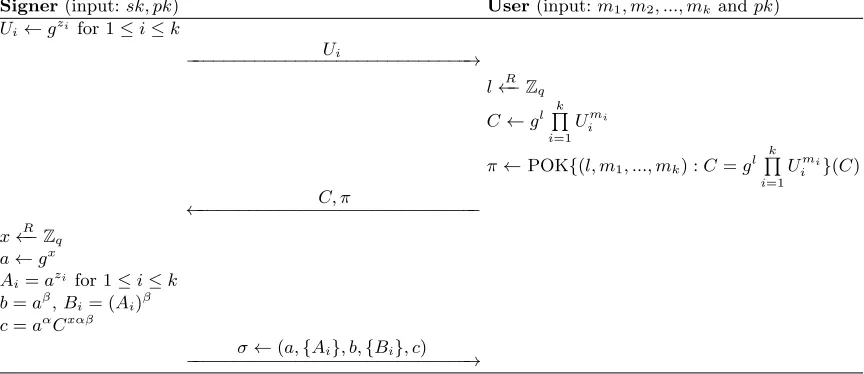
We define EUF-CMA security the same way as the standard digital signature schemes (a re-randomizable signature scheme cannot obviously reach the SEUF-CMA security). As shown in [13] the signature scheme described in figure 3 is EUF-CMA secure and admits an efficient protocol (described in Fig. 4) for obtaining signature on committed value. Moreover, using a proof similar to that of [7], this scheme is re-randomizable if the DDH-assumption holds inG1.
3
Defining Group Signatures
3.1 Syntax
A group signature scheme consists of a set of users, identified by a unique indexi, that can produce signatures on behalf of the group. Users must interact with a certification authority and the group manager to join the group. At the end of this interaction, each user obtains a signature key pair and the group manager obtains some information that will allow him to identify the group signatures issuers. The syntax that we require is as follows.
– Keygen(λ): This algorithm inputs a security parameterλand outputs (gpk, skcert, skM,Sreg,reg), where
gpkis the group public key,skcertis the issuer’s secret key,skM is the group manager’s secret key,Sreg is the group manager’s secret register andregis a public register.
Signer(input:sk, pk) User(input: m1, m2, ..., mk andpk) Ui←gzi for 1≤i≤k
Ui
−−−−−−−−−−−−−−−−−−−−−−−−−−−−→
l←R−Zq C←gl
k Q i=1
Umi
i
π←POK{(l, m1, ..., mk) :C=gl k Q i=1
Umi
i }(C) C, π
←−−−−−−−−−−−−−−−−−−−−−−−−−−−−
x←R−Zq a←gx
Ai=azi for 1≤i≤k
b=aβ,Bi= (Ai)β c=aαCxαβ
σ←(a,{Ai}, b,{Bi}, c)
−−−−−−−−−−−−−−−−−−−−−−−−−−−−→
Fig. 4.Protocol for obtaining a CL signature C on committed values
common inputs of this protocol is gpk and the user’s public key upki. The private input of the user is
uski whereas the private inputs of the issuer and the group manager are skcert and skM respectively. As a result of the first interaction, the user obtains his group signing key ski, the verification keyvki and a certificate, σcert(i), proving membership of the group. Then he uses uski to computeσi, a digital signature onvki. At the end of the second interaction, the group manager obtains and storesvki andσi in Sreg[i] and publishes upki in reg[i].
– Sign(gpk, ski, σcert(i), m) : This algorithm inputs a messagem, the user’s secret key and certificate and outputs a group signatureµonm.
– Verify(gpk, µ, m) : This algorithm inputs a messagemand a group signatureµand outputs 1 ifµis a valid group signature on m, and 0 otherwise.
– Open(gpk, m, µ, skM) : This algorithm inputs a messagem, a group signatureµand the group manager’s secret data skM andSreg. If µis a valid group signature on mfrom user i it returns a proofτ of this statement and the identity i, else it returns⊥.
– Judge(gpk, m, µ, i, τ) : This algorithm inputs a messagem, a group signatureµ, an identityiand a proof of knowledge τ. It returns 1 if τ is a valid proof that µ is a group signature on m, issued by user i. Otherwise it returns 0.
3.2 Security model
In this section we give the security definitions that we require for group signature schemes. We adhere to the model defined by [6], except that we use theselfless anonymitynotion from [10] instead of thefull anonymity for our first two group signature schemes. Informally, selfless anonymity, contrarily to full anonymity, does not protect dishonest users, i.e. the adversary does not know the private keys of the identities he wishes to be challenged on. As in [7], we consider a setting with n users divided statically into sets HU and DU of honest and dishonest users respectively ( i.e an honest user cannot be corrupted during the experiment). This static division implies, by guessing the indices of ”target” users in the anonymity and non-frameability experiment, security in the dynamic corruption case.
– OJoinU D(gpk, upki, skM) is an oracle that executes the user’s side of the join protocol for the input user
i∈ HU. This oracle will be used by an adversary playing the role of the corrupted group manager.
– OJoinDM(gpk, upki, uski) is an oracle that executes the join protocol with the honest group manager. This oracle will be used by an adversary to register a corrupted user.
– OSign(i, m) is an oracle that accepts as input an identityiand a messagemand returns a group signa-tureµif useriis honest and registered.
– OOpen(m, µ) inputs a message-signature pair (m, µ) and returns the result of the function call
Open(Sreg, skM, µ, m). We use the notationOOpen¬(m, µ) when the query (m, µ) is not allowed.
Correctness:We define the correctness of a group signature scheme through a game in which an adversary is allowed to request a signature on some message by any of the honest group members. The adversary wins if either the resulting signature does not pass the verification test, the signature is opened as if it were produced by a different user, or the judging algorithm returns 0. The group signature scheme is correct if for any adversary A and any security parameter λ (we keep this notation in the following experiments),
Pr[ExpcorrA (λ) = 1] is negligible inλ, whereExpcorrA (λ) is defined as follows: 1. HU ← {1..n}.
2. (gpk, skcert, skM)←Keygen(λ).
3. (ski, vki, σcert(i))←Join(gpk, skcert, skM) for each useri∈ HU. 4. (i, m)← AOSign,OOpen(gpk).
5. Ifi /∈ HU then return 0. 6. µ←Sign(ski, m).
7. IfVerify(gpk, m, µ) = 0 then return 1.
8. IfOpen(Sreg, skM, µ, m) = (j, τ) andj6=ithen return 1. 9. IfJudge(m, µ, τ, i) = 0 then return 1.
Anonymity:Informally, anonymity requires that group signatures do not reveal the signer’s identity. In the selfless-anonymity game the adversary’s goal is to determine which of the two users generated the challenge signature. The difference with the full anonymity of [6] consists in not giving the adversaryAaccess to either private key. As in [10] and [7] we define the selfless-anonymity experimentExpanonA −b(λ) as follows:
1. DU ← A(λ). 2. HU ← {1..n} \ DU.
3. (gpk, skcert, skM)←Keygen(λ).
4. (ski, vki, σcert(i))←Join(gpk, skcert, skM) for each useri∈ HU. 5. (m, i0, i1)← AOSign,OOpen,OJoinDM(gpk) with (i0, i1∈ HU).
6. µ←Sign(skib, m) forb
R
←− {0,1}. 7. b∗← AOSign,OOpen¬(m,µ),OJoinDM(gpk).
8. Returnb∗.
We defineAdvanonA −b(λ) =|Pr[b=b∗]−1
2|. The group signature scheme is anonymous if for any probabilistic polynomial time adversary, this advantage is a negligible function of λ. In the full-anonymity experiment, we no longer require thati0, i1∈ HU, we then say that the group signature scheme is fully-anonymous.
Traceability: Traceability requires that no adversary is able to create a valid signature that cannot be traced to some user already registered. We define the traceability experiment as follows:
1. DU ← {1..n}.
2. (gpk, skcert, skM)←Keygen(λ). 3. (m, µ)← AOOpen,OJoinDM(gpk).
5. Return 0.
We define AdvtraceA (λ) = Pr[ExptraceA (λ) = 1]. The group signature scheme is traceable if for any proba-bilistic polynomial time adversary, this advantage is a negligible function ofλ.
Non-frameability: Informally, non-frameability requires that a cheating group manager cannot falsely accuse an honest user of having signed a given message m. We define the non-frameability experiment as follows:
1. DU ← A(λ). 2. HU ← {1..n} \ DU.
3. (gpk, skcert, skM)←Keygen(λ).
4. (ski, vki, σcert(i))←Join(gpk, skcert, skM) for each useri∈ HU. 5. (i, m, µ)← AOSign,OJoinU D(sk
M, gpk).
6. Ifi /∈ HU or Verify(gpk, m, µ) = 0 then return 0. 7. Ifmwas queried toOSignthen return 0.
8. IfJudge(m, µ, τ, i) = 0 then return 0. 9. Return 1.
We defineAdvnfA(λ) =Pr[ExpnfA(λ) = 1]. The group signature scheme is non-frameable if for any proba-bilistic polynomial time adversary, this advantage is a negligible function ofλ.
Remark: We can also define the strong non-frameability experiment in which the adversary’s goal is to accuse an honest user of having created a given signatureµ(we replace the line 7 by: ifµwas produced by
OSign then returns 0).
4
A group signature without encryption
4.1 Description
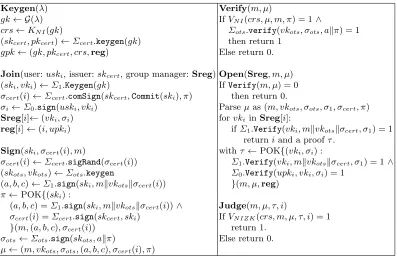
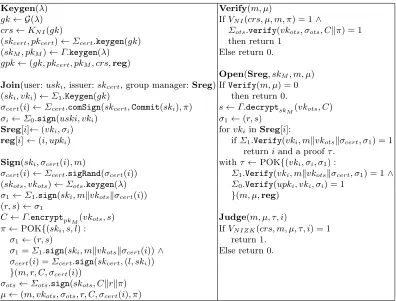
The core of this group signature scheme is the combination of a re-randomizable signature scheme Σcert and the signature schemeΣ1 described in Figure 2. We assume that the system parameters are set up by a trusted party and that each userihas a key pair (uski, upki) for a signature schemeΣ0 whereupki is public and associated toi. At the end of theKeygenalgorithm, the issuer receivesskcert. When a new member joins the group, he creates a key pair (ski, vki) forΣ1, then gets a certificateσcert(i) onski (using the protocol for obtaining signatures on committed values) and finally sendsvki and a signature on it (usinguski) to the group manager who records it in his secret registerSreg. When making a group signature on a messagem, the member will first re-randomize his certificate and generate a key pair (skots, vkots) for a strong one-time signature. Then he will use his secret keyski to sign the concatenation of m, the certificate andvkots and give a non-interactive zero-knowledge proof of knowledge that the certificate is a valid signature onski. To prevent an adversary from randomizing the signature or the non-interactive proof, the user will sign them with the strong one-time signature. We use the following notations to describe our group signature scheme:
Notations:
– λis the security parameter.
– G is a probabilistic polynomial time algorithm that, on input λ, generates (G1,G2,GT, e, g,eg) where g∈G1 andeg∈G2.
– KN Iis a probabilistic polynomial time algorithm that, on input (G1,G2,GT, e, g,eg), generates a common
reference string crsfor the Groth-Sahai proof system. – regis a public register.
– Sreg is the secret register of the group manager. – gpk is the group public key.
Keygen(λ) Verify(m, µ)
gk← G(λ) IfVN I(crs, µ, m, π) = 1∧
crs←KN I(gk) Σots.verify(vkots, σots, akπ) = 1 (skcert, pkcert)←Σcert.keygen(gk) then return 1
gpk←(gk, pkcert, crs,reg) Else return 0.
Join(user:uski, issuer:skcert, group manager:Sreg)Open(Sreg, m, µ) (ski, vki)←Σ1.Keygen(gk) IfVerify(m, µ) = 0 σcert(i)←Σcert.comSign(skcert,Commit(ski), π) then return 0.
σi←Σ0.sign(uski, vki) Parseµas (m, vkots, σots, σ1, σcert, π)
Sreg[i]←(vki, σi) forvki inSreg[i]:
reg[i]←(i, upki) ifΣ1.Verify(vki, mkvkotskσcert, σ1) = 1 returniand a proofτ.
Sign(ski, σcert(i), m) withτ ←POK{(vki, σi) :
σcert(i)←Σcert.sigRand(σcert(i)) Σ1.Verify(vki, mkvkotskσcert, σ1) = 1∧ (skots, vkots)←Σots.keygen Σ0.Verify(upki, vki, σi) = 1
(a, b, c)←Σ1.sign(ski, mkvkotskσcert(i)) }(m, µ,reg) π←POK{(ski) :
(a, b, c) =Σ1.sign(ski, mkvkotskσcert(i))∧ Judge(m, µ, τ, i)
σcert(i) =Σcert.sign(skcert, ski) IfVN IZK(crs, m, µ, τ, i) = 1
}(m,(a, b, c), σcert(i)) return 1.
σots←Σots.sign(skots, akπ) Else return 0. µ←(m, vkots, σots,(a, b, c), σcert(i), π)
Fig. 5.Group signature scheme 1
4.2 Security proofs
Theorem 1. If Σcert is a EUF-CMA secure signature scheme and (P, V) is a sound zero-knowledge proof system, then the group signature is fully traceable.
Theorem 2. If Σ0 and Σ1 are EUF-CMA secure signature schemes, Σots is a strong one-time signature scheme and (P, V) is a sound, zero-knowledge proof system, then the group signature scheme is strongly non-frameable.
Theorem 3. If Σ0 and Σ1 are EUF-CMA secure signature schemes, Σots is a strong one-time signature and (P, V) is a sound, zero-knowledge proof system, then the group signature scheme is anonymous under the SXDH assumption.
The proofs are provided in appendix B.
4.3 A concrete realization
We instantiate this system with theΛsxdhsetting which refers to the case of asymmetric pairings for which the DDH assumption holds in bothG1 andG2.
We use the CL signature scheme described in Fig. 3 for Σcert, the weakly secure Boneh-Boyen signature scheme described in Fig. 8 forΣots and the structure-preserving signature described in Fig. 9 forΣ0. We use the following notations to describe the proofs of knowledge:
Notations:
– (ski, pki)←((αi, βi),(ge
αi, e gβi))
– (skcert, pkcert)←((u, v, z1, z2),(U, V, Z1, Z2)) – (skM, pkM)←((x1,xe1, x2,xe2),(X1,Xe1, X2,Xe2))
– η ←mkvkotskσcert
A group signature, (vkots, σots,(a, b, c), σcert(i)) involves 13 group elements, and a proofπ of the following equations (the variables are underlined):
e(a1,eg)
βi =e(b
1,eg) (1)
(e(a1,eg).e(b1,eg)
η)αi =e(c
1,eg) (2)
e(c,eg) =e(a, U).e(b, U)l.e(B1, U)αi .e(B2, U)βi (3)
whereη ismkvkotskσcertandl is the randomness used by user i in the join stage to obtain signature on the committed valuesαi andβi.
These equations involve 3 variables (αi, βi, l) and thus increase the size of the proof by 6 group elements. Equations (1) and (2) proves that (a1, b1, c1) is a valid Camenisch-Lysyanskaya signature from useri onη. These two equations cost 1 group element each. Equation (3) proves that the certificate is a valid signature onαi andβi and costs 1 group element. The total size of the proof is then 9 group elements.
The total size of the group signature is thus 22 group elements, which amounts to 700 Bytes if we consider an implementation using 256-bit groups sizes. Using naive computations, equation (1) needs for the verification 18 pairings, equation (2), 19 pairings and equation (3), 25 pairings. Checking the consistency of the certifi-cate and of the one-time signature adds 11 pairings. The total cost of theVerifyalgorithm is then 73 pairings.
Remark: We can further reduce the size of the group signature if the group manager and the certificate issuer are the same entity. Indeed, in theJoin protocol we no longer need to use the hiding randomnessl
which decreases both the size of the certificate and the size of the proof by two elements. The size of the group signature is then 18 group elements.
5
A group signature without encryption and without trusted parties
5.1 Description
The main drawbacks of the previous scheme lie in requiring a trusted party to set up the system parameters, and having the cost of the algorithmOpenlinear in the number of users. To solve these two problems, users will now certify their verification keys (instead of their siging keys), allowing thus the group manager to set up the system parameters and to use the extraction keysekof the Groth-Sahai proofs to extract the identity behind a group signature.
This construction is similar to the previous scheme except that we require a different signature scheme for Σcert. We now assume that any digital signature σ, generated using Σcert on an arbitrary message m can be efficiently transformed in a reversible way to a pair (r, s) where r (r may be the empty string) is information theoretically independent fromm,i.e.there exists an algorithmSimulatethat inputsΣcert.sk and a message from the message space and outputs a string indistinguishable from r. We require further the partial randomizability property forΣcert,i.e.Σcert admits two algorithmsSigPrand0 andSigPrand1,
defined as follows:
For each signatureσ→(r, s) on a message m:
– (r0, state)←SigPrand0(r)
– s0 ←SigPrand1(s, state)
wherer0 is unlinkable torandσ0←(r0, s0) is a valid signature onm.
Keygen(λ) Verify(m, µ)
gk← G(λ) IfVN I(crs, µ, m, π) = 1∧
(crs, ek)←KN I(gk) Σots.verify(vkots, σots, akπ) = 1 (skcert, pkcert)←Σcert.keygen(gk) then return 1
gpk←(gk, pkcert, crs,reg) Else return 0.
Join(user:uski, issuer:skcert, group manager:Sreg)Open(Sreg, ek, m, µ) (ski, vki)←Σ1.Keygen(gk) vki←XN I(crs, µ) σcert(i)←Σcert.sign(skcert, vki) Ifvkiis registered inSreg σi←Σ0.sign(uski, vki) returniandτ
Sreg[i]←(vki, σi) Else return⊥
reg[i]←(i, upki) withτ ←POK{(vki, σi) :
Σ1.Verify(vki, mkvkotskr0, σ1) = 1∧ Sign(ski, σcert(i), m) Σ0.Verify(upki, vki, σi) = 1
(r, s)←σcert(i) }(m, µ,reg)
(r0, state)←SigPrand0(r)
s0←SigPrand1(s, state) Judge(m, µ, τ, i)
(skots, vkots)←Σots.keygen(λ) IfVN IZK(crs, m, µ, τ, i) = 1 (a, b, c)←Σ1.sign(ski, mkvkotskr0) return 1.
π←POK{(vki, s0) : Else return 0.
(a, b, c) =Σ1.sign(ski, mkvkotskr0)∧ (r0, s0) =Σcert.sign(skcert, vki)
}(m,(a, b, c), r0)
σots←Σots.sign(skots, akπ) µ←(m, vkots, σots,(a, b, c), r0, π)
Fig. 6.Group signature scheme 2
5.2 Security proofs
Theorem 4. If Σcert is a EUF-CMA secure signature scheme and (P, V) is a sound zero-knowledge proof system, then the group signature is fully traceable.
Theorem 5. If Σ0 and Σ1 are EUF-CMA secure signature schemes, Σots is a strong one-time signature scheme and (P, V) is a sound, zero-knowledge proof system, then the group signature scheme is strongly non-frameable.
Theorem 6. If Σ0 and Σ1 are EUF-CMA secure signature schemes, Σots is a strong one time signature and (P, V) is a sound, zero-knowledge proof system, then the group signature scheme is anonymous under the SXDH assumption.
The proofs are provided in appendix C.
5.3 A concrete realization
We use the Λsxdh setting and the structure-preserving signature scheme described in Fig. 9 forΣcert. We further use the weakly secure Boneh-Boyen signature scheme described in Fig 8 forΣots.
Using the same notations as in section 4 (with (X,e Ye)← (egαi,egβi)) and [1], π is a proof of the following
equations:
e(a1, Y) =e(b1,ge) (1)
e(a1, X).e(b1, X)η=e(c1,eg) (2)
e(gz, z0)e(gr, r0)e(s0, t0)e(g1, X)e(g2, Y) =A (3)
whereσcert←(z0, r0, s0, t0, u0, v0, w0) andηismkvkotsk(s0, t0, v0, w0). The authors of [1] proved that (s0, t0, v0, w0) are information theoretically independant of the signature elementz0 and (X, Y).
These equations involve then 5 variables (X, Y, z0, r0, u0) and thus increase the size of the proof by 10 group
elements. Equations (1) and (2) prove that (a1, b1, c1) is a valid Camenisch-Lysyanskaya signature from user
ion η. These two equations costs 2 group elements each. Equation (3) and (4) prove that the certificate is a valid signature onX and Y and cost 2 group elements each. The total size of the proof is then 18 group elements.
A group signature, (vkots, σots,(a, b, c),(s0, t0, v0, w0)) involves 10 group elements, the total size is thus 28 group elements, which amounts to 900 Bytes if we consider an implementation using 256-bit groups size. Using naive computations, equation (1) involves 22 pairings, equation (2), 27 pairings and equation (3) and (4), 37 pairings each. Verifying the one-time signature adds 1 pairing. The total cost of theVerifyalgorithm is then 124 pairings.
6
A generic construction with encryption
6.1 Description
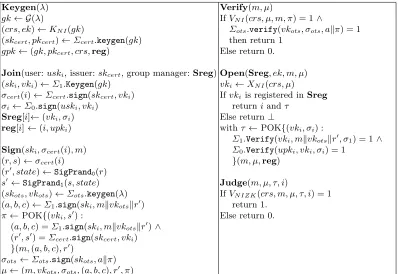
It is possible, using a tag-based encryption schemeΓ, to modify the first group signature scheme to construct a generic scheme. This modification increases the size of the group signature but the new scheme reaches the full anonymity. We now assume thatΣ1is an EUF-CMA secure digital signature scheme. The difference with the first scheme is that the signature produced by Σ1 is now encrypted, using Γ, under the tagvkots. The group manager owns the encryption secret key and is then able to decrypt the ciphertext and proceeds as in theOpenalgorithm of the first scheme.
We assume that any digital signatureσ, generated usingΣ1on an arbitrary messagemcan be efficiently transformed in a reversible way to a pair (s, r) wherer(rmay be the empty string) reveals no information about Σ1.vk, i.e. there exists an algorithm that inputs a key from the key space and outputs a string indistinguishable fromr. This technical detail will improve the efficiency of the construction as it will not necessitate encrypting the entire signatureσ.
The algorithms defining this new group signature are described in Figure 7.
6.2 Security proofs
Theorem 7. If Γ is an IND-st-wCCA secure tag-based encryption scheme, Σots is a strong one-time sig-nature scheme and (P, V) is a sound, zero-knowledge proof system, then the group signature scheme is fully anonymous.
Theorem 8. If Σcert is a EUF-CMA secure signature scheme and (P, V) is a sound zero-knowledge proof system, then the group signature is fully traceable.
Theorem 9. IfΣ0andΣ1are EUF-CMA secure signature schemes,Σotsis a strong one-time signature and (P, V) is a sound, zero-knowledge proof system, then the group signature scheme is strongly non-frameable.
The proofs are provided in appendix D.
6.3 A concrete realization
We instantiate the construction with the following bricks:
1. The tag-based encryption scheme described in Figure 10 with G=G1.
2. The signature scheme described in Figure 2 for Σ1 and the signature scheme described in Figure 3 for
Keygen(λ) Verify(m, µ)
gk← G(λ) IfVN I(crs, µ, m, π) = 1∧
crs←KN I(gk) Σots.verify(vkots, σots, Ckπ) = 1 (skcert, pkcert)←Σcert.keygen(gk) then return 1
(skM, pkM)←Γ.keygen(λ) Else return 0. gpk←(gk, pkcert, pkM, crs,reg)
Open(Sreg, skM, m, µ) Join(user:uski, issuer:skcert, group manager:Sreg) IfVerify(m, µ) = 0 (ski, vki)←Σ1.Keygen(gk) then return 0. σcert(i)←Σcert.comSign(skcert,Commit(ski), π) s←Γ.decryptsk
M(vkots, C)
σi←Σ0.sign(uski, vki) σ1←(r, s)
Sreg[i]←(vki, σi) forvki inSreg[i]:
reg[i]←(i, upki) ifΣ1.Verify(vki, mkvkotskσcert, σ1) = 1 returniand a proofτ.
Sign(ski, σcert(i), m) withτ ←POK{(vki, σi, σ1) :
σcert(i)←Σcert.sigRand(σcert(i)) Σ1.Verify(vki, mkvkotskσcert, σ1) = 1∧ (skots, vkots)←Σots.keygen(λ) Σ0.Verify(upki, vki, σi) = 1
σ1←Σ1.sign(ski, mkvkotskσcert(i)) }(m, µ,reg) (r, s)←σ1
C←Γ.encryptpk
M(vkots, s) Judge(m, µ, τ, i)
π←POK{(ski, s, l) : IfVN IZK(crs, m, µ, τ, i) = 1
σ1←(r, s) return 1.
σ1=Σ1.sign(ski, mkvkotskσcert(i))∧ Else return 0. σcert(i) =Σcert.sign(skcert,(l, ski))
}(m, r, C, σcert(i))
σots←Σots.sign(skots, Ckrkπ) µ←(m, vkots, σots, r, C, σcert(i), π)
Fig. 7.Group signature scheme 3
3. The structure-preserving signature scheme described in Fig. 9 for Σ0.
4. We use the weakly-secure Boneh-Boyen signature scheme descibed in Fig. 8 forΣots.
In a group signatureµ, (vkots, σots, r, C, σcert) involve 16 group elements andπ is a proof for the following equations (we use the notations of section 4 andC←(C1, C2, C3, C4)):
(C1, C2, C3) = (gk,(X1vkotsXe1)
k
,(Xvkots
2 Xe2)
k
) (1)
(e(a1,eg).e(b1,eg)
η)αi =e(C
4,eg).e(X
−1 1 ,eg)
k (2)
e(a1,eg)
βi =e(b
1,eg) (3)
e(c1,eg) =e(a, U).e(b, U)l.e(B1, U)αi .e(B2, U)βi (4)
where l is the randomness used by user i in the join stage to obtain signature on the committed valueαi andβi.
These equations involve 4 variables (αi, βi, l, k) and thus increase the size of the proof by 8 group elements. Equations (1), (2) and (3) prove that r and the value encrypted in C is a valid Camenisch-Lysyanskaya signature from userionη. Equation (1) comprises three sub-equations which cost 1 group element each (lin-ear equation). Equations (2) and (3) cost 1 group element each. Equation (5) proves that the certificate is a valid signature onαiandβiand costs 1 group element. The total size of the proof is then 14 group elements.
The size of the group signature is thus 30 group elements, which amounts to 1 kB if we consider an imple-mentation using 256-bit groups size, which is more compact that the realization in [19] where the total size of the group signature is 50 elements.
requires 2 + 16 = 18 pairings and equation (4), 25 pairings. The verification cost for these equations is then 81 pairings but theVerify algorithm requires 11 more pairings (to check the consistency of the certificate and the one-time signature). The total cost of theVerifyalgorithm is then 92 pairings.
References
1. Masayuki Abe, Georg Fuchsbauer, Jens Groth, Kristiyan Haralambiev, and Miyako Ohkubo. Structure-preserving signatures and commitments to group elements. In Tal Rabin, editor,CRYPTO, volume 6223 ofLecture Notes in Computer Science, pages 209–236. Springer, 2010.
2. Laila El Aimani and Marc Joye. Toward practical group encryption. Cryptology ePrint Archive, Report 2012/155, 2012.
3. Giuseppe Ateniese, Jan Camenisch, Susan Hohenberger, and Breno de Medeiros. Practical group signatures without random oracles. IACR Cryptology ePrint Archive, 2005:385, 2005.
4. Mihir Bellare, Alexandra Boldyreva, and Adriana Palacio. An uninstantiable random-oracle-model scheme for a hybrid-encryption problem. In Christian Cachin and Jan Camenisch, editors,EUROCRYPT, volume 3027 of Lecture Notes in Computer Science, pages 171–188. Springer, 2004.
5. Mihir Bellare, Daniele Micciancio, and Bogdan Warinschi. Foundations of group signatures: Formal definitions, simplified requirements, and a construction based on general assumptions. In Eli Biham, editor,EUROCRYPT, volume 2656 ofLecture Notes in Computer Science, pages 614–629. Springer, 2003.
6. Mihir Bellare, Haixia Shi, and Chong Zhang. Foundations of group signatures: The case of dynamic groups. In Alfred Menezes, editor,CT-RSA, volume 3376 ofLecture Notes in Computer Science, pages 136–153. Springer, 2005.
7. Patrik Bichsel, Jan Camenisch, Gregory Neven, Nigel P. Smart, and Bogdan Warinschi. Get shorty via group signatures without encryption. In Juan A. Garay and Roberto De Prisco, editors,SCN, volume 6280 ofLecture Notes in Computer Science, pages 381–398. Springer, 2010.
8. Olivier Blazy, Georg Fuchsbauer, Malika Izabach`ene, Amandine Jambert, Herv´e Sibert, and Damien Vergnaud. Batch groth-sahai. In Jianying Zhou and Moti Yung, editors,ACNS, volume 6123 ofLecture Notes in Computer Science, pages 218–235, 2010.
9. Dan Boneh and Xavier Boyen. Short signatures without random oracles and the sdh assumption in bilinear groups. J. Cryptology, 21(2):149–177, 2008.
10. Dan Boneh and Hovav Shacham. Group signatures with verifier-local revocation. In Vijayalakshmi Atluri, Birgit Pfitzmann, and Patrick Drew McDaniel, editors,ACM Conference on Computer and Communications Security, pages 168–177. ACM, 2004.
11. Xavier Boyen and Brent Waters. Compact group signatures without random oracles. In Serge Vaudenay, editor, EUROCRYPT, volume 4004 of Lecture Notes in Computer Science, pages 427–444. Springer, 2006.
12. Xavier Boyen and Brent Waters. Full-domain subgroup hiding and constant-size group signatures. In Tatsuaki Okamoto and Xiaoyun Wang, editors, Public Key Cryptography, volume 4450 of Lecture Notes in Computer Science, pages 1–15. Springer, 2007.
13. Jan Camenisch and Anna Lysyanskaya. Signature schemes and anonymous credentials from bilinear maps. In Matthew K. Franklin, editor, CRYPTO, volume 3152 of Lecture Notes in Computer Science, pages 56–72. Springer, 2004.
14. Ran Canetti, Oded Goldreich, and Shai Halevi. The random oracle methodology, revisited (preliminary version). In Jeffrey Scott Vitter, editor,STOC, pages 209–218. ACM, 1998.
15. David Cash, Eike Kiltz, and Victor Shoup. The twin diffie-hellman problem and applications. In Smart [23], pages 127–145.
16. David Chaum. Some weaknesses of ”weaknesses of undeniable signatures”. In Donald W. Davies, editor, EURO-CRYPT, volume 547 ofLecture Notes in Computer Science, pages 554–556. Springer, 1991.
17. C´ecile Delerabl´ee and David Pointcheval. Dynamic fully anonymous short group signatures. In Phong Q. Nguyen, editor,VIETCRYPT, volume 4341 ofLecture Notes in Computer Science, pages 193–210. Springer, 2006. 18. Shafi Goldwasser, Silvio Micali, and Ronald L. Rivest. A digital signature scheme secure against adaptive
chosen-message attacks. SIAM J. Comput., 17(2):281–308, 1988.
19. Jens Groth. Fully anonymous group signatures without random oracles. In Kaoru Kurosawa, editor,ASIACRYPT, volume 4833 ofLecture Notes in Computer Science, pages 164–180. Springer, 2007.
20. Jens Groth and Amit Sahai. Efficient non-interactive proof systems for bilinear groups. In Smart [23], pages 415–432.
22. Victor Shoup and Rosario Gennaro. Securing threshold cryptosystems against chosen ciphertext attack. J. Cryptology, 15(2):75–96, 2002.
23. Nigel P. Smart, editor. Advances in Cryptology - EUROCRYPT 2008, 27th Annual International Conference on the Theory and Applications of Cryptographic Techniques, Istanbul, Turkey, April 13-17, 2008. Proceedings, volume 4965 ofLecture Notes in Computer Science. Springer, 2008.
A
Building Blocks
A.1 Digital signature schemes
A digital signature schemeΣ comprises three algorithms, namely the key generation algorithmkeygen, the signing algorithmsign, and the verification algorithmverify. The standard security notion for a signature scheme is existential unforgeability under chosen message attacks (EUF-CMA), which was introduced in [18]. Informally, this notion refers to the hardness of, given a signing oracle, producing a valid pair of message and corresponding signature such that message has not been queried to the signing oracle. There exists also a stronger notion, SEUF-CMA (strong existential unforgeability under chosen message attack), which allows the adversary to produce a forgery on a previously queried message, however the corresponding signature must not be obtained from the signing oracle.
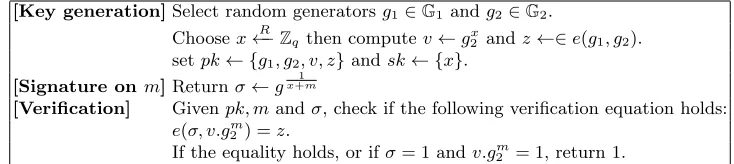
A.2 Boneh-Boyen’s weakly secure signature scheme
We recall in Fig. 8 the Boneh-Boyen’s weakly secure signature scheme [9], proven secure under the q-SDH (Strong Diffie-Hellman) assumption:
The q-SDH assumption: LetG1andG2be two cyclic groups of prime orderq, respectively generated by
g1 andg2. Theq-SDH problem is stated as follows:
Given as input a (q+ 3)-tuple of elements (g1, g1x, gx 2 1 , ..., gx
q
1 , g2, gx2)∈G q+1 1 ×G22, output a pair (c, g
1
x+c
1 )∈Zq×G1for a freely chosen value c∈Zq\ {−x}.
We say that the (q, )-SDH assumption holds in (G1,G2) if no polynomial-time algorithm solves theq-SDH problem with probability greater than.
[Key generation]Select random generatorsg1∈G1 andg2∈G2.
Choose x←R−Zq then computev←gx2 andz←∈e(g1, g2). setpk← {g1, g2, v, z}andsk← {x}.
[Signature onm]Return σ←gx+1m
[Verification] Given pk, mandσ, check if the following verification equation holds: e(σ, v.gm2 ) =z.
If the equality holds, or ifσ= 1 andv.g2m= 1, return 1.
Fig. 8.Boneh-Boyen weakly secure signature scheme
A.3 Structure preserving signature
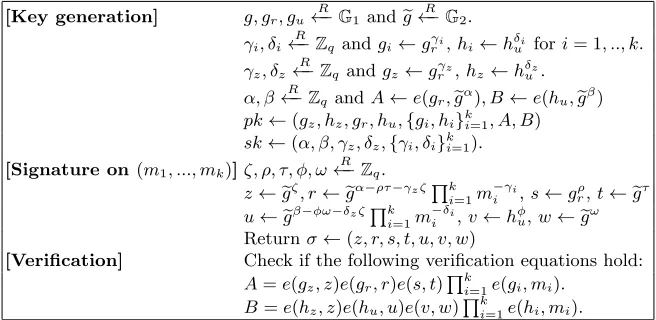
We recall in Fig. 9 the digital signature scheme proposed by Abe et al [1], allowing to sign messages ofn
group elements. The scheme was proved EUF-CMA secure under theq-SFP (Simultaneous Flexible Pairing) assumption:
The q-SFP assumption:Let gz, hz, gr and hu be random generators of G1. Let (a,ea),(b,eb) be random
e(a,ea) =e(gz, z)e(gr, r)e(s, t) ande(b,eb) =e(hz, z)e(hu, u)e(v, w)
Given gz, hz, gr, hu,(a,ae),(b,eb) and R1, ..., Rq it is hard to find (z
∗, r∗, s∗, t∗, u∗, v∗, w∗) that fulfill the
previous relations under the restriction thatz∗6= 1 andz∗6=z∈Rj for 1≤j ≤q.
[Key generation] g, gr, gu←R−G1 andeg R
←−G2. γi, δi←R−Zqandgi←gγri,hi←h
δi
u fori= 1, .., k. γz, δz←R−Zq andgz←grγz,hz ←hδuz.
α, β←R−Zq andA←e(gr,ge α
), B←e(hu,eg β
) pk←(gz, hz, gr, hu,{gi, hi}k
i=1, A, B) sk←(α, β, γz, δz,{γi, δi}k
i=1). [Signature on(m1, ..., mk)]ζ, ρ, τ, φ, ω
R
←−Zq.
z←egζ, r← e
gα−ρτ−γzζQk i=1m
−γi i ,s←g
ρ r,t←eg
τ
u←egβ−φω−δzζQk i=1m
−δi
i ,v←h φ
u,w←egω Returnσ←(z, r, s, t, u, v, w)
[Verification] Check if the following verification equations hold: A=e(gz, z)e(gr, r)e(s, t)Qk
i=1e(gi, mi). B=e(hz, z)e(hu, u)e(v, w)Qk
i=1e(hi, mi).
Fig. 9.Structure preserving signature
A.4 Strong one-time signatures
Strong one-time digital signature schemes can be used to sign, at most, one message; otherwise, signatures can be forged. A new public key is required for each message that is signed. They are, similarly to normal digital signatures, defined by the key generation algorithm, the signing algorithm, and the verification algorithm. We say the one-time signature is strong, if the adversary can neither forge a signature on different message nor create a different signature on the message already signed.
A.5 Tag-based encryption (TBE)
Tag-based encryption, also referred to as encryption with labels, was first introduced in [22]. In these schemes, the encryption algorithm takes as input, in addition to the public keypk and the messagemintended to be encrypted, a tagtwhich specifies information related to the messagemand its encryption context. Similarly, the decryption algorithm takes additionally to the ciphertext and the private key the tag under which the ciphertext was created. Security notions are then defined as usual except that the adversary specifies to his challenger the tag to be used in the challenge ciphertext, and in case he (the adversary) is allowed to query oracles, then he cannot query them on the pair formed by the challenge ciphertext and the tag used to form it. There are also weakened security models for this type of encryption where the adversary specifies the challenge tag before getting the parameters of the scheme, and during the game, he (the adversary) is not allowed to query the allowed oracles w.r.t. the challenge tag; we talk in this case about selective tag security. We specify in the following the formal definition of IND-st-wCCA security for tag-based encryption:
Let Γ be a tag-based encryption scheme scheme. Let further Adenote a probabilistic polynomial time algorithm. We writeAdecrypt(sk,.) to denote that Ahas access to oracle
decrypt(sk, .). When a queryq is not allowed, we use the symbol¬:Adecrypt¬q(sk,.). We define the experimentExpIND−st−wCCA
A (λ) :
1. param ←setup(λ); 2. t← A(param);
4. (m0, m1)← Adecrypt
¬(−,t)(sk,.) (pk);
5. b←R− {0,1};eb←Γ.encryptpk(mb, t);
6. b?← Adecrypt¬(−,t)(sk,.)(e b); 7. Ifb=b? return 1 else 0.
We defineA’s advantage asAdvind-st-wCCAΓ,A (λ) =
Pr
h
Expind-st-wCCAΓ,A (λ) = 1i−1 2
.
Given (t, qd)∈N2and ε∈[0,1],Ais called a (t, ε, qd)-ind-st-wCCA adversary againstΓ if, running in time
tand issuing qd decryption queries,AhasAdvΓ,indA−st−wCCA(λ)≥ε. The schemeΓ is said to be (t, ε, qd)-
ind-st-wCCAsecure if no (t, ε, qd)-ind-st-wCCAadversary against it exists.
The Twin Diffie-Hellman problemwas introduced in [15] as a slight modification to the original Diffie-Hellman (DH) problem which is as hard as the ordinary DH problem,even given access to a corresponding decision oracle. It is defined as follows.
Let G be a prime-order cyclic group generated by some g. Let dh further denotes the Diffie-Hellman function (it inputs (X, Y)∈ G2and returnsZ such that (g, X, Y, Z) is Diffie-Hellman quadruple). TheTwin DH function is defined as follows:
2dh : G
3→ G2
(X1, X2, Y)→(dh(X1, Y),dh(X2, Y))
Cash et al.define further a correspondingtwin DH predicate:
2dhp(X1, X2,Y ,ˆ Zˆ1,Zˆ2) := 2dh(X1, X2,Yˆ) ?
= ( ˆZ1,Zˆ2).
Finally the Strong Twin Diffie-Hellman assumption states that distinguishing the two distributions (X1, X2, Y,dh(X1, Y)) and (X1, X2, Y, Z) for randomX1, X2, Y, Z∈ Gis hard even in the presence of a deci-sion oracle for the predicate 2dhp(X1, X2,−,−,−) which on input ( ˆY ,Zˆ1,Zˆ2)) returns 2dhp(X1, X2,Y ,ˆ Zˆ1,Zˆ2).
Theorem 10. The DDH assumption holds if and only if the Strong Twin DDH assumptions holds. Proof. The proof is given in [15].
[Setup] Choose a group (G,·) generated bygwith prime orderd.
[Key generation]Choose x1,ex1, x2,xe2 R
←−Zdthen computeXi←gxi andXie ←gxei fori= 1,2
setpk ← {Xi,Xie}i=1,2 andsk← {xi,xie}i=1,2. [Encryption] For a messagem∈Gand a tagt∈Zd:
chooser←R−Zd,
compute c1←gr,c2←(X1tXe1)r,c3 ←(X2tXe2)r, andc4=mX1r, set the ciphertext to (c1, c2, c3, c4).
[Decryption] Given a ciphertextc= (c1, c2, c3, c4) and a tagt: check thatc2=ctx1+xe1
1 and thatc3=ctx2+ex2
1 if it is not the case, return⊥, otherwise: compute the plaintext asm←c4c
−x1 1 .
Fig. 10.TBE variant of the Modified Cramer-Shoup [15]
Theorem 11. The encryption scheme in Figure 10 is IND-st-wCCA secure under the Strong Twin Diffie-Hellman assumption.
A.6 Non-interactive proofs of knowledge
LetR be an efficiently computable ternary relation. Given some gk we let L be the language consisting of statementsxthat have a witnesswso (gk, x, w)∈R.
As in [20], such a system is modeled by four probabilistic polynomial time algorithms: a setup algorithm
GN I, a common reference string (crs) generation algorithmKN I, a proverPN I and a verifierVN I. The setup outputs a setup (gk, ek) (ek, the trapdoor, may be the empty string) that KN I takes as input to produce the common reference stringcrs. The proverPN I takes as input (gk, crs, x, w) and produces a proofπ. The verifier takes as inputs (gk, crs, x, π) and outputs 1 if the proof is valid and 0 if rejecting the proof.
In the following, we use the notationP OK{(w) : (gk, x, w)∈R}(gk, crs, x) forPN I(gk, crs, x, w).
A non-interactive proof should satisfy completeness which denotes that an honest prover is able to con-vince an honest verifier whenever the statement belongs to the language and the prover holds a witness testifying to this fact. A further required property is soundness which captures the inability of a cheating proverP to convince the verifier V with an invalid statement.
Informally, a zero-knowledge proof is a proof that shows the statement is true without revealing anything else. This is defined by having a simulator (S1, S2) whose first part, S1, outputs a simulated crs and a simulation trapdoortand whose second part,S2, simulates, usingt, proofs for statements without knowing the corresponding witnesses. Real proofs on a real crs have to be computationally indistinguishable from simulated proofs on a simulatedcrs.
The Groth-Sahai (GS) proof system [20] gives efficient interactive zero knowledge (NIZK) and non-interactive witness-indistinguishable (NIWI) proofs for algebraic statements involving elements in groups equipped with a bilinear mape:G1×G2←GT (we assume that ), e.g.
A pairing-product equation over variablesX1, . . . , Xm∈G1andY1, . . . , Yn∈G2
n
Y
i=1
e(Ai, Yi)· m
Y
i=1
e(Xi, Bi)· m Y i=1 n Y j=1
e(Xi, Yi)γi,j =tT,
for constantsA1, . . . , An∈G1,B1, . . . , Bm)∈G1, andΓ = (γi,j)1≤i≤m
1≤j≤n
∈Zmd×n, andtT ∈GT.
A multi-scalar multiplication over variablesy1, . . . , ym∈Zd andX1, . . . , Xm∈G1
n
Y
i=1
Ayi
i · m
Y
i=1
Xbi
i · m Y i=1 n Y j=1
Xyiγi,j
j =T,
for constantsA1, . . . , An ∈G1, b1, . . . , bm∈Zd, Γ ∈Zmd×n, andT ∈G1. A multi-scalar multiplication equation over variables in G2 is defined analogously.
A quadratic equation over variablesx1, . . . , xm andy1, . . . , yn in Zd
n
X
i=1
aiyi+ m
X
i=1
xibi+ m X i=1 n X j=1
γi,jxiyj=t,
For constantsa1, . . . , an andb1, . . . , bmin Zd, constant matrixΓ ∈Zmd×n, andt∈Zd.
The principle of the GS proof system consists in using the setup parameters and the common reference string (CRS) to commit to the witness components, then generate proof elements that these values committed to satisfy the equations underlying the statement to be proved. Note that proofs for pairing-product equations are only (WI) whentT ∈GT has no particular structure. They can be however transformed into ZK proofs (at the expense of an additional cost) iftT is equal to 1GT or its representation as a pairing product equation
is known.
The GS proof system could be instantiated under different (mild) assumptions, in particular the Λsxdh
G1 G2 Zd Variablesx∈Zd, X∈G1 2 0 0 Variablesy∈Zd, Y ∈G2 0 2 0 Pairing product equations 4 4 0 - Linear equations:Qn
i=1e(Ai, Yi) =tT 2 0 0 - Linear equations:Qn
i=1e(Xi, Bi) =tT 0 2 0 Multi-scalar multiplication equations inG1 2 4 0 - Linear equations:Qn
i=1A yi
i =T1 1 0 0 - Linear equations:Qn
i=1X bi
i =T1 0 0 2 Multi-scalar multiplication equations inG2 4 2 0 - Linear equations:Qn
i=1Y ai
i =T2 0 0 2 - Linear equations:Qn
i=1B xi
i =T2 0 1 0 Quadratic equations inZd 2 2 0 - Linear equations:Pn
i=1aiyi=t 0 0 1 - Linear equations:Pm
i=1xibi=t 0 0 1
Fig. 11.Cost of each variable and equation in terms of group elements fromG1,G2, andZd
Naive computation Batch computation Pairing product equations 5m+ 3n+ 16 m+ 2n+ 8 Multi-scalar multiplication equations inG1 8m+ 2n+ 14 min(2n+ 9,2m+n+ 7) Multi-scalar multiplication equations inG2 8n+ 2m+ 14 min(2m+ 9,2n+m+ 7)
Quadratic equations inZd 8m+ 8n+ 12 2 min(m, n) + 8
Fig. 12.Number of pairings per proof verification (mandnrefer to the number of different types of involved variables - see [8])
B
Security proofs of section 4
B.1 Proof of theorem 1
Proof. LetA be an adversary against the traceability with advantage, we construct Ra reduction using
Athat EUF-CMA breaks the underlying digital signature schemeΣcert.
[keygen] Rruns the Keygen algorithm as usual, except that she does not run Σcert.keygen and gets the issuer public keypkcert from her EUF-CMA challenger.
[openingqueries]Rproceeds as the standard algorithm.
[joining queries] When R receives a joining query, she uses her signing oracle to produce the user’s certificate. Then, she proceeds as the standard algorithm to simulate the interaction between the group manager and the new user.
[Final output] Areturns an untraceable group signature µ on a message m, which contains a certificate
σcert onsk, the secret key used to sign withΣ1, such thatsk6=ski for all registered useri (else, the group signature is traceable). Using the assumption that (P, V) is a sound proof system, A has to forge a new certificate onsk, andRwill run the extractor on the NIZK proofπto getskand returns the pair (sk, σcert) to her challenger.
REUF-CMA breaks the digital signature schemeΣcert with advantage.
B.2 Proof of theorem 2
Proof. Let Abe an adversary against the non-frameability with advantage , we construct Ra reduction usingAthat EUF-CMA breaks the underlying digital signature schemeΣ1.
[joiningqueries]Rhas to simulate the user part of the join protocol with the group manager (simulated byA). Ifj 6=i,Rgenerates a key pair (pkj, skj)←Σ1.keygenand proceeds as in the standard algorithm. Ifj =ithenRgets the verification key from her challenger and uses the simulated common reference string to produce the proofs of knowledge.
[signingqueries]Rproceeds as the standard algorithm ifj6=i, else, she uses her signing oracle to produce a signature and uses the simulated common reference string to produce the proofs of knowledge.
[Final output]Areturns a group signatureµ= (σots, vkots, σ1, σcert, π) on a messagemand an identityj. Ifj 6=i, then Raborts the experiment. Otherwise we proceed as follows We first assume thatσ1 is a valid signaturew.r.t vkib. We distinguish the following two cases:
1. OSignoracle was already requested on (i, m), returningµ∗. Then there are two possibilities:
– vkots orσcert are different from those inµ∗, which implies thatAsuccessfully forge a new signature
σ1. Then,Rforwards (mkvkotskσcert, σ1) to her challenger.
– σ1 or π are different from those inµ∗, thenσ1 orπ have been re-randomized andAhas to forge a new one-time signatureΣots. ThenAcan be turned in an attacker against the security ofΣots. 2. There were no oracle request on (i, m), thenσ1 is a forged signature onmkvkotskσcert.
If σ1 is not a valid signature w.r.t vkib then A has produced a signature σ1 on mkvkotskt and a
verifica-tion key vk such that Σ1.Verify(vk, mkvkotskt, σ1) = 1 and wants to prove in the Judge algorithm that
vk is the verification key for user i. Then he has to prove knowledge of a signature σ0,i on vk such that
Σ0.Verify(upki, vk, σ0,i) = 1. Because of the soundness of the proof, it means that the adversary has pro-duced a forgery onΣ0and then, can be turned in an attacker against the EUF-CMA security ofΣ0.
Let mbe the number of honest users, Ris able to break the EUF-CMA security ofΣ1 with advantage 1
m.A’s advantageis then negligible.
B.3 Proof of theorem 3
Proof. LetAbe an adversary against the anonymity with advantage, we constructRa reduction usingA
against the DDH problem inG1.
Rgets the DDH challenge (g, gx, gy, gz) from her challenger and has to decide whetherz=xyor random.
[keygen] Rruns K.keygenalgorithm as usual and generates a pair (αi, βi) , for each honest useri. In the experimentRwill act as ifski= (αi, yβi), then has to generate a certificate σcert(i) on it. Let (u, v, z1, z2) be the secret certificate key,Rproceeds as follows:
(a, A1, A2, b, B1, B2, c)←(gρ, gρz1, gρz2, gv, gρvz1, gρvz2, au+uvrAuvα1 i(g
y)ρz2uvβi)
which is a valid signature on (αi, yβi) (for random ρandr). [joiningqueries]Rproceeds as the standard algorithm.
[signingqueries] Receiving a request OSign(i, m) fromA,Rproceeds as follows: 1. (skots, vkots)←Σots.keygen
2. σ←Σcert.sigRand(σcert(i)) 3. η ←mkvkotskσ
4. (a, b, c)←(gρ,(gy)ρβi, aα
i(g
y)ραiβiη)
5. Rsimulates the proofπ. 6. σots←Σots.sign(skots, akπ) 7. µ←(vkots, σots,(a, b, c), σ, π)
for a randomρ. The produced signature (a, b, c) is valid andRrecords (i, m, µ) then returns it toA. [open queries]Rdistinguishes two cases:
– If the signature originates from a dishonest user, Rproceeds as the standard algorithm.
[Challenge]A sendsm, i0, i1 toRwho computes b← {0,1}. To produce a signature on behalf of userib,
Rproceeds as follows:
1. (skots, vkots)←Σots.keygen 2. σ←Σcert.sigRand(σcert(ib))
3. (a, b, c)←(gx,(gz)βib, aαib(gz)αibβibη) 4. Rsimulates the proofπ.
5. σots←Σots.sign(skots, akπ) 6. µ←(vkots, σots,(a, b, c), σ, π)
[Post challenge phase]Ranswers signing, joining and opening queries as previously. [Final output] Finally,Aoutputs a bitb0. Ifb=b0 Rreturns 1, else she returns 0.
If (g, gx, gy, gz) is a DDH tuple, the group signature is valid, else µis an element indistinguishable from a random element in the group signature space since z is random, the certificate is generated with the re-randomizable signature scheme Σcert and the proof is zero-knowledge. Let b∗ be the bit computed by the challenger, thenR’s advantage in breaking the DDH problem is:
Adv(R) =|Pr[b=b0|b∗= 1].Pr[b∗= 1] +Pr[b6=b0 |b∗= 0].Pr[b∗= 0]− 1 2|
=|1
4+
2 + 1 4 −
1 2|
= 2
C
Security proofs of section 5
C.1 Proof of theorem 4
Proof. LetA be an adversary against the traceability with advantage, we construct Ra reduction using
Athat EUF-CMA breaks the underlying digital signature schemeΣcert.
[keygen] Rruns the Keygen algorithm as usual, except that she does not run Σcert.keygen and gets the issuer public keypkcert from her EUF-CMA challenger.
[openingqueries]Rproceeds as the standard algorithm.
[joiningqueries] WhenRreceives a joining query, she uses his signing oracle to produce the user’s certifi-cate. Then, she proceeds as the standard algorithm to simulate the interaction between the group manager and the new user.
[Final output] A returns an untraceable group signature µ on a message m, which contains a proof of knowledge of a certificateσcert onvk, the verification key corresponding to the signature produced byΣ1, such that vk 6=vki for all registered user i (else, the group signature is traceable). Using the assumption that (P, V) is a sound proof system,Ahas to forge a new certificate onvk, andRwill run the extractor on the NIZK proofπto getvkandσcert and returns the pair (vk, σcert) to her challenger.
REUF-CMA breaks the digital signature schemeΣcert with advantage.
C.2 Proof of theorem 5
Proof. Let Abe an adversary against the non-frameability with advantage , we construct Ra reduction usingAthat EUF-CMA breaks the underlying digital signature schemeΣ1.
[keygen]Rruns theKeygenalgorithm as usual, except that she choosesi∈ HUand computes (upkj, uskj)←
Σ0.keygenforj ∈ HU.
signature toA.
[signingqueries]Rproceeds as the standard algorithm ifj6=i, else, she uses her signing oracle to produce the signature.
[Final output]A returns a group signatureµ= (σots, vkots, σ1, r, π) on a messagem and an identityj. If
j 6=i, then Raborts the experiment. Else we assume that σ1 is a valid signaturew.r.t vk (else, as in the previous scheme, it involves a forgery onΣ0). We distinguish the two following cases:
1. OSignoracle was already requested on (i, m), returningµ∗. Then there are two possibilities:
– vkots orrare different from those inµ∗, which implies thatAsuccessfully forge a new signatureσ1. Then,Rforwards (mkvkotskr, σ1) to her challenger.
– σ1 or πare different from the one inµ∗, thenσ1or πhas been re-randomized andAhas to forge a new one-time signatureΣots. ThenAcan be turned in an attacker against the security ofΣots. 2. There were no oracle request on (i, m), thenσ1 is a forged signature onmkvkotskr.
Let mbe the number of honest users, Ris able to break the EUF-CMA security ofΣ1 with advantage 1
m.A’s advantageis then negligible.
C.3 Proof of theorem 6
Proof. LetAbe an adversary against the anonymity with advantage, we constructRa reduction usingA
against the DDH problem.
Rgets the DDH challenge (g, gx, gy, gz) from her challenger and has to decide whetherz=xyor random.
[keygen]RrunsK.keygenalgorithm as usual, generates a pair (αi, βi) and computesri ←Simulate(skcert) for each honest useri. In the experimentRwill act as ifski= (αi, yβi).
[joiningqueries]Rproceeds as the standard algorithm.
[signingqueries] Receiving a request OSign(i, m) fromA,Rproceeds as follows:
1. (skots, vkots)←Σots.keygen 2. r←Simulate(skcert) 3. η ←mkvkotskr
4. (a, b, c)←(gρ,(gy)ρβi, aα
i(g
y)ραiβiη)
5. Rsimulates the proofπ. 6. σots←Σots.sign(skots, akπ) 7. µ←(vkots, σots,(a, b, c), r, π)
for a randomρ. The produced signature (a, b, c) is valid andRrecords (i, m, µ) then returns it toA. [open queries]Rdistinguishes two cases:
– If the signature originate from a dishonest user, Rproceeds as the standard algorithm.
– In case the signature was created on the behalf of an honest user then, because of the non-frameability property of our scheme, the signature is a previous output of the OSign oracle. Rlooks in her record and outputs the corresponding identityiwith a simulated proof π0.
[Challenge]A sendsm, i0, i1 toRwho computes b← {0,1}. To produce a signature on behalf of userib,
Rproceeds as follows:
1. (skots, vkots)←Σots.keygen 2. σ←Simulate(skcert) 3. η ←mkvkotskr
4. (a, b, c)←(gx,(gz)βi, aαi(gz)αiβiη)
then simulates the proofπ0.
[Post challenge phase]Ranswers signing, joining and opening queries as previously. [Final output] Finally,Aoutputs a bitb0. Ifb=b0 Rreturns 1, else she returns 0.
If (g, gx, gy, gz) is a DDH tuple, the group signature is valid, elseµis an element indistinguishable from a random element in the group signature space sincezis random andris information theoretically independent from σcert andm. Letb∗ be the bit computed by the challenger, thenR’s advantage in breaking the DDH problem is:
Adv(R) =|Pr[b=b0|b∗= 1].Pr[b∗= 1] +Pr[b6=b0 |b∗= 0].Pr[b∗= 0]− 1 2|
=|1
4+
2 + 1 4 −
1 2|
= 2
D
Security proofs of section 7
D.1 Proof of theorem 9
Proof. LetAbe an adversary against the anonymity with advantage, we constructRa reduction usingA
against the IND-st-wCCA security ofΓ.
[keygen] R gets the parameters ofΓ, computes (skots, vkots) ←Σots.keygen and sends t∗ ←vkots to his challenger. Then, she receives pk, the public key of Γ, and runsK.keygen algorithm as usual, except that she setspkM =pkand computes a simulated common reference string.
[{signing,joining} queries]Rproceeds as the standard algorithms.
[openingqueries]RrunsVerifyon the group signature. If it outputs 1, then she checks the tagtused for encryption. Ift6=t∗,Ruses her decryption oracle onC and then proceeds as the standardOpenalgorithm, else, she returns ⊥. This simulation differs if t∗=t, but this event appears for each query with probability
1
|T | (whereT is the tag space) becauseAdoes not knowt ∗.
[Challenge] A sends m, i0, i1 to R who computes b0 R
←− {0,1}, σcert ← Σcert.sigRand(σcert(ib0), σb ←
Σ1.sign(skib, mkt ∗kσ
cert) and (rb, sb) ← σb for b ∈ {0,1}. She sends s0 and s1 to her challenger who computesb∗ ←R− {0,1} and returnsC∗, an encryption ofsb∗ under the tagt∗. Rsets r←rb
0 and uses the simulated common reference string to produce the proofπ, then computesσots←Σots.sign(skots, C∗krkπ) and sendsµ←(m, t∗, σots, r, C∗, σcert, π) toA.
Recalling the properties ofΣcertandΣ1,σcertis computationally indistinguishable fromσcert(i0) orσcert(i1) (we denote by0 the probability thatAis able to distinguishσcert(i0) fromσcert(i1),0 is negligible under the DDH assumption) andris indistinguishable fromr0 orr1. Moreover, since the proof is zero-knowledge, the distribution of this challenge is the same as in the full anonymity experiment.
[Post challenge phase]R can answer signing, joining and opening (with a tag different fromt∗) queries as previously. If the tag ist∗ then she returns ⊥. Indeed, to produce a valid group signature with the tag
t∗ =vkots,Ahas to forge a new signatureσots because each modification on the challenge group signature involves a differentC∗ or a different proof π. SinceΣots is a strong one-time signature, this event appears with negligible probability.
[Final output] Finally,Aoutputs a bitb0 thatRforwards to her challenger.
R’s behavior is the same as the challenger in the full anonymity experiment, his advantage in breaking the IND-st-wCCA security ofΓ is then (1−0).
D.2 Proof of theorem 8
Proof. LetA be an adversary against the traceability with advantage, we construct Ra reduction using
[keygen] Rruns the Keygen algorithm as usual, except that she does not run Σcert.keygen and gets the issuer public keypkcert from her EUF-CMA challenger.
[openingqueries]Rproceeds as the standard algorithm.
[joiningqueries] WhenRreceives a joining query, she uses his signing oracle to produce the user’s certifi-cate. Then, she proceeds as the standard algorithm to simulate the interaction between the group manager and the new user.
[Final output] Areturns an untraceable group signature µ on a message m, which contains a certificate
σcert onsk, the secret key used to sign withΣ1, such thatsk6=ski for all registered useri (else, the group signature is traceable). Using the assumption that (P, V) is a sound proof system, A has to forge a new certificate, andR will run the extractor on the NIZK proofπto get skand returns the pair (sk, σcert) to her challenger.
REUF-CMA breaks the digital signature schemeΣcert with advantage.
D.3 Proof of theorem 9
Proof. Let Abe an adversary against the non-frameability with advantage , we construct Ra reduction usingAthat EUF-CMA breaks the underlying digital signature schemeΣ1.
[keygen] R runs the Keygen algorithm as usual, except that she computes a simulated common reference stringcrs.Rchoosesi∈ HU and computes (upkj, uskj)←Σ0.keygenforj ∈ HU.
[joiningqueries]Rhas to simulate the user part of the join protocol with the group manager (simulated byA). Ifj 6=i,Rgenerates a key pair (pkj, skj)←Σ1.keygenand proceeds as in the standard algorithm. Ifj =ithenRgets the verification key from her challenger and uses the simulated common reference string to produce the proofs of knowledge.
[signingqueries]Rproceeds as the standard algorithm ifj6=i, else, she uses her signing oracle to produce a signature and uses the simulated common reference string to produce the proofs of knowledge.
[Final output]Areturns a group signatureµon a messagemand an identityj. Ifj6=i, thenRaborts the experiment. Else we assume thatσ1 is a valid signaturew.r.t vk (else, as in the previous scheme, it involves a forgery onΣ0). We distinguish the two following cases:
1. OSignoracle was already requested on (i, m), returningµ∗. Then there are two possibilities:
– vkots orσcert are different from those inµ∗, which implies thatAsuccessfully forge a new signature
σ1. Then,Rforwards (mkvkotskσcert, σ1) to her challenger.
– C or π are different from those inµ∗, then C or π have been re-randomized and Ahas to forge a new one-time signatureΣots. ThenAcan be turned in an attacker against the security ofΣots. 2. There were no oracle request on (i, m), thenσ1 is a forged signature onmkvkotskσcert.
Letmbe the number of honest users,Ris able to break the EUF-CMA security ofΣ1 with advantage m1.

![Fig. 10. TBE variant of the Modified Cramer-Shoup [15]](https://thumb-us.123doks.com/thumbv2/123dok_us/7884073.1308153/16.612.106.503.477.614/fig-tbe-variant-modied-cramer-shoup.webp)

![3 [(Cyclohexylidene)amino] 1 (4 methylphenyl)thiourea](data:image/gif;base64,R0lGODlhAQABAIAAAP///wAAACH5BAEAAAAALAAAAAABAAEAAAICRAEAOw==)