Volume 2008, Article ID 735351,16pages doi:10.1155/2008/735351
Research Article
Sliding Window Generalized Kernel Affine Projection
Algorithm Using Projection Mappings
Konstantinos Slavakis1and Sergios Theodoridis2
1Department of Telecommunications Science and Technology, University of Peloponnese, Karaiskaki St., Tripoli 22100, Greece 2Department of Informatics and Telecommunications, University of Athens, Ilissia, Athens 15784, Greece
Correspondence should be addressed to Konstantinos Slavakis,[email protected]
Received 8 October 2007; Revised 25 January 2008; Accepted 17 March 2008
Recommended by Theodoros Evgeniou
Very recently, a solution to the kernel-based online classification problem has been given by the adaptive projected subgradient method (APSM). The developed algorithm can be considered as a generalization of a kernel affine projection algorithm (APA) and the kernel normalized least mean squares (NLMS). Furthermore, sparsification of the resulting kernel series expansion was achieved by imposing a closed ball (convex set) constraint on the norm of the classifiers. This paper presents another sparsification method for the APSM approach to the online classification task by generating a sequence of linear subspaces in a reproducing kernel Hilbert space (RKHS). To cope with the inherent memory limitations of online systems and to embed tracking capabilities to the design, an upper bound on the dimension of the linear subspaces is imposed. The underlying principle of the design is the notion of projection mappings. Classification is performed by metric projection mappings, sparsification is achieved by orthogonal projections, while the online system’s memory requirements and tracking are attained by oblique projections. The resulting sparsification scheme shows strong similarities with the classical sliding window adaptive schemes. The proposed design is validated by the adaptive equalization problem of a nonlinear communication channel, and is compared with classical and recent stochastic gradient descent techniques, as well as with the APSM’s solution where sparsification is performed by a closed ball constraint on the norm of the classifiers.
Copyright © 2008 K. Slavakis and S. Theodoridis. This is an open access article distributed under the Creative Commons Attribution License, which permits unrestricted use, distribution, and reproduction in any medium, provided the original work is properly cited.
1. INTRODUCTION
Kernel methods play a central role in modern classification and nonlinear regression tasks and they can be viewed as the nonlinear counterparts of linear supervised and unsupervised learning algorithms [1–3]. They are used in a wide variety of applications from pattern analysis [1–3], equalization or identification in communication systems [4,5], to time series analysis and probability density estima-tion [6–8].
A positive-definite kernel function defines a high- or even infinite-dimensionalreproducing kernel Hilbert space (RKHS) H, widely calledfeature space[1–3,9,10]. It also gives a way to mapdata, collected from the Euclideandata space, to the feature spaceH. In such a way, processing is transfered to the high-dimensional feature space, and the classification task in H is expected to be linearly separable according to Cover’s theorem [1]. The inner product inH is given by a simple
evaluation of the kernel function on the data space, while the explicit knowledge of the feature spaceHis unnecessary. This is well known as thekernel trick[1–3].
We will focus on the two-class classification task, where the goal is to classify an unknown feature vector x to one of the two classes, based on the classifier value f(x). The online setting will be considered here, where data arrive sequentially. If these data are represented by the sequence (xn)n≥0⊂Rm, wheremis a positive integer, then the objective
of online kernel methods is to form an estimate of f inH
given by a kernel series expansion:
f :=
∞
n=0 γnκ
xn,·∈H, (1)
whereκstands for the kernel function, (xn)n≥0parameterizes
the kernel function, (γn)n≥0 ⊂R, and we assume, of course,
A convex analytic viewpoint of the online classification
task in an RKHS was given in [11]. The standard
classi-fication problem was viewed as the problem of finding a point in a closed half-space (a special closed convex set) of H. Since data arrive sequentially in an online setting, online classification was considered as the task of finding a point in the nonempty intersection of an infinite sequence of closed half-spaces. A solution to such a problem was given by the recently developedadaptive projected subgradient
method (APSM), a convex analytic tool for the convexly
constrained asymptotic minimization of an infinite sequence of nonsmooth, nonnegative convex, but not necessarily differentiable objectives in real Hilbert spaces [12–14]. It was discovered that many projection-based adaptive filtering [15] algorithms like the classical normalized least mean squares
(NLMS)[16,17], the more recently exploredaffine projection
algorithm (APA)[18,19], as well as more recently developed
algorithms [20–28] become special cases of the APSM [13,
14]. In the same fashion, the present algorithm can be viewed as a generalization of a kernel affine projection algorithm.
To form the functional representation in (1), the coeffi -cients (γn)n≥0must be kept in memory. Since the number of incoming data increases, the memory requirements as well as the necessary computations of the system increase linearly with time [29], leading to a conflict with the limitations and complexity issues as posed by any online setting [29,
30]. Recent research focuses on sparsification techniques, that is, on introducing criteria that lead to an approximate representation of (1) using a finite subset of (γn)n≥0. This is equivalent to identifying those kernel functions whose
removal is expected to have a negligible effect, in some
predefined sense, or, equivalently, building dictionaries out of the sequence (κ(xn,·))n≥0[31–36].
To introduce sparsification, the design in [30], apart from the sequence of closed half-spaces, imposes an additional constraint on the norm of the classifier. This leads to a sparsified representation of the expansion of the solution given in (1), with an effect similar to that of a forgetting factor which is used in recursive-least-squares- (RLS-) [15] type algorithms.
This paper follows a different path to the sparsification in the line with the rationale adopted in [36]. A sequence
of linear subspaces (Mn)n≥0 of H is formed, by using
the incoming data together with an approximate linear
dependency/independency criterion. To satisfy the memory
requirements of the online system, and in order to provide with tracking capabilities to our design, a bound on the dimension of the generating subspaces (Mn)n≥0 is imposed.
This upper bound turns out to be equivalent to the length of a memory buffer. Whenever the buffer becomes full and each time a new data enters the system, an old observation is discarded. Hence, an upper bound on dimension results into a sliding window effect. The underlying principle of the proposed design is the notion of projection mappings. Indeed, classification is performed bymetric projection map-pings, sparsification is conducted by orthogonal projections onto the generated linear subspaces (Mn)n≥0, and memory
limitations (which lead to enhanced tracking capabilities) are established by employingoblique projections. Note that
although the classification problem is considered here, the tools can readily be adopted for regression tasks, with different cost functions that can be either differentiable or nondifferentiable.
The paper is organized as follows. Mathematical pre-liminaries and elementary facts on projection mappings are given in Section 2. A short description of the convex analytic perspective introduced in [11,30] is presented in Sections3and4, respectively. A byproduct of this approach,
a kernel affine projection algorithm (APA), is introduced
in Section 4.2. The sparsification procedure based on the generation of a sequence of linear subspaces is given in
Section 5. To validate the design, the adaptive equalization problem of a nonlinear channel is chosen. We compare the present scheme with the classical kernel perceptron algorithm, its generalization, the NORMA method [29], as well as the APSM’s solution but with the norm constraint sparsification [30] in Section 7. InSection 8, we conclude our discussion, and several clarifications as well as a table of the main symbols, used in the paper, are gathered in the appendices.
2. MATHEMATICAL PRELIMINARIES
Henceforth, the set of all integers, nonnegative integers, positive integers, real and complex numbers will be denoted byZ, Z≥0,Z>0,RandC, respectively. Moreover, the symbol
card(J) will stand for the cardinality of a setJ, andj1,j2:=
{j1,j1+ 1,. . .,j2}, for any integersj1≤j2.
2.1. Reproducing kernel Hilbert space
We provide here with a few elementary facts about
reproduc-ing kernel Hilbert spaces (RKHS). The symbolH will stand
for an infinite-dimensional, in general, real Hilbert space [37,38] equipped with an inner product denoted by·,·. The induced norm inHwill be given by f := f,f1/2, for
all f ∈H. An example of a finite-dimensional real Hilbert
space is the well-known Euclidean spaceRm of dimension
m∈Z>0. In this space, the inner product is nothing but the
vector dot productx1,x2:=x1tx2, for allx1,x2∈Rm, where
the superscript (·)tstands for vector transposition.
Assume a real Hilbert space H which consists of
functions defined onRm, that is, f :Rm →R. The function
κ(·,·) :Rm×Rm→Ris called areproducing kernelofH if
(1) for every x ∈ Rm, the function κ(x,·) : Rm → R belongs toH,
(2) thereproducing propertyholds, that is,
f(x)=f,κ(x,·), ∀x∈Rm, ∀f ∈H. (2)
In this case, H is called areproducing kernel Hilbert space (RKHS)[2,3,9]. If such a functionκ(·,·) exists, it is unique [9]. A reproducing kernel is positive definite and symmetric in its arguments [9]. (A kernelκ is called positive definite if Nl,j=1ξlξjκ(xl,xj) ≥ 0, for allξl,ξj ∈ R, for allxl,xj ∈
Rm, and for anyN ∈ Z
>0 [9]. This property underlies the
positive definite function κ(·,·) : Rm ×Rm → R there
corresponds a unique RKHSH whose reproducing kernel
isκitself [9]. Such an RKHS is generated by taking first the space of all finite combinationsjγjκ(xj,·), whereγj ∈R,
xj ∈ Rm, and then completing this space by considering
also all its limit points [9]. Notice here that, by (2), the inner product ofH is realized by a simple evaluation of the kernel function, which is well known as thekernel trick[1,2]; κ(xi,·),κ(xj,·) =κ(xi,xj), for alli,j∈Z≥0.
There are numerous kernel functions and associated
RKHS H, which have extensively been used in pattern
analysis and nonlinear regression tasks [1–3]. Celebrated examples are (i) the linear kernelκ(x,y) :=xty, for allx,y∈
Rm(here the RKHSH is the data spaceRmitself), and (ii) the Gaussian or radial basis function (RBF) kernelκ(x,y) := exp(−((x−y)t(x−y))/2σ2), for allx,y∈Rm, whereσ >0 (here the associated RKHS is of infinite dimension [2,3]). For more examples and systematic ways of generating more involved kernel functions by using fundamental ones, the reader is referred to [2,3]. Hence, an RKHS offers a unifying framework for treating several types of nonlinearities in classification and regression tasks.
2.2. Closed convex sets, metric, orthogonal, and oblique projection mappings
A subsetC ofH will be called convex if for all f1,f2 ∈ C
the segment{λf1+ (1−λ)f2:λ∈[0, 1]}with endpointsf1
and f2lies inC. A functionΘ:H →R∪ {∞}will be called
convex if for all f1,f2 ∈ H and for all λ ∈ (0, 1) we have Θ(λ f1+ (1−λ)f2)≤λΘ(f1) + (1−λ)Θ(f2).
Given any point f ∈ H, we can quantify its distance
from a nonempty closed convex setCby themetric distance function d(·,C) : H → R : f → d(f,C) := inf{ f −
f : f ∈ C} [37, 38], where inf denotes the infimum.
The functiond(·,C) is nonnegative, continuous, and convex [37,38]. Note that any point f∈Cis of zero distance from
C, that is,d(f,C)=0, and that the set of all minimizers of
d(·,C) overHisCitself.
Given a point f ∈ H and a closed convex setC ⊂ H,
an efficient way to move from f to a point inC, that is, to a minimizer ofd(·,C), is by means of themetric projection
mapping PC ontoC, which is defined as the mapping that
takesf to theuniquelyexisting pointPC(f) ofCthat achieves the infimum value f −PC(f) = d(f,C) [37,38]. For a geometric interpretation refer toFigure 1. Clearly, if f ∈C
thenPC(f)=f.
A well-known example of a closed convex set is aclosed linear subspaceM[37,38] of a real Hilbert spaceH. The met-ric projection mappingPMis called noworthogonal projection since the following property holds:f −PM(f),f =0, for all f ∈M, for allf ∈H[37,38]. Given an f∈H, the shift of a closed linear subspaceMby f, that is,V := f+M:= {f+ f : f ∈M}, is called an(affine) linear variety[38].
Givena /=0 inH andξ ∈R, let aclosed half-spacebe the closed convex setΠ+ := {f∈H :a,f ≥ξ}, that is, Π+ is the set of all points that lie on the “positive” side of
0
M PM,M(f)
PM(f)
f0 PB[f0,δ](f)
B[f0,δ]
PC(f)
M
H
f
C
Figure1: An illustration of the metric projection mappingPConto
the closed convex subsetCofH, the projectionPB[f0,δ] onto the closed ballB[f0,δ], the orthogonal projectionPMonto the closed
linear subspaceM, and the oblique projectionPM,M onMalong
the closed linear subspaceM.
thehyperplaneΠ := {f ∈ H : a,f =ξ}, which defines
the boundary ofΠ+ [37]. The vectorais usually called the
normal vectorofΠ+. The metric projection operatorP
Π+can
easily be obtained by simple geometric arguments, and it is shown to have the closed-form expression [37,39]:
PΠ+(f)=f +
ξ− a,f+
a 2 a, ∀f ∈H, (3)
whereτ+:=max{0,τ}denotes the positive part of aτ∈R.
Given the center f0∈Hand the radiusδ >0, we define
theclosed ballB[f0,δ] := {f ∈ H : f0− f ≤ δ}[37].
The closed ballB[f0,δ] is clearly a closed convex set, and its
metric projection mapping is given by the simple formula: for all f ∈H,
PB[f0,δ](f)= ⎧ ⎪ ⎪ ⎨ ⎪ ⎪ ⎩
f, iff −f0≤δ,
f0+ δ
f −f0
f −f0
, iff −f0> δ,
(4)
which is the point of intersection of the sphere and the segment joining f and the center of the sphere in the case where f /∈B[f0,δ] (seeFigure 1).
Let, now, M and M be linear subspaces of a
finite-dimensional linear subspaceV ⊂ H. Then, letM+Mbe
defined as the subspaceM+M:= {h+h:h∈M,h∈M}.
If also M∩M = {0}, thenM +M is called the direct
sum ofM andMand is denoted by M⊕M [40,41]. In
the case where V = M⊕M, then every f ∈ V can be
expressed uniquely as a sum f = h+h, whereh ∈ M
and h ∈ M [40, 41]. Then, we define here a mapping
PM,M :V =M⊕M →Mwhich takes any f ∈V to that
3. CONVEX ANALYTIC VIEWPOINT OF KERNEL-BASED CLASSIFICATION
In pattern analysis [1,2],dataare usually given by a sequence of vectors (xn)n∈Z≥0 ⊂X⊂R
m, for somem∈Z
>0. We will
assume that each vector inXis drawn from two classes and is thus associated to a labelyn∈Y:= {±1},n∈Z≥0. As such,
a sequence of (training) pairsD:=((xn,yn))n∈Z≥0⊂X×Y
is formed.
To benefit from a larger than m or even
infinite-dimensional space, modern pattern analysis reformulates the classification problem in an RKHSH (implicitly defined by a predefined kernel functionκ), which is widely known as
the feature space [1–3]. A mapping φ : Rm → H which
takes (xn)n∈Z≥0 ⊂ R
m onto (φ(xn))
n∈Z≥0 ⊂ H is given by
the kernel function associated to the RKHS feature spaceH:
φ(x) :=κ(x,·)∈H, for allx∈Rm. Then, theclassification
problemis defined in the feature spaceHas selecting a point
f ∈Hand an offsetb∈Rsuch thaty(f(x) +b)≥ρ, for all (x,y)∈D, and for somemarginρ≥0 [1,2].
For convenience, we merge f ∈ H andb ∈ R into a
single vectoru := (f,b) ∈ H ×R, whereH ×Rstands for the product space [37,38] ofH andR. Henceforth, we
will call a point u ∈ H ×R a classifier, and H ×R the
space of all classifiers. The space H ×R of all classifiers can be endowed with an inner product as follows: for any
u1 := (f1,b1), u2 := (f2,b2) ∈H ×R, letu1,u2H×R := f1,f2H +b1b2. The spaceH ×Rof all classifiers becomes
then a Hilbert space. The notation·,·will be used for both ·,·H×Rand·,·H.
A standard penalty function to be minimized in classifi-cation problems is thesoft margin loss function[1,29] defined on the space of all classifiersH ×Ras follows: given a pair (x,y)∈Dand the margin parameterρ≥0,
lx,y,ρ(u) :H×R−→R: ( f,b)
u
−→ρ−yf(x) +b+
=ρ−ygf,b(x) +
,
(5)
where the functiongf,bis defined by
gf,b(x) := f(x) +b, ∀x∈Rm, ∀(f,b)∈H×R. (6)
If the classifieru:=(f,b) is such thatygf,b(x)< ρ, then this classifier fails to achieve the marginρat (x,y) and (5) scores a penalty. In such a case, we say that the classifier committed a margin error. Amisclassificationoccurs at (x,y) ifygf,b(x)< 0.
The studies in [11, 30] approached the classification task from a convex analytic perspective. By the definition of the classification problem, our goal is to look for classifiers (points inH ×R) that belong to the setΠ+
x,y,ρ := {(f,b)∈ H ×R : y(f(x) +b) ≥ ρ}. If we recall the reproducing property (2), a desirable classifier satisfies y(f,κ(x,·)+
b) ≥ ρ or f,yκ(x,·)H + yb ≥ ρ. Thus, for a given pair (x,y) and a margin ρ, by the definition of the inner
product·,·H×R, the set of alldesirableclassifiers (that do not commit a margin error at (x,y)) is
Π+
x,y,ρ=
u∈H×R:u,ax,y
H×R≥ρ
, (7)
where ax,y := (yκ(x,·),y) = y(κ(x,·), 1) ∈ H ×R. The vector (κ(x,·), 1)∈H×Ris an extended (to account for the constant factorb) vector that is completely specified by the pointx and the adopted kernel function. By (7), we notice thatΠ+
x,y,ρis a closed half-space ofH×R(seeSection 2.2). That is, all classifiers that do not commit a margin error at (x,y) belong in the closed half-space Π+
x,y,ρ specified by the chosen kernel function.
The following proposition builds the bridge between the standard loss functionlx,y,ρand the closed convex setΠ+x,y,ρ.
Proposition 1(see [11,30]). Given the parameters(x,y,ρ), the closed half-spaceΠ+
x,y,ρcoincides with the set of all minimiz-ers of the soft margin loss function, that is,arg min{lx,y,ρ(u) : u∈H×R} =Π+
x,y,ρ.
Starting from this viewpoint, the following section describes shortly a convex analytic tool [11,30] which tackles the online classification task, where a sequence of parameters (xn,yn,ρn)n∈Z≥0, and thus a sequence of closed half-spaces
(Π+
xn,yn,ρn)n∈Z≥0, is assumed.
4. THE ONLINE KERNEL-BASED CLASSIFICATION TASK AND THE ADAPTIVE PROJECTED SUBGRADIENT METHOD
At every time instantn∈Z≥0, a pair (xn,yn)∈D becomes
available. If we also assume a nonnegative margin parameter
ρn, then we can define the set of all classifiers that achieve this margin by the closed half-spaceΠ+
xn,yn,ρn := {u = (f,b) ∈
H×R:yn(f(xn) +b)≥ρn}. Clearly, in an online setting, we deal with a sequence of closed half-spaces (Π+
xn,yn,ρn)n∈Z≥0 ⊂
H ×R and since each one of them contains the set of all
desirable classifiers, our objective is to find a classifier that belongs to or satisfies most of these half-spaces or, more precisely, to find a classifier that belongs to all but a finite
number ofΠ+
xn,yn,ρns, that is, au∈ ∩n≥N0Π +
xn,yn,ρn ⊂H×R,
for someN0∈Z≥0. In other words, we look for a classifier in
the intersection of these half-spaces.
The studies in [11, 30] propose a solution to the
above problem by the recently developedadaptive projected
subgradient method (APSM)[12–14]. The APSM approaches
the above problem as an asymptotic minimization of a sequence ofnot necessarily differentiable nonnegative convex
functionsover a closed convex set in a real Hilbert space.
Instead of processing a single pair (xn,yn) at each n,
APSM offers the freedom to process concurrently a set
{(xj,yj)}j∈Jn, where the index setJn⊂0,nfor everyn∈Z,
and where j1,j2 := {j1,j1 + 1,. . .,j2} for every integers j1 ≤ j2. Intuitively, concurrent processing is expected to
To keep the discussion simple, we assume thatn ∈ Jn, for alln∈Z≥0. An example of such an index setJnis given in (13). In other words, (13) treats the case where at time instant n, the pairs {(xj,yj)}j∈n−q+1,n, for some q ∈ Z>0,
are considered. This is in line with the basic rationale of the celebrated affine projection algorithm (APA), which has extremely been used in adaptive filtering [15].
Each pair (xj,yj), and thus each index j, defines a half-space Π+
xj,yj,ρ(n)j
by (7). In order to point out explicitly
the dependence of such a half-space on the index set Jn,
we slightly modify the notation for Πxj,yj,ρ(n)
j and use Π
+
j,n
for any j ∈ Jn, and for any n ∈ Z≥0. The metric
projection mapping PΠ+
j,n is analytically given by (3). To
assign different importance to each one of the projections corresponding to Jn, we associate to each half-space, that is, to each j ∈ Jn, a weight ω(jn) such thatω
(n)
j ≥ 0, for
all j ∈ Jn, and j∈Jnω (n)
j = 1, for all n ∈ Z≥0. This
is in line with the adaptive filtering literature that tends to assign higher importance in the most recent samples. For the less familiar reader, we point out that if Jn := {n}, for all n ∈ Z≥0, the algorithm breaks down to the
NLMS. Regarding the APA, a discussion can be found below.
As it is also pointed out in [29,30], the major drawback of online kernel methods is the linear increase of complexity with time. To deal with this problem, it was proposed in [30] to further constrain the norm of the desirable classifiers by a closed ball. To be more precise, one constrains the desirable classifiers in [30] byK :=B[0,δ]×R ⊂H×R, for some predefinedδ > 0. As a result, one seeks for classifiers that belong to K ∩(j∈Jn,n≥N0Π
+
j,n), for ∃N0 ∈ Z≥0. By the
definition of the closed ballB[0,δ] inSection 2.2, we easily see that the addition ofKimposes a constraint on the norm of f in the vectoru = (f,b) by f ≤ δ. The associated metric projection mapping is analytically given by the simple computationPK(u)= (PB[0,δ](f),b), for allu := (f,b) ∈
H×R, wherePB[0,δ]is obtained by (4). It was observed that
constraining the norm results into a sequence of classifiers with a fading memory, where old data can be eliminated [30].
For the sake of completeness, we give a summary of the sparsified algorithm proposed in [30].
Algorithm 1(see [30]). For anyn∈Z≥0, consider the index
setJn ⊂ 0,n, such thatn ∈ Jn. An example ofJn can be found in (13). For any j ∈Jnand for anyn ∈Z≥0, let the
closed half-spaceΠ+
j,n:= {u=(f,b)∈H×R:yj(f(xj) +
b)≥ρ(jn)}, and the weightω( n)
j ≥0 such that
j∈Jnω (n)
j =1,
for alln∈Z≥0. For an arbitrary initial offsetb0∈R, consider
as an initial classifier the pointu0 :=(0,b0)∈ H×Rand
generate the following point (classifier) sequence inH×R
by
un+1:=PK
⎛ ⎝un+μn
⎛
⎝
j∈Jn ω(jn)PΠ+
j,n
un
−un
⎞ ⎠ ⎞
⎠, ∀n∈Z≥0,
(8a)
where theextrapolation coefficientμn∈[0, 2Mn] with
Mn:=
⎧ ⎪ ⎪ ⎪ ⎨ ⎪ ⎪ ⎪ ⎩
j∈Jnω (n)
j PΠ+ j,n
un
−un2
j∈J nω
(n)
j PΠ+ j,n
un
−un2
, ifun∈/
j∈Jn
Π+
j,n,
1, otherwise.
(8b)
Due to the convexity of · 2, the parameter M
n ≥ 1,
for all n ∈ Z≥0, so that μn can take values larger than or equal to 2. The parameters that can be preset by the designer are the concurrency index setJnandμn. The bigger
the cardinality of Jn, the more closed half-spaces to be
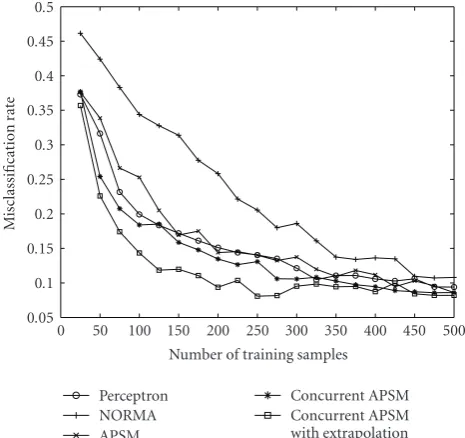
concurrently processed at the time instantn, which results into a potentially increased convergence speed. An example of Jn, which will be followed in the numerical examples, can be found in (13). In the same fashion, for extrapolation parameter valuesμn close to 2Mn (μn ≤ 2Mn), increased convergence speed can be also observed (seeFigure 6).
If we define
β(jn):=ω(jn)yj
ρ(jn)−yjgn
xj
+
1 +κxj,xj
, ∀j∈Jn, ∀n∈Z≥0,
(8c)
wheregn :=gfn,bn by (6), then the algorithmic process (8a)
can be written equivalently as follows:
fn+1,bn+1
=
⎛ ⎝PB[0,δ]
⎛ ⎝fn+μn
j∈Jn β(jn)κ
xj,·
⎞⎠
,bn+μn
j∈Jn β(jn)
⎞ ⎠,
∀n∈Z≥0.
(8d)
The parameterMntakes the following form after the proper algebraic manipulations:
Mn:=
⎧ ⎪ ⎪ ⎪ ⎪ ⎪ ⎪ ⎪ ⎨ ⎪ ⎪ ⎪ ⎪ ⎪ ⎪ ⎪ ⎩
j∈Jnω (n)
j
ρ(jn)−yjgn
xj
+2
/1+κxj,xj
i,j∈Jnβ (n)
i β(jn)
1 +κxi,xj
,
if un∈/
j∈Jn
Π+
j,n,
1, otherwise.
(8e)
As explained in [30], the introduction of the closed ball constraint B[0,δ] on the norm of the estimates (fn)n results into a potential elimination of the coefficients γn that correspond to time instants close to index 0 in (1), so that a buffer with lengthNb can be introduced to keep only the most recent Nb data (xl)nl=n−Nb+1. This introduces
sparsification to the design. Since the complexity of all the metric projections in Algorithm 1is linear, the overall complexity is linear on the number of the kernel function, or after inserting the buffer with lengthNb, it is of orderO(Nb).
4.1. Computation of the margin levels
For simplicity, all the concurrently processed margins are assumed to be equal to each other, that is,ρn:=ρ(jn), for all
j ∈Jn, for alln∈Z≥0. Of course, more elaborate schemes
can be adopted.
Whenever (ρn− yjgn(xj))+ = 0, the soft margin loss function lxj,yj,ρn in (5) attains a global minimum, which
means by Proposition 1 that un := (fn,bn) belongs to
Π+
j,n. In this case, we say that we havefeasibility for j ∈ Jn. Otherwise, that is, if un∈/Π+j,n,infeasibility occurs. To describe such situations, let us denote the feasibility cases by the index setJn := {j ∈ Jn : (ρn−yjgn(xj))+ = 0}. The infeasibility cases are obviouslyJn\Jn.
If we set card(∅) :=0, then we define thefeasibility rateas the quantityR(feasn) :=card(Jn)/card(Jn), for alln∈Z≥0. For
example,R(feasn) =1/2 denotes that the number of feasibility
cases is equal to the number of infeasibility ones at the time instantn∈Z≥0.
If, at time n, R(feasn) is larger than or equal to some predefinedR, we assume that this will also happen for the next time instantn+1, provided we work in a slowly changing environment. More than that, we expectR(feasn+1) ≥Rto hold for a marginρn+1slightly larger thanρn. Hence, at timen, if R(feasn) ≥R, we setρn+1 > ρnunder some rule to be discussed below. On the contrary, ifR(feasn) < R, then we assume that if
the margin parameter value is slightly decreased toρn+1< ρn,
it may be possible to have R(feasn+1) ≥ R. For example, if we set R := 1/2, this scheme aims at keeping the number of feasibility cases larger than or equal to those of infeasibilities, while at the same time it tries to push the margin parameter to larger values for better classification at the test phase.
In the design of [11, 30], the small variations of the parameters (ρn)n∈Z≥0are controlled by the linear parametric
modelνAPSM(θ−θ0) +ρ0,θ∈R, whereθ0,ρ0∈R,ρ0≥0,
are predefined parameters andνAPSM is a sufficiently small
positive slope (e.g., see Section 7). For example, in [30],
ρn:=(νAPSM(θn−θ0) +ρ0)+, whereθn+1 :=θn±δθ, for all
n, and where the±symbol refers to the dichotomy of either
R(feasn+1) ≥ Ror R (n+1)
feas < R. In this way, an increase ofθ by δθ > 0 will increaseρ, whereas a decrease ofθby−δθwill forceρto take smaller values. Of course, other models, other than this simple linear one, can also be adopted.
4.2. Kernel affine projection algorithm
Here we introduce a byproduct of Algorithm 1, namely, a
kernelized version of the standard affine projection algo-rithm [15,18,19].
Motivated by the discussion in Section 3, Algorithm 1
was devised in order to find at each time instantna point in the set of all desirable classifiersj∈JnΠ+j,n=/ ∅. Since any point in this intersection is suitable for the classification task at timen, any nonempty subset ofj∈JnΠ
+
j,ncan be used for the problem at hand. In what follows we see that if we limit the set of desirable classifiers and deal with the boundaries {Πj,n}j∈Jn, that is, hyperplanes (Section 2.2), of the closed
half-spaces{Π+
j,n}j∈Jn, we end up with a kernelized version
of the classical affine projection algorithm [18,19].
Π1,n
Π+1,n
Π+ 1,n∩Π+2,n
un+μn(2j=1ω(jn)PΠ+
j,n(un)−un)
PΠ+ 1,n(un)
Vn PVn(un) PΠ+ 2,n(un)
un
Π2,n
Π+ 2,n
Figure2: For simplicity, we assume that at some time instantn∈
Z≥0, the cardinality card(Jn)=2. This figure illustrates the closed
half-spaces{Π+
j,n}2j=1and their boundaries, that is, the hyperplanes
{Πj,n}2j=1. In the case where 2
j=1Πj,n=/ ∅, the defined in (11)
linear variety becomesVn= 2
j=1Πj,n, which is a subset of 2
j=1Π+j,n.
The kernel APA aims at finding a point in the linear varietyVn,
whileAlgorithm 1and the APSM consider the more general setting of finding a point in2j=1Π+j,n. Due to the range of the extrapolation
parameter μn ∈ [0, 2Mn] andMn ≥ 1, the APSM can rapidly
furnish solutions close to the large intersection of the closed half-spaces (see alsoFigure 6), without suffering from instabilities in the calculation of a Moore-Penrose pseudoinverse matrix necessary for finding the projectionPVn.
Definition 1 (kernel affine projection algorithm). Fixn ∈
Z≥0 and letqn := card(Jn). Define the set of hyperplanes {Πj,n}j∈Jnby
Πj,n:=
(f,b)∈H×R:(f,b),yjκ
xj,·
,yj
H×R=ρ( n)
j
=u∈H×R:u,aj,n
H×R=ρ(jn)
, ∀j∈Jn,
(9)
where aj,n := yj(κ(xj,·), 1), for all j ∈ Jn. These hyper-planes are the boundaries of the closed half-spaces{Π+
j,n}j∈Jn
(see Figure 2). Note that such hyperplane constraints as in (9) are often met in regression problems with the difference that there the coefficients{ρ(jn)}j∈Jnare part of the given data
and not parameters as in the present classification task. Since we will be looking for classifiers in the assumed nonempty intersection j∈JnΠj,n, we define the function en:H×R→Rqnby
en(u) :=
⎡ ⎢ ⎢ ⎢ ⎣
ρ(1n)−
a1,n,u
.. .
ρq(nn)−
aqn,n,u
⎤ ⎥ ⎥ ⎥
⎦, ∀u∈H×R, (10)
and let the set (seeFigure 2)
Vn:=arg min u∈H×R
qn
j=1 ##ρ(n)
j −
u,aj,n##
2
=arg min
u∈H×R
en(u)2
Rqn.
(11)
This set is a linear variety (for a proof see Appendix A). Clearly, ifj∈JnΠj,n=/ ∅, thenVn=
an arbitrary initialu0, thekernel affine projection algorithmis
defined by the following point sequence:
un+1:=un+μn
PVn
un
−un
=un+μn
a1,n,. . .,aqn,n
G†nen
un
, ∀n∈Z≥0,
(12)
where the extrapolation parameterμn∈[0, 2],Gnis a matrix of dimensionqn×qn, where its (i,j)th element is defined by
yiyj(κ(xi,xj) + 1), for alli,j∈1,qn, the symbol†stands for the (Moore-Penrose) pseudoinverse operator [40], and the notation (a1,n,. . .,aqn,n)λ:=
qn
j=1λjaj,n, for allλ∈Rqn. For
the proof of the equality in (12), refer toAppendix A.
Remark 1. The fact that the classical (linear kernel) APA
[18,19] can be seen as a projection algorithm onto a
sequence of linear varieties was also demonstrated in
[26, Appendix B]. The proof in Appendix A extends the
defining formula of the APA, and thus the proof given in [26, Appendix B], to infinite-dimensional Hilbert spaces. Extend-ing [26], the APSM [12–14] devised a convexly constrained asymptotic minimization framework which contains APA, the NLMS, as well as a variety of recently developed projection-based algorithms [20–25,27,28].
By Definition 1 and Appendix A, at each time instant
n, the kernel APA produces its estimate by projecting onto the linear variety Vn. In the special case where qn := 1, that is, Jn = {n}, for all n, then (12) gives the kernel NLMS [42]. Note also that in this case, the pseudoinverse is simplified to G†n = an/ an 2, for all n. Since Vn is a closed convex set, the kernel APA can be included in the wide frame of the APSM (see also the remarks just after Lemma 3.3 or Example 4.3 in [14]). Under the APSM frame, more directions become available for the kernel APA, not only in terms of theoretical properties, but also in devising variations and extensions of the kernel APA by considering more general convex constraints thanVnas in [26], and by incorporating a priori information about the model under study [14].
Note that in the case wherej∈JnΠj,n=/ ∅, thenVn =
j∈JnΠj,n. Since Πj,n is the boundary and thus a subset
of the closed half-space Π+
j,n, it is clear that looking for points inj∈JnΠj,n, in the kernel APA and not in the larger
j∈JnΠ +
j,n as inAlgorithm 1, limits our view of the online classification task (see Figure 2). Under mild conditions,
Algorithm 1 produces a point sequence that enjoys prop-erties like monotone approximation, strong convergence to a point in the intersection K ∩(j∈JnΠ
+
j,n), asymptotic optimality, as well as a characterization of the limit point.
To speed up convergence,Algorithm 1offers the extrapo-lation parameterμnwhich has a range ofμn∈[0, 2Mn] with Mn≥1. The calculation of the upper boundMnis given by simple operations that do not suffer by instabilities as in the computation of the (Moore-Penrose) pseudoinverses (G†n)n in (12) [40]. A usual practice for the efficient computation of the pseudoinverse matrix is to diagonally load some matrix with positive values prior inversion, leading thus to solutions
towards an approximation of the original problem at hand [15,40].
The above-introduced kernel APA is based on the fundamental notion of metric projection mapping on linear varieties in a Hilbert space, and it can thus be straightfor-wardly extended to regression problems. In the sequel, we will focus on the more general view offered to classification by Algorithm 1 and not pursue further the kernel APA approach.
5. SPARSIFICATION BY A SEQUENCE OF FINITE-DIMENSIONAL SUBSPACES
In this section, sparsification is achieved by the construction of a sequence of linear subspaces (Mn)n∈Z≥0, together with
their bases (Bn)n∈Z≥0, in the spaceH. The present approach
is in line with the rationale presented in [36], where a monotonically increasing sequence of subspaces (Mn)n∈Z≥0
was constructed, that is, Mn ⊆ Mn+1, for all n ∈ Z≥0.
Such a monotonic increase of the subspaces’ dimension undoubtedly raises memory resources issues. In this paper, such a monotonicity restriction is not followed.
To accomodate memory limitations and tracking
requirements, two parameters, namely Lb and α, will be
of central importance in our design. The parameter Lb
establishes a bound on the dimensions of (Mn)n∈Z≥0, that is,
if we defineLn:=dim(Mn), thenLn≤Lb, for alln ∈Z≥0.
Given a basisBn, a buffer is needed in order to keep track of the Lnbasis elements. The larger the dimension for the subspaceMn, the larger the buffer necessary for saving the
basis elements. Here, Lb gives the designer the freedom
to preset an upper bound for the dimensions (Ln)n, and
thus upper-bound the size of the buffer according to the
available computational resources. Note that this introduces
a tradeoff between memory savings and representation
accuracy; the larger the buffer, the more basis elements
to be used in the kernel expansion, and thus the larger the accuracy of the functional representation, or, in other words, the larger the span of the basis, which gives us more candidates for our classifier. We will see below that such a bound Lb results into a sliding window effect. Note also that if the data {xn}n∈Z≥0 are drawn from a compact set
in Rm, then the algorithmic procedure introduced in [36] produces a sequence of monotonically increasing subspaces with dimensions upper-bounded by some bound not known a priori.
The parameter α is a measure of approximate
lin-ear dependency or independency. Every time a new ele-ment κ(xn+1,·) becomes available, we compare its
dis-tance from the available finite-dimensional linear
sub-space Mn = span(Bn) with α, where span stands
for the linear span operation. If the distance is larger than α, then we say that κ(xn+1,·) is sufficiently linearly
independent of the basis elements ofBn, we decide that it carries enough “new information,” and we add this element to the basis, creating a new Bn+1 which clearly contains Bn. However, if the above distance is smaller than or equal to α, then we say that κ(xn+1,·) is approximately linearly
is not needed. In other words,αcontrols the frequency by which new elements enter the basis. Obviously, the larger the
α, the more “difficult” for a new element to contribute to the basis. Again, a tradeoffbetween the cardinality of the basis and the functional representation accuracy is introduced, as also seen above for the parameterLb.
To increase the speed of convergence of the proposed algorithm, concurrent processing is introduced by means of the index set Jn, which indicates which closed half-spaces will be processed at the time instantn. Note once again that such a processing is behind the increase of the convergence
speed met in APA [18,19] when compared to that of the
NLMS [16,17], in classical adaptive filtering [15]. Without any loss of generality, and in order to keep the discussion simple, we consider here the following simple case forJn:
Jn:=
$
0,n, if n < q−1,
n−q+ 1,n, if n≥q−1, ∀n∈Z≥0, (13)
whereq∈Z>0is a predefined constant denoting the number
of closed half-spaces to be processed at each time instantn≥
q−1. In other words, forn≥q−1, at each time instantn, we consider concurrent projections on the closed half-spaces
associated with theq most recent samples. We state now a
definition whose motivation is the geometrical framework of the oblique projection mapping given inFigure 1.
Definition 2. Givenn∈Z≥0, assume the finite-dimensional
linear subspaces Mn,Mn+1 ⊂ H with dimensions Ln and
Ln+1, respectively. Then it is well known that there exists a
linear subspaceWn, such thatMn+Mn+1=Wn⊕Mn+1, where
the symbol⊕stands for the direct sum [40,41]. Then, the following mapping is defined:
πn:Mn+Mn+1−→Mn+1
: f −→πn(f) :=
$
f, if Mn⊆Mn+1 PMn+1,Wn(f), if Mn⊆/ Mn+1,
(14)
wherePMn+1,Wn denotes the oblique projection mapping on Mn+1alongWn. To visualize this in the case whenMn⊆/ Mn+1,
refer toFigure 1, whereMbecomesMn+1, andMbecomes
Wn.
To exhibit the sparsification method, the constructive approach of mathematical induction onn∈Z≥0 is used as
follows.
5.1. Initialization
Let us begin, now, with the construction of the bases (Bn)n∈Z≥0and the linear subspaces (Mn)n∈Z≥0. At the starting
time 0, our basis B0 consists of only one vector ψ1(0) := κ(x0,·) ∈ H, that is,B0 := {ψ1(0)}. This basis defines the
linear subspaceM0:=span(B0). The characterization of the
elementκ(x0,·) by the basisB0is obvious here:κ(x0,·) =
1·ψ1(0). Hence, we can associate toκ(x0,·) the
one-dimen-sional vectorθ(0)x0 :=1, which completely describesκ(x0,·) by
the basisB0. Let alsoK0 :=κ(x0,x0)>0, which guarantees
the existence of the inverseK−1
0 =1/κ(x0,x0).
5.2. At the time instantn∈Z>0
We assume, now, that at time n ∈ Z>0 the basis Bn =
{ψ1(n),. . .,ψ (n)
Ln }is available, whereLn∈Z>0. Define also the
linear subspaceMn:=span(Bn), which is of dimensionLn. Without loss of generality, we assume thatn≥q−1, so that the index setJn:=n−q+ 1,nis available. Available are also the kernel functions {κ(xj,·)}j∈Jn. Our sparsification
method is built on the sequence of closed linear subspaces (Mn)n. At every time instantn, all the information needed for the realization of the sparsification method will be contained within Mn. As such, each κ(xj,·), for j ∈ Jn, must be
associated or approximated by a vector in Mn. Thus, we
associate to eachκ(xj,·), j∈Jn, a set of vectors{θ(n) xj }j∈Jn,
as follows
κxj,·−→k(n) xj :=
Ln
l=1
θ(xnj,)lψl(n)∈Mn, ∀j∈Jn. (15)
For example, at time 0, κ(x0,·) → kx(0)0 := ψ (0)
1 . Since we
follow the constructive approach of mathematical induction, the above set of vectors is assumed to be known.
Available is also the matrixKn ∈ RLn×Ln whose (i,j)th component is (Kn)i,j:= ψi(n),ψ(jn), for alli,j∈1,Ln. It can be readily verified thatKnis a Gram matrix which, by the assumption that {ψ(ln)}
Ln
l=1 are linearly independent, is also
positive definite [40,41]. Hence, the existence of its inverse
K−1
n is guaranteed. We assume here thatKn−1is also available.
5.3. At timen+ 1, the new dataxn+1becomes available
At time n + 1, a new element κ(xn+1,·) of H becomes
available. Since Mn is a closed linear subspace of H, the orthogonal projection ofκ(xn+1,·) ontoMn is well defined and given by
PMn
κxn+1,·
= Ln
l=1 ζx(nn+1,+1)lψ
(n)
l ∈Mn, (16)
where the vectorζ(xnn+1+1):=[ζ (n+1) xn+1,1,. . .,ζ(
n+1) xn+1,Ln]
t∈RLnsatisfies
the normal equationsKnζ(xnn+1+1) = c (n+1) xn+1 withc
(n+1)
xn+1 given by
[37,38]
c(xnn+1+1):= ⎡ ⎢ ⎢ ⎢ ⎣
κxn+1,·
,ψ1(n)
.. .
κxn+1,·
,ψL(nn)
⎤ ⎥ ⎥ ⎥
⎦∈RLn. (17)
SinceK−1
n was assumed available, we can computeζ( n+1) xn+1 by
ζ(n+1) xn+1 =K
−1
n c(xnn+1+1). (18)
Now, the distancedn+1ofκ(xn+1,·) fromMn(inFigure 1 this is the quantity f−PM(f) ) can be calculated as follows:
0≤d2
n+1:=κ
xn+1,·
−PMn
κxn+1,·2
=κxn+1,xn+1
−c(xnn+1+1) tζ(n+1)
xn+1 .
(19)
In order to derive (19), we used the fact that the linear oper-atorPMnis selfadjoint and the linearity of the inner product
·,·[37,38]. Let us define nowBn+1:= {ψl(n+1)} Ln+1
5.3.1. Approximate linear dependency(dn+1≤α)
If the metric distance ofκ(xn+1,·) fromMnsatisfiesdn+1≤α,
then we say thatκ(xn+1,·) isapproximately linearly dependent
on Bn := {ψl(n)} Ln
l=1, and that it is not necessary to insert κ(xn+1,·) into the new basisBn+1. That is, we keepBn+1 := Bn, which clearly implies thatLn+1:=Ln, andψl(n+1):=ψ
(n)
l , for alll∈1,Ln. Moreover,Mn+1 :=span(Bn+1)=Mn. Also,
we letKn+1:=Kn, andKn−+11 :=Kn−1.
Notice here thatJn+1 := n−q+ 2,n+ 1. The
approxi-mations given by (15) have to be transfered now to the new linear subspaceMn+1. To do so, we employ the mappingπn given inDefinition 2: for all j ∈ Jn+1 \ {n+ 1},kx(nj+1) := πn(k(xnj)). Since,Mn+1=Mn, then by (14),
k(xnj+1):=πn
kx(nj)
=kx(nj). (20)
As a result, θ(xnj+1) := θ (n)
xj , for all j ∈ Jn\ {n+ 1}. As
fork(xnn+1+1), we use (16) and let k (n+1)
xn+1 := PMn(κ(xn+1,·)). In
other words, κ(xn+1,·) is approximated by its orthogonal
projectionPMn(κ(xn+1,·)) ontoMn, and this information is
kept in memory by the coefficient vectorθ(xnn+1+1):=ζ(n+1) xn+1 .
5.3.2. Approximate linear independency(dn+1> α)
On the other hand, if dn+1 > α, then κ(xn+1,·) becomes
approximately linearly independent on Bn, and we add it
to our new basis. If we also have Ln ≤ Lb −1, then we
can increase the dimension of the basis without exceeding the memory of the buffer:Ln+1 := Ln+ 1 and Bn+1 := Bn∪{κ(xn+1,·)}, such that the elements{ψl(n+1)}
Ln+1
l=1 ofBn+1
become ψl(n+1) := ψl(n), for all l ∈ 1,Ln, and ψL(nn+1+1) := κ(xn+1,·). We also update the Gram matrix by
Kn+1:= ⎡
⎣ Kn c
(n+1) xn+1
c(xnn+1+1) t
κxn+1,xn+1
⎤ ⎦=:
⎡
⎣rn+1 htn+1 hn+1 Hn+1 ⎤ ⎦.
(21)
The factdn+1 > α ≥ 0 guarantees that the vectors inBn+1
are linearly independent. In this way the Gram matrixKn+1
is positive definite. It can be verified by simple algebraic manipulations that
K−1
n+1= ⎡ ⎢ ⎢ ⎢ ⎢ ⎢ ⎣
K−1
n +
ζ(n+1) xn+1
ζ(n+1)
xn+1 t
d2
n+1
−ζ
(n+1) xn+1 d2
n+1
−
ζ(n+1)
xn+1 t
d2n+1
1
d2n+1 ⎤ ⎥ ⎥ ⎥ ⎥ ⎥ ⎦=:
%
sn+1 ptn+1 pn+1 Pn+1 &
.
(22)
Since Bn Bn+1, we immediately obtain that Mn
Mn+1. All the information given by (15) has to be translated
now to the new linear subspaceMn+1by the mappingπnas we did above in (20):kx(nj+1) := πn(k
(n) xj ) = k
(n)
xj . Since the
cardinality of Bn+1 is larger than the cardinality of Bn by one, thenθ(xnj+1) = [(θ(xnj))t, 0]t, for all j ∈ Jn+1\ {n+ 1}.
The new vectorκ(xn+1,·), being a basis vector itself, satisfies
κ(xn+1,·)∈Mn+1, so thatkx(nn+1+1) :=κ(xn+1,·). Hence, it has
the following representation with respect to the new basis
Bn+1:θ(xnn+1+1):=[0
t, 1]t∈RLn+1.
5.3.3. Approximate linear independency(dn+1> α)
and buffer overflow(Ln+ 1> Lb); the sliding window effect
Now, assume that dn+1 > α and thatLn = Lb. According to the above methodology, we still need to addκ(xn+1,·) to
our new basis, but if we do so the cardinalityLn+ 1 of this
new basis will exceed our buffer’s memoryLb. We choose
here to discard the oldest element ψ1(n) in order to make
space forκ(xn+1,·): Bn+1 := (Bn\ {ψ1(n)})∪ {κ(xn+1,·)}.
This discard of ψ1(n) and the addition of κ(xn+1,·) results
in the sliding window effect. We stress here that instead of discardingψ1(n), other elements ofBncan be removed, if we use different criteria than the present ones. Here, we choose
ψ1(n) for simplicity, and for allowing the algorithm to focus
on recent system changes by making its dependence on the remote past diminishing as time moves on.
We define hereLn+1:=Lb, such that the elements ofBn+1
becomeψl(n+1):=ψ
(n)
l+1,l∈1,Lb−1, andψL(nb+1):=κ(xn+1,·).
In this way, the update for the Gram matrix becomesKn+1:= Hn+1by (21), where it can be verified that
K−1
n+1=Hn−+11 =Pn+1−
1
sn+1pn+1p
t
n+1, (23)
wherePn+1is defined by (22) (the proof of (23) is given in Appendix B).
Upon definingMn+1 :=span(Bn+1), it is easy to see that Mn⊆/Mn+1. By the definition of the oblique projection, of the
mappingπn, and bykx(nj) := Ln
l=1θ (n) xj,lψ
(n)
l , for allj ∈Jn+1\
{n+ 1}, we obtain
k(n+1) xj :=πn
k(n)
xj
= Ln
l=2 θ(xnj,)lψ
(n)
l + 0·κ
xn+1,·
= Ln+1
l=1
θx(nj,+1)l ψl(n+1), ∀j∈Jn+1\ {n+ 1},
(24)
whereθ(xnj,+1)l :=θ
(n)
xj,l+1, for alll∈1,Lb−1, andθ(xnj,+1)Lb :=0,
for all j ∈Jn+1\ {n+ 1}. Sinceκ(xn+1,·) ∈ Mn+1, we set kx(nn+1+1) := κ(xn+1,·) with the following representation with
respect to the new basisBn+1:θ(xnn+1+1) :=[0
t, 1]t ∈RLb. The
sparsification scheme can be found in pseudocode format in
Algorithm 2.
6. THE APSM WITH THE SUBSPACE-BASED
SPARSIFICATION
In this section, we embed the sparsification strategy of