Abstract
HEO, TAE-YOUNG. Spatial Modeling for Capturing the Effects of Point Sources. (Under the direction of Dr. Jacqueline M. Hughes-Oliver.)
The point source is the most common type of source to be modeled for its effect on air pollution. Point sources provide auxiliary information that may impact both the mean and covariance structure of measured responses, but these possible impacts are often overlooked by spatial modelers. In this dissertation, we investigate the impact of point sources on both the mean and covariance by incorporating subject-matter expertise to obtain large- and small-scale models of variability for two real applications. Inference proceeds according to the Bayesian hierarchical paradigm and is implemented using Markov chain Monte Carlo methods.
SPATIAL MODELING FOR CAPTURING THE EFFECTS
OF POINT SOURCES
by
TAE-YOUNG HEO
A dissertation submitted to the Graduate Faculty of North Carolina State University
in partial fulfillment of the requirements for the Degree of
Doctor of Philosophy
STATISTICS
Raleigh 2005
APPROVED BY:
Jacqueline M. Hughes-Oliver S. Pal Arya
Chair of Advisory Committee
Biography
Acknowledgements
I would like to express my deepest gratitude and biggest appreciation to my advisor Dr. Jacqueline M. Hughes-Oliver. It is difficult to overstate my gratitude to Dr. Hughes-Oliver for her enthusiasm, inspiration, and effort to explain things clearly and simply. Throughout my thesis writing period she provided encouragement, sound advice, good teaching and lots of good ideas.
I would also like to thank my committee, including Dr. Ghosh, Dr. Dickey and Dr. Arya. Without their support and active participation in every step of the process, this thesis may never have been completed.
I gratefully acknowledge all faculty members in the Department of Statistics of North Carolina State University and especially Dr. Pantula and Dr. Swallow. I also gratefully acknowledge all faculty members in the Department of Information Statistics of Chungbuk National University. I would also like to thank the rest of the academic and support staff of the Department of Statistics of North Carolina State University for making my stay pleasant. In particular, I am grateful to Terry for assistance in my computing problem.
I made many friends in Raleigh and I would like to thank them all for their friendship. Warm thanks are also due to my high school and college friends, brothers and sisters in Korea for their encouragement and words of support. I also would like to express my deepest thank and regret to my one of the best friends, Geehyun, who passed away two years ago and will never forget his smile.
Contents
List of Tables vii
List of Figures ix
1 Introduction to Point Source Modeling 1
2 An Autoregressive Point Source Model for Spatial Processes 4
2.1 Introduction . . . 6
2.2 Process Decomposition . . . 8
2.3 Autoregressive Point Source Modeling . . . 11
2.4 Restrictions On The Parameter Space . . . 15
2.5 Modeling Electromagnetism In a Field Containing a Metal Pole . . . . 17
2.5.1 Dataset and Candidate Models . . . 17
2.5.2 Model Comparison . . . 28
2.6 Concluding Remarks . . . 33
3 Modeling Plume Dispersion 42 3.1 Typical Inputs for Atmospheric Dispersion Model . . . 43
3.1.1 Atmospheric Stability and Turbulence . . . 43
3.1.2 Wind Speed and Direction . . . 44
3.1.3 Wind Rose and Pollution Rose . . . 48
3.2 Gaussian Plume Model . . . 49
3.2.1 Effective Stack Height . . . 51
3.2.2 Dispersion parameters σy and σz . . . 54
3.3 Non-Gaussian Plume Dispersion Models . . . 57
3.4 Appendix : Unit Conversions . . . 59
4 Statistical Adjustments to Air Dispersion Modeling for Determining the Effect of a Point Source 60 4.1 Introduction . . . 63
4.3 Atmospheric Dispersion Modeling: An Error-Component-Adjustment
Approach . . . 73
4.4 Modeling Concentrations During the Kincaid Field Experiments . . . 77
4.4.1 Kincaid Tracer Experiments . . . 77
4.4.2 Process Decomposition for Point Sources . . . 84
4.4.3 Preliminary Analysis . . . 85
4.4.4 Six Model Scenarios . . . 100
4.4.5 Bayesian Hierarchical Modeling . . . 102
4.5 Conclusions . . . 127
5 Clustered Double Conditional Autoregressive Model 141 5.1 A Brief Introduction . . . 141
5.2 Methods for Capturing Stochastic Pattern: CCAR and CDCAR . . . 142
5.2.1 Findings from CDCAR . . . 147
6 Suggestions for Future Research 151 6.1 Vector Autoregressive Point Source Model . . . 151
6.2 Space Time Autoregressive Point Source Model . . . 153
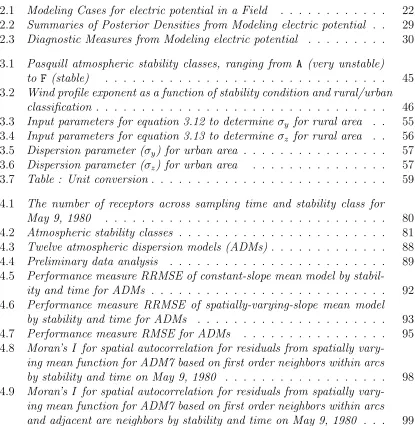
List of Tables
2.1 Modeling Cases for electric potential in a Field . . . 22
2.2 Summaries of Posterior Densities from Modeling electric potential . . 29
2.3 Diagnostic Measures from Modeling electric potential . . . 30
3.1 Pasquill atmospheric stability classes, ranging from A (very unstable) to F (stable) . . . 45
3.2 Wind profile exponent as a function of stability condition and rural/urban classification . . . 46
3.3 Input parameters for equation 3.12 to determine σy for rural area . . 55
3.4 Input parameters for equation 3.13 to determine σz for rural area . . 56
3.5 Dispersion parameter (σy) for urban area . . . 57
3.6 Dispersion parameter (σz) for urban area . . . 57
3.7 Table : Unit conversion. . . 59
4.1 The number of receptors across sampling time and stability class for May 9, 1980 . . . 80
4.2 Atmospheric stability classes . . . 81
4.3 Twelve atmospheric dispersion models (ADMs) . . . 88
4.4 Preliminary data analysis . . . 89
4.5 Performance measure RRMSE of constant-slope mean model by stabil-ity and time for ADMs . . . 92
4.6 Performance measure RRMSE of spatially-varying-slope mean model by stability and time for ADMs . . . 93
4.7 Performance measure RMSE for ADMs . . . 95
4.8 Moran’s I for spatial autocorrelation for residuals from spatially vary-ing mean function for ADM7 based on first order neighbors within arcs by stability and time on May 9, 1980 . . . 98
4.10 Summaries of Posterior Densities from Modeling Kincaid Dataset for 1:10-11 . . . 105 4.11 Summaries of Posterior Densities from Modeling Kincaid Dataset for
2:14-15 . . . 107 4.12 Summaries of Posterior Densities from Modeling Kincaid Dataset for
3:12-13 . . . 109 4.13 Summaries of Posterior Densities from Modeling Kincaid Dataset for
3:13-14 . . . 111 4.14 Summaries of Posterior Densities from Modeling Kincaid Dataset for
3:15-16 . . . 113 4.15 Summaries of Posterior Densities from Modeling Kincaid Dataset for
4:11-12 . . . 115 4.16 DIC values for each model obtained fromWinBUGS1.4.1 usingcar.proper
function based on posterior samples from modeling Kincaid dataset. ME indicates measurement error. . . . 119 4.17 Performance measure RRMSE of spatially varying ADM7 (without
er-ror components) and ECA-ADM Model 5 by stability and time combi-nations . . . 123 4.18 Moran’s I for spatial autocorrelation for residuals from ECA-ADM
List of Figures
2.1 Illustration of regions for the autoregressive point source process. . . . 12 2.2 Contours of electric potential measurements, g, in a field containing
a metal pole. The measurement sites (•) fall on a regular grid, with spacings of one meter in both directions. The metal pole is located at (12,33.4) in the original coordinate system, and at (0,0) in the trans-lated coordinate system. The contours represent the following sample percentiles: .7, 1, 2.5, 5, 10, 20, 30, 40, 50, 60, 70, 80, 90. . . 19 2.3 Electric potential (plotted as bullets) as a function of distance between
measurement sites and the metal pole. Locations of ARPS regions
R1, . . . , R10 and boxplots of transformed electric potential within these
regions are also shown. . . . 19 2.4 MCMC trace and posterior density plots for Model 6 using three chains. 24 2.5 MCMC results forψ of Model 6. Panel (a) is the autocorrelation
func-tion of ψ for each chain. Panel (b) is the posterior histogram of ψ for each chain. Panel (c) shows side-by-side boxplots of posterior values for ψ from each chain. . . . 25 2.6 Histogram of posterior simulations of σ2 from models with nine
differ-ent prior distributions: σc distributed as uniform(0,.1) (top row), σc2
distributed as inverse gamma(.001,.001) (middle row),σ2
c distributed as
inverse gamma(.01,.01) (bottom row), σ2 distributed as uniform(0,.1) (left column),σ2
2 distributed as inverse gamma(.001,.001) (middle col-umn), σ2
2 distributed as inverse gamma(.01,.01) (right column). Solid line denotes the prior distribution. . . . 26 2.7 Posterior densities of ψ obtained from nine different combinations of
priors for σ2
c (σc) andσ22 (σ2) in Model 6. Label (a) indicates all three densities corresponding to σ2 having a uniform(0,.1) prior, the most noninformative prior considered. Likewise, labels (b) and (c) indicate all three densities corresponding toσ2
2.8 Fitted variances from Models 3 (modified), 5, and 6. A modification is necessary for Model 3 because this fitted model is singular. For this model, we replaceρ= 1withρ= 0.99to obtain invertible matrices that yield variances. Panel (a) shows variances for all models, while panel (b) shows variances only for Model 5 and panel (c) shows variances only for modified Model 3. Observation sites numbers are used as plotting symbols in panels (b) and (c), where site 1 is in the bottom left corner of Figure 2.2 and site 160 is in the top right corner. . . . 32 2.9 Fitted correlations from Models 3 (modified), 5, and 6. A modification
is necessary for Model 3 because this fitted model is singular. For this model, we replace ρ = 1 with ρ = 0.99 to obtain an invertible matrix that yields correlations. Panels (a), (b), and (c) show correlations for Models 5, 3, and 6, respectively. All panels display correlations between all pairs of sites where both sites are either in ARPS Region R1 or R10. Panel (c) also displays correlations between all pairs of sites where both sites are in ARPS Region R2. . . . 34 3.1 Wind direction is direction from which the wind is blowing, measured
in degree. . . . 47 3.2 Downwind and crosswind distance. . . . 48 3.3 (a) Example of wind rose. (b) Example of pollution rose. . . . 49 3.4 Plume envelope, plume rise (4h), and effective stack height (H) for a
buoyant plume. Plume rise at 200 meters is shown as “1” and at 1000 meters it is shown as “2.” . . . 52 4.1 Plume envelope, plume rise (4h), and effective stack height (H) for a
buoyant plume. Plume rise at 200 meters is shown as “1” and at 1000 meters it is shown as “2.” . . . 69 4.2 Location of sampling sites for Kincaid experiment. Source is located at
(0,0). . . . 78 4.3 Location of sampling site by date. . . . 79 4.4 Crosswind pattern of observed and modeled concentrations on
05-09-80. Blue circle: modeled values from ADM using equation (4.5), red circle: observed concentrations. . . . 83 4.5 Location of sampling sites on 05-09-80 . . . 84 4.6 Scatter plot of maximum (centerline) observed concentrations versus
4.7 Scatter plot of observed concentrations versus modeled output from twelve atmospheric dispersion models using all data on May 09, 1980 for all receptors. Plot scales differ for ADM8. The simple OLS linear regression line and its R2 are also shown. . . . . 87 4.8 Scatter plot of observed concentrations versus modeled output for ADM7
by stability and time combinations. The simple OLS linear regression line and its R2 are also shown. . . . . 96 4.9 Scatter plot of observed concentration versus modeled output for ADM7
by stability:time for each arc. Rows indicate stability and time combi-nations, with values 1:10-11 (top), 4:11-12, 3:12-13, 3:13-14, 2:14-15, 3:15-16 (bottom). Columns indicate arc, with values 2km (left), 3km, 5km, 7km, 10km, 15km (right). X-axis denotes model output, Y-axis denotes concentration, relative to release rate (s/m3). . . . . 97 4.10 Posterior densities of MSPEi, i= 1,2, . . . ,6 by stability:time . . . . 118
4.11 Posterior densities of βi, i= 1,2, . . . ,6 by stability:time . . . 120 4.12 Posterior densities of σ2
vi, i= 1,2, . . . ,6 by stability:time . . . 121
4.13 Posterior densities of ρi, i= 1,2, . . . ,6 by stability:time . . . 122
4.14 Predicted SF6 concentrations. This figure show the mean of the poste-rior predictive distribution . . . 125 4.15 Standard error of the posterior predictive distribution for the SF6
con-centrations . . . 126 5.1 Graphical representation of clustered conditional autoregressive model
(CCAR); ρ denotes the spatial correlation parameter for between clus-tered regions effect. . . . 143 5.2 Graphical representation of clustered double conditional autoregressive
Chapter 1
Introduction to Point Source
Modeling
In the epidemiology literature, there has been much development of statistical methods for disease, much of it motivated by the investigation of putative disease clusters near nuclear installations; see Bithell and Stone (1989) and Cook-Mozzaffari
et al. (1989). However, their primary goal is to test whether or not clusters of disease cases in space and/or time are significant, after accounting for chance variation. In their nomenclature, a “focused” test is used to detect significant clustering around a point source exposure to a pollutant that is presumed to increase disease risk. Beyond relative location impact, there is no literature that quantifies how much a point source contributes to disease risk.
In point source modeling with environmental data application, the factors that affect the transport, dilution, and dispersion of air pollutants can be grouped into four categories: emission or source characteristics, the nature of the pollutant material, meteorological characteristics and, the effects of terrain and anthropogenic structures. In environmental science, point source is defined as
A stationary location or fixed facility from which pollutants are discharged or emitted. Any single identifiable source of pollution, such as a pipe or factory smokestack.
In environmental science, atmospheric dispersion models (ADMs) (e.g., ISCST, AERMOD, and HPDM) can be used to aid in demonstrating environmental compli-ance, analyzing process changes and evaluating the impacts of accidental releases and are used to estimate the downwind concentrations of pollutants emitted by various pollution sources such as industrial facilities and nuclear plants. However, almost all computer ADMs only provide deterministic predictions without measures of their uncertainties.
In this dissertation, we propose an error-components-adjusted ADM to evaluate effect of point source. We also suggest a process decomposition approach to model stochastic processes across spatial domains and consider the case where a point source impacts the stochastic process of interest using various kinds of point sources.
Chapter 2
An Autoregressive Point Source
Model for Spatial Processes
An Autoregressive Point Source Model for
Spatial Processes
Jacqueline M. Hughes-Oliver, Tae-Young Heo, Sujit K.
Ghosh
1Department of Statistics, North Carolina State University, Raleigh, NC 27695-8203
May 20, 2003
Abstract
We suggest a parametric modeling approach for nonstationary spatial processes driven by point sources. Baseline near-stationarity, which may be reasonable in the absence of a point source, is modeled using a conditional autoregressive Markov random field. Variability due to the point source is captured by our proposed autoregressive point source model. Inference proceeds according to the Bayesian hierarchical paradigm, and is implemented using Markov chain Monte Carlo methods. The parametric ap-proach allows a formal test of effectiveness of the point source. Application is made to a real dataset on electric potential measurements in a field containing a metal pole and the finding is that our approach captures the pole’s impact on small-scale variability of the electric potential process.
2.1
Introduction
Stochastic processes across spatial domains are often modeled by decomposing them into trend and stationary error processes. However, it has become increasingly clear that an assumption of stationarity of the error process is driven more by math-ematical convenience than by reality, and more practitioners are choosing to replace this convenient assumption with the more realistic assumption of nonstationarity; see, for example, Sampson and Guttorp (1992), Haas (1995), Cressie and Majure (1997), Higdon et al. (1999), Fuentes (2002), and Wikle (2004). Nonstationary error models are difficult to develop and estimate because deviations from stationarity can occur in many ways. They require direct or indirect methods for describing variance and correlation as they change over the index set of the process, while guaranteeing that linear transformations of the process will have non-negative variances. Auxiliary in-formation, if available, can ease the difficulty associated with modeling nonstationary error processes.
disease risk. These efforts typically model disease incidence using the Cox process based on inhomogeneous Poisson processes. A few key references are Diggle and Rowlingson (1994), Bithell (1995), Lawson (1995, 2001), Lawson and Waller (1996), and Diggle et al. (1997). Hughes-Oliver et al. (1998a), Hughes-Oliveret al. (1998b), and Hughes-Oliver and Gonzalez-Farias (1999) discuss the effects of point sources on a deposition process in semiconductor manufacturing and measuring electric potential in a field.
We propose a hierarchical Bayesian approach to an extension of the process de-composition model suggested by Hughes-Oliver and Gonzalez-Farias (1999). There are three major benefits afforded by the Bayesian paradigm. First, it is able to ac-count for uncertainty in parameter estimates when evaluating prediction uncertainty; frequentist approaches are highly criticized for their inability to deal with this issue. Second, Bayesian inference does not require derivation of asymptotic properties (as sample size increases) of estimators because results are based entirely on simulated observations from relevant posterior distributions. Third, the Bayesian paradigm al-lows the incorporation of prior information that may not be as easily incorporated in a frequentist approach. There are also benefits of the process decomposition model. This model provides a parametric method for decomposing the observed process into a trend surface, a baseline error process, and an additional error process (associated with the point source) that may be viewed as a “shock” to the baseline. Nonstation-arity is easily modeled by this additional error process since no restrictions are placed on the forms of their covariance functions.
capturing the effect of a point source on the error component of a process. This process is attractive for at least three reasons. First, it allows site-specific variances to be a function of proximity to source, where no restriction is placed on definition of distance; that is, any relevant distance metric may be used. Second, site-to-site correlations may be a function of proximity to source. Third, and possibly most attractive, this model is parametric and lends itself to testing the statistical significance of point source impacts on the error component of a process. We use the data from Hughes-Oliver and Gonzalez-Farias (1999) to illustrate our proposed method for modeling the effect of a point source.
Section 2.2 contains a description of the process decomposition approach. Sec-tion 2.3 introduces our approach, the so-called ARPS process, for modeling the effect of a point source on the covariance structure. The full, overall covariance structure is explored in Section 2.4. Section 2.5 contains modeling details for electric potential in a field containing a metal pole. Concluding remarks are presented in Section 2.6.
2.2
Process Decomposition
process is decomposed into trend and error as
Y(s) = µ(s) +Z(s), (2.1)
whereµ(s) = f(X(s), β) (the trend) is the expectation ofY(s) conditioned on covari-ates X(s) at site s and Z(s) (the error or detrended response) has zero expectation. Effect of the point source on trend or large-scale variation is modeled by judicious choice of the functionf(·,·). This is commonly done using a linear or non-linear func-tion where the funcfunc-tional form off(·,·) is completely known and only the vector β is unknown. Generalized additive models (GAMs, Hastie and Tishirani 1990) may also be used as a first-stage approximation of the trend assuming errors are independent and identically distributed; see Holland et al. (2000) for an application of GAMs to environmental data.
It is also possible, however, that the point source affects the covariance or small-scale variation; see Hughes-Oliver et al. (1998a, 1998b), and Hughes-Oliver and Gonzalez-Farias (1999) for discussions and datasets. This effect leads to covariances that are functions of the distances (and possibly angles) between the sites and source. The resulting nonstationarity ofY(s), where the covariance is site-dependent, is mod-eled using Z(s).
Suppose that Z(s) is the result of a baseline zero-mean process Z0(s) that has been “shocked” by the zero-mean point source process Z1(s) in such a way that
Z(s) =Z0(s) +Z1(s). (2.2)
Suppose further that processes Z0 and Z1 are independent and that Covi(·,·) is the
function for Z is then Cov(s, t) = Cov0(s, t) + Cov1(s, t).
Any valid covariance may be assigned to the Covis and this will automatically
guarantee that the covariance of Z is valid, thus linear transformations of the Z
process will have nonnegative variances. The choice of Covi should be motivated by
the data in such a way that the baseline process is well represented and parameters of Cov1 measure the strength of importance of the source. Specific features may be built into the Covis in a variety of ways. Suppose the effect of source P on error
process Z is such that the detrended response is the same at all sites equi-distant fromP; note this does not imply that the effect of the point source on the response is necessarily taken to be constant at all sites equi-distant from P, only that the errors are constant. Then the required two-dimensional covariance Cov1(s, t) may be built from a one-dimensional covariance r1(ds, dt), where ds ≡ ||s−P|| is the Euclidean distance between site s and the source. This is because {Z1(s) : s ∈ D ⊆ R2} may be written as a process {Z∗
1(ds) : ds ∈ R} on the real line; see Hughes-Oliver
2.3
Autoregressive Point Source Modeling
Building on the process decomposition model in equations (2.1) and (2.2), we propose using an autoregressive random effects model to capture the effect of the point source on error process Z1. For this point source at P, we create a sequence of concentric regions Rk ⊆D for k = 1, . . . , r ≤ n, such that P ∈ Rr and the outer
boundary of Rk is the inner boundary of Rk−1 for k = 2, . . . , r, where Rk∩Rk0 =
φ, for all k 6= k0; see Figure 2.1 for an illustration of such concentric regions. Next,
we assume that the (random) spatial effect due to point source P for the region Rk
is captured by αk. In other words,{R1, . . . , Rr} forms a partition of the index setD
and the process Z1 is constant across each of these regions. It is important to realize that this assumption of constancy applies to the error process and not the response. In fact, the trend term of equation (2.1) allows the mean response to vary within any particular region Rk. Finally, the random effects α1, . . . , αr arise as an AR(1)
process. This assumption is based on the fact that the spatial effect due to regionRk
depends on the two neighboring regions Rk−1 and Rk+1. More specifically, the error process caused by the point source P may be written as
Z1(s) =
r X
k=1
αkI(s ∈Rk)
α1 ∼ N(0, σ12), σ21 >0 (2.3)
αk|αk−1 ∼ N(ψαk−1, σ22), σ22 >0, k = 2,· · · , r.
In the ensuing discussion, we will refer to the model in (6.1) as ARPS(ψ, σ2 1, σ22), where ARPS stands for autoregressive point source.
D
. . .
Point Source, P
R1
R2
Rr−1
Rr
Figure 2.1: Illustration of regions for the autoregressive point source process.
be the vector of responses from the point source process over all n sampling sites. Then Σ1 ≡Var(Z1) has (i, j)th element
r X
k=1
r X
m=1
I(si ∈Rk)I(sj ∈Rm)Cov(αk, αm)
where, assuming m≥k,
Cov(αk, αm)ψm−k µ
σ21ψ2(k−1)+σ22
k−2
X
q=0
ψ2q ¶
. (2.4)
Suppose Z†1 contains the reordered entries of Z1 such that Z†1 = [Z11,Z12,· · · ,Z1r]0,
variance-covariance matrix for Z†1 is the n×n matrix
Σ†1 = Var(Z†1) =
δ1,1Jn1×n1 δ1,2Jn1×n2 δ1,3Jn1×n3 · · · δ1,rJn1×nr
δ1,2Jn2×n1 δ2,2Jn2×n2 δ2,3Jn2×n3 · · · δ2,rJn2×nr
δ1,3Jn3×n1 δ2,3Jn3×n2 δ3,3Jn3×n3 · · · δ3,rJn3×nr
... ... ... . .. ...
δ1,rJnr×n1 δ2,rJnr×n2 δ3,rJnr×n3 · · · δr,rJnr×nr
=
δ1,1Jn1×n1 ψδ1,1Jn1×n2 ψ
2δ
1,1Jn1×n3 · · · ψ
r−1δ
1,1Jn1×nr
ψδ1,1Jn2×n1 δ2,2Jn2×n2 ψδ2,2Jn2×n3 · · · ψr−2δ2,2Jn2×nr
ψ2δ
1,1Jn3×n1 ψδ2,2Jn3×n2 δ3,3Jn3×n3 · · · ψr−3δ3,3Jn3×nr
... ... ... . .. ...
ψr−1δ
1,1Jnr×n1 ψr−2δ2,2Jnr×n2 ψr−3δ3,3Jnr×n3 · · · δr,rJnr×nr
,
where J is a matrix with all elements equal to 1,δ1,1 =σ12, δk,k =ψ2δk−1,k−1+σ22 for
k = 2,3, . . . , r, andδk,m=ψδk,m−1fork = 1, . . . , r−1 andm=k+1, . . . , r. Ifψ =±1, the variance-covariance matrix Var(Z†1) takes a simpler form withδk,m=σ2
1+(k−1)σ22 ifψ = 1 andδk,m = (−1)m−k[σ2
1+ (k−1)σ22] if ψ =−1, fork ≤m. Note that Var(Z†1) is always singular when r < n. Also note that there is relatively little information available for estimating σ2
1, so in a Bayesian framework one needs to either specify a very informative prior for σ2
1 or impose a constraint such as a relationship between
σ2
1 and one or more of the other parameters; we develop this idea more fully in Section 2.4.
Alternative expressions for the ARPS model allows it to benefit from insights commonly gained for mixed effect models. Specifically, we can write Z1 as
Z1 = ∆α,
1, . . . , r. Consequently,
Σ1 = ∆C∆0,
whereC = ((ckm)) andckm = Cov(αk, αm) is as specified in (2.4), fork, m= 1, . . . , r. Because rank(Σ1) = rank(C) = r, it is clear that Σ1 is singular when r < n.
The ARPS model in (6.1) allows for two types of nonstationarity that we loosely call variance nonstationarity and correlation nonstationarity. Variance nonstationar-ity is nonconstant variance and correlation nonstationarnonstationar-ity is correlation that is not a function only of site-to-site distance. If σ2
1 > σ21ψ2 +σ22, then variance increases as sites are further from the source. On the other hand, variance is constant when
σ2
1 = σ12ψ2 +σ22 and decreases when σ12 < σ12ψ2 +σ22. If ψ 6= 0, then correlation is a function of both site-to-site and site-to-source distances from P, no matter what relationships exist between σ2
1, σ22, and ψ. Consequently, we test the impact of point source P on small-scale variability by testing the null hypothesis that
ψ = 0 and σ2
1 =σ22
against an appropriate alternative; under these conditions, the process exhibits nei-ther variance nonstationarity nor correlation nonstationarity. Using slightly different notation, let
η= σ12
σ2
1ψ2+σ22
.
Then,
• η > 1 and ψ = 0 implies there is no correlation and the point source causes a
• η > 1 and ψ 6= 0 implies variance increases as sites are further from source P
and correlation is a function of site-to-source distances;
• η = 1 and ψ = 0 implies that variance is constant and there is no correlation, i.e., the point source does not affect small-scale variability of the process Y;
• η= 1 and ψ 6= 0 implies that variance is constant and correlation is a function of site-to-source distances;
• η < 1 and ψ = 0 implies there is no correlation and the point source causes a
single decrease in variance from R2 toR1 (variance is the same inR2, . . . , Rr);
and
• η < 1 and ψ 6= 0 implies variance decreases as sites are further from source P
and correlation is a function of site-to-source distances.
We can thus test the impact of point sourceP on small-scale variability by testing the null hypothesis that ψ = 0 and η= 1 against any of the above bulleted alternatives.
2.4
Restrictions On The Parameter Space
Process decomposition, in particular equation (2.2), separates the overall error process into two component processes, one representing the baseline (when no source acts on the system) and the other representing the point source. Point source process
The baseline process Z0 is assumed to include a measurement error component and a residual component. In other words, using Σ0 to represent Var(Z0), where Z0 = [Z0(s1), . . . , Z0(sn)]0, we get
Σ0 = Σ00+ Σ01 =σe2In+ Σ01,
and consequently
Σ = σ2
eIn+ Σ01+ Σ1
is the overall covariance matrix of the Y process based on (2.1) and (2.2).
Let Z†0 = [Z01,Z02,· · · ,Z0r]
0 follow the order of Z†
1 as described in Section 2.3. If the Z0 process is iid (making Σ01 the zero matrix) and Z1 is ARPS(1, σ12, σ22), then
Σ†=σ2
eIn+ Σ†1
where
Σ†1 =
σ2
1Jn1×n1 σ
2
1Jn1×n2 σ
2
1Jn1×n3 · · · σ
2 1Jn1×nr
σ2
1Jn2×n1 (σ21+σ22)Jn2×n2 (σ21 +σ22)Jn2×n3 · · · (σ12+σ22)Jn2×nr
σ2
1Jn3×n1 (σ21+σ22)Jn3×n2 (σ12+ 2σ22)Jn3×n3 · · · (σ12+ 2σ22)Jn3×nr
... ... ... . .. ...
σ2
1Jnr×n1 (σ21+σ22)Jnr×n2 (σ12+ 2σ22)Jnr×n3 · · · [σ12+ (r−1)σ22]Jnr×nr
.
In this case, the scale parameterσ2
e always appears with scale parameterσ12asσ2e+σ12. To improve identifiability, we can place a restriction on eitherσ2
e,σ12, or both. A com-monly used restriction in time series analysis is one that guarantees stationarity of the one-dimensional autoregressive process, namely σ2
alternative restriction σ2
1 = σe2. This is quite reasonable given that σ2e represents
measurement variability of the baseline process Z0. Region R1, whose variance is σ12, is farthest from the source and is thus least affected by that source. Depending on the strength of impact of the source and the relative size of study regionD, we argue that
R1 should exhibit features very similar to the baseline process Z0, thus supporting the restriction σ2
1 =σ2e. We use this restriction throughout.
2.5
Modeling Electromagnetism In a Field
Con-taining a Metal Pole
2.5.1
Dataset and Candidate Models
To illustrate some details of our approach, we now describe a real dataset from Hughes-Oliver and Gonzalez-Farias (1999) in which a point source acts as a catalyst for the response. Quoting these authors (pp. 63–64), “measurements [of electric potential] are taken at sites falling on a regular grid, as shown in [Figure 2.2], where the sites are one meter apart in both the vertical and horizontal directions. . . . [electric potential] is expected to be fairly constant across the field, but an existing metal pole affects the measuring device so that the constant pattern in the field is not observable. It is in this sense that we consider the metal pole to be a point source. . . . [electric potential] appears to be a function only of distance to the point source, and because the contours are approximately circular, there is no apparent need for rotating or rescaling the axes.”
g(s):
Y(s) = 46300−g(s) 4630 .
This simple rescaling moderates extreme behavior in our Markov chain Monte Carlo (MCMC) techniques discussed below. Another view of the data is given in Figure 2.3, where both electric potential and transformed electric potential are plotted as a func-tion of distance from the point source. This figure clearly suggests that the mean and variance of Y(s) are decreasing functions of distance from the point source. Using
d(s) to represent Euclidean distance between s and source P, we use equation (2.1) with
µ(s) =β0+ β1
d(s) to describe the trend surface and
Z(s) = Z00(s) +Z01(s) +Z1(s)
to describe the error process as in (2.2) for Z0(s) = Z00(s) + Z01(s). In this error process, Z00 is a measurement error process and Z01 captures the effect of spatial proximity in the baseline process; Z00and Z01together represent the baseline process
Z0 discussed in Sections 2.2 and 2.4. The process Z1 captures the effect of the point source, based on r= 10 concentric regions from the metal pole. ARPS regions
R1, . . . , R10are indicated in Figure 2.3, along with boxplots of the transformed electric
potential, y, within these regions. The processesZ00,Z01, andZ1 all have mean zero and are assumed independent, conditioned on the mean function µ(·).
39707.9 41326.4
43318.27 43977.3
44718.645306.145637.545819.6
45887.75 45887.75 45976.8 45976.8 46037 46037 46087.86 46087.86 46087.86 46087.86 46142.85 • • • • • • • • • • • • • • • • • • • • • • • • • • • • • • • • • • • • • • • • • • • • • • • • • • • • • • • • • • • • • • • • • • • • • • • • • • • • • • • • • • • • • • • • • • • • • • • • • • • • • • • • • • • • • • • • • • • • • • • • • • • • • • • • • • • • • • • • • • • • • • • • • • • • • • • • • • • • • • • •
5 10 15 20
-7 -2 3 8
28 30 32 34 -5.4 -3.4 -1.4 0.6 Original x-coord: Translated x-coord: Translated y-coord Original y-coord
Figure 2.2: Contours of electric potential measurements, g, in a field containing a metal pole. The measurement sites (•) fall on a regular grid, with spacings of one meter in both directions. The metal pole is located at (12,33.4)in the original coordi-nate system, and at (0,0)in the translated coordinate system. The contours represent the following sample percentiles: .7, 1, 2.5, 5, 10, 20, 30, 40, 50, 60, 70, 80, 90.
• • • • • • • • • • • •• • • •• • •• •• •• • • • • • • • •• • • • • • • • • • • • • • • • • • • •• • • •• • • • • • •• • • • • • • • •• • • • •• •• •• •• • • • • • • • • • • • • • •• •• •• • • • • • • • • • • • • • • •• •• •• • • • • • • • • • • • • • •• •• •• •• • • • • • • • •• • • • • • • •
Distance from pole
0 2 4 6 8 10 12
40000 42000 44000 46000 Electromagnetism, g
10 9 8 7 6 5 4 3 2 1
ARPS region Transformed Electromagnetism, y 0.0 0.5 1.0 1.5
an adjustment in interpretation of the variance-covariance matrix by incorporating a scale factor; we do not pursue this here. The Z00 process is assumed to follow a normal distribution with constant varianceσ2
e; theZ01 process is assumed to follow a normal conditional autoregressive (CAR) model; and theZ1 process follows an ARPS model. More specifically, suppose D is an index set containing sitess1, . . . , sn on the regular grid of Figure 2.2, where n = 160. Then, the Bayesian hierarchical model may be written as follows:
Y(sj) ∼ Normal(Y∗(sj), σe2), j = 1, . . . , n
Y∗(s
j) = β0+
β1
d(sj)
+Z01(sj) +Z1(sj) (2.5)
Z01(·) ∼ CAR(ρ, σ2c)
Z1(·) ∼ ARPS(ψ, σ12 =σe2, σ22).
The measurement error variance is σ2
e. While the CAR(1, σc2) process is more
pop-ular, we prefer the more general CAR(ρ, σ2
c) process (Sun et al. 2000) for several
reasons. First, because−1≤ρ≤1, the former is actually a special case of the latter. Second, the value of ρ indicates the strength of spatial correlation. And third, when
−1< ρ <1, CAR(ρ, σ2
c) yields a positive definite covariance structure for Z01, unlike the semidefinite covariance offered by CAR(1, σ2
c). The CAR(ρ, σ2c) process specifies
conditional distributions as
Z01(sj)|{Z01(sk), j 6=k} ∼Normal µ
ρ n X
k=1
bjkZ01(sk), ²2j ¶
,
where bjj = 0, bjk = (1/Nj)I(locations sj and sk are neighbors), Nj is the number
of neighbors of sj, ²2j = σc2/Nj, and σ2c is a scale parameter measuring smoothness.
B = ((bjk))nj,k=1 and M is a diagonal matrix with elements ²21, . . . , ²2n. Carlin and
Banerjee (2002) argue that negative smoothness parameters are not desirable, so they use 0< ρ <1.
We use proper priors for all hyper-parameters, θ = (β0, β1, σ2e, ρ, σc2, ψ, σ22), as outlined below:
β0 ∼ Normal(0,10000)
β1 ∼ Normal(0,10000)
σ2
e ∼ Inverse Gamma(0.001,0.001) ρ ∼ Uniform(0,1)
σc2 ∼ Inverse Gamma(.01, .01)
ψ ∼ Uniform(−0.1,2)
σ2
2 ∼ Inverse Gamma(0.001,0.001).
The six modeling scenarios considered here are summarized in Table 2.1. Model 1 recognizes no spatial patterns in small-scale variability, neither in the baseline process nor due to the point source; Model 1 uses ordinary least squares estimation. Models 2, 4, and 6 all include point source covariance models. For Model 2, no spatial proximity modeling is used for the baseline process. Models 3 and 4 both fit the singular CAR model, while Models 5 and 6 fit the more general CAR model.
Table 2.1: Modeling Cases for electric potential in a Field
Model∗ CAR(1, τ) CAR(ρ, τ) ARPS(ψ, σ2, σ2 2) 1, trend+ME
2, trend+ME+ARPS x
3, trend+ME+CAR1 x
4, trend+ME+CAR1+ARPS x x
5, trend+ME+CARρ x
6, trend+ME+CARρ+ARPS x x
CAR(ρ, σ2
c), but only for deterministic ρ. We hard-coded the cases where ρ was
allowed to be random, namely, Models 5 and 6. WinBUGS offers many useful conver-gence measures that can be conveniently summarized using the CODA module (Best
et al. 1996) running under R or SPlus.
Using this Bayesian hierarchical approach, we implement a Gibbs sampler method to sample from the full conditional distributions of all these parameters. While all hyperpriors are proper, Models 2, 4, and 6 contain the singular ARPS and Models 3 and 4 contain the singular CAR(1,σ2
c). Presence of the measurement error (ME)
component, however, ensures that the overall covariance ofY, given by Σ, is a positive definite matrix and hence all posterior distributions are proper. Concerns raised by Sunet al. (1999), Sun et al. (2000), and Sunet al. (2001) are not applicable here. In Table 2.2, we report summaries of the posterior densities for each of the six models, and in Table 2.3 we report model diagnostics. Results are based on three chains of 70,000 iterations each after a burn-in period of 30,000 iterations.
(1992) diagnostic measure R; all values were very close to unity, indicating good mixing of the chains. Trace and posterior density plots for all three chains obtained for Model 6 (the most complicated model considered) are given in Figure 2.4. Additional details on the effect of multiple starting values are provided in Figure 2.5 for ψ of Model 6, whereψ is the parameter of greatest interest in capturing effect of the point source on the error process. Recall from Section 2.3 that if ψ 6= 0 then correlation is a function of both site-to-site and site-to-source distances. There is strong evidence of convergence.
Recent developments in Bayesian modeling of random effects suggest that results can be very sensitive to the priors on the associated variances (Gelman 2004; Spiegel-halteret al. 2004, chap. 5). To investigate the effect of priors on Model 6, we consid-ered two additional priors for σ2
c andσ22, leading us to nine combinations of priors for these two parameters based on individual priors of uniform(0,.1) for σc or σ2 (most noninformative), inverse gamma(.001,.001) for σ2
c orσ22, and inverse gamma(.01,.01) forσ2
c orσ22 (most informative). Figure 2.6 shows histograms of posterior simulations ofσ2 from the nine combinations of priors. Inference onσ2 clearly differs according to prior specification for σ2 (but not for σc), with the most informative prior leading to
larger values for σ2, but none of the inverse gamma priors considered here constrain posterior inference to the degree presented in Gelman et al. (2003, Appendix C). The parameter σ2 is not of direct interest when determining the impact of ARPS, however, so we once again focus attention toψ.
Figure 2.7 shows posterior densities of ψ for each of the nine combinations con-sidered. Given a prior for σ2
sigma_2
0.00 0.04 0.08
sigma_2
0.00 0.04 0.08 0.12
sigma_2
0.00 0.10 0.20
sigma_2
0.00 0.04 0.08
sigma_2
0.00 0.04 0.08 0.12
sigma_2
0.00 0.10 0.20 0.30
sigma_2
0.00 0.04 0.08
sigma_2
0.00 0.05 0.10 0.15
sigma_2
0.00 0.10 0.20
Figure 2.6: Histogram of posterior simulations of σ2 from models with nine differ-ent prior distributions: σc distributed as uniform(0,.1) (top row), σc2 distributed as
inverse gamma(.001,.001) (middle row), σ2
c distributed as inverse gamma(.01,.01)
(bottom row), σ2 distributed as uniform(0,.1) (left column), σ22 distributed as inverse gamma(.001,.001) (middle column), σ2
0.0 0.5 1.0 1.5 2.0
0.0
0.5
1.0
1.5
2.0
2.5
psi
Density
a
b
c
Figure 2.7: Posterior densities of ψ obtained from nine different combinations of priors for σ2
c (σc) and σ22 (σ2) in Model 6. Label (a) indicates all three densities corresponding toσ2 having a uniform(0,.1) prior, the most noninformative prior con-sidered. Likewise, labels (b) and (c) indicate all three densities corresponding to σ2 2 having inverse gamma(.001,.001) or inverse gamma(.01,.01) priors, respectively. Ver-tical reference lines indicate 2.5th posterior percentiles for ψ.
posterior distribution of ψ. On the other hand, choice of prior for σ2
2 (σ2) has a big effect on the model. Vague or noninformative priors allow the data to dominate, and this leads to a stronger effect, or large values, of the point source parameter ψ. As expected, very informative priors that place little prior probability on a strong ARPS process lead to small values of ψ. It is important to note, however, that 95% credible sets for ψ never include 0, which suggests that the ARPS process adds an important component to the model for this data.
For all models, the 2.5th posterior percentile of β1 exceeds 0.68, thus suggesting that electric potential increases at sites further from the pole. Posterior regions for
of σ2
e under Models 1 and 2 are almost double the values under other models, thus
suggesting that the residuals of Models 1 and 2 contain spatial variation that is later captured by the CAR process. The fitted ARPS process is most impressive when the CAR process is not modeled, as expected. In the presence of the strong spatial structure created by a degenerate CAR(1, σ2
c), ARPS parameters are closer to their
null values, with posterior means of 1.147 for ψ (null value is 0) and 0.5262 for η
(null value is 1) in Model 4. When strength of spatial dependence is estimated using CAR(ρ, σ2
c) with random ρ, as in Model 6, posterior means are 1.332 for ψ, 0.3801
for η, and 0.4643 for ρ.
2.5.2
Model Comparison
Many techniques have been suggested for choosing among competing models. Akaike’s Information Criterion (AIC), Bayesian Information Criterion (BIC), and Bayes factors are among the most often used, but these methods fail in our models because of the random effects and some improper priors (Spiegelhalter et al. 2002). Bayes factors are not interpretable with a CAR(1, σ2
c) prior for spatial effects (Han
and Carlin 2001). This CAR(1, σ2
c) prior createsn additional parameters that cannot
be counted as n free parameters, thus making AIC and BIC inapplicable. For our model comparisons, we use the Deviance Information Criterion (DIC) proposed by Spiegelhalteret al. (2002). Sum of squared errors (SSE) is used as a secondary model comparison criterion. SSE due to prediction is computed as
SSE = E
½Xn
j=1
£
Y(sj)−Yb(sj) ¤2
|Y(·)
Table 2.2: Summaries of Posterior Densities from Modeling electric potential
Parameter Mean MCerror 2.5% Median 97.5%
Model 1
β0 -0.0400 1.397E-5 -0.0477 -0.0400 -0.0324
β1 0.8059 3.904E-5 0.7848 0.8059 0.8271
σ2
e 0.001326 3.143E-7 0.001062 0.001315 0.001653
Model 2
β0 -0.0211 2.796E-5 -0.0299 -0.0211 -0.0123
β1 0.7281 1.036E-4 0.6985 0.7281 0.7579
σ2
e 0.001011 3.097E-7 0.000806 0.001003 0.001266
ψ 1.330 3.213E-3 0.5619 1.3430 1.9280
η 0.4737 1.955E-3 0.2265 0.4259 1.0580
σ2
2 0.000586 1.710E-6 0.000179 0.000472 0.001671 Model 3
β0 -0.0224 4.356E-5 -0.0312 -0.0224 -0.0137
β1 0.7339 1.712E-4 0.7012 0.7340 0.7660
σ2
e 0.000599 1.211E-6 0.000330 0.000593 0.000906 σ2
c 0.001775 3.568E-6 0.001051 0.001725 0.002776
Model 4
β0 -0.0191 4.190E-5 -0.0282 -0.0191 0.0100
β1 0.7201 1.637E-4 0.6866 0.7202 0.7534
σ2
e 0.000665 1.173E-6 0.000392 0.000661 0.000959 σ2
c 0.001454 3.927E-6 0.000815 0.001398 0.002420
ψ 1.1470 4.478E-3 0.2223 1.182 1.866
η 0.5262 3.107E-3 0.2037 0.4479 1.384
σ2
2 0.000588 1.498E-6 0.000180 0.000476 0.001671 Model 5
β0 -0.0292 1.067E-4 -0.0433 -0.0295 -0.0127
β1 0.7633 2.263E-4 0.7267 0.7632 0.8001
σ2
e 0.000596 1.779E-6 0.000279 0.000588 0.000962
ρ 0.8527 8.813E-4 0.5397 0.8817 0.9934
σ2
c 0.002221 6.378E-6 0.001143 0.002147 0.003705
Model 6
β0 -0.0204 5.191E-5 -0.0307 -0.0204 -0.0098
β1 0.7252 1.719E-4 0.6928 0.7253 0.7574
σ2
e 0.000554 1.527E-6 0.000265 0.000549 0.000878
ρ 0.4643 1.339E-3 0.0330 0.4630 0.9254
σ2
c 0.002090 5.583E-6 0.001116 0.002031 0.003378
ψ 1.3320 2.858E-3 0.5457 1.3470 1.9250
η 0.3801 1.299E-3 0.1706 0.3494 0.7814
σ2
Table 2.3: Diagnostic Measures from Modeling electric potential Criteria
Model DIC(Rank) pD pθ D(θ) D SSE(Rank)
1, trend+ME -606(6) 3 3 -612 -609 0.4197(6)
2, trend+ME+ARPS -642(5) 10 15 -662 -652 0.3199(5)
3, trend+ME+CAR1 -660(2) 82 164 -824 -742 0.1876(3) 4, trend+ME+CAR1+ARPS -648(4) 74 176 -796 -722 0.2104(4) 5, trend+ME+CARρ -656(3) 89 165 -834 -745 0.1860(2)
6, trend+ME+CARρ+ARPS -664(1) 90 177 -845 -755 0.1745(1)
where the expectation is taken with respect to the posterior predictive distribution of Yb(·). See Gelfand and Ghosh (1998) for a decision-theoretic justication of this quantity as a model-choice criterion.
DIC, like AIC and BIC, balances model adequacy against model complexity. Model adequacy is measured by the posterior mean D =Eθ|y(D(θ)) of the deviance D(θ), where D(θ) = −2 logf(y|θ) + 2 log(h(y)) andh(y) is unaffected by the model. Model complexity is measured by the effective numbers of parameters,pD =D−D(θ), where D(θ) is the deviance evaluated at the posterior mean, θ, of the parameters. Consequently, DIC =D+pD and small values are desirable. DIC is effective in
high-dimensional or very complicated models because of the method used for determining the effective number of parameters.
good as Models 3, 5, and 6. Model 6 is the best model by all measures.
Model 6 has many interesting features. While the CAR process enforces unequal variances only to address edge effects caused by differing numbers of neighbors, the ARPS process explicitly fits unequal variances as suggested by the data in Figure 2.3. Figure 2.8(a) shows fitted variances (obtained as the diagonal elements of Σ evaluated at the posterior mean, θ, of the parameters) for Models 3, 5, and 6. The curve for Model 6 is much more variable than the curves for Models 3 and 5. Figure 2.8(b) shows fitted variances only for Model 5, and it is clear that these fitted variances are not consistent with the patterns in the data, as displayed in Figure 2.3. Corner sites (site numbers 1, 20, 141, and 160) have largest variances, followed by sites adjacent to corners, followed by other edge sites, and finally followed by interior sites. Figure 2.8(c) shows fitted variances only for Model 3, and, again, these fitted variances are clearly not consistent with the data. In both Models 3 and 5, fitted variances are a function of number of neighbors and they increase away from the pole. There are much stronger spatial patterns and smoothness in Model 3 (ρ =.99 and σ2
c =.0018
in CAR) than in Model 5 (ρ =.85 and σ2
c =.0022 in CAR).
0.0 0.05 0.10 0.15 0.20 0.25 Fitted
Variance 10 9 8 7 6 5 4 3 2 1 ARPS region Model 3* Model 5 Model 6 (a) 0.0014 0.0016 0.0018 0.0020 0.0022 (b) 112 132 111 113 131 133 92 152 91 93 151 153 110 114 130 134 729094
150 154
71 73 109115
129 135 70 74899552
149 155
51 53 69755054108116
128 136 88 96 148 156
323133 49 556876
30 34 107 117 127 137 87 974856 147 157
29 35 121113
67 77 10 14 28 36 106 11812613847578698
9 15 146 158
66 782737
8 16
46 58105119
125 13985 99 145 159 7 17 65 792638
45 59 104 120 124 140 6 18 84 100144 160 25 39 64 80 44 605 19 103 123 8324 40 143 63 43 4 20 10223 122 82 142 62 3 42 22 101 121 81 141 61 2 41 21 1 corners, 2 neighbors beside corners, 3 neighbors 3 neighbors 4 neighbors
Distance from pole
0 2 4 6 8 10 12
0.0020 0.0025 0.0030 (c) 112 132 111 113 131 133 92 152 91 93 151 153 110 114 130 134
729094 150 154
71 73109115
129 135
70 74899552
149 155
51 5369755054108116
128 136 88 96 148 156
323133 49 55 68 76 30 34 107 117 127 137 87 974856 147 157
29 35 121113
67 77 10 14 28 36 106 118 126 13847578698 9 15 146 158 66 7827 37 8 16 46 58 105 119 125 139 85 99 145 159 7 17 65 7926 38 45 59 104 120124 140 6 18 84 100 144 160 25 39 64 80 44 60 5 19 103 123 83 24 40 143 6343 4 20 10223 122 82 142 62 3 42 22 101 121 81 141 61 2 41 21 1
Figure 2.8: Fitted variances from Models 3 (modified), 5, and 6. A modification is necessary for Model 3 because this fitted model is singular. For this model, we replace
separation of correlations according to distance from pole, but the separation is still small. On the other hand, Model 6, as shown in Figure 2.9(c), clearly has correlations that are a function of distance to pole. Moreover, correlations between sites in R10 are largest.
Third, focusing only on the ARPS process, we consider the one-step correlations from regions R1 to R10, defined as
Corr(α1, α2) = ψ
s σ2
1
σ2
1ψ2+σ22
,
Corr(αk, αk+1) = ψ
v u u
tσ21ψ2(k−1)+σ22
Pk−2
q=0ψ2q
σ2
1ψ2k+σ22
Pk−1
q=0ψ2q
for k= 2,3, . . . ,9.
Evaluating atθ for Model 6, we obtain Corr(αk, αk+1),k = 1,2, . . . ,9 as: 0.790, .908, .954, .975, .987, .993, .996, .998, .999. These numbers change quickly from k = 1 to
k = 3 and are primarily responsible for the differences seen in Figure 2.9(c).
Finally, as evidenced by the posterior density intervals forψandηgiven in Table 2, as well as additional results not presented here, there is clear evidence of statistical significance of the ARPS model. More specifically, the posterior interval for ψ does not contain the value 0 and the posterior interval for η does not contain the value 1.
2.6
Concluding Remarks
0.0 0.2 0.4 0.6 0.8 1.0 Correlation
(a)
0.0 0.2 0.4 0.6 0.8 1.0
ARPS Region 1 ARPS Region 2 ARPS Region 10
(b)
Distance between sites
0 2 4 6
0.0 0.2 0.4 0.6 0.8 1.0
(c)
Figure 2.9: Fitted correlations from Models 3 (modified), 5, and 6. A modification is necessary for Model 3 because this fitted model is singular. For this model, we replace
σ2
1 of the ARPS process to equal the measurement error variance σe2, we strengthen
the interpretation that ARPS captures extra variation due to the point source, and sites far from this source are well represented by the baseline error process. Addition-ally, we comment on the interplay between the ARPS process, the commonly used CAR(1, σ2
c) process, and the more desirable CAR(ρ, σc2) process. This is all done in
a Bayesian hierarchical framework where key objectives include simple tests for, and clear interpretations of, the impact of a point source.
A complete analysis of electric potential in a field containing a metal pole clearly shows the advantages of our approach. With ARPS, we capture the observed trend of decreasing variances away from the pole; this finding is consistent with Hughes-Oliver and Gonzalez-Farias (1999). We also achieve greater flexibility in modeling correlations within and across regions of various distances from the pole. Posterior density regions for parameters ψ and η clearly do not contain null values, thus im-plying ARPS is important in capturing statistical significance of the pole’s impact on small-scale variability of the electric potential process. Model selection is based on both the DIC and SSE.
parametric, we allow testing for the contribution of ARPS toward improving fit of the observed data, as we have demonstrated for the data on electric potential. Also, by lettingr approach infinity, we can approximate any stochastic process by a sequence of simple stochastic processes. This idea is similar to approximating a measurable function by a sequence of simple functions (Billingsley, 1986, pp. 63-65).
There are, however, several issues that are currently being investigated. One such issue deals with dynamic regionalization for the ARPS process, where we observe a spatio-temporal process that can possibly alter the effect of a source over time. This is particularly relevant in spatio-temporal processes affected by meteorological conditions. On the other hand, regionalization for purely spatial processes may be done in a straightforward manner, with model fits from different choices forR1, . . . , Rr
compared for adequacy. Ideally, we desireras large as possible, but this increases the number of parameters and reduces reliability of the model. Cost-benefits analyses, possibly using cross validation, may be necessary for selecting r.
REFERENCES
Sampson, P. D., and Guttorp, P. (1992) Nonparametric estimation of nonstationary spatial covariance structure. Journal of the American Statistical Association, 87, 108-119.
Haas, T. C. (1995). Local Predictions of a spatio-temporal process with an applica-tion to wet sulphate deposiapplica-tion. Journal of the American Statistical Association, 90, 1189–1199.
Cressie, N. A. C., and Majure, J. J. (1997) Spatio-temporal statistical modeling of livestock waste in streams. Journal of Agricultural, Biological, and Environ-mental Statistics, 2, 24–47.
Higdon, D., Swall, J., and Kern, J. (1999) Non-stationary spatial modeling. In Bayesian Statistics 6 (eds. J. M. Bernardo, J. O. Berger, A. P. Dawid, and A. F. M. Smith). Oxford: Oxford University Press, 761–768.
Fuentes, M. (2002) Spectral methods for nonstationary spatial processes. Biometrika, 89, 197–210.
Wikle, C.K. (2004) Hierarchical models in environmental science. International Statistical Review, to appear.
Bithell, J. F. (1995) The choice of test for detecting raised disease risk near a point source. Statistics in Medicine, 14, 2309–2322.
Lawson, A. B. (1995) MCMC methods for putative pollution source problems in environmental epidemiology. Statistics in Medicine,14, 2473–2485.
Lawson, A. B. (2001)Statistical Methods in Spatial Epidemiology. New York: Wiley.
Lawson, A. B. and Waller, L. A. (1996) A review of point pattern methods for spatial modelling of events around sources of pollution. Environmetrics, 7, 471–487.
Diggle, P., Morris, S., Elliot, P., and Shaddick, G. (1997) Regression modelling of disease risk in relation to point sources. Journal of the Royal Statistical Society Series A–Statistics in Society, 160, 491–505.
Hughes-Oliver, J. M., Gonzalez-Farias, G., Lu, J. C., and Chen, D. (1998) Para-metric nonstationary correlation models. Statistics & Probability Letters, 40, 267–268.
Hughes-Oliver, J. M., Lu, J. C., Davis, J. C., and Gyurcsik, R. S. (1998). Achiev-ing uniformity in a semiconductor fabrication process usAchiev-ing spatial modelAchiev-ing. Journal of the American Statistical Association, 93, 36–45.
Hughes-Oliver, J. M., and Gonzalez-Farias, G. (1999) Parametric covariance mod-els for shock-induced stochastic processes. Journal of Statistical Planning and Inference,77, 51–72.
Holland, D. M., DeOliveira, V., Cox, L. H., and Smith, R. L. (2000) Estimation of regional trends in sulfur dioxide over the eastern United States. Environmetrics, 11, 373–393.
Heo, T. Y., and Hughes-Oliver, J. M. (2004) A simple statistical air dispersion model and its prediction, presented at the Spring ENAR Meetings of The Biometric Society, March 2004.
Sun, D., Tsutakawa, R. K., Kim, H., and He, Z.Q. (2000) Spatio-temporal interac-tion with disease mapping. Statistics in Medicine,19, 2015–2035.
Carlin, B. P., and Banerjee, S. (2002) Hierarchical multivariate CAR models for spatio-temporally correlated survival data, (with discussion). InBayesian Statis-tics 7 (eds. J. M. Bernardo, M. J. Bayarri, J. O. Berger, A. P. Dawid, D. Heckerman, A. F. M. Smith, and M. West). Oxford: Oxford University Press.
Spiegelhalter, D. J., Thomas, A., and Best, N. G. (2000)WinBUGS Version 1.3 User Manual. Cambridge: Medical Research Council Biostatistics Unit. (Available from
http://www.mrc-bsu.cam.ac.uk/bugs.)
Best, N., Cowles, M.K., and Vines, K. (1996) Convergence Diagnostics and Output Analysis Software for Gibbs Sampling Output. Cambridge: MRC Biostatistics Unit, Institute of Public Health.
Sun, D., Tsutakawa, R. K., and He, Z.Q. (2001) Propriety of posteriors with im-proper priors in hierarchical linear mixed models. Statistica Sinica,11, 77–95.
Gelman, A. and Rubin, D. B. (1992). Inference from iterative simulation using multiple sequence (with Discussion). Statistical Science, 7, 457-511.
Gelman, A. (2004). Prior distributions for variance parameters in hierarchical mod-els, unpublished manuscript available at
http://www.stat.columbia.edu/~gelman/research/unpublished/tau5.pdf (accessed April 2004).
Spiegelhalter, D. J., Abrams, K. R., and Myles, J. P. (2004) Bayesian Approaches to Clinical Trials and Health-Care Evaluation. Chichester: Wiley.
Gelman, A. Carlin, J. B., Stern, H. S., and Rubin, D. B. (2003). Bayesian Data Analysis, second edition. London: Chapman and Hall.
Spiegelhalter, D. J., Best, N. G., Carlin, B. P., and van der Linde, A. (2002) Bayesian measures of model complexity and fit. Journal of the Royal Statistical Society, Series B, 64(4), 583–639.
Han, C. and Carlin, B. (2001). MCMC methods for computing Bayes factors: A comparative review. Journal of the American Statistical Association,96, 1122– 1132.
Gelfand, A. E., and Ghosh, S. K. (1998). Model choice: A minimum posterior predictive loss approach. Biometrika, 85, 1–11.
Henry, R. C. (1997) History and fundamentals of multivariate air duality receptor models. Chemometrics and Intelligent Laboratory Systems, 37, 37–42.
Henry, R. C., Speigelman, C. H., Collins, J. F., and Park, E. S. (1997) Reported emissions of organic gases are not consistent with observations, Proceedings of the National Academy of Sciences, USA, 94, 6596–6599.
Park, E. S., Guttorp, P., and Henry, R. C. (2001) Multivariate receptor modeling for temporally correlated data by using MCMC.Journal of the American Statistical Association, 96, 1171–1183.
Christensen, W. F., and Sain, S. R. (2002) Accounting for dependence in a flexible multivariate receptor model. Technometrics, 44, 328–337.
Park, E. S., Spiegelman, C. H., and Henry, R. C. (2002) Bilinear estimation of pollution source profiles and amounts by using multivariate receptor models. Environmetrics,13, 775–809.