Available Online at www.ijcsmc.com
International Journal of Computer Science and Mobile Computing
A Monthly Journal of Computer Science and Information Technology
ISSN 2320–088X
IJCSMC, Vol. 4, Issue. 3, March 2015, pg.529 – 535
RESEARCH ARTICLE
A NOVEL METHOD OF SPEED
AND VOLTAGE CONTROL OF
BLDC MOTOR
M. Daniel Pradeep
1, S. Dhamodharan
2, S. Raja Rajeshwari
3, S. Suriya Kumar
41,2
Assistant Professor, 3,4UG Scholar
Department of Electrical and Electronics Engineering Info Institute of Engineering, Coimbatore, Tamil Nadu
1
[email protected], 2 [email protected], 3 suriya18ssk @gmail.com
ABSTRACT: This paper presents the speed control of BLDC motor by the 3phase semiconductor bridge by the signal sensed by rotor position sensor. In the proposed method the back emf of the motor is stored in the battery and the speed of motor is sensed and is given the PI controller which drives the semiconductor Thus, by this proposed method the energy consumption will be less and generated energy can be stored and reused, and it has high efficiency, long operating life, noiseless operation, and high speed range.. The simulation is on the MATLAB.
Keywords: Buck Boost converter, Brushless DC motor, Hall sensor, PIC controller.
I. INTRODUCTION
machine using sensors the present position of the rotor is needed. The fixed gain PI controller has the limitations of bring suitable only for a limited operating range around the operating point. To reduce the speed oscillation, the voltage across the motor varied which can be obtained by varying the duty cycle of PWM signal[1]. When the phase current and phase back-emf voltage are in phase the BLDC motor have the high efficiency by reduced copper and conduction losses[2]. Tozune [8] proposed a phase advancing circuit which changes the lead angle depending on the motor speed. The circuit is simple and effective for high speeds. However, it is not easy to design the proposed circuit for the entire speed range and for various demand torques. Safi [9] studied the effects of the lead angle on both the speed/torque performance and the phase current with an analytical model.
This paper the speed of the BLDC motor is controlled by the 3phase semiconductor bridge by the signal sensed by rotor position sensor. The sensed signal is given to the PIC controll
er which
drives the converter
. During motoring operation of the motor, the semiconductor acts as inverter and during the regenerative operation the semiconductor acts as rectifier and the current generated by the motor is stored in the battery.II. BRUSHLESS DC MOTOR
In conventional control method, the speed and the position of the motor is to be known. The sensor determines the motor speed and position and is given to the controller. The controller selects the switches of the drive of inverter for the speed control. But in this proposed method, the generative power from the rotating motor is stored back in the battery and can be used for the starting the motor.
II.A. WORKING
The BLDC motor is an AC synchronous motor with permanent magnets on the rotor and windings on the stator. Permanent magnets create the flux and the windings create electromagnet poles and hence the stator attracts the rotor. This is the fundamental action used in synchronous permanent magnet motors. . These offers a good compromise between control and the number of power electronic devices is required to control the stator currents. This makes the control of BLDC in all the four quadrants very vital. Fig 1.
The braking methods of a BLDC motor are similar to that of a direct current machine. Braking is nothing but stopping the machine at a desired position which has the similar importance with the starting of the motor. . If the input current is inphase with back emf, motoring torque is developed. Braking action can be achieved by generating a torque of opposite polarity (braking torque) to that of motoring torque which opposes the motion (i.e) the input current is in out of phase with back and hence the machine will work as a generator, absorbing mechanical energy from load and converting it into electrical energy.
Braking during forward motoring is called Forward braking while it is in reverse rotation is called Reverse braking. In Speed-Torque plane, forward braking will result in second quadrant operation where as reverse braking results in fourth quadrant operation. The electromagnetic torque developed is
(N-m)
In regenerative mode, all switches are turned off and the current can flow back through the freewheeling diodes. In regenerative braking, instead of wasting the power in external resistance the power generated during retardation is fed back towards the source i.e., the motor works as a generator developing a negative torque which opposes the motion and the generated energy is supplied to the source. For the generated energy to be supplied to the source two conditions should be satisfied
Fig 1: Four Quadrants of operation
II.B. MODELING OF BLDC MOTOR
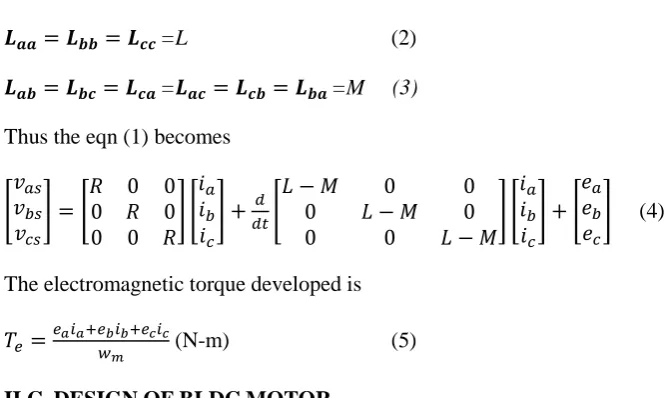
In volage equation of BLDC motor becomes
[ ] [ ] [ ] [ ] [ ] [ ] (1)
It is assumed that Resistance are equal in all the windings.
=L (2)
= =M (3)
Thus the eqn (1) becomes
[ ] [ ] [ ] [
] [ ] [ ] (4)
The electromagnetic torque developed is
(N-m) (5)
II.C. DESIGN OF BLDC MOTOR
This terminology defines the shape of the back-emf of the synchronous motor. The increased efficiency and reliability that a brushless motor offers, along with its low weight and small size, make this type of motor the perfect choice for a wide range of applications. Find the brushless motor that’s ideal for your project today. The design specification of BLDC motor is shown in table1
Table 1. Specification of BLDC motor
1 Product type Brushless DC motor 2 Rated speed 3000rpm
3 Rated voltage 12V
First Quadrant +ve speed +ve torque
Fourth Quadrant +ve speed -ve Second Quadrant
-ve speed +-ve torque
Third Quadrant -ve speed -ve torque
Motoring Generati
ng voltage (speed) Motoring Generati
ng I II III I
6 Number of poles 14 7 Weight 160
III. HALL SENSORS
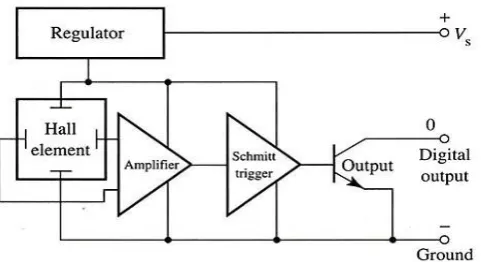
A Hall Effect sensor is a transducer that varies its output voltage in response to a magnetic field. Hall Effect sensors are used for proximity switching, positioning, speed detection, and current sensing applications. With a known magnetic field, its distance from the Hall plate can be determined. Using groups of sensors, the relative position of the magnet can be deduced. A Hall sensor is combined with circuitry that allows the device to act in a digital (on/off) mode, and may be called a switch in this configuration. Hall sensors are commonly used to time the speed of wheels and shafts, such as for internal combustion engine ignition timing, tachometers and anti-lock braking systems.
The Hall sensor are used in brushless DC electric motors to detect the position of the permanent magnet. In the pictured wheel with two equally spaced magnets, the voltage from the sensor will peak twice for each revolution. This arrangement is commonly used to regulate the speed of disc drives
HALL EFFECT
The Hall effect is the production of a voltage difference (the Hall voltage) across an electrical conductor, transverse to an electric current in the conductor and a magnetic field perpendicular to the current. The Hall coefficient is defined as the ratio of the induced electric field to the product of the current density and the applied magnetic field. It is a characteristic of the material from which the conductor is made, since its value depends on the type, number, and properties of the charge carriers that constitute the current
III.B. WORKING
Fig 2. Working of rotor position sensor
IV. PIC CONTROLLER
Table 2: Specification of rotor sensor
V. BUCK BOOST CONVERTER
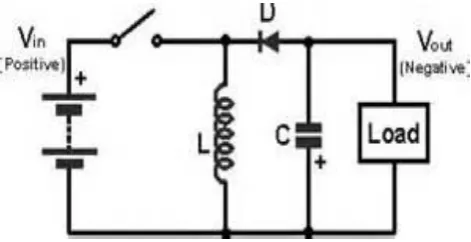
The electric power can be converted from one form to another by the power electronic devices. The buck boost converter is the combination of buck and the boost converter (i.e) step down and step up converter fig 10. The basic working of the buck–boost converter is when the converter is in ON state the input voltage source is directly connected to the inductor(L) and it conducts for 0 to
hence the current flows in inductance, this results in accumulating energy in the inductor and the capacitor supplies energy to the load, and when the converter is in OFF state for to T , the inductor is connected to the load and hence the inductance current decreases And the capacitor gets charged.
Fig 10: Basic block diagram of Buck-Boost converter The characteristics of the buck–boost converter are mainly:
Polarity of the output voltage is opposite to that of the input hence called as inverting regulator.
The output voltage can vary continuously from 0 to (for an ideal converter).
V.A MODELLING OF CONVERTER
V.A.1 INDUCTOR SELECTION
The inductor must have high current rating. The equation of buck and boost mode is given
Supply Voltage : Pulse Out:
Frequency Range: Air Gap:
Temperature Ranges: Thread Length: Thread Sizes:
8 - 30 Vdc @ 5 mA
0.06 – 4.95 V typical (2.5 V at zero field strength)
0 Hz - 30 kHz
Depends on field strength (up to 1.0" @ 3000 Gauss)
2TE: -40° to 221° F (-40° to
105° C)
3TE: -40° to 300° F (-40° to
150° C)
and (6)
(7)
Co-efficient that represents the ripple current of the inductor relative to maximum output current.
It varies between 0.2 to 0.4.
V.A.2 CAPACITOR SELECTION
The input capacitor selection must be minimum value to stabilize the input voltage due to the peak current requirements of switching current. The output capacitor selection is that the value must be larger than both minimum required output capacitance of buck and boost. The equation of buck and boost mode of capacitor is given respectively,
and (8)
(9)
is the dutty cycle.
(10)
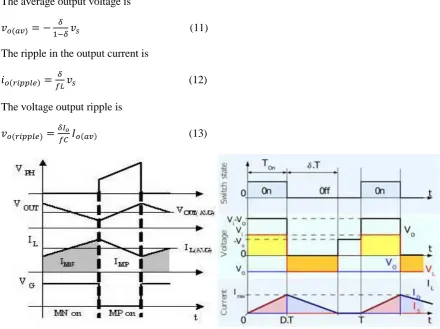
The two modes of operation of converter is continuous and discontinuous mode. When the current through the inductor never comes to zero it is continuous mode and when it comes to zero it is discontinuous mode of operation.
The average output voltage is
(11)
The ripple in the output current is
(12)
The voltage output ripple is
(13)
The Buck-Boost converter is used in applications where the inverter output is required. It is high efficient and the short circuit protection can be implemented.
REFERENCES
[1] Vinod Kr Singh Patel, A.K.Pandey, “Modeling and simulation of brushless dc motor using PWM control technique”, International Journal of Engineering Research and Applications (IJERA) ISSN: 2248-9622 www.ijera.com Vol. 3, Issue 3, May-Jun 2013, pp.612-620 612.
[2] Bon-Gwan Gu†, Jun-Hyuk Choi*, and In-Soung Jung*,“Simple lead angle adjustment method for brushless dc motors”Journal of Power Electronics, Vol. 14, No. 3, pp. 541-548, May 2014.
[3]Alex Simpkins† and Emanuel Todorov‡,“Position estimation and control of compact bldc motors based onanalog linear hall effect sensors” 2010 American Control Conference Marriott Waterfront, Baltimore, MD, USA. June 30-July 02, 2010.
[4]
Champa.P, Somasiri.P, Wipauramonton.P and Nakmahachalasint.P, "Initial rotor position estimation for sensorless brushless dc drives", IEEE Trans. on Ind. Applications, Vol.45,No.4, pp.1318-1324,July 2009.
[5] Somanatham, R. ; Dept. of Electr. Eng., Osmania Univ., Hyderabad ; Prasad, P.V.N. ; Rajkumar, A.D. “Modeling and simulation of sensorless control of pmbldc motor using zero-crossing back e.m.f. detection”, Power Electronics, Electrical Drives, Automation and Motion, 2006. SPEEDAM 2006. International Symposium on 23-26 May 2006.
[6] A. Tozune and T. Takeuchi, “Improvement of torque-speed characteristics of brushless motor by automatic lead angle adjustment,” IPEMC 2004, Vol. 2, pp.583-587, 2004.
[7] Z. Chen, M. Tomita, S. Doki, and S. Okuma, "New adaptive sliding observers for position and velocity sensorless controls of brushless dc motors ",IEEE Trans. Ind. Electron., vol.47, no.3, pp. 582-591, June 2000.