Available online: https://edupediapublications.org/journals/index.php/IJR/ P a g e | 107
System
K.V.Ravi Kiran1,
Mr.
B.v.v.Satyanarayana Rao
2
1PG Scholar, Dept of CSE, MalineniLakshmaiah Engineering College, Singarayakonda,
Prakasam(Dt), AP, India.
2Asst Professor, Dept of CSE, MalineniLakshmaiah Engineering College, Singarayakonda,
Prakasam(Dt), AP, India.
Abstract_ Abundance and
unnecessary features in the large
amount of data have caused a
problem in data traffic
classification which in turn
slowdowns the classification
process. Not only does this it also
not allow the classifier for making
extract decisions, which play a
major role in big data. This system
uses an algorithm based on mutual
information which in turn selects
the optimal features for
classifications analytically, since it
can handle linear and non linear
features. Its efficiency can be
evaluated in the network detection
system. An Intrusion Detection
System (IDS) named Least Square
Support Vector Machine is
fabricated using the feature
selected by the algorithm. The
performance of LSSVM-IDS can
be obtained using three kinds of
dataset namely KDD Cup 99,
NSL-KDD and Kyoto 2006 dataset. The
results show that algorithm
contributes more critical features
for the LSSVM-IDS to accomplish
better exactness and lower
computational cost.
Keywords: Big data, Classifier,
Intrusion Detection System,
Performance, Support Vector
Machines.
I.INTRODUCTION
Available online: https://edupediapublications.org/journals/index.php/IJR/ P a g e | 108
Recent exploits also suggest that the more sensitive the information that is held is, the higher the probability of being a target. Several Retailers, banks, public utilities and organizations have lost millions of customer data to attackers, losing money and damaging their brand image [2]. In some cases attackers steal sensitive information and attempt to blackmail companies by threatening to sell it to third parties
In the second quarter of 2014, Code Spaces (source code company) was forced out of business after attackers deleted its client databases and backups. JP Morgan, Americas‟ largest bank, suffered a cyber-attack in 2014 that impacted 76 million members [3]. In 2014, Benesse, A Japanese Education Company for children suffered a major breach whereby a disgruntled former employee of a third-party partner disclosed up to 28 million customer accounts to advertisers [4]. Most notably the “Sony Pictures hack” best displayed how significant a companies‟ losses are in the aftermath of a security breach. The network servers were temporarily shut down due to the hack [4]. Cybersecurity experts estimate that Sony lost up to $100 million [5] [6]. Other companies under the Sony blanket fell victim to attacks [7]. To tackle this growing trend in computer attacks and respond threat, industry professionals and academics are joining forces in a bid to develop systems that monitor network traffic activity raising alerts for unpermitted activities. These systems are
best described as Intrusion Detection Systems.
II. RELATED WORKS
C-Available online: https://edupediapublications.org/journals/index.php/IJR/ P a g e | 109
implies bunching. At that point, neuro-fluffy is prepared, to such an extent that each of the information point is prepared with the comparing neuro-fluffy classifier related with the bunch. In this manner, a vector for SVM grouping is framed and in the fourth step, order utilizing spiral SVM is performed to recognize interruption has happened or not. Informational index utilized is the KDD glass 99 dataset and framework has utilized affectability, specificity and precision as the assessment measurements parameters. Our system could accomplish better precision for a wide range of interruptions. It accomplished around 98.94 precision in the event of DOS assault and achieved statures of 97.11 exactness if there should arise an occurrence of PROBE assault.
S. Mukkamala, A. H. Sung, A. Abraham et al proposed Soft figuring procedures are progressively being utilized for critical thinking. This framework addresses utilizing an outfit approach of various delicate processing and hard figuring strategies for interruption location. Because of expanding episodes of digital assaults, building successful interruption discovery frameworks are fundamental for ensuring data frameworks security, but then it remains a slippery objective and an awesome test. Framework concentrated the execution of Artificial Neural Networks (ANNs), Support Vector Machines (SVMs) and Multivariate Adaptive Regression Splices (MARS). Framework demonstrates that a group of ANNs, SVMs and MARS is better than
individual methodologies for interruption discovery [6].
III. METHODOLOGY
An intrusion detection system (IDS) is a device or software application that monitors a network or systems for malicious activity or policy violations. Any detected activity or violation is typically reported either to an administrator or collected centrally using a security information and event management (SIEM) system.
A. Intrusion Detection Framework on Least Square Vector Machine
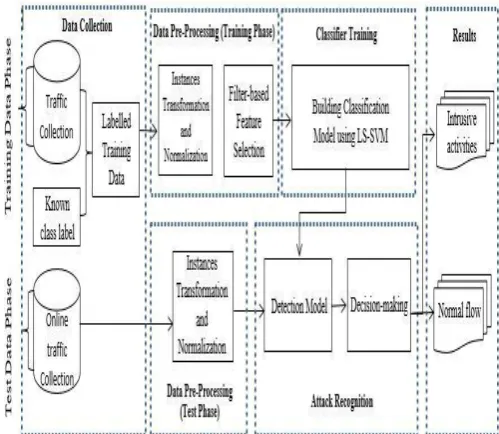
The framework of the proposed intrusion detection system is depicted in figure 1. The detection framework is comprised of four phases: (1) data collection (2) data preprocessing (3) classifier training, and (4) attack recognition.
Available online: https://edupediapublications.org/journals/index.php/IJR/ P a g e | 110
Data Collection
In data collection we collect a data from the KDD Cup 99 dataset where data is collected based on two factors design and effectiveness of IDS.
Data Preprocessing
In data preprocessing we have stages which are explained below
Data Transferring
Here in data transferring ever symbolic feature in dataset is converted to integer type. For example, the KDD CUP 99 dataset contains both symbolic feature and integer type, these symbolic features include TCP,UDP further it is replaced with integer type.
Data Normalization
There are 3 types of normalization step. In first one we delete all the duplicate data and unwanted data. In second step we generalize the some of the field values. In third step we put zero for the entire field which do not contain any value or which are empty. With help of this step comparison becomes easy.
Feature Selection
In Feature Selection the values which system have got are compared with trained dataset and only some features are selected based on the algorithm flexible mutual information based feature selection and flexible linear correlation coefficient based feature selection.
Attack recognition
In this there are two main steps, in first step the system takes the data and compare with the trained dataset and recognitions if the data is attacked or normal data. If the data is attack then it will undergo the second step, in which the attacked data is classified according to which type of attack is occurred by comparing it with the trained dataset.
V. CONCLUSION
The two main components to build an IDS are robust classification and feature selection .As proposed an algorithm namely Flexible Mutual Information Feature Selection (FMIFS) supervised by Filter Based feature selection algorithm .FMIFS modifies the Battitis algorithm which redundancy among the features and eliminated the redundancy used in MIFS and MMIFS. There is no pre described procedure to select value. FIMS+LSSVM is used to build an IDS. The proposed LSSVM-IDS+FMIFS has been evaluated here with the help of KDDCUP 99 data set .But we get many other datasets like NSL-KDD and Kyoto 2006+datasets for evaluation The corrected set of data of KDD cup 99 data set are tested on normal, DOS and probe classes .The performance is evaluated in the term of accuracy, detection rate, False positive and F-measure. Finally, based on the experimental results achieved on KDD CUP 99.So the result of the system is achieved promising performance in detecting intrusions in the network.
Available online: https://edupediapublications.org/journals/index.php/IJR/ P a g e | 111 [1] S. Pontarelli, G. Bianchi, and
S. Teofili, “Traffic-aware design of a
high-speed FPGA network intrusion
detection system,” IEEE Trans.
Comput., vol. 62, no. 11, pp. 2322–
2334, Nov. 2013.
[2] B. P fahringer, “Winning the
KDD99 classification cup: Bagged
boosting,”
SIGKDD Explorations Newslett., vol. 1,
no. 2, pp. 65–66, 2000.
[3] S. Mukkamala, A. H. Sung, and A. Abraham, “Intrusion
detectionusing an ensemble of
intelligent paradigms,” J. Netw.
Comput.Appl., vol. 28, no. 2, pp. 167–
182, 2005.
[4] C. Grosan, C. Martin-Vide, A.
Abraham, "Evolutionary Design of
Intrusion Detection Programs",
International Journal of Network
Security, vol. 4, pp. 328-339, 2007.
[5] A. N. Toosi and M. Kahani, “A
new approach to intrusion
detectionbased on an evolutionary soft
computing model using
neurofuzzyclassifiers,” Comput.
Commun., vol. 30, no. 10, pp. 2201–
2212, 2007.
[6] Z. Tan, A. Jamdagni, X. He, P.
Nanda, L. R. Ping Ren, and J.
Hu,“Detection of denial-of-service
attacks based on computer
visiontechniques,” IEEE Trans.
Comput., vol. 64, no. 9, pp. 2519–
2533,Sep. 2015.
[7] A. M. Ambusaidi, X. He, and P. Nanda, “Unsupervised
featureselection method for intrusion
detection system,” in Proc. Int.Conf.
Trust, Security Privacy Comput
Commun., 2015, pp. 295–301.
[8] A. M. Ambusaidi, X. He, Z.
Tan, P. Nanda, L. F. Lu, and T.
U.Nagar, “A novel feature selection
approach for intrusion detectiondata
classification,” in Proc. Int. Conf.
Trust, Security Privacy
Comput.Commun., 2014, pp. 82–89.
Author’s Profile
K.V.Ravi Kiran completed M.C.A in 2007 Horizon institute of technology in Hyderabad
Available online: https://edupediapublications.org/journals/index.php/IJR/ P a g e | 112
Engineering college ,Singarayakonda, Prakasam (Dist).AP, India.