© 2015, IRJET.NET- All Rights Reserved
Page 340
Implementation of DCT DWT SVD based watermarking
algorithms for copyright protection
Ritesh Patel
1Prof.A.B.Nandurbarkar
21
P.G Scholar
,
Department of Elect & Comm Engineering
,
L.D College Of Engineering, Ahmedabad
2
Associate Professor
,
Department of Elect & Comm Engineering
,
L.D College Of Engineering, Ahmedabad
---***---Abstract
-
In recent year, to protect digital content(text, images, audio, and video) from illegal manipulations that has been developed digital image watermarking techniques. In this paper we proposed two different watermarking schemes based on DCT-DWT-SVD. One watermarking scheme is based on SVD of DC coefficients using second level DWT decompose-tion and other scheme is based on SVD of all DCT values of second level DWT composition of cover image. To check both schemes by Imperceptibility and robustness used PSNR and NC parameters.
Key Words: Watermarking, DWT,DCT, SVD,PSNR; NC
1. INTRODUCTION
In recent years, the global developing applications using digital multimedia technologies has emphasized the need to protect digital multimedia data from illegal issues. Authentication and information hiding, copyright protection, content identification and proof ownership have also become important issues. Watermarking technology is used to solve these issues. These kinds of work in this field have several watermarking techniques such as spatial domain and transform domain [9]. In transform domain basic transforms are used discrete cosine transform (DCT), discrete wavelet transform (DWT), singular value decomposition (SVD) and their cross relation [10]. Watermarking techniques is a process embedding a secret information into a multimedia data, such as image, audio and video in such a way that it is imperceptible to a human. Before the development of digital image watermarking, it was very difficult to achieve copyright protection, authentication, data hiding, content identification and proof ownership. But currently it is very easy to give these kinds goal using watermarking techniques. Every watermarking schemes consists of two processes embedding and extraction process. Generally, digital watermarking system is consisted of two main processes, one is
embedding process and second is
extracting process. During the embedding process,
the watermark data is embedded into the multimedia
digital data. The original data will modified after
embedding process, this modified data is known as a
watermarked data. In extracting process embedded watermark data is extracted from the watermarked data and recover the original multimedia data. The extracted
watermark is compared with original watermark; if the watermark is same it result in authenticated data. During the sending of the watermarked data on network, the attacker may destroyed the data, and if any changing in the data can be detected by comparing the extracted watermark with the original watermark. Watermarking technique have main two properties such as imperceptibility and robustness [11]. If we cannot distinguish between host image and watermarked image called imperceptibility. Basically imperceptibility depends on similarity between host image and watermarked image. Robustness measures how difficult to remove or destroy watermark from watermarked image [11]. In this paper we proposed a two digital watermarking techniques based DWT, DCT and SVD transform. These two schemes is provided a good imperceptibility and high robustness against various kinds processing attacks. The rest of the paper is organized as follows: Section 2, focuses on overview of Transforms for watermarking schemes. Section 3, gives details the proposed watermarking algorithms 1. Section 4, gives details the proposed watermarking algorithms 2. In section 5, gives evolution parameter and experimental results. In section 6, conclusion is drawn.
2. PRELIMINARIES
In this section, we will briefly describe the details of DCT, DWT and SVD transformations in below.
2.1 Discrete Wavelet Transform (DWT)
© 2015, IRJET.NET- All Rights Reserved
Page 341
robustness of the watermark [6]. A one level DWT decomposition process is shown in Figure 1.
Fig 1.
Single level decomposition using DWT2.2 Discrete Cosine Transform (DCT)
The DCT is popular transform used in signal processing. It transforms a signal from spatial domain to frequency domain. It has been used in JPEG standard for image compression for good result. It is a function represents a technique applied to image pixels in spatial domain in order to transform them into a frequency domain in which redundancy can be branded. DCT techniques in frequency domain are more robust compared to spatial domain techniques. Such algorithms are robust against image processing operations like adjustment, brightness, blurring, contrast and low pass filtering and so on. But it is difficult to implement and computationally more expensive. The one-dimensional DCT is useful in processing one dimensional signals such as speech waveforms. For analysis of two-dimensional (2D) signals Such as images, we need a 2D version of the DCT.
2.3 Singular Value Decomposition (SVD)
The image is non-negative real matrix in the viewpoint of linear algebra [12]. The SVD of a matrix is orthogonal transforms used for matrix diagonalization. Let P be an image, and its size be M×N. The SVD of P can be presented as follows: Where U and V are two M×N and N×N unitary orthogonal matrices, and S is an N×N diagonal matrix. The elements of S are nonnegative values on diagonal representing singular values of P. The diagonal elements of matrix S = diag (s1, s2……. sn) satisfy the order: s1 ≥ s2 ≥ …….. ≥ sn [4]. It is important to note that
• The nonnegative components of S represent the luminance value of the image
• Changing them slightly does not affect the image quality and they also don’t Change much after attacks, watermarking algorithms make use of these properties.
3. PROPOSED ALGORITHM 1
In this Proposed algorithm combines advantages of three different techniques DCT, DWT and SVD. First one level DWT is applied to original cover image. To achieve better imperceptibility LL band is select for second level decomposition and HH band is selected. It is divided into 4X4 sub blocks. DCT is applied to each sub blocks of HH
band and first DC coefficient of each block is selected and formed it in matrix. SVD is applied to this matrix and singular values of cover image are modified with singular values of watermark. Inverse SVD, inverse DCT and inverse DWT is performed to get watermarked image. The procedure for embedding and extracting the watermark is given below
3.1 Watermark embedding process
The embedding process is divided into following steps and is briefly described as given below
1. Select Original cover image of size N x N. apply DWT to decompose it into four sub-bands LL, HL, LH and HH
2. Select LL band and Apply DWT to decompose it into four sub-bands LL_LL, LL_HL, LL_LH and LL_HH.
3. Select LL_HH band, divide it into 4X4 square blocks and apply DCT to it, select first DCT value of each block and get new DCT coefficient matrix B.
4. Apply SVD to B, B=U1*S1*V1T, and obtain U1, S1and V1.
5. Select watermark image. Apply SVD to it and obtain U2, S2 and V2.
6. Modify Singular value S1 with watermark such that S=S1 + α*S2.
7. Obtain B* using B*= U1*S*V1T.
8. Apply inverse DCT to B* to produce LL_HH*.
9. Apply inverse DWT to LL_LL, LL_HL, LL_LH and LL_HH* to get matrix LL*.
10. Apply inverse DWT to LL*, HL, LH and HH, get watermarked image.
3.2 Watermark extraction process
1 Apply DWT to attacked watermarked image to get LL*, HL, LH and HH.
2. Apply second level DWT on LL* and get LL_LL, LL_HL, LL_LH and LL_HH*.
3. Select LL_HH* band and divide it into 4X4 blocks.
4. Apply DCT to each block of sub band LL_HH*, select first DCT values and get matrix A.
5. Apply SVD to A, A= U3*S3*V3T and obtain U3, S3, V3
6. Obtain SW=(S1-S3) /α
© 2015, IRJET.NET- All Rights Reserved
Page 342
4. PROPOSED ALGORITHM 2
In this algorithm first level decomposition of wavelet is applied to cover image then LL band is selected for second level decomposition. Now DCT is applied to HH band and get DCT coefficient matrix. SVD is apply on this DCT coefficient matrix. Watermark image is decomposed at first level and HH band is selected. DCT is applied to this HH band and we get DCT coefficients of watermark then SVD is applied to it. Singular values of cover image is modified with singular values of watermark image by scaling factor. Perform inverse transform and we get watermarked image.
4.1 Watermark embedding process
The embedding process is divided into following steps and is briefly described as given below:
1. Select the cover image. Apply DWT to decompose it into four sub-bands LL, HL, LH and HH.
2. Select LL band and Apply DWT to decompose it into four sub-bands LL_LL, LL_HL, LL_LH and LL_HH.
3. Select LL_HH band, apply DCT to it, and get DCT coefficient matrix B.
4. Apply SVD to B, B=U*S*VT, and obtain U, S and V.
5. Select the watermark image. Apply DWT to decompose it into four sub-bands WLL, WHL, WLH and WHH.
6. Select WHH band and apply DCT to it and get DCT coefficient matrix D.
7. Apply SVD to D matrix, D=U1*S1*V1T, and obtain U1, S1 and V1.
8. Modify S with watermark such that S2=S + α*S1.
9. Obtain B* using B*= U*S2*VT.
10. Apply inverse DCT to B* to produce LL_HH*.
11. Apply inverse DWT to LL_LL, LL_HL, LL_LH and LL_HH* to get matrix LL*.
12. Apply inverse DWT to LL*, HL, LH and HH, get watermarked image.
4.2 Watermark extraction process
1. Apply DWT to attacked watermarked image to get LL*, HL, LH and HH.
2. Apply DWT to WI to get LL_LL, LL_HL, LL_LH and LL_HH*.
3. Select LL_HH* band and Apply DCT to sub band LL_HH*, and get matrix A.
4. Apply SVD to A matrix, A= WU*WS*WVT and obtain WU, WS, WV
5. Obtain singular value S3=(S-WS) /α
6. Obtain reconstructed SVD matrix Wr= U1*S3*V1T
7. Apply inverse DCT to Wr and get W.
8. Apply inverse DWT to LL, HL, LH and W and get extracted watermark.
5. EXPERIMENTAL RESULT ANALYSIS
To check effectiveness of the schemes the PSNR and NC are used as evaluation parameter.
(1)
(2
)
NC=
(
3)
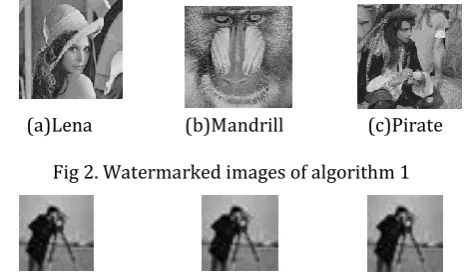
To check the efficiency of proposed algorithm different size of images are considered for numerical simulation. It is tested using the tool MATLAB 14.0. Here results are given using 512 x 512 gray image “LENA”, “MANDRIL” and“PIRATE” as cover image and 32 x 32 gray scale cameraman image as watermark in algorithm one and 256x256 gray scale cameraman image as watermark in second algorithm.
(a)Lena (b)Mandrill (c)Pirate
Fig 2. Watermarked images of algorithm 1
© 2015, IRJET.NET- All Rights Reserved
Page 343
(a)Lena (b) Mandrill (c) Pirate
Fig.4 Watermarked images of algorithm 2
Fig.5 Extracted Watermark from watermarked images of algorithm 2
Both watermarking algorithms was tested using thirteen Attacks with Matlab: Salt & papers noise, Gaussian noise, JPEG compression, rescaling, rotation, cropping, contrast adjustment, histogram equalization, and gamma correction, median filter, low pass filter, sharpen and speckle noise. Table 1 and Table 2 gives the values of the correlation coefficient between the extracted and original watermark images using the cover images, Lena, Mandrill, and Pirate, and the same watermark image, It is seen from these tables that the values of the correlation coefficient are almost invariably larger than 0.9 for the various attacks regardless of the watermark and cover images used in our experiments.
Table-1: Result of algorithm 1 for NC value for different attacks and PSNR value for watermark embedding
Table-2: Result of algorithm 2 for NC value for different attacks and PSNR value for watermark embedding
6. CONCLUSION
In this paper, we performed two watermarking algorithm where discrete wavelet transform (DWT), discrete cosine transform (DCT) Singular Value decomposition (SVD) and their cross combination have been applied successfully in many in digital image watermarking. Algorithm I is not robust against low pass filter attacks. Algorithm II gives quiet better results in all listed attacks. It gives good NC value for jpeg up to 20% quality factor. In both algorithm extraction of watermark is done using original cover image so both are non-blind scheme. In future we will try to develop algorithm which do not depends on original cover image at the time of extraction using DCT, DWT and SVD.
REFERENCES
[1] Chiou Ting HSU and Ja Ling wu, “Hidden digital watermarks in images” IEEE transcation on image processing, vol.8,no.1,pp.56-58,January.1999.
[2]Shinfeng D.Lin and Chin Feng Chen, “A robust DCT based watermarking for copyright protection” IEEE transaction on consumer electronics, vol.46, no.3, pp.415-421, august.2000
[3] Ruizhen Lia and Tieniu Tan “A SVD based watermarking scheme for protecting rightful Result of Algorithm I I Image database
Cover image Lena Mandrill Pirate
P PSNRSPNR 41.4765 40.7665 41.3346
NC without attack 0.9998 0.9998 0.9998
NC NC NC
Salt & Papers noise 0.9809 0.9776 0.9808 Gaussian noise 0.9956 0.9952 0.9915
Rotation 0.7790 0.4023 0.6876
Histogram equalization 0.9335 0.9245 0.9292 Median filter 0.9774 0.8008 0.9149 Contract adjust 0.9465 0.9537 0.9283 Speckle noise 0.9836 0.9744 0.9884 Gamma correction(0.8) 0.9933 0.9978 0.9863 Gamma correction(1.2) 0.9887 0.9844 0.9826 Low pass filter -0.1172 -0.5089 -0.4119
Resize 0.8420 0.2976 0.4909
Crop 0.5491 0.7366 0.7223
Sharpen 0.9699 0.9339 0.9428
Jpeg compression 0.9312 0.9708 0.9750
Result of Algorithm II I Image database
Cover image Lena Mandrill Pirate
P PSNRSPNR 56.784 55.0555 56.5956
NC without attack 1 1 1
NC NC NC
Salt & Papers noise 0.9812 0.9935 0.9868 Gaussian noise 0.9962 0.9989 0.9978
Rotation 0.9959 0.9852 0.9965
Histogram equalization 0.9744 0.8331 0.9620 Median filter 0.9940 0.9605 0.9889 Contract adjust 0.9850 0.9270 0.9741 Speckle noise 0.9805 0.9913 0.9907 Gamma correction(0.8) 0.9972 0.9998 0.9923 Gamma correction(1.2) 0.9983 0.9905 0.9951 Low pass filter 0.9481 0.8281 0.9276
Resize 0.9789 0.9291 0.9673
Crop 0.9489 0.8672 0.9659
Sharpen 0.8375 0.6707 0.7817
© 2015, IRJET.NET- All Rights Reserved
Page 344
ownership”IEEE transaction on multimedia, vol.4, no.1, pp.121-128, march-2002
[4] Roman Rykaczewski, “comments on “an SVD based watermarking scheme for protecting rightful ownership” IEEE transaction on multimedia, vol.9, no.2, pp.412-423, feb.2007.
[5] Pie-Yu-Lin, Jung-San Lee and Chin Chen Chang, “Dual digital watermarking for internet media based on hybrid strategies” IEEE transaction on circuits and system for video technology, vol.8, no.8, pp.1169-1177, august.2009
[6] Chih-chin-Lai and Cheng Chih Tsai, “Digital image watermarking using discrete wavelet transform and singular value decomposition” IEEE transaction on instrumentation and measurement, vol.59,no.11,pp.3060-3063,nov-2010
[7]Sushila Kamble1,Vikas Maheshkar2,Suneeta Agarwal3,And Vinay Kumar Srivastava4,” DWT-SVD Based Robust Image Watermarking Using Arnold Map” International Journal of Information Technology and Knowledge Management January-June 2012, Volume 5, No. 1, pp. 101-105
[8] Kaushik Deb,1*Md. Sajib Al-Seraj,1 Md. Moshiul Hoque,2 and Md. Iqbal Hasan Sarkar1,” Combined DWT-DCT Based Digital Image Watermarking Technique for Copyright Protection”, in proceeding of IEEE International Conference on Electrical and Computer Engineering, pp. 458-461.2012
[9] Priyanka Singh, and Suneeta Agarwal “A Hybrid DCT-SVD Based Robust Watermark Scheme for Copyright Protection” International Conference on Emerging Trends in Engineering and Technology (ICETET'2013) Dec. 7-8, 2013 , pp. 1-5
[10] Sneha Jose, Rajesh Cherian Roy, Sreenesh Shashidharan, “Robust Image Watermarking based on DCT-DWT-SVD Method” International journal of computer applications. Vol.21, pp.12-15, nov.2012.
[11] Nidhi H. Divecha, N. N. Jani, “ Image Watermarking Algorithm using Dct, Dwt and Svd” National Conference on Innovative Paradigms in Engineering & Technology(NCIPET-2012) ,Proceedings published by International Journal of Computer Applications® (IJCA),2012
BIOGRAPHIES
PG Scholar, EC Department, L.D.College of engineering, Ahmedabad
Associate Professor, EC Department,
L.D.College of engineering Ahmedabad
Author’s
Photo
Author’s
Pho