Modelling the Relationship between
Hotel Employee Commitment and Cultural difference
Tongrawee Silanoi
Bachelor of Business Administration (Hotel and Tourism), Khon Kaen University, Thailand
Master of Business Administration (International Hospitality Management), IMI, Switzerland
A thesis submitted in total fulfilment of the requirement for the degree of
Doctor of Philosophy
College of Business, Faculty of Business and Law
Victoria University
ii
DEDICATION
This thesis is dedicated to
My lovely parents, Associate Professor Ladda and Associate Professor Ongart My wonderful twin sisters Doctor Wongwarin and Wongwarun, and
iii
DECLARATION
I, Miss Tongrawee Silanoi, declare that the PhD thesis entitled Modelling the Relationship between Hotel Employee Commitment and Cultural difference is no more than 100,000 words in length including quotes and exclusive tables, figures, appendices, bibliography, references and footnotes. This thesis contains no material that has been submitted previously, in whole or in part, for the award of any other academic degree or diploma. Except where otherwise indicated, this thesis is my own work.
iv
ACKNOWLEDGEMENT
This thesis would not be finished without the strong support, encouragement, and inspiration of several people and organisations. I would love to present my appreciation to all those who provided their support in many different ways.
Firstly, I would like to thank my principal supervisor Professor Lindsay Turner from Victoria University for his valuable guidance and his big support during this journey. I feel so appreciative of having worked with him and his professional academic background. He helped clear any problems and kept me constantly focused on my work. I can remember the first time I met him, he told me ―you can tell me everything‖, without his caring attitude this thesis would not have been completed. He embraces every responsibility of a principal supervisor to guide my research. I am very fortunate to be under his supervision. I also acknowledge the essential support of my co-supervisor Dr. Leonie Lockstone-Binney, who provided me valuable assistance and she helped me with reading and giving feedback on my thesis. For both of my supervisors I would like to give them a hearty thank you.
I would like to thank you my previous supervisor Professor Barry O‘Mahony, who gave me a chance to study a doctorate degree at Victoria University, and Associate Professor Jim Sillitoe for being my first co-supervisor, he showed me how to work on research professionally.
I would like to acknowledge the Faculty of Management Sciences, Khon Kaen University for their sponsorship, granting me a scholarship to achieve my doctorate, and also my colleagues in the Department of Hotel and Events who pushed me to go through with this journey.
Particular thank you for all the hotels that participated in this study, specifically, I would like to thank the hotel employees for their willingness to participate, and keenness in providing me with any assistance I needed during data collection.
Finally, my great appreciation and thanks are to my family who are always with me in this long journey; my parents, my twin sisters and my lovely husband, who have given me a lot of encouragement and inspiration to fight for my success. Especially my mom and dad who have always supported me, both of you are my best teachers ever. A special thank you go to my brilliant twin sisters Paw and Parn, who have encouraged me and helped me to clarify many situations during my long journey.
Last but not least, I would like to thank you to my beloved husband, Jum who has stayed beside me and given me valuable assistance especially in statistics, you always told me ―no worry, you can do it‖ when I wanted to give up in this journey.
v
ABSTRACT
This study aims to model the relationship between employee commitment and cultural difference in the hotel sectors in Hua Hin, Thailand and Melbourne, Australia. The purpose of this study is to clarify and better understand the relationship between employee commitment and human culture in the hospitality industry and to clarify the influence of culture using a sample of luxury four and five star hotels located in both Thailand and Australia. The focus is upon determining the relevance of culture by examining the impact of cultural difference on employee commitment.
A research model in this study is originally developed by several scholars including Rokeach (1973) whose work provides the characteristics of cultural values. This study uses an adapted RVS scale to identify the individual culture of hotel employees. In order to identify employee commitment in three terms, this study adapted the scales from three models including Meyer and Allen (1991; 2001), who developed the three component model used to conceptualised organisational commitment, Peccei and Rosenthal (1997) who applied the three-component model of organisational commitment to clarify the components of employee commitment to customers and Meyer et al. (1993) was modified a model to measure occupational commitment.
vi
LIST OF ABBREVIAIONS
RQ Research question
H Hypothesis
TCM Three component analysis
PCA Principle Component Analysis
SEM Structural Equation of Modelling
SPSS Statistical Package for the Social Sciences
AMOS Analysis of Moment structure
DF Degree of Freedom
RMR Root mean square residual
GFI Goodness of fit
AGFI Adjusted goodness of fit
NFI Normed Fix Index
CFI Comparative Fix Index
RMSEA Root mean square error of approximation
PCLOSE p of close fit
BIC Bayesian information criterion
vii
TABLE OF CONTENTS
DEDICATION ii
DECLARATION iii
ACKNOWLEDGEMENT iv
ABSTRACT v
LIST OF ABBREVIATIONS vi
TABLE OF CONTENTS vii
LIST OF TABLES xii
LIST OF FIGURES xviii
CHAPTER ONE: INTRODUCTION
1.1Background of the study 1
1.2Aims of the research 4
1.3Research questions 5
1.4Contribution to knowledge 6
1.5Statement of significance 6
1.6Study location 8
1.7Key terms 10
1.8Overview of research and Research procedure 11
CHAPTER TWO: LITERATURES REVIEW
2.1Introduction 14
2.2Employee commitment 15
2.2.1 Background of employee commitment 15
2.2.2 The antecedents of commitment 18
2.2.3 Model development of commitment 26
2.2.3.1 Organisational commitment 28
2.2.3.2 Commitment to customer 32
2.2.3.3 Commitment to career 34
2.2.4 Consequences of commitment 36
2.2 Culture 40
2.3.1 The definition of culture 41
2.3.2 Cultural difference 43
2.3.3 The dimension of culture 43
viii
2.4 Cross-cultural studies in hospitality industry 47
2.4.1 The relationship between employee and culture 49
2.4.2 Related literature in Thai context 52
2.5 Individual human culture 54
2.5.1 Values 54
2.5.1.1The concept of individual values 55
2.5.1.2Measuring individual values 56
2.5.1.3The list of value (LOV) 57
2.5.1.4The value survey of Rokeach (RVS) 59
2.5.1.5Outcomes of individual values 61
2.5.1.6Individual values in hospitality 61
2.5.2 Attitude 62
2.5.2.1The concept of attitude 63
2.5.2.2The measurement of attitude 64
2.5.2.3The Likert scale measurement 64
2.5.2.4The consequence of attitude research 65
2.5.2.5Attitude in the hospitality industry 66
2.5.3 Summary of individual human culture 67
2.6 Summary of propose research 68
CHAPTER THREE: CONCEPTUAL MODEL
3.1Introduction 69
3.2The proposed Theoretical model overview 69
3.3Human culture 72
3.3.1 Human culture and attitudes to antecedents
of commitment 72
3.4Antecedents of employee commitment 78
3.4.1 Attitudes to antecedents of commitment and
employee commitment 78
3.5Employee commitment 82
Employee commitment and employee behaviour 82
3.6Cultural difference 85
3.7Summary 86
CHAPTER FOUR: METHODOLOGY
4.1 Introduction 88
4.2 Methodological overview 88
4.3 Scale development 92
4.3.1Human culture 94
4.3.2 Attitudes to antecedents of commitment 96
ix
4.3.3.1 Organisational commitment 109
4.3.3.2 Career commitment 112
4.3.3.3 Commitment to customer 114
4.3.4 Employee behaviour 116
4.4 Questionnaire 127
4.4.1 Questionnaire translation and back translation 129
4.5 Pre-test 130
4.5.1 Pre-test sampling frame 130
4.5.2 Pre-test stages 130
4.6 Final survey 131
4.6.1 Final survey sampling frame 131
4.6.1.1 Thailand 132
4.6.1.2 Australia 133
4.6.2 Final survey procedure 135
4.7 Data analysis Methods 136
4.7.1 Preliminary data analysis 136
4.7.2 Mann Whiney U test 136
4.7.3 Principal component analysis 137
4.7.4 Structure Equation Modelling 137
4.8 Ethics and Confidentiality 137
4.9 Summary 138
CHAPTER FIVE: DESCRIPTIVE ANALYSIS
5.1 Introduction 139
5.2 Demographic characteristics 140
5.3 Employee commitment and human culture constructs. 142
5.3.1 Human culture 143
5.3.2 Attitudes to antecedents of employee commitment 146
5.3.3 Employee commitment 148
5.3.4 Employee behaviour 150
5.4 Mann Whitney U test 153
5.4.1 Human culture 154
5.4.2 Attitudes to antecedents of employee commitment 159
5.4.3 Employee commitment 162
5.4.4 Employee behaviour 165
5.5 Reliability 169
5.6 Summary 170
CHAPTER SIX: PRINCIPAL COMPONENT ANALYSIS
6.1 Introduction 172
x
6.2.1 Thai Sample 175
6.2.2 Australia Sample 177
6.2.3 Comparison of Human culture 182
6.3 Principal Component Analysis of the antecedents of employee
commitment 183
6.3.1 Thai Sample 183
6.3.2 Australia Sample 188
6.3.3 Comparison of attitude to antecedents of commitment 193
6.4 Principal Component Analysis of employee commitment 194
6.4.1 Thai Sample 194
6.4.2 Australia Sample 197
6.4.3 Comparison of employee commitment 200
6.5 Principal Component Analysis of employee behaviour 201
6.5.1 Thai Sample 201
6.5.2 Australia Sample 205
6.5.3 Comparison of employee behaviour 209
6.6 Summary 211
6.7 Conclusion 212
CHAPTER SEVEN: STRUCTURAL EQUATION MODELLING
7.1 Introduction 213
7.2 Testing of the conceptual framework theorised relationship
between cultural difference and employee commitment for Thai sample 223
7.2.1 Model of the relationship between human culture and attitudes to antecedents of employee commitment for Thai sample 223
7.2.2 Model of the relationship between attitudes to antecedents of employee commitment and employee commitment
for Thai sample 233
7.2.3 Model of the relationship between employee commitment
and employee behaviour for Thai sample 241
7.3 Testing of the conceptual framework theorised relationship between
cultural difference and employee commitment for Australian sample 249
7.3.1 Model of the relationship between human culture and attitudes
to antecedents of employee commitment for Australian sample 249
7.3.2 Model of the relationship between attitudes to antecedents of employee commitment and employee commitment for Australian
sample 258
7.3.3 Model of the relationship between employee commitment
and employee behaviour for Australian sample 265
7.4 Comparison of the results between the Thai and Australian samples 274
7.4.1 The comparison of AIC and BIC values of human culture and
attitudes to antecedents of employee commitment between Thai
xi
7.4.2 The comparison of AIC and BIC values of attitudes to antecedents of employee commitment and employee commitment between Thai and
Australian samples 274
7.4.3 The comparison of AIC and BIC values of employee commitment
and employee behaviour between Thai and Australian samples 275
7.5 Results of testing the hypotheses of this thesis 275
7.5.1 Human culture attitudes positively cause the antecedents
of employee commitment 275
7.5.2 The attitudes of antecedents of employee commitment
to employee commitment 276
7.5.3 Employee commitment positively cause employee behaviour 277
7.6 Summary 278
CHAPTER EIGHT: CONCLUSION
8.1 Introduction 279
8.2 The sample 280
8.3 Summary of the results 281
8.3.1 The results of the Mann- Whitney U test 281
8.3.2 The results of the Principle Component Analysis 284
8.3.3 The results of the Structural Equation Modelling 292
8.4 Consequence of the study 303
8.5 Implications 303
8.5.1 Theoretical Implications 303
8.5.2 Managerial Implications 304
8.6 Contribution to knowledge 309
8.6.1 Theoretical perspective 309
8.6.2 Practical contribution 310
8.7 Thesis Limitation 311
8.8 Summary 312
REFERENCES 313
APPENDICES
Appendix A: Acceptance of ethic application 360
Appendix B: Hotel consent form 362
Appendix C: Participant consent form 364
Appendix D: Information for participants 366
xii
LIST OF TABLES
Chapter Two
Table 2.1 The definition of commitment 16
Table 2.2 Diversity of culture definitions adapted from Bodley (1994) 41
Table 2.3 The value survey of Rokeach 60
Chapter Four
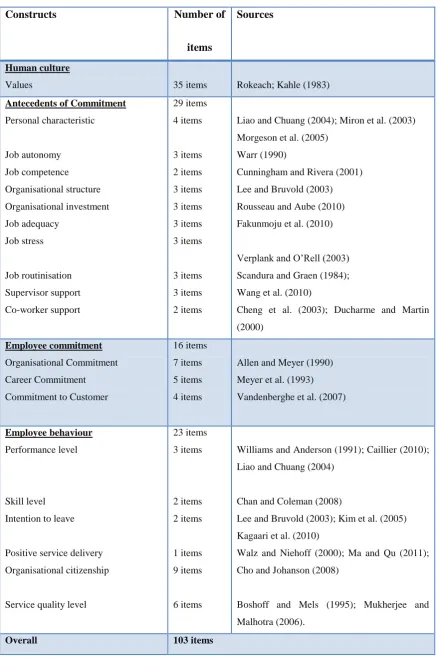
Table 4.1 Total of Scale Items used in this thesis 93
Table 4.2 Personal values scale items 95
Table 4.3.1 Original scale for measure personal characteristics 97
Table 4.3.2 Personal characteristics scale items used in this study 98
Table 4.3.3 Job autonomy scale items used in this study 99
Table 4.3.4 Original scale for measure job competence 100
Table 4.3.5 Job competence scale items used in this study 100
Table 4.3.6 Original scale for measure organisational structure 101
Table 4.3.7 Organisational structure scale items used in this study 102
Table 4.3.8 Original scale for measure organisational investment 102
Table 4.3.9 Organisational investment scale items used in this study 103
Table 4.3.10 Original scale for measure job adequacy 104
Table 4.3.11 Job adequacy scale items used in this study 104
Table 4.3.12 Original scale for measure job stress 105
Table 4.3.13 Job stress scale items used in this study 106
Table 4.3.14 Original scale for measure job routinisation 106
Table 4.3.15 Job routinisation scale items used in this study 107
Table 4.3.16 Original scale for measure supervisor support 107
Table 4.3.17 Supervisor support scale items used in this study 108
Table 4.3.18 Original scale for measure co-worker support 108
Table 4.3.19 Co-worker support scale items used in this study 109
Table 4.4.1 Original scale for measure organisational commitment 110
Table 4.4.2 Organisational commitment scale items used in this study 112
Table 4.4.3 Original scale for measure career commitment 113
Table 4.4.4 Career commitment scale items used in this study 114
Table 4.4.5 Original scale for measure commitment to customer 115
Table 4.4.6 Commitment to customer scale items used in this study 116
Table 4.5.1 Original scale for measure employee performance 117
Table 4.5.2 Employee performance scale items used in this study 118
Table 4.5.3 Original scale for measure employee skill 118
xiii Table 4.5.5 Original scale for measure intention to quit and
positive service delivery
120
Table 4.5.6 Intention to quit and positive service delivery scale items
used in this study 121
Table 4.5.7 Original scale for measure Organisational citizenship
behaviour 122
Table 4.5.8 Organisational citizenship behaviour scale items used
in this study 125
Table 4.5.9 Original scale for measure service quality 126
Table 4.5.10 Service quality scale items used in this study 127
Table 4.6 Procedure used in Pre-test 131
Chapter Five
Table 5.1 Gender of respondents 140
Table 5.2 Ages of respondents 141
Table 5.3 Work position of respondents 141
Table 5.4 Comparison of mean, min and max 142
Table 5.5 Comparative measures of the constructs related to
human culture 144
Table 5.6 Comparative measures of the constructs related
to attitudes to antecedents of commitment 147
Table 5.7 Comparative measures of the constructs related
to employee commitment 149
Table 5.8 Comparative measures of the constructs related
to employee behaviour 152
Table 5.9 The Mann Whitney U test of significant differences in
human cultural value between Thais and Australians 154
Table 5.10 The Mann Whitney U test of significant differences in
attitudes to antecedents between Thais and Australians 159
Table 5.11 The Mann Whitney U test of significant differences in
employee commitment between Thais and Australians 162
Table 5.12 The Mann Whitney U test of significant differences in
employee behaviour between Thais and Australians 165
Table 5.13 Number of the significant difference between Thais and
Australians 168
Table 5.14 Reliability analysis of the survey instrument 169
Chapter Six
Table 6.1 Result of the rotated factor extraction for 35 variables
related to human cultural values in the Thai sample 173
xiv Table 6.3 Result of varimax rotated factor matrix for the Thai sample
extraction for 35 variables related to human cultural values 175 Table 6.4 Result of the rotated factor extraction for 35 variables
related to human cultural values in the Australian sample 177
Table 6.5 Rotated component matrix of Australian human
cultural values 178
Table 6.6 Result of varimax rotated factor matrix for the Australian sample extraction for 35 variables related to human cultural
values 180
Table 6.7 Comparison of human culture between Thai and
Australian hotel employees 182
Table 6.8 Result of the rotated factor extraction for 29 variables related to attitudes to antecedents of employee commitment
in the Thai sample 183
Table 6.9 Rotated component matrix of Thai human attitudes to antecedents
of employee commitment 184
Table 6.10 Result of varimax rotated factor matrix for the Thai sample extraction for 29 variables related to attitudes to antecedents
of employee commitment 186
Table 6.11 Result of the rotated factor extraction for 29 variables related to attitudes to antecedents of employee commitment
in the Australian sample 188
Table 6.12 Rotated component matrix of Australian attitudes to antecedents
of employee commitment 189
Table 6.13 Result of varimax rotated factor matrix for the Australian sample extraction for 29 variables related to attitudes
to antecedents of employee commitment 191
Table 6.14 Comparison of attitudes to antecedents of employee
commitment between Thai and Australian hotel employees 193
Table 6.15 Result of the rotated factor extraction for 16 variables representing
constructs of employee commitment in the Thai sample 194
Table 6.16 Rotated component matrix of Thai employee commitment 195
Table 6.17 Result of varimax rotated factor matrix for the Thai sample for 16 variables representing constructs of employee commitment 196
Table 6.18 Result of the rotated factor extraction for 16 representing constructs of employee commitment in the Australian
sample 197
Table 6.19 Rotated component matrix of Australian employee commitment 198
Table 6.20 Result of varimax rotated factor matrix for the Australian sample for 16 variables representing constructs of
employee commitment 199
Table 6.21 Comparison of employee commitment between Thai
xv Table 6.22 Result of the rotated factor extraction for 23 variables
related to employee behaviour for the Thai sample 202
Table 6.23 Rotated component matrix of Thai employee behaviour 203
Table 6.24 Result of varimax rotated factor matrix for the Thai sample for 23 variables representing constructs of employee behaviour 204
Table 6.25 Result of the rotated factor extraction for 23 variables
related to employee behaviour in the Australian sample 206
Table 6.26 Rotated component matrix of Australian employee behaviour 207
Table 6.27 Result of varimax rotated factor matrix for the Australian sample for 23 variables representing constructs of employee
behaviour 208
Table 6.28 Comparison of employee behaviour between Thai and
Australian hotel employees 209
Chapter Seven
Table 7.1 SEM codes cultural differences and employee commitment 215
Table 7.2 Standardised regression weights for the SEM of the relationship between human culture and attitudes to antecedents of employee
commitment (adjusted model) of Thai sample 227
Table 7.3 Squared multiple correlations for the SEM of the relationship between human culture and attitudes to antecedents of employee
commitment (adjusted model) of Thai sample 228
Table 7.4 Select error measures for the SEM (adjusted model) of
Thai sample 229
Table 7.5 Standardised regression weights for the SEM of the relationship between attitudes to antecedents of employee commitment
and employee commitment (adjusted model) of Thai sample 236
Table 7.6 Squared multiple correlations for the SEM of the relationship attitudes to antecedents of employee commitment and
employee commitment (adjusted model) of Thai sample 237
Table 7.7 Select error measures for the SEM (adjusted model) of
Thai sample 237
Table 7.8 Standardised regression weights for the SEM of the relationship between employee commitment and employee behaviour
(adjusted model) of Thai sample 244
Table 7.9 Squared multiple correlations for the SEM of the relationship employee commitment and employee behaviour
(adjusted model) of Thai sample 245
Table 7.10 Select error measures for the SEM (adjusted model) of
xvi
Table 7.11 Standardised regression weights for the SEM of the relationship between human culture and attitudes to antecedents of
employee commitment (adjusted model) of Australian sample 252
Table 7.12 Squared multiple correlations for the SEM of the relationship between human culture and attitudes to antecedents of
employee commitment (adjusted model) of Australian sample 254
Table 7.13 Select error measures for the SEM (adjusted model)
of Australian sample 254
Table 7.14 Standardised regression weights for the SEM of the relationship between attitudes to antecedents of employee commitment and employee commitment (adjusted model) of Australian
sample 261
Table 7.15 Squared multiple correlations for the SEM of the relationship attitudes to antecedents of employee commitment and
employee commitment (adjusted model) of Australian sample 262
Table 7.16 Select error measures for the SEM (adjusted model) of
Australian sample 262
Table 7.17 Standardised regression weights for the SEM of the relationship between employee commitment and employee behaviour
(adjusted model) of Australian sample 269
Table 7.18 Squared multiple correlations for the SEM of the relationship employee commitment and employee behaviour
(adjusted model) of Australian sample 270
Table 7.19 Select error measures for the SEM (adjusted model) of
Australian sample 271
Table 7.20 The comparison of AIC and BIC values of human culture attitudes and antecedents to employee commitment model
between Thai and Australian samples 274
Table 7.21 The comparison of AIC and BIC values of attitudes of antecedents to employee commitment and employee commitment model
between Thai and Australian samples 274
Table 7.22 The comparison of AIC and BIC values of employee commitment and employee behaviour model between Thai
and Australian samples 275
Chapter Eight
Table 8.1 The significant difference between the Thai and Australian
respondents 282
Table 8.2 The comparison of the ranking of human culture between
xvii
Table 8.3 The comparison of the ranking of attitudes to antecedents
of employee commitment between two samples 286
Table 8.4 The comparison of the ranking of employee commitment
between two samples 288
Table 8.5 The comparison of the ranking of employee behaviour
between two samples 290
Table 8.6 Significant paths of culture difference influencing employee
commitment between Thai and Australian samples 293
Table 8.7 Influential paths of cultural difference and employee
xviii
TABLE OF FIGURES
Chapter One
Figure 1.1 Map of Hua Hin, Thailand 9
Figure 1.2 Map of Melbourne, Australia 10
Figure 1.3 Summary of research structure 11
Chapter Two
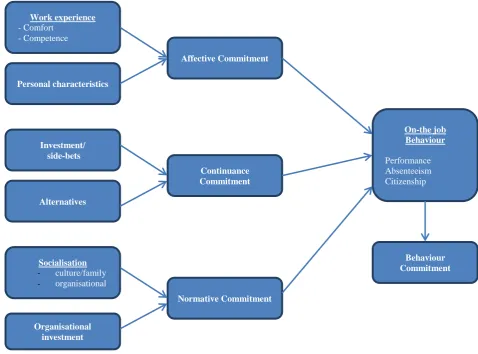
Figure 2.1 A three component model of organisational commitment
by Meyer and Allen (1991) 29
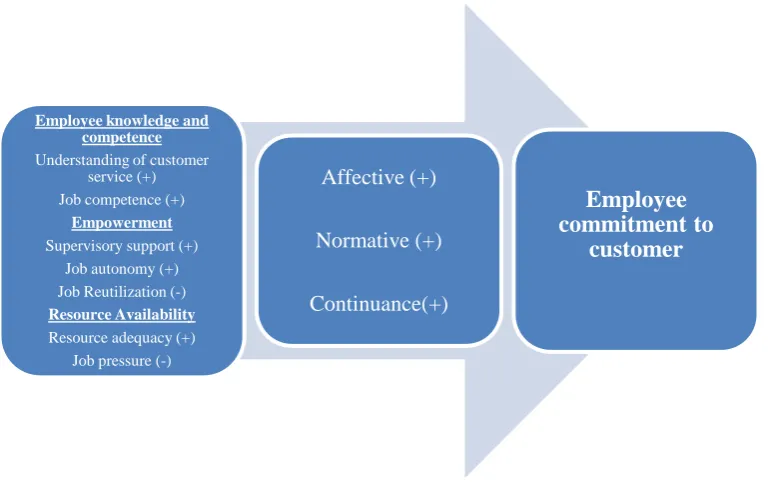
Figure 2.2 The concept of employee commitment to customer from
Peccei and Rosenthal (1997) 33
Chapter Three
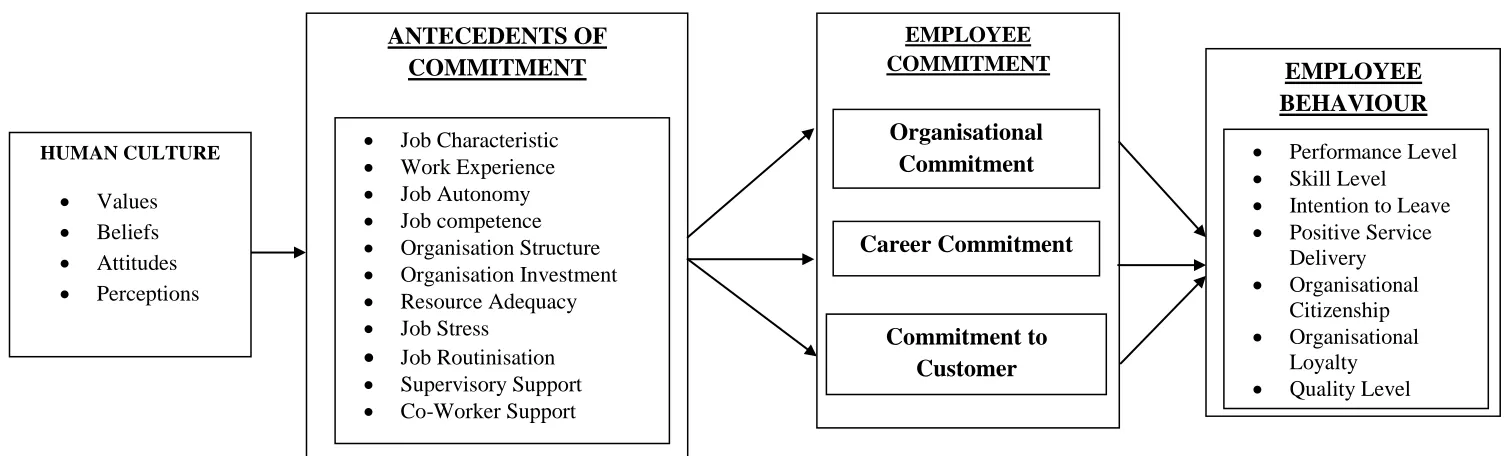
Figure 3.1 Conceptual framework 71
Chapter Four
Figure 4.1 Overview of methodology 91
Chapter Seven
Figure 7.1 The initial model of the relationship between human culture and attitudes to the antecedents of employee commitment
(Thai sample) 224
Figure 7.2 The adjusted model of the relationship between human culture and attitudes to the antecedents of employee commitment
(Thai sample) 226
Figure 7.3 The model of the relationship between human culture and attitudes to the antecedents of employee commitment with no significant
path (Thai sample) 231
Figure 7.4 The initial model of the relationship between attitudes to the antecedents of employee commitment and employee commitment
xix Figure 7.5 The adjusted model of the relationship between attitudes to
the antecedents of employee commitment and employee
commitment (Thai sample) 227
Figure 7.6 The model of the relationship between attitudes to the antecedents of employee commitment and employee commitment with only
significant paths (Thai sample) 231
Figure 7.7 The initial model of the relationship between employee
commitment and employee commitment and employee behaviour
(Thai sample) 234
Figure 7.8 The adjusted model of the relationship between employee commitment and employee commitment and employee behaviour
(Thai sample) 235
Figure 7.9 The model of the relationship between employee commitment and employee commitment and employee behaviour with
only significant paths (Thai sample) 239
Figure 7.10 The initial model of the relationship between human culture and attitudes to the antecedents of employee commitment
(Australian sample) 242
Figure 7.11 The adjusted model of the relationship between human culture and attitudes to the antecedents of employee commitment
(Australian sample) 243
Figure 7.12 The model of the relationship between human culture and attitudes to the antecedents of employee commitment with
no significant path (Australian sample) 248
Figure 7.13 The initial model of the relationship between attitudes to the antecedents of employee commitment and employee
commitment (Australian sample) 251
Figure 7.14 The adjusted model of the relationship between attitudes to the antecedents of employee commitment and employee
commitment (Australian sample) 252
Figure 7.15 The model of the relationship between attitudes to the antecedents of employee commitment and employee commitment with
xx
Figure 7.16 The initial model of the relationship between employee commitment and employee commitment and employee
behaviour (Australian sample) 259
Figure 7.17 The adjusted model of the relationship between employee commitment and employee commitment and employee
behaviour (Australian sample) 260
Figure 7.18 The model of the relationship between employee commitment and employee commitment and employee behaviour with
1
CHAPTER ONE
INTRODUCTION
1.1 Background
Tourism is an important economic activity contributing to at least 9% of the world‘s GDP and employing over 260 million people worldwide
(
World travel& Tourism Council 2013). Since 2001, the hospitality industry has grown phenomenally from increased leisure and business demand (Kloppers 2005). According to the International Labour Organisation (ILO) (2010), the hospitality sector of the tourism industry is a vital economic driver in the global economy because it is one of the few industries that is predicted to enjoy employment growth. However, over the last ten years the sector has entered an era of intense competition (Keating & Harrington 2003) and, as a result, countries that rely on tourism for employment growth and economic success need to be proactive in the global marketplace. Investment in accommodation provision is essential to support the growing industry.Due to the constantly changing increasing pace of business, organisations are facing new challenges and opportunities. Werner (2007) states that ―social, cultural, political, technological and global forces challenge organisations to redefine their strategies‖ (p.11). Organisations continually explore alternative ways to acquire, retain and improve their business position. The hospitality industry is confronted by high pressure at a global level, rapid advances in technology and greater customer expectations.
2 significant negative impact on profitability (O'Mahony 2007). The hotel industry needs to continuously develop, because high competition in the hotel market leads most hotels to improve their performance, to be more unique, and to develop a competitive and unique market offering.
As humans are the key issue in the service process, many organisations realise that employees are a significant key factor related to the growth of their organisations. Previous studies have identified that the employee is directly related to organisation performance, thus many scholars have undertaken research to develop employee performance through several aspects. According to Costley and Todd (1987, p.13) ―people work for money, but they also work for more than money‖. Most employees want to be proud of their organisations, to have a good relationship with other employees and managers, and to believe they have worthwhile jobs. Many factors influence both individuals and groups in organisations, but not all are considered when trying to understand the behaviour of people at work. Among those that are most frequently overlooked are the environment and culture of the organisations with which individuals are associated. Some studies relate the significance of employee satisfaction to the development of the organisation. According to Gelade and Young (2005, pp.2-3) ―satisfied and motivated employees produce satisfied customers, and satisfied customers tend to purchase more, thereby increasing revenue and profits for the organisation‖. In addition, satisfied motivated employees can develop employee commitment and strong relationships with customers leading to customer loyalty, the outcomes of which are repeat visitation and positive word of mouth communication (O‘Mahony & Sillitoe 2001; Teas 1994). However, the study of employee satisfaction also states that there is no guarantee that employee satisfaction will lead to increasing customer satisfaction.
3 organisation and customer service (Davidson 2003; Papis 2006). According to Cohen (2003, p.3), organisational commitment ―as a research topic is important regardless of its setting because a better understanding of the phenomenon may help us to better understand the nature of the psychological process through which people choose to identify with different objects in their environment and how they find purpose in life‖. However, in previous literature, several terms of employee commitment are used related to the development of the organisation, and the improvement of customer service such as employee commitment to career (Aryee & Tan 1992; Carson & Bedeian 1994; Arthur & Rousseau 1996; Jones 2007; Doeschot 2008) and employee commitment to the customer (Peccei & Rosenthal 1997; Chung & Schneider 2002; Vandenberghe et al. 2007).
Moreover, in the highly competitive hospitality industry, many hotel businesses attempt to expand their activities overseas with different markets and cultures. This could lead to more diverse recruitment of employees from international, national and local markets. In turn this leads to increasing diversity of cultures in multi-national organisations. Culture is potentially one of the most powerful forces influencing employee performance. The role of human culture is crucial to understanding employee psychology and behaviour. According to Lee et al. (2001), culture has a strong influence on employee commitment. Culture involves norms and standards that describe how employees should behave, and their study also suggests that culture influences employee‘ behaviour and attitudes (Brewster et al. 2007). Cultural differences exist in the correlation between the antecedents and components of organisational commitment (Meyer et al. 2002).
4 Vanderberghe et al. 2007; Clark et al. 2009), employee skill development (Aryee & Tan 1992; Aryee et al. 1994) and organisational citizenship behaviour (Carson & Carson 1998; Somech & Bogler 2002).
In summary, current research indicates that there is a relationship between employee commitment and organisational performance. However, very little research considers the relationship between employee commitment and the employee culture (as opposed to the organisation) in the service sector generally. Therefore, the purpose of this study is to better understand the relationship between three terms of employee commitment comprising organisational commitment, career commitment and commitment to customer, and human culture in the hospitality industry, and to study this relationship in the context of luxury four and five star hotels located in both Thailand and Australia, and to ascertain the impact of cultural difference on employee commitment.
1.2 Aims of the Research
The aim of this research is to develop a conceptual model of the factors influencing the relationship between employee commitment and cultural difference in the hospitality industry, especially an understanding of the specific role of human culture in influencing employee commitment in its several forms.
The research seeks to:
1. Explore the difference between employee commitment and employee human culture in hotel organisations in Australia and Thailand.
2. Develop a model of the relationship between employee human culture and employee commitment in hotels in Australia and Thailand.
3. Evaluate the constructs and variables of the developed model to determine their relationship to existing employee commitment models, and how these vary between Thailand and Australia.
5
1.3 Research questions
The main goal of this research is modelling the relationship between hotel employee commitment and cultural difference from the Thai and Australian perspectives, which in turn represent sound examples of both eastern and western culture. Specifically, this study investigates the influence of human culture on employee commitment in terms of organisational commitment, career commitment and employee commitment to the customer.
Employee commitment is recognised in the literature as the major driver behind the growth of service based organisations, especially in the hospitality industry. This study attempts to provide a better understanding of employee commitment in its different forms, and the influence of human culture on employee commitment. Moreover, this study presents the differences between Australian and Thai employees so that hospitality providers in each country, and more generally in eastern and western environments, can better manage their employees to be more committed. In particular, this study covers the following research questions:
Research question 1: Is there any difference in cultural and employee commitment between hotel employees in Australia and Thailand?
Research question 2: How can a better understanding of the cultural characteristics of employees improve employee commitment, resulting in improved organisational competitiveness?
Research question 3: What is the relationship between employee commitment and employee human culture, in hotel employees in Australia and Thailand?
6 between eastern and western work environments, which has potential significance beyond the countries studied.
1.4 Contribution to Knowledge (Academic Contribution)
The research proposed in this study develops a new model to study the relationship between hotel employee commitment and employee cultural difference. There is no current literature that analyses and develops a model for the relationship between employee commitment in all three forms, and employee cultural difference. This study makes a significant contribution to knowledge in addressing this research gap. Moreover, it will extend the literature relating to employee commitment and employee performance in the hospitality sector and specifically in the academic study of hotel performance in tourism. Thus, the purpose of this study is highly important for the tourism, hospitality and marketing sectors in contributing knowledge to the current gap related to the influence of human culture on employee commitment in the hospitality industry. The results of this study will draw together what are currently two separate areas of study in tourism, namely employee commitment currently focussing upon improved customer loyalty, and employee culture currently referred to as host culture, which is part of the wider study of cultural differences between hosts and guests.
1.5 Statement of Significance (Practical Contribution)
7 Past research on the influence of employee commitment to organisations has found positive impacts on the level of staff turnover (Porter et al. 1974; Steers 1977; Lee et al. 1992; Wasti 2003), organisational performance (Angel & Perry 1981; Meyer et al. 1989; Jaramillo et al. 2005) and employee performance (Boshoff & Tait 1996; Becker et al. 1996; Chen 2002; Sharma et al. 2009; Pakistan 2010). Additionally, research has shown that the cost to replace an employee is significant (Iverson& Deery 1997; Sagie et al. 2002; Lazar 2004). Research on employee commitment as it relates to customers has demonstrated the significance of commitment to customers in relation to employee performance (Peccei & Rosenthal 1997; 2001; Vandenberghe et al. 2007) and the quality of service provided (Peccei & Rosenthal 1997; 2001; Pugh 2001; Tsai & Huang 2002; Homburg & Stock 2004 Vanderberghe et al. 2007).
This study contributes to the existing body of knowledge by investigating the assumptions and human culture related to employee commitment in terms of organisational commitment, career commitment and commitment to the customer, enabling organisations to assess the significance of employee commitment to gain more positive consequences, including increased organisational profitability (Sanford 2005).
8
1.6 Study Location
The proposed study is conducted in Thailand and Australia to examine the similarities and difference in the cultural background of hospitality employees. Data is collected from over 600 questionnaires administered to employees who work in four to five stars hotels located in Hua Hin and Melbourne. The sample consists of equal participants of employees in Thailand and Australia, at least 300 questionnaires administered in each location.
9 Figure 1.1: Map of Hua Hin, Thailand
Source: http://www.Hua Hininjapan.com
10 Figure 1.2: Map of Melbourne
Source: http://www.australia-migration.com
1.7 Key terms
Human culture: refers to personal employee culture consisting of cultural values, attitudes and behaviour.
Cultural difference: refers to differences in hotel employee human culture between Thailand and Australia.
Employee commitment: refers to three terms of employee commitment including organisational commitment, career commitment and employee commitment to the customer.
11 Thailand: refers to hotel employees who work in Hua Hin sub district of Prachuapkhirikhan province in Thailand.
Australia: refers to hotel employees who working in Melbourne, Victoria, in Australia.
1.8 Overview of the Research and Research Procedure
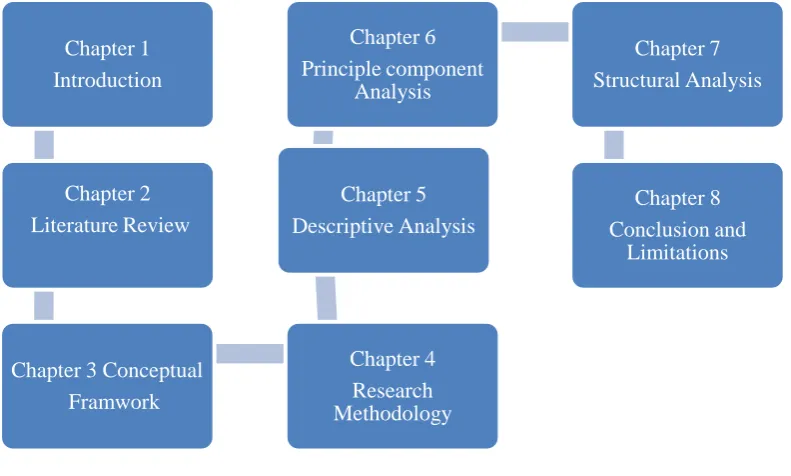
The objective of this study is to investigate the relationship between hotel employee commitment and human culture. Additionally, this study aims to compare cross cultural factors between the Thai and Australian perspectives as representative of eastern and western cultures. The study is organised into eight chapters, this section provides a brief review of the structure of the thesis as follows:
Figure 1.3: Summary of research structure
Chapter One. Introduction: this chapter provides a general introduction to the research study. The issues related to the topic under investigation, with a brief background to the study including research questions, research aims and objectives, contribution to knowledge and significance of the study and location.
Chapter 1 Introduction
Chapter 2 Literature Review
Chapter 3 Conceptual Framwork
Chapter 4 Research Methodology
Chapter 5 Descriptive Analysis
Chapter 6 Principle component
Analysis
Chapter 7 Structural Analysis
Chapter 8 Conclusion and
12 Chapter Two. Literature Review: this section reviews the current literature related to the aim of the study, including an overview of employee commitment, human culture theories, cultural difference studies and cross cultural studies.
Chapter Three. Conceptual Framework: this chapter develops a theoretical conceptual framework of the relationship between hotel employee commitment and cultural difference, as derived from the literature review and proposed in the thesis. The chapter discusses the hypotheses to be tested and analysed, that directly link to the research questions, outlined in Chapter One.
Chapter Four. Research Methodology: the methodology which is used to empirically examine the proposed model established in this chapter is outlined. This methodology conducts an overview of the design and justifies the use of the quantitative method, describes the scale items selected to measure the underlying constructs, discusses the instrument used to collect data, discusses the pre-test and final survey, identifies the technique used to collect data, discusses the importance of reliable and valid constructs, presents ethical considerations related to the study, and finally provides the instruments and procedures used to analyse the data. Moreover, this section critically reviews the background of Thailand and Australia, particularly in the hospitality contexts for Hua Hin and Melbourne.
Chapter Five. Descriptive Analysis: this chapter presents the results of the descriptive analysis. Frequency, mean, standard deviations are descriptive techniques used to analyse the data. Moreover, a Mann-Whitney U test is also used to summarise and compare the data from the Thai and Australian respondents. This chapter also analyses the results which directly link to the research questions, outlined in Chapter One.
13 the Thai and Australian samples. This chapter also answers the research question as outlined in chapter One.
Chapter Seven. Structural Analysis: this chapter provides results from the investigation of the relationship between hotel employee commitment and human culture. The chapter discusses the development and use of one of the most effective statistical techniques for structural analysis of the component variables developed in Chapter Six called Structural Equation Modelling. The results from the analysis for the Thai and Australian samples are presented separately and then compared. This chapter also provides answers to the research questions outlined in Chapter One and tests hypotheses developed in Chapter Three.
14
CHAPTER TWO
LITERATURE REVIEW
2.1 Introduction
In a highly competitive global tourism industry, many businesses have to explore new marketing strategies to maintain and increase their customer base. In the hospitality industry, hotel entrepreneurs have to develop marketing strategies to increase competitive advantage. One issue of marketing strategy that could be a significant factor in the hospitality industry is workforce development. Employees become the most important enterprise assets for tourism and hospitality businesses, and human capital represents the only sustainable source of competitive advantage. Infrastructure investment is only competitive in developing new hotels, while the infrastructure technology is universally available. As Davidson (2003) states, the right employees can increase the likelihood of success for service organisations and provide a competitive edge. Previous studies have highlighted the importance of employees to the growth of organisations in general including the hotel industry, based on the need for highly competent employees who have knowledge and skills to provide the best service to unpredictable customer requirements. However, there are few relevant studies that identify the influence of culture on employee performance in a cross cultural setting in the service sector, or cross cultural research on employee performance. Additionally, cross-cultural studies of employee workforce commitment are also limited.
15 The following literature review includes a discussion of employee commitment in terms of organisational commitment, employee commitment to customers and career commitment as a new a paradigm, followed by a discussion of culture in terms of human culture, which is used as a basis for further discussion about the constructs underpinning the proposed model of this study. The next section will present an overview of employee commitment theory (2.2), an overview of culture theory (2.3), and provide a background for discussing the constructs of interest (2.2, 2.3). The following section (2.4) then explains the cross cultural studies in the hospitality industry, then section (2.5) provide an overview individual‘s human culture. Finally, there is a detailed of A brief summary concludes Chapter Two (2.7).
2.2 Employee Commitment
This section begins by discussing the background to employee commitment (2.2.1), and the three main issues related to employee commitment including; organisational commitment (2.2.2), employee commitment to the customer (2.2.3) and career commitment (2.2.4). Each section also discusses the influences on overall employee commitment.
2.2.1 Background of Employee Commitment
For over a decade, research on commitment is of interest to scholars (Mowday et al. 1982), with the construct related to employee behaviour such as turnover, attendance, quality of work, job performance and loyalty (Somers & Birnbuam 1998).
16 et al. 1993), teams and leaders (e.g., Becker 1992; Hunt & Morgan 1994), careers (e.g., Blau 1985; 1988; Hall 1996) and customer service (e.g., Peccei & Rosenthal 1997; 2001; Vandenberghe et al. 2007).
2.2.1.1 The Definition of Commitment
There are several scholars who have attempted to define commitment such as Meyer and Herscovitch who state that commitment is ―a force that binds an individual to a course of action that is of relevance to a particular target‖ (2001 p.301). Table 2.1 presents a set of key definitions of commitment synthesised from the commitment literature. Many of the definitions listed in Table 2.1 view commitment as a singular (unidimensional) construct (e.g. Becker 1960; Mowday et al. 1979 Wiener 1982). In other cases, scholars present commitment as a common element linking it to a multi-dimensional model (e.g., O‘reilly & Chatman 1986; Allen & Meyer 1990), and finally some definitions state that commitment has a core essence that distinguishes it from other constructs (e.g., Brickman 1987; Brown 1996; Scholl 1981).
Table 2.1: Definitions of Commitment
In general:
―Commitment comes into being when a person, by making a side bet, links extraneous interests with a consistent line of activity.‖ (Becker 1960, p.32)
―…a state of being in which an individual becomes bound by his actions and through these actions to beliefs that sustain the activities of his own involvement.‖ (Salancik 1977, p.62)
―…a force that stabilises individual behaviour under circumstances where the individual would otherwise be tempted to change that behaviour.‖ (Brickman 1987, p.2)
―… an obliging force which requires that the person honour the commitment, even in the face of fluctuating attitude and whims.‖ (Brown 1996, p.241)
Organisational Commitment:
17 Table 2.1: Definitions of Commitment(Con.)
Organisational Commitment is defined as the psychological attachment felt by a person for the organisation (He et al. 2011).
―the strength of an individual‘s identification with and involvement‖ in an organisation (Porter et al. 1974, p.604).
―the strength of an individual‘s identification with and involvement in a particular organisation‖ (Crewson 1997, p.507).
―affective attachment to the goals and values of the organisation‖ (Buchanan 1974, p. 533).
Commitment to customer service:
―The relative propensity of an individual to engage in continuous improvement and to exert effort on the job for the benefit of the customer‖ (Peccei & Rosenthal 1997, p.69).
Goals Commitment:
―A committed person is thought to adopt a specific performance goal and to persist in attempts to reach it even through difficulties‖ (Tubbs 1993, p.86).
―…an unwillingness to subsequently reduce goals to a lower level when confronted with error signals‖ (Campion & Lord 1982, p.268).
―…one‘s attachment to or determination to reach a goal, regardless of the goal‘s origin‖ (Locke et al. 1988, p.24).
―…the determination to try for a goal and the persistence in pursuing it over time‖ (Hollenbeck et al. 1989, p.18).
Career Commitment:
Career commitment is termed as ―one‘s attitude to one‘s profession or vacation‖ (Blau 1985, p.278).
―the strength of one‘s motivation to work in a chosen career role. Commitment to entire career field or roles is to be distinguished from commitment to the job… or to one‘s organisation‖ (Hall 1971, p.59).
18 From the definitions of commitment, it could be stated that the construct is one of the most significant factors involved in employee behavioural support for change initiatives (Coetsee 1992; Klein & Sorra 1996; Herscovitch & Meyer 2002). It is revealed that forms of commitment in the workplace define the relationship between employees and employers. Through commitment, employers can be confident that an employee provides mental, physical and emotional support to the organisation (Welsch & Lavan 1981). Because of the labour intensive characteristics of the hospitality industry, hospitality businesses try to understand the motivations of their employees (Davidson 2003; Papis 2006) in order to satisfy them, and in this regard, employee commitment could be an important intervening variable (Silva 2006; He et al. 2011).
A brief introduction to these three forms of commitment (organisational commitment, employee commitment to the customer, and career commitment) follows. This will provide an opportunity to understand the development of commitment in this field and the difference between the three forms. The discussion will then move to an explanation of the three forms of commitment and their significance to this study.
2.2.2 The Antecedents of Commitment
From the previous literature there are various antecedents that are correlated with employee commitment. In this study, the antecedents of commitment are divided into three terms which are the antecedents to organisational commitment; career commitment and employee commitment to customer.
2.2.2.1 The Antecedents to Organisational Commitment
19
Personal Characteristics
Personal characteristics can be defined as ―those variables that define the individual‖ (Steers 1997, p.47). It is asserted that personal characteristics such as age, tenure, gender, family status and educational level can be linked to commitment (Buchanan 1974; Steers 1977; Angle & Perry 1981; Morris & Sherman 1981; Meyer and Allen 1984; Mottaz 1988; Thornhill et al. 1996; Suman & Srivastava 2012). Meyer and Allen (1997) indicate that personal characteristics can be measured by demographic variables. In the hospitality industry, several scholars indicate that personal characteristics have an influence on employee commitment to the organisation (Barlett 2007; Katsikea et al. 2011 Ozturk et al. 2013).
Previous studies found that employees who have a strong confidence in their abilities and achievement level tend to have a greater level of affective commitment (Steers 1977; Mathieu & Zajac 1990). Also Meyer and Allen (1991) identify the need for achievement, affiliation and autonomy as positively correlated with organisational commitment. Another approach is to consider the ―person-environment fit‖ which refers to employees being able to fulfil their needs and utilise their abilities in their work environment (Stumpf & Hartman 1984; Meyer & Allen 1991).
Organisational Structure
There are a few studies on the relationship between organisational commitment and organisational structure, and some evidence exists from the study of Meyer and Allen (1991) of the relationship of affective commitment to decentralisation. They argue that the decentralisation decision has an impact on organisational commitment. However, there are still some arguments that there is no evidence to confirm the significance of the relationship between organisational structure and commitment (Matieu & Zajac 1990).
Work Experience
20 physical (job security, working condition, salary) and motivational factor (recognition, advancement, achievement) (Herzberg 1968).
Job security is an employee requirement, and Kirmizi and Deniz (2009) indicate that job security impacts upon employee commitment to the organisation.
Pay satisfaction relates to an employee‘s satisfaction with the organisation. Pay may include basic salary and any incentive bonuses or other benefits that are received during employment. Islam et al. (2012) supports the concept that the level of employee commitment to the organisation depends on financial rewards received during employment.
Steers (1977) finds that if the organisation is unable to fulfil the employee‘s needs in both physical and motivation factors, individual employees will be less committed to the organisation, and more committed to their profession instead.
According to Buchanan (1974) work experiences can influence the level of employee commitment. Workexperiences are viewed as a major socializing force, that are found to have positive effects on commitment, including employee attitude toward the organisation (Buchanan 1974; Patchen 1970; Steers 1977), and trust in the organisation (Buchanan 1974; Hrebiniak 1974).
Investments
21
Alternatives
Rusbult and Farrell (1983) find that increased organisational commitment by the individual impacts negatively on the attractiveness of alternative employment opportunities, thereby causing them to be less attractive. Also Allen and Meyer (1990) identify that the fewer perceived available employment alternatives exist for an individual, the stronger the normative commitment.
Socialisation
Socialisation has a positive influence on employees before entry into the organisation, through family or cultural socialisation. Clugston et al. (2000) states that cultural socialisation is an antecedent of organisational commitment.
However, socialisation can also take place post-entry to the organisation (Meyer & Allen 1991). Meyer and Allen (1997) assume that internalisation is the process involved in the development of normative commitment, during the early days of assuming employment with an organisation.
Organisational Investment
Normative commitment can develop through organisational investment such as skill training that influences the relationship between employee and the organisation, and creates a need for reciprocation on the part of an employee (Meyer & Allen 1997; Fleetwood & Hesketh 2006; Boxall & Macky 2009; Brum 2010). Given the norm of reciprocity, employees may feel an obligation to the organisation as employees try to rectify the imbalance (Meyer & Allen 1991). Therefore, the relationship between employees and employers can be based on reciprocity.
2.2.2.2 Antecedent of Employee Commitment to Customer
22 and resource availability, which are more likely to impact an individuals‘ capacity to engage continuous development, and effectively respond to customer expectation. The essential principle for the influence of job characteristics is presented as a motivational force that inspires employees to improve, and apply more effort in the performance of their tasks (Gardner & Cummings 1988; Singh 1998).
Understanding of Customer Service
This variable refers to understanding what high quality of service entails, and how to provide the best service quality (Peccei & Rosenthal 1997).
Employees who have a strong understanding of customer service are expected to have stronger values related to providing high service quality to customers, and have a better understanding of the relationship requirements to customers (Peccei & Rosenthal 2001). Singh (1998) finds that a high level of understanding of customer service is positively correlated to high levels of job satisfaction and commitment.
Job Competence
Under expectancy theory and the basic goal setting argument, job competence refers to ―the extent to which individuals perceive that they have the necessary training, skills and competence to do their job well and cope with any unexpected problems in their work‖ (Peccei & Rosenthal 1997 p.72). A strong sense of job competence can impact to increase individual confidence and the ability to provide a high quality of service to customers (Peccei & Rosenthal 1997), job satisfaction (Hackman & Oldman 1976; Singh 1998), and commitment (Singh 1998).
Therefore, a clear understanding of the customer service performance requirement and of job competence can improve individual performance, and increase the ability to provide a greater quality of service. Both variables are hypothesized to have a positive impact on commitment to the customer (Peccei & Rosenthal 1997; 2001).
Supervisory Support
23 employer appears to be a dynamic, with employees monitoring and responding to changes in the organisation‘s apparent commitment. Because employees personify the organisation; they consider unfavourable or favourable treatment from the organisation as indicative of the organisation‘s orientation toward them (Rhoades et al. 2001). Employees who receive favourable treatment will increase their level of commitment and performance (Rhoades et al. 2001). However, Susskind et al. (2003) points out that a high level of supervisor support results in an increasing level of customer orientation.
Job Autonomy
In the job design paradigm, job autonomy refers to allowing employees to have the power to act directly in the environment. Job autonomy is defined as employees having the freedom to make decisions, and to be required to control their own work discretion (Swanepoel et al. 1998).
Hackman and Oldman (1980) identified that in the job characteristics model, autonomy is a significant measurement contributing to job satisfaction, which in turn increases the level of employee motivation and commitment. The relationship between autonomy, job satisfaction and commitment is supported by several scholars such as Fried and Ferris (1987), Singh (1989), and Brown and Peterson (1993).
Moreover, later studies have provided evidence that autonomy and empowerment result in the development of performance (Leach et al. 2003). Consequently, job autonomy is a significant dimension of empowerment (Peccei & Rosenthal 2001).
Job Routinisation
Job routinisation refers to the degree to which the work task is perceived to be repetitive. To avoid monotonous jobs the employees‘ routine should be influenced by motivation to perform well, while a challenging job enhances motivation itself (Kreitner et al. 1999).
24 number of employees who leave their jobs. Under the empowerment argument, supportive supervision and job autonomy are hypothesized to have a positive effect on commitment to customer service (Peccei & Rosenthal 1997; 2001).
Resource Adequacy
Resource adequacy refers to the extent to which the individual employee feels that their department is sufficiently well staffed to enable them to do their job well (Peccei & Rosenthal 1997). Demerouti et al. (2001) also find that employees will experience disengagement when job resources are lacking.
Lower levels of staffing will lead to increasingly high workloads of individual employees. Moreover, it also follows that employees will be less able to reach their goals, and stress will be increased that is negatively relating to job satisfaction, organisational commitment and performance (Demerouti et al. 2001).
Job Pressure
Job pressure refers to the degree employees perceive their job to be pressurized both in terms of workloads and the pace of work (Peccei & Rosenthal 1997). Additionally, job pressure also defines physical, organisational or social aspects of the job that require sustained physical or mental effort by employees (Demerouti et al. 2001). A high level of pressure can create a high level of stress including employee overload, and an overworked and uncertain feeling (Netemeyer et al. 1995). Stress can produce harmful physiological outcomes and negatively relates to job satisfaction, organisational commitment and performance (Demerouti et al. 2001).
Consequently, job pressure is expected to have a negative impact on commitment to customer service, whereas resource adequacy has a positive effect on commitment to customers (Peccei & Rosenthal 1997; 2001).
25 employee commitment to customers of the organisation. These seven variables (above) can be a driver to force employee commitment to customers in the hospitality industry.
2.2.2.3 Antecedent of Career Commitment
From previous studies of the antecedents of career commitment, there are four categories, including personal variables, individual variables, social variables, institutional variables, organisation dependency and remuneration and benefits. Each category is discussed below.
Personal Variables
Personal variables refer to employee characteristics a person brings to their work environment that influence the nature of their work. For instance age and education background, these variables positively correlate with career commitment (Colarelli & Bishop 1990; Goulet & Singh 2002; Meyer et al. 2002).
Individual Occupational Variables
Individual occupational variables refer to individual variables that are influenced or controlled by the individual that impact on work character. Esteem and importance are involved with career commitment and utility of the current job (Vanderberghe & Scarpello 1994; Lee et al. 2000; Somech & Bogler 2002) this also includes participation and inclusion by the employer in areas such as decision making (Somech & Bogler 2002). Length of service indicates a measure of investment a person has sunk into their career (Shoemaker et al. 1977; Lee et al. 2000). Additionally, it is found that satisfaction with one‘s current job can impact to enhance career commitment. Lee et al. (2000) also suggest that the relationship occurs because ―attitudes toward the job itself may be a central concern in committing to one‘s occupation‖ (p.799).
Social Occupational Variables