New Developments in DD4hep
MarkoPetriˇc1,∗,MarkusFrank1,FrankGaede2, andAndréSailer1
1CERN, CH-1211 Geneva 23, Switzerland
2DESY, Notkestraße 85, D-22607 Hamburg, Germany
Abstract.For a successful experiment, it is of utmost importance to provide a consistent detector description. This is also the main motivation behind DD4hep, which addresses detector description in a broad sense including the geometry and the materials used in the device, and additional parameters de-scribing, e.g., the detection techniques, constants required for alignment and calibration, description of the readout structures and conditions data. An inte-gral part of DD4hep is DDG4 which is a powerful tool that converts arbitrary DD4hep detector geometries to Geant4 and provides access to all Geant4 action stages. It is equipped with a comprehensive plugins suite that includes handling of different IO formats; Monte Carlo truth linking and a large set of segmenta-tion and sensitive detector classes, allowing the simulasegmenta-tion of a wide variety of
detector technologies. In the following, recent developments in DD4hep/DDG4
like the addition of a ROOT based persistency mechanism for the detector de-scription and the development of framework support for DDG4 are highlighted. Through this mechanism an experiment’s data processing framework can inter-face its essential tools to all DDG4 actions. This allows for simple integration of DD4hep into existing experiment frameworks.
1 Introduction
The DD4hep package [1] is a software toolkit that aims to unify aspects of detector descrip-tion at different stages of an experiment and increases the efficiency and the ease of use. The goal is to provide a consistent description from a single source in simulation, reconstruction and analysis phases. The advantages of such a consistent, comprehensive description are clearly established from experience in high energy physics experiments.
The DD4hep toolkit was developed using experience from the LHCb experiment [2] and the efforts of the Linear Collider Community [3]. The aim is to cover on the one side the geometrical and material properties, and on the other side also providing parameters such as alignment constants and calibration, description of the readout structures and conditions, and those directly associated with detection techniques. The main idea behind DD4hep is to build on widely used pre-existing software to achieve a comprehensive generic detector description. The construction and visualisation of the detector geometry are implemented through the ROOT geometry package [4], while the detector simulation is performed via an interface with the Geant4 simulation toolkit [5].
2 Main objectives
The requirements which DD4hep aims to satisfy are:
• Complete detector description: A full geometry description including all structures and the corresponding materials, the attributes necessary for visualization, the parameters needed for alignment, calibration, and environment description, as well as detector readout information.
• Coverage of the full life cycle of an experiment: Offering functionality for all stages
in the life-cycle of the experiment, from concept development, through construction to operation, providing a smooth transition between various stages.
• Single source of information:Containing all of the necessary information for interpreta-tion of data in all stages, from simulainterpreta-tion to reconstrucinterpreta-tion and analysis.
• Ease of use: Provides the final user with a simple and intuitive interface, which requires minimal external dependencies.
3 The DD4hep toolkit
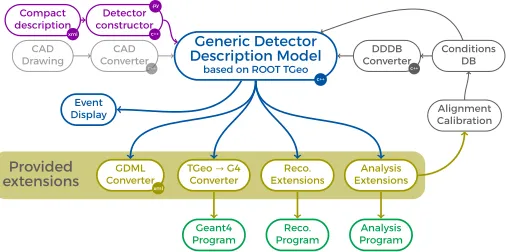
DD4hep is built around a core based on the ROOT TGeo package, named Generic Detector Description Model (GDDM) . It is an in-memory model, that consists of a set of objects con-taining geometry and auxiliary information about the detector. Figure 1 shows a schematic depiction of the various DD4hep components, the interactions between them and the end-user applications, such as alignment, visualisation and reconstruction.
ċë Ďā ~ĎáŇőļë
7ëħëļĎá ëŇëáŇĭļ ëŀáļĎĹŇĎĭħ eĭçëğ
àÊŀëç ĭħ ss 7ëĭ
ëŇëáŇĭļ áĭħŀŇļőáŇĭļ ĭĦĹÊáŇ
çëŀáļĎĹŇĎĭħ
ĭħŜëļŇëļ
ļÊŝĎħā
7e_
ĭħŜëļŇëļ 7ëĭĭħŜëļŇëļ→7ƈ !ŧŇëħŀĎĭħŀëáĭǕ !ŧŇëħŀĎĭħŀħÊğŨŀĎŀ
7ëÊħŇƈ
~ļĭāļÊĦ ~ļĭāļÊĦëáĭǕ ~ļĭāļÊĦħÊğŨŀĎŀ
ĭħŜëļŇëļ ĭħçĎŇĎĭħŀ
ğĎāħĦëħŇ ÊğĎàļÊŇĎĭħ
~ļĭŜĎçëç ëŧŇëħŀĎĭħŀ
áǼǼ áǼǼ
áǼǼ áǼǼ
ǕĹŨ
ŧĦğ
ŧĦğ !ŜëħŇ ĎŀĹğÊŨ
Marko Petrič (CERN) [email protected] Detector Simulations with DD4hep ƉǛƅƈ
Figure 1.The components of the DD4hep detector geometry toolkit (light gray components represent planned future developments).
The working principles of DD4hep [6] and details about simulation [7] have been sum-marized at previous conferences. The aim of these proceedings is to summarize the most relevant changes that occurred since release DD4hep v00-17 (now at v01-09). Developments related to conditions and alignment are discussed separately in [8].
3.1 Namespace reorganization
2 Main objectives
The requirements which DD4hep aims to satisfy are:
• Complete detector description: A full geometry description including all structures and the corresponding materials, the attributes necessary for visualization, the parameters needed for alignment, calibration, and environment description, as well as detector readout information.
• Coverage of the full life cycle of an experiment: Offering functionality for all stages
in the life-cycle of the experiment, from concept development, through construction to operation, providing a smooth transition between various stages.
• Single source of information:Containing all of the necessary information for interpreta-tion of data in all stages, from simulainterpreta-tion to reconstrucinterpreta-tion and analysis.
• Ease of use: Provides the final user with a simple and intuitive interface, which requires minimal external dependencies.
3 The DD4hep toolkit
DD4hep is built around a core based on the ROOT TGeo package, named Generic Detector Description Model (GDDM) . It is an in-memory model, that consists of a set of objects con-taining geometry and auxiliary information about the detector. Figure 1 shows a schematic depiction of the various DD4hep components, the interactions between them and the end-user applications, such as alignment, visualisation and reconstruction.
ċë Ďā ~ĎáŇőļë
7ëħëļĎá ëŇëáŇĭļ ëŀáļĎĹŇĎĭħ eĭçëğ
àÊŀëç ĭħ ss 7ëĭ
ëŇëáŇĭļ áĭħŀŇļőáŇĭļ ĭĦĹÊáŇ çëŀáļĎĹŇĎĭħ ĭħŜëļŇëļ ļÊŝĎħā 7e_
ĭħŜëļŇëļ 7ëĭĭħŜëļŇëļ→7ƈ !ŧŇëħŀĎĭħŀëáĭǕ !ŧŇëħŀĎĭħŀħÊğŨŀĎŀ
7ëÊħŇƈ ~ļĭāļÊĦ ~ļĭāļÊĦëáĭǕ ~ļĭāļÊĦħÊğŨŀĎŀ ĭħŜëļŇëļ ĭħçĎŇĎĭħŀ ğĎāħĦëħŇ ÊğĎàļÊŇĎĭħ ~ļĭŜĎçëç ëŧŇëħŀĎĭħŀ áǼǼ áǼǼ áǼǼ áǼǼ ǕĹŨ ŧĦğ ŧĦğ !ŜëħŇ ĎŀĹğÊŨ
Marko Petrič (CERN) [email protected] Detector Simulations with DD4hep ƉǛƅƈ
Figure 1.The components of the DD4hep detector geometry toolkit (light gray components represent planned future developments).
The working principles of DD4hep [6] and details about simulation [7] have been sum-marized at previous conferences. The aim of these proceedings is to summarize the most relevant changes that occurred since release DD4hep v00-17 (now at v01-09). Developments related to conditions and alignment are discussed separately in [8].
3.1 Namespace reorganization
To facilitate the ease of use and to streamline future developments, the DD4hep namespaces have been reorganized to be all lower case and shortened:
namespace DD4hep -> dd4hep;
namespace DD4hep::DDRec -> dd4hep::rec;
namespace DD4hep::Simulation -> dd4hep::sim;
namespace XML -> xml;
namespace JSON -> json;
All other namespaces have also been renamed according to the following pattern: the names-pace DD4hep::Geometry:: was incorporated into dd4hep::. All utilities are moved to
dd4hep::detail. LCDD (name deriving from Linear Collider Detector Description) was renamed toDetectorto more clearly denote the generic nature of the object.
3.2 Changes to the VolumeManager interface
Due to the ambiguous meaning of the function used to lookup a placement from the volume manager, discrepancies of how clients use this function have been observed: it may be con-sidered as the placement of the closest detector element – a functionality used by various tests – or to be the placement of the sensitive volume itself. Since there can be sensitive volumes which are directly connected to more than oneDetElementstructure, this function was split to resolve this ambiguity. Since each sensitive volume in the DD4hep tests is represented by aDetElementstructure, so far both approaches referenced the same placed volume.
/// Lookup a physical (placed) volume identified by its 64 bit hit ID PlacedVolume lookupVolumePlacement(VolumeID volume_id) const;
/// Lookup a physical (placed) volume of the detector element /// containing a volume identified by its 64 bit hit ID
PlacedVolume lookupDetElementPlacement(VolumeID volume_id) const;
3.3 The ROOT persistency mechanism
A new functionality of saving and restoring the full detector description from ROOT files has been added. Object extensions can also be stored, this requires a dictionary for the extension itself and a dictionary for the class holding the extension. These are:
// for DetElement extensions.
dd4hep::DetElement::DetElementExtension<IFACE,CONCRETE>
// for simple extension managed by the user framework (user calls explicitly destructor).
→
dd4hep::SimpleExtension<IFACE,CONCRETE>
// for simple extension managed by dd4hep (dd4hep calls automatically destructor on hosting object destruction).
→
dd4hep::DeleteExtension<IFACE,CONCRETE>
// As above, but these extensions support calling the copy constructor of the embedded object and hence allow to copy also the hosting objects.
→
dd4hep::CopyDeleteExtension<IFACE,CONCRETE>
The functionality has some limitations, concerning the usage of void pointers and the impos-sibility to save callback objects, which store in-memory pointers to member functions. These depend on the loading of libraries at run-time and hence may differ from execution to
3.4 Cell ID encoding
Information about the location of a sensitive cell that was hit in the simulation is stored in DD4hep via help of theBitField64class, which is not thread safe. A new thread-safe class
BitFieldCoderwas introduced as a replacement forBitField64, whileBitField64was
reimplemented usingBitFieldCoderand exhibits thread safety if used locally. It can be instantiated from const BitFieldCoder*. Heap allocation of BitFieldElementswas removed andmoveconstructors for an efficient filling of vectors were added.
3.5 Support for importing and exporting GDML data
DD4hep now supports importing and exporting partial geometry trees with GDML. This however requires ROOT version 6.12, since some changes were necessary in the ROOT GDML handlers. The plugin implementation can be reviewed in DDCore/src/gdml/GdmlPlugin.cpp.
3.6 External framework support in DDG4
The integration of DDG4 into event processing frameworks has been simplified. The
Geant4Contextis the main thread specific accessor to DDG4 and the user framework.
Access to the DD4hep objects is via theGeant4Context::detectorDescription() call, to DDG4 as a whole is supported via Geant4Context::kernel() and to the user framework using a specialized implementation of template <typename T> T&
userFramework() const. User defined implementations must be specialized somewhere
in a compilation unit of the user framework, not in an header file. The framework object could host e.g. references for histogramming, logging and data access. In this way any ex-periment related data processing framework can exhibit its essential tools as DDG4 actions. An example specialised implementation is as follows:
struct Gaudi { IMessageSvc* msg; IHistogramSvc* histos;
// ....
};
template<> Gaudi& Geant4Context::userFramework<Gaudi>() const { UserFramework& fw = m_kernel->userFramework();
if ( fw.first && &typeid(T) == fw.second ) return *(T*)fw.first;
throw std::runtime_error("No user specified framework context present!"); }
To access the user framework, after initialization the following call is then used:
Gaudi * fw = context->userFramework<Gaudi>(); GaudiKernel& kernel = // initialize kernel ;
kernel.setUserFramework(fw);
TheG4RunManageris now instantiated via a plugin. To allow for user defined run managers
in DDG4, the run manager is encapsulated in aGeant4Action. An example implementation can be foundDDG4/plugins/Geant4RunManagers.cpp. Currently there are two factories implemented; G4RunManageris a factory that invokes the single threadedG4RunManager
andG4MTRunManageris a factory that invokes the multi threadedG4MTRunManager. The
3.4 Cell ID encoding
Information about the location of a sensitive cell that was hit in the simulation is stored in DD4hep via help of theBitField64class, which is not thread safe. A new thread-safe class
BitFieldCoderwas introduced as a replacement forBitField64, whileBitField64was
reimplemented usingBitFieldCoderand exhibits thread safety if used locally. It can be instantiated from const BitFieldCoder*. Heap allocation of BitFieldElementswas removed andmoveconstructors for an efficient filling of vectors were added.
3.5 Support for importing and exporting GDML data
DD4hep now supports importing and exporting partial geometry trees with GDML. This however requires ROOT version 6.12, since some changes were necessary in the ROOT GDML handlers. The plugin implementation can be reviewed in DDCore/src/gdml/GdmlPlugin.cpp.
3.6 External framework support in DDG4
The integration of DDG4 into event processing frameworks has been simplified. The
Geant4Contextis the main thread specific accessor to DDG4 and the user framework.
Access to the DD4hep objects is via theGeant4Context::detectorDescription() call, to DDG4 as a whole is supported via Geant4Context::kernel() and to the user framework using a specialized implementation of template <typename T> T&
userFramework() const. User defined implementations must be specialized somewhere
in a compilation unit of the user framework, not in an header file. The framework object could host e.g. references for histogramming, logging and data access. In this way any ex-periment related data processing framework can exhibit its essential tools as DDG4 actions. An example specialised implementation is as follows:
struct Gaudi { IMessageSvc* msg; IHistogramSvc* histos;
// ....
};
template<> Gaudi& Geant4Context::userFramework<Gaudi>() const { UserFramework& fw = m_kernel->userFramework();
if ( fw.first && &typeid(T) == fw.second ) return *(T*)fw.first;
throw std::runtime_error("No user specified framework context present!"); }
To access the user framework, after initialization the following call is then used:
Gaudi * fw = context->userFramework<Gaudi>(); GaudiKernel& kernel = // initialize kernel ;
kernel.setUserFramework(fw);
TheG4RunManageris now instantiated via a plugin. To allow for user defined run managers
in DDG4, the run manager is encapsulated in aGeant4Action. An example implementation can be foundDDG4/plugins/Geant4RunManagers.cpp. Currently there are two factories implemented; G4RunManageris a factory that invokes the single threadedG4RunManager
andG4MTRunManageris a factory that invokes the multi threadedG4MTRunManager. The
factory names here are identical to the names of the native Geant4 classes.
3.7 String parsing
The Detector class was expanded to support parsing of XML from string. The existing view
dd4hep::DetectorLoadwas enhanced to allow this functionality:
Detector detector = ....;
/// We parse the raw XML string
DetectorLoad loader(detector); loader.processXMLString(buffer,0);
A detailed example can be reviewed underClientTests/src/XML_InMemory.cpp.
3.8 Geometry building state
The Detector object has a new state functionDetector::state()which returns three val-ues:
/// The detector description states
enum State {
/// The detector description object is freshly created. No geometry nothing.
→
NOT_READY = 1<<0,
/// The geometry is being created and loaded. (parsing ongoing)
LOADING = 1<<1,
/// The geometry is loaded.
READY = 1<<2 };
It starts withNOT_READY, moves toLOADINGonce the geometry is opened and goes toREADY once the geometry is closed. The initial object is invalid and gets created only once the geometry is opened. As a corollary, the object may not be accessed before. Geometry parsers must take this behavior into account.
3.9 SensitiveDetector types behaviour
The sensitive detector type defined in the detector constructors is no longer changed in-transparently in the users’ background. This does not work with Geant4, where a map-ping of these types must be applied to supported sensitive detectors. Now the mapmap-ping of aSensitiveDetectortype (e.g. "tracker") is strictly in the python setup. The default fac-tory to create any sensitive detector instance in Geant4 is a property of theGeant4Kernel instance and defaults to:
declareProperty("DefaultSensitiveType", m_dfltSensitiveDetectorType =
"Geant4SensDet");
→
3.10 Parallel geometries
It is possible to define volumes in a parallel world, which might be used for track or event reconstruction or for distinguishing different behaviors in the association of Monte Carlo truth information or any other means. In principle any volume hierarchy may be attached to the parallel world. None of these volumes participate in the tracking as long as the “connected” attribute is set to false. The hierarchy of parallel world volumes can be accessed from the main detector object using:
dd4hep::Volume parallel = dd4hep::Description::parallelWorldVolume()
This parallel world volume is created when the geometry is opened together with the world volume itself. If the name of the volume is “tracking_volume” within the compact notation it is declared as the Detector’s trackingVolume entity and is accessible as well:
dd4hep::Volume trackers = dd4hep::Description::trackingVolume()
Although the concept is available in the DD4hep core, its configuration from XML is only implemented for the compact notation. If the volume should be connected to the world one has to setconnected = true. This is useful for debugging because the volume can be visu-alized; otherwise set connected = false to make the volume only part of the parallel-world. The volume is always connected to the top level. The anchor detector element defines the base transformation to place the volume within the (parallel) world.
<parallelworld_volume name="tracking_volume" anchor="/world" material="Air"
connected="true" vis="VisibleBlue">
→
<shape type="BooleanShape" operation="Subtraction"> <shape type="BooleanShape" operation="Subtraction">
<shape type="BooleanShape" operation="Subtraction" > <shape type="Tube" rmin="0*cm" rmax="100*cm" dz="100*cm"/> <shape type="Cone" rmin2="0*cm" rmax2="60*cm" rmin1="0*cm"
rmax1="30*cm" z="40*cm"/>
→
<position x="0*cm" y="0*cm" z="65*cm"/> </shape>
<shape type="Cone" rmin1="0*cm" rmax1="60*cm" rmin2="0*cm"
rmax2="30*cm" z="40*cm"/>
→
<position x="0" y="0" z="-65*cm"/> </shape>
<shape type="Cone" rmin2="0*cm" rmax2="55*cm" rmin1="0*cm" rmax1="55*cm"
z="30*cm"/>
→
<position x="0" y="0" z="0*cm"/> </shape>
<position x="0*cm" y="50*cm" z="0*cm"/> <rotation x="pi/2.0" y="0" z="0"/> </parallelworld_volume>
The above example shows how the subtraction of shapes including translations can be defined with the help ofBooleanShape. With such an approach an arbitrary parallel world volume can be created.
3.11 Enhancement of assemblies, regions and production cuts
3.10 Parallel geometries
It is possible to define volumes in a parallel world, which might be used for track or event reconstruction or for distinguishing different behaviors in the association of Monte Carlo truth information or any other means. In principle any volume hierarchy may be attached to the parallel world. None of these volumes participate in the tracking as long as the “connected” attribute is set to false. The hierarchy of parallel world volumes can be accessed from the main detector object using:
dd4hep::Volume parallel = dd4hep::Description::parallelWorldVolume()
This parallel world volume is created when the geometry is opened together with the world volume itself. If the name of the volume is “tracking_volume” within the compact notation it is declared as the Detector’s trackingVolume entity and is accessible as well:
dd4hep::Volume trackers = dd4hep::Description::trackingVolume()
Although the concept is available in the DD4hep core, its configuration from XML is only implemented for the compact notation. If the volume should be connected to the world one has to setconnected = true. This is useful for debugging because the volume can be visu-alized; otherwise set connected = false to make the volume only part of the parallel-world. The volume is always connected to the top level. The anchor detector element defines the base transformation to place the volume within the (parallel) world.
<parallelworld_volume name="tracking_volume" anchor="/world" material="Air"
connected="true" vis="VisibleBlue">
→
<shape type="BooleanShape" operation="Subtraction"> <shape type="BooleanShape" operation="Subtraction">
<shape type="BooleanShape" operation="Subtraction" > <shape type="Tube" rmin="0*cm" rmax="100*cm" dz="100*cm"/> <shape type="Cone" rmin2="0*cm" rmax2="60*cm" rmin1="0*cm"
rmax1="30*cm" z="40*cm"/>
→
<position x="0*cm" y="0*cm" z="65*cm"/> </shape>
<shape type="Cone" rmin1="0*cm" rmax1="60*cm" rmin2="0*cm"
rmax2="30*cm" z="40*cm"/>
→
<position x="0" y="0" z="-65*cm"/> </shape>
<shape type="Cone" rmin2="0*cm" rmax2="55*cm" rmin1="0*cm" rmax1="55*cm"
z="30*cm"/>
→
<position x="0" y="0" z="0*cm"/> </shape>
<position x="0*cm" y="50*cm" z="0*cm"/> <rotation x="pi/2.0" y="0" z="0"/> </parallelworld_volume>
The above example shows how the subtraction of shapes including translations can be defined with the help ofBooleanShape. With such an approach an arbitrary parallel world volume can be created.
3.11 Enhancement of assemblies, regions and production cuts
Particle specific production cuts may now be specified in the compact notation. These pro-duction cuts are specified ascutentities in thelimitset. The hierarchy of cuts to be applied
is: if present particle specific production cuts for a region exist, they are applied – otherwise thecutattribute of the compact region specification is used. If none of the above is specified, the global Geant4 cut is automatically applied by Geant4. An example is shown below:
<limits>
<limitset name="VXD_RegionLimitSet">
<!--These are particle specific limits applied to the region ending in Geant4 as a G4UserLimits instance
-->
<limit name="step_length_max" particles="*" value="5.0" unit="mm" /> <limit name="track_length_max" particles="*" value="5.0" unit="mm" /> <limit name="time_max" particles="*" value="5.0" unit="ns" /> <limit name="ekin_min" particles="*" value="0.01" unit="MeV" /> <limit name="range_min" particles="*" value="5.0" unit="mm" />
<!--These are particle specific production cuts applied to the region ending in Geant4 as a G4ProductionCuts instance
-->
<cut particles="e+" value="2.0" unit="mm" /> <cut particles="e-" value="2.0" unit="mm" /> <cut particles="gamma" value="5.0" unit="mm" /> </limitset>
</limits>
4 Conclusion
The DD4hep Detector Description Toolkit provides an extended toolset for detector descrip-tion, event simulation and reconstruction. The user community of DD4hep is growing as is the list of features developed to help clients and users of the toolkit. The toolkit is under in-vestigation for future software implementation in the LHCb and CMS collaborations. These proceedings mostly cover features developed for clients of the toolkit to make their adoption easier.
Acknowledgements
This project has received funding from the European Union’s Horizon 2020 Research and Innovation programme under Grant Agreement no. 654168.
References
[1] M. Frank, F. Gaede, M. Petric, A. Sailer, AIDASoft/DD4hep (2018), webpage:
http://dd4hep.cern.ch/,https://doi.org/10.5281/zenodo.592244
[2] S. Ponce, P. Mato Vila, A. Valassi, I. Belyaev, eConf C0303241, THJT007 (2003), physics/0306089
[3] LCC,The Linear Collider Collaboration,https://www.linearcollider.org/ [4] R. Brun, A. Gheata, M. Gheata, Nucl. Instrum. Meth.A502, 676 (2003)
[5] S. Agostinelli et al. (GEANT4), Nucl. Instrum. Meth.A506, 250 (2003) [6] M. Frank, F. Gaede, C. Grefe, P. Mato, J. Phys. Conf. Ser.513, 022010 (2014)
[7] M. Petriˇc, M. Frank, F. Gaede, S. Lu, N. Nikiforou, A. Sailer, Journal of Physics: Con-ference Series898, 042015 (2017)