Proceedings of the Third Workshop on Statistical Machine Translation, pages 44–52,
Using Syntax to Improve Word Alignment Precision for Syntax-Based
Machine Translation
Victoria Fossum Dept. of Computer Science
University of Michigan Ann Arbor, MI 48104
Kevin Knight
Information Sciences Institute University of Southern California
Marina del Rey, CA 90292
Steven Abney Dept. of Linguistics University of Michigan
Ann Arbor, MI 48104
Abstract
Word alignments that violate syntactic cor-respondences interfere with the extraction of string-to-tree transducer rules for syntax-based machine translation. We present an algorithm for identifying and deleting incor-rect word alignment links, using features of the extracted rules. We obtain gains in both alignment quality and translation quality in Chinese-English and Arabic-English transla-tion experiments relative to a GIZA++ union baseline.
1 Introduction
1.1 Motivation
Word alignment typically constitutes the first stage of the statistical machine translation pipeline. GIZA++ (Och and Ney, 2003), an implementation of the IBM (Brown et al., 1993) and HMM (?) alignment models, is the most widely-used align-ment system. GIZA++ union alignalign-ments have been used in the state-of-the-art syntax-based statistical MT system described in (Galley et al., 2006) and in the hierarchical phrase-based system Hiero (Chiang, 2007). GIZA++ refined alignments have been used in state-of-the-art phrase-based statistical MT sys-tems such as (Och, 2004); variations on the refined heuristic have been used by (Koehn et al., 2003) (diag and diag-and) and by the phrase-based system Moses (grow-diag-final) (Koehn et al., 2007).
GIZA++ union alignments have high recall but low precision, while intersection or refined
align-ments have high precision but low recall.1 There are two natural approaches to improving upon GIZA++ alignments, then: deleting links from union align-ments, or adding links to intersection or refined alignments. In this work, we delete links from GIZA++ union alignments to improve precision.
The low precision of GIZA++ union alignments poses a particular problem for syntax-based rule ex-traction algorithms such as (Quirk et al., 2005; Gal-ley et al., 2006; Huang et al., 2006; Liu et al., 2006): if the incorrect links violate syntactic corre-spondences, they force the rule extraction algorithm to extract rules that are large in size, few in number, and poor in generalization ability.
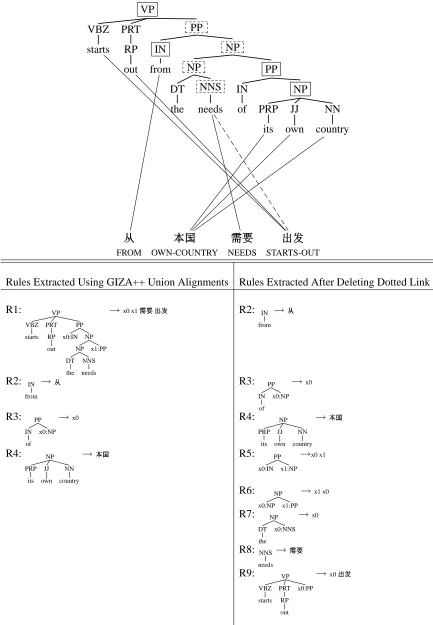
Figure 1 illustrates this problem: the dotted line represents an incorrect link in the GIZA++ union alignment. Using the rule extraction algorithm de-scribed in (Galley et al., 2004), we extract the rules shown in the leftmost column (R1–R4). Rule R1 is large and unlikely to generalize well. If we delete the incorrect link in Figure 1, we can extract the rules shown in the rightmost column (R2–R9): Rule R1, the largest rule from the initial set, disappears, and several smaller, more modular rules (R5–R9) re-place it.
In this work, we present a supervised algorithm that uses these two features of the extracted rules (size of largest rule and total number of rules), as well as a handful of structural and lexical features, to automatically identify and delete incorrect links from GIZA++ union alignments. We show that link
1For a complete discussion of alignment symmetrization
heuristics, including union, intersection, and refined, refer to (Och and Ney, 2003).
VP
VBZ
starts PRT
RP
out
PP
IN
from
NP
NP
DT
the
NNS
needs
PP
IN
of
NP
PRP
its JJ
own
NN
country
,
,, ýýý ))) ñññ
FROM OWN-COUNTRY NEEDS STARTS-OUT
Rules Extracted Using GIZA++ Union Alignments Rules Extracted After Deleting Dotted Link
R1: VP
VBZ
starts PRT
RP
out PP
x0:IN NP
NP
DT
the NNS
needs x1:PP
→x0 x1 ñññ R2: IN
from
→,,,
R2: IN
from
→,,, R3: PP
IN
of x0:NP
→x0
R3: PP
IN
of x0:NP
→x0 R4: NP
PRP
its JJ
own NN
country
→ýýý )))
R4: NP
PRP
its JJ
own NN
country
→ýýý ))) R5: PP
x0:IN x1:NP
→x0 x1
R6: NP
x0:NP x1:PP
→x1 x0
R7: NP
DT
the x0:NNS
→x0
R8: NNS
needs
→
R9: VP
VBZ
starts PRT
RP
out x0:PP
→x0ñññ
deletion improves alignment quality and translation quality in Chinese-English and Arabic-English MT, relative to a strong baseline. Our link deletion al-gorithm is easy to implement, runs quickly, and has been used by a top-scoring MT system in the Chi-nese newswire track of the 2008 NIST evaluation.
1.2 Related Work
Recently, discriminative methods for alignment have rivaled the quality of IBM Model 4 alignments (Liu et al., 2005; Ittycheriah and Roukos, 2005; Taskar et al., 2005; Moore et al., 2006; Fraser and Marcu, 2007b). However, except for (Fraser and Marcu, 2007b), none of these advances in align-ment quality has improved translation quality of a state-of-the-art system. We use a discriminatively trained model to identify and delete incorrect links, and demonstrate that these gains in alignment qual-ity lead to gains in translation qualqual-ity in a state-of-the-art syntax-based MT system. In contrast to the semi-supervised LEAF alignment algorithm of (Fraser and Marcu, 2007b), which requires 1,500-2,000 CPU days per iteration to align 8.4M Chinese-English sentences (anonymous, p.c.), link deletion requires only 450 CPU hours to re-align such a cor-pus (after initial alignment by GIZA++, which re-quires 20-24 CPU days).
Several recent works incorporate syntactic fea-tures into alignment. (May and Knight, 2007) use syntactic constraints to re-align a parallel corpus that has been aligned by GIZA++ as follows: they extract string-to-tree transducer rules from the corpus, the target parse trees, and the alignment; discard the ini-tial alignment; use the extracted rules to construct a forest of possible string-to-tree derivations for each string/tree pair in the corpus; use EM to select the Viterbi derivation tree for each pair; and finally, in-duce a new alignment from the Viterbi derivations, using the re-aligned corpus to train a syntax-based MT system. (May and Knight, 2007) differs from our approach in two ways: first, the set of possible re-alignments they consider for each sentence pair is limited by the initial GIZA++ alignments seen over the training corpus, while we consider all alignments that can be reached by deleting links from the ini-tial GIZA++ alignment for that sentence pair. Sec-ond, (May and Knight, 2007) use a time-intensive training algorithm to select the best re-alignment
for each sentence pair, while we use a fast greedy search to determine which links to delete; in con-trast to (May and Knight, 2007), who require 400 CPU hours to re-align 330k Chinese-English sen-tence pairs (anonymous, p.c), link deletion requires only 18 CPU hours to re-align such a corpus.
(Lopez and Resnik, 2005) and (Denero and Klein, 2007) modify the distortion model of the HMM alignment model (Vogel et al., 1996) to reflect tree distance rather than string distance; (Cherry and Lin, 2006) modify an ITG aligner by introducing a penalty for induced parses that violate syntac-tic bracketing constraints. Similarly to these ap-proaches, we use syntactic bracketing to constrain alignment, but our work extends beyond improving alignment quality to improve translation quality as well.
2 Link Deletion
We propose an algorithm to re-align a parallel bitext that has been aligned by GIZA++ (IBM Model 4), then symmetrized using the union heuristic. We then train a syntax-based translation system on the re-aligned bitext, and evaluate whether the re-re-aligned bitext yields a better translation model than a base-line system trained on the GIZA++ union aligned bitext.
2.1 Link Deletion Algorithm
Our algorithm for re-alignment proceeds as follows. We make a single pass over the corpus. For each sen-tence pair, we initialize the alignmentA = Ainitial
(the GIZA++ union alignment for that sentence pair). We represent the score of A as a weighted linear combination of features hi of the alignment A, the target parse treeparse(e)(a phrase-structure syntactic representation ofe), and the source string
f:
score(A) = n X
i=0
λi·hi(A, parse(e), f)
We define a branch of links to be a contiguous 1-to-many alignment.2 We define two alignments, A
2
In Figure 1, the 1-to-many alignment formed by {ýýý)))
-its, ýýý)))- own,ýýý)))-country} constitutes a branch, but the
1-to-many alignment formed by{ñññ-starts,ñññ-out,ñññ
and A′, to be neighbors if they differ only by the deletion of a link or branch of links. We consider all alignments A′ in the neighborhood of A, greedily deleting the linkl or branch of links bmaximizing the score of the resulting alignment A′ = A\l or
A′ =A\b. We delete links until no further increase in the score ofAis possible.3
In section 2.2 we describe the features hi, and in
section 2.4 we describe how to set the weightsλi.
2.2 Features
2.2.1 Syntactic Features
We use two features of the string-to-tree trans-ducer rules extracted from A, parse(e), and f ac-cording to the rule extraction algorithm described in (Galley et al., 2004):
ruleCount: Total number of rules extracted from
A, parse(e), and f. As Figure 1 illustrates, in-correct links violating syntactic brackets tend to de-crease ruleCount; ruleCount inde-creases from 4 to 8 after deleting the incorrect link.
sizeOfLargestRule: The size, measured in terms of internal nodes in the target parse tree, of the single largest rule extracted from A, parse(e), andf. In Figure 1, the largest rules in the leftmost and right-most columns are R1 (with 9 internal nodes) and R9 (with 4 internal nodes), respectively.
2.2.2 Structural Features
wordsUnaligned: Total number of unaligned words.
1-to-many Links: Total number of links for which one word is aligned to multiple words, in either di-rection. In Figure 1, the links {ñññ-starts,ñññ -out,ñññ-needs} represent a 1-to-many alignment. 1-to-many links appear more frequently in GIZA++ union alignments than in gold alignments, and are therefore good candidates for deletion. The cate-gory of 1-to-many links is further subdivided, de-pending on the degree of contiguity that the link ex-hibits with its neighbors.4 Each link in a 1-to-many
3
While using a dynamic programming algorithm would likely improve search efficiency and allow link deletion to find an optimal solution, in practice, the greedy search runs quickly and improves alignment quality.
4
(Deng and Byrne, 2005) observe that, in a manually aligned Chinese-English corpus, 82% of the Chinese words that are
alignment can have 0, 1, or 2 neighbors, according to how many links are adjacent to it in the 1-to-many alignment:
zeroNeighbors: In Figure 1, the linkñññ-needs has 0 neighbors.
oneNeighbor: In Figure 1, the links ñññ-starts and ñññ-out each have 1 neighbor–namely, each other.
twoNeighbors: In Figure 1, in the 1-to-many alignment formed by {ýýý)))-its,ýýý)))-own,ýýý))) -country}, the link ýýý)))-own has 2 neighbors, namelyýýý )))-it andýýý )))-country.
2.2.3 Lexical Features
highestLexProbRank: A link ei-fj is
“max-probable from ei tofj” ifp(fj|ei) > p(fj′|ei) for all alternative words fj′ with which ei is aligned
in Ainitial. In Figure 1, p(|needs) > p(ñññ
|needs), so -needs is max-probable for “needs”. The definition of “max-probable fromfjto ei” is analogous, and a link is max-probable
(nondi-rectionally) if it is max-probable in either direction. The value of highestLexProbRank is the total num-ber of max-probable links. The conditional lexical probabilitiesp(ei|fj)andp(fj|ei)are estimated us-ing frequencies of aligned word pairs in the high-precision GIZA++ intersection alignments for the training corpus.
2.2.4 History Features
In addition to the above syntactic, structural, and lexical features of A, we also incorporate two features of the link deletion history itself into
Score(A):
linksDeleted: Total number of links deleted
Ainitial thus far. At each iteration, either a link or
a branch of links is deleted.
aligned to multiple English words are aligned to a contiguous block of English words; similarly, 88% of the English words that are aligned to multiple Chinese words are aligned to a
con-tiguous block of Chinese words. Thus, if a Chinese word is
stepsTaken: Total number of iterations thus far in the search; at each iteration, either a link or a branch is deleted. This feature serves as a constant cost function per step taken during link deletion.
2.3 Constraints
Protecting Refined Links from Deletion: Since GIZA++ refined links have higher precision than union links5, we do not consider any GIZA++ re-fined links for deletion.6
Stoplist: In our Chinese-English corpora, the 10 most common English words (excluding punc-tuation marks) include {a,in,to,of,and,the}, while the 10 most common Chinese words include
{êêê,444,óóó,ZZZ,{{{}. Of these, {a,the} and {êêê,{{{} have no explicit translational equivalent in the other language. These words are aligned with each other frequently (and erroneously) by GIZA++ union, but rarely in the gold standard. We delete all links in the set {a, an, the} × {{{{, êêê} from Ainitial as a preprocessing step.7
2.4 Perceptron Training
We set the feature weights λusing a modified ver-sion of averaged perceptron learning with structured outputs (Collins, 2002). Following (Moore, 2005), we initialize the value of our expected most infor-mative feature (ruleCount) to 1.0, and initialize all other feature weights to 0. During each pass over the discriminative training set, we “decode” each sen-tence pair by greedily deleting links fromAinitialin
order to maximize the score of the resulting align-ment using the current settings ofλ(for details, refer to section 2.1).
5
On a 400-sentence-pair Chinese-English data set, GIZA++ union alignments have a precision of 77.32 while GIZA++ re-fined alignments have a precision of 85.26.
6
To see how GIZA++ refined alignments compare to GIZA++ union alignments for syntax-based translation, we compare systems trained on each set of alignments for Chinese-English translation taskA. Union alignments result in a test set BLEU score of 41.17, as compared to only 36.99 for refined.
7
The impact upon alignment f-measure of deleting these stoplist links is small; on Chinese-English Data SetA, the f-measure of the baseline GIZA++ union alignments on the test set increases from 63.44 to 63.81 after deleting stoplist links, while the remaining increase in f-measure from 63.81 to 75.14 (shown in Table 3) is due to the link deletion algorithm itself.
We construct a set of candidate alignments
Acandidates for use in reranking as follows. Starting
withA = Ainitial, we iteratively explore all
align-ments A′ in the neighborhood of A, adding each
neighbor to Acandidates, then selecting the neigh-bor that maximizes Score(A′). When it is no longer possible to increase Score(A) by deleting any links, link deletion concludes and returns the highest-scoring alignment,A1-best.
In general, Agold ∈/ Acandidates; following
(Collins, 2000) and (Charniak and Johnson, 2005) for parse reranking and (Liang et al., 2006) for trans-lation reranking, we define Aoracle as alignment in Acandidates that is most similar toAgold.8 We
up-date each feature weightλi as follows: λi = λi+ hAoracle
i −h
A1-best
i .9
Following (Moore, 2005), after each training pass, we average all the feature weight vectors seen during the pass, and decode the discriminative train-ing set ustrain-ing the vector of averaged feature weights. When alignment quality stops increasing on the dis-criminative training set, perceptron training ends.10 The weight vector returned by perceptron training is the average over the training set of all weight vectors seen during all iterations; averaging reduces overfit-ting on the training set (Collins, 2002).
3 Experimental Setup
3.1 Data Sets
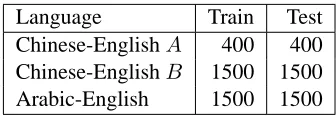
We evaluate the effect of link deletion upon align-ment quality and translation quality for two Chinese-English data sets, and one Arabic-Chinese-English data set. Each data set consists of newswire, and contains a small subset of manually aligned sentence pairs. We divide the manually aligned subset into a training set (used to discriminatively set the feature weights for link deletion) and a test set (used to evaluate the im-pact of link deletion upon alignment quality). Table 1 lists the source and the size of the manually aligned training and test sets used for each alignment task.
8
We discuss alignment similarity metrics in detail in Section 3.2.
9(Liang et al., 2006) report that, for translation reranking,
such local updates (towards the oracle) outperform bold updates (towards the gold standard).
10
Using the feature weights learned on the manually aligned training set, we then apply link deletion to the remainder (non-manually aligned) of each bilin-gual data set, and train a full syntax-based statistical MT system on these sentence pairs. After maximum BLEU tuning (Och, 2003a) on a held-out tuning set, we evaluate translation quality on a held-out test set. Table 2 lists the source and the size of the training, tuning, and test sets used for each translation task.
3.2 Evaluation Metrics
AER (Alignment Error Rate) (Och and Ney, 2003) is the most widely used metric of alignment qual-ity, but requires gold-standard alignments labelled with “sure/possible” annotations to compute; lack-ing such annotations, we can compute alignment f-measure instead.
However, (Fraser and Marcu, 2007a) show that, in phrase-based translation, improvements in AER or f-measure do not necessarily correlate with im-provements in BLEU score. They propose two mod-ifications to f-measure: varying the precision/recall tradeoff, and fully-connecting the alignment links before computing f-measure.11
Weighted Fully-Connected F-Measure Given a hypothesized set of alignment linksH and a gold-standard set of alignment linksG, we defineH+=
f ullyConnect(H)andG+ = f ullyConnect(G),
and then compute:
f-measure(H+) = α 1
precision(H+)+ 1−
α recall(H+)
For phrase-based Chinese-English and Arabic-English translation tasks, (Fraser and Marcu, 2007a) obtain the closest correlation between weighted fully-connected alignment f-measure and BLEU score using α=0.5 and α=0.1, respectively. We use weighted fully-connected alignment f-measure as the training criterion for link deletion, and to eval-uate alignment quality on training and test sets.
Rule F-Measure To evaluate the impact of link deletion upon rule quality, we compare the rule pre-cision, recall, and f-measure of the rule set extracted
11
In Figure 1, the fully-connected version of the alignments shown would include the links-starts and- out.
Language Train Test
Chinese-EnglishA 400 400
Chinese-EnglishB 1500 1500
Arabic-English 1500 1500
Table 1: Size (sentence pairs) of data sets used in align-ment link deletion tasks
from our hypothesized alignments and a Collins-style parser against the rule set extracted from gold alignments and gold parses.
BLEU For all translation tasks, we report case-insensitive NIST BLEU scores (Papineni et al., 2002) using 4 references per sentence.
3.3 Experiments
Starting with GIZA++ union (IBM Model 4) align-ments, we use perceptron training to set the weights of each feature used in link deletion in order to opti-mize weighted fully-connected alignment f-measure (α=0.5 for Chinese-English andα=0.1 for Arabic-English) on a manually aligned discriminative train-ing set. We report the (fully-connected) precision, recall, and weighted alignment f-measure on a held-out test set after running perceptron training, relative to the baseline GIZA++ union alignments. Using the learned feature weights, we then perform link deletion over the GIZA++ union alignments for the entire training corpus for each translation task. Us-ing these alignments, which we refer to as “GIZA++ union + link deletion”, we train a syntax-based trans-lation system similar to that described in (Galley et al., 2006). After extracting string-to-tree translation rules from the aligned, parsed training corpus, the system assigns weights to each rule via frequency estimation with smoothing. The rule probabilities, as well as trigram language model probabilities and a handful of additional features of each rule, are used as features during decoding. The feature weights are tuned using minimum error rate training (Och and Ney, 2003) to optimize BLEU score on a held-out development set. We then compare the BLEU score of this system against a baseline system trained us-ing GIZA++ union alignments.
Language Train Tune Test1 Test2
Chinese-EnglishA 9.8M/newswire 25.9k/NIST02 29.0k/NIST03 –
Chinese-EnglishB 12.3M/newswire 42.9k/newswire 42.1k/newswire –
Arabic-English 174.8M/newswire 35.8k/NIST04-05 40.3k/NIST04-05 53.0k/newswire
Table 2: Size (English words) and source of data sets used in translation tasks
and compare the effect on translation quality for Chinese-English data setA.
4 Results
For each translation task, link deletion improves translation quality relative to a GIZA++ union base-line. For each alignment task, link deletion tends to improve fully-connected alignment precision more than it decreases fully-connected alignment recall, increasing weighted fully-connected alignment f-measure overall.
4.1 Chinese-English
On Chinese-English translation taskA, link deletion increases BLEU score by 1.26 points on tuning and 0.76 points on test (Table 3); on Chinese-English translation task B, link deletion increases BLEU score by 1.38 points on tuning and 0.49 points on test (Table 3).
4.2 Arabic-English
On the Arabic-English translation task, link dele-tion improves BLEU score by 0.84 points on tuning, 0.18 points on test1, and 0.56 points on test2 (Ta-ble 3). Note that the training criterion for Arabic-English link deletion uses α=0.1; because this pe-nalizes a loss in recall more heavily than it re-wards an increase in precision, it is more difficult to increase weighted fully-connected alignment f-measure using link deletion for Arabic-English than for Chinese-English. This difference is reflected in the average number of links deleted per sentence: 4.19 for Chinese-EnglishB (Table 3), but only 1.35 for Arabic-English (Table 3). Despite this differ-ence, link deletion improves translation results for Arabic-English as well.
4.3 Varyingα
On Chinese-English data set A, we explore the ef-fect of varying α in the weighted fully-connected
93 187 375 750 1500 46
48 50 52 54 56 58 60 62 64
Training Sentence Pairs
Test Set Weighted Fully−Connected Alignment F−Measure
GIZA++ union GIZA++ union + link deletion
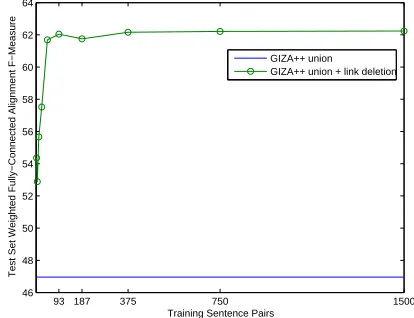
Figure 2: Effect of discriminative training set size on link deletion accuracy for Chinese-EnglishB,α=0.5
alignment f-measure used as the training criterion for link deletion. Usingα=0.5 leads to a higher gain in BLEU score on the test set relative to the base-line (+0.76 points) than eitherα=0.4 (+0.70 points) orα=0.6 (+0.67 points).
4.4 Size of Discriminative Training Set
To examine how many manually aligned sentence pairs are required to set the feature weights reli-ably, we vary the size of the discriminative training set from 2-1500 sentence pairs while holding test set size constant at 1500 sentence pairs; run per-ceptron training; and record the resulting weighted fully-connected alignment f-measure on the test set. Figure 2 illustrates that using 100-200 manually aligned sentence pairs of training data is sufficient for Chinese-English; a similarly-sized training set is also sufficient for Arabic-English.
4.5 Effect of Link Deletion on Extracted Rules
pre-Language Alignment Prec Rec α F-measure Links Del/ Grammar BLEU
Sent Size Tune Test1 Test2
Chi-EngA GIZA++ union 54.76 75.38 0.5 63.44 – 23.4M 41.80 41.17 –
Chi-EngA GIZA++ union + 79.59 71.16 0.5 75.14 4.77 59.7M 43.06 41.93 –
link deletion
Chi-EngB GIZA++ union 36.61 66.28 0.5 47.16 – 28.9M 39.59 41.39 –
Chi-EngB GIZA++ union + 65.52 59.28 0.5 62.24 4.19 73.0M 40.97 41.88 –
link deletion
Ara-Eng GIZA++ union 35.34 84.05 0.1 73.87 – 52.4M 54.73 50.9 38.16
Ara-Eng GIZA++ union + 52.68 79.75 0.1 75.85 1.35 64.9M 55.57 51.08 38.72
link deletion
Table 3: Results of link deletion. Weighted fully-connected alignment f-measure is computed on alignment test sets (Table 1); BLEU score is computed on translation test sets (Table 2).
Alignment Parse Rule
Precision Recall F-measure Total Non-Unique
gold gold 100.00 100.00 100.00 12,809
giza++ union collins 50.49 44.23 47.15 11,021
giza++ union+link deletion,α=0.5 collins 47.51 53.20 50.20 13,987
giza++ refined collins 44.20 54.06 48.64 15,182
Table 4: Rule precision, recall, and f-measure of rules extracted from 400 sentence pairs of Chinese-English data
cision, recall, and f-measure of the GIZA++ union alignments and various link deletion alignments on a held-out Chinese-English test set of 400 sentence pairs. Table 4 indicates the total (non-unique) num-ber of rules extracted for each alignment/parse pair-ing, as well as the rule precision, recall, and f-measure of each pair. As more links are deleted, more rules are extracted–but of those, some are of good quality and others are of bad quality. Link-deleted alignments produce rule sets with higher rule f-measure than either GIZA++ union or GIZA++ re-fined.
5 Conclusion
We have presented a link deletion algorithm that im-proves the precision of GIZA++ union alignments without notably decreasing recall. In addition to lical and structural features, we use features of the ex-tracted syntax-based translation rules. Our method improves alignment quality and translation quality on Chinese-English and Arabic-English translation tasks, relative to a GIZA++ union baseline. The algorithm runs quickly, and is easily applicable to
other language pairs with limited amounts (100-200 sentence pairs) of manually aligned data available.
Acknowledgments
References
Peter F. Brown, Stephen Della Pietra, Vincent J. Della Pietra, and Robert L. Mercer. The Mathematics of
Sta-tistical Machine Translation: Parameter Estimation.
Computational Linguistics, Vol. 19, No. 2, 1993. Eugene Charniak and Mark Johnson. Coarse-to-fine
n-best parsing and MaxEnt discriminative reranking.
Proceedings of ACL, 2005.
Colin Cherry and Dekang Lin. Soft Syntactic Constraints
for Word Alignment through Discriminative Training.
Proceedings of ACL (Poster), 2006.
David Chiang. A Hierarchical Phrase-Based Model for
Statistical Machine Translation. Proceedings of ACL,
2005.
David Chiang. Hierarchical phrase-based translation. Computational Linguistics, 2007.
Michael Collins. Discriminative Reranking for Natural
Language Parsing. Proceedings of ICML, 2000.
Michael Collins. Discriminative training methods for hidden Markov models: theory and experiments with perceptron algorithms. Proceedings of EMNLP, 2002.
John DeNero and Dan Klein. Tailoring Word Align-ments to Syntactic Machine Translation. Proceedings
of ACL, 2007.
Yonggang Deng and William Byrne. HMM word and
phrase alignment for statistical machine translation.
Proceedings of HLT/EMNLP, 2005.
Alexander Fraser and Daniel Marcu. Measuring Word
Alignment Quality for Statistical Machine Translation.
Computational Linguistics, Vol. 33, No. 3, 2007. Alexander Fraser and Daniel Marcu. Getting the
Struc-ture Right for Word Alignment: LEAF. Proceedings of
EMNLP, 2007.
Michel Galley, Mark Hopkins, Kevin Knight, and Daniel Marcu. What’s in a Translation Rule? Proceedings of HLT/NAACL-04, 2004.
Michel Galley, Jonathan Graehl, Kevin Knight, Daniel Marcu, Steve DeNeefe, Wei Wang, and Ignacio Thayer. Scalable Inference and Training of
Context-Rich Syntactic Translation Models. Proceedings of ACL, 2006.
Liang Huang, Kevin Knight, and Aravind Joshi.
Statis-tical Syntax-Directed Translation with Extended Do-main of Locality. Proceedings of AMTA, 2006.
Abraham Ittycheriah and Salim Roukos. A Maximum
En-tropy Word Aligner for Arabic-English Machine Trans-lation. Proceedings of HLT/EMNLP, 2005.
Philipp Koehn, Franz Josef Och, and Daniel Marcu.
Statistical Phrase-Based Translation. Proceedings of
HLT/NAACL, 2003.
Philipp Koehn, Hieu Hoang, Alexandra Birch, Chris Callison-Burch, Marcello Federico, Nicola Bertoldi, Brooke Cowan, Wade Shen, Christine Moran, Richard Zens, Chris Dyer, Ondrej Bojar, Alexandra Con-stantin, Evan Herbst. Moses: Open Source Toolkit for
Statistical Machine Translation. Proceedings of ACL
(demo), 2007.
Percy Liang, Alexandre Bouchard-Cote, Dan Klein, and Ben Taskar. An end-to-end discriminative approach to
machine translation. Proceedings of COLING/ACL,
2006.
Yang Liu, Qun Liu, and Shouxun Lin. Log-linear Models
for Word Alignment. Proceedings of ACL, 2005.
Yang Liu, Qun Liu, and Shouxun Lin. Tree-to-String
Alignment Template for Statistical Machine Transla-tion. Proceedings of ACL, 2006.
Adam Lopez and Philip Resnik. Improved HMM
Align-ment Models for Languages with Scarce Resources.
Proceedings of the ACL Workshop on Parallel Text, 2005.
Jonathan May and Kevin Knight. Syntactic Re-Alignment
Models for Machine Translation. Proceedings of EMNLP-CoNLL, 2007.
Robert C. Moore. A Discriminative Framework for
Bilin-gual Word Alignment. Proceedings of HLT/EMNLP,
2005.
Robert C. Moore, Wen-tau Yih, and Andreas Bode.
Im-proved discriminative bilingual word alignment.
Pro-ceedings of ACL, 2006.
Franz Josef Och. Minimum Error Rate Training in
Sta-tistical Machine Translation. Proceedings of ACL, 2003.
Franz Josef Och and Hermann Ney. A Systematic Comparison of Various Statistical Alignment Models.
Computational Linguistics, Vol. 29, No. 1, 2003. Franz Josef Och and Hermann Ney. The alignment
template approach to statistical machine translation.
Computational Linguistics, 2004.
K. Papineni, S. Roukos, T. Ward, and W. J. Zhu. BLEU:
a Method for Automatic Evaluation of Machine Trans-lation. Proceedings of ACL, 2002.
Chris Quirk, Arul Menezes, and Colin Cherry. De-pendency Treelet Translation: Syntactically Informed Phrasal SMT. Proceedings of ACL, 2005.
Ben Taskar, Simon Lacoste-Julien, and Dan Klein. A
Discriminative Matching Approach to Word Align-ment. Proceedings of HTL/EMNLP, 2005.
Stephan Vogel, Hermann Ney, and Christoph Tillmann.