PARSING TREE ADJOINING GRAMMARS
AND TREE INSERTION GRAMMARS
WITH SIMULTANEOUS ADJUNCTIONS
Miguel A. Alonso
Departamento de Computaci´on
Universidade da Coru˜
na
Campus de Elvi˜
na s/n
15071 La Coru˜
na (Spain)
[email protected]
V´ıctor J. D´ıaz
Departamento de Lenguajes
y Sistemas Inform´aticos
Universidad de Sevilla
Avda. Reina Mercedes s/n
41012 Sevilla (Spain)
[email protected]
Abstract
A large part of wide coverage Tree Adjoining Grammars (TAG) is formed by trees that satisfy the restrictions imposed by Tree Insertion Grammars (TIG). This characteristic can be used to reduce the practical complexity of TAG parsing, applying the standard adjunction operation only in those cases in which the simpler cubic-time TIG adjunction cannot be applied. In this paper, we describe a parsing algorithm managing simultaneous adjunctions in TAG and TIG.
1
Introduction
Tree Adjoining Grammar (TAG) [5] and Tree Insertion Grammar (TIG) [7] are grammatical formalisms that make use of a tree-based operation called adjunction. TAG generates tree adjoining languages, a strict superset of context-free languages, and the complexity of parsing algorithms is inO(n6) for time and inO(n4) for space with respect to the lengthnof the input
string. In contrast, TIG generates context-free languages and can be parsed inO(n3) for time
and inO(n2) for space, due to restrictions on the form of trees.
Formally, a TAG is a 5-tupleG= (VN, VT, S,I,A), where VN is a finite set of non-terminal symbols, VT a finite set of terminal symbols, S the axiom of the grammar, I a finite set of
initial treesand Aa finite set ofauxiliary trees. I∪A is the set ofelementary trees. Internal
nodes are labeled by non-terminals and leaf nodes by terminals or the empty stringε, except for just one leaf per auxiliary tree (thefoot) which is labeled by the same non-terminal used as the label of its root node. The path in an elementary tree from the root node to the foot node is called thespineof the tree. New trees are derived byadjunction: letγbe a tree containing a nodeNγ labeled byAand letβbe an auxiliary tree whose root and foot nodes are also labeled
byA. Then, the adjunction ofβ at theadjunction nodeNγ is obtained by excising the subtree
ofγ with root Nγ, attaching β to Nγ and attaching the excised subtree to the foot ofβ. We
S
S
Adv
NP VP
VP
VP
runs slowly
John
NP VP
John VP Adv
slowly runs
spine
Inital tree Auxiliary tree
[image:2.595.79.497.42.217.2]Derived tree
Figure 1: Adjunction operation
adjoining the VP auxiliary tree on the node labeled by VP located in the initial tree is also shown.
We can consider the setA as formed by the union of the setsAL, containing left auxiliary
treesin which every nonempty frontier node is to the left of the foot node,AR, containingright
auxiliary treesin which every nonempty frontier node is to the right of the foot node, andAW,
containingwrapping auxiliary trees in which nonempty frontier nodes are placed both to the left and to the right of the foot node. Given an auxiliary tree, we call spine nodes to those nodes placed on the spine andleft nodes (resp. right nodes) to those nodes placed to the left (resp. right) of the spine. The setASL⊆AL(resp. ASR⊆AR) ofstrongly left (resp. strongly
right) auxiliary trees is formed by trees in which no adjunction is permitted on right (resp. left)
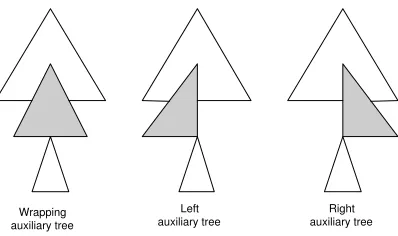
nodes and only strongly left (resp. right) auxiliary trees are allowed to adjoin on spine nodes. Figure 2 shows three derived trees resulting from the adjunction of a wrapping, left and right auxiliary tree, respectively. We denote byA0the set A−(A
SL∪ASR).
In essence, a TIG is a restricted TAG where auxiliary trees must be either strongly left or strongly right and adjunctions are not allowed in root and foot nodes of auxiliary trees.
It has been found that most of the trees and adjunction operations involved in wide coverage grammars like XTAG [4] are compatible with the TIG formalism [7]. As the full power of a TAG parser is only put into practice in adjunctions involving a given set of trees, to apply a parser working inO(n6) time complexity when most of the work can be done by aO(n3) parser
seems to be a waste of computing resources. Therefore, we propose to create mixed parsers taking the best of both worlds: those parts of the grammar that correspond to a TIG should be managed inO(n3) time and O(n2) space complexity, and only those parts of the grammar
involving the full kind of adjunction present in TAG should be managed in O(n6) time and
O(n4) space complexity.
Wrapping auxiliary tree
Left
[image:3.595.186.385.40.158.2]auxiliary tree auxiliary treeRight
Figure 2: TAG vs. TIG adjunction operation
obtained by the resulting algorithm, its usefulness is limited by the fact that a lot of trees with a TIG-skeleton do not satisfy the definition of strongly left or strongly right auxiliary trees because we can not combine both types of trees on a single node. For example, determiners or adjectives are usually modelled with left auxiliary trees but relative clauses are modelled with right auxiliary trees. Then, we need to combine left and right auxiliary trees when a noun is modified at the same time with determiners and relative clauses. The only way to do that is using adjunction operations. If these adjunctions are not performed simultaneously at the same node, auxiliary trees for determiners and relative clauses cannot be considered as strongly left and strongly right auxiliary trees, respectively, and therefore the algorithm in [2] behaves like a classical TAG parser with respect to these adjunctions.
1.1
Notation for parsing algorithms
We will describe parsing algorithms using Parsing Schemata, a framework for high-level de-scriptions of parsing algorithms [9]. Aparsing systemfor a grammarGand stringa1. . . an is a
triplehI,H,Di, withI a set ofitemswhich represent intermediate parse results, Han initial set of items calledhypothesisthat encodes the sentence to be parsed, and Da set ofdeduction
stepsthat allow new items to be derived from already known items. Deduction steps are of the
form η1,...,ηk
ξ cond, meaning that if all antecedents ηi of a deduction step are present and the
conditionscond are satisfied, then the consequentξ should be generated by the parser. A set
F ⊆ I of final items represent the recognition of a sentence. A parsing schema is a parsing system parameterized by a grammar and a sentence.
In order to describe the parsing algorithms for tree-based formalisms, we must be able to rep-resent the partial recognition of elementary trees. Parsing algorithms for context-free grammars usually denote partial recognition of productions by dotted productions. We can extend this approach to the case of tree-based grammars by considering each elementary treeγ as formed by a set of context-free productionsP(γ): a nodeNγ and its childrenNγ
1 . . . Ngγ are represented
by a productionNγ →Nγ
1 . . . Ngγ. Thus, the position of the dot in the tree is indicated by the
position of the dot in a production inP(γ). The elements of the productions are the nodes of the tree.
To simplify the description of parsing algorithms we consider an additional production> → Rαfor eachα∈I and the two additional productions> →Rβ andFβ→ ⊥ for eachβ∈A,
where Rβ and Fβ correspond to the root node and the foot node of β, respectively. After
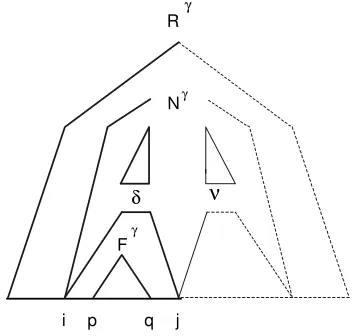
γ
N
δ Rγ
ν
i p q j
γ
[image:4.595.196.373.47.215.2]F
Figure 3: Graphical representation of items
intact. We introduce also the following notation: given two pairs (p, q) and (i, j) of integers, (p, q)≤(i, j) is satisfied if i≤pandq≤j and given two integerspandq we definep∪q asp
ifq is undefined and asqifpis undefined, being undefined in other case.
We useβ ∈adj(Nγ) to denote that a tree β may be adjoined at nodeNγ of the elementary
treeγ. If adjunction is not mandatory atNγ thennil∈adj(Nγ) wherenil∈/ I∪Ais a dummy
symbol. If adjunction is not allowed atNγ then{nil}= adj(Nγ).
2
The parsing algorithm
In this section we define a parsing system PMix=hIMix,HMix,DMixicorresponding to a mixed
parsing algorithm for TAG and TIG in which the adjunction of strongly left and strongly right auxiliary trees1 will be managed by specialized deduction steps. Simultaneous adjunctions are allowed on any node, with the following ordering: the adjunction of strongly left auxiliary trees will take place before the adjunction of other types of trees. This ordering has been established for compatibility with the definition of simultaneous adjunctions in TIG [7].
For PMix, we consider a set of itemsIMix=IMix(a) ∪ IMix(b) formed by the union of the following
subsets:
• A subsetIMix(a) with items of the form [Nγ →δ•ν, i, j|p, q|adj] such thatNγ →δν∈ P(γ), γ∈I∪A, 0≤i≤j, (p, q) = (−,−) or (p, q)≤(i, j), and adj ∈ {true,false}. The boolean component adj is needed to manage mandatory adjunction: adj = true if and only if one or more adjunctions have taken place atNγ, otherwise adj = false. The two indices with
respect to the input string i and j indicate the portion of the input string that has been spanned fromδ (see figure 3). Ifγ ∈A0, pand qare two indices with respect to the input
string that indicate that part of the input string recognized by the foot node ofγ if it is a descendant ofδ. In other casep=q =−representing they are undefined. Therefore, this 1Given the set Aof a TAG, we can determine the set A
kind of items satisfy one of the following conditions:
1. γ∈A0,δ6=ε, (p, q)6= (−,−) andδspans the stringai
+1. . . apFγ aq+1. . . aj
2. δ6=ε, (p, q) = (−,−) andδspans the stringai+1. . . aj.
3. δ = ε, (p, q) = (−,−), adj = true and there exists a sequence of strongly left auxiliary trees that have been adjoined atNγ. In this case,iandjindicate the portion of the input
string spanned by the strongly left auxiliary trees adjoined atNγ.
• A subsetIMix(b) with items of the form [Nγ → •υ, j, j| −,− |false] such thatMγ →δν∈ P(γ), γ∈I∪Aand any auxiliary tree has been adjoined onNγ.
The hypotheses defined for this parsing system encode the input stringa1. . . an in the
stan-dard way:
HMix=
n
[a, i−1, i]|a=ai,1≤i≤n
o
The set of deduction steps is formed by the following subsets:
DMix= DInit
Mix∪ DScanMix ∪ DεMix∪ DPredMix ∪ D Comp Mix ∪
DLAdjPredMix ∪ DLAdjCompMix ∪ DRAdjPredMix ∪ DMixRAdjComp∪ DLRFoot Mix ∪
DAdjPredMix ∪ DFootPred Mix ∪ D
FootComp Mix ∪ D
AdjComp
Mix ∪ DMixComb
The parsing process starts by creating the items corresponding to productions having the root of an initial tree as left-hand side and the dot in the leftmost position of the right-hand side:
DInitMix=
[> → •Rα,0,0| −,− |false] α∈I ∧ S = label(R α)
Then, a set of deduction steps inDPred Mix and D
Comp
Mix traverse each elementary tree, while steps
inDScan
Mix andDεMix scan input symbols and the empty string, respectively:2
DPred Mix =
[Nγ →δ•Mγν, i, j|p, q|adj]
[Mγ → •υ, j, j | −,− |false]
DMixComp=
[Nγ→δ•Mγν, i, j|p, q|adj],
[Mγ →υ•, j, k|p0, q0|adj0]
[Nγ →δMγ•ν, i, k|p∪p0, q∪q0|adj]
adj0 = true ifnil6∈adj(Mγ) adj0 = false if{nil}= adj(Mγ)
DScanMix =
[Nγ →δ•Mγν, i, j|p, q|adj],
[a, j, j+ 1]
[Nγ →δMγ•ν, i, j+ 1|p, q|adj] a= label(M γ)
Dε
Mix=
[Nγ →δ•Mγν, i, j|p, q|adj]
[Nγ →δMγ•ν, i, j|p, q|adj] ε= label(M γ)
The rest of steps are in charge of managing adjunction operations. If a strongly left auxiliary tree β ∈ ASL can be adjoined at a given node Mγ, a step in DLAdjPredMix starts the traversal
2The conditions checked by steps in DComp
ofβ. When β has been completely traversed, a step in DLAdjCompMix starts the traversal of the subtree corresponding toMγ. Simultaneous adjunction of several strongly left auxiliary trees
on a nodeMγ is achieved by repeating this process for each tree.
DMixLAdjPred= [M
γ → •υ, i, j| −,− |adj]
[> → •Rβ, j, j| −,− |false] β∈ASL ∧ β∈adj(M γ)
DMixLAdjComp=
[Mγ → •υ, i, j| −,− |adj],
[> →Rβ•, j, k| −,− |false]
[Mγ → •υ, i, k| −,− |true] β∈ASL ∧ β∈adj(M γ)
If a strongly right auxiliary tree β ∈ ASR can be adjoined at a given node Mγ, when the
subtree corresponding to this node has been completely traversed, a step inDRAdjPredMix starts the traversal of the treeβ. Whenβhas been completely traversed, a step inDMixRAdjCompupdates the input positions spanned byMγ taking into account the part of the input string spanned by β. Simultaneous adjunction of several strongly right auxiliary trees on a nodeMγ is achieved
by repeating this process for each tree.
DMixRAdjPred= [M
γ→υ•, i, j|p, q|adj]
[> → •Rβ, j, j| −,− |false] β∈ASR ∧ β∈adj(M γ)
DRAdjCompMix =
[Mγ →υ•, i, j|p, q|adj],
[> →Rβ•, j, k| −,− |false]
[Mγ →υ•, i, k|p, q|true] β ∈ASR ∧ β∈adj(M γ)
No special treatment is given to the foot node of strongly left and right auxiliary trees and so, it is simply skipped by a step in the setDLRFoot
Mix .
DLRFoot Mix =
[Fβ→ •⊥, j, j| −,− |adj]
[Fβ→ ⊥•, j, j| −,− |adj] β ∈ASL∪ASR
A step inDMixAdjPredpredicts the adjunction of an auxiliary treeβ ∈A0in a node of an elementary
treeγand starts the traversal of β. Once the foot of β has been reached, the traversal ofβ is momentary suspended by a step inDFootPred
Mix , which re-takes the subtree of γ which must be
attached to the foot ofβ. At this moment, there is no information available about the node in which the adjunction ofβ has been performed, so all possible nodes are predicted. When the traversal of a predicted subtree has finished, a step inDFootCompMix re-takes the traversal ofβ
continuing at the foot node. When the traversal ofβ is completely finished, a deduction step in DAdjCompMix checks if the subtree attached to the foot ofβ corresponds with the adjunction node. The adjunction if finished by a step in DMixComp, taking into account that p0 and q0 are
instantiated if and only if the adjunction node is on the spine ofγ. It is interesting to remark that we follow the approach of [6], splitting the completion of adjunction between DAdjCompMix
andDMixComp.
DMixAdjPred= [M
γ → •υ, i, j| −,− |adj]
[> → •Rβ, j, j| −,− |false] β∈A0 ∧ β∈adj(M γ)
DFootPredMix =
[Fβ→ •⊥, k, k| −,− |adj]
DFootCompMix =
[Fβ→ •⊥, l, l| −,− |adj],
[Mγ →υ•, l, m|p0, q0|adj0]
[Fβ → ⊥•, l, m|l, m|adj] β ∈A0 ∧ β ∈adj(M γ)
DAdjCompMix =
[> →Rβ•, k, r|l, m|false],
[Mγ→υ•, l, m|p0, q0|adj]
[Mγ →υ•, k, r|p0, q0|true] β ∈A
0 ∧ β∈adj(Mγ)
Simultaneous adjunction of several auxiliary trees inβ ∈A0 is achieved by applying steps in
DMixAdjPredtaking as antecedent the consequent item of aDFootPred Mix step.
The subset DComb
Mix is needed to put together the results corresponding to the simultaneous
adjunctions of strongly left and wrapping auxiliary trees:
DComb Mix =
[Mγ→ •υ, i, j| −,− |true],
[Mγ→υ•, j, k|p, q|true]
[Mγ →υ•, i, k|p, q|true]
The input string belongs to the language defined by the grammar if and only if a final item in the setF=n [> →Rα•,0, n| −,− |false]|α∈I ∧ S= label(Rα) ois generated.
[image:7.595.135.442.65.173.2]3
An example
Figure 4 illustrate the adjunction of a strongly-left auxiliary treeβl1, a strongly right auxiliary
tree βr1, two wrapping trees βw1 and βw2, a strongly-left auxiliary tree βl2 and a strongly
right auxiliary treeβr2, enumerated in a top-down view of the resulting derived tree, which is
obtained as follows:
1. Once the adjunction node Mγ is reached at positionj
1, a step in DPredMix generates the item
[Mγ → •υ, j
1, j1 | −,− | false]. Then, a step in DLAdjPredMix is applied in order to start
the adjunction of βl1, which is finished by a step in DLAdjCompMix that generates the item
[Mγ → •υ, j
1, j2| −,− |true].
2. Strongly right auxiliary trees do not span anything to the left of their spine, therefore no action is performed with respect toβr1 at this moment. Instead, a step inDAdjPredMix predicts
the adjunction ofβw1, generating the item [> → •Rβw1, j2, j2| −,− |false].
3. When the foot node of βw1 is reached at position j3, a DMixFootPred step generates the item
[Mγ → •υ, j
3, j3 | −,− |false], which is taken as antecedent by a step in DAdjPredMix to start
the adjunction ofβw2, generating the item [> → •Rβw2, j3, j3| −,− |false].3 When the foot
node ofβw2 is reached at position j4, the traversal of γ is re-taken at Mγ by means of the
application of a step inDFootPred
Mix , generating the item [Mγ→ •υ, j4, j4| −,− |false].
4. The adjunction of βl2 is then predicted by a step in DMixLAdjPred. The completion of this
adjunction by a step in DLAdjCompMix yields the item [Mγ → •υ, j
4, j5 | −,− | true]. It
M
γ 1 6 7 8 9 4 3 2β
r2:
β
l2:
β
w2:
β
w1:
β
r1:
β
l1:
[image:8.595.228.334.45.391.2]5 j1 k6 k5 j5 k9 k8 k7 j4 j3 j2
γ:
Figure 4: An example of simultaneous adjunctions
is interesting to remark that the ordering imposed on the trees involved in simultaneous adjunctions has been preserved due to the adjunctions ofβl1 and βl2 have been completely
performed before the adjunction of other types of auxiliary trees.
5. βr2 is not considered at this moment. Once the subtree rooted byMγ has been completely
traversed, we get the item [Mγ →υ•, j
4, k5| −,− |true].
6. At this moment, a step in DRAdjPredMix starts the adjunction of βr2 by generating the item
[> → •Rβr2, k
5, k5 | −,− |false]. The item [Mγ → •υ, j4, k6 | −,− |true] is produced by a
step inDMixRAdjCompas a result of the completion of this adjunction.
7. At this point, a step inDFootCompMix re-takes the traversal ofβw2, generating the item [Fβw2 →
⊥•, j4, k6|j4, k6|false] which means that the subtree corresponding to the adjunction node
of this auxiliary tree is expected to span the substringaj4+1. . . ak6. The complete traversal ofβw2 is indicated by the item [> →Rβw2•, j3, k7|j4, k6|false], which is used by a step in
DMixAdjCompto generate the item [Mγ→υ•, j
3, k7| −,− |true] indicating that the adjunction
corresponding toβw2 has been completed.
8. A step in DMixFootComp re-takes the traversal of βw1, generating the item [Fβw1 → ⊥•, j3, k7 |
auxiliary tree is expected to span the substringaj3+1. . . ak7. The adjunction ofβw1is finished by a step inDMixAdjComp, yielding the item [Mγ →υ•, j
2, k8| −,− |true].
9. At this moment we have two possibilities in order to adjoin βr1:
(a) A step in DComb
Mix combines the item [Mγ → •υ, j1, j2 | −,− |true] and the item [Mγ →
υ•, j2, k8| −,− |true] to obtain [Mγ →υ•, j1, k8 | −,− |true]. Then, the adjunction of
βr1 can be predicted by a step in DMixRAdjPred. Once this strongly right auxiliary tree has
been completely traversed, the item [Mγ →υ•, j
1, k9| −,− |true] is generated by a a step
inDMixRAdjComp.
(b) A step in DRAdjPredMix starts the adjunction ofβr1. Once this auxiliary tree has been
com-pletely traversed, the item [Mγ → υ•, j
2, k9 | −,− | true] is generated by a step in
DRAdjCompMix . Then, a step in DComb
Mix combines the items [Mγ → •υ, j1, j2 | −,− | true]
and [Mγ →υ•, j
2, k9| −,− |true] to obtain the item [Mγ →υ•, j1, k9| −,− |true].
This spurious ambiguity could be eliminated by imposing a more restrictive ordering of trees in simultaneous adjunctions: one possibility is to force that trees inA0 should be adjoined
first, then trees in ASL and finally trees in ASR; other possibility is to force that trees in
ASLshould be adjoined first, then trees inA0and finally trees in ASR.
4
Complexity
The worst-case space complexity of the algorithm isO(n4), as at most four input positions are
stored into items corresponding to auxiliary trees belonging toA0. Initial trees and strongly
left and right auxiliary trees contributeO(n2) to the final result. With respect to the worst-case
time complexity:
• TIG adjunction, the adjunction of a strongly left or right auxiliary tree on a node of a tree belonging toI∪ASL∪ASR, is managed inO(n3) by steps inDLAdjCompMix andD
RAdjComp Mix .
• Full TAG adjunction is managed in O(n6) by deduction steps in DAdjComp
Mix , which are in
charge of dealing with auxiliary trees belonging toA0. In fact,O(n6) is only attained when
a wrapping auxiliary tree is adjoined on a spine node of a wrapping auxiliary tree. The adjunction of a wrapping auxiliary tree on a right node of a wrapping auxiliary tree is managed inO(n5) due to deduction steps inDComp
Mix . The same complexity is attained by the
adjunction of a strongly right auxiliary tree on a spine or right node of a wrapping auxiliary tree, due to deduction steps inDRAdjCompMix .
• Other cases of adjunction, e.g. the adjunction of a strongly left or right auxiliary tree on a spine node of a tree belonging to (AL−ASL)∪(AR−ASR), are managed inO(n4).
5
Experimental results
Table 1: XTAG results, in seconds, for PMix and PMix0parsers
Sentence PMix PMix0 Reduction
(1) Srini bought a book 0.08 0.13 38.46%
(2) Srini bought Beth a book 0.11 0.17 35.29%
(3) Srini bought a book at the bookstore 0.15 0.21 28.57%
(4) he put the book on the table 0.13 0.18 27.78%
(5) *he put the book 0.07 0.10 30.00%
(6) the sun melted the ice 0.11 0.17 35.29%
(7) the ice melted 0.07 0.10 30.00%
(8) Elmo borrowed a book 0.08 0.13 38.46%
(9) *a book borrowed 0.06 0.08 25.00%
(10) he hopes Muriel wins 0.14 0.21 33.33%
(11) he hopes that Muriel wins 0.20 0,27 25.93%
(12) the man who Muriel likes bought a book 0,24 0,32 25.00%
(13) the man that Muriel likes bought a book 0.21 0.28 25.00% (14) the music should have been being played for the president 0.29 0.33 12.12%
(15) Clove caught a frisbee 0.09 0.12 25.00%
(16) who caught a frisbee 0.09 0.12 25.00%
(17) what did Clove catch 0.07 0.13 46.15%
(18) the aardvark smells terrible 0.07 0.10 30.00%
(19) the emu thinks that the aardvark smells terrible 0.27 0.32 15.63%
(20) who does the emu think smells terrible 0.12 0.21 42.86%
(21) who did the elephant think the panda heard the emu said smells terrible
0.39 0.58 32.76%
(22) Herbert is angry 0.07 0.09 22.22%
(23) Herbert is angry and furious 0.09 0.14 35.71%
(24) Herbert is more livid than angry 0.08 0.12 33.33%
(25) Herbert is more livid and furious than angry 0.10 0.13 23.08%
and Gr (with ASL = ∅). For a TIG, the time complexity of the adjunction completion step
of a TAG parser is O(n4), in contrast with the O(n3) complexity of left and right adjunction
completion for a TIG parser. Therefore, we expected the TIG parser to be considerably faster than the TAG parser. In effect, forGl we have observed that the TIG parser is up to 18 times faster than the TAG parser, but in the case ofGrthe difference becomes irrelevant.
These results have been corroborated by a second experiment performed on artificial TAGs with the mixed (PMix) and the TAG parser: the performance of the mixed parser improves
when strongly left auxiliary trees are involved in the analysis of the input string.
In a third experiment, we have taken a subset of the XTAG grammar [4], consisting of 27 elementary trees that cover a variety of English constructions: relative clauses, auxiliary verbs, unbounded dependencies, extraction, etc. In order to eliminate the time spent by unification, we have not considered the feature structures of elementary trees. Instead, we have simulated the features using local constraints. Every sentence has been parsed without previous filtering of elementary trees.
the results of this experiment including information about the time in seconds spent by both parsers. As we can observe in the table, our approach obtains a reduction in time that varies in percentage from 12% to 46%, depending on the kind of trees involved in the analysis of each sentence.
We would like to address the results obtained by our approach in sentences 12, 13 and 14 where simultaneous adjunctions of left and right auxiliary trees must be applied. In these cases, the parser PMix0 needs to apply a classical wrapping adjunction.
6
Conclusion
We have defined a parsing algorithm which reduces the practical complexity of TAG parsing by taking into account that a large part of actual TAG grammars can be managed as a TIG. The resulting parser extends the classical adjunction operation in TAG by considering the possibility of simultaneous adjunctions at a given node.
The performance of the algorithm could be improved by means of the application of practical optimizations, such as the replacement of the componentspand q of items [Nγ →δ•ν, i, j | p, q] ∈ IMix(a) by the list of all adjunctions that are still under completion on Nγ [3], albeit
this modification increase the worst-case complexity of the algorithm. As further work, we are investigating a variant of the algorithm presented in this paper that preserves the correct prefix property [6].
Acknowledgements
The research reported in this paper has been supported in part by Ministerio de Ciencia y Tec-nolog´ıa (grants TIC2000-0370-C02-01, FIT-150500-2002-416, HP2001-0044 and HF2002-0081), Xunta de Galicia (grants PGIDT01PXI10506PN and PGIDIT02SIN01E) and Universidade da Coru˜na.
References
[1] Miguel A. Alonso, David Cabrero, Eric de la Clergerie, and Manuel Vilares. Tabular algo-rithms for TAG parsing. InProc. of EACL’99, Ninth Conference of the European Chapter of
the Association for Computational Linguistics, pages 150–157, Bergen, Norway, June 1999.
[2] Miguel A. Alonso, Vicente Carrillo, and V´ıctor J. D´ıaz. Mixed parsing of tree insertion and tree adjoining grammars. In Francisco J. Garijo, Jos´e C. Riquelme, and Miguel Toro, editors,Advances in Artificial Intelligence - IBERAMIA 2002, volume 2527 ofLecture Notes
in Artificial Intelligence, pages 694–703. Springer-Verlag, Berlin-Heidelberg-New York, 2002.
[3] Eric de la Clergerie. Refining tabular parsers for TAGs. InProceedings of Language Tech-nologies 2001: The Second Meeting of the North American Chapter of the Association for
Computational Linguistics (NAACL’01), pages 167–174, Pittsburgh, PA, USA, June 2001.
[4] Christy Doran, Dania Egedi, Beth Ann Hockey, B. Srinivas, and Martin Zaidel. XTAG sys-tem — a wide coverage grammar for English. InProc. of the 15th International Conference
[5] Aravind K. Joshi and Yves Schabes. Tree-adjoining grammars. In Grzegorz Rozenberg and Arto Salomaa, editors, Handbook of Formal Languages. Vol 3: Beyond Words, chapter 2, pages 69–123. Springer-Verlag, Berlin/Heidelberg/New York, 1997.
[6] Mark-Jan Nederhof. The computational complexity of the correct-prefix property for TAGs.
Computational Linguistics, 25(3):345–360, 1999.
[7] Yves Schabes and Richard C. Waters. Tree insertion grammar: A cubic-time parsable for-malism that lexicalizes context-free grammar without changing the trees produced.
Com-putational Linguistics, 21(4):479–513, December 1995.
[8] Stuart M. Shieber, Yves Schabes, and Fernando C. N. Pereira. Principles and implementa-tion of deductive parsing. Journal of Logic Programming, 24(1–2):3–36, July-August 1995.
[9] Klaas Sikkel. Parsing Schemata — A Framework for Specification and Analysis of Parsing
Algorithms. Texts in Theoretical Computer Science — An EATCS Series. Springer-Verlag,