JATE 2.0: Java Automatic Term Extraction with Apache Solr
Ziqi Zhang, Jie Gao, Fabio Ciravegna
Regent Court, 211 Portobello, Sheffield, UK, S1 4DP[email protected], [email protected], [email protected]
Abstract
Automatic Term Extraction (ATE) or Recognition (ATR) is a fundamental processing step preceding many complex knowledge engineering tasks. However, few methods have been implemented as public tools and in particular, available as open-source freeware. Further, little effort is made to develop an adaptable and scalable framework that enables customization, development, and comparison of algorithms under a uniform environment. This paper introduces JATE 2.0, a complete remake of the free Java Automatic Term Extraction Toolkit (Zhang et al., 2008) delivering new features including: (1) highly modular, adaptable and scalable ATE thanks to integration with Apache Solr, the open source free-text indexing and search platform; (2) an extended collection of state-of-the-art algorithms. We carry out experiments on two well-known benchmarking datasets and compare the algorithms along the dimensions of effectiveness (precision) and efficiency (speed and memory consumption). To the best of our knowledge, this is by far the only free ATE library offering a flexible architecture and the most comprehensive collection of algorithms.
Keywords:term extraction, term recognition, NLP, text mining, Solr, search, indexing
1.
Introduction
Automatic Term Extraction (or Recognition) is an impor-tant Natural Language Processing (NLP) task that deals with the extraction of terminologies from domain-specific textual corpora. ATE is widely used by both industries and researchers in many complex tasks, such as Informa-tion Retrieval (IR), machine translaInforma-tion, ontology engineer-ing and text summarization (Bowker, 2003; Brewster et al., 2007; Maynard et al., 2007). Over the years, there has been constant effort on researching new algorithms, adapting to different domains and/or languages, and creat-ing benchmarkcreat-ing datasets (Ananiadou, 1994; Church and Gale, 1995; Ahmad et al., 1999; Frantzi et al., 2000; Park et al., 2002; Matsuo and Ishizuka, 2003; Sclano and Ve-lardi, 2007; Rose et al., 2010; Spasi´c et al., 2013; Zadeh and Handschuh, 2014).
Given the fundamental role of ATE in many tasks, a real benefit to the community would be releasing the tools to facilitate the development of downstream applications, also encouraging code-reuse, comparative studies, and fostering further research. Unfortunately, effort in this direction has been extremely limited. First, only very few tools have been published with readily available source code (Spasi´c et al., 2013) and some are proprietary (labs.translated.net, 2015; Yahoo!, 2015), or no longer maintained (Sclano and Ve-lardi, 2007)1. Second, different tools have been developed
under different scenarios and evaluated in different domains using proprietary language resources, making it difficult for comparison. Third, it is unclear whether and how well these tools can adapt to different domain tasks and scale up to large data.
To the best of our knowledge, the only effort towards ad-dressing these issues is the Java Automatic Term Extrac-tion Toolkit (JATE)2, where we originally implemented
five state-of-the-art algorithms under a uniform framework (Zhang et al., 2008). This work makes one step further
1Original link:http://lcl2.di.uniroma1.it/ 2
https://code.google.com/p/jatetoolkit. Google Code has been shut down since Jan 2016.
by completely re-designing and re-implementing JATE to fulfill three goals:adaptability,scalability, andextended collections of algorithms. The new library, namedJATE 2.03, is built on the Apache Solr4 free-text indexing and
search platform and can be either used as a separate mod-ule, or a Solr plugin during document processing to en-rich the indexed documents with terms. JATE 2.0 deliv-ersdomain-specific adaptabilityandscalabilityby seam-lessly integrating with the Solr text analysis capability in the form of ‘analyzers’5, allowing users to directly exploit
the highly modular and scalable Solr text analysis to facili-tate term extraction for large data from various content for-mats. Last but not least, JATE 2.0expands its collection of state-of-the-art algorithms6 to double that in the origi-nal JATE release. We also evaluate these algorithms under uniform settings on two publicly available benchmarking datasets. Released as open source software, we believe that JATE 2.0 offers significant value to both researchers and practitioners.
The remainder of this paper is structured as follows. Sec-tion 2. discusses related work. SecSec-tion 3. describes JATE 2.0 in details. Section 5. describes experiments and dis-cusses results. Section 6. concludes this paper.
2.
Related Work
We describe related work from three persectives: ATE methods in general, ATE tools and software, and text min-ing plugins based on Solr.
ATE methods typically start with linguistic processors as the first stage toextract candidate terms; followed by
3
https://github.com/ziqizhang/jate
4
http://lucene.apache.org/solr/
5https://cwiki.apache.org/confluence/
display/solr/Analyzers
6
statistics-based term ranking algorithms to perform can-didate filtering. Linguistic processors are domain spe-cific, and designed to capture term formation and collo-cation patterns. They often take two forms: ‘closed fil-ters’ (Arora et al., 2014) focus on precision and are usu-ally restricted to nouns or noun sequences. ‘Open filters’ (Frantzi et al., 2000) are more permissive and often al-low adjectives, adverbs, etc. For both, widely used tech-niques include Part-of-Speech (PoS) tag sequence match-ing, N-gram extraction, Noun Phrase (NP) Chunkmatch-ing, and dictionary lookup. The selection of linguistic processors is often domain-specific and important for the trade-off be-tween precision and recall. The ranking algorithms are of-ten based on: ‘unithood’ indicating the collocation strength of units that comprise a single term (Matsuo and Ishizuka, 2003); and ‘termhood’ indicating the association strength of a term to domain concepts (Ahmad et al., 1999). Most methods combine both termhood and unithood measures (Ananiadou, 1994; Frantzi et al., 2000; Park et al., 2002; Sclano and Velardi, 2007; Spasi´c et al., 2013). Two unique features of JATE 2.0 are (1) customization of linguistic pro-cessors of the two forms hence making it adaptable to many domains and languages, and (2) a wide selection of imple-mented ranking algorithms, which are not available in any other tools.
Existing ATE tools and software are extremely limited for several reasons. First, many are proprietary soft-ware (labs.translated.net, 2015), quota-limited (e.g., Open-Calais7), or restricted to academic usage only (e.g., Ter-Mine8). Second, all tools, including the original JATE (Zhang et al., 2008), are built in a monolithic architec-ture which allows very limited customization and scala-bility (Spasi´c et al., 2013). Third, most offer very limited (typically a single choice) configurability, e.g., in terms of term candidate extraction and/or ranking algorithms (e.g., TermRaider (Maynard et al., 2008), TOPIA9, and
Flex-iTerm (Spasi´c et al., 2013). JATE 2.0 is a free, open-source library. It is highly modular, allowing customization and configuration of many components. Meanwhile, to our best knowledge, no available ATE tools support automatic in-dexing.
Solr plugins for text mining Solr is an open source en-terprise search platform written in Java. It is highly mod-ular, customizable, and scalable, hence widely used as an industry standard. A core component of Solr is its power-ful, extensible text processing library covering a wide range of functionality and languages. Many text mining and NLP tools have integrated with Solr to benefit from these fea-tures as well as contributing additional support for doc-ument indexing (e.g., OpenNLP plugins10,
SolrTextTag-ger11, and UIMA12). However, no plugin is available for
7http://new.opencalais.com/
8http://www.nactem.ac.uk/software/
termine/
9https://pypi.python.org/pypi/topia.
termextract
10https://wiki.apache.org/solr/OpenNLP 11https://github.com/OpenSextant/
SolrTextTagger
12https://uima.apache.org
ATE.
3.
JATE 2.0 Architecture
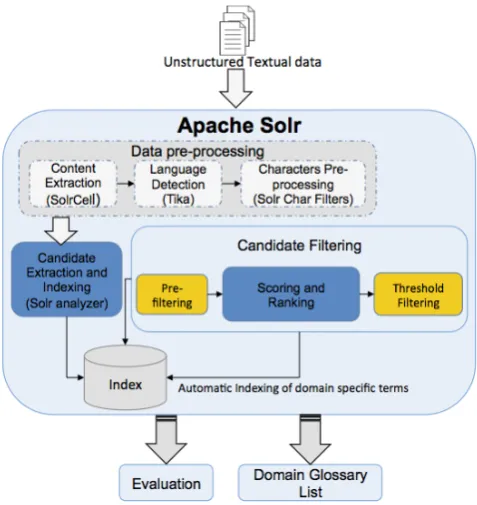
Figure 1 shows the general architecture of JATE 2.0 and its workflow, which consists of four phases: (1) data pre-processing; (2) term candidate extraction and indexing; (3) candidate scoring and filtering and (4) final term indexing and export.
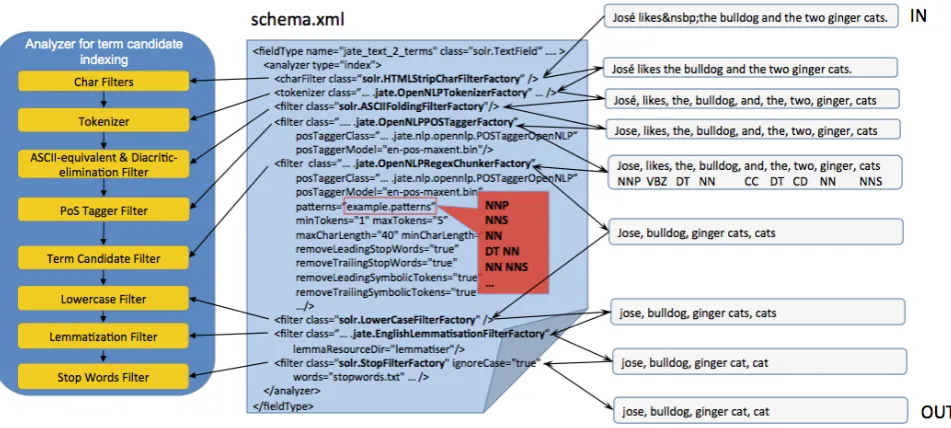
Data pre-processing (Section 3.1.) parses input docu-ments to raw text content and performs text normaliza-tion in order to reduce ‘noise’ in irregular data. The pre-processed text content then passes through thecandidate extraction(Section 3.2.) component that extracts and nor-malizes term candidates from each document. Candidate extraction and data pre-processing are embedded as part of the Solr document indexing process, largely realized by Solr’s ‘analyzers’. An analyzer is composed of a series of processors (‘tokenizers’ and ‘filters’) to form a pipeline, or an analysis ‘chain’ that examines the text content from each document, generates a token stream and records sta-tistical information. Solr already implements a very large text processing library for this purpose. JATE 2.0 further extends these. Depending on individual needs, users may assemble customized analyzers for term candidate genera-tion. Defining analyzers is achieved by configuration in the Solr schema, such as that shown in Figure 2.
Next, the candidates are processed by the subsequent filter-ing component (Section 3.3.), where different ATE algo-rithms can be configured to score and rank the candidates, and making the final selection. The implementation of the algorithms are largely parallelized. The resulting terms can either be exported for further validation, or written back to the index to annotate documents.
JATE 2.0 can be run in two modes: (1) as a separate mod-ule to extract terms from a corpus using an embedded Solr instance (Section 4.1.), or (2) as a Solr plugin that performs ATE as part of the document indexing process to anno-tate documents with domain-specific terminologies (Sec-tion 4.2.). Both modes undergo the same workflow de-scribed above.
JATE 2.0 offers adaptability and scalability thanks to its seamless integration with Solr and parallelized implemen-tation. Access to Solr’s very large collection of multi-lingual text processing libraries that can be configured in a plug-and-play way enables JATE 2.0 to be adapted to dif-ferent languages, document formats, and domains. The rich collection of algorithms also give users options to better tailor the tool to specific use cases. Parallelization enables JATE 2.0 to scale up to large datasets. Parallelization for term candidate generation can be achieved via Solr’s dis-tributed indexing capability under SolrCloud13. Users
sim-ply follow Solr’s guide on configuring distributed indexing. Parallelization for scoring and ranking algorithms comes as standard in JATE 2.0 and is also configurable. Detailed guidelines on defining analyzers for ATE and configura-tions can be found on the JATE 2.0 homepage.
13https://cwiki.apache.org/confluence/
Figure 1: General Architecture of JATE 2.0
3.1.
Data pre-processing
With the standard JATE 2.0 configuration, data pre-processing begins with Solr Content Extraction Library (also known as SolrCell14) to extract textual content from
files. It integrates the popular Apache Tika framework15
that supports detecting and extracting metadata and text from a large range of file formats such as plain text, HTML, PDF, and Microsoft Office. To use this, users simply con-figure an instance ofExtractingRequestHandler16
for their data in Solr.
To support multi-lingual documents, users may also use Solr’s capability for detecting languages of texts in documents and map text to language-specific analyzers for indexing using the langid
UpdateRequestProcessor17.
Next, a recommended practice for pre-processing irregu-lar textual data (commonly found in corporate datasets) is applying the Solr char filter component18 to
per-form character-level text normalization. For example,
HTMLStripCharFilterFactory detects HTML
en-tities (e.g., ‘A’, ‘ ’) with corresponding charac-ters. This can reduce errors in downstream processors (e.g., PoS tagger) in the analyzer. This can be configured as part of the analyzer in the Solr schema, usually placed before
14
https://cwiki.apache.org/confluence/ display/solr/Uploading+Data+with+Solr+Cell+ using+Apache+Tika
15https://tika.apache.org 16https://wiki.apache.org/solr/
ExtractingRequestHandler
17https://cwiki.apache.org/confluence/
display/solr/Detecting+Languages+During+ Indexing
18https://cwiki.apache.org/confluence/
display/solr/CharFilterFactories
tokenization, such as line 3 of schema.xml shown in Figure 2.
3.2.
Candidate Extraction
Term candidate extraction is realized as part of the Solr in-dexing process. A dedicated ‘field’19 is defined within the Solr indexing schema to hold candidates for each document (candidate field). The field is bound to a ‘fieldType’, which uses a customized analyzer to break content into term can-didates and normalize them to conflate the variants that are dispersed throughout the corpus. The Solr indexing pro-cess also generatesbasic statistical informationabout can-didates, such as a candidate’s frequency within each docu-ment, and the number of documents it appears in20.
The analyzer is highly customizable and adaptable. All ex-isting Solr text analysis libraries can be used, such as tok-enization, case folding, stop words removal, token N-gram extraction, stemming, etc. It is also easy to implement new components to replace or complement existing ones in a plug-and-play way. Currently, Solr 5.3 supports nearly 20 implementations of tokenization and over 100 text normal-ization and filtering methods21, covering a wide range of languages and use cases. Thus by selecting different com-ponents and assembling them in different orders, one can create different analyzers to achieve different extraction and normalization results.
To support ATE, JATE 2.0 extends Solr’s text analysis li-braries by supporting three types of linguistic filters for term candidate extraction. These include: (1) a PoS pattern based chunker that extracts candidates based on user spec-ified patterns (e.g., line 9 of schema.xml in Figure 2); (2) a token N-gram extractor that extends the built-in one; (3) a noun phrase chunker. All of these are implemented with the capability to normalize noisy terms, such as removing leading and trailing stop words, and non-alphanumeric to-kens. In addition, JATE 2.0 also implements an English lemmatizer, which is a recommended replacement of stem-mers that can sometimes be too aggressive for ATE. These offer great flexibility enabling almost any customized term candidate extraction. Figure 2 shows a standard configu-ration of an text analyzer for PoS pattern based candidate extraction for English.
3.3.
Filtering
Extracted term candidates are further processed to make a final decision to separate terms from non-terms.
3.3.1. Pre-filtering
It is often a common practice to apply a filtering process to term candidates to reduce both noise (e.g., due to irregular textual data or erroneous PoS tagging) and computation be-fore the subsequent step of term scoring and ranking. The
19
https://cwiki.apache.org/confluence/ display/solr/Solr+Glossary
20
For practical reasons, we rely on a separate field that indexes the same content as token N-grams and stored term vectors which provides the lookup of statistics about term candidates. Details on this can be found on the JATE website and Solr documentation for Inverted Index.
21
Figure 2: Example of PoS pattern based candidate extraction
following strategies have been implemented in JATE 2.0 and can be configured according to user needs to balance precision and recall.
Minimal and maximal character length restricts candi-dates to a fixed range of character length. Minimal and maximal token numberrequires a valid candidate to con-tain cercon-tain number of tokens (e.g., to limit multi-word ex-pressions). Minimal stop words removalremoves lead-ing and/or traillead-ing stop words in a multi-word expression (e.g.,‘the cat’ becomes ‘cat’, but ‘Tower of London’ re-mains intact). All these are implemented as part of the three term candidate extraction methods described before and can be configured in the analyzer.
Frequency thresholdallows candidates to be filtered by a minimum total frequency in the corpus. This is often used in typical ATE methods, and is configurable via individual scoring and ranking algorithms that follow.
3.3.2. Scoring and ranking
In this step, term candidates that pass the pre-filter are scored and ranked. Their basic statistical information is gathered from the Solr index, to create complex features required by different algorithms.
JATE 2.0 has implemented 10 algorithms for scoring can-didates, listed in Table 1. TTFis the total frequency of a candidate in the corpus. It’s usage in ATE was firstly docu-mented in (Justeson and Katz, 1995).ATTFdividesTTFby the number of documents a candidate appears in.TTF-IDF adapts the classic document-specificTF-IDFused in IR to work at corpus level, by replacingTFwithTTF.
RIDF was initially proposed by (Church and Gale, 1995) as an enhancement to IDF to identify keywords in a doc-ument collection. It measures the deviation of the actual IDF score of a word from its ‘expected’ IDF score, which is predicted based on a Poisson distribution. The hypothe-sis is based on the fact that Poisson model fits poorly with such keywords. Thus a prediction of IDF based on Poisson can deviate from its actual IDF observed based on a
cor-pus. Empirically, it is shown that all words have real IDF scores that deviate from the expected value under a Poisson distribution. However, keywords tend to have larger devi-ations than non-keywords. We adapt it to work with term candidates that can be either single words or multi-word expressions.
CValue observes that real terms in technical domains are often long, multi-word expressions and usually not nested in other terms (i.e., as part of the longer terms). Frequency-based methods are not effective for such terms as (1) nested term candidates will have at least the same and often higher frequency, and (2) the fact that a longer string appears n times is a lot more important than that of a shorter string appearingn times. ThusCValue computes a score that is based on the frequency of a candidate and its length, then adjusted by the frequency of longer candidates that contain it.
Similarly, RAKE is designed to favour longer multi-word expressions. It firstly computes a score for individual words based on two components: one that favours words oc-curring often and in longer term candidates, and one that favours words occurring frequently regardless of the words which they co-occur with. Then it adds up the scores of composing words for a candidate.
χ2promotes term candidates that co-occur very often with
‘frequent’ candidates in the corpus. First, candidates are ranked by frequency in the corpus and a subset (typically topn%) is selected - to be called ‘frequent terms’. Next, candidates are scored based on the degree to which their co-occurrence with these frequent terms are biased. These biases can be due to semantic, lexical, or other relations of two terms. Thus, a candidate showing strong co-occurrence biases with frequent terms may have an important mean-ing. To evaluate the statistical significance of the biases,
Table 1: ATE algorithms implemented in JATE 2.0
Name Full name Ref.
TTF Term Total Frequency
(Justeson and Katz, 1995), FiveFilters.org
ATTF Average TTF
-TTF-IDF TTF and Inverse Doc Frequency
-RIDF Residual IDF (Church and Gale, 1995) CValue C-Value (Ananiadou, 1994)
χ2
Chi-Square (Matsuo and Ishizuka, 2003) RAKE Rapid Keyword
Extraction
(Rose et al., 2010)
Weirdness Weirdness (Ahmad et al., 1999) GlossEx Glossry Extraction (Park et al., 2002) TermEx Term Extraction (Sclano and Velardi, 2007)
terms’.
Both RAKE and χ2 were initially developed for extract-ing document-specific keywords. We adapt them for ATE from document collections. This is done by replac-ing document-level frequency with corpus-level frequency, wherever needed.
Weirdnessis a contrastive approach (Drouin, 2003) which is particularly interesting when trying to identify low-frequency terms. The method compares normalized fre-quency of a term candidate in a domain-specific corpus with a reference corpus, such as the general-purpose British National Corpus22. The idea is that candidates appearing
more often in the target corpus are more specific to that corpus and therefore, more likely to be real terms. To cope with out-of-vocabulary candidates, we modify this by tak-ing the sum of theWeirdness scores of composing words for a candidate.
BothGlossExandTermExextendWeirdness. GlossEx lin-early combines ‘domain specificity’, which normalizes the Weirdnessscore by the length (number of words) of a term candidate, with ‘term cohesion’ that measures the degree to which the composing words tend to occur together as a can-didate other than appearing individually. This is computed based on comparing the frequency of a candidate against its composing words. TermEx, in a very similar form, further extendsGlossExby linearly combining a third component that promotes candidates with an even probability distribu-tion across the documents in the corpus (in an analogy, the candidate ‘gains consensus’ among the documents).
Essentially both GlossExandTermEx combine termhood with unithood, which exploits a reference corpus. For these we introduce a scalar to balance the contribution of unit-hood, which tends to dominate the final score in case of largely disproportionate sizes of the domain and reference corpora (e.g., orders of magnitude difference). The scalar adjusts the normalized frequency of words in both the tar-get and reference corpora to be in the same orders of mag-nitude23.
22http://www.natcorp.ox.ac.uk
23Details can be found in the implementation of the two
algo-rithms in JATE 2.0.
3.3.3. Threshold cutoff
Next, a cutoff decision is to be made to separate real terms from non-terms based on their scores. Three options are supported: (1) hard threshold, where term candidates with scores no less than the threshold are chosen; (2) top K, where top rankedKcandidates are chosen; (3) and topK%, where the top rankedK percentage of candidates are cho-sen.
4.
Using JATE 2.0 in Two Modes
4.1.
Embedded mode
The embedded mode is recommended when users need a list of domain-specific terms from a corpus to be used in subsequent knowledge engineering tasks. Users configure a Solr instance and in particular, a text analysis chain that defines how term candidates are extracted and normalized. The Solr instance is instantiated as an embedded24module
that interacts with other components. Users then explicitly start an indexing process on a corpus to trigger term candi-date extraction, then use specific ATE utility classes25, each
wrapping an individual ATE algorithm, to perform candi-date scoring, ranking, filtering and export.
4.2.
Plugin mode
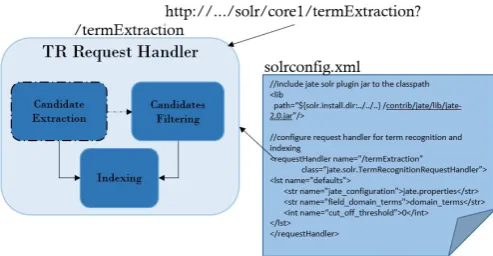
The plugin mode is recommended when users need to in-dex new or enrich existing inin-dex using extracted terms, which can, e.g., support faceted search. ATE is per-formed as a Solr plugin. A SolrRequestHandler26
is implemented so that term extraction can be triggered by HTTP request. Users configure their Solr instance in the same way as above, then start the instance as a back-end server. To trigger ATE, users send an HTTP request to the
SolrRequestHandler, passing parameters specifying the input data and the ATE algorithms. Candidate extrac-tion is opextrac-tional if the process is performed with document indexing. ATE then begins and when finished, updates doc-uments in the index with extracted terms.
Figure 3: Term Extraction by HTTP request (Plugin mode)
24https://wiki.apache.org/solr/
EmbeddedSolr
25See details in theapppackage of JATE 2.0 26https://wiki.apache.org/solr/
5.
Experiment
We evaluate JATE 2.0 on two datasets, the GENIA dataset (Kim et al., 2003), a semantically annotated corpus for bio-textmining previously used by (Zhang et al., 2008); and the ACL RD-TEC dataset (Zadeh and Handschuh, 2014), containing publications in the domain of computational lin-guistics and a list of manually annotated domain-specific terms.
GENIA contains 1,999 Medline abstracts, selected using a PubMed query for the terms ‘human’, ‘blood cells’, and ‘transcription factors’. The corpus is annotated with var-ious levels of linguistic and semantic information. We extract any text annotated as ‘cons’ (concept) to compile a gold standard list of terms. ACL RD-TEC contains over 10,900 scientific publications. In (Zadeh and Hand-schuh, 2014), the corpus is automatically segmented and PoS tagged. Candidate terms are extracted by applying a list of patterns based on PoS sequence. These are then ranked by several ATE algorithms, and the top set of over 82,000 candidates are manually annotated as valid or in-valid. We use the valid candidates as gold standard terms. We notice three different versions of corpus available27:
one only contains the sentences where at least one of the annotated candidate terms must be present (under ‘anno-tation’), one contains complete raw text files in XML for-mat (under ‘cleansed text’), and one contains plain text files from the ACL ARC (under ‘external resource’). We use the XML version and only extract content from ‘<title>’ and ‘<paragraph>’ elements.
We ran all experiments on a server with 16 CPUs. All algo-rithms follow the same candidate extraction process, unless otherwise noted. Detailed configurations are as follows:
• three different analyzers have been tested, each using PoS sequence pattern based (PoS based) , noun phrase chunking based (NP Chunking based), and the N-gram based term candidate extraction. The pipelines are slightly different for each analyzer and each dataset. Detailed configuration can be found in the example section of the JATE website;
• for PoS-based term candidate extraction, we use: for GENIA, a list of PoS sequence patterns defined in (Ananiadou, 1994); for ACL RD-TEC, a list of PoS sequence patterns defined in (Zadeh and Handschuh, 2014);
• min. character length of 2; max. of 40; • min. tokens of 1, max. of 5;
• leading and trailing stop words and non-alphanumeric character removal. (for N-gram based removal ofany non-alphanumeric characters);
• stop words removal;
• min. frequency threshold of 2;
• for χ2, the ‘frequent terms’ are selected as top 10%.
Moreover, only candidates that appear in at least two sentences are considered;
• forWeirdness,GlossExandTermEx, the BNC corpus is used as reference;
27http://atmykitchen.info/datasets/acl_rd_
tec/. Accessed: 10 March 2016
Table 2: Comparision of candidate extraction on GENIA (run in a single thread)
Method Term candidates Recall CPU time (millsec) PoS-based 10,582/38,850 10% 68,914
NP-based 35,799/44,479 23% 118,753 N-gram 48,945/440,974 16% 33,721
Table 3: Comparision of candidate extraction on ACL RD-TEC (run in a single thread)
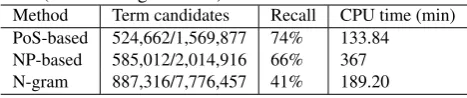
Method Term candidates Recall CPU time (min) PoS-based 524,662/1,569,877 74% 133.84 NP-based 585,012/2,014,916 66% 367 N-gram 887,316/7,776,457 41% 189.20
The total number of term candidates extracted for each dataset under each analyzer setting after/before applying the minimum frequency threshold with associated overall recall and CPU time are shown in Tables 2 and 3. The low recall for GENIA may be due to several reasons. First, a substantial part of the gold standard terms are ‘irregular’, as they contain numbers, punctuations and symbols. The pat-terns in our experiment are mainly based on adjectives and nouns, and will not match irregular terms. Second, we use a general purpose PoS tagger which does not perform well for the biomedical text. In addition, GENIA consists of very short abstracts and as a result, many legitimate terms may be removed due to the frequency threshold and lexical pruning. However, this can be easily rectified by relaxing the pre-filters.
We then show precision of topKterms ranked by each al-gorithm, commonly used in ATE. Figure 4 shows results for the GENIA dataset and Figure 5 shows results for the ACL RD-TEC dataset. First, all algorithms achieve very high precision on the GENIA dataset. This is partly because the gold standard terms are very densely distributed. Our anal-ysis shows that 49% of words are annotated as part of a term. Second, TFIDF andCValueappear to be the most reliable methods as they obtain consistently good results on both datasets. Third, Weirdness, GlossExandTermEx are very sensitive to the choice of reference corpus. For example, on the ACL RD-TEC dataset, phrases containing ‘treebank’ are very highly ranked. However, many of them are not valid terms. Finally, RAKE is the worst perform-ing algorithm on both datasets, possibly because it is very specifically tailored to document-level (other than corpus-level) keyword extraction.
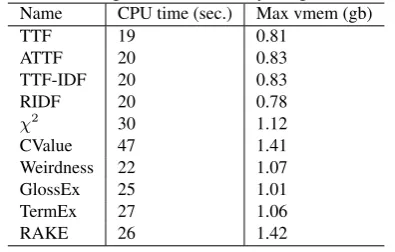
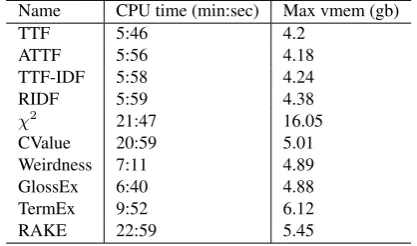
Next we compare the efficiency of each algorithm for scor-ing and rankscor-ing term candidates, by measurscor-ing the max-imum memory footprint and CPU time for computation. We found consistent patterns among different algorithms, despite what term candidate extractor is used (which only affects absolute figures as it changes the number of candi-dates generated, see Tables 2 and 3). Using the PoS-based term candidate extractor as example, we show the statistics in Table 4 and Table 5 for the two datasets. As it is shown,
Top K terms
0 1000 2000 3000 4000 5000
Precision
0.65 0.7 0.75 0.8 0.85 0.9 0.95 1
Precision at Rank K (NP-Chunking based)
TTF ATTF TTF-IDF RIDF ChiSquare CValue Weirdness GlossEx TermEx RAKE
Top K terms
0 1000 2000 3000 4000 5000
Precision
0.65 0.7 0.75 0.8 0.85 0.9 0.95
1 Precision at Rank
K (PoS based)
Top K terms
0 1000 2000 3000 4000 5000
Precision
0.2 0.3 0.4 0.5 0.6 0.7 0.8 0.9
1 Precision at Rank
K (N-gram based)
Figure 4: Comparison of TopKprecisions on GENIA
Top K terms
1000 2000 3000 4000 5000 6000 7000 8000 9000 10000
Precision
0 0.1 0.2 0.3 0.4 0.5 0.6
Precision at Rank K (PoS based)
TTF ATTF TTF-IDF RIDF ChiSquare CValue Weirdness GlossEx TermEx RAKE Top K terms
1000 2000 3000 4000 5000 6000 7000 8000 9000 10000
Precision
0 0.1 0.2 0.3 0.4 0.5 0.6
Precision at Rank K (NP-Chunking based)
Top K terms
1000 2000 3000 4000 5000 6000 7000 8000 9000 10000
Precision
0 0.1 0.2 0.3 0.4 0.5
0.6 Precision at Rank K(N-gram based)
Figure 5: Comparison of TopKprecisions on ACL RD-TEC
χ2, CValueandRAKE are among the slowest. Whileχ2
spends significant time on co-occurrence related computa-tion,CValueandRAKEspend substantial time on comput-ing the containment relations among candidates.
6.
Conclusion
This paper describes JATE 2.0, a highly modular, adaptable and scalable ATE library with 10 implemented algorithms, developed within the Apache Solr framework. It advances existing ATE tools mainly by enabling a significant degree of customization and adaptation thanks to the flexibility un-der the Solr framework; and making available a large col-lection of state-of-the-art algorithms. It is expected that the tool will bring both academia and industries under a uni-form development and benchmarking framework that will
Table 4: Running time and memory usage on GENIA Name CPU time (sec.) Max vmem (gb)
TTF 19 0.81
ATTF 20 0.83
TTF-IDF 20 0.83
RIDF 20 0.78
χ2 30 1.12
CValue 47 1.41
Weirdness 22 1.07
GlossEx 25 1.01
TermEx 27 1.06
RAKE 26 1.42
Table 5: Running time and memory usage on ACL RD-TEC
Name CPU time (min:sec) Max vmem (gb)
TTF 5:46 4.2
ATTF 5:56 4.18
TTF-IDF 5:58 4.24
RIDF 5:59 4.38
χ2 21:47 16.05
CValue 20:59 5.01
Weirdness 7:11 4.89
GlossEx 6:40 4.88
TermEx 9:52 6.12
RAKE 22:59 5.45
foster further contributions in terms of novel algorithms, benchmarkings, support for new languages, new text pro-cessing capabilities, and so on. Future work will look into the implementation of additional ATE algorithms, particu-larly machine learning based methods.
7.
Acknowledgement
Part of this research has been sponsored by the EU funded project WeSenseIt under grant agreement number 308429; and the SPEEAK-PC collaboration agreement 101947 of the Innovative UK.
8.
Bibliographical References
Ahmad, K., Gillam, L., and Tostevin, L. (1999). University of surrey participation in trec 8: Weirdness indexing for logical document extrapolation and retrieval (wilder). In Proceedings of the 8th Text REtrieval Conference. Ananiadou, S. (1994). A methodology for automatic term
recognition. In Proceedings of the 15th Conference on Computational Linguistics, pages 1034–1038, Strouds-burg, PA, USA. Association for Computational Linguis-tics.
Arora, C., Sabetzadeh, M., Briand, L., and Zimmer, F. (2014). Improving requirements glossary construction via clustering: approach and industrial case studies. In Proceedings of the 8th ACM/IEEE International Sympo-sium on Empirical Software Engineering and Measure-ment, page 18. ACM.
Bowker, L. (2003). Terminology tools for translators. BENJAMINS TRANSLATION LIBRARY, 35:49–66. Brewster, C., Iria, J., Zhang, Z., Ciravegna, F., Guthrie, L.,
and Wilks, Y. (2007). Dynamic iterative ontology learn-ing. InProceedings of the 6th International Conference on Recent Advances in Natural Language Processing, Borovets, Bulgaria, September.
Church, K. W. and Gale, W. A. (1995). Inverse document frequency (idf): A measure of deviations from poisson. InProceedings of the ACL 3rd Workshop on Very Large Corpora, pages 121–130, Stroudsburg, PA, USA. Asso-ciation for Computational Linguistics.
Drouin, P. (2003). Term extraction using non-technical corpora as a point of leverage. Terminology, 9(1):99– 115.
Frantzi, K. T., Ananiadou, S., and Mima, H. (2000). Auto-matic recognition of multi-word terms:. the
c-value/nc-value method. Natural Language Processing For Digital Libraries, 3(2):115–130.
Justeson, J. and Katz, S. M. (1995). Technical terminol-ogy: some linguistic properties and an algorithm for identification in text. Natural Language Engineering, 1(1):9–27.
Kim, J.-D., Ohta, T., Tateisi, Y., and ichi Tsujii, J. (2003). GENIA corpus - a semantically annotated corpus for bio-textmining. In ISMB (Supplement of Bioinformatics), pages 180–182.
labs.translated.net. (2015). Terminology extraction. https://developer.yahoo.com/contentanalysis/ [Online; accessed 9-October-2015].
Matsuo, Y. and Ishizuka, M. (2003). Keyword extraction from a single document using word co-occurrence sta-tistical information. International Journal on Artificial Intelligence Tools, 13(1):157–169.
Maynard, D., Saggion, H., Yankova, M., Bontcheva, K., and Peters, W. (2007). Natural language technology for information integration in business intelligence. In Busi-ness Information Systems, pages 366–380. Springer. Maynard, D., Li, Y., and Peters, W. (2008). Nlp techniques
for term extraction and ontology population. In Proceed-ings of the 2008 Conference on Ontology Learning and Population: Bridging the Gap Between Text and Knowl-edge, pages 107–127, Amsterdam, The Netherlands, The Netherlands. IOS Press.
Park, Y., Byrd, R. J., and Boguraev, B. K. (2002). Auto-matic glossary extraction: Beyond terminology identifi-cation. InProceedings of the 19th International Confer-ence on Computational Linguistics, pages 1–7, Strouds-burg, PA, USA. Association for Computational Linguis-tics.
Rose, S., Engel, D., Cramer, N., and Cowley, W., (2010). Automatic keyword extraction from individual docu-ments. John Wiley and Sons.
Sclano, F. and Velardi, P. (2007). Termextractor: a web application to learn the shared terminology of emer-gent web communities. InProceedings of the 3rd Inter-national Conference on Interoperability for Enterprise Software and Applications.
Spasi´c, I., Greenwood, M., Preece, A., Francis, N., and El-wyn, G. (2013). Flexiterm: a flexible term recognition method.Journal of Biomedical Semantics, 4(27). Yahoo! (2015). Yahoo! content analysis api.
https://developer.yahoo.com/contentanalysis/ [Online; accessed 9-October-2015].
Zadeh, B. and Handschuh, S. (2014). The acl rd-tec: A dataset for benchmarking terminology extraction and classification in computational linguistics. In Proceed-ings of the 4th International Workshop on Computational Terminology (Computerm), pages 52–63, Dublin, Ire-land, August. Association for Computational Linguistics and Dublin City University.